

Idealizationin cognitive and generative linguisticsBarbara KonatInstitute of PhilosophyAdam Mickiewicz UniversityPhiLang2011Second International Conference on Philosophy of Language and Linguistics University of Lodz (Poland), 12-14 May 2011
Agenda1) Whyphilosophy?2) Philosophicalasummptionsaccording to Carnap, Popper and Kuhn3) IdealizationTheoryLanguage and ontologicalperspectiveStructure of science4) Conclusions  -ontology of GG and CL5) Futurestudy6) Possibleapplications2Barbara Konat -  PhilLang 2011
ObjectivesThis presentation adopts metascientificperspective (philosophy of science). The aim of a presentation is to reconstruct internal structure of linguistic research. First step: ontologicalassumptions.3Barbara Konat -  PhilLang 2011
Why can’t we just eliminate philosophical assumptions from thescience?ViennaCircleRudolf Carnap Pseudoproblems of philosophy(1928):rejection of metaphysicsverificationismK. R. Popper: Theories are nets cast to catch what we call 'the world‘The interaction between philosophical base and empirical work4Barbara Konat -  PhilLang 2011
Kuhn - paradigmMature science:KeytheoriesInstrumentsValuesMetaphysicalassumptions5Barbara Konat -  PhilLang 2011
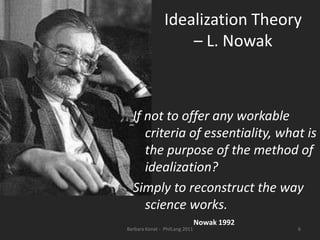
IdealizationTheory – L. NowakIf not to offer any workablecriteria of essentiality, what is the purpose of the method of idealization? Simplyto reconstruct the way science works. Nowak 19926Barbara Konat -  PhilLang 2011
IdealizationTheory – L. NowakAccording to the idealizational methodology, there are three main stages of scientific conduct:I. pre-theoretical stage: postulation of essentialist hypotheses putting forwardpossible images of the essential structures of considered magnitudes;II. theoretical stage: postulation of a body of idealizational hypotheses whichsubsequently undergo the process of concretization;III. empirical testing of the theory.Nowak 19927Barbara Konat -  PhilLang 2011
What will this reality consist of?1) Language2) Ontologicalperspective:A) Stratificationprinciplesi. Classification principles ii. Ordering principles B) Ontological relations principlesi. PositiveIi. NegativeNowak 19768Barbara Konat -  PhilLang 2011
Ontological perspective- LanguageBoth natural languages and thoseadopted from previous traditionscreatecertainontological typesNowak 19769Barbara Konat -  PhilLang 2011
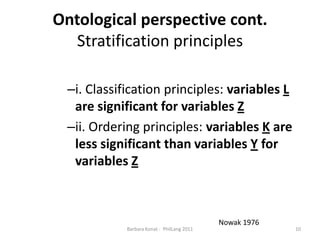
Ontological perspectivecont. Stratificationprinciplesi. Classification principles: variables L are significant for variables Zii. Ordering principles: variables K are less significant than variables Y for variables ZNowak 197610Barbara Konat -  PhilLang 2011
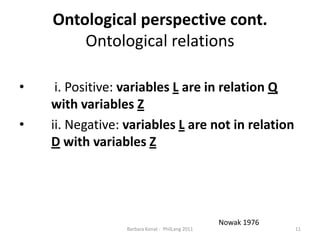
Ontological perspectivecont. Ontological relationsi. Positive: variables L are in relation Qwith variables Z	ii. Negative: variables L are not in relation D with variables ZNowak 197611Barbara Konat -  PhilLang 2011
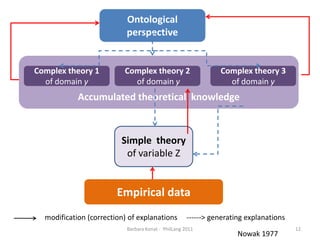
OntologicalperspectiveAccumulatedtheoreticalknowledgeComplextheory 1 of domainyComplextheory 2of domainyComplextheory 3 ofdomainySimple  theoryof variable ZEmpirical datamodification (correction) of explanations------> generatingexplanationsNowak 197712Barbara Konat -  PhilLang 2011
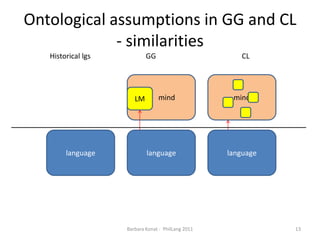
Ontologicalassumptionsin GG and CL - similaritiesHistoricallgs		GG			CLmindmindLMlanguagelanguagelanguage13Barbara Konat -  PhilLang 2011
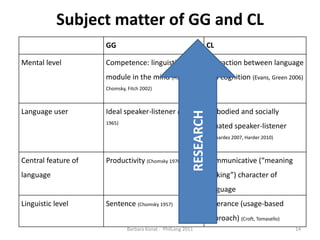
Subjectmatter of GG and CL14RESEARCHBarbara Konat -  PhilLang 2011
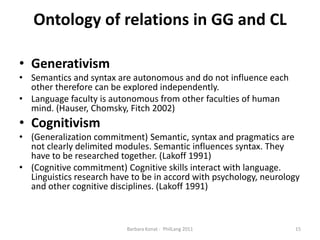
Ontology of relations in GG and CLGenerativismSemantics and syntax are autonomous and do not influence each other therefore can be explored independently.Language faculty is autonomous from other faculties of human mind. (Hauser, Chomsky, Fitch 2002)Cognitivism(Generalization commitment)Semantic, syntax and pragmatics are not clearly delimited modules. Semantic influences syntax. They have to be researched together. (Lakoff 1991)(Cognitive commitment)Cognitive skills interact with language. Linguistics research have to be in accord with psychology, neurology and other cognitive disciplines. (Lakoff 1991)15Barbara Konat -  PhilLang 2011
Ongoingstudy…Work still in progressSecond and third step in the scientific conductIdealizationinmethods of CL and GGCasestudy: definitedescriptions16Barbara Konat -  PhilLang 2011
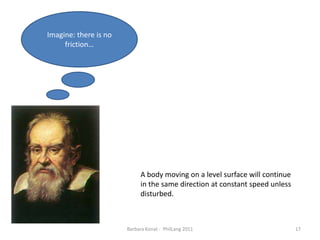
Barbara Konat -  PhilLang 201117Imagine: thereis no friction…A body moving on a level surface will continue in the same direction at constant speed unless disturbed.
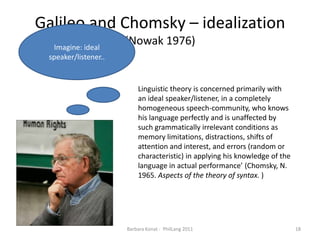
Galileo and Chomsky – idealization(Nowak 1976)Barbara Konat -  PhilLang 201118Imagine: ideal speaker/listener..Linguistic theory is concerned primarily with an ideal speaker/listener, in a completely homogeneous speech-community, who knows his language perfectly and is unaffected by such grammatically irrelevant conditions as memory limitations, distractions, shifts of attention and interest, and errors (random or characteristic) in applying his knowledge of the language in actual performance’ (Chomsky, N. 1965. Aspects of the theory of syntax.)
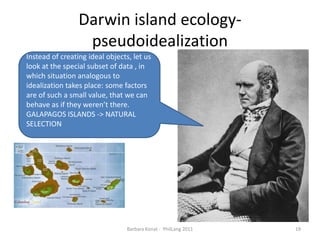
Darwin islandecology- pseudoidealizationBarbara Konat -  PhilLang 201119Instead of creating ideal objects, let us look at the special subset of data , in which situation analogous to idealization takes place: some factors are of such a small value, that we can behave as if they weren’t there. GALAPAGOS ISLANDS -> NATURAL SELECTION
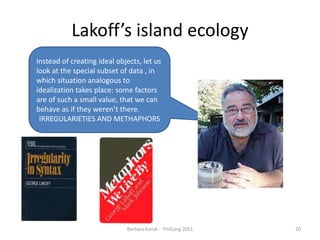
Lakoff’sislandecologyBarbara Konat -  PhilLang 201120Instead of creating ideal objects, let us look at the special subset of data , in which situation analogous to idealization takes place: some factors are of such a small value, that we can behave as if they weren’t there. IRREGULARIETIES AND METHAPHORS
Third step: casestudy, PLMProf. Yishai Tobin: Will explanations of given linguistic fact A propounded by GG and CL stay in accord with reconstructionproposedhere?dr. KatarzynaMiechowicz- Mathiasen: Definite descriptionsGG: focus on grammaticalrulesCL: e.g. proximizationtheory: focus on communicativeintentionsBarbara Konat -  PhilLang 201121
PossibleapplicationsOperationalization of crucial notions inCLFormulating more falsifiable hypotheses in CLAreas of possible integration between CL and GG 22Barbara Konat -  PhilLang 2011
Thankyou23Barbara Konat -  PhilLang 2011
ReferencesCarnap, R. (1928). Pseudoproblems in Philosophy.Chomsky, N. (1982). Zagadnienia teorii składni. Wrocław: Wydawnictwo Zakład Narodowy Imienia Ossolińskich.Evans, V., & Green, M. (2006). Cognitive Linguistics. An Introduction.Edynburg: Edinburgh University Press.Fromkin, V., Rodman, R., & Hyams, N. (2007). An Introduction to Language. Boston: Thomson Wadsworth.Grucza, F. (1983). Zagadnienia metalingwistyki. Warszawa: PWN.Harder, P. (2010). Meaning in Mind and Society. Berlin/NowyJork: Walter de Gruyter.Lakoff, G. (1991). Cognitive versus generative linguistics: how commitments influence results. Language & Communication, 11 (1-2), strony 53-62.Muszyński, Z. (2006). Założenia filozoficzne w koncepcjach językoznawczych. W P. Stalmaszczyk, Metodologie językoznawstwa. Łódź: Wydawnictwo Uniwersytetu Łódzkiego.Nowak, L. (1973). Filozoficzne podstawy teorii naukowej. Studia Filozoficzne (3).Nowak, L. (1977). Wstęp do idealizacyjnej teorii nauki. Warszawa: PWN.Nowak, l. (2000). „Darwin’stheory of natural selection”. Idealization X: Therichness of idealization. Eds: Nowak, L., Nowakowa, I., Amsterdam/Atlanta:Rodopi24Barbara Konat -  PhilLang 2011

Idealization in cognitive and generative linguistics

  • 1.
    Idealizationin cognitive andgenerative linguisticsBarbara KonatInstitute of PhilosophyAdam Mickiewicz UniversityPhiLang2011Second International Conference on Philosophy of Language and Linguistics University of Lodz (Poland), 12-14 May 2011
  • 2.
    Agenda1) Whyphilosophy?2) Philosophicalasummptionsaccordingto Carnap, Popper and Kuhn3) IdealizationTheoryLanguage and ontologicalperspectiveStructure of science4) Conclusions -ontology of GG and CL5) Futurestudy6) Possibleapplications2Barbara Konat - PhilLang 2011
  • 3.
    ObjectivesThis presentation adoptsmetascientificperspective (philosophy of science). The aim of a presentation is to reconstruct internal structure of linguistic research. First step: ontologicalassumptions.3Barbara Konat - PhilLang 2011
  • 4.
    Why can’t wejust eliminate philosophical assumptions from thescience?ViennaCircleRudolf Carnap Pseudoproblems of philosophy(1928):rejection of metaphysicsverificationismK. R. Popper: Theories are nets cast to catch what we call 'the world‘The interaction between philosophical base and empirical work4Barbara Konat - PhilLang 2011
  • 5.
    Kuhn - paradigmMaturescience:KeytheoriesInstrumentsValuesMetaphysicalassumptions5Barbara Konat - PhilLang 2011
  • 6.
    IdealizationTheory – L.NowakIf not to offer any workablecriteria of essentiality, what is the purpose of the method of idealization? Simplyto reconstruct the way science works. Nowak 19926Barbara Konat - PhilLang 2011
  • 7.
    IdealizationTheory – L.NowakAccording to the idealizational methodology, there are three main stages of scientific conduct:I. pre-theoretical stage: postulation of essentialist hypotheses putting forwardpossible images of the essential structures of considered magnitudes;II. theoretical stage: postulation of a body of idealizational hypotheses whichsubsequently undergo the process of concretization;III. empirical testing of the theory.Nowak 19927Barbara Konat - PhilLang 2011
  • 8.
    What will thisreality consist of?1) Language2) Ontologicalperspective:A) Stratificationprinciplesi. Classification principles ii. Ordering principles B) Ontological relations principlesi. PositiveIi. NegativeNowak 19768Barbara Konat - PhilLang 2011
  • 9.
    Ontological perspective- LanguageBothnatural languages and thoseadopted from previous traditionscreatecertainontological typesNowak 19769Barbara Konat - PhilLang 2011
  • 10.
    Ontological perspectivecont. Stratificationprinciplesi.Classification principles: variables L are significant for variables Zii. Ordering principles: variables K are less significant than variables Y for variables ZNowak 197610Barbara Konat - PhilLang 2011
  • 11.
    Ontological perspectivecont. Ontologicalrelationsi. Positive: variables L are in relation Qwith variables Z ii. Negative: variables L are not in relation D with variables ZNowak 197611Barbara Konat - PhilLang 2011
  • 12.
    OntologicalperspectiveAccumulatedtheoreticalknowledgeComplextheory 1 ofdomainyComplextheory 2of domainyComplextheory 3 ofdomainySimple theoryof variable ZEmpirical datamodification (correction) of explanations------> generatingexplanationsNowak 197712Barbara Konat - PhilLang 2011
  • 13.
    Ontologicalassumptionsin GG andCL - similaritiesHistoricallgs GG CLmindmindLMlanguagelanguagelanguage13Barbara Konat - PhilLang 2011
  • 14.
    Subjectmatter of GGand CL14RESEARCHBarbara Konat - PhilLang 2011
  • 15.
    Ontology of relationsin GG and CLGenerativismSemantics and syntax are autonomous and do not influence each other therefore can be explored independently.Language faculty is autonomous from other faculties of human mind. (Hauser, Chomsky, Fitch 2002)Cognitivism(Generalization commitment)Semantic, syntax and pragmatics are not clearly delimited modules. Semantic influences syntax. They have to be researched together. (Lakoff 1991)(Cognitive commitment)Cognitive skills interact with language. Linguistics research have to be in accord with psychology, neurology and other cognitive disciplines. (Lakoff 1991)15Barbara Konat - PhilLang 2011
  • 16.
    Ongoingstudy…Work still inprogressSecond and third step in the scientific conductIdealizationinmethods of CL and GGCasestudy: definitedescriptions16Barbara Konat - PhilLang 2011
  • 17.
    Barbara Konat - PhilLang 201117Imagine: thereis no friction…A body moving on a level surface will continue in the same direction at constant speed unless disturbed.
  • 18.
    Galileo and Chomsky– idealization(Nowak 1976)Barbara Konat - PhilLang 201118Imagine: ideal speaker/listener..Linguistic theory is concerned primarily with an ideal speaker/listener, in a completely homogeneous speech-community, who knows his language perfectly and is unaffected by such grammatically irrelevant conditions as memory limitations, distractions, shifts of attention and interest, and errors (random or characteristic) in applying his knowledge of the language in actual performance’ (Chomsky, N. 1965. Aspects of the theory of syntax.)
  • 19.
    Darwin islandecology- pseudoidealizationBarbaraKonat - PhilLang 201119Instead of creating ideal objects, let us look at the special subset of data , in which situation analogous to idealization takes place: some factors are of such a small value, that we can behave as if they weren’t there. GALAPAGOS ISLANDS -> NATURAL SELECTION
  • 20.
    Lakoff’sislandecologyBarbara Konat - PhilLang 201120Instead of creating ideal objects, let us look at the special subset of data , in which situation analogous to idealization takes place: some factors are of such a small value, that we can behave as if they weren’t there. IRREGULARIETIES AND METHAPHORS
  • 21.
    Third step: casestudy,PLMProf. Yishai Tobin: Will explanations of given linguistic fact A propounded by GG and CL stay in accord with reconstructionproposedhere?dr. KatarzynaMiechowicz- Mathiasen: Definite descriptionsGG: focus on grammaticalrulesCL: e.g. proximizationtheory: focus on communicativeintentionsBarbara Konat - PhilLang 201121
  • 22.
    PossibleapplicationsOperationalization of crucialnotions inCLFormulating more falsifiable hypotheses in CLAreas of possible integration between CL and GG 22Barbara Konat - PhilLang 2011
  • 23.
  • 24.
    ReferencesCarnap, R. (1928).Pseudoproblems in Philosophy.Chomsky, N. (1982). Zagadnienia teorii składni. Wrocław: Wydawnictwo Zakład Narodowy Imienia Ossolińskich.Evans, V., & Green, M. (2006). Cognitive Linguistics. An Introduction.Edynburg: Edinburgh University Press.Fromkin, V., Rodman, R., & Hyams, N. (2007). An Introduction to Language. Boston: Thomson Wadsworth.Grucza, F. (1983). Zagadnienia metalingwistyki. Warszawa: PWN.Harder, P. (2010). Meaning in Mind and Society. Berlin/NowyJork: Walter de Gruyter.Lakoff, G. (1991). Cognitive versus generative linguistics: how commitments influence results. Language & Communication, 11 (1-2), strony 53-62.Muszyński, Z. (2006). Założenia filozoficzne w koncepcjach językoznawczych. W P. Stalmaszczyk, Metodologie językoznawstwa. Łódź: Wydawnictwo Uniwersytetu Łódzkiego.Nowak, L. (1973). Filozoficzne podstawy teorii naukowej. Studia Filozoficzne (3).Nowak, L. (1977). Wstęp do idealizacyjnej teorii nauki. Warszawa: PWN.Nowak, l. (2000). „Darwin’stheory of natural selection”. Idealization X: Therichness of idealization. Eds: Nowak, L., Nowakowa, I., Amsterdam/Atlanta:Rodopi24Barbara Konat - PhilLang 2011