

Intuitive Interaction in
Children
Shital Desai
Assoc. Prof. AletheaBlackler : PrincipalSupervisor
Prof. Vesna Popovic :AssociateSupervisor
Outline
• Introduction
• Literature Review
• Research Problem
• Research Design
• Contributions and Outcomes
2
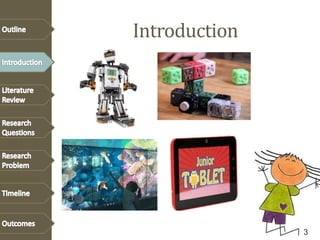
Introduction
3
Introduction
• For a product and an interface to be
intuitive to use, it should adapt to the
context of use (Moran et al., 2001).
• Intuitive-ness is a human quality developed
over time (Dane et al., 2012) .
4
Introduction
• Intuitive-use is an unconscious application
of one’s prior knowledge (Mohs et al., 2006).
• People use knowledge gained from their
experiences using other products and
features in order to intuitively interact with
interfaces (Blackler et al., 2007).
• Intuitive-ness is an attribute of an object
(Norman, 2002).
5
Introduction
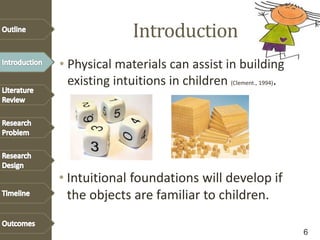
• Physical materials can assist in building
existing intuitions in children (Clement., 1994).
• Intuitional foundations will develop if
the objects are familiar to children.
6
Literature Review
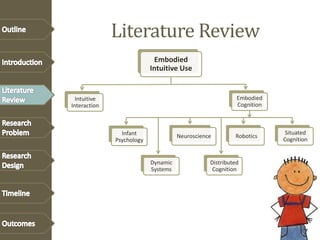
Embodied
Intuitive Use
Intuitive
Interaction
Embodied
Cognition
Infant
Psychology
Dynamic
Systems
Neuroscience Robotics
Situated
Cognition
Distributed
Cognition
7
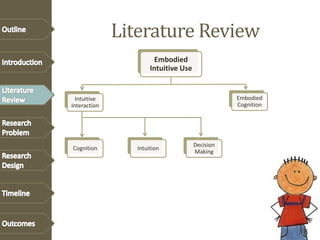
Literature Review
Embodied
Intuitive Use
Intuitive
Interaction
Embodied
Cognition
Cognition Intuition
8
Decision
Making
Intuitive Interaction
• Prior Knowledge.
• Familiarity.
• Image Schemas.
• Diversity in prior knowledge with age.
• Diversity in familiarity with age.
9
Intuitive Interaction
• Prior Knowledge
• Prior experience with similar products and
features enables intuitive use of features.
• Familiarity
• Make function, location and appearance
familiar for known features.
• Use familiar things to demonstrate function,
appearance and location of less known
features.
• Consistency and Redundancy.
10
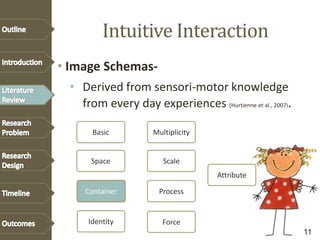
Intuitive Interaction
• Image Schemas-
• Derived from sensori-motor knowledge
from every day experiences (Hurtienne et al., 2007).
Basic
Space
Container
Identity
Multiplicity
Scale
Process
Force
Attribute
Container
11
Intuitive Interaction
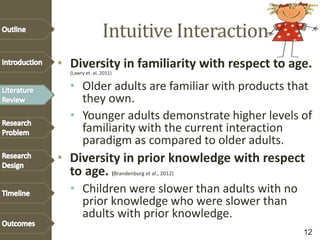
• Diversity in familiarity with respect to age.
(Lawry et. al, 2011)
• Older adults are familiar with products that
they own.
• Younger adults demonstrate higher levels of
familiarity with the current interaction
paradigm as compared to older adults.
• Diversity in prior knowledge with respect
to age. (Brandenburg et al., 2012)
• Children were slower than adults with no
prior knowledge who were slower than
adults with prior knowledge.
12
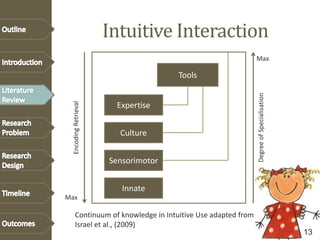
Intuitive Interaction
Continuum of knowledge in Intuitive Use adapted from
Israel et al., (2009)
13
Culture
Tools
Expertise
Sensorimotor
Innate
EncodingRetrieval
DegreeofSpecialisation
Max
Max
Embodied Cognition
14
Embodied Cognition
Real World
Real Time
Evolutionary
Clark (2013)
Lungarella (2003)
Thelen (2010
Brooks (1999)
Eelen et al., (2013)
Kirsh (2013)
Turner (2013)
Hayles (2013)
Anderson (2005)
15
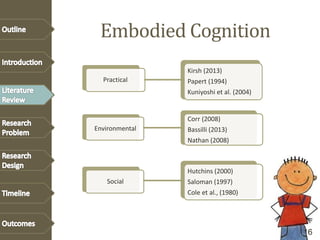
Embodied Cognition
Practical
Environmental
Kirsh (2013)
Papert (1994)
Kuniyoshi et al. (2004)
Corr (2008)
Bassilli (2013)
Nathan (2008)
Social
Hutchins (2000)
Saloman (1997)
Cole et al., (1980)
16
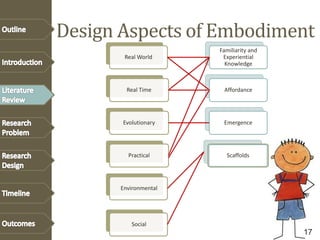
Design Aspects of Embodiment
Social
Real World
Real Time
Evolutionary
Practical
Environmental
Familiarity and
Experiential
Knowledge
Scaffolds
Affordance
Emergence
17
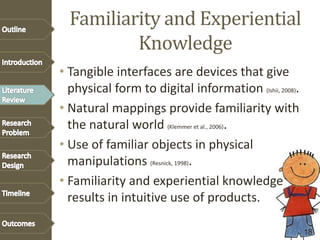
Familiarity and Experiential
Knowledge
• Tangible interfaces are devices that give
physical form to digital information (Ishii, 2008).
• Natural mappings provide familiarity with
the natural world (Klemmer et al., 2006).
• Use of familiar objects in physical
manipulations (Resnick, 1998).
• Familiarity and experiential knowledge
results in intuitive use of products.
18
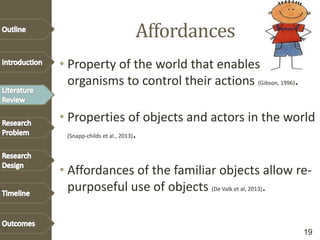
Affordances
• Property of the world that enables
organisms to control their actions (Gibson, 1996).
• Properties of objects and actors in the world
(Snapp-childs et al., 2013).
• Affordances of the familiar objects allow re-
purposeful use of objects (De Valk et al, 2013).
19
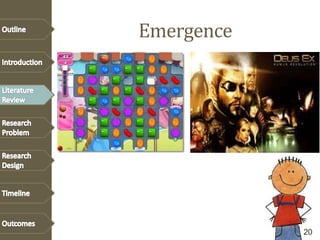
Emergence
20
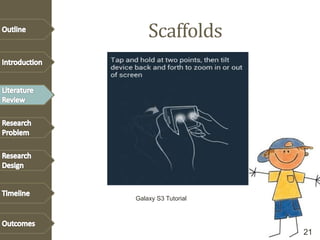
Scaffolds
Galaxy S3 Tutorial
21
Research Problem
• Embodiment provides natural and intuitive
form of interaction (Ishii, 2008).
• The term embodiment has been
increasingly used in interaction design to
mean bodily action and physicality.
22
Research Problem
• Use of physical body movements as the
basis for interactional metaphors that relate
to abstract representations which in turn
facilitate intuitive use (Antle et al., 2013) .
• Aspects contributing to intuitive embodied
mappings?
23
Research Questions
• Main Research Question:
• What is the role of embodiment in intuitive
use in children?
• Sub-questions:
• What are the aspects of embodiment that
contribute to intuitive use in children?
• How can these aspects facilitate interaction in
children?
24
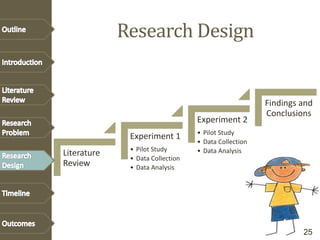
Research Design
Literature
Review
Experiment 1
• Pilot Study
• Data Collection
• Data Analysis
Experiment 2
• Pilot Study
• Data Collection
• Data Analysis
Findings and
Conclusions
25
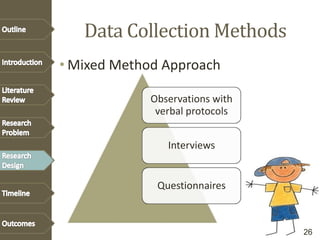
Data Collection Methods
• Mixed Method Approach
Observations with
verbal protocols
Interviews
Questionnaires
26
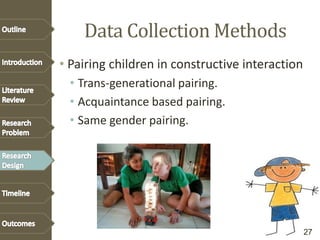
Data Collection Methods
• Pairing children in constructive interaction
• Trans-generational pairing.
• Acquaintance based pairing.
• Same gender pairing.
27
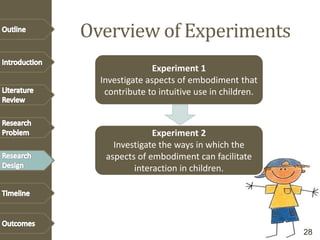
Overview of Experiments
Experiment 1
Investigate aspects of embodiment that
contribute to intuitive use in children.
Experiment 2
Investigate the ways in which the
aspects of embodiment can facilitate
interaction in children.
28
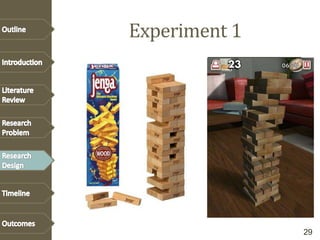
Experiment 1
Investigate aspects of embodiment that contribute to intuitive use in
children.
Pre-experiment Experiment Post-experiment
Location home QUT People and Systems Lab and local
state schools
Participants 80-100 children (40-50 pairs) from local state schools (prep-
grade 5)
Duration 10 minutes 30 minutes 10-20 minutes
Data Collection
Technique
Questionnaire Observations Semi-structured
retrospective
Interview
Data Analysis Tool Excel, SPSS Observer XT, SPSS Atlas.Ti, SPSS
Toy Selected Jenga
29
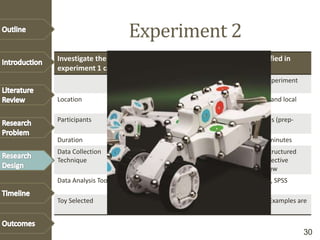
Experiment 2
Investigate the ways in which the aspects of embodiment identified in
experiment 1 can facilitate interaction in children.
Pre-experiment Experiment Post-experiment
Location home QUT People and Systems Lab and local
state schools
Participants 80-100 children (40-50 pairs) from local state schools (prep-
grade 5)
Duration 10 minutes 30 minutes 10-20 minutes
Data Collection
Technique
Questionnaire Observations Semi-structured
retrospective
Interview
Data Analysis Tool Excel, SPSS Observer XT, SPSS Atlas.Ti, SPSS
Toy Selected Will be decided based on Experiment 1 outcomes. Examples are
Cubelets, Mackey Mackey
30
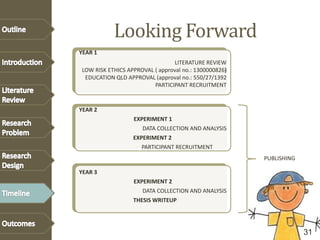
Looking Forward
YEAR 1
LITERATURE REVIEW
LOW RISK ETHICS APPROVAL ( approval no.: 1300000826)
EDUCATION QLD APPROVAL (approval no.: 550/27/1392
PARTICIPANT RECRUITMENT
YEAR 2
EXPERIMENT 1
DATA COLLECTION AND ANALYSIS
EXPERIMENT 2
PARTICIPANT RECRUITMENT
YEAR 3
EXPERIMENT 2
DATA COLLECTION AND ANALYSIS
THESIS WRITEUP
31
PUBLISHING
Research Contributions
• New theory of embodied intuitive
interaction.
• Better understanding of how children
interact with products.
• New research and design methods.
• Knowledge that is transferrable to other
areas.
32
Research Outcomes
• Design framework to develop intuitive
products for children.
• Children will be able to use their inherent
intuitions and subsequently build upon
them while interacting with products and
features.
• This will result in less cognitive load.
• Children will not give up on products
designed for them.
33
Thank You
Questions?
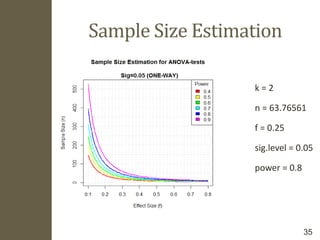
Sample Size Estimation
k = 2
n = 63.76561
f = 0.25
sig.level = 0.05
power = 0.8
35
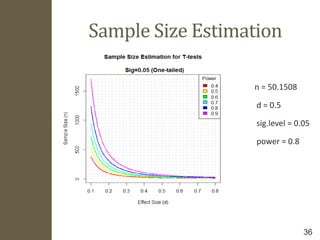
Sample Size Estimation
n = 50.1508
d = 0.5
sig.level = 0.05
power = 0.8
36
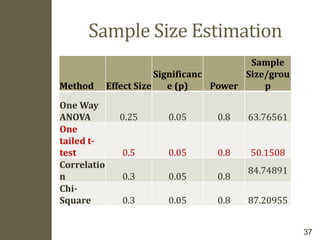
Sample Size Estimation
Method Effect Size
Significanc
e (p) Power
Sample
Size/grou
p
One Way
ANOVA 0.25 0.05 0.8 63.76561
One
tailed t-
test 0.5 0.05 0.8 50.1508
Correlatio
n 0.3 0.05 0.8
84.74891
Chi-
Square 0.3 0.05 0.8 87.20955
37
38

Intuitive Interaction in Children

  • 1.
    Intuitive Interaction in Children ShitalDesai Assoc. Prof. AletheaBlackler : PrincipalSupervisor Prof. Vesna Popovic :AssociateSupervisor
  • 2.
    Outline • Introduction • LiteratureReview • Research Problem • Research Design • Contributions and Outcomes 2
  • 3.
  • 4.
    Introduction • For aproduct and an interface to be intuitive to use, it should adapt to the context of use (Moran et al., 2001). • Intuitive-ness is a human quality developed over time (Dane et al., 2012) . 4
  • 5.
    Introduction • Intuitive-use isan unconscious application of one’s prior knowledge (Mohs et al., 2006). • People use knowledge gained from their experiences using other products and features in order to intuitively interact with interfaces (Blackler et al., 2007). • Intuitive-ness is an attribute of an object (Norman, 2002). 5
  • 6.
    Introduction • Physical materialscan assist in building existing intuitions in children (Clement., 1994). • Intuitional foundations will develop if the objects are familiar to children. 6
  • 7.
  • 8.
  • 9.
    Intuitive Interaction • PriorKnowledge. • Familiarity. • Image Schemas. • Diversity in prior knowledge with age. • Diversity in familiarity with age. 9
  • 10.
    Intuitive Interaction • PriorKnowledge • Prior experience with similar products and features enables intuitive use of features. • Familiarity • Make function, location and appearance familiar for known features. • Use familiar things to demonstrate function, appearance and location of less known features. • Consistency and Redundancy. 10
  • 11.
    Intuitive Interaction • ImageSchemas- • Derived from sensori-motor knowledge from every day experiences (Hurtienne et al., 2007). Basic Space Container Identity Multiplicity Scale Process Force Attribute Container 11
  • 12.
    Intuitive Interaction • Diversityin familiarity with respect to age. (Lawry et. al, 2011) • Older adults are familiar with products that they own. • Younger adults demonstrate higher levels of familiarity with the current interaction paradigm as compared to older adults. • Diversity in prior knowledge with respect to age. (Brandenburg et al., 2012) • Children were slower than adults with no prior knowledge who were slower than adults with prior knowledge. 12
  • 13.
    Intuitive Interaction Continuum ofknowledge in Intuitive Use adapted from Israel et al., (2009) 13 Culture Tools Expertise Sensorimotor Innate EncodingRetrieval DegreeofSpecialisation Max Max
  • 14.
  • 15.
    Embodied Cognition Real World RealTime Evolutionary Clark (2013) Lungarella (2003) Thelen (2010 Brooks (1999) Eelen et al., (2013) Kirsh (2013) Turner (2013) Hayles (2013) Anderson (2005) 15
  • 16.
    Embodied Cognition Practical Environmental Kirsh (2013) Papert(1994) Kuniyoshi et al. (2004) Corr (2008) Bassilli (2013) Nathan (2008) Social Hutchins (2000) Saloman (1997) Cole et al., (1980) 16
  • 17.
    Design Aspects ofEmbodiment Social Real World Real Time Evolutionary Practical Environmental Familiarity and Experiential Knowledge Scaffolds Affordance Emergence 17
  • 18.
    Familiarity and Experiential Knowledge •Tangible interfaces are devices that give physical form to digital information (Ishii, 2008). • Natural mappings provide familiarity with the natural world (Klemmer et al., 2006). • Use of familiar objects in physical manipulations (Resnick, 1998). • Familiarity and experiential knowledge results in intuitive use of products. 18
  • 19.
    Affordances • Property ofthe world that enables organisms to control their actions (Gibson, 1996). • Properties of objects and actors in the world (Snapp-childs et al., 2013). • Affordances of the familiar objects allow re- purposeful use of objects (De Valk et al, 2013). 19
  • 20.
  • 21.
  • 22.
    Research Problem • Embodimentprovides natural and intuitive form of interaction (Ishii, 2008). • The term embodiment has been increasingly used in interaction design to mean bodily action and physicality. 22
  • 23.
    Research Problem • Useof physical body movements as the basis for interactional metaphors that relate to abstract representations which in turn facilitate intuitive use (Antle et al., 2013) . • Aspects contributing to intuitive embodied mappings? 23
  • 24.
    Research Questions • MainResearch Question: • What is the role of embodiment in intuitive use in children? • Sub-questions: • What are the aspects of embodiment that contribute to intuitive use in children? • How can these aspects facilitate interaction in children? 24
  • 25.
    Research Design Literature Review Experiment 1 •Pilot Study • Data Collection • Data Analysis Experiment 2 • Pilot Study • Data Collection • Data Analysis Findings and Conclusions 25
  • 26.
    Data Collection Methods •Mixed Method Approach Observations with verbal protocols Interviews Questionnaires 26
  • 27.
    Data Collection Methods •Pairing children in constructive interaction • Trans-generational pairing. • Acquaintance based pairing. • Same gender pairing. 27
  • 28.
    Overview of Experiments Experiment1 Investigate aspects of embodiment that contribute to intuitive use in children. Experiment 2 Investigate the ways in which the aspects of embodiment can facilitate interaction in children. 28
  • 29.
    Experiment 1 Investigate aspectsof embodiment that contribute to intuitive use in children. Pre-experiment Experiment Post-experiment Location home QUT People and Systems Lab and local state schools Participants 80-100 children (40-50 pairs) from local state schools (prep- grade 5) Duration 10 minutes 30 minutes 10-20 minutes Data Collection Technique Questionnaire Observations Semi-structured retrospective Interview Data Analysis Tool Excel, SPSS Observer XT, SPSS Atlas.Ti, SPSS Toy Selected Jenga 29
  • 30.
    Experiment 2 Investigate theways in which the aspects of embodiment identified in experiment 1 can facilitate interaction in children. Pre-experiment Experiment Post-experiment Location home QUT People and Systems Lab and local state schools Participants 80-100 children (40-50 pairs) from local state schools (prep- grade 5) Duration 10 minutes 30 minutes 10-20 minutes Data Collection Technique Questionnaire Observations Semi-structured retrospective Interview Data Analysis Tool Excel, SPSS Observer XT, SPSS Atlas.Ti, SPSS Toy Selected Will be decided based on Experiment 1 outcomes. Examples are Cubelets, Mackey Mackey 30
  • 31.
    Looking Forward YEAR 1 LITERATUREREVIEW LOW RISK ETHICS APPROVAL ( approval no.: 1300000826) EDUCATION QLD APPROVAL (approval no.: 550/27/1392 PARTICIPANT RECRUITMENT YEAR 2 EXPERIMENT 1 DATA COLLECTION AND ANALYSIS EXPERIMENT 2 PARTICIPANT RECRUITMENT YEAR 3 EXPERIMENT 2 DATA COLLECTION AND ANALYSIS THESIS WRITEUP 31 PUBLISHING
  • 32.
    Research Contributions • Newtheory of embodied intuitive interaction. • Better understanding of how children interact with products. • New research and design methods. • Knowledge that is transferrable to other areas. 32
  • 33.
    Research Outcomes • Designframework to develop intuitive products for children. • Children will be able to use their inherent intuitions and subsequently build upon them while interacting with products and features. • This will result in less cognitive load. • Children will not give up on products designed for them. 33
  • 34.
  • 35.
    Sample Size Estimation k= 2 n = 63.76561 f = 0.25 sig.level = 0.05 power = 0.8 35
  • 36.
    Sample Size Estimation n= 50.1508 d = 0.5 sig.level = 0.05 power = 0.8 36
  • 37.
    Sample Size Estimation MethodEffect Size Significanc e (p) Power Sample Size/grou p One Way ANOVA 0.25 0.05 0.8 63.76561 One tailed t- test 0.5 0.05 0.8 50.1508 Correlatio n 0.3 0.05 0.8 84.74891 Chi- Square 0.3 0.05 0.8 87.20955 37
  • 38.