UCI Extension
Paper-Based TOEFL Workshop

Listening Part A (1)
Listening Comprehension Skills 1-10
Longman Preparation Course for the TOEFL Test

Tutorial prepared by Marla Yoshida

1
The Listening Comprehension Section
The Listening Comprehension Section on the paper-based
TOEFL measures your ability to understand spoken English,
especially in academic contexts. It has a total of 50 questions,
and it lasts 30-40 minutes. It is divided into three parts:
Part A: Short conversations
(30 dialogs, one question each)
Part B: Long conversations
(2 conversations, several questions each)
Part C: Longer talks
(3 talks, several questions each)

2
The Listening Comprehension Section
Here are some general strategies for the Listening section:
1. Know the directions. If you already know what to do, you
won’t have to waste time during the test reading the
directions.
2. Listen carefully. Stay calm and try not to get distracted or
let your attention wander. You will hear everything only
once.
3. The questions go from easier to harder.
4. Don’t leave any answers blank on your answer sheet.
Even if you don’t know the answer, guess.
5. Look ahead at the answers to the next question if you have
time. That will help you be ready to understand it better.

3
Listening Comprehension Section, Part A
In Part A, you will hear 30 very short conversations between a
man and a woman. For each one, you will hear a question and
choose the best answer from the four choices written in your test
book. For example, you might hear:
(Man)

Billy really made a big mistake this time.

(Woman)

Yes, he forgot to turn in his research paper.

(Question)

What does the woman say about Billy?

In your test book, you read:
(A) It was the first time he made a mistake.
(B) He forgot to write his paper.
(C) He turned in the paper in the wrong place.
(D) He didn’t remember to submit his assignment.

4
Listening Comprehension Section, Part A
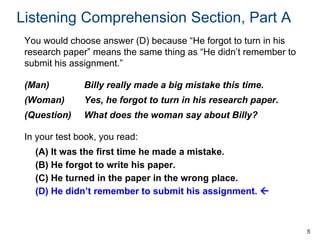
You would choose answer (D) because “He forgot to turn in his
research paper” means the same thing as “He didn’t remember to
submit his assignment.”
(Man)

Billy really made a big mistake this time.

(Woman)

Yes, he forgot to turn in his research paper.

(Question)

What does the woman say about Billy?

In your test book, you read:
(A) It was the first time he made a mistake.
(B) He forgot to write his paper.
(C) He turned in the paper in the wrong place.
(D) He didn’t remember to submit his assignment. 

5
Listening Comprehension Section, Part A
In this example, the answer to the question is clearly stated in
the dialog. However, in many of the conversations, the
information will not be stated directly. You will have to make
an inference from what the speakers say. In other words, you
will have to make an intelligent guess.

Now let’s look at some strategies for doing well on Part A of
the Listening Comprehension Section.

6
Focus on the second line of the dialog.
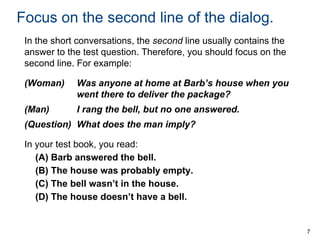
In the short conversations, the second line usually contains the
answer to the test question. Therefore, you should focus on the
second line. For example:
(Woman)

Was anyone at home at Barb’s house when you
went there to deliver the package?

(Man)

I rang the bell, but no one answered.

(Question) What does the man imply?
In your test book, you read:
(A) Barb answered the bell.
(B) The house was probably empty.
(C) The bell wasn’t in the house.
(D) The house doesn’t have a bell.

7
Focus on the second line of the dialog.
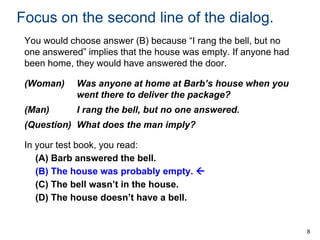
You would choose answer (B) because “I rang the bell, but no
one answered” implies that the house was empty. If anyone had
been home, they would have answered the door.
(Woman)

Was anyone at home at Barb’s house when you
went there to deliver the package?

(Man)

I rang the bell, but no one answered.

(Question) What does the man imply?
In your test book, you read:
(A) Barb answered the bell.
(B) The house was probably empty. 
(C) The bell wasn’t in the house.
(D) The house doesn’t have a bell.

8
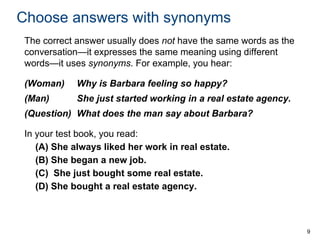
Choose answers with synonyms
The correct answer usually does not have the same words as the
conversation—it expresses the same meaning using different
words—it uses synonyms. For example, you hear:
(Woman)

Why is Barbara feeling so happy?

(Man)

She just started working in a real estate agency.

(Question) What does the man say about Barbara?
In your test book, you read:
(A) She always liked her work in real estate.
(B) She began a new job.
(C) She just bought some real estate.
(D) She bought a real estate agency.

9
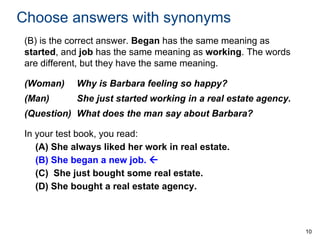
Choose answers with synonyms
(B) is the correct answer. Began has the same meaning as
started, and job has the same meaning as working. The words
are different, but they have the same meaning.
(Woman)

Why is Barbara feeling so happy?

(Man)

She just started working in a real estate agency.

(Question) What does the man say about Barbara?
In your test book, you read:
(A) She always liked her work in real estate.
(B) She began a new job. 
(C) She just bought some real estate.
(D) She bought a real estate agency.

10
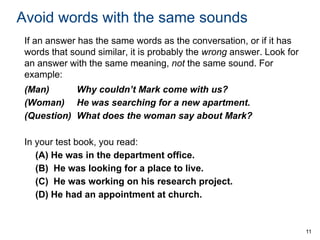
Avoid words with the same sounds
If an answer has the same words as the conversation, or if it has
words that sound similar, it is probably the wrong answer. Look for
an answer with the same meaning, not the same sound. For
example:
(Man)
Why couldn’t Mark come with us?
(Woman) He was searching for a new apartment.
(Question) What does the woman say about Mark?
In your test book, you read:
(A) He was in the department office.
(B) He was looking for a place to live.
(C) He was working on his research project.
(D) He had an appointment at church.

11
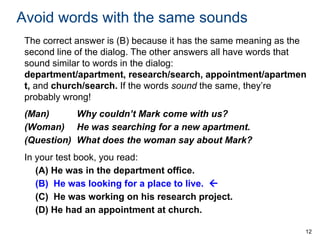
Avoid words with the same sounds
The correct answer is (B) because it has the same meaning as the
second line of the dialog. The other answers all have words that
sound similar to words in the dialog:
department/apartment, research/search, appointment/apartmen
t, and church/search. If the words sound the same, they’re
probably wrong!

(Man)
Why couldn’t Mark come with us?
(Woman) He was searching for a new apartment.
(Question) What does the woman say about Mark?
In your test book, you read:
(A) He was in the department office.
(B) He was looking for a place to live. 
(C) He was working on his research project.
(D) He had an appointment at church.
12
Common questions on Part A
• Questions like these are often heard in Part A. Be sure you
know what they mean.
What does the man/woman mean?
What does the man/woman imply?

What does the man/woman say about ____ ?
What does the man/woman suggest about ____ ?

13
Draw conclusions about who, what, where
In many conversations, you will have to make an inference
from what the speakers say. You might hear questions like
these:
Who is the man/woman?
What will the man/woman probably do next?
What will probably happen next?
Where does this conversation probably take place?

Use clues in the conversation to help you make an intelligent
guess about the answers to these questions.

14
Draw conclusions about who, what, where
Here is an example with a question that asks who.
(Woman)

Can you tell me what assignments I missed when
I was absent from your class?

(Man)

You missed one homework assignment and a
quiz.

(Question) Who is the man?
In your test book, you read:
(A) A newspaper editor.
(B) A police officer.
(C) A teacher.
(D) A student.

15
Draw conclusions about who, what, where
The clues your class, homework, and quiz tell us that the man is
probably a teacher, so we choose answer (C).

(Woman)

Can you tell me what assignments I missed when
I was absent from your class?

(Man)

You missed one homework assignment and a
quiz.

(Question) Who is the man?
In your test book, you read:
(A) A newspaper editor.
(B) A police officer.
(C) A teacher. 
(D) A student.

16
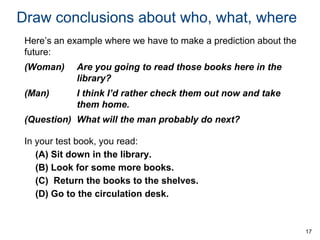
Draw conclusions about who, what, where
Here’s an example where we have to make a prediction about the
future:

(Woman)

Are you going to read those books here in the
library?

(Man)

I think I’d rather check them out now and take
them home.

(Question) What will the man probably do next?
In your test book, you read:
(A) Sit down in the library.
(B) Look for some more books.
(C) Return the books to the shelves.
(D) Go to the circulation desk.

17
Draw conclusions about who, what, where
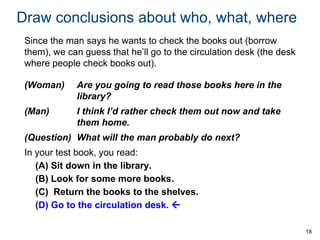
Since the man says he wants to check the books out (borrow
them), we can guess that he’ll go to the circulation desk (the desk
where people check books out).
(Woman)

Are you going to read those books here in the
library?

(Man)

I think I’d rather check them out now and take
them home.

(Question) What will the man probably do next?

In your test book, you read:
(A) Sit down in the library.
(B) Look for some more books.
(C) Return the books to the shelves.
(D) Go to the circulation desk. 
18
Draw conclusions about who, what, where
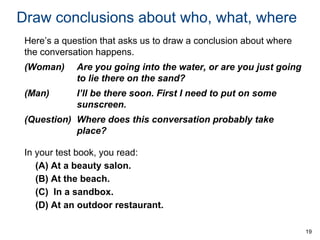
Here’s a question that asks us to draw a conclusion about where
the conversation happens.

(Woman)

Are you going into the water, or are you just going
to lie there on the sand?

(Man)

I’ll be there soon. First I need to put on some
sunscreen.

(Question) Where does this conversation probably take
place?

In your test book, you read:
(A) At a beauty salon.
(B) At the beach.
(C) In a sandbox.
(D) At an outdoor restaurant.
19
Draw conclusions about who, what, where
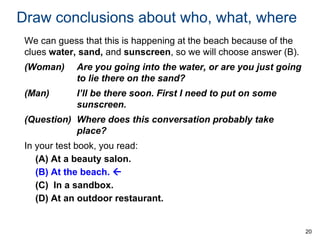
We can guess that this is happening at the beach because of the
clues water, sand, and sunscreen, so we will choose answer (B).

(Woman)

Are you going into the water, or are you just going
to lie there on the sand?

(Man)

I’ll be there soon. First I need to put on some
sunscreen.

(Question) Where does this conversation probably take
place?
In your test book, you read:
(A) At a beauty salon.
(B) At the beach. 
(C) In a sandbox.
(D) At an outdoor restaurant.

20
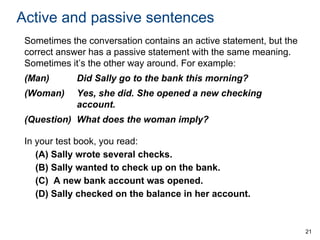
Active and passive sentences
Sometimes the conversation contains an active statement, but the
correct answer has a passive statement with the same meaning.
Sometimes it’s the other way around. For example:
(Man)

Did Sally go to the bank this morning?

(Woman)

Yes, she did. She opened a new checking
account.

(Question) What does the woman imply?
In your test book, you read:
(A) Sally wrote several checks.
(B) Sally wanted to check up on the bank.
(C) A new bank account was opened.
(D) Sally checked on the balance in her account.

21
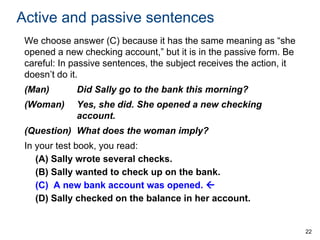
Active and passive sentences
We choose answer (C) because it has the same meaning as “she
opened a new checking account,” but it is in the passive form. Be
careful: In passive sentences, the subject receives the action, it
doesn’t do it.
(Man)

Did Sally go to the bank this morning?

(Woman)

Yes, she did. She opened a new checking
account.

(Question) What does the woman imply?
In your test book, you read:
(A) Sally wrote several checks.
(B) Sally wanted to check up on the bank.
(C) A new bank account was opened. 
(D) Sally checked on the balance in her account.

22
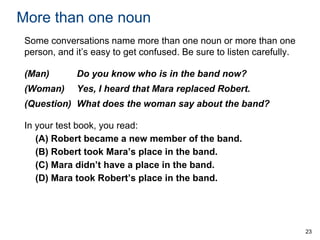
More than one noun
Some conversations name more than one noun or more than one
person, and it’s easy to get confused. Be sure to listen carefully.
(Man)

Do you know who is in the band now?

(Woman)

Yes, I heard that Mara replaced Robert.

(Question) What does the woman say about the band?
In your test book, you read:
(A) Robert became a new member of the band.
(B) Robert took Mara’s place in the band.
(C) Mara didn’t have a place in the band.
(D) Mara took Robert’s place in the band.

23
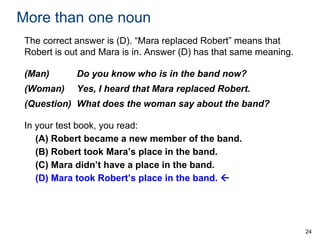
More than one noun
The correct answer is (D). “Mara replaced Robert” means that
Robert is out and Mara is in. Answer (D) has that same meaning.
(Man)

Do you know who is in the band now?

(Woman)

Yes, I heard that Mara replaced Robert.

(Question) What does the woman say about the band?
In your test book, you read:
(A) Robert became a new member of the band.
(B) Robert took Mara’s place in the band.
(C) Mara didn’t have a place in the band.
(D) Mara took Robert’s place in the band. 

24
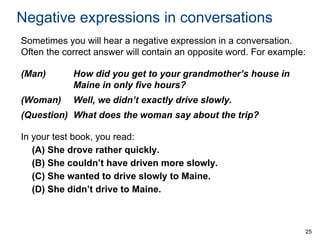
Negative expressions in conversations
Sometimes you will hear a negative expression in a conversation.
Often the correct answer will contain an opposite word. For example:
(Man)

How did you get to your grandmother’s house in
Maine in only five hours?

(Woman)

Well, we didn’t exactly drive slowly.

(Question) What does the woman say about the trip?
In your test book, you read:
(A) She drove rather quickly.
(B) She couldn’t have driven more slowly.
(C) She wanted to drive slowly to Maine.
(D) She didn’t drive to Maine.

25
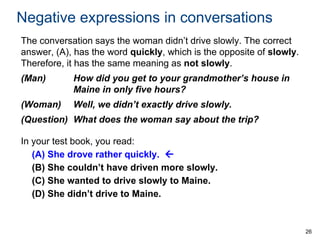
Negative expressions in conversations
The conversation says the woman didn’t drive slowly. The correct
answer, (A), has the word quickly, which is the opposite of slowly.
Therefore, it has the same meaning as not slowly.
(Man)

How did you get to your grandmother’s house in
Maine in only five hours?

(Woman)

Well, we didn’t exactly drive slowly.

(Question) What does the woman say about the trip?
In your test book, you read:
(A) She drove rather quickly. 
(B) She couldn’t have driven more slowly.
(C) She wanted to drive slowly to Maine.
(D) She didn’t drive to Maine.

26
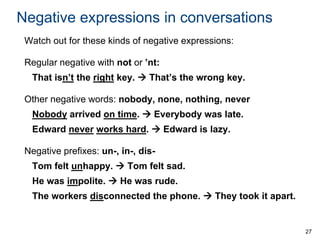
Negative expressions in conversations
Watch out for these kinds of negative expressions:
Regular negative with not or ’nt:
That isn’t the right key.  That’s the wrong key.
Other negative words: nobody, none, nothing, never

Nobody arrived on time.  Everybody was late.
Edward never works hard.  Edward is lazy.
Negative prefixes: un-, in-, disTom felt unhappy.  Tom felt sad.
He was impolite.  He was rude.
The workers disconnected the phone.  They took it apart.

27
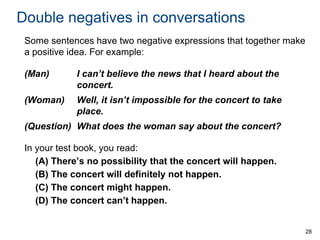
Double negatives in conversations
Some sentences have two negative expressions that together make
a positive idea. For example:
(Man)

I can’t believe the news that I heard about the
concert.

(Woman)

Well, it isn’t impossible for the concert to take
place.

(Question) What does the woman say about the concert?
In your test book, you read:
(A) There’s no possibility that the concert will happen.
(B) The concert will definitely not happen.
(C) The concert might happen.
(D) The concert can’t happen.

28
Double negatives in conversations
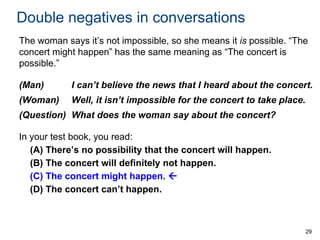
The woman says it’s not impossible, so she means it is possible. “The
concert might happen” has the same meaning as “The concert is
possible.”
(Man)

I can’t believe the news that I heard about the concert.

(Woman)

Well, it isn’t impossible for the concert to take place.

(Question) What does the woman say about the concert?
In your test book, you read:
(A) There’s no possibility that the concert will happen.
(B) The concert will definitely not happen.
(C) The concert might happen. 
(D) The concert can’t happen.

29
Double negatives in conversations
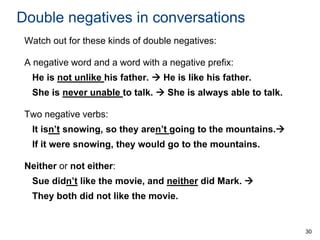
Watch out for these kinds of double negatives:
A negative word and a word with a negative prefix:
He is not unlike his father.  He is like his father.
She is never unable to talk.  She is always able to talk.

Two negative verbs:
It isn’t snowing, so they aren’t going to the mountains.
If it were snowing, they would go to the mountains.
Neither or not either:
Sue didn’t like the movie, and neither did Mark. 
They both did not like the movie.

30
Double negatives in conversations
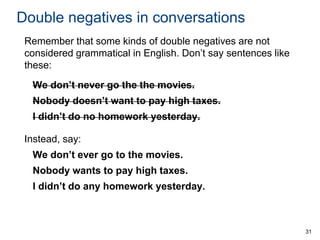
Remember that some kinds of double negatives are not
considered grammatical in English. Don’t say sentences like
these:
We don’t never go the the movies.
Nobody doesn’t want to pay high taxes.

I didn’t do no homework yesterday.
Instead, say:

We don’t ever go to the movies.
Nobody wants to pay high taxes.
I didn’t do any homework yesterday.

31
Almost negative expressions
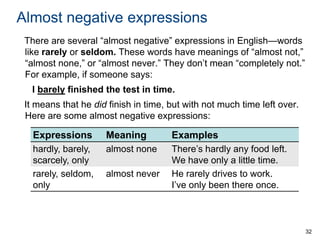
There are several “almost negative” expressions in English—words
like rarely or seldom. These words have meanings of “almost not,”
“almost none,” or “almost never.” They don’t mean “completely not.”
For example, if someone says:
I barely finished the test in time.
It means that he did finish in time, but with not much time left over.
Here are some almost negative expressions:

Expressions

Meaning

Examples

hardly, barely,
scarcely, only
rarely, seldom,
only

almost none

There’s hardly any food left.
We have only a little time.
He rarely drives to work.
I’ve only been there once.

almost never

32
Almost negative expressions
Here’s an example of a conversation with an almost negative
expression:
(Woman)

Were you able to pay the electric bill?

(Man)

I had barely enough money.

(Question) What does the man imply?
In your test book, you read:
(A) He had plenty of money for the bill.
(B) He did not have enough money for the bill.
(C) He paid the bill but has no money left.
(D) He was unable to pay the bill.

33
Almost negative expressions
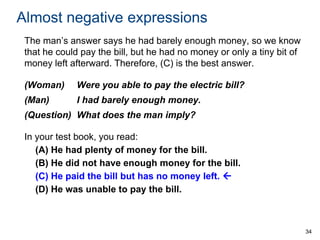
The man’s answer says he had barely enough money, so we know
that he could pay the bill, but he had no money or only a tiny bit of
money left afterward. Therefore, (C) is the best answer.
(Woman)

Were you able to pay the electric bill?

(Man)

I had barely enough money.

(Question) What does the man imply?
In your test book, you read:
(A) He had plenty of money for the bill.
(B) He did not have enough money for the bill.
(C) He paid the bill but has no money left. 
(D) He was unable to pay the bill.

34
Summary
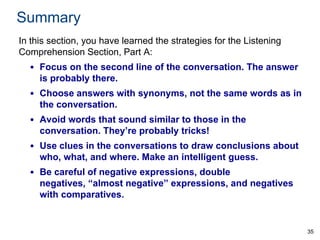
In this section, you have learned the strategies for the Listening
Comprehension Section, Part A:

• Focus on the second line of the conversation. The answer
is probably there.
• Choose answers with synonyms, not the same words as in
the conversation.

• Avoid words that sound similar to those in the
conversation. They’re probably tricks!
• Use clues in the conversations to draw conclusions about
who, what, and where. Make an intelligent guess.
• Be careful of negative expressions, double
negatives, “almost negative” expressions, and negatives
with comparatives.

35

Listening a skills 1 10

  • 1.
    UCI Extension Paper-Based TOEFLWorkshop Listening Part A (1) Listening Comprehension Skills 1-10 Longman Preparation Course for the TOEFL Test Tutorial prepared by Marla Yoshida 1
  • 2.
    The Listening ComprehensionSection The Listening Comprehension Section on the paper-based TOEFL measures your ability to understand spoken English, especially in academic contexts. It has a total of 50 questions, and it lasts 30-40 minutes. It is divided into three parts: Part A: Short conversations (30 dialogs, one question each) Part B: Long conversations (2 conversations, several questions each) Part C: Longer talks (3 talks, several questions each) 2
  • 3.
    The Listening ComprehensionSection Here are some general strategies for the Listening section: 1. Know the directions. If you already know what to do, you won’t have to waste time during the test reading the directions. 2. Listen carefully. Stay calm and try not to get distracted or let your attention wander. You will hear everything only once. 3. The questions go from easier to harder. 4. Don’t leave any answers blank on your answer sheet. Even if you don’t know the answer, guess. 5. Look ahead at the answers to the next question if you have time. That will help you be ready to understand it better. 3
  • 4.
    Listening Comprehension Section,Part A In Part A, you will hear 30 very short conversations between a man and a woman. For each one, you will hear a question and choose the best answer from the four choices written in your test book. For example, you might hear: (Man) Billy really made a big mistake this time. (Woman) Yes, he forgot to turn in his research paper. (Question) What does the woman say about Billy? In your test book, you read: (A) It was the first time he made a mistake. (B) He forgot to write his paper. (C) He turned in the paper in the wrong place. (D) He didn’t remember to submit his assignment. 4
  • 5.
    Listening Comprehension Section,Part A You would choose answer (D) because “He forgot to turn in his research paper” means the same thing as “He didn’t remember to submit his assignment.” (Man) Billy really made a big mistake this time. (Woman) Yes, he forgot to turn in his research paper. (Question) What does the woman say about Billy? In your test book, you read: (A) It was the first time he made a mistake. (B) He forgot to write his paper. (C) He turned in the paper in the wrong place. (D) He didn’t remember to submit his assignment.  5
  • 6.
    Listening Comprehension Section,Part A In this example, the answer to the question is clearly stated in the dialog. However, in many of the conversations, the information will not be stated directly. You will have to make an inference from what the speakers say. In other words, you will have to make an intelligent guess. Now let’s look at some strategies for doing well on Part A of the Listening Comprehension Section. 6
  • 7.
    Focus on thesecond line of the dialog. In the short conversations, the second line usually contains the answer to the test question. Therefore, you should focus on the second line. For example: (Woman) Was anyone at home at Barb’s house when you went there to deliver the package? (Man) I rang the bell, but no one answered. (Question) What does the man imply? In your test book, you read: (A) Barb answered the bell. (B) The house was probably empty. (C) The bell wasn’t in the house. (D) The house doesn’t have a bell. 7
  • 8.
    Focus on thesecond line of the dialog. You would choose answer (B) because “I rang the bell, but no one answered” implies that the house was empty. If anyone had been home, they would have answered the door. (Woman) Was anyone at home at Barb’s house when you went there to deliver the package? (Man) I rang the bell, but no one answered. (Question) What does the man imply? In your test book, you read: (A) Barb answered the bell. (B) The house was probably empty.  (C) The bell wasn’t in the house. (D) The house doesn’t have a bell. 8
  • 9.
    Choose answers withsynonyms The correct answer usually does not have the same words as the conversation—it expresses the same meaning using different words—it uses synonyms. For example, you hear: (Woman) Why is Barbara feeling so happy? (Man) She just started working in a real estate agency. (Question) What does the man say about Barbara? In your test book, you read: (A) She always liked her work in real estate. (B) She began a new job. (C) She just bought some real estate. (D) She bought a real estate agency. 9
  • 10.
    Choose answers withsynonyms (B) is the correct answer. Began has the same meaning as started, and job has the same meaning as working. The words are different, but they have the same meaning. (Woman) Why is Barbara feeling so happy? (Man) She just started working in a real estate agency. (Question) What does the man say about Barbara? In your test book, you read: (A) She always liked her work in real estate. (B) She began a new job.  (C) She just bought some real estate. (D) She bought a real estate agency. 10
  • 11.
    Avoid words withthe same sounds If an answer has the same words as the conversation, or if it has words that sound similar, it is probably the wrong answer. Look for an answer with the same meaning, not the same sound. For example: (Man) Why couldn’t Mark come with us? (Woman) He was searching for a new apartment. (Question) What does the woman say about Mark? In your test book, you read: (A) He was in the department office. (B) He was looking for a place to live. (C) He was working on his research project. (D) He had an appointment at church. 11
  • 12.
    Avoid words withthe same sounds The correct answer is (B) because it has the same meaning as the second line of the dialog. The other answers all have words that sound similar to words in the dialog: department/apartment, research/search, appointment/apartmen t, and church/search. If the words sound the same, they’re probably wrong! (Man) Why couldn’t Mark come with us? (Woman) He was searching for a new apartment. (Question) What does the woman say about Mark? In your test book, you read: (A) He was in the department office. (B) He was looking for a place to live.  (C) He was working on his research project. (D) He had an appointment at church. 12
  • 13.
    Common questions onPart A • Questions like these are often heard in Part A. Be sure you know what they mean. What does the man/woman mean? What does the man/woman imply? What does the man/woman say about ____ ? What does the man/woman suggest about ____ ? 13
  • 14.
    Draw conclusions aboutwho, what, where In many conversations, you will have to make an inference from what the speakers say. You might hear questions like these: Who is the man/woman? What will the man/woman probably do next? What will probably happen next? Where does this conversation probably take place? Use clues in the conversation to help you make an intelligent guess about the answers to these questions. 14
  • 15.
    Draw conclusions aboutwho, what, where Here is an example with a question that asks who. (Woman) Can you tell me what assignments I missed when I was absent from your class? (Man) You missed one homework assignment and a quiz. (Question) Who is the man? In your test book, you read: (A) A newspaper editor. (B) A police officer. (C) A teacher. (D) A student. 15
  • 16.
    Draw conclusions aboutwho, what, where The clues your class, homework, and quiz tell us that the man is probably a teacher, so we choose answer (C). (Woman) Can you tell me what assignments I missed when I was absent from your class? (Man) You missed one homework assignment and a quiz. (Question) Who is the man? In your test book, you read: (A) A newspaper editor. (B) A police officer. (C) A teacher.  (D) A student. 16
  • 17.
    Draw conclusions aboutwho, what, where Here’s an example where we have to make a prediction about the future: (Woman) Are you going to read those books here in the library? (Man) I think I’d rather check them out now and take them home. (Question) What will the man probably do next? In your test book, you read: (A) Sit down in the library. (B) Look for some more books. (C) Return the books to the shelves. (D) Go to the circulation desk. 17
  • 18.
    Draw conclusions aboutwho, what, where Since the man says he wants to check the books out (borrow them), we can guess that he’ll go to the circulation desk (the desk where people check books out). (Woman) Are you going to read those books here in the library? (Man) I think I’d rather check them out now and take them home. (Question) What will the man probably do next? In your test book, you read: (A) Sit down in the library. (B) Look for some more books. (C) Return the books to the shelves. (D) Go to the circulation desk.  18
  • 19.
    Draw conclusions aboutwho, what, where Here’s a question that asks us to draw a conclusion about where the conversation happens. (Woman) Are you going into the water, or are you just going to lie there on the sand? (Man) I’ll be there soon. First I need to put on some sunscreen. (Question) Where does this conversation probably take place? In your test book, you read: (A) At a beauty salon. (B) At the beach. (C) In a sandbox. (D) At an outdoor restaurant. 19
  • 20.
    Draw conclusions aboutwho, what, where We can guess that this is happening at the beach because of the clues water, sand, and sunscreen, so we will choose answer (B). (Woman) Are you going into the water, or are you just going to lie there on the sand? (Man) I’ll be there soon. First I need to put on some sunscreen. (Question) Where does this conversation probably take place? In your test book, you read: (A) At a beauty salon. (B) At the beach.  (C) In a sandbox. (D) At an outdoor restaurant. 20
  • 21.
    Active and passivesentences Sometimes the conversation contains an active statement, but the correct answer has a passive statement with the same meaning. Sometimes it’s the other way around. For example: (Man) Did Sally go to the bank this morning? (Woman) Yes, she did. She opened a new checking account. (Question) What does the woman imply? In your test book, you read: (A) Sally wrote several checks. (B) Sally wanted to check up on the bank. (C) A new bank account was opened. (D) Sally checked on the balance in her account. 21
  • 22.
    Active and passivesentences We choose answer (C) because it has the same meaning as “she opened a new checking account,” but it is in the passive form. Be careful: In passive sentences, the subject receives the action, it doesn’t do it. (Man) Did Sally go to the bank this morning? (Woman) Yes, she did. She opened a new checking account. (Question) What does the woman imply? In your test book, you read: (A) Sally wrote several checks. (B) Sally wanted to check up on the bank. (C) A new bank account was opened.  (D) Sally checked on the balance in her account. 22
  • 23.
    More than onenoun Some conversations name more than one noun or more than one person, and it’s easy to get confused. Be sure to listen carefully. (Man) Do you know who is in the band now? (Woman) Yes, I heard that Mara replaced Robert. (Question) What does the woman say about the band? In your test book, you read: (A) Robert became a new member of the band. (B) Robert took Mara’s place in the band. (C) Mara didn’t have a place in the band. (D) Mara took Robert’s place in the band. 23
  • 24.
    More than onenoun The correct answer is (D). “Mara replaced Robert” means that Robert is out and Mara is in. Answer (D) has that same meaning. (Man) Do you know who is in the band now? (Woman) Yes, I heard that Mara replaced Robert. (Question) What does the woman say about the band? In your test book, you read: (A) Robert became a new member of the band. (B) Robert took Mara’s place in the band. (C) Mara didn’t have a place in the band. (D) Mara took Robert’s place in the band.  24
  • 25.
    Negative expressions inconversations Sometimes you will hear a negative expression in a conversation. Often the correct answer will contain an opposite word. For example: (Man) How did you get to your grandmother’s house in Maine in only five hours? (Woman) Well, we didn’t exactly drive slowly. (Question) What does the woman say about the trip? In your test book, you read: (A) She drove rather quickly. (B) She couldn’t have driven more slowly. (C) She wanted to drive slowly to Maine. (D) She didn’t drive to Maine. 25
  • 26.
    Negative expressions inconversations The conversation says the woman didn’t drive slowly. The correct answer, (A), has the word quickly, which is the opposite of slowly. Therefore, it has the same meaning as not slowly. (Man) How did you get to your grandmother’s house in Maine in only five hours? (Woman) Well, we didn’t exactly drive slowly. (Question) What does the woman say about the trip? In your test book, you read: (A) She drove rather quickly.  (B) She couldn’t have driven more slowly. (C) She wanted to drive slowly to Maine. (D) She didn’t drive to Maine. 26
  • 27.
    Negative expressions inconversations Watch out for these kinds of negative expressions: Regular negative with not or ’nt: That isn’t the right key.  That’s the wrong key. Other negative words: nobody, none, nothing, never Nobody arrived on time.  Everybody was late. Edward never works hard.  Edward is lazy. Negative prefixes: un-, in-, disTom felt unhappy.  Tom felt sad. He was impolite.  He was rude. The workers disconnected the phone.  They took it apart. 27
  • 28.
    Double negatives inconversations Some sentences have two negative expressions that together make a positive idea. For example: (Man) I can’t believe the news that I heard about the concert. (Woman) Well, it isn’t impossible for the concert to take place. (Question) What does the woman say about the concert? In your test book, you read: (A) There’s no possibility that the concert will happen. (B) The concert will definitely not happen. (C) The concert might happen. (D) The concert can’t happen. 28
  • 29.
    Double negatives inconversations The woman says it’s not impossible, so she means it is possible. “The concert might happen” has the same meaning as “The concert is possible.” (Man) I can’t believe the news that I heard about the concert. (Woman) Well, it isn’t impossible for the concert to take place. (Question) What does the woman say about the concert? In your test book, you read: (A) There’s no possibility that the concert will happen. (B) The concert will definitely not happen. (C) The concert might happen.  (D) The concert can’t happen. 29
  • 30.
    Double negatives inconversations Watch out for these kinds of double negatives: A negative word and a word with a negative prefix: He is not unlike his father.  He is like his father. She is never unable to talk.  She is always able to talk. Two negative verbs: It isn’t snowing, so they aren’t going to the mountains. If it were snowing, they would go to the mountains. Neither or not either: Sue didn’t like the movie, and neither did Mark.  They both did not like the movie. 30
  • 31.
    Double negatives inconversations Remember that some kinds of double negatives are not considered grammatical in English. Don’t say sentences like these: We don’t never go the the movies. Nobody doesn’t want to pay high taxes. I didn’t do no homework yesterday. Instead, say: We don’t ever go to the movies. Nobody wants to pay high taxes. I didn’t do any homework yesterday. 31
  • 32.
    Almost negative expressions Thereare several “almost negative” expressions in English—words like rarely or seldom. These words have meanings of “almost not,” “almost none,” or “almost never.” They don’t mean “completely not.” For example, if someone says: I barely finished the test in time. It means that he did finish in time, but with not much time left over. Here are some almost negative expressions: Expressions Meaning Examples hardly, barely, scarcely, only rarely, seldom, only almost none There’s hardly any food left. We have only a little time. He rarely drives to work. I’ve only been there once. almost never 32
  • 33.
    Almost negative expressions Here’san example of a conversation with an almost negative expression: (Woman) Were you able to pay the electric bill? (Man) I had barely enough money. (Question) What does the man imply? In your test book, you read: (A) He had plenty of money for the bill. (B) He did not have enough money for the bill. (C) He paid the bill but has no money left. (D) He was unable to pay the bill. 33
  • 34.
    Almost negative expressions Theman’s answer says he had barely enough money, so we know that he could pay the bill, but he had no money or only a tiny bit of money left afterward. Therefore, (C) is the best answer. (Woman) Were you able to pay the electric bill? (Man) I had barely enough money. (Question) What does the man imply? In your test book, you read: (A) He had plenty of money for the bill. (B) He did not have enough money for the bill. (C) He paid the bill but has no money left.  (D) He was unable to pay the bill. 34
  • 35.
    Summary In this section,you have learned the strategies for the Listening Comprehension Section, Part A: • Focus on the second line of the conversation. The answer is probably there. • Choose answers with synonyms, not the same words as in the conversation. • Avoid words that sound similar to those in the conversation. They’re probably tricks! • Use clues in the conversations to draw conclusions about who, what, and where. Make an intelligent guess. • Be careful of negative expressions, double negatives, “almost negative” expressions, and negatives with comparatives. 35