Basic Concepts in PhoneticsBy William Orellana
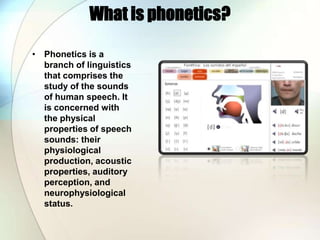
What is phonetics?Phonetics is a branch of linguistics that comprises the study of the sounds of human speech. It is concerned with the physical properties of speech sounds: their physiological production, acoustic properties, auditory perception, and neurophysiological status.
BranchesPhonetics is divided into three branches:Articulatory phoneticsThe study of how speech sounds are produced by the human vocal apparatus.Acoustic phoneticsThe study of the sound waves made by the human vocal organs for communication.Auditory phoneticsThe study of how speech sounds are perceived by the ear, auditory nerve, and brain.
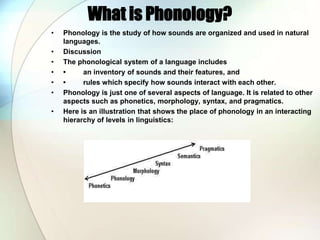
What is Phonology?Phonology is the study of how sounds are organized and used in natural languages.DiscussionThe phonological system of a language includes•	an inventory of sounds and their features, and•	rules which specify how sounds interact with each other.Phonology is just one of several aspects of language. It is related to other aspects such as phonetics, morphology, syntax, and pragmatics.Here is an illustration that shows the place of phonology in an interacting hierarchy of levels in linguistics:
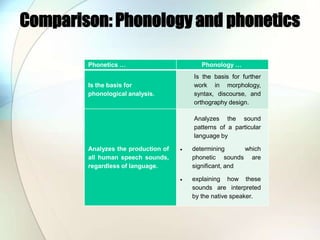
What is the difference between phonology and phonetics?Phonetics and phonology are the two fields dedicated to the study of human speech sounds and sound structures. The difference between phonetics and phonology is that phonetics deals with the physical production of these sounds while phonology is the study of sound patterns and their meanings both within and across languages.
Comparison: Phonology and phonetics
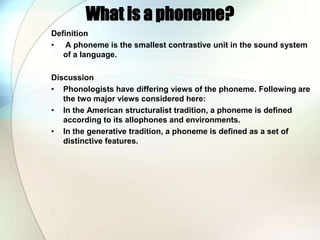
What is a phoneme?Definition A phoneme is the smallest contrastive unit in the sound system of a language.DiscussionPhonologists have differing views of the phoneme. Following are the two major views considered here:In the American structuralist tradition, a phoneme is defined according to its allophones and environments.In the generative tradition, a phoneme is defined as a set of distinctive features.
What is an allophone?DefinitionAn allophone is a phonetic variant of a phoneme in a particular language.Examples (English)[p] and [pH] are allophones of the phoneme /p/.[t] and [tH] are allophones of the phoneme /t/.Examples (Spanish)[b] and [B] are allophones of the phoneme /b/.[d] and [D] are allophones of the phoneme /d/.
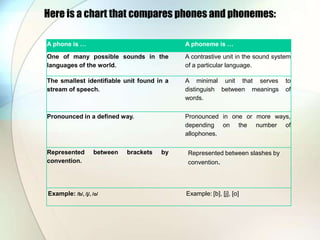
Here is a chart that compares phones and phonemes:
Examples (English): Minimal pairHere are examples of the phonemes /r/ and /l/ occurring in a minimal pair:•	rip•	lipThe phones [r] and [l] contrast in identical environments and are considered to be separate phonemes. The phonemes /r/ and /l/ serve to distinguish the word rip from the word lip.
What is a grapheme? Linguistics one of a set of orthographic symbols (letters or combinations of letters) in a given language that serve to distinguish one word from another and usually correspond to or represent phonemes, e.g. the f in fun, the ph in phantom, and the gh in laugh[from Greek graphēma a letter]
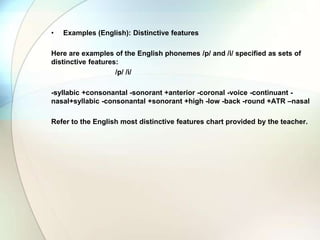
Examples (English): Distinctive featuresHere are examples of the English phonemes /p/ and /i/ specified as sets of distinctive features:	/p/ /i/-syllabic +consonantal -sonorant +anterior -coronal -voice -continuant -nasal+syllabic -consonantal +sonorant +high -low -back -round +ATR –nasalRefer to the English most distinctive features chart provided by the teacher.
SourcesBurquest and Payne, 1993http://www.sil.org/linguistics/GlossaryOfLinguisticTerms/GlossaryLinguisticsP.htmwww.wikipedia.com

Basic concepts in phonetics

  • 1.
    Basic Concepts inPhoneticsBy William Orellana
  • 2.
    What is phonetics?Phoneticsis a branch of linguistics that comprises the study of the sounds of human speech. It is concerned with the physical properties of speech sounds: their physiological production, acoustic properties, auditory perception, and neurophysiological status.
  • 3.
    BranchesPhonetics is dividedinto three branches:Articulatory phoneticsThe study of how speech sounds are produced by the human vocal apparatus.Acoustic phoneticsThe study of the sound waves made by the human vocal organs for communication.Auditory phoneticsThe study of how speech sounds are perceived by the ear, auditory nerve, and brain.
  • 4.
    What is Phonology?Phonologyis the study of how sounds are organized and used in natural languages.DiscussionThe phonological system of a language includes• an inventory of sounds and their features, and• rules which specify how sounds interact with each other.Phonology is just one of several aspects of language. It is related to other aspects such as phonetics, morphology, syntax, and pragmatics.Here is an illustration that shows the place of phonology in an interacting hierarchy of levels in linguistics:
  • 5.
    What is thedifference between phonology and phonetics?Phonetics and phonology are the two fields dedicated to the study of human speech sounds and sound structures. The difference between phonetics and phonology is that phonetics deals with the physical production of these sounds while phonology is the study of sound patterns and their meanings both within and across languages.
  • 6.
  • 7.
    What is aphoneme?Definition A phoneme is the smallest contrastive unit in the sound system of a language.DiscussionPhonologists have differing views of the phoneme. Following are the two major views considered here:In the American structuralist tradition, a phoneme is defined according to its allophones and environments.In the generative tradition, a phoneme is defined as a set of distinctive features.
  • 8.
    What is anallophone?DefinitionAn allophone is a phonetic variant of a phoneme in a particular language.Examples (English)[p] and [pH] are allophones of the phoneme /p/.[t] and [tH] are allophones of the phoneme /t/.Examples (Spanish)[b] and [B] are allophones of the phoneme /b/.[d] and [D] are allophones of the phoneme /d/.
  • 9.
    Here is achart that compares phones and phonemes:
  • 10.
    Examples (English): MinimalpairHere are examples of the phonemes /r/ and /l/ occurring in a minimal pair:• rip• lipThe phones [r] and [l] contrast in identical environments and are considered to be separate phonemes. The phonemes /r/ and /l/ serve to distinguish the word rip from the word lip.
  • 11.
    What is agrapheme? Linguistics one of a set of orthographic symbols (letters or combinations of letters) in a given language that serve to distinguish one word from another and usually correspond to or represent phonemes, e.g. the f in fun, the ph in phantom, and the gh in laugh[from Greek graphēma a letter]
  • 12.
    Examples (English): DistinctivefeaturesHere are examples of the English phonemes /p/ and /i/ specified as sets of distinctive features: /p/ /i/-syllabic +consonantal -sonorant +anterior -coronal -voice -continuant -nasal+syllabic -consonantal +sonorant +high -low -back -round +ATR –nasalRefer to the English most distinctive features chart provided by the teacher.
  • 13.
    SourcesBurquest and Payne,1993http://www.sil.org/linguistics/GlossaryOfLinguisticTerms/GlossaryLinguisticsP.htmwww.wikipedia.com