Pharmaceutical Inspection
Convention
Presented By
KULDEEP KUMAR
Assistant Professor
GISIPS, Dehradun
CONTENT
INTRODUCTION
AIM
MISSION
VISION AND VALUES
GOALS
HISTORY of PIC/S
BENEFITS
ORGANISATIONAL STRUCTURE
INTERNATIONAL CO-OPERATION
INTRODUCTION
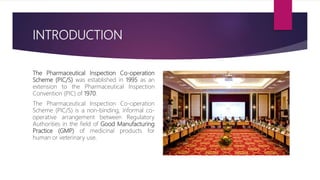
The Pharmaceutical Inspection Co-operation
Scheme (PIC/S) was established in 1995 as an
extension to the Pharmaceutical Inspection
Convention (PIC) of 1970.
The Pharmaceutical Inspection Co-operation
Scheme (PIC/S) is a non-binding, informal co-
operative arrangement between Regulatory
Authorities in the field of Good Manufacturing
Practice (GMP) of medicinal products for
human or veterinary use.
 The Pharmaceutical Inspection Convention and Pharmaceutical Inspection Co-operation
Scheme (PIC/S) are two international instruments between countries and pharmaceutical
inspection authorities.
 The PIC/S is meant as an instrument to improve co-operation in the field of Good
Manufacturing Practices between regulatory authorities and the pharmaceutical industry.
 It is open to any Authority having a comparable GMP inspection system. PIC/S presently
comprises 53 Participating Authorities coming from all over the world (Europe, Africa,
America, Asia and Australasia).
AIM
 PIC/S aims at harmonising inspection
procedures worldwide by developing
common standards in the field of GMP
and by providing training opportunities
to Inspectors.
 It also aims at facilitating co-operation
and networking between competent
authorities, regional and international
organisations, thus increasing mutual
confidence.
MISSION
 The PIC/S’ mission is to lead the
international development,
implementation and maintenance of
harmonised Good Manufacturing
Practice (GMP) standards and quality
systems of inspectorates in the field of
medicinal products.
PIC/S’ mission is to be achieved by:
 Developing and promoting harmonised GMP
standards and guidance documents.
 Training Competent Authorities, in particular GMP
Inspectors.
 Facilitating co-operation and networking for
Competent Authorities and International
Organisations
VISION AND VALUES
PIC/S’ successful development has been possible due to the common sharing of the following
shared vision and principles:
 A technical expert’s organisation: PIC/S has always taken great pride in featuring itself as a
purely technical organisation in the field of regulatory GMP
 Based on consensus and mutual trust: Consensus in PIC/S has been based on the
understanding that all Members have equal rights and obligations
 Driven by Members: PIC/S is an organisation which is mainly driven by Participating
Regulatory Authorities and where the Secretariat has remained flexible and productive.
 Cemented by strong professional and personal links: PIC/S’ strength relies on its informal
character, networking and the strong personal links between individual Members or
Inspectors which have created a forum for brain storming, discussing new ideas and sharing
information.
GOALS
The original goals of PIC were:
 Mutual recognition of inspections;
 Harmonisation of GMP requirements;
 Uniform inspection systems;
 Training of Inspectors;
 Exchange of information;
 Mutual confidence.
HISTORY of PIC/S
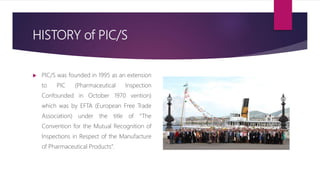
 PIC/S was founded in 1995 as an extension
to PIC (Pharmaceutical Inspection
Confounded in October 1970 vention)
which was by EFTA (European Free Trade
Association) under the title of “The
Convention for the Mutual Recognition of
Inspections in Respect of the Manufacture
of Pharmaceutical Products”.
Cont…..
 The initial Members of PIC comprised the 10 Member countries of EFTA at that time, ie. Austria,
Denmark, Finland, Iceland, Liechtenstein, Norway, Portugal, Sweden, Switzerland and United
Kingdom. Membership of PIC was subsequently expanded to include Hungary, Ireland, Romania,
Germany, Italy, Belgium, France and Australia.
 It was realised in the early 1990s that because of an incompatibility between the Convention and
European law, it was not possible for new countries to be admitted as Members of PIC. Australia
was the last country that was able to become a Member of PIC in January 1993. Consequently,
the PIC Scheme was formed on 2 November 1995. PIC and the PIC Scheme, which operate
together in parallel, are jointly referred to as PIC/S.
BENEFITS
 PIC/S offers a variety of advantages to its
Participating Authorities. Some of the
main benefits for Medicines Regulatory
Authorities resulting from PIC/S
Membership are detailed below.
 PIC/S Membership also involves indirect
benefits to industry, when their relevant
Medicines Regulatory Authority becomes
a Member of PIC/S.
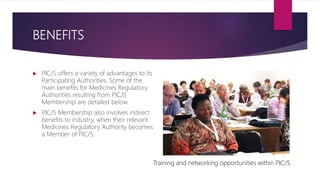
Training and networking opportunities within PIC/S
Main benefits for Members:
 Training opportunities: PIC/S provides a forum for the training of GMP Inspectors thus allowing
the latter to benefit from increased training opportunities by attending PIC/S Seminars and Expert
Circles and by participating in the PIC/S Joint Visits Programme. In this respect, PIC/S is unique as
there is no other international training forum run jointly by Regulatory Authorities (individually,
Regulatory Authorities or organisations such as WHO or the EMA provide basic training courses,
mainly to new Inspectors).
 International GMP harmonisation: By taking part in the meetings of the PIC/S Committee, PIC/S
Participating Authorities are involved in the development and harmonisation of international GMP
guides and guidelines. The PIC/S Committee also actively promotes the uniform interpretation of
GMP and Quality Systems for GMP Inspectorates.
Cont…..
 Networking: By attending PIC/S activities, participants benefit from personal contacts with other
agencies, whether they are part of PIC/S or not. This networking often simplifies contacts and the
exchange of GMP related information. In addition, PIC/S is one of the few international GMP fora for
networking and confidence building amongst Regulatory Inspectors where experts (GMP Inspectors,
specialist GMP Inspectors and Chief Inspectors) can meet, discuss issues of mutual concern and share
experiences and information. In other fora, participation is either at the level of Heads of Agencies (e.g.
WHO) or at the level of experts in a particular field (ICH).
 High standards: PIC/S ensures that all Members comply with PIC/S standards at all times (assessment of
new applicants and reassessment of existing Member Inspectorates). Preparing for the accession to the
Scheme (or reassessment) forces improvements in the GMP inspection system and procedures. This
results in increased efficiency of the GMP Inspectorate. This is particularly true for Quality System
requirements, where PIC/S standards are high, and for GMP training, which is essential in PIC/S.
Cont…..
 Sharing of information: PIC/S allows for a more effective use of inspection resources through the
voluntary sharing of GMP inspections reports. Membership is also a cost-saving measure for the
inspection authorities confronted with an increase of inspections, notably in the field of Active
Pharmaceutical Ingredients (APIs).
 Rapid Alert System: Through PIC/S Membership, Regulatory Authorities automatically benefit
from being part of the PIC/S Rapid Alert and Recall System arising from quality defects of batches
medicinal products, which have been distributed on the market. The PIC/S Alert and Recall
part of a wider system, which includes the Alert and Recall System of EU/EEA/MRA partners.
Cont…..
 Facilitating the conclusion of other Agreements: Membership in PIC/S may also facilitate the conclusion
of other agreements, e.g. Mutual Recognition Agreements, between Members at various levels (e.g.
Australia-Canada MRA, EU-Switzerland MRA, etc.). During the recently concluded initial negotiation on
ASEAN MRA on GMP Inspection, PIC/S Membership accession was accepted as one of the essential
criteria for MRA.
Indirect Benefits for Industry:
 There are also indirect benefits to industry when their relevant Regulatory Authority becomes a
of PIC/S. These benefits may include the following:
 Reduced duplication of inspections;
 Cost savings;
 Export facilitation;
 Enhanced market access.
Cont…..
ORGANISATIONAL STRUCTURE
 As the PIC Scheme is an arrangement
between Regulatory Authorities, it is very
flexible, dynamic and proactive. A
Committee of the Participating
Authorities’ representatives (PIC/S
Committee) supervises the operation of
the Scheme.
The Organisational Structure divided into subparts:
 Legal form
 Governance
 Committee
 Executive Bureau
 Secretariat
 Office Holders
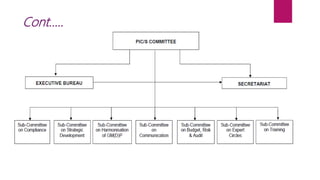
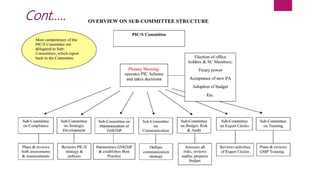
All decisions are taken unanimously. The Committee is assisted in its task by 7 Sub-Committees (e.g.
on the training of Inspectors, on GMDP harmonisation, etc.), by an Executive Bureau, which steers the
Organisation in between meetings, and by a small Secretariat, which mainly assists the Committee,
the Sub-Committees, the Bureau and Participating Authorities in their duties.
Cont…..
Cont…..
Legal form
 PIC/S is constituted since 2004 as a Swiss Association governed by articles 60 et seq. of the
Swiss Code of Civil Law.
Between 1971 and 2003, PIC/S did not have a distinct legal identity. Its Secretariat was provided by
the European Free Trade Association.
At its meeting on 3 June 2003 in Bratislava (Slovak Republic), the PIC/S Committee decided to
constitute itself as a Swiss Association in accordance with Articles 60ff of the Swiss Code of Civil
Law.
This status is shared with a number of other internationally active organisations established in
Switzerland such as the International Committee of the Red Cross (ICRC), which - unlike UN
Specialised Organisations - are not treaty-based.
 On 1 January 2004, PIC/S became independent and established its own Secretariat.
 Since 11 November 2004, PIC/S is also officially registered as an Association under the Swiss
Law with the “Registre du Commerce” (Trade Registry) of the Canton of Geneva. Its official
name is “Pharmaceutical Inspection Co-operation Scheme - Association de Droit Suisse”. Its
reference number is CH-660-9587004-3.
Cont…..
Governance
 The decision-making (“legislative”) body is the PIC/S Committee, which is an assembly of
the representatives of all Participating Authorities. The PIC/S Committee has 7 Sub-
Committees and numerous working groups.
 The executive body is the PIC/S Executive Bureau, which comprises the Chairperson, the
Deputy Chairperson, the immediate former Chairperson, the 7 Chairs of Sub-Committees
and the Secretary. The PIC/S Secretariat assists both the PIC/S Committee and the PIC/S
Executive Bureau in their tasks.
Cont…..
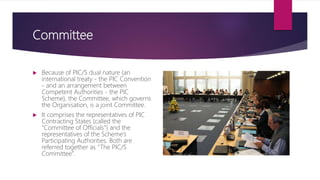
Committee
 Because of PIC/S dual nature (an
international treaty - the PIC Convention
- and an arrangement between
Competent Authorities - the PIC
Scheme), the Committee, which governs
the Organisation, is a joint Committee.
 It comprises the representatives of PIC
Contracting States (called the
“Committee of Officials”) and the
representatives of the Scheme’s
Participating Authorities. Both are
referred together as “The PIC/S
Committee”.
 Each Participating Authority has one vote. In some cases, two Authorities of one and the same country
may have jointly one vote (e.g. Germany’s Federal Ministry of Health and ZLG have together one vote
only). Decisions are taken by consensus.
 The PIC/S Committee is steered by the Chairperson (The PIC/S Chairperson) during and in between
meetings.
The mandate of the PIC/S Committee is defined in the PIC Scheme. The PIC/S Committee meets at
twice a year to:
 consider measures for achieving the appropriate and effective operation of the Scheme;
 make recommendations and proposals for the amendment, updating and improvement of (i) standards
of Good Manufacturing Practice currently applied under the Scheme, and (ii) any other GxP standards
or good practices applied on a voluntary basis;
Cont…..
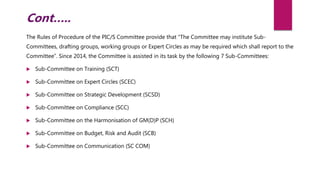
The Rules of Procedure of the PIC/S Committee provide that “The Committee may institute Sub-
Committees, drafting groups, working groups or Expert Circles as may be required which shall report to the
Committee”. Since 2014, the Committee is assisted in its task by the following 7 Sub-Committees:
 Sub-Committee on Training (SCT)
 Sub-Committee on Expert Circles (SCEC)
 Sub-Committee on Strategic Development (SCSD)
 Sub-Committee on Compliance (SCC)
 Sub-Committee on the Harmonisation of GM(D)P (SCH)
 Sub-Committee on Budget, Risk and Audit (SCB)
 Sub-Committee on Communication (SC COM)
Cont…..
INTERNATIONAL CO-OPERATION
 PIC/S has been a pioneer organisation in
the field of pharmaceutical inspections
and Good Manufacturing Practice (GMP).
It has successfully adapted to a constantly
changing environment, in particular
globalisation.
 t is the only organisation worldwide
which exclusively deals with GMP.
the increasing globalisation of public health concerns and the multiplication of actors involved (both
in industry and among Regulatory Authorities) makes it necessary to further increase harmonisation
efforts in setting regulatory requirements, inspecting and evaluating GMP compliance, licensing
manufacturing sites, recalling defective batches and increasing the exchange of information. PIC/S
offers an attractive platform to respond to the challenges of globalisation.
PIC/S is, however, not alone to handle GMP. There are other organisations, which are also involved in
this field, although - unlike PIC/S - the GMP part of their activities may only represent a fraction of
their total activities.
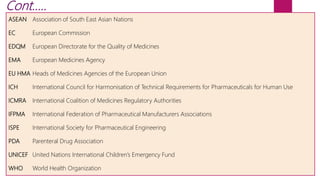
PIC/S has relations with the following organisations (in alphabetical order):
Cont…..
ASEAN Association of South East Asian Nations
EC European Commission
EDQM European Directorate for the Quality of Medicines
EMA European Medicines Agency
EU HMA Heads of Medicines Agencies of the European Union
ICH International Council for Harmonisation of Technical Requirements for Pharmaceuticals for Human Use
ICMRA International Coalition of Medicines Regulatory Authorities
IFPMA International Federation of Pharmaceutical Manufacturers Associations
ISPE International Society for Pharmaceutical Engineering
PDA Parenteral Drug Association
UNICEF United Nations International Children’s Emergency Fund
WHO World Health Organization
Cont…..
PIC/S aims at turning into a more global and efficient organisation and harmonise international
efforts in the field of GMP.
This is what PIC/S aims to achieve through its international co-operation efforts.
Associated Partner Organisations
PIC/S has signed co-operation agreement with the following four organisations:
 European Medicines Agency (EMA);
 European Directorate for the Quality of Medicines (EDQM);
 United Nations International Children’s Emergency Fund (UNICEF);
 World Health Organization (WHO).
Cont…..
Other Organisations
PIC/S co-operates with an increasing number of other Organisations, which are also active in the
of GMDP.
 Association of South East Asian Nations (ASEAN)
 European Commission (EC)
 Heads of Medicines Agencies of the European Union (HMA)
 The International Council for Harmonisation of Technical Requirements for Pharmaceuticals for
Human Use (ICH)
 International Coalition of Medicines Regulatory Authorities (ICMRA)
 Organisation for Economic Co-operation and Development (OECD)
Cont…..
Professional Organisations & Industry
 Since the manufacturer is at the heart of the GMP process, it is essential for PIC/S to maintain
good relations with industry and professional organisations, notably those more active in the
of regulation, guidance documents and training.
 The support of industry associations and professional organisations to the goals of PIC/S is a
prerequisite for the latter’s successful expansion.
PIC/S maintains relations with other industry and professional associations such as:
 The International Federation of Pharmaceutical Manufacturers Associations (IFPMA)
 Fédération Internationale Pharmaceutique (FIP)
 Drugs Information Association (DIA)
 European Compliance Academy (ECA)
Cont…..
THANK YOU

Pharmaceutical inspection convention (PIC/S)

  • 1.
    Pharmaceutical Inspection Convention Presented By KULDEEPKUMAR Assistant Professor GISIPS, Dehradun
  • 2.
    CONTENT INTRODUCTION AIM MISSION VISION AND VALUES GOALS HISTORYof PIC/S BENEFITS ORGANISATIONAL STRUCTURE INTERNATIONAL CO-OPERATION
  • 3.
    INTRODUCTION The Pharmaceutical InspectionCo-operation Scheme (PIC/S) was established in 1995 as an extension to the Pharmaceutical Inspection Convention (PIC) of 1970. The Pharmaceutical Inspection Co-operation Scheme (PIC/S) is a non-binding, informal co- operative arrangement between Regulatory Authorities in the field of Good Manufacturing Practice (GMP) of medicinal products for human or veterinary use.
  • 4.
     The PharmaceuticalInspection Convention and Pharmaceutical Inspection Co-operation Scheme (PIC/S) are two international instruments between countries and pharmaceutical inspection authorities.  The PIC/S is meant as an instrument to improve co-operation in the field of Good Manufacturing Practices between regulatory authorities and the pharmaceutical industry.  It is open to any Authority having a comparable GMP inspection system. PIC/S presently comprises 53 Participating Authorities coming from all over the world (Europe, Africa, America, Asia and Australasia).
  • 5.
    AIM  PIC/S aimsat harmonising inspection procedures worldwide by developing common standards in the field of GMP and by providing training opportunities to Inspectors.  It also aims at facilitating co-operation and networking between competent authorities, regional and international organisations, thus increasing mutual confidence.
  • 6.
    MISSION  The PIC/S’mission is to lead the international development, implementation and maintenance of harmonised Good Manufacturing Practice (GMP) standards and quality systems of inspectorates in the field of medicinal products.
  • 7.
    PIC/S’ mission isto be achieved by:  Developing and promoting harmonised GMP standards and guidance documents.  Training Competent Authorities, in particular GMP Inspectors.  Facilitating co-operation and networking for Competent Authorities and International Organisations
  • 8.
    VISION AND VALUES PIC/S’successful development has been possible due to the common sharing of the following shared vision and principles:  A technical expert’s organisation: PIC/S has always taken great pride in featuring itself as a purely technical organisation in the field of regulatory GMP  Based on consensus and mutual trust: Consensus in PIC/S has been based on the understanding that all Members have equal rights and obligations  Driven by Members: PIC/S is an organisation which is mainly driven by Participating Regulatory Authorities and where the Secretariat has remained flexible and productive.  Cemented by strong professional and personal links: PIC/S’ strength relies on its informal character, networking and the strong personal links between individual Members or Inspectors which have created a forum for brain storming, discussing new ideas and sharing information.
  • 9.
    GOALS The original goalsof PIC were:  Mutual recognition of inspections;  Harmonisation of GMP requirements;  Uniform inspection systems;  Training of Inspectors;  Exchange of information;  Mutual confidence.
  • 10.
    HISTORY of PIC/S PIC/S was founded in 1995 as an extension to PIC (Pharmaceutical Inspection Confounded in October 1970 vention) which was by EFTA (European Free Trade Association) under the title of “The Convention for the Mutual Recognition of Inspections in Respect of the Manufacture of Pharmaceutical Products”.
  • 11.
    Cont…..  The initialMembers of PIC comprised the 10 Member countries of EFTA at that time, ie. Austria, Denmark, Finland, Iceland, Liechtenstein, Norway, Portugal, Sweden, Switzerland and United Kingdom. Membership of PIC was subsequently expanded to include Hungary, Ireland, Romania, Germany, Italy, Belgium, France and Australia.  It was realised in the early 1990s that because of an incompatibility between the Convention and European law, it was not possible for new countries to be admitted as Members of PIC. Australia was the last country that was able to become a Member of PIC in January 1993. Consequently, the PIC Scheme was formed on 2 November 1995. PIC and the PIC Scheme, which operate together in parallel, are jointly referred to as PIC/S.
  • 12.
    BENEFITS  PIC/S offersa variety of advantages to its Participating Authorities. Some of the main benefits for Medicines Regulatory Authorities resulting from PIC/S Membership are detailed below.  PIC/S Membership also involves indirect benefits to industry, when their relevant Medicines Regulatory Authority becomes a Member of PIC/S. Training and networking opportunities within PIC/S
  • 13.
    Main benefits forMembers:  Training opportunities: PIC/S provides a forum for the training of GMP Inspectors thus allowing the latter to benefit from increased training opportunities by attending PIC/S Seminars and Expert Circles and by participating in the PIC/S Joint Visits Programme. In this respect, PIC/S is unique as there is no other international training forum run jointly by Regulatory Authorities (individually, Regulatory Authorities or organisations such as WHO or the EMA provide basic training courses, mainly to new Inspectors).  International GMP harmonisation: By taking part in the meetings of the PIC/S Committee, PIC/S Participating Authorities are involved in the development and harmonisation of international GMP guides and guidelines. The PIC/S Committee also actively promotes the uniform interpretation of GMP and Quality Systems for GMP Inspectorates. Cont…..
  • 14.
     Networking: Byattending PIC/S activities, participants benefit from personal contacts with other agencies, whether they are part of PIC/S or not. This networking often simplifies contacts and the exchange of GMP related information. In addition, PIC/S is one of the few international GMP fora for networking and confidence building amongst Regulatory Inspectors where experts (GMP Inspectors, specialist GMP Inspectors and Chief Inspectors) can meet, discuss issues of mutual concern and share experiences and information. In other fora, participation is either at the level of Heads of Agencies (e.g. WHO) or at the level of experts in a particular field (ICH).  High standards: PIC/S ensures that all Members comply with PIC/S standards at all times (assessment of new applicants and reassessment of existing Member Inspectorates). Preparing for the accession to the Scheme (or reassessment) forces improvements in the GMP inspection system and procedures. This results in increased efficiency of the GMP Inspectorate. This is particularly true for Quality System requirements, where PIC/S standards are high, and for GMP training, which is essential in PIC/S. Cont…..
  • 15.
     Sharing ofinformation: PIC/S allows for a more effective use of inspection resources through the voluntary sharing of GMP inspections reports. Membership is also a cost-saving measure for the inspection authorities confronted with an increase of inspections, notably in the field of Active Pharmaceutical Ingredients (APIs).  Rapid Alert System: Through PIC/S Membership, Regulatory Authorities automatically benefit from being part of the PIC/S Rapid Alert and Recall System arising from quality defects of batches medicinal products, which have been distributed on the market. The PIC/S Alert and Recall part of a wider system, which includes the Alert and Recall System of EU/EEA/MRA partners. Cont…..
  • 16.
     Facilitating theconclusion of other Agreements: Membership in PIC/S may also facilitate the conclusion of other agreements, e.g. Mutual Recognition Agreements, between Members at various levels (e.g. Australia-Canada MRA, EU-Switzerland MRA, etc.). During the recently concluded initial negotiation on ASEAN MRA on GMP Inspection, PIC/S Membership accession was accepted as one of the essential criteria for MRA. Indirect Benefits for Industry:  There are also indirect benefits to industry when their relevant Regulatory Authority becomes a of PIC/S. These benefits may include the following:  Reduced duplication of inspections;  Cost savings;  Export facilitation;  Enhanced market access. Cont…..
  • 17.
    ORGANISATIONAL STRUCTURE  Asthe PIC Scheme is an arrangement between Regulatory Authorities, it is very flexible, dynamic and proactive. A Committee of the Participating Authorities’ representatives (PIC/S Committee) supervises the operation of the Scheme.
  • 18.
    The Organisational Structuredivided into subparts:  Legal form  Governance  Committee  Executive Bureau  Secretariat  Office Holders All decisions are taken unanimously. The Committee is assisted in its task by 7 Sub-Committees (e.g. on the training of Inspectors, on GMDP harmonisation, etc.), by an Executive Bureau, which steers the Organisation in between meetings, and by a small Secretariat, which mainly assists the Committee, the Sub-Committees, the Bureau and Participating Authorities in their duties. Cont…..
  • 19.
  • 20.
    Legal form  PIC/Sis constituted since 2004 as a Swiss Association governed by articles 60 et seq. of the Swiss Code of Civil Law. Between 1971 and 2003, PIC/S did not have a distinct legal identity. Its Secretariat was provided by the European Free Trade Association. At its meeting on 3 June 2003 in Bratislava (Slovak Republic), the PIC/S Committee decided to constitute itself as a Swiss Association in accordance with Articles 60ff of the Swiss Code of Civil Law.
  • 21.
    This status isshared with a number of other internationally active organisations established in Switzerland such as the International Committee of the Red Cross (ICRC), which - unlike UN Specialised Organisations - are not treaty-based.  On 1 January 2004, PIC/S became independent and established its own Secretariat.  Since 11 November 2004, PIC/S is also officially registered as an Association under the Swiss Law with the “Registre du Commerce” (Trade Registry) of the Canton of Geneva. Its official name is “Pharmaceutical Inspection Co-operation Scheme - Association de Droit Suisse”. Its reference number is CH-660-9587004-3. Cont…..
  • 22.
    Governance  The decision-making(“legislative”) body is the PIC/S Committee, which is an assembly of the representatives of all Participating Authorities. The PIC/S Committee has 7 Sub- Committees and numerous working groups.  The executive body is the PIC/S Executive Bureau, which comprises the Chairperson, the Deputy Chairperson, the immediate former Chairperson, the 7 Chairs of Sub-Committees and the Secretary. The PIC/S Secretariat assists both the PIC/S Committee and the PIC/S Executive Bureau in their tasks.
  • 23.
  • 24.
    Committee  Because ofPIC/S dual nature (an international treaty - the PIC Convention - and an arrangement between Competent Authorities - the PIC Scheme), the Committee, which governs the Organisation, is a joint Committee.  It comprises the representatives of PIC Contracting States (called the “Committee of Officials”) and the representatives of the Scheme’s Participating Authorities. Both are referred together as “The PIC/S Committee”.
  • 25.
     Each ParticipatingAuthority has one vote. In some cases, two Authorities of one and the same country may have jointly one vote (e.g. Germany’s Federal Ministry of Health and ZLG have together one vote only). Decisions are taken by consensus.  The PIC/S Committee is steered by the Chairperson (The PIC/S Chairperson) during and in between meetings. The mandate of the PIC/S Committee is defined in the PIC Scheme. The PIC/S Committee meets at twice a year to:  consider measures for achieving the appropriate and effective operation of the Scheme;  make recommendations and proposals for the amendment, updating and improvement of (i) standards of Good Manufacturing Practice currently applied under the Scheme, and (ii) any other GxP standards or good practices applied on a voluntary basis; Cont…..
  • 26.
    The Rules ofProcedure of the PIC/S Committee provide that “The Committee may institute Sub- Committees, drafting groups, working groups or Expert Circles as may be required which shall report to the Committee”. Since 2014, the Committee is assisted in its task by the following 7 Sub-Committees:  Sub-Committee on Training (SCT)  Sub-Committee on Expert Circles (SCEC)  Sub-Committee on Strategic Development (SCSD)  Sub-Committee on Compliance (SCC)  Sub-Committee on the Harmonisation of GM(D)P (SCH)  Sub-Committee on Budget, Risk and Audit (SCB)  Sub-Committee on Communication (SC COM) Cont…..
  • 27.
    INTERNATIONAL CO-OPERATION  PIC/Shas been a pioneer organisation in the field of pharmaceutical inspections and Good Manufacturing Practice (GMP). It has successfully adapted to a constantly changing environment, in particular globalisation.  t is the only organisation worldwide which exclusively deals with GMP.
  • 28.
    the increasing globalisationof public health concerns and the multiplication of actors involved (both in industry and among Regulatory Authorities) makes it necessary to further increase harmonisation efforts in setting regulatory requirements, inspecting and evaluating GMP compliance, licensing manufacturing sites, recalling defective batches and increasing the exchange of information. PIC/S offers an attractive platform to respond to the challenges of globalisation. PIC/S is, however, not alone to handle GMP. There are other organisations, which are also involved in this field, although - unlike PIC/S - the GMP part of their activities may only represent a fraction of their total activities. PIC/S has relations with the following organisations (in alphabetical order): Cont…..
  • 29.
    ASEAN Association ofSouth East Asian Nations EC European Commission EDQM European Directorate for the Quality of Medicines EMA European Medicines Agency EU HMA Heads of Medicines Agencies of the European Union ICH International Council for Harmonisation of Technical Requirements for Pharmaceuticals for Human Use ICMRA International Coalition of Medicines Regulatory Authorities IFPMA International Federation of Pharmaceutical Manufacturers Associations ISPE International Society for Pharmaceutical Engineering PDA Parenteral Drug Association UNICEF United Nations International Children’s Emergency Fund WHO World Health Organization Cont…..
  • 30.
    PIC/S aims atturning into a more global and efficient organisation and harmonise international efforts in the field of GMP. This is what PIC/S aims to achieve through its international co-operation efforts. Associated Partner Organisations PIC/S has signed co-operation agreement with the following four organisations:  European Medicines Agency (EMA);  European Directorate for the Quality of Medicines (EDQM);  United Nations International Children’s Emergency Fund (UNICEF);  World Health Organization (WHO). Cont…..
  • 31.
    Other Organisations PIC/S co-operateswith an increasing number of other Organisations, which are also active in the of GMDP.  Association of South East Asian Nations (ASEAN)  European Commission (EC)  Heads of Medicines Agencies of the European Union (HMA)  The International Council for Harmonisation of Technical Requirements for Pharmaceuticals for Human Use (ICH)  International Coalition of Medicines Regulatory Authorities (ICMRA)  Organisation for Economic Co-operation and Development (OECD) Cont…..
  • 32.
    Professional Organisations &Industry  Since the manufacturer is at the heart of the GMP process, it is essential for PIC/S to maintain good relations with industry and professional organisations, notably those more active in the of regulation, guidance documents and training.  The support of industry associations and professional organisations to the goals of PIC/S is a prerequisite for the latter’s successful expansion. PIC/S maintains relations with other industry and professional associations such as:  The International Federation of Pharmaceutical Manufacturers Associations (IFPMA)  Fédération Internationale Pharmaceutique (FIP)  Drugs Information Association (DIA)  European Compliance Academy (ECA) Cont…..
  • 33.