ICH Guidelines: purpose, participants, process of harmonization, Brief overview of QSEM,
with special emphasis on Q-series guidelines, ICH stability testing guidelines
ICH Guidelines
TheInternational Council for Harmonisation of Technical
Requirements for Pharmaceuticals for Human Use (ICH) is
unique in bringing together the regulatory authorities and
pharmaceutical industry to discuss scientific and technical
aspects of drug registration.
In the simple word, it provide all types of guidelines that one can
implement and use to get and quality product to the customers
3.
Purpose/ Mission
Tomake recommendations towards achieving greater harmonisation in the
interpretation and application of technical guidelines and requirements for
pharmaceutical product registration and the maintenance of such registrations;
To maintain a forum for a constructive dialogue on scientific issues between
regulatory authorities and the pharmaceutical industry on the harmonisation of the
technical requirements for pharmaceutical products;
To contribute to the protection of public health in the interest of patients from an
international perspective;
To monitor and update harmonised technical requirements leading to a greater
mutual acceptance of research and development data;
To avoid divergent future requirements through harmonisation of selected topics
needed as a result of therapeutic advances and the development of new
technologies for the production of medicinal products;
4.
Purpose/ Mission
Tofacilitate the adoption of new or improved technical research and development
approaches which update or replace current practices;
To encourage the implementation and integration of common standards through the
dissemination of/ spreading of, the communication of information about and coordination
of training on, harmonised guidelines and their use;
And to develop policy for the ICH Medical Dictionary for Regulatory Activities Terminology
(MedDRA) whilst ensuring the scientific and technical maintenance, development and
dissemination of MedDRA as a standardised dictionary which facilitates the sharing of
regulatory information internationally for medicinal products used by humans.
5.
Participants
Members
They are peoplefrom the
various contries
For Example –
1. Funding regulatory
members
2. Funding Industrial Members
3. Standing regulatory
members etc.
Observer
These people are the
observer. For example –
1. Standing observer
2. Legislative/
administrative
authorities/obsever etc
6.
Brief overview ofQSEM/ Process of Harmonization
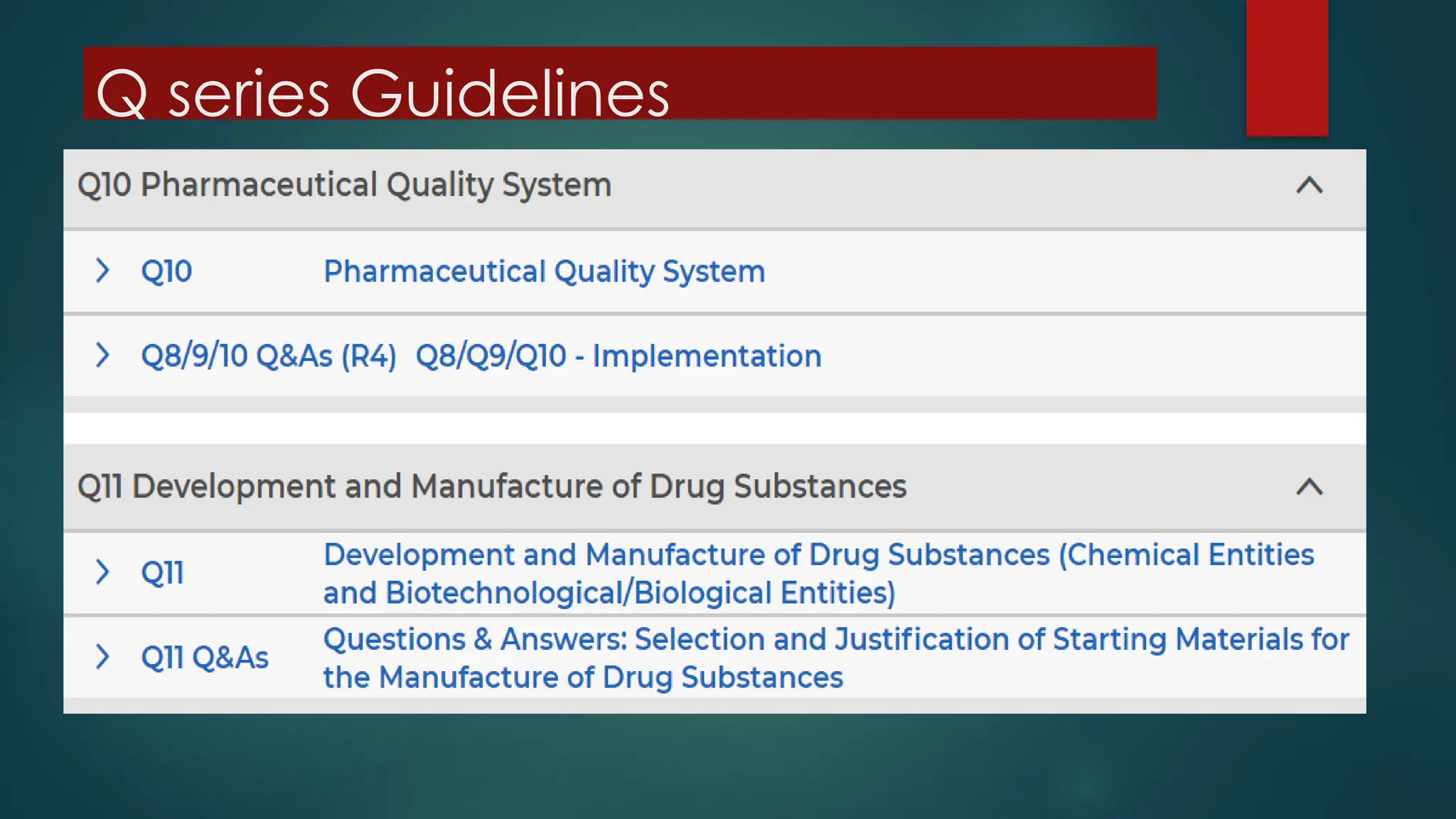
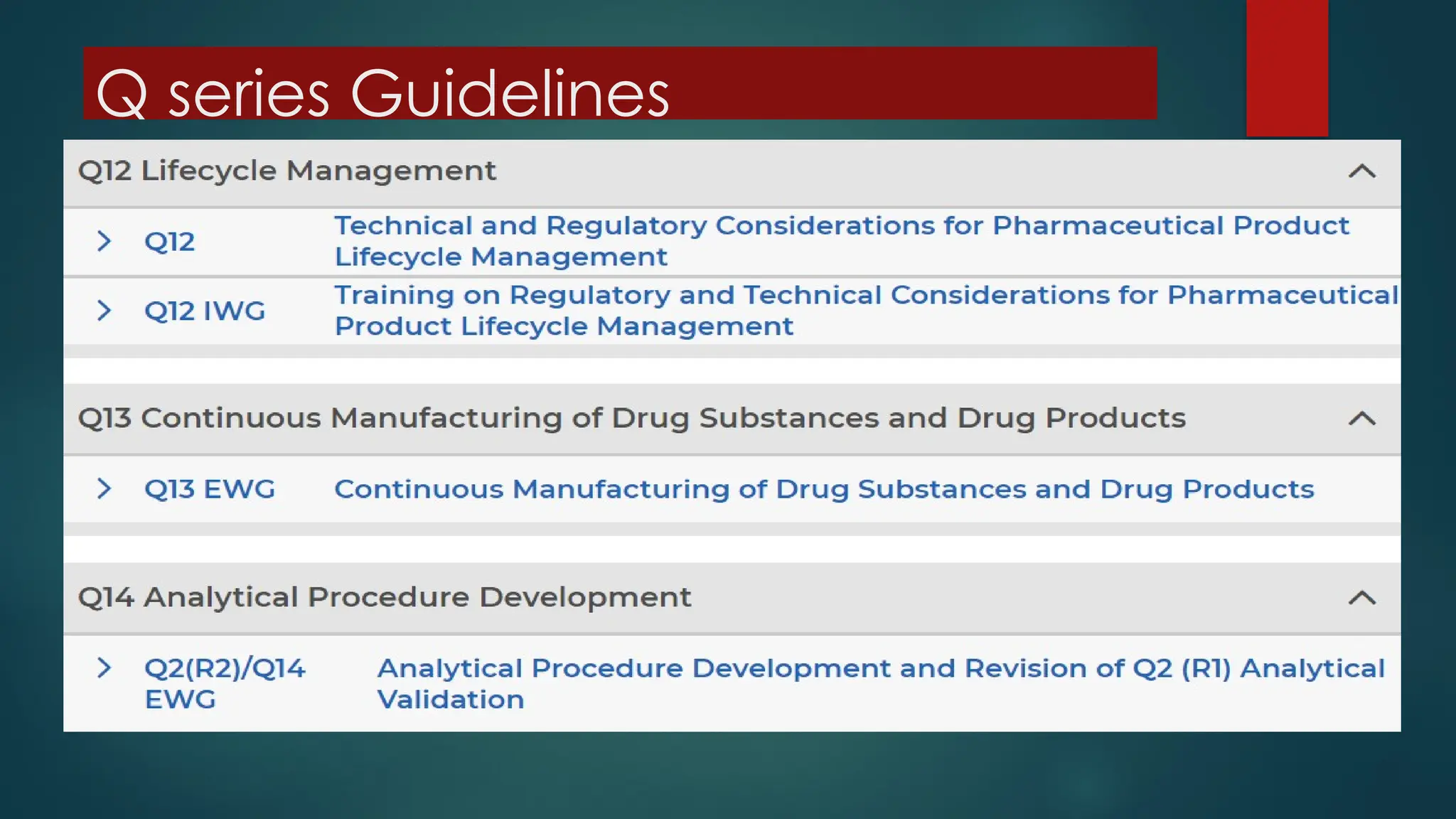
ICH provides official guidelines in the form of QSEM.
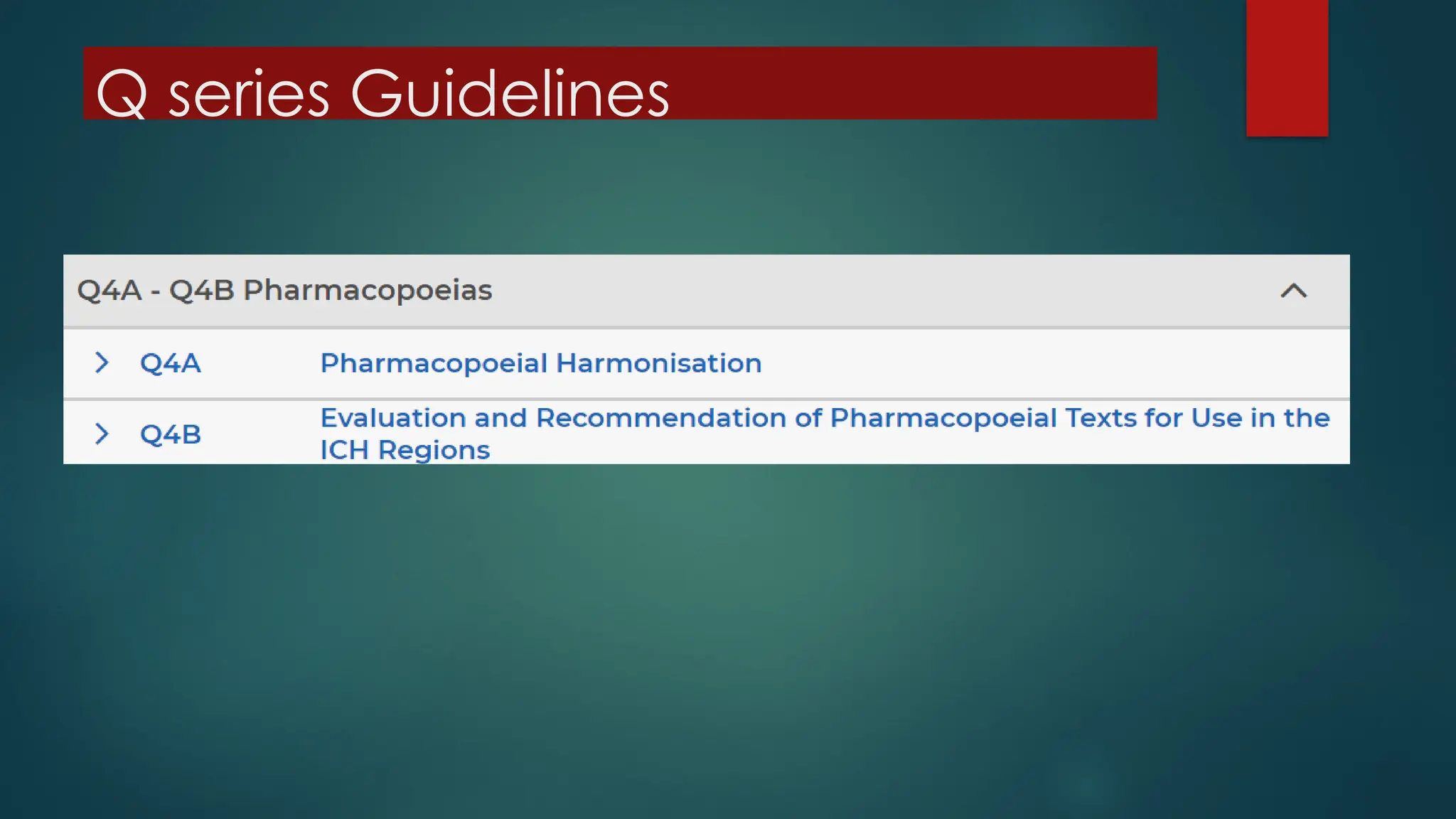
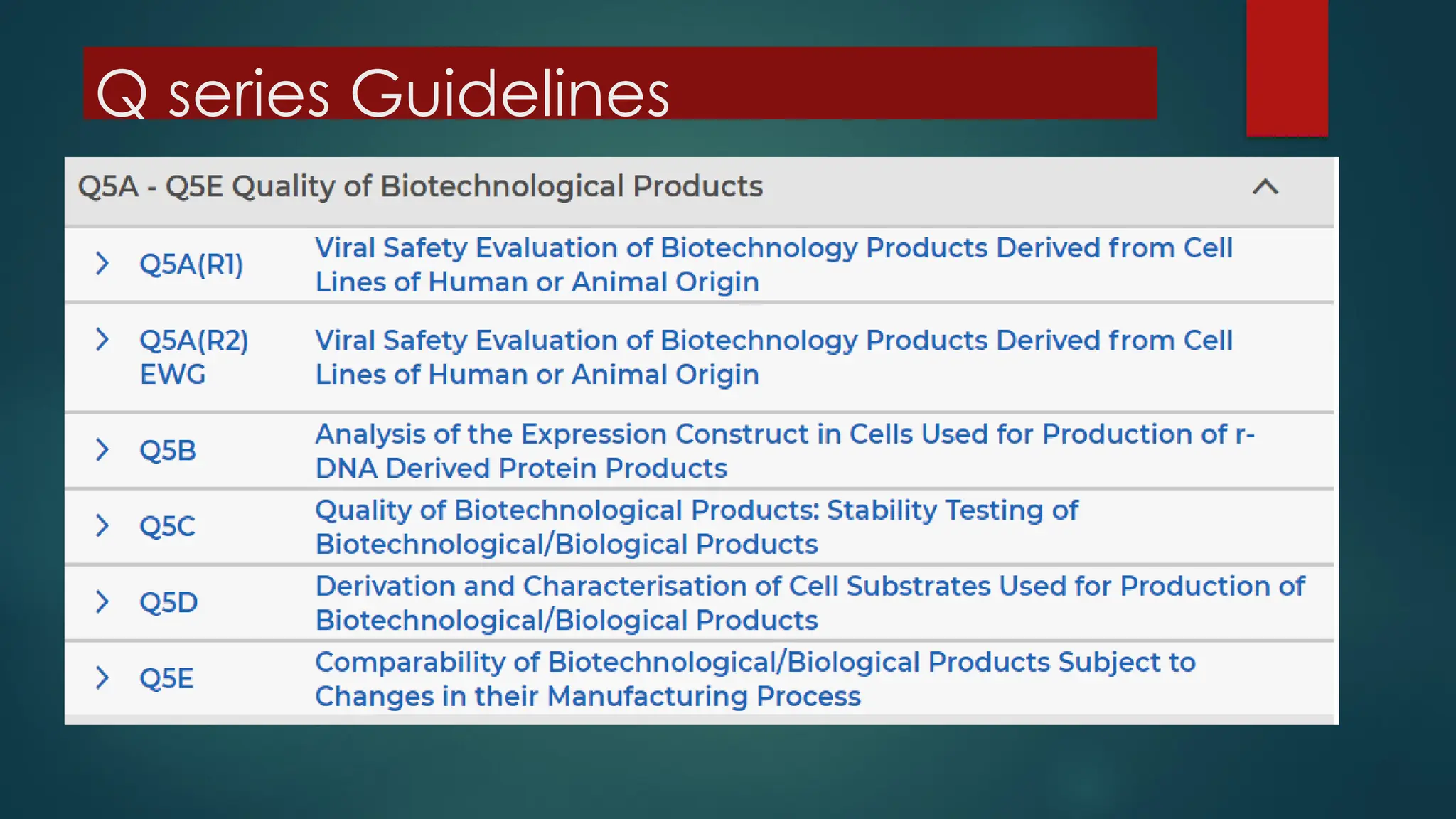
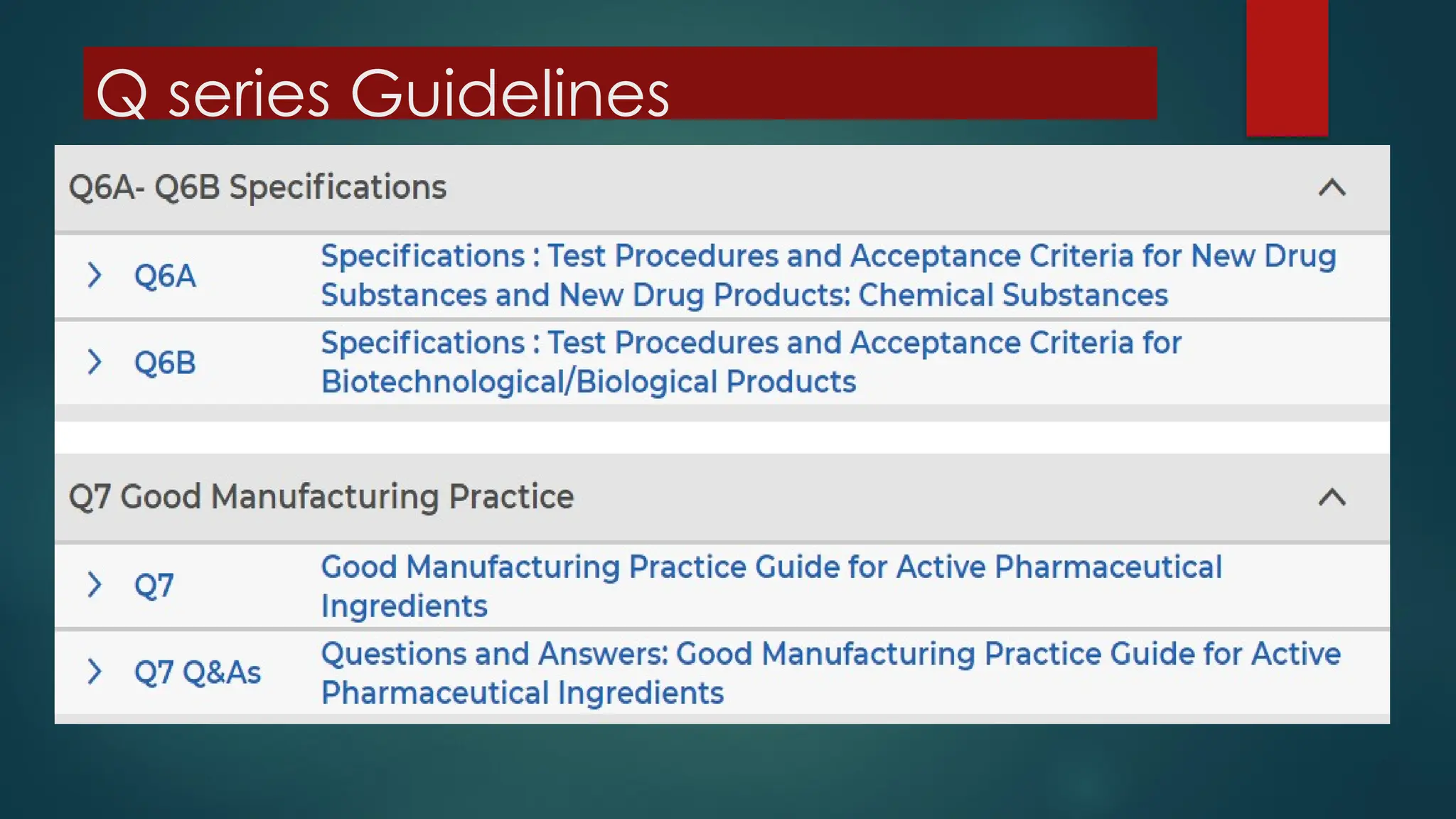
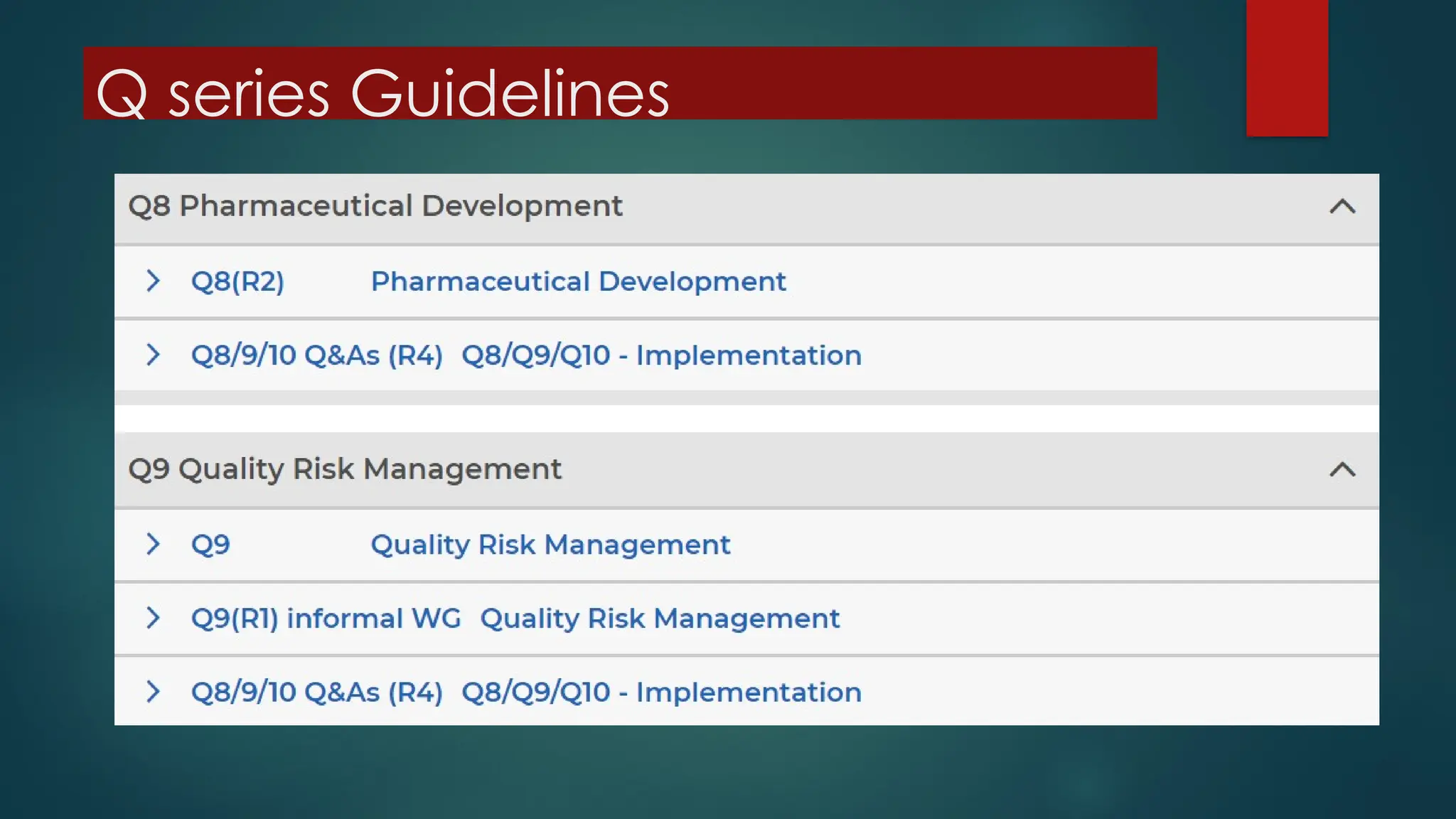
Q – Quality Guideline series – Chemicals and Pharmaceutical Quality Assurance
S – Safety Guideline series – Mainly dealing with In vivo – in vitro preclinical study
E – Efficacy Guideline series – Clinical study in human being
M – Multi Disciplinary Guideline series – Terminology, electronic standard and CTD,
common technical document
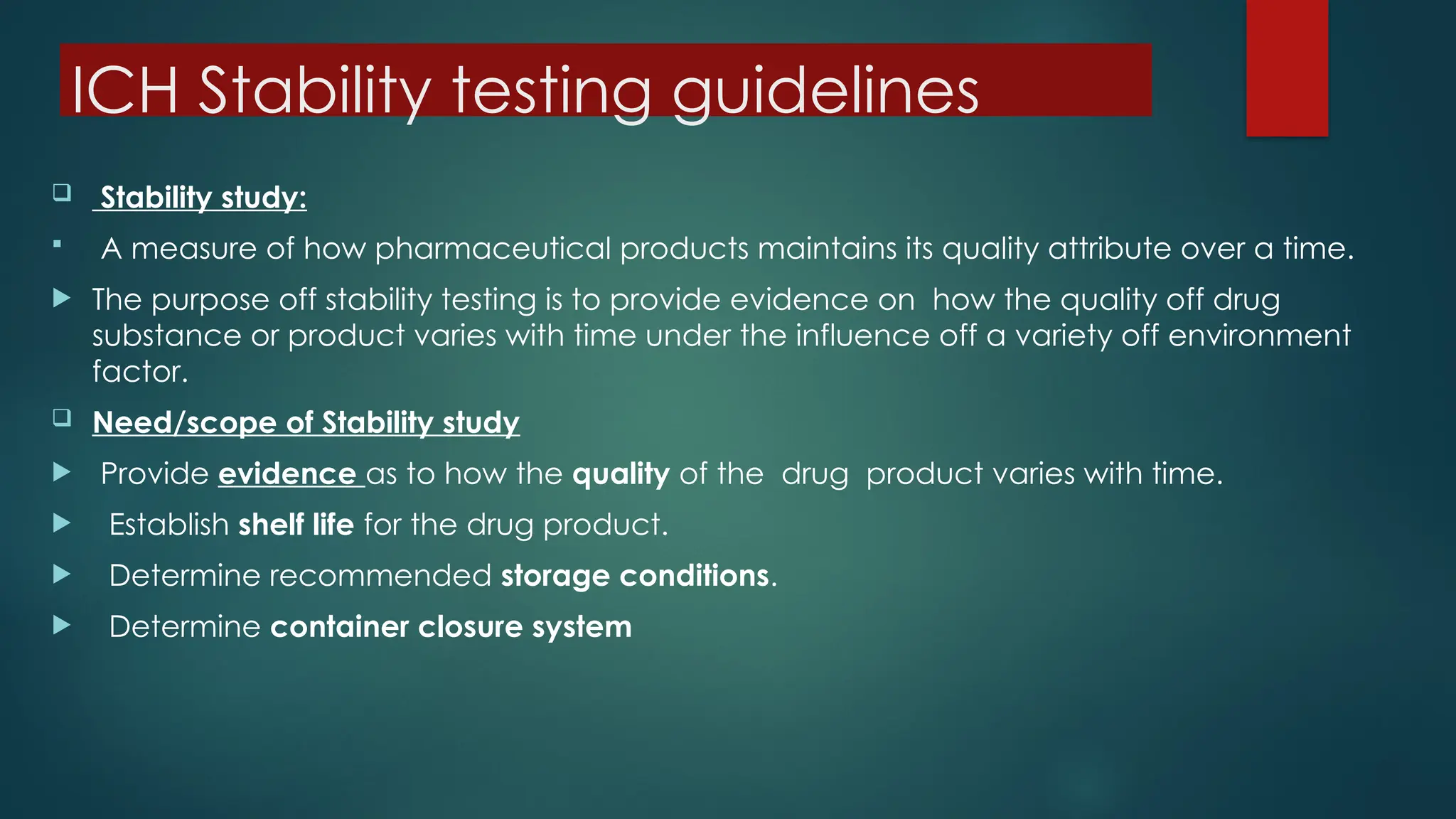
ICH Stability testingguidelines
Stability study:
A measure of how pharmaceutical products maintains its quality attribute over a time.
The purpose off stability testing is to provide evidence on how the quality off drug
substance or product varies with time under the influence off a variety off environment
factor.
Need/scope of Stability study
Provide evidence as to how the quality of the drug product varies with time.
Establish shelf life for the drug product.
Determine recommended storage conditions.
Determine container closure system
18.
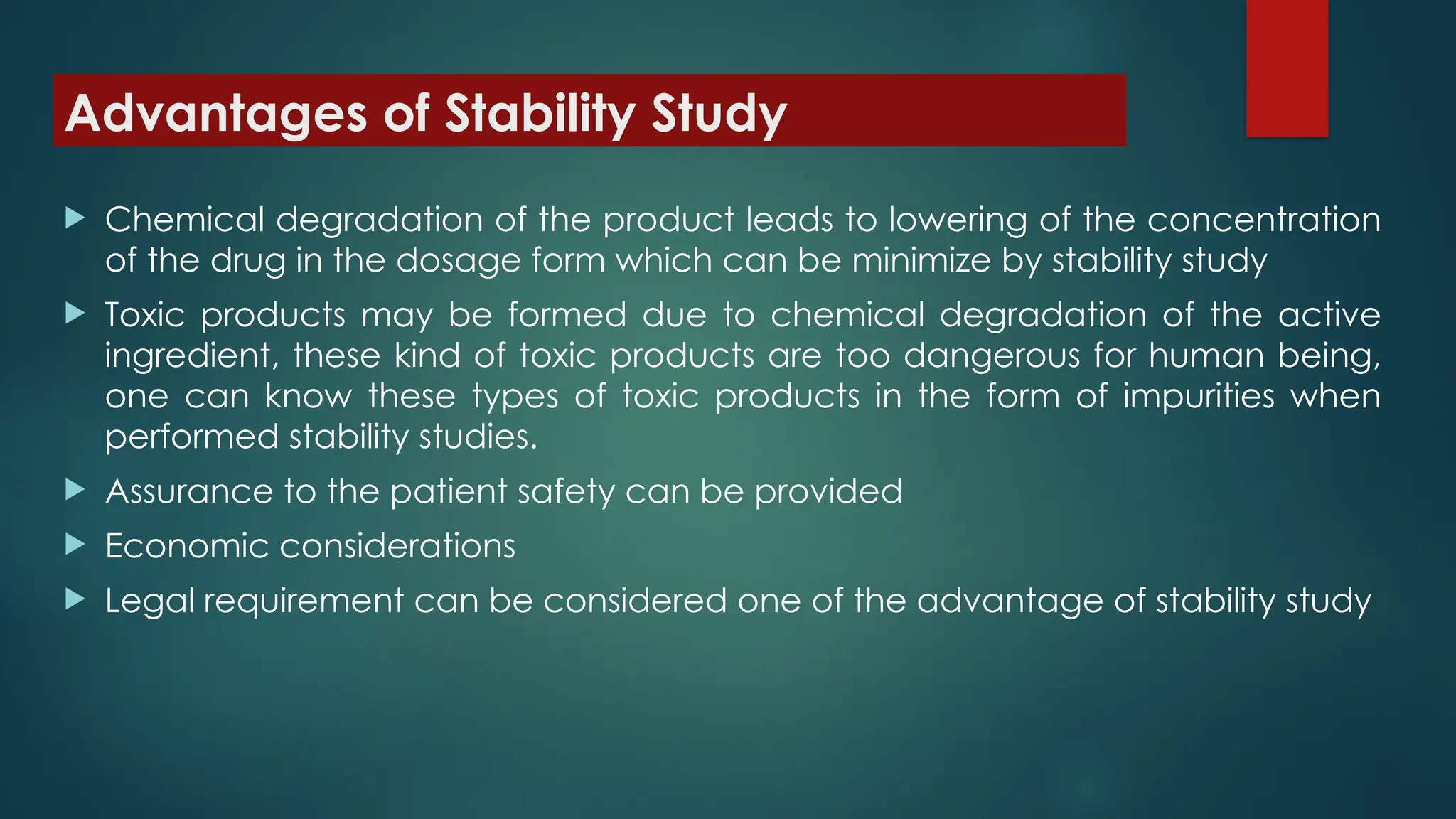
Advantages of StabilityStudy
Chemical degradation of the product leads to lowering of the concentration
of the drug in the dosage form which can be minimize by stability study
Toxic products may be formed due to chemical degradation of the active
ingredient, these kind of toxic products are too dangerous for human being,
one can know these types of toxic products in the form of impurities when
performed stability studies.
Assurance to the patient safety can be provided
Economic considerations
Legal requirement can be considered one of the advantage of stability study
19.
VARIABLES AFFECTING THESTABILITY
Formulation
Packaging
Site and method of manufacture
API
Finished product
Batch size
Batch to batch variability
Process validation
Quality risk management
Container labeling
Changes to product
20.
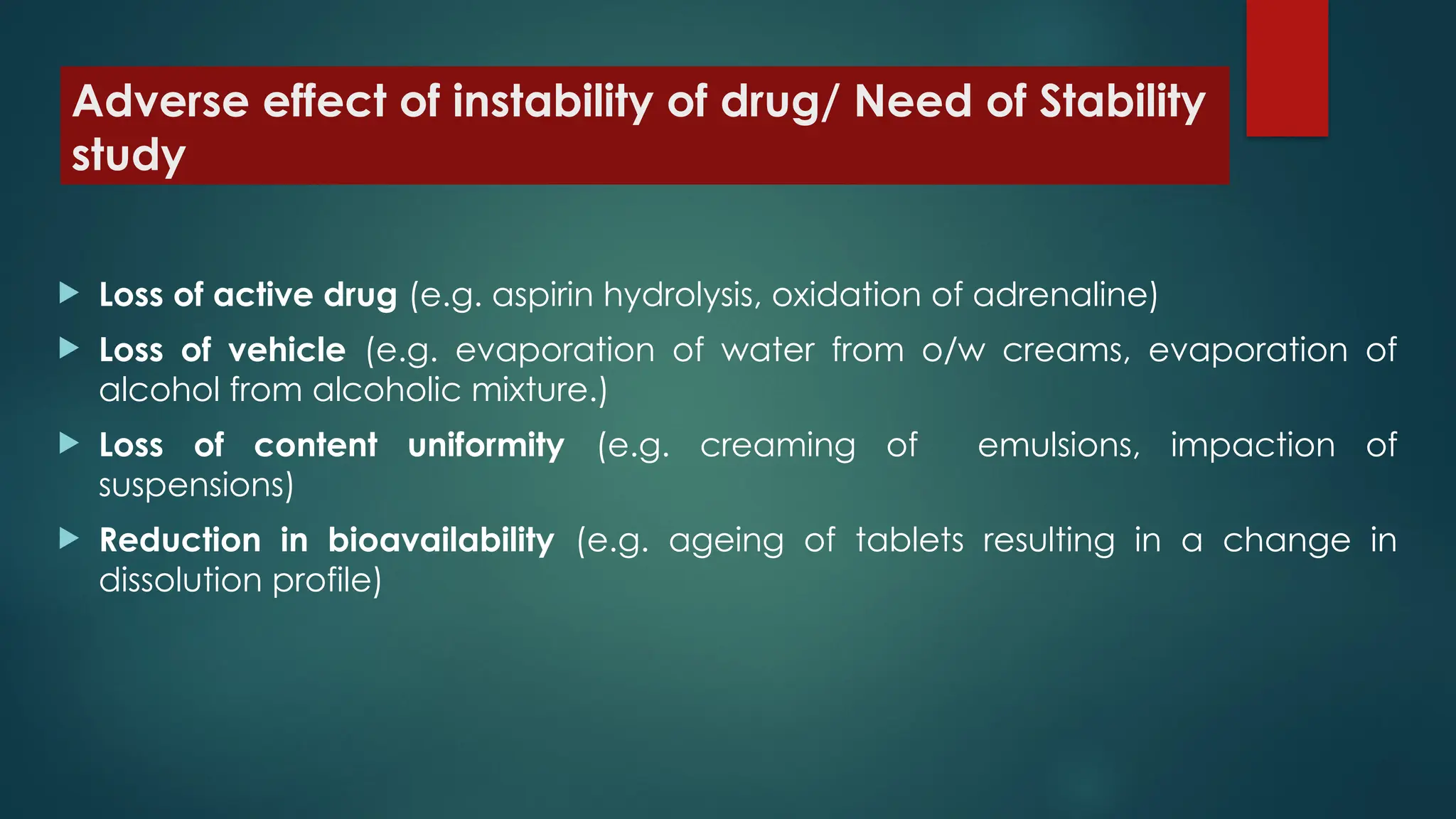
Adverse effect ofinstability of drug/ Need of Stability
study
Loss of active drug (e.g. aspirin hydrolysis, oxidation of adrenaline)
Loss of vehicle (e.g. evaporation of water from o/w creams, evaporation of
alcohol from alcoholic mixture.)
Loss of content uniformity (e.g. creaming of emulsions, impaction of
suspensions)
Reduction in bioavailability (e.g. ageing of tablets resulting in a change in
dissolution profile)
21.
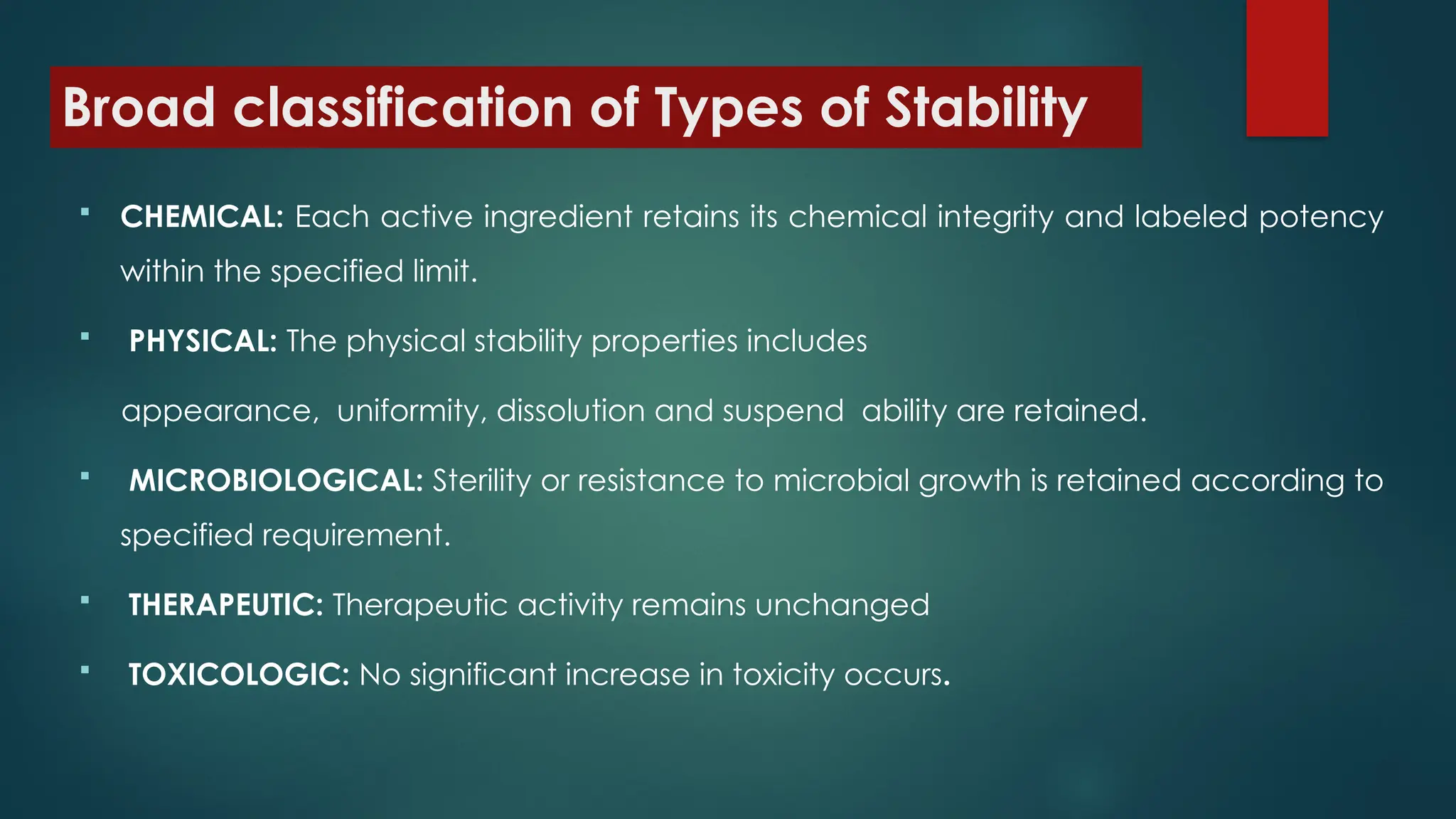
Broad classification ofTypes of Stability
CHEMICAL: Each active ingredient retains its chemical integrity and labeled potency
within the specified limit.
PHYSICAL: The physical stability properties includes
appearance, uniformity, dissolution and suspend ability are retained.
MICROBIOLOGICAL: Sterility or resistance to microbial growth is retained according to
specified requirement.
THERAPEUTIC: Therapeutic activity remains unchanged
TOXICOLOGIC: No significant increase in toxicity occurs.
22.
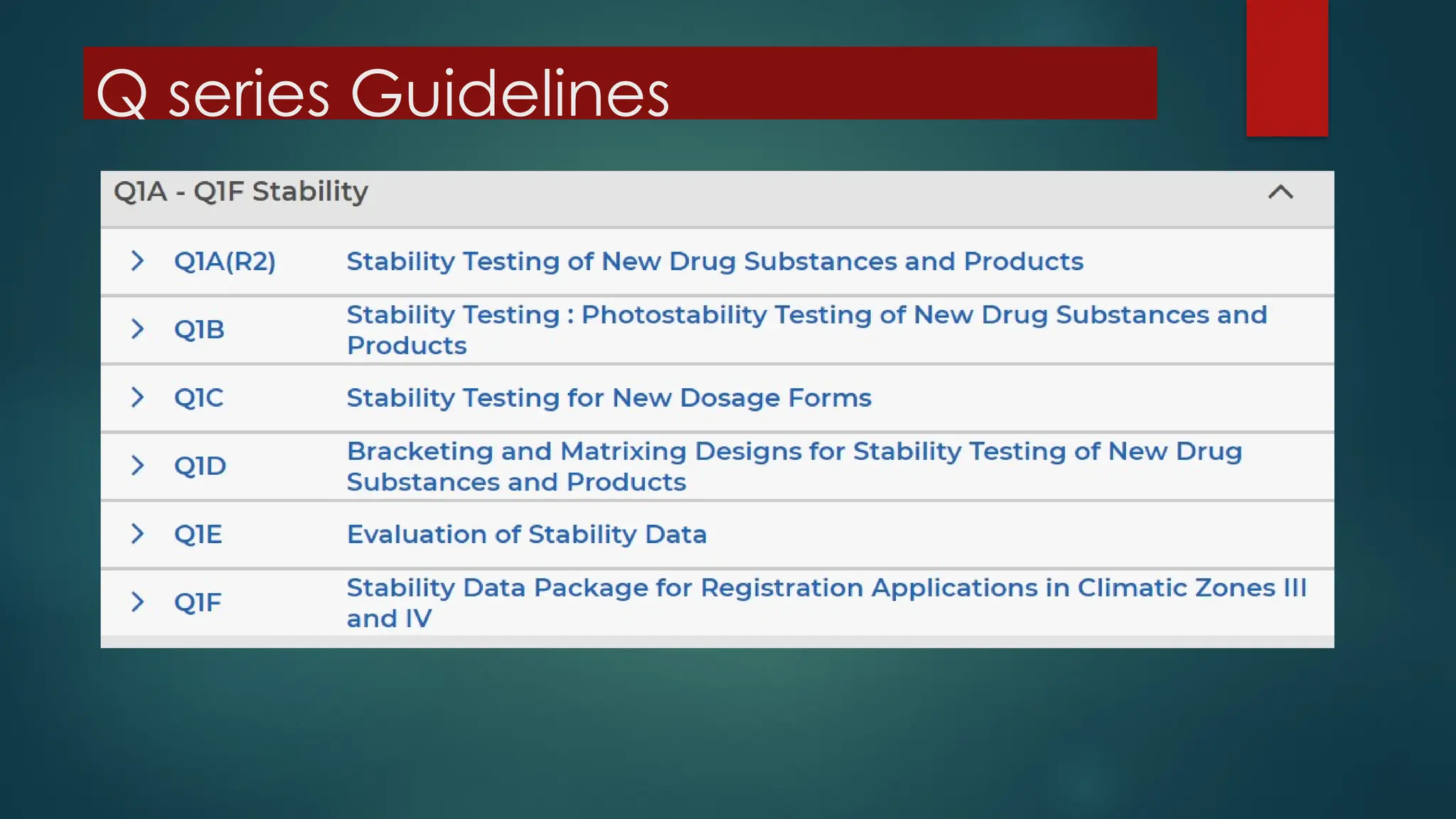
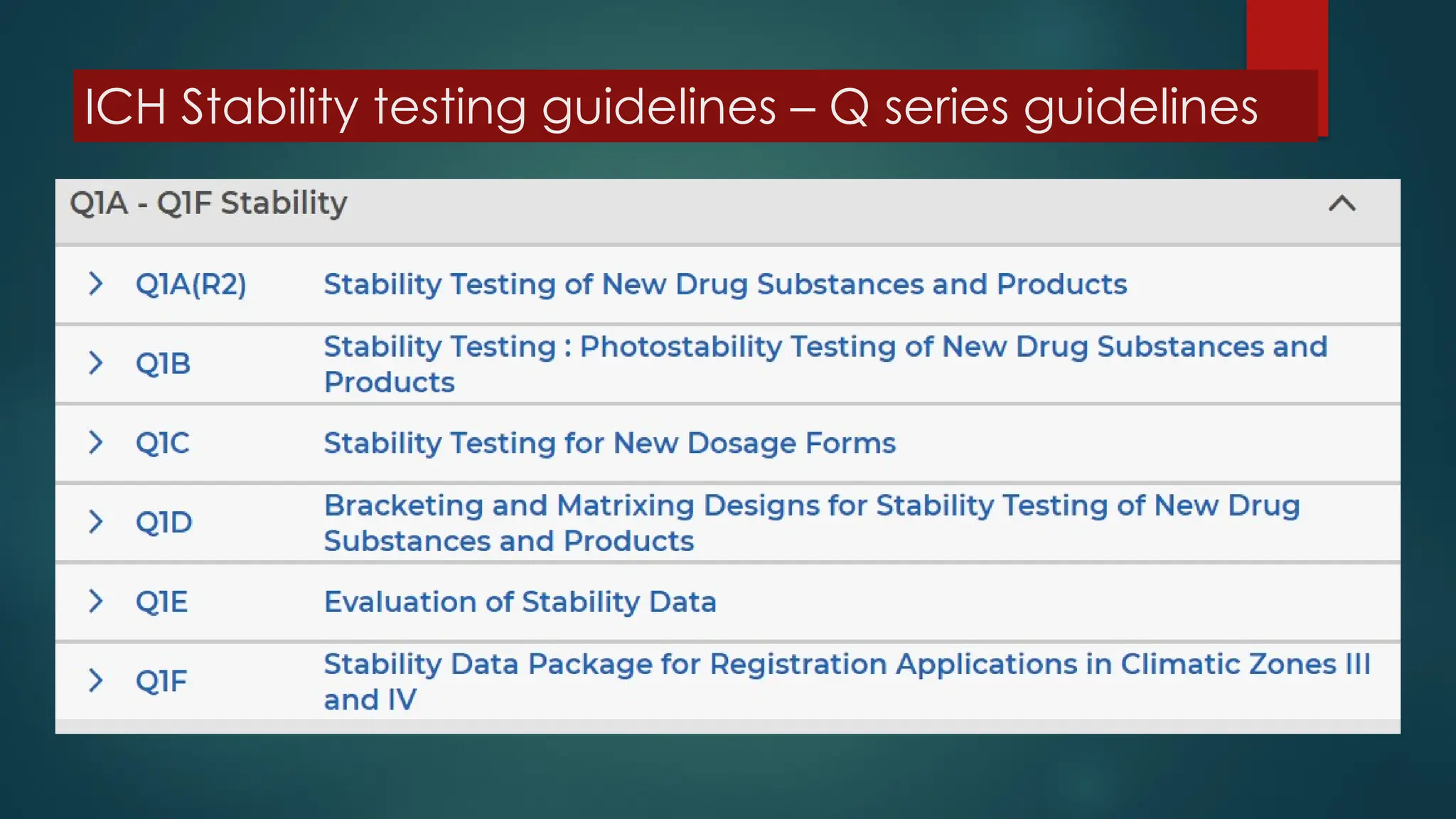
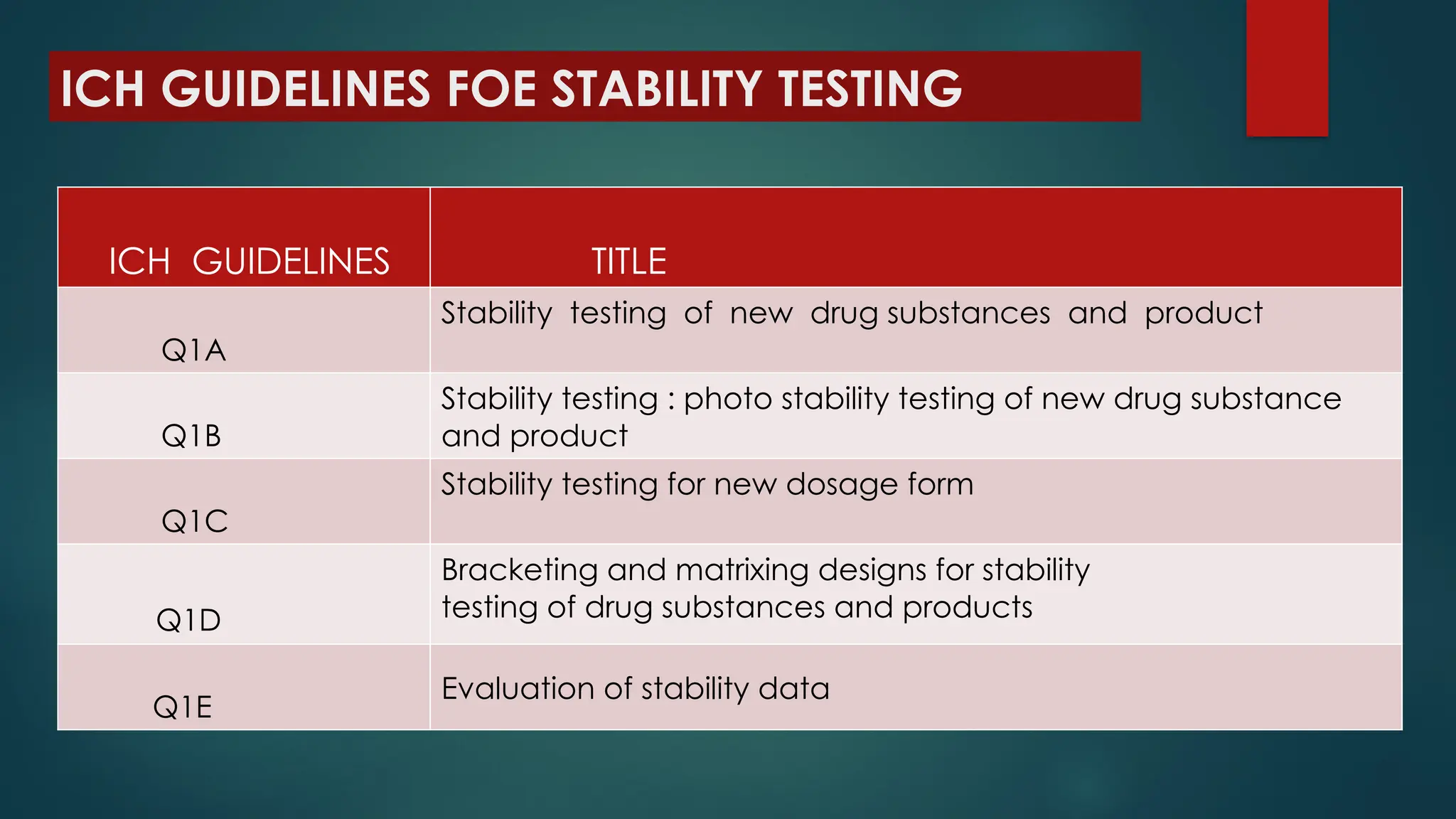
ICH GUIDELINES FOESTABILITY TESTING
ICH GUIDELINES TITLE
Q1A
Stability testing of new drug substances and product
Q1B
Stability testing : photo stability testing of new drug substance
and product
Q1C
Stability testing for new dosage form
Q1D
Bracketing and matrixing designs for stability
testing of drug substances and products
Q1E
Evaluation of stability data
23.
Stability testing ofAPI
Following are the consideration -
General
Stress Testing
Selection of Batches
Container Closure System
Specification
Testing Frequency
Storage Conditions
Stability Commitment
Evaluation
Statements/ Labelling
24.
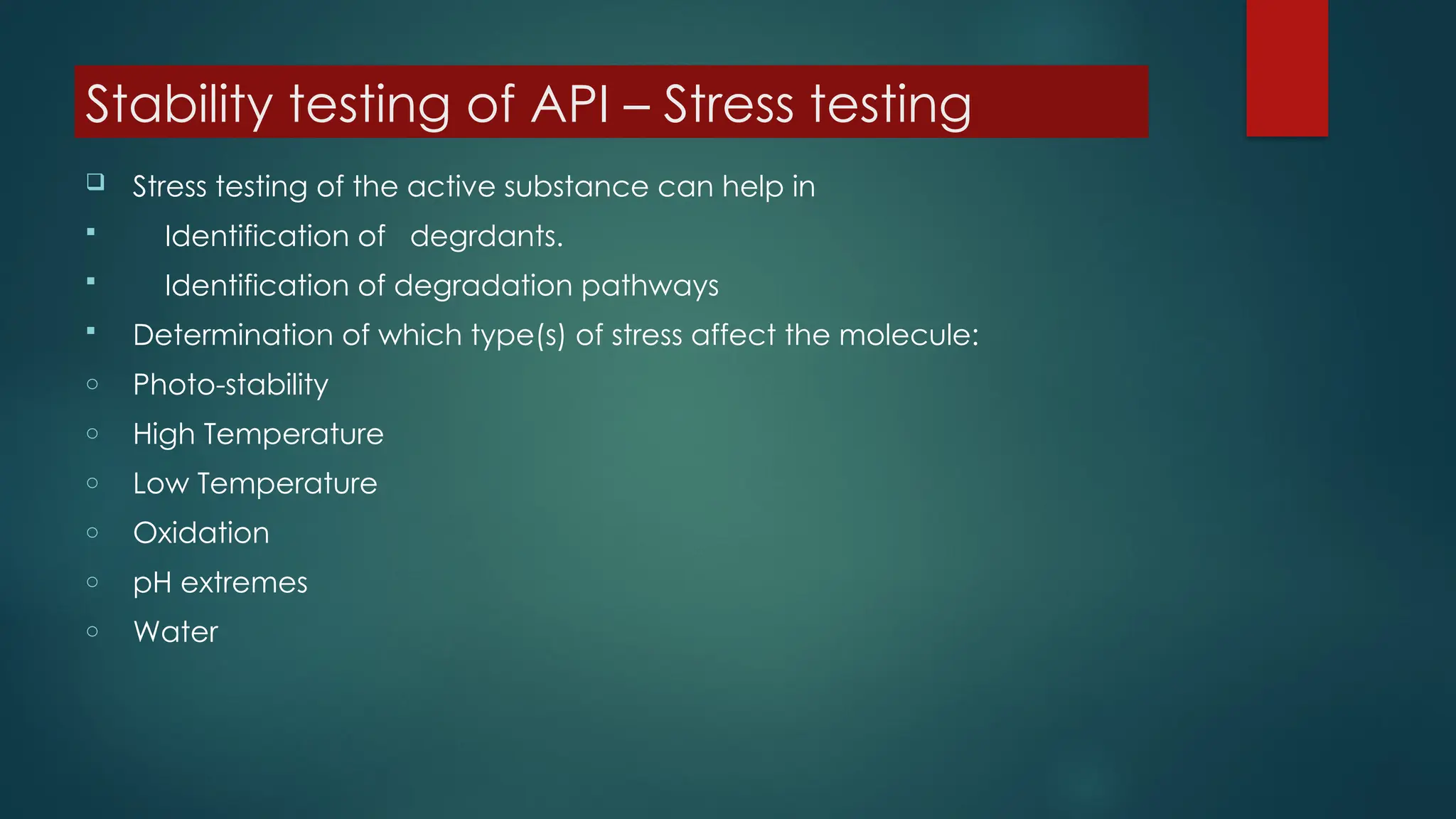
Stability testing ofAPI – Stress testing
Stress testing of the active substance can help in
Identification of degrdants.
Identification of degradation pathways
Determination of which type(s) of stress affect the molecule:
o Photo-stability
o High Temperature
o Low Temperature
o Oxidation
o pH extremes
o Water
25.
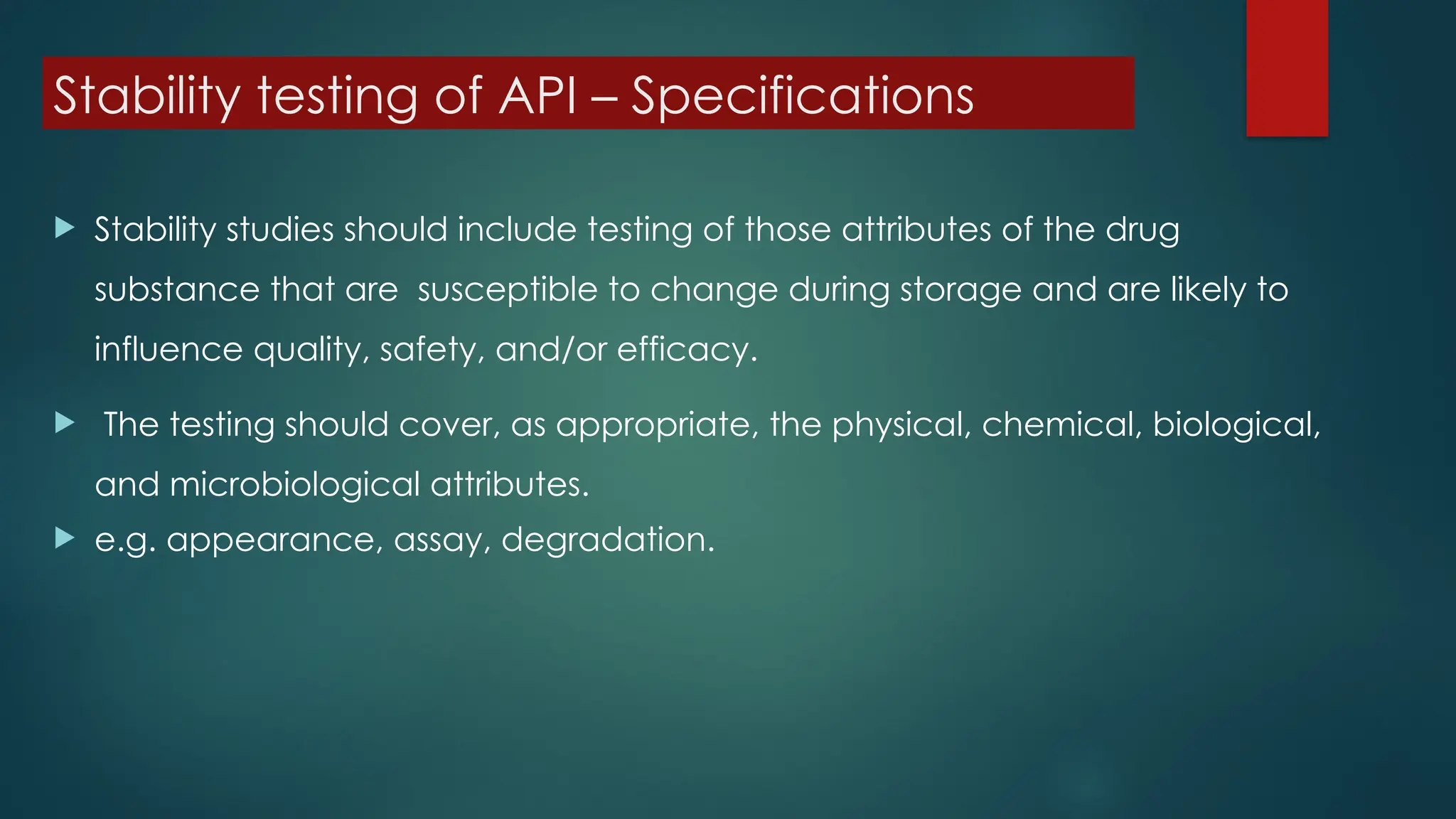
Stability testing ofAPI – Specifications
Stability studies should include testing of those attributes of the drug
substance that are susceptible to change during storage and are likely to
influence quality, safety, and/or efficacy.
The testing should cover, as appropriate, the physical, chemical, biological,
and microbiological attributes.
e.g. appearance, assay, degradation.
26.
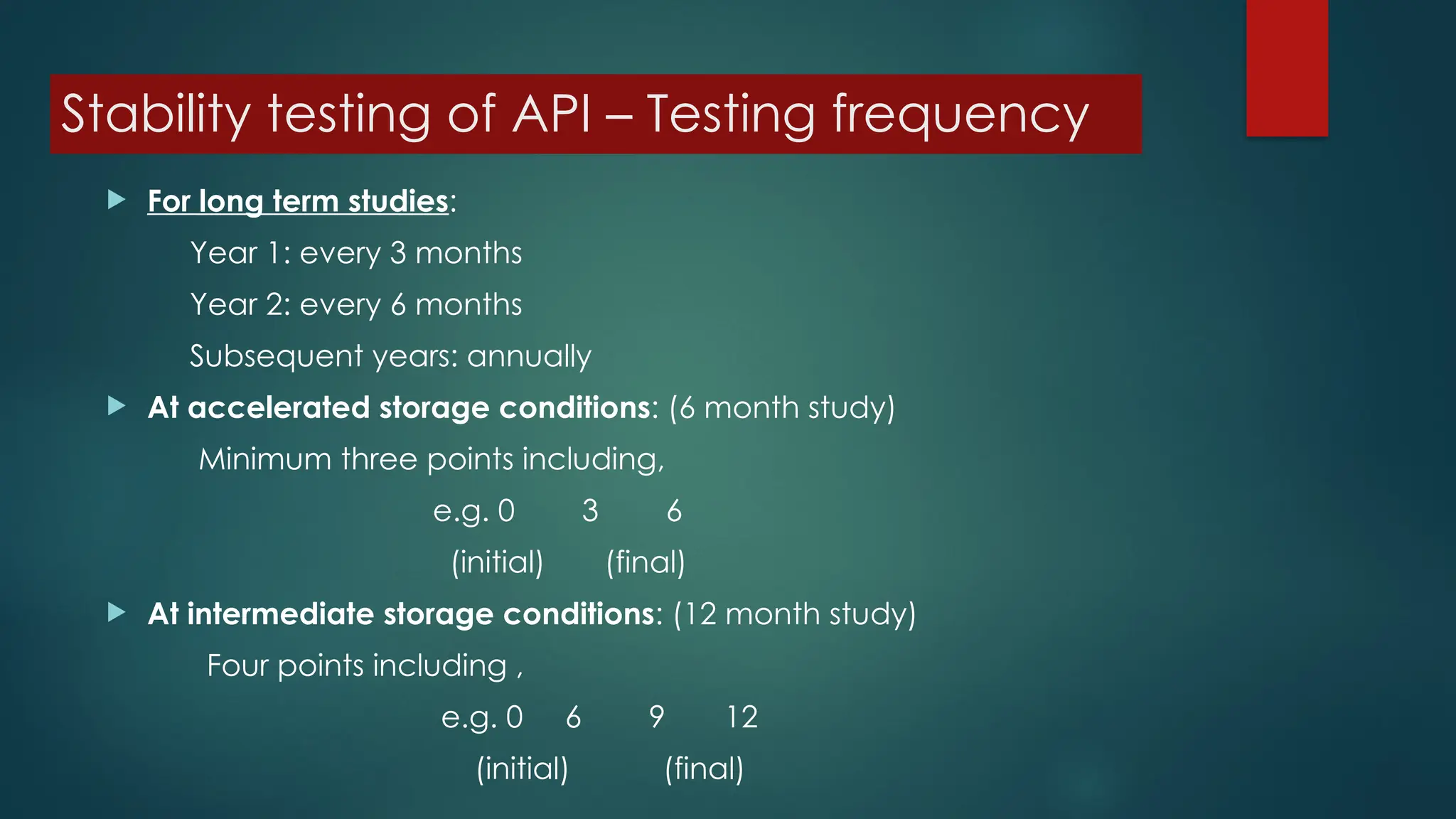
Stability testing ofAPI – Testing frequency
For long term studies:
Year 1: every 3 months
Year 2: every 6 months
Subsequent years: annually
At accelerated storage conditions: (6 month study)
Minimum three points including,
e.g. 0 3 6
(initial) (final)
At intermediate storage conditions: (12 month study)
Four points including ,
e.g. 0 6 9 12
(initial) (final)
27.
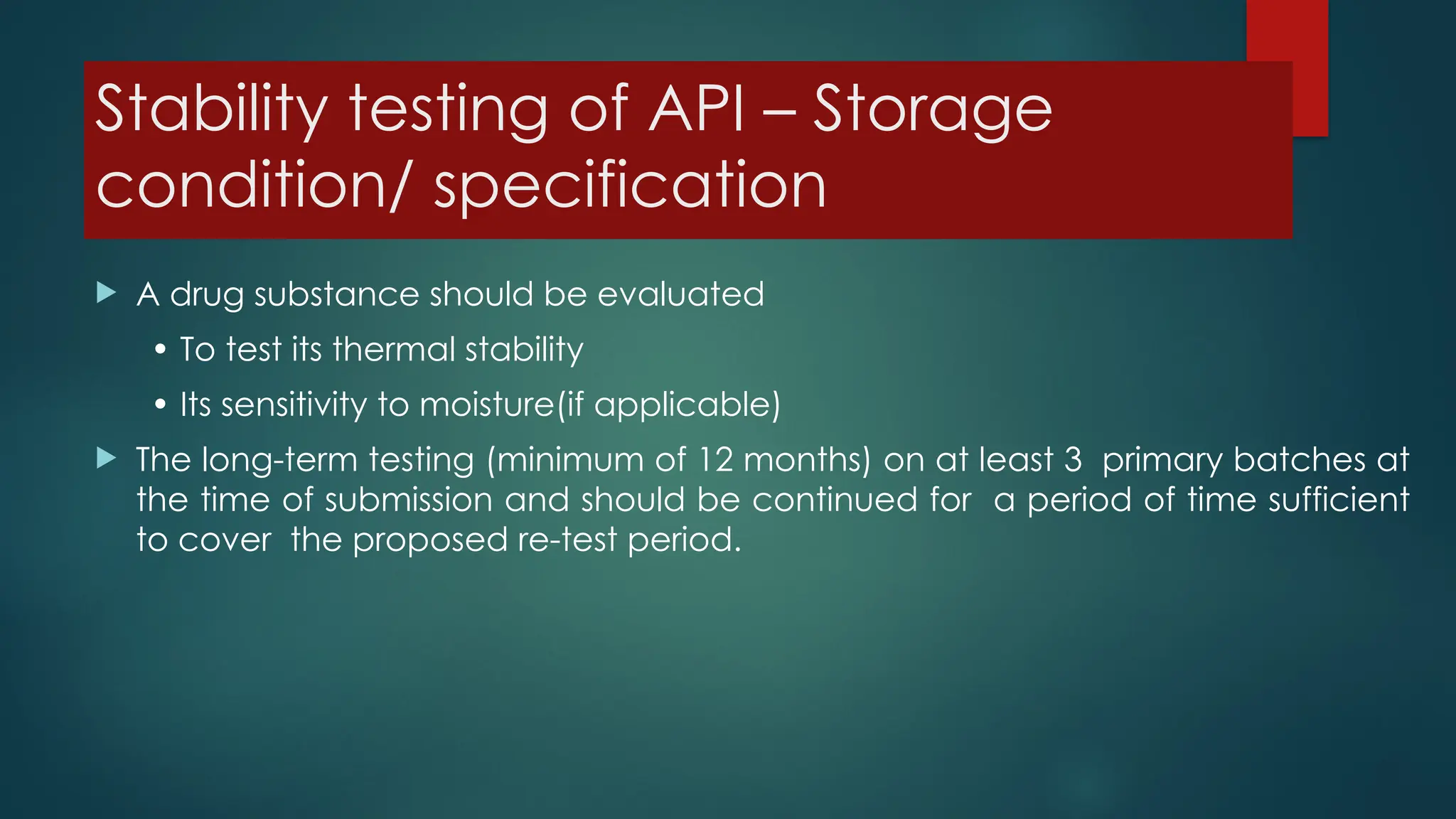
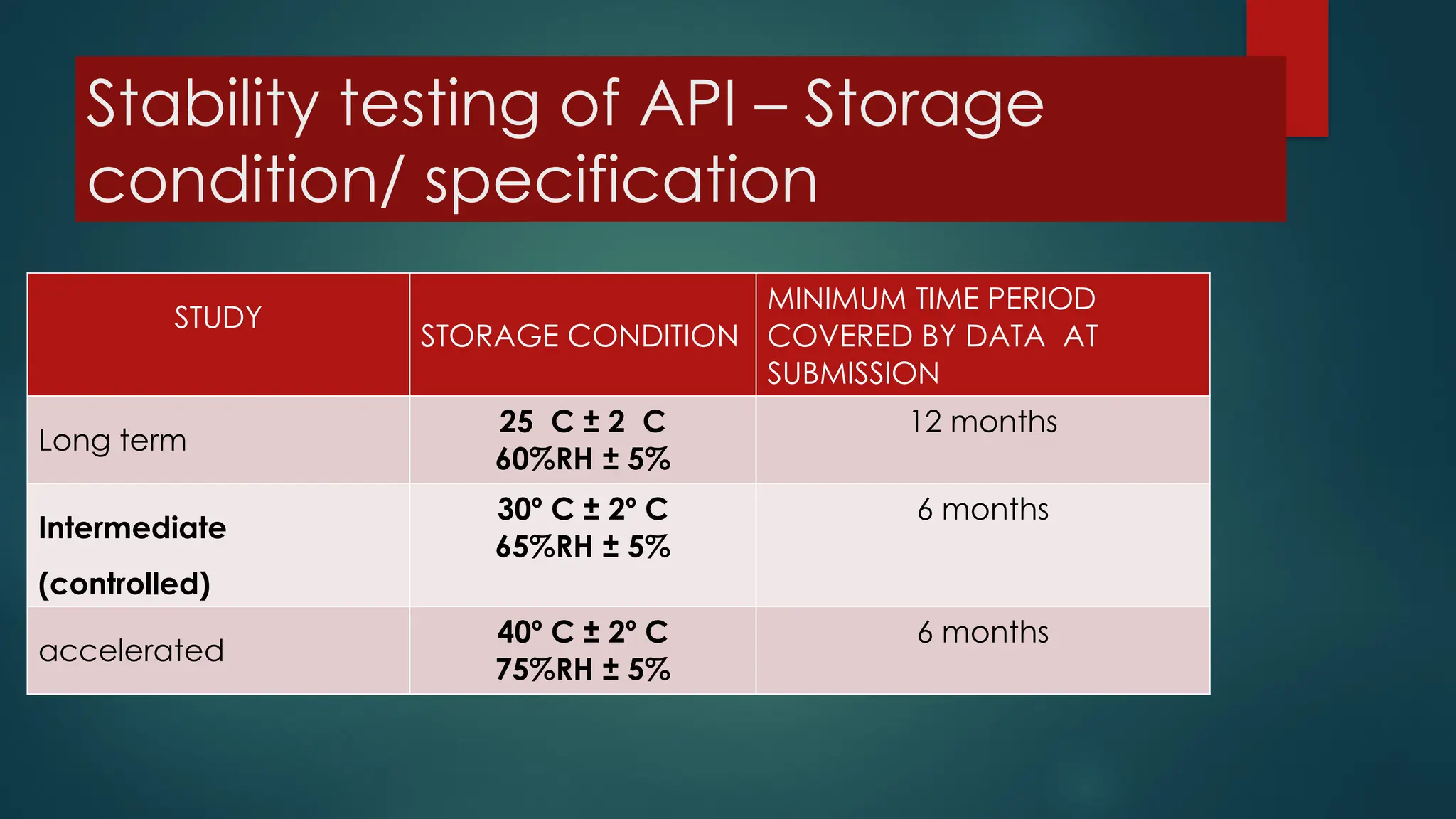
Stability testing ofAPI – Storage
condition/ specification
A drug substance should be evaluated
• To test its thermal stability
• Its sensitivity to moisture(if applicable)
The long-term testing (minimum of 12 months) on at least 3 primary batches at
the time of submission and should be continued for a period of time sufficient
to cover the proposed re-test period.
28.
Stability testing ofAPI – Storage
condition/ specification
STUDY
STORAGE CONDITION
MINIMUM TIME PERIOD
COVERED BY DATA AT
SUBMISSION
Long term
25 C ± 2 C
60%RH ± 5%
12 months
Intermediate
(controlled)
30º C ± 2º C
65%RH ± 5%
6 months
accelerated
40º C ± 2º C
75%RH ± 5%
6 months
29.
Types of StabilityStudies
Three types of stability studies:
1. Accelerated
studies designed to know short term excursion temperature on the drug substance.
2. Intermediate
Studies conducted incase of failure in accelerated studies and the conditions of
temperature and humidity are in between long term and accelerated.
3. long term
studies designed to check the stability of the drug substance.











![Understanding Parkinson’s Disease: Causes, Symptoms, and Treatment [2025]](https://cdn.slidesharecdn.com/ss_thumbnails/understandingparkinson-251208102525-80ba3223-thumbnail.jpg?width=640&height=640&fit=bounds)


