Presented By :-
Chinmayee Kishor Padte.
M. Pharm (Quality Assurance)
Under the Guidance of
Mr. Mukesh S. Patil
Assistant Professor(Quality Assurance )
Shri D.D. Vispute college of Pharmacy and research center
panvel
1
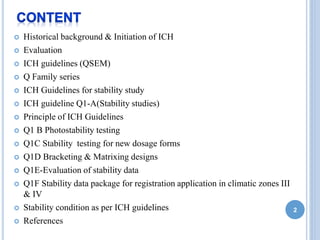
 Historical background & Initiation of ICH
 Evaluation
 ICH guidelines (QSEM)
 Q Family series
 ICH Guidelines for stability study
 ICH guideline Q1-A(Stability studies)
 Principle of ICH Guidelines
 Q1 B Photostability testing
 Q1C Stability testing for new dosage forms
 Q1D Bracketing & Matrixing designs
 Q1E-Evaluation of stability data
 Q1F Stability data package for registration application in climatic zones III
& IV
 Stability condition as per ICH guidelines
 References
2
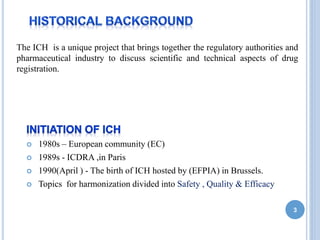
The ICH is a unique project that brings together the regulatory authorities and
pharmaceutical industry to discuss scientific and technical aspects of drug
registration.
 1980s – European community (EC)
 1989s - ICDRA ,in Paris
 1990(April ) - The birth of ICH hosted by (EFPIA) in Brussels.
 Topics for harmonization divided into Safety , Quality & Efficacy
3
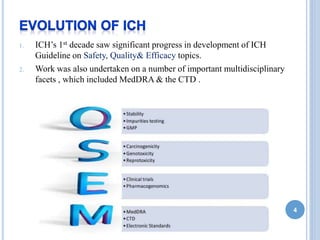
1. ICH’s 1st decade saw significant progress in development of ICH
Guideline on Safety, Quality& Efficacy topics.
2. Work was also undertaken on a number of important multidisciplinary
facets , which included MedDRA & the CTD .
4
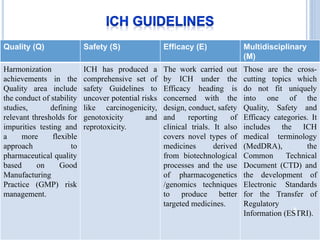
Quality (Q) Safety (S) Efficacy (E) Multidisciplinary
(M)
Harmonization
achievements in the
Quality area include
the conduct of stability
studies, defining
relevant thresholds for
impurities testing and
a more flexible
approach to
pharmaceutical quality
based on Good
Manufacturing
Practice (GMP) risk
management.
ICH has produced a
comprehensive set of
safety Guidelines to
uncover potential risks
like carcinogenicity,
genotoxicity and
reprotoxicity.
The work carried out
by ICH under the
Efficacy heading is
concerned with the
design, conduct, safety
and reporting of
clinical trials. It also
covers novel types of
medicines derived
from biotechnological
processes and the use
of pharmacogenetics
/genomics techniques
to produce better
targeted medicines.
Those are the cross-
cutting topics which
do not fit uniquely
into one of the
Quality, Safety and
Efficacy categories. It
includes the ICH
medical terminology
(MedDRA), the
Common Technical
Document (CTD) and
the development of
Electronic Standards
for the Transfer of
Regulatory
Information (ESTRI).5
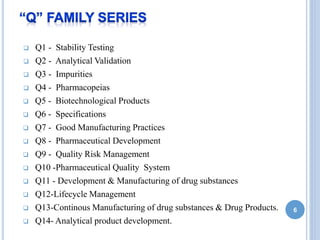
 Q1 - Stability Testing
 Q2 - Analytical Validation
 Q3 - Impurities
 Q4 - Pharmacopeias
 Q5 - Biotechnological Products
 Q6 - Specifications
 Q7 - Good Manufacturing Practices
 Q8 - Pharmaceutical Development
 Q9 - Quality Risk Management
 Q10 -Pharmaceutical Quality System
 Q11 - Development & Manufacturing of drug substances
 Q12-Lifecycle Management
 Q13-Continous Manufacturing of drug substances & Drug Products.
 Q14- Analytical product development.
6
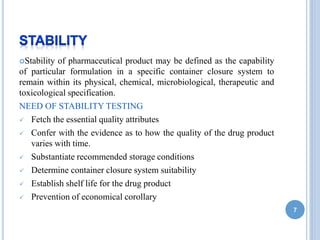
Stability of pharmaceutical product may be defined as the capability
of particular formulation in a specific container closure system to
remain within its physical, chemical, microbiological, therapeutic and
toxicological specification.
NEED OF STABILITY TESTING
 Fetch the essential quality attributes
 Confer with the evidence as to how the quality of the drug product
varies with time.
 Substantiate recommended storage conditions
 Determine container closure system suitability
 Establish shelf life for the drug product
 Prevention of economical corollary
7
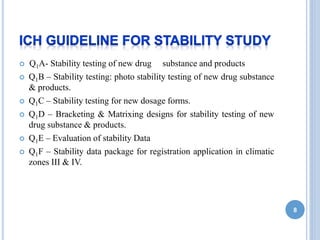
 Q1A- Stability testing of new drug substance and products
 Q1B – Stability testing: photo stability testing of new drug substance
& products.
 Q1C – Stability testing for new dosage forms.
 Q1D – Bracketing & Matrixing designs for stability testing of new
drug substance & products.
 Q1E – Evaluation of stability Data
 Q1F – Stability data package for registration application in climatic
zones III & IV.
8
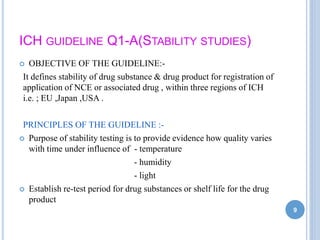
ICH GUIDELINE Q1-A(STABILITY STUDIES)
 OBJECTIVE OF THE GUIDELINE:-
It defines stability of drug substance & drug product for registration of
application of NCE or associated drug , within three regions of ICH
i.e. ; EU ,Japan ,USA .
PRINCIPLES OF THE GUIDELINE :-
 Purpose of stability testing is to provide evidence how quality varies
with time under influence of - temperature
- humidity
- light
 Establish re-test period for drug substances or shelf life for the drug
product
9
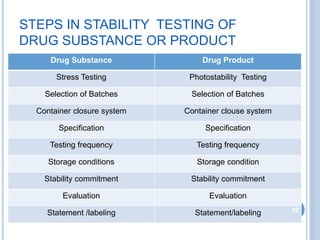
STEPS IN STABILITY TESTING OF
DRUG SUBSTANCE OR PRODUCT
Drug Substance Drug Product
Stress Testing Photostability Testing
Selection of Batches Selection of Batches
Container closure system Container clouse system
Specification Specification
Testing frequency Testing frequency
Storage conditions Storage condition
Stability commitment Stability commitment
Evaluation Evaluation
Statement /labeling Statement/labeling 10
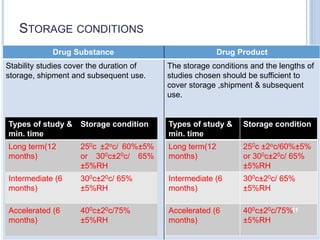
STORAGE CONDITIONS
Drug Substance Drug Product
Stability studies cover the duration of
storage, shipment and subsequent use.
The storage conditions and the lengths of
studies chosen should be sufficient to
cover storage ,shipment & subsequent
use.
Types of study &
min. time
Storage condition
Long term(12
months)
250c ±2oc/ 60%±5%
or 300c±20c/ 65%
±5%RH
Intermediate (6
months)
300c±20c/ 65%
±5%RH
Accelerated (6
months)
400c±20c/75%
±5%RH
Types of study &
min. time
Storage condition
Long term(12
months)
250c ±2oc/60%±5%
or 300c±20c/ 65%
±5%RH
Intermediate (6
months)
300c±20c/ 65%
±5%RH
Accelerated (6
months)
400c±20c/75%
±5%RH
11
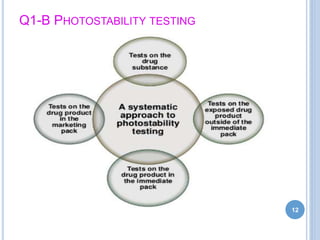
Q1-B PHOTOSTABILITY TESTING
12
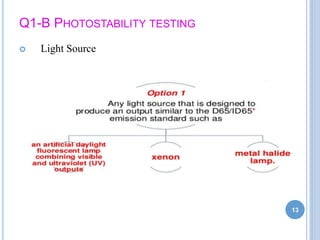
Q1-B PHOTOSTABILITY TESTING
13
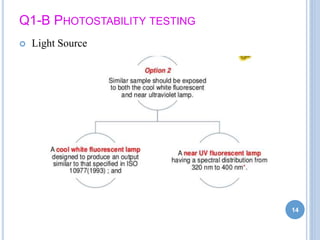
 Light Source
Q1-B PHOTOSTABILITY TESTING
14
 Light Source
Q1B DRUG SUBSTANCE & DRUG PRODUCT
15
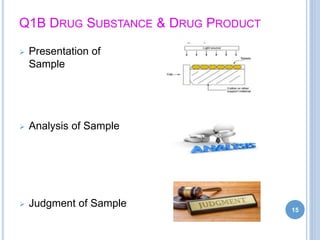
 Presentation of
Sample
 Analysis of Sample
 Judgment of Sample
Q1-B PHOTOSTABILITY TESTING
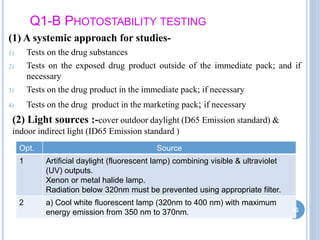
(1) A systemic approach for studies-
1) Tests on the drug substances
2) Tests on the exposed drug product outside of the immediate pack; and if
necessary
3) Tests on the drug product in the immediate pack; if necessary
4) Tests on the drug product in the marketing pack; if necessary
(2) Light sources :-cover outdoor daylight (D65 Emission standard) &
indoor indirect light (ID65 Emission standard )
Opt. Source
1 Artificial daylight (fluorescent lamp) combining visible & ultraviolet
(UV) outputs.
Xenon or metal halide lamp.
Radiation below 320nm must be prevented using appropriate filter.
2 a) Cool white fluorescent lamp (320nm to 400 nm) with maximum
energy emission from 350 nm to 370nm. 16
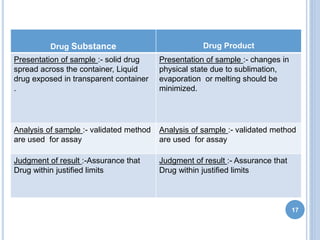
Drug Substance Drug Product
Presentation of sample :- solid drug
spread across the container, Liquid
drug exposed in transparent container
.
Presentation of sample :- changes in
physical state due to sublimation,
evaporation or melting should be
minimized.
Analysis of sample :- validated method
are used for assay
Analysis of sample :- validated method
are used for assay
Judgment of result :-Assurance that
Drug within justified limits
Judgment of result :- Assurance that
Drug within justified limits
17
Q1C:STABILITY TESTING FOR NEW DOSAGE
FORMS
 A drug product which is a different pharmaceutical
product type, but contains the same active
substance as included in the existing drug product
approved by the pertinent regulatory authority.
 e.g., -oral to parenteral,
-immediate release tablet to modified release
tablet,etc.
18
Q1D :BRACKETING & MATRIXING DESIGNS FOR
STABILITY TESTING
Guideline recommends for application of bracketing and matrixing
Applicability of reduced designs:
To the formal stability study of most types of drug products.
For the study of drug substances , matrixing is of limited utility and
bracketing is generally not applicable.
Data variability and product stability ,as shown by supporting data ,
should be considered when a matrixing is applied.
Bracketing:-
Bracketing is the design of a stability schedule such that only samples
on the extremes of certain design factors (e.g., strength, container size
and/or fill) are tested at all time as in a full design.
Design Example :-
Example is based on product available in 3 strengths & 3 container
sizes. 19
Matrixing :-
Matrixing is the design of a stability schedule such that a selected
subset of the total number of possible samples for all factor
combinations would be tested at a specified time point .
Design Examples :-
The terms “one-half reduction” & “one - third reduction” refer to the
reduction strategy initially applied to the full study design & a “one-
third reduction” initially removes one in every three .
20
Q1D :BRACKETING & MATRIXING DESIGNS FOR
STABILITY TESTING
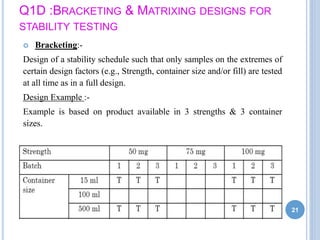
 Bracketing:-
Design of a stability schedule such that only samples on the extremes of
certain design factors (e.g., Strength, container size and/or fill) are tested
at all time as in a full design.
Design Example :-
Example is based on product available in 3 strengths & 3 container
sizes.
21
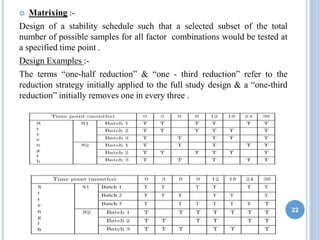
 Matrixing :-
Design of a stability schedule such that a selected subset of the total
number of possible samples for all factor combinations would be tested at
a specified time point .
Design Examples :-
The terms “one-half reduction” & “one - third reduction” refer to the
reduction strategy initially applied to the full study design & a “one-third
reduction” initially removes one in every three .
22
Q1E:EVALUATION OF STABILITY DATA
Objectives:
To provide recommendations on how to use stability data generated in
accordance with the principles detailed in the ICH guideline “Q 1 A
stability testing of new drug substances and products”
SCOPE:
It covers stability studies using single- or multi-factor designs and full
or reduced designs.
23
Q 1 F:STABILITY DATA PACKAGE FOR
REGISTRATION APPLICATIONS IN CLIMATIC
ZONES III & IV
 These guidelines were adopted by the ICH in
February 2003 and subsequently implemented in
the ICH regions. Due to some reasons the
guidelines were withdrawn.
24
STABILITY CONDITION AS PER ICH GUIDELINES
Climatic
zones
Types of climate Temperature Humidity
I Temperate zone Japan , UK,
Northern Europe, Canada,
Russia , US
210c 45%
II Mediterranean /subtropical zones
Japan,US ,Southern Europe
250c 60%
III Hot Dry Zone Iran, Iraq , Sudan 300c 35%
IV Hot Humid /Tropical zones India,
Brazil , Ghana, Indonesia.
300c 70%
IV B ASEAN testing condition
hot/high humidity
300c 70%
25
REFERENCES
[1]Om M. Bagade, Textbook of pharmaceutical QUALITY
ASSURANCE First Edition, Career Publication. page No.220-256
[2] https://www.ich.org/
[3] C.V. S. Subrahmanyam, Pharmaceutical Regulatory Affairs ,Vallabh
Prakashan .page no. 182-199
[4]https://www.researchgate.net/publication/306312875_Adoptio
n_and_Reasons_for_Withdrawal_of_ICH_Q1F_Guidelines
[5]Dr. Ruchi Tiwari,Dr.Gaurav Tiwari,Intellactual Property Rights &
Drug Regulatory Affairs,Nirali Prakashan,Page No.23.1-23.12
[6]Vandana patravale.,John Disouza.,Maharukh
Rustomji,Pharmaceutical product Development CRC press Group
of taylor and francis. Page no.207-213.
26
27

Drug stability

  • 1.
    Presented By :- ChinmayeeKishor Padte. M. Pharm (Quality Assurance) Under the Guidance of Mr. Mukesh S. Patil Assistant Professor(Quality Assurance ) Shri D.D. Vispute college of Pharmacy and research center panvel 1
  • 2.
     Historical background& Initiation of ICH  Evaluation  ICH guidelines (QSEM)  Q Family series  ICH Guidelines for stability study  ICH guideline Q1-A(Stability studies)  Principle of ICH Guidelines  Q1 B Photostability testing  Q1C Stability testing for new dosage forms  Q1D Bracketing & Matrixing designs  Q1E-Evaluation of stability data  Q1F Stability data package for registration application in climatic zones III & IV  Stability condition as per ICH guidelines  References 2
  • 3.
    The ICH isa unique project that brings together the regulatory authorities and pharmaceutical industry to discuss scientific and technical aspects of drug registration.  1980s – European community (EC)  1989s - ICDRA ,in Paris  1990(April ) - The birth of ICH hosted by (EFPIA) in Brussels.  Topics for harmonization divided into Safety , Quality & Efficacy 3
  • 4.
    1. ICH’s 1stdecade saw significant progress in development of ICH Guideline on Safety, Quality& Efficacy topics. 2. Work was also undertaken on a number of important multidisciplinary facets , which included MedDRA & the CTD . 4
  • 5.
    Quality (Q) Safety(S) Efficacy (E) Multidisciplinary (M) Harmonization achievements in the Quality area include the conduct of stability studies, defining relevant thresholds for impurities testing and a more flexible approach to pharmaceutical quality based on Good Manufacturing Practice (GMP) risk management. ICH has produced a comprehensive set of safety Guidelines to uncover potential risks like carcinogenicity, genotoxicity and reprotoxicity. The work carried out by ICH under the Efficacy heading is concerned with the design, conduct, safety and reporting of clinical trials. It also covers novel types of medicines derived from biotechnological processes and the use of pharmacogenetics /genomics techniques to produce better targeted medicines. Those are the cross- cutting topics which do not fit uniquely into one of the Quality, Safety and Efficacy categories. It includes the ICH medical terminology (MedDRA), the Common Technical Document (CTD) and the development of Electronic Standards for the Transfer of Regulatory Information (ESTRI).5
  • 6.
     Q1 -Stability Testing  Q2 - Analytical Validation  Q3 - Impurities  Q4 - Pharmacopeias  Q5 - Biotechnological Products  Q6 - Specifications  Q7 - Good Manufacturing Practices  Q8 - Pharmaceutical Development  Q9 - Quality Risk Management  Q10 -Pharmaceutical Quality System  Q11 - Development & Manufacturing of drug substances  Q12-Lifecycle Management  Q13-Continous Manufacturing of drug substances & Drug Products.  Q14- Analytical product development. 6
  • 7.
    Stability of pharmaceuticalproduct may be defined as the capability of particular formulation in a specific container closure system to remain within its physical, chemical, microbiological, therapeutic and toxicological specification. NEED OF STABILITY TESTING  Fetch the essential quality attributes  Confer with the evidence as to how the quality of the drug product varies with time.  Substantiate recommended storage conditions  Determine container closure system suitability  Establish shelf life for the drug product  Prevention of economical corollary 7
  • 8.
     Q1A- Stabilitytesting of new drug substance and products  Q1B – Stability testing: photo stability testing of new drug substance & products.  Q1C – Stability testing for new dosage forms.  Q1D – Bracketing & Matrixing designs for stability testing of new drug substance & products.  Q1E – Evaluation of stability Data  Q1F – Stability data package for registration application in climatic zones III & IV. 8
  • 9.
    ICH GUIDELINE Q1-A(STABILITYSTUDIES)  OBJECTIVE OF THE GUIDELINE:- It defines stability of drug substance & drug product for registration of application of NCE or associated drug , within three regions of ICH i.e. ; EU ,Japan ,USA . PRINCIPLES OF THE GUIDELINE :-  Purpose of stability testing is to provide evidence how quality varies with time under influence of - temperature - humidity - light  Establish re-test period for drug substances or shelf life for the drug product 9
  • 10.
    STEPS IN STABILITYTESTING OF DRUG SUBSTANCE OR PRODUCT Drug Substance Drug Product Stress Testing Photostability Testing Selection of Batches Selection of Batches Container closure system Container clouse system Specification Specification Testing frequency Testing frequency Storage conditions Storage condition Stability commitment Stability commitment Evaluation Evaluation Statement /labeling Statement/labeling 10
  • 11.
    STORAGE CONDITIONS Drug SubstanceDrug Product Stability studies cover the duration of storage, shipment and subsequent use. The storage conditions and the lengths of studies chosen should be sufficient to cover storage ,shipment & subsequent use. Types of study & min. time Storage condition Long term(12 months) 250c ±2oc/ 60%±5% or 300c±20c/ 65% ±5%RH Intermediate (6 months) 300c±20c/ 65% ±5%RH Accelerated (6 months) 400c±20c/75% ±5%RH Types of study & min. time Storage condition Long term(12 months) 250c ±2oc/60%±5% or 300c±20c/ 65% ±5%RH Intermediate (6 months) 300c±20c/ 65% ±5%RH Accelerated (6 months) 400c±20c/75% ±5%RH 11
  • 12.
  • 13.
  • 14.
  • 15.
    Q1B DRUG SUBSTANCE& DRUG PRODUCT 15  Presentation of Sample  Analysis of Sample  Judgment of Sample
  • 16.
    Q1-B PHOTOSTABILITY TESTING (1)A systemic approach for studies- 1) Tests on the drug substances 2) Tests on the exposed drug product outside of the immediate pack; and if necessary 3) Tests on the drug product in the immediate pack; if necessary 4) Tests on the drug product in the marketing pack; if necessary (2) Light sources :-cover outdoor daylight (D65 Emission standard) & indoor indirect light (ID65 Emission standard ) Opt. Source 1 Artificial daylight (fluorescent lamp) combining visible & ultraviolet (UV) outputs. Xenon or metal halide lamp. Radiation below 320nm must be prevented using appropriate filter. 2 a) Cool white fluorescent lamp (320nm to 400 nm) with maximum energy emission from 350 nm to 370nm. 16
  • 17.
    Drug Substance DrugProduct Presentation of sample :- solid drug spread across the container, Liquid drug exposed in transparent container . Presentation of sample :- changes in physical state due to sublimation, evaporation or melting should be minimized. Analysis of sample :- validated method are used for assay Analysis of sample :- validated method are used for assay Judgment of result :-Assurance that Drug within justified limits Judgment of result :- Assurance that Drug within justified limits 17
  • 18.
    Q1C:STABILITY TESTING FORNEW DOSAGE FORMS  A drug product which is a different pharmaceutical product type, but contains the same active substance as included in the existing drug product approved by the pertinent regulatory authority.  e.g., -oral to parenteral, -immediate release tablet to modified release tablet,etc. 18
  • 19.
    Q1D :BRACKETING &MATRIXING DESIGNS FOR STABILITY TESTING Guideline recommends for application of bracketing and matrixing Applicability of reduced designs: To the formal stability study of most types of drug products. For the study of drug substances , matrixing is of limited utility and bracketing is generally not applicable. Data variability and product stability ,as shown by supporting data , should be considered when a matrixing is applied. Bracketing:- Bracketing is the design of a stability schedule such that only samples on the extremes of certain design factors (e.g., strength, container size and/or fill) are tested at all time as in a full design. Design Example :- Example is based on product available in 3 strengths & 3 container sizes. 19
  • 20.
    Matrixing :- Matrixing isthe design of a stability schedule such that a selected subset of the total number of possible samples for all factor combinations would be tested at a specified time point . Design Examples :- The terms “one-half reduction” & “one - third reduction” refer to the reduction strategy initially applied to the full study design & a “one- third reduction” initially removes one in every three . 20
  • 21.
    Q1D :BRACKETING &MATRIXING DESIGNS FOR STABILITY TESTING  Bracketing:- Design of a stability schedule such that only samples on the extremes of certain design factors (e.g., Strength, container size and/or fill) are tested at all time as in a full design. Design Example :- Example is based on product available in 3 strengths & 3 container sizes. 21
  • 22.
     Matrixing :- Designof a stability schedule such that a selected subset of the total number of possible samples for all factor combinations would be tested at a specified time point . Design Examples :- The terms “one-half reduction” & “one - third reduction” refer to the reduction strategy initially applied to the full study design & a “one-third reduction” initially removes one in every three . 22
  • 23.
    Q1E:EVALUATION OF STABILITYDATA Objectives: To provide recommendations on how to use stability data generated in accordance with the principles detailed in the ICH guideline “Q 1 A stability testing of new drug substances and products” SCOPE: It covers stability studies using single- or multi-factor designs and full or reduced designs. 23
  • 24.
    Q 1 F:STABILITYDATA PACKAGE FOR REGISTRATION APPLICATIONS IN CLIMATIC ZONES III & IV  These guidelines were adopted by the ICH in February 2003 and subsequently implemented in the ICH regions. Due to some reasons the guidelines were withdrawn. 24
  • 25.
    STABILITY CONDITION ASPER ICH GUIDELINES Climatic zones Types of climate Temperature Humidity I Temperate zone Japan , UK, Northern Europe, Canada, Russia , US 210c 45% II Mediterranean /subtropical zones Japan,US ,Southern Europe 250c 60% III Hot Dry Zone Iran, Iraq , Sudan 300c 35% IV Hot Humid /Tropical zones India, Brazil , Ghana, Indonesia. 300c 70% IV B ASEAN testing condition hot/high humidity 300c 70% 25
  • 26.
    REFERENCES [1]Om M. Bagade,Textbook of pharmaceutical QUALITY ASSURANCE First Edition, Career Publication. page No.220-256 [2] https://www.ich.org/ [3] C.V. S. Subrahmanyam, Pharmaceutical Regulatory Affairs ,Vallabh Prakashan .page no. 182-199 [4]https://www.researchgate.net/publication/306312875_Adoptio n_and_Reasons_for_Withdrawal_of_ICH_Q1F_Guidelines [5]Dr. Ruchi Tiwari,Dr.Gaurav Tiwari,Intellactual Property Rights & Drug Regulatory Affairs,Nirali Prakashan,Page No.23.1-23.12 [6]Vandana patravale.,John Disouza.,Maharukh Rustomji,Pharmaceutical product Development CRC press Group of taylor and francis. Page no.207-213. 26
  • 27.