Overview   of  ICH GCP Syed Sarfaraz Uddin e-mail: syed.sarfaraz.uddin@gmail.com
What is ICH? ICH is a joint initiative involving both the regulators and the industry as equal partners in the scientific and technical discussions of the testing procedures which are required to ensure and assess the safety, quality and efficacy of medicines.
How did it evolve? The need to harmonize Public disasters, serious fraud and abuse of human rights. Trials of War criminals-Nuremberg code 1949 Thalidomide- Declaration of Helsinki 1964 Belmont report 1978(  Ethical Principles and guidelines for the protection of human subjects of research)- Tuskegee syphilis study
History 1962  US FDA IND Guidelines 1964  Declaration of Helsinki 1968  Committee on Safety of Medicines, uk 1978  GCP, US FDA 1991  GCP, Europe 1996  ICH GCP 1997  ICH GCP Guideline
When did it begin?   I st  conf. in 1990 in Brussels 3 regions participated  Representatives from  Industry Academia Ministry of health
ICH parties 6 parties EU  EFPIA   European federation of pharmaceutical industries’ associations MHLW  Ministry of health, Labor and welfare, Japan JPMA  Japan Pharmaceuticals manufacturers Association  US FDA PhRMA Observers : WHO, TPP(canada) International federation of Pharmaceutical manufacturer’s association
Key objective To discuss and define the minimum standards for the development and registration of investigational products
The result? Many guidelines made Most important- ICH GCP guidelines Evolved in several steps Consolidated guideline ICH E6 Sept 1997
ICH Guidelines: examples Efficacy:  clinical trials etc Safety:  pharmacovigilance, adverse drug reaction reporting Quality:  raw materials, impurities, residual solvents etc Multidisciplinary:  common technical document, electronic submission, coding systems
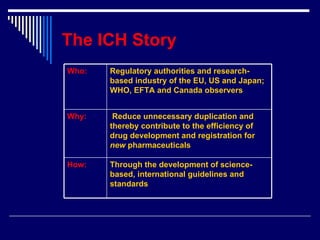
The ICH Story Through the development of science-based, international guidelines and standards How: Reduce unnecessary duplication and thereby contribute to the efficiency of  drug development and registration for  new  pharmaceuticals Why: Regulatory authorities and research-based industry of the EU, US and Japan; WHO, EFTA and Canada observers Who:
What is GCP? A standard for the design, conduct, performance, monitoring ,auditing, recording, analyses and reporting of clinical trials that provide assurance that the data and the reported results are credible, accurate and that the rights, integrity and confidentiality of trial subjects are protected.
Why is it needed?   To ensure the rights, safety and well being of the trial subjects are protected Ensure the credibility of clinical trial data
The ICH GCP guideline Provide a unified standard for the EU, Japan and USA regions to facilitate mutual acceptance of clinical trial data by the regulatory authorities in these regions . ?The need No acceptance of foreign clinical data Regional variation in reg guidelines Escalating costs Extended time for registration ICH region covers 85% of Pharm. sales
ICH GCP guideline 8 sections
ICH GCP guideline 1.   Glossary Common language for investigators/sponsors/ethics committees 2.Principles of Good Clinical Practice 13 tenets of ICH GCP 3.Requirements for IRB/IEC Roles responsibilities and composition
ICH GCP guideline 4.Responsibilities of the investigator 5.Responsibilities of the sponsor 6.Requirements for clinical trial protocol and protocol amendments 7.Responsibility of the sponsor in the development of investigator’s brochure. 8.Essential documents
Principles of ICH GCP Ethical conduct as per Declaration of Helsinki GCP Regulatory Requirements Risk- Benefit Primary concern- Subject
Principles of ICH GCP Supportive data Protocol Scientifically sound, clear, detailed Ethical Clearance Study to be conducted in compliance to the protocol which has received EC approval
Principles of ICH GCP Subject Care  Medical decisions responsibility of qualified physician Qualified staff By education, training, experience in their area of responsibility Informed Consent
Principles of ICH GCP Clinical Trial data Recorded, handled and stored to enable accurate reporting, interpretation and verification Confidentiality
Principles of ICH GCP Investigational Product Manufactured, handled and stored as per GMP Used as per the protocol
Principles of ICH GCP Quality Assurance Systems and procedures to ensure the Quality of every aspect of the trial
Concerns about ICH Industry driven agenda or public health oriented approach Public health implications- inability to achieve standards and withdrawal of essential drugs Misdirecting national priorities
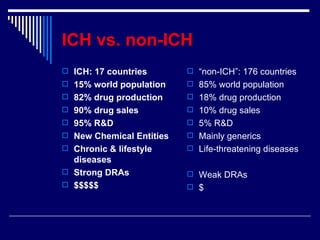
ICH vs. non-ICH ICH: 17 countries 15% world population 82% drug production 90% drug sales 95% R&D New Chemical Entities Chronic & lifestyle diseases Strong DRAs $$$$$ “ non-ICH”: 176 countries 85% world population 18% drug production 10% drug sales 5% R&D Mainly generics Life-threatening diseases Weak DRAs $
Indian GCP guidelines   Released in Dec 2001(Developed by CDCSO and endorsed by DCGI) In general, in line with ICH GCP Has Revised Schedule Y (Jan 2005) addressed discrepancies?
Issues in Developing Countries The informed consent process Economic Vulnerability Patient doctor relationship Education level
ROLE OF GCP ? Good clinical practice (gcp) is an international ethical & scientific standard for conducting clinical trials that involve the participation of human subjects Compliance with this standard provides public assurance that the rights, safety & well-being of trial subjects are protected, which is consistent with the principles outlined in the declaration of helsinki GCP also ensures the credibility of clinical trial data.
INTERNATIONAL ETHICAL STANDARDS Professional standards for the protection of human subjects in research did not exist till late 1940’s. Nuremberg tribunal held in 1945 and 1946 that “voluntary consent of the human subject is absolutely essential”  The Declaration of Helsinki outlines 12 principles by which physicians must conduct research in therapeutic & non-therapeutic interventions.
Fundamental Ethical Principles Guiding Protection Of Human Subjects In Biomedical Research RESPECT FOR PERSONS : Acknowledges the dignity & autonomy of individuals. This principle requires that subjects give their informed consent prior to participating in research. BENEFICENCE :  Obligates researchers to treat subjects fairly. JUSTICE : requires the equitable selection of subjects in light of research setting & research purposes.
PRINCIPLES BEHIND GCP Before initiating any clinical trial, ANTICIPATED RISKS should be weighed against EXPECTED BENEFITS for the trial subject & society The RIGHTS, SAFETY & WELL BEING of trial subjects are the most important considerations & should prevail over the interests of science & society. The entire study procedure should be scientifically sound  & detailed in a trial protocol. This protocol should receive a prior APPROVAL FROM AN INDEPENDENT ETHICS COMMITTEE.
ETHICAL REVIEW SHOULD DEFINE JUSTIFIABLE BOUNDARIES BETWEEN THE RIGHTS OF THE SUBJECT AND THE BENEFITS THAT MIGHT ACCRUE TO SOCIETY THROUGH SCIENTIFIC INFORMATION DEVELOPED IN CLINICAL TRIALS. Regulations have been established internationally, to ensure ethical & scientific conduct of trials
GOALS OF INTERNATIONAL HARMONIZATION OF REGULATORY REQUIREMENTS SAFEGUARD PUBLIC HEALTH ASSURE CONSUMER PROTECTION STANDARDS FACILITATE AVAILABILITY OF SAFE AND EFFECTIVE PRODUCTS ELIMINATE INCONSISTENT STANDARDS INTERNATIONALLY FACILITATE MUTUAL ACCEPTANCE OF DATA FROM CLINICAL TRIALS
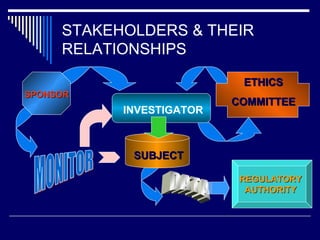
STAKEHOLDERS & THEIR RELATIONSHIPS MONITOR DATA SUBJECT REGULATORY AUTHORITY SPONSOR ETHICS COMMITTEE INVESTIGATOR
ROLE OF ETHICS COMMITTEES Play a vital role in protecting human subjects in clinical trials. They review trial protocols to ensure that …. informed consents are obtained from the subjects subjects are not exposed to unreasonable risks Establishment of EC’s has become a cornerstone of protection of human subjects in clinical research
Protection of Human Subjects Prior To Study Start The investigator must request ethics approval for: Protocol Informed Consent Form/Advertisements/Other Information Protocol amendment and /or Informed Consent Amendments All sites at which patient activity will occur
Protection of Human Subjects   During the study The investigator must request ethics approval for any change in the research activity The investigator must submit progress reports to the IRB as required The subject must be informed of any new information which might affect their decision to continue participation in the trial
RESPONSIBILITIES OF THE INVESTIGATOR Conduct the research in accordance with the protocol and Good Clinical Practice (GCP) Protect the rights, safety, and welfare of the subjects Report all adverse events (serious and non-serious) Retain study documents and medical records Control the distribution and use of the study medication
RESPONSIBILITIES OF THE SPONSOR The sponsor is responsible for implementing and maintaining quality assurance of data generated in compliance with the protocol Sponsor is responsible for securing agreement from all involved parties to ensure direct access to all sites, source data & reports for the purpose of monitoring & auditing by regulatory authorities Agreements made by the sponsor with the investigator should be in writing
MEDICAL CARE OF TRIAL SUBJECTS During and following a subject’s participation in a trial, the investigator & institution should ensure that adequate medical care is provided to deal with adverse events related to the trial The investigator should inform the subject’s primary physician about the trial & the subject’s participation
Protection of Human Subjects Informed Consent Must be signed and dated by the subject prior to study start Language understandable to the subject  Subject Information Sheet approved by the Ethics Committee The Consent Form must contain the elements required by GCP Subject must be given a copy
Study Documentation Before the study starts IRB approval letter Members of IRB and their qualifications/affiliation Normal ranges of clinical laboratory
Study Documentation During the study The investigator must keep: Source documents Medical records (including access to computer records) Laboratory reports ECGs, X-rays, etc. Any other medical records, reports or notes (hospital admissions and discharges) A subject identification list Copies of all study related documentation
Medical Records In particular, they should contain notes on: Sufficient information to support subject eligibility This should be well documented (signed and dated) Subject’s participation in the study Dates of visits Procedures, investigations done Observations, diagnoses Medications taken (including study medication) Adverse events / SAE’s Completion or withdrawal (reason) from the study
Study Documentation After the study The sponsor needs from the investigator: Final drug accountability records All used and unused supplies and medication All required documents completed
The trial subjects should be explained the correct use of the investigational product and compliance to these instructions should be checked periodically Investigator should maintain records of the delivery of the product, the inventory, use by each subject as per protocol  INVESTIGATIONAL PRODUCT
MONITORING The rights & well-being of human subjects are protected The reported data are accurate, complete & verifiable from source documents The conduct of the trial is in compliance with approved protocol & with applicable regulatory requirements THE PURPOSES OF MONITORING ARE TO VERIFY THAT…
Questions?
 

ICH GCP

  • 1.
    Overview of ICH GCP Syed Sarfaraz Uddin e-mail: syed.sarfaraz.uddin@gmail.com
  • 2.
    What is ICH?ICH is a joint initiative involving both the regulators and the industry as equal partners in the scientific and technical discussions of the testing procedures which are required to ensure and assess the safety, quality and efficacy of medicines.
  • 3.
    How did itevolve? The need to harmonize Public disasters, serious fraud and abuse of human rights. Trials of War criminals-Nuremberg code 1949 Thalidomide- Declaration of Helsinki 1964 Belmont report 1978( Ethical Principles and guidelines for the protection of human subjects of research)- Tuskegee syphilis study
  • 4.
    History 1962 US FDA IND Guidelines 1964 Declaration of Helsinki 1968 Committee on Safety of Medicines, uk 1978 GCP, US FDA 1991 GCP, Europe 1996 ICH GCP 1997 ICH GCP Guideline
  • 5.
    When did itbegin? I st conf. in 1990 in Brussels 3 regions participated Representatives from Industry Academia Ministry of health
  • 6.
    ICH parties 6parties EU EFPIA European federation of pharmaceutical industries’ associations MHLW Ministry of health, Labor and welfare, Japan JPMA Japan Pharmaceuticals manufacturers Association US FDA PhRMA Observers : WHO, TPP(canada) International federation of Pharmaceutical manufacturer’s association
  • 7.
    Key objective Todiscuss and define the minimum standards for the development and registration of investigational products
  • 8.
    The result? Manyguidelines made Most important- ICH GCP guidelines Evolved in several steps Consolidated guideline ICH E6 Sept 1997
  • 9.
    ICH Guidelines: examplesEfficacy: clinical trials etc Safety: pharmacovigilance, adverse drug reaction reporting Quality: raw materials, impurities, residual solvents etc Multidisciplinary: common technical document, electronic submission, coding systems
  • 10.
    The ICH StoryThrough the development of science-based, international guidelines and standards How: Reduce unnecessary duplication and thereby contribute to the efficiency of drug development and registration for new pharmaceuticals Why: Regulatory authorities and research-based industry of the EU, US and Japan; WHO, EFTA and Canada observers Who:
  • 11.
    What is GCP?A standard for the design, conduct, performance, monitoring ,auditing, recording, analyses and reporting of clinical trials that provide assurance that the data and the reported results are credible, accurate and that the rights, integrity and confidentiality of trial subjects are protected.
  • 12.
    Why is itneeded? To ensure the rights, safety and well being of the trial subjects are protected Ensure the credibility of clinical trial data
  • 13.
    The ICH GCPguideline Provide a unified standard for the EU, Japan and USA regions to facilitate mutual acceptance of clinical trial data by the regulatory authorities in these regions . ?The need No acceptance of foreign clinical data Regional variation in reg guidelines Escalating costs Extended time for registration ICH region covers 85% of Pharm. sales
  • 14.
  • 15.
    ICH GCP guideline1. Glossary Common language for investigators/sponsors/ethics committees 2.Principles of Good Clinical Practice 13 tenets of ICH GCP 3.Requirements for IRB/IEC Roles responsibilities and composition
  • 16.
    ICH GCP guideline4.Responsibilities of the investigator 5.Responsibilities of the sponsor 6.Requirements for clinical trial protocol and protocol amendments 7.Responsibility of the sponsor in the development of investigator’s brochure. 8.Essential documents
  • 17.
    Principles of ICHGCP Ethical conduct as per Declaration of Helsinki GCP Regulatory Requirements Risk- Benefit Primary concern- Subject
  • 18.
    Principles of ICHGCP Supportive data Protocol Scientifically sound, clear, detailed Ethical Clearance Study to be conducted in compliance to the protocol which has received EC approval
  • 19.
    Principles of ICHGCP Subject Care Medical decisions responsibility of qualified physician Qualified staff By education, training, experience in their area of responsibility Informed Consent
  • 20.
    Principles of ICHGCP Clinical Trial data Recorded, handled and stored to enable accurate reporting, interpretation and verification Confidentiality
  • 21.
    Principles of ICHGCP Investigational Product Manufactured, handled and stored as per GMP Used as per the protocol
  • 22.
    Principles of ICHGCP Quality Assurance Systems and procedures to ensure the Quality of every aspect of the trial
  • 23.
    Concerns about ICHIndustry driven agenda or public health oriented approach Public health implications- inability to achieve standards and withdrawal of essential drugs Misdirecting national priorities
  • 24.
    ICH vs. non-ICHICH: 17 countries 15% world population 82% drug production 90% drug sales 95% R&D New Chemical Entities Chronic & lifestyle diseases Strong DRAs $$$$$ “ non-ICH”: 176 countries 85% world population 18% drug production 10% drug sales 5% R&D Mainly generics Life-threatening diseases Weak DRAs $
  • 25.
    Indian GCP guidelines Released in Dec 2001(Developed by CDCSO and endorsed by DCGI) In general, in line with ICH GCP Has Revised Schedule Y (Jan 2005) addressed discrepancies?
  • 26.
    Issues in DevelopingCountries The informed consent process Economic Vulnerability Patient doctor relationship Education level
  • 27.
    ROLE OF GCP? Good clinical practice (gcp) is an international ethical & scientific standard for conducting clinical trials that involve the participation of human subjects Compliance with this standard provides public assurance that the rights, safety & well-being of trial subjects are protected, which is consistent with the principles outlined in the declaration of helsinki GCP also ensures the credibility of clinical trial data.
  • 28.
    INTERNATIONAL ETHICAL STANDARDSProfessional standards for the protection of human subjects in research did not exist till late 1940’s. Nuremberg tribunal held in 1945 and 1946 that “voluntary consent of the human subject is absolutely essential” The Declaration of Helsinki outlines 12 principles by which physicians must conduct research in therapeutic & non-therapeutic interventions.
  • 29.
    Fundamental Ethical PrinciplesGuiding Protection Of Human Subjects In Biomedical Research RESPECT FOR PERSONS : Acknowledges the dignity & autonomy of individuals. This principle requires that subjects give their informed consent prior to participating in research. BENEFICENCE : Obligates researchers to treat subjects fairly. JUSTICE : requires the equitable selection of subjects in light of research setting & research purposes.
  • 30.
    PRINCIPLES BEHIND GCPBefore initiating any clinical trial, ANTICIPATED RISKS should be weighed against EXPECTED BENEFITS for the trial subject & society The RIGHTS, SAFETY & WELL BEING of trial subjects are the most important considerations & should prevail over the interests of science & society. The entire study procedure should be scientifically sound & detailed in a trial protocol. This protocol should receive a prior APPROVAL FROM AN INDEPENDENT ETHICS COMMITTEE.
  • 31.
    ETHICAL REVIEW SHOULDDEFINE JUSTIFIABLE BOUNDARIES BETWEEN THE RIGHTS OF THE SUBJECT AND THE BENEFITS THAT MIGHT ACCRUE TO SOCIETY THROUGH SCIENTIFIC INFORMATION DEVELOPED IN CLINICAL TRIALS. Regulations have been established internationally, to ensure ethical & scientific conduct of trials
  • 32.
    GOALS OF INTERNATIONALHARMONIZATION OF REGULATORY REQUIREMENTS SAFEGUARD PUBLIC HEALTH ASSURE CONSUMER PROTECTION STANDARDS FACILITATE AVAILABILITY OF SAFE AND EFFECTIVE PRODUCTS ELIMINATE INCONSISTENT STANDARDS INTERNATIONALLY FACILITATE MUTUAL ACCEPTANCE OF DATA FROM CLINICAL TRIALS
  • 33.
    STAKEHOLDERS & THEIRRELATIONSHIPS MONITOR DATA SUBJECT REGULATORY AUTHORITY SPONSOR ETHICS COMMITTEE INVESTIGATOR
  • 34.
    ROLE OF ETHICSCOMMITTEES Play a vital role in protecting human subjects in clinical trials. They review trial protocols to ensure that …. informed consents are obtained from the subjects subjects are not exposed to unreasonable risks Establishment of EC’s has become a cornerstone of protection of human subjects in clinical research
  • 35.
    Protection of HumanSubjects Prior To Study Start The investigator must request ethics approval for: Protocol Informed Consent Form/Advertisements/Other Information Protocol amendment and /or Informed Consent Amendments All sites at which patient activity will occur
  • 36.
    Protection of HumanSubjects During the study The investigator must request ethics approval for any change in the research activity The investigator must submit progress reports to the IRB as required The subject must be informed of any new information which might affect their decision to continue participation in the trial
  • 37.
    RESPONSIBILITIES OF THEINVESTIGATOR Conduct the research in accordance with the protocol and Good Clinical Practice (GCP) Protect the rights, safety, and welfare of the subjects Report all adverse events (serious and non-serious) Retain study documents and medical records Control the distribution and use of the study medication
  • 38.
    RESPONSIBILITIES OF THESPONSOR The sponsor is responsible for implementing and maintaining quality assurance of data generated in compliance with the protocol Sponsor is responsible for securing agreement from all involved parties to ensure direct access to all sites, source data & reports for the purpose of monitoring & auditing by regulatory authorities Agreements made by the sponsor with the investigator should be in writing
  • 39.
    MEDICAL CARE OFTRIAL SUBJECTS During and following a subject’s participation in a trial, the investigator & institution should ensure that adequate medical care is provided to deal with adverse events related to the trial The investigator should inform the subject’s primary physician about the trial & the subject’s participation
  • 40.
    Protection of HumanSubjects Informed Consent Must be signed and dated by the subject prior to study start Language understandable to the subject Subject Information Sheet approved by the Ethics Committee The Consent Form must contain the elements required by GCP Subject must be given a copy
  • 41.
    Study Documentation Beforethe study starts IRB approval letter Members of IRB and their qualifications/affiliation Normal ranges of clinical laboratory
  • 42.
    Study Documentation Duringthe study The investigator must keep: Source documents Medical records (including access to computer records) Laboratory reports ECGs, X-rays, etc. Any other medical records, reports or notes (hospital admissions and discharges) A subject identification list Copies of all study related documentation
  • 43.
    Medical Records Inparticular, they should contain notes on: Sufficient information to support subject eligibility This should be well documented (signed and dated) Subject’s participation in the study Dates of visits Procedures, investigations done Observations, diagnoses Medications taken (including study medication) Adverse events / SAE’s Completion or withdrawal (reason) from the study
  • 44.
    Study Documentation Afterthe study The sponsor needs from the investigator: Final drug accountability records All used and unused supplies and medication All required documents completed
  • 45.
    The trial subjectsshould be explained the correct use of the investigational product and compliance to these instructions should be checked periodically Investigator should maintain records of the delivery of the product, the inventory, use by each subject as per protocol INVESTIGATIONAL PRODUCT
  • 46.
    MONITORING The rights& well-being of human subjects are protected The reported data are accurate, complete & verifiable from source documents The conduct of the trial is in compliance with approved protocol & with applicable regulatory requirements THE PURPOSES OF MONITORING ARE TO VERIFY THAT…
  • 47.
  • 48.

Editor's Notes

  • #28 Helsinki declaration was adopted by World Medical Assembly in 1964, amended in Tokyo in 1975, in Venice in 1983 and subsequently in Hong Kong in 1989. The most important principle being “Interests of the subject must always prevail over the interests of science and society.” However, this declaration does not necessitate informed consent for therapeutic trials and only requires documentation of reasons for not obtaining the same. The physician is obliged to preserve the accuracy of the results. Thus GCP ensures the credibility of the data.
  • #29 Most of the current requirements of ethical protection are as a result of reaction by the public, scientific community and politicians in response to reports of abuse of trial subjects during 1960’s and 70’s.