Environment
SOLID WASTE MANAGEMENT AND EXCRETA DISPOSAL
Kuldeep Vyas
Asst. Prof Community 1Kuldeep Vyas M.Sc. CHN
MANAGEMENT
OF
SOLID WASTE
2Kuldeep Vyas M.Sc. CHN
Solid waste
• Garbage (food waste)
• Rubbish (paper, plastic, wood, glass etc.)
• Demolition products (bricks, masonry)
• Sewage treatment residue (sludge & solids)
• Dead animals
• Manure & other discarded material
 Strictly speaking it should not contain night soil
 The per capita daily production is 0.25 to 2.5 kg
3Kuldeep Vyas M.Sc. CHN
Solid waste-health hazards
• On accumulation it decomposes & favors fly breeding
• Attracts rodents & vermin
• Pathogens present in waste may be conveyed back to man’s food through flies & dust
• Possibility of water & soil pollution
• Unsightly appearance
• Nuisance from bad odours
There is a correlation between improper disposal of solid wastes & incidence of
vector borne diseases 4Kuldeep Vyas M.Sc. CHN
Sources of solid waste
Domestic Refuse
Industrial refuse
Ash
Rubbish
Garbage
5Kuldeep Vyas M.Sc. CHN
Street refuse
Leaves, straw, paper
Market refuse
Putrid vegetable & animal matter
Stable litter
Animal droppings, left over animal feeds
6Kuldeep Vyas M.Sc. CHN
Solid waste-storage
• First consideration is to proper storage of refuse while awaiting collection
• The galvanized steel dust bin with close fitting cover is a suitable for storing
• The output of refuse per capita per day in india is estimated to vary from 1/10-1/20c.Ft.
For a family of 5 members
• The public bins in India are without cover
• They are placed on concrete platform raised 2-3 inches above ground level to prevent
flood water entering the bins
7Kuldeep Vyas M.Sc. CHN
Storage
Public bins Paper sacs
Galvanized steel
dustbins
Household
8Kuldeep Vyas M.Sc. CHN
Collection
House to house collection
Rag pickers
Refuse collection vehicles
• Open type
• Enclosed
9Kuldeep Vyas M.Sc. CHN
Methods of disposal
• Dumping
• Controlled tipping or sanitary land fill
• Incineration
• Composting
• Manure pits
• Burial
10Kuldeep Vyas M.Sc. CHN
Dumping
Method of disposal in low lying areas
Partly as method of reclamation of
land
Mainly as method of disposal of dry
refuse
Drawbacks
Exposure to flies and rodents
Unsightly appearance and bad odour
Dispersion by action of wind
Pollution of surface and ground water
11Kuldeep Vyas M.Sc. CHN
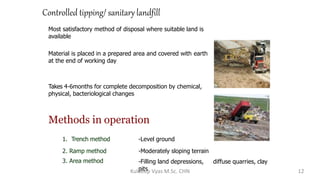
Controlled tipping/ sanitary landfill
Methods in operation
1. Trench method
2. Ramp method
3. Area method diffuse quarries, clay
-Level ground
-Moderately sloping terrain
-Filling land depressions,
pits
Most satisfactory method of disposal where suitable land is
available
Material is placed in a prepared area and covered with earth
at the end of working day
Takes 4-6months for complete decomposition by chemical,
physical, bacteriological changes
12Kuldeep Vyas M.Sc. CHN
13Kuldeep Vyas M.Sc. CHN
Mechanism
• Chemical, bacteriological & physical changes occur in buried refuse
• Temp. Raises to 600. C in 7 days & kills all the pathogens and hastens
decomposition
• Cools down in 2-3 weeks
• Complete decomposition to an innocuous mass takes place by 4-6 months
• This method has been revolutionized by mechanization. The bull dozer achieves
the tasks of spreading trimming and spreading top soil
14Kuldeep Vyas M.Sc. CHN
Incineration
It is hygienic method of disposal of refuse
Method of choice where suitable land is not available
Most suitable for hospital waste
Not a popular method in india because the refuse
contains a fair proportion of fine ash which makes
burning difficult
Drawbacks
Heavy outlay and expenditure
Manipulative difficulties
Loss to community in terms of much
needed manure 15Kuldeep Vyas M.Sc. CHN
Composting
Combined disposal of refuse and night soil or sludge
Organic matter Manure/humusBacteriological
action
Prinicipal by-products are carbondioxide, water, heat
Heat produced is >60deg over days destroys eggs, larvae of flies, weed seeds and
pathogenic agents
The end product-few or no disease producing organisms & is good soil builder
16Kuldeep Vyas M.Sc. CHN
Composting
Methods
Bangalore method (anaerobic/hot fermentation method)
Mechanical composting (aerobic method)
Bangalore method
Refuse(15cm)
Night soil(5cm)
Refuse
Night soil
Refuse
Earth
(25cm)
17Kuldeep Vyas M.Sc. CHN
Mechanicalcomposting
In this compost is manufactured on large scale by processing raw materials and turning
out a finished product
Refuse is cleared of salvagable materials
Pulverisation
Mixed with sewage, sludge or nightsoil in rotating machine
Incubated for 4-6weeks
In vogue in some developed countries
In india, govt is considering the installation of these plants in cities like delhi, hyd,
mumbai, chennai etc.,
18Kuldeep Vyas M.Sc. CHN
Composting: some benefits
Compost allows the soil to retain more plant nutrients over a longer period.
It supplies part of the 16 essential elements needed by the plants.
It helps reduce the adverse effects of excessive alkalinity, acidity, or
the excessive use of chemical fertilizer.
It makes soil easier to cultivate.
It helps keep the soil cool in summer and warm in winter.
It aids in preventing soil erosion by keeping the soil covered.
It helps in controlling the growth of weeds in the garden.
19Kuldeep Vyas M.Sc. CHN
Manure pits
• Method of refusal in rural area by individual householders
• The garbage, cattle dung, straw and leaves are dumped into the manure
pits and covered with earth after each day
• In 5-6 months of time refuse is converted into manure which can be
returned to fields
• Two such pits are created, when one is closed the other will be in use
20Kuldeep Vyas M.Sc. CHN
Burial
• Suitable for small camps
• A trench 1.5m wide and 2m deep is excavated,
and at end of each day the refuse is covered with 20-30cm of earth
• When level in the in the trench is 40 cms above the ground level, the
trench is filled with earth and compacted, and new trench is dug out
• The contents may be taken out after 4-6months and used
on fields 21Kuldeep Vyas M.Sc. CHN
• Do wait until you reach a waste bin to dispose of your litter.
• Do dispose of your garbage appropriately. Put garbage out in
secure containers for the appropriate collection only.
• Do empty away stagnant water that may accumulate in
your garbage bin and reduce the risk of dengue fever and other
disease
Do’s of solid waste
22Kuldeep Vyas M.Sc. CHN
• Do place only manageable amounts of garbage out in sturdy bags or
bins.
• Do wrap broken objects in newspaper before disposing of them in the
garbage to avoid injury to yourself and others including waste collection
staff.
• Do ensure that bags are securely tied and that waste is completely
covered inside of the bin.
Do’s of solid waste
23Kuldeep Vyas M.Sc. CHN
• Do not litter. If we drop litter it will encourage others to litter.
• Do not put out garbage too early, especially garbage that contains meat and fish
scraps.
• Do not dump or litter illegally at the sides of the roads or in gullies, it is not only
unsightly but dangerous and hazardous to health.
• Do not allow water to collect in your garbage bin.
Dont’s of solid waste
24Kuldeep Vyas M.Sc. CHN
• Do not throw broken objects (e.g. Glass, ceramic, etc.) Into the garbage without wrapping
them first.
• Do not overload your garbage bags; they may burst as a result of excessive weight or
bulk.
• Do not place needles and syringes in the garbage or leave them lying around.
• Do not compact waste in the waste bin. This makes it difficult to extract the waste.
Dont’s of solid waste
25Kuldeep Vyas M.Sc. CHN
Excreta disposal
26Kuldeep Vyas M.Sc. CHN
Public Health Importance
Human excreta is a source of infection
Important cause of environment pollution
Responsibility of society to dispose it safely
Failure to dispose safely leads to severe threat to public health
27Kuldeep Vyas M.Sc. CHN
Health hazards
Improper excreta disposal causes
Soil pollution
Water pollution
Contamination of foods
Propagation of flies
Burden to community in terms of sickness, mortality & low
expectation of life
Deterrent to social & economic progress 28Kuldeep Vyas M.Sc. CHN
Diseases-improper disposal
Bacterial: typhoid, dysenteries
Viral: hepatitis, diarrhoeas
Helminths: hook worm, ascariasis
29Kuldeep Vyas M.Sc. CHN
Extent of problem-India
74% of population is rural and majority of them go to fields for
defecation
Situation in urban area is equally worse
The solution to the problem is only through hygienic disposal of
human excreta which is a corner stone of all public health services
30Kuldeep Vyas M.Sc. CHN
HOW THE DISEASE IS CARRIED FROM EXCRETA
FAECES
FINGERS
FLUID/WATER
FLIES
FIELD/SOIL
FOOD NEW HOST
31Kuldeep Vyas M.Sc. CHN
Transmission of diseases to the human host is prevented by
segregation of faeces, protection of food, personal hygiene,
control of flies.
Transmission of faecal born diseases
32Kuldeep Vyas M.Sc. CHN
FAECES
FINGERS
WATER
FLIES
SOIL
FOOD
PROTECTED HOST
S
A
N
I
T
A
T
I
O
N
B
A
R
R
I
E
R
Sanitation barrier –
Transmission of faecal-borne diseases
33Kuldeep Vyas M.Sc. CHN
SANITATION BARRIER
Segregation of excreta by imposing a barrier is called Sanitation
barrier. This is the most effective step so that the disease agent
can not reach the new host directly or indirectly
34Kuldeep Vyas M.Sc. CHN
METHODS OF EXCRETA DISPOSAL
Unsewered Areas Sewered Areas
35Kuldeep Vyas M.Sc. CHN
Unsewered Areas
I) Service type (conservative)
II) Non service type (sanitary latrine)
1. Bore hole latrine
2. Dug well or pit latrine
3. Water-seal type of latrines
a) PRAI
b) RCA
c) SULABH
4. Septic tank
5. Aqua privy
III) Latrine suitable for camps & temporary use
• Shallow trench/deep trench/pit/bore hole latrines
36Kuldeep Vyas M.Sc. CHN
I) SERVICE TYPE
Night soil is collected from pail or bucket type of latrines by
human agency, and later disposed by burying or
composting.
37Kuldeep Vyas M.Sc. CHN
DRAWBACKS
Water pollution
Soil pollution
Access to flies
Corrosion of buckets and pans
Recruitment of staff is difficult (UNETHICAL), should be replaced
by sanitary latrine
38Kuldeep Vyas M.Sc. CHN
II) Non- Service type/ Sanitarylatrines
Criteria-
Excreta should not contaminate the ground or surface water
Excreta should not pollute the soil
Excreta should not be accessible to flies, rodents, animals & other
vehicles of transmission
Excreta should not create a nuisance due to odour or unsightly
appearance
39Kuldeep Vyas M.Sc. CHN
1.Borehole latrine
Forerunner of the non-service type of latrine
First introduced by Rockefeller foundation during 1930’s in campaigns of
hookworm control
It consists of a circular hole of 30 to 40 cm diameter and 4 to 8 m depth
Special equipment Auger is used
40Kuldeep Vyas M.Sc. CHN
41Kuldeep Vyas M.Sc. CHN
Contd.
The hole is lined with bamboo matting or earthen ware rings to prevent
caving of soil.
A concrete squatting plate with a central opening and foot rests paced
over the hole and an enclosure for privacy
It serves for a family per year
Night soil under goes anaerobic digestion.
42Kuldeep Vyas M.Sc. CHN
Contd.
MERITS
No need for sweeper for daily removal.
DEMERITS
Small capacity
Auger may not be available
If the soil is loose it becomes difficult to dig
43Kuldeep Vyas M.Sc. CHN
2.DUGWELL LATRINE/ PIT LATRINE
Introduced first in Singur in West Bengal in 1949-50
It is an improved Bore hole latrine
It is a circular pit of 75 cm diameter and 3 to 3.5
depth lined by pottery rings.
A squatting plate at the top with a super structure
44Kuldeep Vyas M.Sc. CHN
45Kuldeep Vyas M.Sc. CHN
Contd.
MERITS
No need of auger
Greater capacity
Last for 5 years per family
46Kuldeep Vyas M.Sc. CHN
3. WATER SEAL LATRINES
It has water seal which prevent access to flies
and escape of odour.
Modifications of water seal latrines
a) P.R.A.I evolved by planning research and action institute Lucknow.
b)R.C.A. type by research cum action projects in environmental sanitation
of ministry of health.
Direct type
Indirect
Type
47Kuldeep Vyas M.Sc. CHN
of
LOCATION: It should be away from source of water supply to prevent contamination.
SQUATTING PLATE or SLAB: It is made up of an impervious material to keep it clean
and dry. So that it will not facilitate the
growth of hook warm larva.
Dimensions 90 cms square,
5cms thickness, slop ½ inch for drainage
water with footrests.
RCA Latrine (more popular)
48Kuldeep Vyas M.Sc. CHN
Pan: Receives the night soil, urine and wash water. The length of pan is
42.5cm. The width of the front portion of the pan has a minimum of 12.5cm
and the width at widest portion is 20cm. There is a uniform slope from front
to back of the pan and the pan is given a smooth finish
49Kuldeep Vyas M.Sc. CHN
Trap: the trap is a bent pipe, about 7.5cm in diameter and is connected with
the pan. It holds water and provides the necessary water seal
the water seal provides the access by flies and suppresses the nuisance
from smell
2cm
50Kuldeep Vyas M.Sc. CHN
Connecting pipe: when the pit is dug, away from the squat plate, the trap is
connected to the pit by a short length of connecting pipe 7.5cm in diameter
and at least 1m in length with a bend at the end
it is used in indirect type and the advantage with this is that when the pit fills
up, a second pit can be put into operation
51Kuldeep Vyas M.Sc. CHN
1
2
3
4
5
Indirect Type 52Kuldeep Vyas M.Sc. CHN
Dug well: 75 cm in diameter, 3-3.5m deep
Superstructure: Attractive superstructure
Maintenance: Proper maintenance involves health education of the
people which is very necessary for the success of any sanitation related
programme
53Kuldeep Vyas M.Sc. CHN
Comparison of Direct and Indirect type Water Seal Latrines
Direct type Indirect type
• Pit is below the squatting plate
• Best for areas with hard ground
• Cheaper
• Easy construction
• Occupies less space
• Pit is away from the squatting plate
• When the pit is full, direction of
connecting pipe can be changed to
another pit
• Preferred over direct type
54Kuldeep Vyas M.Sc. CHN
c) Sulabh Shauchalya
Low cost water-seal type latrine by Patna based firm. 5Rs/use charged 55Kuldeep Vyas M.Sc. CHN
It is a water tight masonry tank used for individual dwelling, small
groups of houses and institutions.
DESIGN: Single chambered or double chambered.
CAPACITY: 20 to 30 gallons per person for household with a
minimum of 500 gallons.
4.SEPTIC TANK
56Kuldeep Vyas M.Sc. CHN
LENGTH: Twice the breadth.
DEPTH: 1.5 to 2 meters.
LIQUID DEPTH: 1.2 meters.
AIR SPACE: 30cms It is the level between
liquid and undersurface of cover.
BOTTOM: Sloping towards inlet end for
retentions of solids.
INLET AND OUTLET:
COVER: Concrete slab with a manhole.
RETENSION PERIOD: 24hrs if it is too small
inadequate treatment too long undue septicity occurs
57Kuldeep Vyas M.Sc. CHN
• WORKING: That is purification of sewage by 2 stages
Anaerobic digestion in septic tank proper
Aerobic oxidation out side the septic tank in the sub soil
Sludge and scum  anaerobic digestion  effluent  aerobic oxidation
Septic tank-contd.
58Kuldeep Vyas M.Sc. CHN
MAINTAINANCE: Disinfectants should be avoided as they are
injurious to bacterial flora of tank.
De sludging should be done as excessive accumulation interfere
with proper working
Newly built tanks first fill with water up to the outlet then with sludge
to provide right type of bacteria to carry out decomposition process.
Septic tank-contd.
59Kuldeep Vyas M.Sc. CHN
5.Aqua Privy
• Similar to septic tank
• For a family per 6 years
60Kuldeep Vyas M.Sc. CHN
III) Latrines suitable for temporary use/ camps
1. Shallow trench latrine
2. Deep trench latrine
3. Pit latrine
4. Borehole latrine
61Kuldeep Vyas M.Sc. CHN
Trench Latrines
Dug up Earth
piled up on
the side for
covering
62Kuldeep Vyas M.Sc. CHN
Trench Latrines
Shallow trench latrine Deep trench latrine
• 30 cm wide
• 90-150 cm deep
• Serves for a week
• 75-90cm wide
• 1.8 – 2.5cm deep
• Serves for weeks to months
63Kuldeep Vyas M.Sc. CHN
Next class-Sewered areas and sewaget/t
64Kuldeep Vyas M.Sc. CHN
Thank you...
65Kuldeep Vyas M.Sc. CHN

Environment - Solid Waste and Excreta Disposal

  • 1.
    Environment SOLID WASTE MANAGEMENTAND EXCRETA DISPOSAL Kuldeep Vyas Asst. Prof Community 1Kuldeep Vyas M.Sc. CHN
  • 2.
  • 3.
    Solid waste • Garbage(food waste) • Rubbish (paper, plastic, wood, glass etc.) • Demolition products (bricks, masonry) • Sewage treatment residue (sludge & solids) • Dead animals • Manure & other discarded material  Strictly speaking it should not contain night soil  The per capita daily production is 0.25 to 2.5 kg 3Kuldeep Vyas M.Sc. CHN
  • 4.
    Solid waste-health hazards •On accumulation it decomposes & favors fly breeding • Attracts rodents & vermin • Pathogens present in waste may be conveyed back to man’s food through flies & dust • Possibility of water & soil pollution • Unsightly appearance • Nuisance from bad odours There is a correlation between improper disposal of solid wastes & incidence of vector borne diseases 4Kuldeep Vyas M.Sc. CHN
  • 5.
    Sources of solidwaste Domestic Refuse Industrial refuse Ash Rubbish Garbage 5Kuldeep Vyas M.Sc. CHN
  • 6.
    Street refuse Leaves, straw,paper Market refuse Putrid vegetable & animal matter Stable litter Animal droppings, left over animal feeds 6Kuldeep Vyas M.Sc. CHN
  • 7.
    Solid waste-storage • Firstconsideration is to proper storage of refuse while awaiting collection • The galvanized steel dust bin with close fitting cover is a suitable for storing • The output of refuse per capita per day in india is estimated to vary from 1/10-1/20c.Ft. For a family of 5 members • The public bins in India are without cover • They are placed on concrete platform raised 2-3 inches above ground level to prevent flood water entering the bins 7Kuldeep Vyas M.Sc. CHN
  • 8.
    Storage Public bins Papersacs Galvanized steel dustbins Household 8Kuldeep Vyas M.Sc. CHN
  • 9.
    Collection House to housecollection Rag pickers Refuse collection vehicles • Open type • Enclosed 9Kuldeep Vyas M.Sc. CHN
  • 10.
    Methods of disposal •Dumping • Controlled tipping or sanitary land fill • Incineration • Composting • Manure pits • Burial 10Kuldeep Vyas M.Sc. CHN
  • 11.
    Dumping Method of disposalin low lying areas Partly as method of reclamation of land Mainly as method of disposal of dry refuse Drawbacks Exposure to flies and rodents Unsightly appearance and bad odour Dispersion by action of wind Pollution of surface and ground water 11Kuldeep Vyas M.Sc. CHN
  • 12.
    Controlled tipping/ sanitarylandfill Methods in operation 1. Trench method 2. Ramp method 3. Area method diffuse quarries, clay -Level ground -Moderately sloping terrain -Filling land depressions, pits Most satisfactory method of disposal where suitable land is available Material is placed in a prepared area and covered with earth at the end of working day Takes 4-6months for complete decomposition by chemical, physical, bacteriological changes 12Kuldeep Vyas M.Sc. CHN
  • 13.
  • 14.
    Mechanism • Chemical, bacteriological& physical changes occur in buried refuse • Temp. Raises to 600. C in 7 days & kills all the pathogens and hastens decomposition • Cools down in 2-3 weeks • Complete decomposition to an innocuous mass takes place by 4-6 months • This method has been revolutionized by mechanization. The bull dozer achieves the tasks of spreading trimming and spreading top soil 14Kuldeep Vyas M.Sc. CHN
  • 15.
    Incineration It is hygienicmethod of disposal of refuse Method of choice where suitable land is not available Most suitable for hospital waste Not a popular method in india because the refuse contains a fair proportion of fine ash which makes burning difficult Drawbacks Heavy outlay and expenditure Manipulative difficulties Loss to community in terms of much needed manure 15Kuldeep Vyas M.Sc. CHN
  • 16.
    Composting Combined disposal ofrefuse and night soil or sludge Organic matter Manure/humusBacteriological action Prinicipal by-products are carbondioxide, water, heat Heat produced is >60deg over days destroys eggs, larvae of flies, weed seeds and pathogenic agents The end product-few or no disease producing organisms & is good soil builder 16Kuldeep Vyas M.Sc. CHN
  • 17.
    Composting Methods Bangalore method (anaerobic/hotfermentation method) Mechanical composting (aerobic method) Bangalore method Refuse(15cm) Night soil(5cm) Refuse Night soil Refuse Earth (25cm) 17Kuldeep Vyas M.Sc. CHN
  • 18.
    Mechanicalcomposting In this compostis manufactured on large scale by processing raw materials and turning out a finished product Refuse is cleared of salvagable materials Pulverisation Mixed with sewage, sludge or nightsoil in rotating machine Incubated for 4-6weeks In vogue in some developed countries In india, govt is considering the installation of these plants in cities like delhi, hyd, mumbai, chennai etc., 18Kuldeep Vyas M.Sc. CHN
  • 19.
    Composting: some benefits Compostallows the soil to retain more plant nutrients over a longer period. It supplies part of the 16 essential elements needed by the plants. It helps reduce the adverse effects of excessive alkalinity, acidity, or the excessive use of chemical fertilizer. It makes soil easier to cultivate. It helps keep the soil cool in summer and warm in winter. It aids in preventing soil erosion by keeping the soil covered. It helps in controlling the growth of weeds in the garden. 19Kuldeep Vyas M.Sc. CHN
  • 20.
    Manure pits • Methodof refusal in rural area by individual householders • The garbage, cattle dung, straw and leaves are dumped into the manure pits and covered with earth after each day • In 5-6 months of time refuse is converted into manure which can be returned to fields • Two such pits are created, when one is closed the other will be in use 20Kuldeep Vyas M.Sc. CHN
  • 21.
    Burial • Suitable forsmall camps • A trench 1.5m wide and 2m deep is excavated, and at end of each day the refuse is covered with 20-30cm of earth • When level in the in the trench is 40 cms above the ground level, the trench is filled with earth and compacted, and new trench is dug out • The contents may be taken out after 4-6months and used on fields 21Kuldeep Vyas M.Sc. CHN
  • 22.
    • Do waituntil you reach a waste bin to dispose of your litter. • Do dispose of your garbage appropriately. Put garbage out in secure containers for the appropriate collection only. • Do empty away stagnant water that may accumulate in your garbage bin and reduce the risk of dengue fever and other disease Do’s of solid waste 22Kuldeep Vyas M.Sc. CHN
  • 23.
    • Do placeonly manageable amounts of garbage out in sturdy bags or bins. • Do wrap broken objects in newspaper before disposing of them in the garbage to avoid injury to yourself and others including waste collection staff. • Do ensure that bags are securely tied and that waste is completely covered inside of the bin. Do’s of solid waste 23Kuldeep Vyas M.Sc. CHN
  • 24.
    • Do notlitter. If we drop litter it will encourage others to litter. • Do not put out garbage too early, especially garbage that contains meat and fish scraps. • Do not dump or litter illegally at the sides of the roads or in gullies, it is not only unsightly but dangerous and hazardous to health. • Do not allow water to collect in your garbage bin. Dont’s of solid waste 24Kuldeep Vyas M.Sc. CHN
  • 25.
    • Do notthrow broken objects (e.g. Glass, ceramic, etc.) Into the garbage without wrapping them first. • Do not overload your garbage bags; they may burst as a result of excessive weight or bulk. • Do not place needles and syringes in the garbage or leave them lying around. • Do not compact waste in the waste bin. This makes it difficult to extract the waste. Dont’s of solid waste 25Kuldeep Vyas M.Sc. CHN
  • 26.
  • 27.
    Public Health Importance Humanexcreta is a source of infection Important cause of environment pollution Responsibility of society to dispose it safely Failure to dispose safely leads to severe threat to public health 27Kuldeep Vyas M.Sc. CHN
  • 28.
    Health hazards Improper excretadisposal causes Soil pollution Water pollution Contamination of foods Propagation of flies Burden to community in terms of sickness, mortality & low expectation of life Deterrent to social & economic progress 28Kuldeep Vyas M.Sc. CHN
  • 29.
    Diseases-improper disposal Bacterial: typhoid,dysenteries Viral: hepatitis, diarrhoeas Helminths: hook worm, ascariasis 29Kuldeep Vyas M.Sc. CHN
  • 30.
    Extent of problem-India 74%of population is rural and majority of them go to fields for defecation Situation in urban area is equally worse The solution to the problem is only through hygienic disposal of human excreta which is a corner stone of all public health services 30Kuldeep Vyas M.Sc. CHN
  • 31.
    HOW THE DISEASEIS CARRIED FROM EXCRETA FAECES FINGERS FLUID/WATER FLIES FIELD/SOIL FOOD NEW HOST 31Kuldeep Vyas M.Sc. CHN
  • 32.
    Transmission of diseasesto the human host is prevented by segregation of faeces, protection of food, personal hygiene, control of flies. Transmission of faecal born diseases 32Kuldeep Vyas M.Sc. CHN
  • 33.
  • 34.
    SANITATION BARRIER Segregation ofexcreta by imposing a barrier is called Sanitation barrier. This is the most effective step so that the disease agent can not reach the new host directly or indirectly 34Kuldeep Vyas M.Sc. CHN
  • 35.
    METHODS OF EXCRETADISPOSAL Unsewered Areas Sewered Areas 35Kuldeep Vyas M.Sc. CHN
  • 36.
    Unsewered Areas I) Servicetype (conservative) II) Non service type (sanitary latrine) 1. Bore hole latrine 2. Dug well or pit latrine 3. Water-seal type of latrines a) PRAI b) RCA c) SULABH 4. Septic tank 5. Aqua privy III) Latrine suitable for camps & temporary use • Shallow trench/deep trench/pit/bore hole latrines 36Kuldeep Vyas M.Sc. CHN
  • 37.
    I) SERVICE TYPE Nightsoil is collected from pail or bucket type of latrines by human agency, and later disposed by burying or composting. 37Kuldeep Vyas M.Sc. CHN
  • 38.
    DRAWBACKS Water pollution Soil pollution Accessto flies Corrosion of buckets and pans Recruitment of staff is difficult (UNETHICAL), should be replaced by sanitary latrine 38Kuldeep Vyas M.Sc. CHN
  • 39.
    II) Non- Servicetype/ Sanitarylatrines Criteria- Excreta should not contaminate the ground or surface water Excreta should not pollute the soil Excreta should not be accessible to flies, rodents, animals & other vehicles of transmission Excreta should not create a nuisance due to odour or unsightly appearance 39Kuldeep Vyas M.Sc. CHN
  • 40.
    1.Borehole latrine Forerunner ofthe non-service type of latrine First introduced by Rockefeller foundation during 1930’s in campaigns of hookworm control It consists of a circular hole of 30 to 40 cm diameter and 4 to 8 m depth Special equipment Auger is used 40Kuldeep Vyas M.Sc. CHN
  • 41.
  • 42.
    Contd. The hole islined with bamboo matting or earthen ware rings to prevent caving of soil. A concrete squatting plate with a central opening and foot rests paced over the hole and an enclosure for privacy It serves for a family per year Night soil under goes anaerobic digestion. 42Kuldeep Vyas M.Sc. CHN
  • 43.
    Contd. MERITS No need forsweeper for daily removal. DEMERITS Small capacity Auger may not be available If the soil is loose it becomes difficult to dig 43Kuldeep Vyas M.Sc. CHN
  • 44.
    2.DUGWELL LATRINE/ PITLATRINE Introduced first in Singur in West Bengal in 1949-50 It is an improved Bore hole latrine It is a circular pit of 75 cm diameter and 3 to 3.5 depth lined by pottery rings. A squatting plate at the top with a super structure 44Kuldeep Vyas M.Sc. CHN
  • 45.
  • 46.
    Contd. MERITS No need ofauger Greater capacity Last for 5 years per family 46Kuldeep Vyas M.Sc. CHN
  • 47.
    3. WATER SEALLATRINES It has water seal which prevent access to flies and escape of odour. Modifications of water seal latrines a) P.R.A.I evolved by planning research and action institute Lucknow. b)R.C.A. type by research cum action projects in environmental sanitation of ministry of health. Direct type Indirect Type 47Kuldeep Vyas M.Sc. CHN
  • 48.
    of LOCATION: It shouldbe away from source of water supply to prevent contamination. SQUATTING PLATE or SLAB: It is made up of an impervious material to keep it clean and dry. So that it will not facilitate the growth of hook warm larva. Dimensions 90 cms square, 5cms thickness, slop ½ inch for drainage water with footrests. RCA Latrine (more popular) 48Kuldeep Vyas M.Sc. CHN
  • 49.
    Pan: Receives thenight soil, urine and wash water. The length of pan is 42.5cm. The width of the front portion of the pan has a minimum of 12.5cm and the width at widest portion is 20cm. There is a uniform slope from front to back of the pan and the pan is given a smooth finish 49Kuldeep Vyas M.Sc. CHN
  • 50.
    Trap: the trapis a bent pipe, about 7.5cm in diameter and is connected with the pan. It holds water and provides the necessary water seal the water seal provides the access by flies and suppresses the nuisance from smell 2cm 50Kuldeep Vyas M.Sc. CHN
  • 51.
    Connecting pipe: whenthe pit is dug, away from the squat plate, the trap is connected to the pit by a short length of connecting pipe 7.5cm in diameter and at least 1m in length with a bend at the end it is used in indirect type and the advantage with this is that when the pit fills up, a second pit can be put into operation 51Kuldeep Vyas M.Sc. CHN
  • 52.
  • 53.
    Dug well: 75cm in diameter, 3-3.5m deep Superstructure: Attractive superstructure Maintenance: Proper maintenance involves health education of the people which is very necessary for the success of any sanitation related programme 53Kuldeep Vyas M.Sc. CHN
  • 54.
    Comparison of Directand Indirect type Water Seal Latrines Direct type Indirect type • Pit is below the squatting plate • Best for areas with hard ground • Cheaper • Easy construction • Occupies less space • Pit is away from the squatting plate • When the pit is full, direction of connecting pipe can be changed to another pit • Preferred over direct type 54Kuldeep Vyas M.Sc. CHN
  • 55.
    c) Sulabh Shauchalya Lowcost water-seal type latrine by Patna based firm. 5Rs/use charged 55Kuldeep Vyas M.Sc. CHN
  • 56.
    It is awater tight masonry tank used for individual dwelling, small groups of houses and institutions. DESIGN: Single chambered or double chambered. CAPACITY: 20 to 30 gallons per person for household with a minimum of 500 gallons. 4.SEPTIC TANK 56Kuldeep Vyas M.Sc. CHN
  • 57.
    LENGTH: Twice thebreadth. DEPTH: 1.5 to 2 meters. LIQUID DEPTH: 1.2 meters. AIR SPACE: 30cms It is the level between liquid and undersurface of cover. BOTTOM: Sloping towards inlet end for retentions of solids. INLET AND OUTLET: COVER: Concrete slab with a manhole. RETENSION PERIOD: 24hrs if it is too small inadequate treatment too long undue septicity occurs 57Kuldeep Vyas M.Sc. CHN
  • 58.
    • WORKING: Thatis purification of sewage by 2 stages Anaerobic digestion in septic tank proper Aerobic oxidation out side the septic tank in the sub soil Sludge and scum  anaerobic digestion  effluent  aerobic oxidation Septic tank-contd. 58Kuldeep Vyas M.Sc. CHN
  • 59.
    MAINTAINANCE: Disinfectants shouldbe avoided as they are injurious to bacterial flora of tank. De sludging should be done as excessive accumulation interfere with proper working Newly built tanks first fill with water up to the outlet then with sludge to provide right type of bacteria to carry out decomposition process. Septic tank-contd. 59Kuldeep Vyas M.Sc. CHN
  • 60.
    5.Aqua Privy • Similarto septic tank • For a family per 6 years 60Kuldeep Vyas M.Sc. CHN
  • 61.
    III) Latrines suitablefor temporary use/ camps 1. Shallow trench latrine 2. Deep trench latrine 3. Pit latrine 4. Borehole latrine 61Kuldeep Vyas M.Sc. CHN
  • 62.
    Trench Latrines Dug upEarth piled up on the side for covering 62Kuldeep Vyas M.Sc. CHN
  • 63.
    Trench Latrines Shallow trenchlatrine Deep trench latrine • 30 cm wide • 90-150 cm deep • Serves for a week • 75-90cm wide • 1.8 – 2.5cm deep • Serves for weeks to months 63Kuldeep Vyas M.Sc. CHN
  • 64.
    Next class-Sewered areasand sewaget/t 64Kuldeep Vyas M.Sc. CHN
  • 65.