Epidemiology
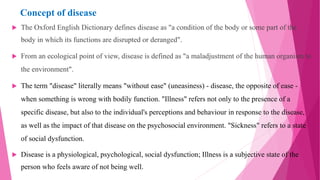
Concept of disease
 The Oxford English Dictionary defines disease as "a condition of the body or some part of the
body in which its functions are disrupted or deranged".
 From an ecological point of view, disease is defined as "a maladjustment of the human organism to
the environment".
 The term "disease" literally means "without ease" (uneasiness) - disease, the opposite of ease -
when something is wrong with bodily function. "Illness" refers not only to the presence of a

specific disease, but also to the individual's perceptions and behaviour in response to the disease,
as well as the impact of that disease on the psychosocial environment. "Sickness" refers to a state
of social dysfunction.
 Disease is a physiological, psychological, social dysfunction; Illness is a subjective state of the
person who feels aware of not being well.
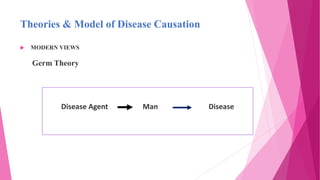
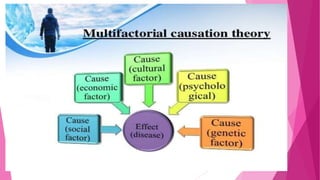
Theories & Model of Disease Causation
 MODERN VIEWS
Germ Theory
Disease Agent Man Disease
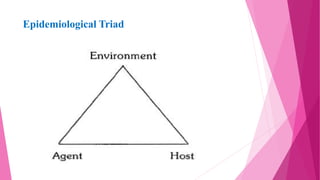
Epidemiological Triad
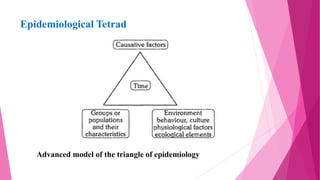
Epidemiological Tetrad
Advanced model of the triangle of epidemiology
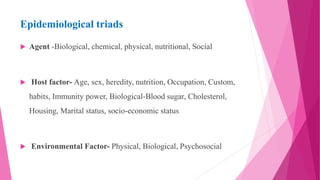
Epidemiological triads
 Agent -Biological, chemical, physical, nutritional, Social
 Host factor- Age, sex, heredity, nutrition, Occupation, Custom,
habits, Immunity power, Biological-Blood sugar, Cholesterol,
Housing, Marital status, socio-economic status
 Environmental Factor- Physical, Biological, Psychosocial
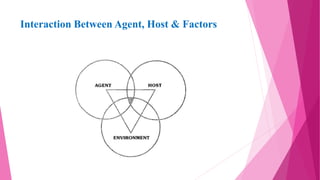
Interaction Between Agent, Host & Factors
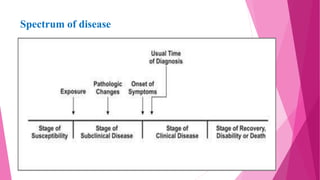
Spectrum of disease
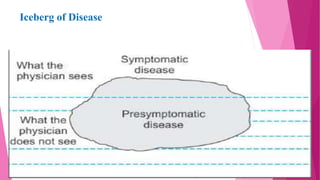
Iceberg of Disease
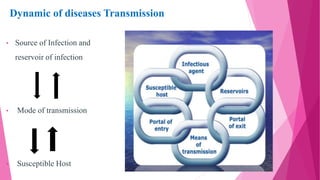
Dynamic of diseases Transmission
• Source of Infection and
reservoir of infection
• Mode of transmission
• Susceptible Host
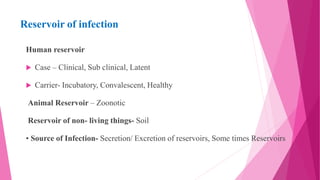
Reservoir of infection
Human reservoir
 Case – Clinical, Sub clinical, Latent
 Carrier- Incubatory, Convalescent, Healthy
Animal Reservoir – Zoonotic
Reservoir of non- living things- Soil
• Source of Infection- Secretion/ Excretion of reservoirs, Some times Reservoirs
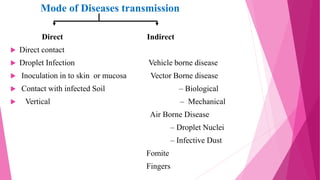
Mode of Diseases transmission
Direct Indirect
 Direct contact
 Droplet Infection Vehicle borne disease
 Inoculation in to skin or mucosa Vector Borne disease
 Contact with infected Soil – Biological
 Vertical – Mechanical
Air Borne Disease
– Droplet Nuclei
– Infective Dust
Fomite
Fingers
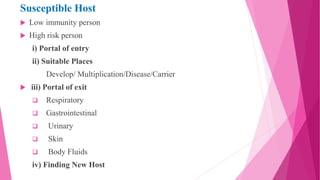
Susceptible Host
 Low immunity person
 High risk person
i) Portal of entry
ii) Suitable Places
Develop/ Multiplication/Disease/Carrier
 iii) Portal of exit
 Respiratory
 Gastrointestinal
 Urinary
 Skin
 Body Fluids
iv) Finding New Host
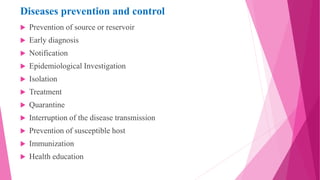
Diseases prevention and control
 Prevention of source or reservoir
 Early diagnosis
 Notification
 Epidemiological Investigation
 Isolation
 Treatment
 Quarantine
 Interruption of the disease transmission
 Prevention of susceptible host
 Immunization
 Health education
Levels of Prevention
Prevention is better Than Cure…!
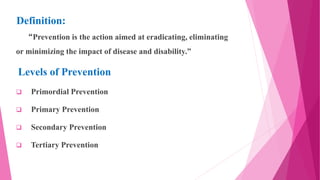
Definition:
“Prevention is the action aimed at eradicating, eliminating
or minimizing the impact of disease and disability.”
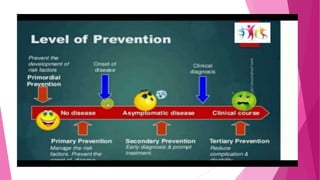
Levels of Prevention
 Primordial Prevention
 Primary Prevention
 Secondary Prevention
 Tertiary Prevention
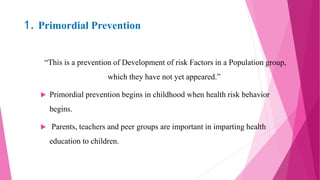
1. Primordial Prevention
“This is a prevention of Development of risk Factors in a Population group,
which they have not yet appeared.”
 Primordial prevention begins in childhood when health risk behavior
begins.
 Parents, teachers and peer groups are important in imparting health
education to children.
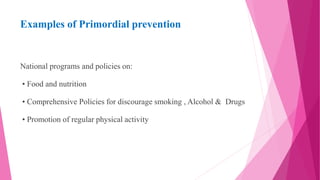
Examples of Primordial prevention
National programs and policies on:
• Food and nutrition
• Comprehensive Policies for discourage smoking , Alcohol & Drugs
• Promotion of regular physical activity
2. Primary Prevention
“Primary prevention can be defined as the action taken prior to
the onset of disease, which removes the possibility that the
disease will ever occur.”
3. Secondary prevention
 Secondary prevention can be defined as "action which halts the progress of
a disease at its incipient stage and prevents complications".
 The specific interventions are :
early diagnosis (e.g., screening tests, case finding programmes) and
adequate treatment &
Referral
Secondary prevention is largely the domain of clinical medicine. The
health programmes initiated by governments are usually at the level of
secondary prevention.
4. Tertiary prevention
 Tertiary prevention can be defined as "all measures available to reduce or limit
impairments and disabilities, minimize suffering caused by existing departures
from good health and to promote the patient's adjustment to irremediable
conditions".
 For example, treatment may prevent sequelae and limit disability. When defect
and disability are more or less stabilized, rehabilitation may play a preventable
role.
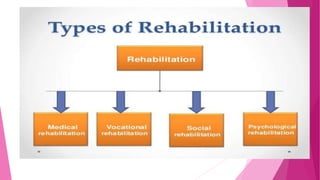
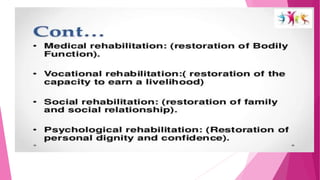
 Modern rehabilitation includes psychosocial, vocational, and medical
components based on team work from a variety of professions.
Modes of Intervention
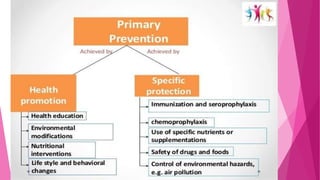
 1. Health promotion
 2. Specific protection
 3. Early diagnosis and treatment
 4. Disability limitation
 5. Rehabilitation
Health promotion
i. Health Education
ii. Environmental Modifications
iii. Nutritional Interventions
iv. Lifestyle And Behavioral Changes
Specific protection
 Immunization
 Use Of Specific Nutrients
 Chemoprophylaxis
 Protection Against Occupational Hazards
 Protection Against Accidents
 Protection From Carcinogens
 Avoidance Of Allergens
 The Control Of Specific Hazards In The General Environment, Air
Pollution, Noise Control
 Control Of Consumer Product Quality And Safety Of Foods, Drugs, Cosmetics,
Etc.
Early diagnosis and treatment
@ the main interventions of disease control. The earlier a disease is
diagnosed and treated the better it is from the point of view of
@ better prognosis and preventing the occurrence of secondary
cases or any long-term disability
@ It is like stamping out the "spark" rather than calling the fire
brigade to put out the fire.
Disability limitation
 to prevent or halt the transition of the disease process from impairment to handicap.
Rehabilitation
 “the combined and coordinated use of medical, social, educational and vocational
measures for training and retraining the individual to the highest possible level of
functional ability”
 aimed at reducing the impact of disabling and handicapping conditions and at enabling
the disabled and handicapped to achieve social integration .
 Social integration has been defined as the active participation of disabled and
handicapped people in the mainstream of community life.
Role of a nurse in epidemiology
 Role of a nurse in epidemiology can be explained in 4 aspects.
These are:
1. Preventive role
2. Promotive role
3. Curative role
4. Rehabilitative role
Epidemiology PPT.pptx

Epidemiology PPT.pptx

  • 1.
  • 2.
    Concept of disease The Oxford English Dictionary defines disease as "a condition of the body or some part of the body in which its functions are disrupted or deranged".  From an ecological point of view, disease is defined as "a maladjustment of the human organism to the environment".  The term "disease" literally means "without ease" (uneasiness) - disease, the opposite of ease - when something is wrong with bodily function. "Illness" refers not only to the presence of a specific disease, but also to the individual's perceptions and behaviour in response to the disease, as well as the impact of that disease on the psychosocial environment. "Sickness" refers to a state of social dysfunction.  Disease is a physiological, psychological, social dysfunction; Illness is a subjective state of the person who feels aware of not being well.
  • 3.
    Theories & Modelof Disease Causation  MODERN VIEWS Germ Theory Disease Agent Man Disease
  • 4.
  • 5.
    Epidemiological Tetrad Advanced modelof the triangle of epidemiology
  • 6.
    Epidemiological triads  Agent-Biological, chemical, physical, nutritional, Social  Host factor- Age, sex, heredity, nutrition, Occupation, Custom, habits, Immunity power, Biological-Blood sugar, Cholesterol, Housing, Marital status, socio-economic status  Environmental Factor- Physical, Biological, Psychosocial
  • 8.
  • 9.
  • 10.
  • 11.
    Dynamic of diseasesTransmission • Source of Infection and reservoir of infection • Mode of transmission • Susceptible Host
  • 12.
    Reservoir of infection Humanreservoir  Case – Clinical, Sub clinical, Latent  Carrier- Incubatory, Convalescent, Healthy Animal Reservoir – Zoonotic Reservoir of non- living things- Soil • Source of Infection- Secretion/ Excretion of reservoirs, Some times Reservoirs
  • 13.
    Mode of Diseasestransmission Direct Indirect  Direct contact  Droplet Infection Vehicle borne disease  Inoculation in to skin or mucosa Vector Borne disease  Contact with infected Soil – Biological  Vertical – Mechanical Air Borne Disease – Droplet Nuclei – Infective Dust Fomite Fingers
  • 14.
    Susceptible Host  Lowimmunity person  High risk person i) Portal of entry ii) Suitable Places Develop/ Multiplication/Disease/Carrier  iii) Portal of exit  Respiratory  Gastrointestinal  Urinary  Skin  Body Fluids iv) Finding New Host
  • 15.
    Diseases prevention andcontrol  Prevention of source or reservoir  Early diagnosis  Notification  Epidemiological Investigation  Isolation  Treatment  Quarantine  Interruption of the disease transmission  Prevention of susceptible host  Immunization  Health education
  • 16.
    Levels of Prevention Preventionis better Than Cure…!
  • 17.
    Definition: “Prevention is theaction aimed at eradicating, eliminating or minimizing the impact of disease and disability.” Levels of Prevention  Primordial Prevention  Primary Prevention  Secondary Prevention  Tertiary Prevention
  • 19.
    1. Primordial Prevention “Thisis a prevention of Development of risk Factors in a Population group, which they have not yet appeared.”  Primordial prevention begins in childhood when health risk behavior begins.  Parents, teachers and peer groups are important in imparting health education to children.
  • 20.
    Examples of Primordialprevention National programs and policies on: • Food and nutrition • Comprehensive Policies for discourage smoking , Alcohol & Drugs • Promotion of regular physical activity
  • 21.
    2. Primary Prevention “Primaryprevention can be defined as the action taken prior to the onset of disease, which removes the possibility that the disease will ever occur.”
  • 23.
    3. Secondary prevention Secondary prevention can be defined as "action which halts the progress of a disease at its incipient stage and prevents complications".  The specific interventions are : early diagnosis (e.g., screening tests, case finding programmes) and adequate treatment & Referral Secondary prevention is largely the domain of clinical medicine. The health programmes initiated by governments are usually at the level of secondary prevention.
  • 24.
    4. Tertiary prevention Tertiary prevention can be defined as "all measures available to reduce or limit impairments and disabilities, minimize suffering caused by existing departures from good health and to promote the patient's adjustment to irremediable conditions".  For example, treatment may prevent sequelae and limit disability. When defect and disability are more or less stabilized, rehabilitation may play a preventable role.  Modern rehabilitation includes psychosocial, vocational, and medical components based on team work from a variety of professions.
  • 25.
    Modes of Intervention 1. Health promotion  2. Specific protection  3. Early diagnosis and treatment  4. Disability limitation  5. Rehabilitation
  • 26.
    Health promotion i. HealthEducation ii. Environmental Modifications iii. Nutritional Interventions iv. Lifestyle And Behavioral Changes
  • 27.
    Specific protection  Immunization Use Of Specific Nutrients  Chemoprophylaxis  Protection Against Occupational Hazards  Protection Against Accidents  Protection From Carcinogens  Avoidance Of Allergens  The Control Of Specific Hazards In The General Environment, Air Pollution, Noise Control  Control Of Consumer Product Quality And Safety Of Foods, Drugs, Cosmetics, Etc.
  • 28.
    Early diagnosis andtreatment @ the main interventions of disease control. The earlier a disease is diagnosed and treated the better it is from the point of view of @ better prognosis and preventing the occurrence of secondary cases or any long-term disability @ It is like stamping out the "spark" rather than calling the fire brigade to put out the fire. Disability limitation  to prevent or halt the transition of the disease process from impairment to handicap.
  • 29.
    Rehabilitation  “the combinedand coordinated use of medical, social, educational and vocational measures for training and retraining the individual to the highest possible level of functional ability”  aimed at reducing the impact of disabling and handicapping conditions and at enabling the disabled and handicapped to achieve social integration .  Social integration has been defined as the active participation of disabled and handicapped people in the mainstream of community life.
  • 33.
    Role of anurse in epidemiology  Role of a nurse in epidemiology can be explained in 4 aspects. These are: 1. Preventive role 2. Promotive role 3. Curative role 4. Rehabilitative role