Michael Tarekegn ( MD , MPH )
Concepts of Disease prevention and control
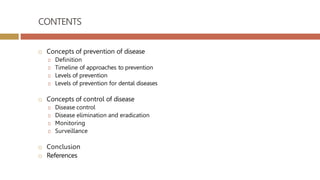
CONTENTS
 Concepts of prevention of disease
🞑 Definition
🞑 Timeline of approaches to prevention
🞑 Levels of prevention
🞑 Levels of prevention for dental diseases
 Concepts of control of disease
🞑 Disease control
🞑 Disease elimination and eradication
🞑 Monitoring
🞑 Surveillance
 Conclusion
 References
CONCEPTS OF PREVENTION
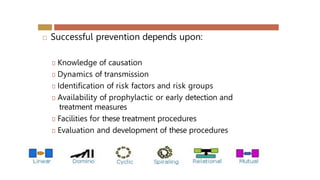
 Successful prevention depends upon:
🞑 Knowledge of causation
🞑 Dynamics of transmission
🞑 Identification of risk factors and risk groups
🞑 Availability of prophylactic or early detection and
treatment measures
🞑 Facilities for these treatment procedures
🞑 Evaluation and development of these procedures
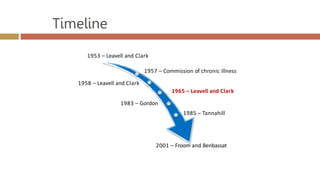
Timeline
1953 – Leavell and Clark
1957 – Commission of chronic illness
1958 – Leavell and Clark
1965 – Leavell and Clark
1983 – Gordon
1985 – Tannahill
2001 – Froom and Benbassat
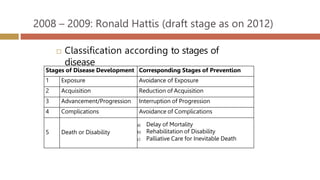
2008 – 2009: Ronald Hattis (draft stage as on 2012)
 Classification according to stages of
disease
Stages of Disease Development Corresponding Stages of Prevention
1 Exposure Avoidance of Exposure
2 Acquisition Reduction of Acquisition
3 Advancement/Progression Interruption of Progression
4 Complications Avoidance of Complications
5 Death or Disability
a) Delay of Mortality
b) Rehabilitation of Disability
c) Palliative Care for Inevitable Death
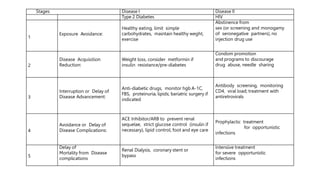
Stages Disease I Disease II
Type 2 Diabetes HIV
1
Exposure Avoidance:
Healthy eating, limit simple
carbohydrates, maintain healthy weght,
exercise
Abstinence from
sex (or screening and monogamy
of seronegative partners), no
injection drug use
2
Disease Acquisition
Reduction:
Weight loss, consider metformin if
insulin resistance/pre-diabetes
Condom promotion
and programs to discourage
drug abuse, needle sharing
3
Interruption or Delay of
Disease Advancement:
Anti-diabetic drugs, monitor hgb A-1C,
FBS, proteinuria, lipids; bariatric surgery if
indicated
Antibody screening, monitoring
CD4, viral load; treatment with
antiretrovirals
4
Avoidance or Delay of
Disease Complications:
ACE Inhibitor/ARB to prevent renal
sequelae, strict glucose control (insulin if
necessary), lipid control, foot and eye care
Prophylactic treatment
for opportunistic
infections
5
Delay of
Mortality from Disease
complications
Renal Dialysis, coronary stent or
bypass
Intensive treatment
for severe opportunistic
infections
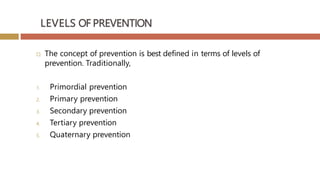
LEVELS OF PREVENTION
 The concept of prevention is best defined in terms of levels of
prevention. Traditionally,
1. Primordial prevention
2. Primary prevention
3. Secondary prevention
4. Tertiary prevention
5. Quaternary prevention
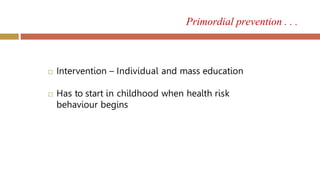
Primordial prevention . . .
 Intervention – Individual and mass education
 Has to start in childhood when health risk
behaviour begins
Primordial prevention . . .
 Examples of primordial prevention
🞑 National programmes and policies on:
 Food and nutrition
 Against smoking and drugs
 To promote regular physical activity
Primordial prevention . . .
 Responsibility of primordial prevention:
🞑 parents, teachers and peer groups: imparting health
education
🞑 Government: legislating and enacting laws
🞑 Professional and nonprofessional organisations
🞑 Industry
🞑 Hospitals, health practitioners, health care workers
PRIMARY PREVENTION
 Action taken prior to the onset of disease, which
removes the
possibility that a disease will ever occur
 Intervention – prepathogenesis stage of disease
 Concept of positive health: an acceptable level of health
that will enable every individual to lead a socially and
economically productive life
primary prevention . . .
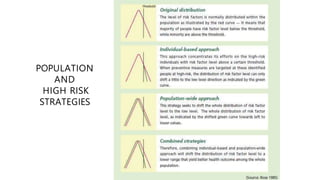
 Approaches for primary prevention for chronic diseases
(WHO):
A. Population (mass) strategy:
 Directed at whole population irrespective of individual risk
levels
 Directed towards socio-economic, behavioral and lifestyle
changes
B. High risk strategy:
 To individuals at special risk
POPULATION
AND
HIGH RISK
STRATEGIES
 Achievements of primary prevention:
🞑 Controlling diseases like cholera, typhoid, dysentry,
plague, tuberculosis, by raising standard of living
 Holistic approach
 Modes of intervention:
🞑 Health promotion
🞑 Specific protection
primary prevention . . .
Health promotion
 Process of enabling people to increase control over
and to
improve health
 Not directed against any particular disease
 Interventions in this area:
🞑 Health education
🞑 Environmental modifications
🞑 Nutritional interventions
🞑 Lifestyle and behavioural changes
 Values in health promotion
🞑 Equity and social justice
🞑 A holistic definition of health
🞑 Covers a full range of health determinants
🞑 Recognizes influence of environment on health
🞑 Seeks to enhance people’s social participation
🞑 Involves intersectoral collaboration (ottawa reference)
Specific protection
 Efforts directed toward protection against specific diseases
 Interventions
🞑 Immunization
🞑 Use of specific nutrients
🞑 Chemoprophylaxis
🞑 Protection against occupational hazards
🞑 Protection against accidents
🞑 Protection from carcinogens
🞑 Avoidance of allergens etc.
SECONDARY PREVENTION
 Action which halts the progress of the disease at its
incipient
stage and prevents complications
 Intervention – early pathogenesis stage
 It is the domain of clinical medicine
 Drawback
🞑 Patient already subjected to mental anguish & physical pain
🞑 More expensive than primary prevention
Early diagnosis and prompt
treatment
 Earlier diagnosed – better prognosis
 Reduces morbidity and mortality
 Effective in acute conditions
TERTIARY PREVENTION
 All measures available to reduce or limit impairments
and disabilities, minimize suffering caused by existing
departures from good health and to promote the
patients adjustment to irremediable conditions
 Intervention – late pathogenesis stage
 Modes of intervention:
🞑 Disability limitation
🞑 Rehabilitation
Disability limitation
 To prevent or halt the transition of disease process from
impairment to handicap
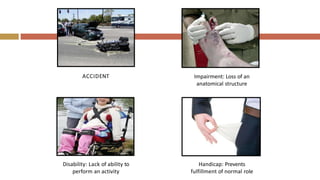
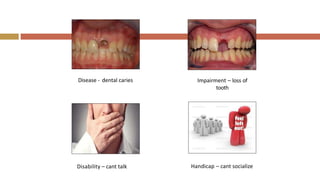
 Disease impairment disability handicap
 Impairment: any loss or abnormality of psychological,
physiological or anatomic structure or function
 Disability: any restriction or lack of ability to perform an
activity
in the manner considered normal for a human being
 Handicap: disadvantage for a given individual, resulting
from
impairment or disability, that limits or prevents the
Rehabilitation
 The combined and coordinated use of medical, educational, social and vocational
measures for training and retraining the individual to the highest possible level
of functional ability
 Types of rehabilitation
🞑 Medical: restoration of function
🞑 Vocational: restoration of capacity to earn a livelihood
🞑 Social: restoration of family and social relationships
🞑 Psychological: restoration of personal dignity and confidence
 Examples of rehabilitation
🞑 Establishing schools for blind
🞑 Provision of aids for crippled
🞑 Exercises in neurological disorders
🞑 Prosthetic restoration of lost tooth
 Requires cooperation from different sections of society
ACCIDENT Impairment: Loss of an
anatomical structure
Disability: Lack of ability to
perform an activity
Handicap: Prevents
fulfillment of normal role
Disease - dental caries Impairment – loss of
tooth
Disability – cant talk Handicap – cant socialize
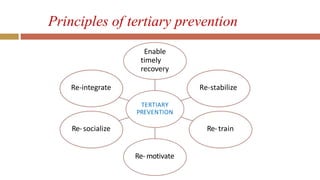
Principles of tertiary prevention
TERTIARY
PREVENTION
Enable
timely
recovery
Re-stabilize
Re-train
Re-motivate
Re-socialize
Re-integrate
QUATERNARY PREVENTION
 The action taken to identify patient at risk of over-medicalisation, to
protect him from new medical invasion, and to suggest to him
interventions, which are ethically acceptable.
 Quaternary prevention is the set of health activities to mitigate or avoid
the consequences of unnecessary or excessive intervention of the
health system.
 Quaternary prevention should take precedence over any alternative
preventive, diagnostic and therapeutic, as is the practice version
‘primum non nocere’
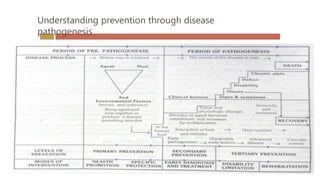
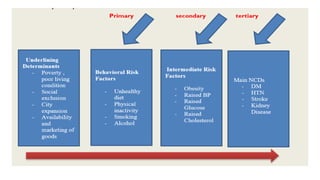
Understanding prevention through disease
pathogenesis
CONCEPTS OF DISEASE CONTROL
DISEASE CONTROL
 Describes (ongoing) operations aimed at reducing:
🞑 The incidence of disease
🞑 Duration of disease (risk of transmission)
🞑 Effects of infection (both physical and psychosocial)
🞑 Financial burden to the community
 Mainly focused on primary and secondary prevention
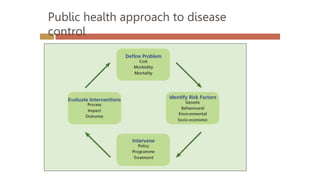
Public health approach to disease
control
There are several steps involved in disease control
1. Surveillance: Surveillance involves monitoring the occurrence of a disease and
tracking its spread over time. This can involve collecting data on disease incidence
and prevalence, as well as monitoring outbreaks and trends in disease occurrence.
2. Detection: Detection involves identifying cases of a disease, either through
screening or clinical diagnosis. Early detection is critical for effective disease control,
as it allows for prompt treatment and reduces the risk of further transmission.
3. Treatment: Treatment involves providing medical care to individuals who have
been diagnosed with a disease. This can include medication, surgery, and supportive
care.
4. Control Measures: Control measures are interventions designed to prevent or
reduce the spread of a disease. This can include measures such as isolation and
quarantine, environmental control measures, and health education and
communication.
5. Evaluation: Evaluation involves assessing the effectiveness of disease control
interventions and strategies. This can involve monitoring disease incidence and
prevalence, as well as tracking outcomes such as morbidity, mortality, and quality of
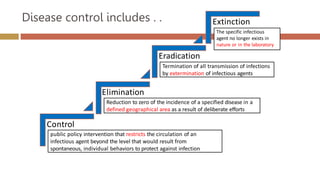
Disease control includes . .
Control
Elimination
Eradication
Extinction
public policy intervention that restricts the circulation of an
infectious agent beyond the level that would result from
spontaneous, individual behaviors to protect against infection
Reduction to zero of the incidence of a specified disease in a
defined geographical area as a result of deliberate efforts
Termination of all transmission of infections
by extermination of infectious agents
The specific infectious
agent no longer exists in
nature or in the laboratory
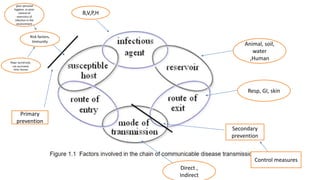
MODEL
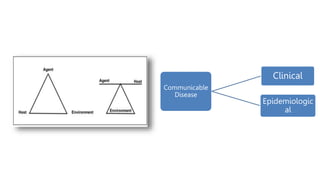
Communicable
Disease
Clinical
Epidemiologic
al
Primary
prevention
B,V,P,H
Animal, soil,
water
,Human
Resp, GI, skin
Secondary
prevention
Direct ,
Indirect
Control measures
Risk factors,
Immunity
poor personal
hygiene, or poor
control of
reservoirs of
infection in the
environment
Poor NUTRITION ,
not vaccinated,
other disease
Thank you

Concept of DPC new.pptx

  • 1.
    Michael Tarekegn (MD , MPH ) Concepts of Disease prevention and control
  • 2.
    CONTENTS  Concepts ofprevention of disease 🞑 Definition 🞑 Timeline of approaches to prevention 🞑 Levels of prevention 🞑 Levels of prevention for dental diseases  Concepts of control of disease 🞑 Disease control 🞑 Disease elimination and eradication 🞑 Monitoring 🞑 Surveillance  Conclusion  References
  • 3.
  • 4.
     Successful preventiondepends upon: 🞑 Knowledge of causation 🞑 Dynamics of transmission 🞑 Identification of risk factors and risk groups 🞑 Availability of prophylactic or early detection and treatment measures 🞑 Facilities for these treatment procedures 🞑 Evaluation and development of these procedures
  • 5.
    Timeline 1953 – Leavelland Clark 1957 – Commission of chronic illness 1958 – Leavell and Clark 1965 – Leavell and Clark 1983 – Gordon 1985 – Tannahill 2001 – Froom and Benbassat
  • 6.
    2008 – 2009:Ronald Hattis (draft stage as on 2012)  Classification according to stages of disease Stages of Disease Development Corresponding Stages of Prevention 1 Exposure Avoidance of Exposure 2 Acquisition Reduction of Acquisition 3 Advancement/Progression Interruption of Progression 4 Complications Avoidance of Complications 5 Death or Disability a) Delay of Mortality b) Rehabilitation of Disability c) Palliative Care for Inevitable Death
  • 7.
    Stages Disease IDisease II Type 2 Diabetes HIV 1 Exposure Avoidance: Healthy eating, limit simple carbohydrates, maintain healthy weght, exercise Abstinence from sex (or screening and monogamy of seronegative partners), no injection drug use 2 Disease Acquisition Reduction: Weight loss, consider metformin if insulin resistance/pre-diabetes Condom promotion and programs to discourage drug abuse, needle sharing 3 Interruption or Delay of Disease Advancement: Anti-diabetic drugs, monitor hgb A-1C, FBS, proteinuria, lipids; bariatric surgery if indicated Antibody screening, monitoring CD4, viral load; treatment with antiretrovirals 4 Avoidance or Delay of Disease Complications: ACE Inhibitor/ARB to prevent renal sequelae, strict glucose control (insulin if necessary), lipid control, foot and eye care Prophylactic treatment for opportunistic infections 5 Delay of Mortality from Disease complications Renal Dialysis, coronary stent or bypass Intensive treatment for severe opportunistic infections
  • 8.
    LEVELS OF PREVENTION The concept of prevention is best defined in terms of levels of prevention. Traditionally, 1. Primordial prevention 2. Primary prevention 3. Secondary prevention 4. Tertiary prevention 5. Quaternary prevention
  • 9.
    Primordial prevention .. .  Intervention – Individual and mass education  Has to start in childhood when health risk behaviour begins
  • 10.
    Primordial prevention .. .  Examples of primordial prevention 🞑 National programmes and policies on:  Food and nutrition  Against smoking and drugs  To promote regular physical activity
  • 11.
    Primordial prevention .. .  Responsibility of primordial prevention: 🞑 parents, teachers and peer groups: imparting health education 🞑 Government: legislating and enacting laws 🞑 Professional and nonprofessional organisations 🞑 Industry 🞑 Hospitals, health practitioners, health care workers
  • 12.
    PRIMARY PREVENTION  Actiontaken prior to the onset of disease, which removes the possibility that a disease will ever occur  Intervention – prepathogenesis stage of disease  Concept of positive health: an acceptable level of health that will enable every individual to lead a socially and economically productive life
  • 13.
    primary prevention .. .  Approaches for primary prevention for chronic diseases (WHO): A. Population (mass) strategy:  Directed at whole population irrespective of individual risk levels  Directed towards socio-economic, behavioral and lifestyle changes B. High risk strategy:  To individuals at special risk
  • 14.
  • 15.
     Achievements ofprimary prevention: 🞑 Controlling diseases like cholera, typhoid, dysentry, plague, tuberculosis, by raising standard of living  Holistic approach  Modes of intervention: 🞑 Health promotion 🞑 Specific protection primary prevention . . .
  • 16.
    Health promotion  Processof enabling people to increase control over and to improve health  Not directed against any particular disease  Interventions in this area: 🞑 Health education 🞑 Environmental modifications 🞑 Nutritional interventions 🞑 Lifestyle and behavioural changes
  • 17.
     Values inhealth promotion 🞑 Equity and social justice 🞑 A holistic definition of health 🞑 Covers a full range of health determinants 🞑 Recognizes influence of environment on health 🞑 Seeks to enhance people’s social participation 🞑 Involves intersectoral collaboration (ottawa reference)
  • 18.
    Specific protection  Effortsdirected toward protection against specific diseases  Interventions 🞑 Immunization 🞑 Use of specific nutrients 🞑 Chemoprophylaxis 🞑 Protection against occupational hazards 🞑 Protection against accidents 🞑 Protection from carcinogens 🞑 Avoidance of allergens etc.
  • 19.
    SECONDARY PREVENTION  Actionwhich halts the progress of the disease at its incipient stage and prevents complications  Intervention – early pathogenesis stage  It is the domain of clinical medicine  Drawback 🞑 Patient already subjected to mental anguish & physical pain 🞑 More expensive than primary prevention
  • 20.
    Early diagnosis andprompt treatment  Earlier diagnosed – better prognosis  Reduces morbidity and mortality  Effective in acute conditions
  • 21.
    TERTIARY PREVENTION  Allmeasures available to reduce or limit impairments and disabilities, minimize suffering caused by existing departures from good health and to promote the patients adjustment to irremediable conditions  Intervention – late pathogenesis stage  Modes of intervention: 🞑 Disability limitation 🞑 Rehabilitation
  • 22.
    Disability limitation  Toprevent or halt the transition of disease process from impairment to handicap  Disease impairment disability handicap  Impairment: any loss or abnormality of psychological, physiological or anatomic structure or function  Disability: any restriction or lack of ability to perform an activity in the manner considered normal for a human being  Handicap: disadvantage for a given individual, resulting from impairment or disability, that limits or prevents the
  • 23.
    Rehabilitation  The combinedand coordinated use of medical, educational, social and vocational measures for training and retraining the individual to the highest possible level of functional ability  Types of rehabilitation 🞑 Medical: restoration of function 🞑 Vocational: restoration of capacity to earn a livelihood 🞑 Social: restoration of family and social relationships 🞑 Psychological: restoration of personal dignity and confidence
  • 24.
     Examples ofrehabilitation 🞑 Establishing schools for blind 🞑 Provision of aids for crippled 🞑 Exercises in neurological disorders 🞑 Prosthetic restoration of lost tooth  Requires cooperation from different sections of society
  • 25.
    ACCIDENT Impairment: Lossof an anatomical structure Disability: Lack of ability to perform an activity Handicap: Prevents fulfillment of normal role
  • 26.
    Disease - dentalcaries Impairment – loss of tooth Disability – cant talk Handicap – cant socialize
  • 27.
    Principles of tertiaryprevention TERTIARY PREVENTION Enable timely recovery Re-stabilize Re-train Re-motivate Re-socialize Re-integrate
  • 28.
    QUATERNARY PREVENTION  Theaction taken to identify patient at risk of over-medicalisation, to protect him from new medical invasion, and to suggest to him interventions, which are ethically acceptable.  Quaternary prevention is the set of health activities to mitigate or avoid the consequences of unnecessary or excessive intervention of the health system.  Quaternary prevention should take precedence over any alternative preventive, diagnostic and therapeutic, as is the practice version ‘primum non nocere’
  • 29.
  • 30.
  • 31.
    DISEASE CONTROL  Describes(ongoing) operations aimed at reducing: 🞑 The incidence of disease 🞑 Duration of disease (risk of transmission) 🞑 Effects of infection (both physical and psychosocial) 🞑 Financial burden to the community  Mainly focused on primary and secondary prevention
  • 32.
    Public health approachto disease control
  • 33.
    There are severalsteps involved in disease control 1. Surveillance: Surveillance involves monitoring the occurrence of a disease and tracking its spread over time. This can involve collecting data on disease incidence and prevalence, as well as monitoring outbreaks and trends in disease occurrence. 2. Detection: Detection involves identifying cases of a disease, either through screening or clinical diagnosis. Early detection is critical for effective disease control, as it allows for prompt treatment and reduces the risk of further transmission.
  • 34.
    3. Treatment: Treatmentinvolves providing medical care to individuals who have been diagnosed with a disease. This can include medication, surgery, and supportive care. 4. Control Measures: Control measures are interventions designed to prevent or reduce the spread of a disease. This can include measures such as isolation and quarantine, environmental control measures, and health education and communication. 5. Evaluation: Evaluation involves assessing the effectiveness of disease control interventions and strategies. This can involve monitoring disease incidence and prevalence, as well as tracking outcomes such as morbidity, mortality, and quality of
  • 35.
    Disease control includes. . Control Elimination Eradication Extinction public policy intervention that restricts the circulation of an infectious agent beyond the level that would result from spontaneous, individual behaviors to protect against infection Reduction to zero of the incidence of a specified disease in a defined geographical area as a result of deliberate efforts Termination of all transmission of infections by extermination of infectious agents The specific infectious agent no longer exists in nature or in the laboratory
  • 36.
  • 37.
  • 38.
    Primary prevention B,V,P,H Animal, soil, water ,Human Resp, GI,skin Secondary prevention Direct , Indirect Control measures Risk factors, Immunity poor personal hygiene, or poor control of reservoirs of infection in the environment Poor NUTRITION , not vaccinated, other disease
  • 41.