RABIESRABIESEPIDEMIOLOGY &
PREVENTION
DR. SYED SANOWAR ALI
ASSOCIATE PROFSSOR
CHS, UMDC
EPIDEMIOLOGYEPIDEMIOLOGY
The study of theThe study of the DISTRIBUTION andand
DETERMINANTS of health-relatedof health-related
states or events in specified populationstates or events in specified population
and application of this study to theand application of this study to the
control of health problemscontrol of health problems
1. DISTRIBUTION OF
DISEASE
A. When (time)
B. Who (person)
C. Where (place)
Descriptive EpidemiologyEpidemiology
2. DETERMINANTS OF2. DETERMINANTS OF
DISEASEDISEASE
A. Why
B. How
Analytical Epidemiology
DEFINITION
Human Rabies is a viral infection of the
CNS usually transmitted by contamination
of a wound with saliva from a rabid animal
and is virtually
100%fatal
once symptoms develop.
• Rabies is a zoonotic
disease (a disease that is
transmitted to humans from
animals) that is caused by a
virus.
GEOGRAPHIC
DISTRIBUTION* Rabies Free Area in which no case has
occurred in human or any animal species for 2
years.
* Rabies is a major public problem in areas in which
Dogs are uncontrolled.
* Rabies is present on all continents with the
exception of Antarctica, but more than 95% of
human deaths occur in Asia and Africa. Once
symptoms of the disease develop, rabies is nearly
always fatal.
Rabies Human DeathsRabies Human Deaths
Annual human deaths worldwide are
approximately 55,000; every 15 minutes a
patient dies of rabies.
In the United States, there has been a mean of
3 deaths per year since 1990.
PAKISTANPAKISTAN
• In Pakistan 2000 - 5000 cases / yr.
• Rabies is endemic in Pakistan.
• Human rabies is not a notifiable
disease in Pakistan
• The main vector for rabies in Pakistan
is the domestic dog
KEY FACTS
• Rabies is a vaccine-preventable viral disease which
occurs in more than 150 countries and territories.
• Infection causes tens of thousands of deaths every
year, mostly in Asia and Africa.
• 40% of people who are bitten by suspect rabid
animals are children under 15 years of age.
• Dogs are the source of the vast majority of human
rabies deaths.
• Immediate wound cleansing and immunization
within a few hours after contact with a suspect
rabid animal can prevent the onset of rabies and
death.
• Every year, more than 15 million people
worldwide receive a post-exposure vaccination to
prevent the disease – this is estimated to prevent
hundreds of thousands of rabies deaths annually.
KEY FACTS
INCUBATION PERIODINCUBATION PERIOD
Highly variable
usually 20 – 180 days,
peak at 30 – 60 days
MODE OFMODE OF
TRANSMISSIONTRANSMISSION
A- ANIMAL BITES : through rabid dog
bites and the saliva of the biting animal
contain the virus.
B- LICKS : licks on abraded skin and mucosa
transmit the disease.
Who is most at risk?
•Dog rabies potentially threatens over 3 billion
people in Asia and Africa.
•Poor people are at a higher risk (cost = US$ 49 in
Asia)
•Although all age groups are susceptible, rabies is
most common in children aged under 15 & majority
are male.
Rabies attacks theRabies attacks the
Central NervousCentral Nervous
SystemSystem
 Watch as the rabies virus
from an exposure on the
leg spreads up the spinal
cord to the brain and
throughout the rest of the
body.
Rabies virus entering
the body.
Headache, fever, sore throat
Nervousness, confusion
Pain or tingling at the site of the bite
Hallucinations
– Seeing things that are not really there
Hydrophobia
– “Fear of water" due to spasms in the throat
Paralysis
– Unable to move parts of the body
Coma and death
Signs / SymptomsSigns / Symptoms
Clinical DiagnosisClinical Diagnosis
PREVENTIONPREVENTION
OFOF
HUMAN RABIESHUMAN RABIES
POST-EXPOSURE
PRE-EXPOSURE
PREVENTIONPREVENTION
Pre-exposure
immunization in people
•Travellers spending a lot of time outdoors, especially in rural areas.
•People in certain high-risk occupations such as laboratory workers
dealing with live rabies virus and other rabies-related viruses.
•People involved in any activities that might bring them
professionally or otherwise into direct contact with Dogs.
•Children.
•Living in or visiting high risk areas.
PRE- EXPOSUREPRE- EXPOSURE
PROPHYLAXSISPROPHYLAXSIS
1. Vaccination of domestic dogs1. Vaccination of domestic dogs
2. Elimination of stray dogs2. Elimination of stray dogs
3. Eliminating rabies in dogs3. Eliminating rabies in dogs
4. Active Immunization Doses:4. Active Immunization Doses:
Day 0,7 and 28 (100% response)Day 0,7 and 28 (100% response)
WHO Recommended Pre-exposure
3-dose series intramuscular
Pre-exposure
Exposure: No Rabies immunoglobulin
needed
day 0 7 21 or 28
3
Vaccine should never be administered
in the gluteal region.
Was There An Exposure?Was There An Exposure?
A bite (penetration of the skin by
teeth) from a known or suspect rabid animal
Scratches, abrasions, open wounds (bleeding within
24 hrs), or mucous membranes (eyes) contaminated
with saliva or other potentially infectious material
from a known or suspect rabid animal
Other contact - such as petting an animal or contact
with urine, feces - does NOT constitute an exposure
10 Day Confinement10 Day Confinement
& Observation Period& Observation Period
Clinical course usually less than 7 days - animal
dead before end of 10 days
Rabies Vaccination Status ofRabies Vaccination Status of
AnimalAnimal
Lower risk if animal has been regularly
vaccinated
But NO vaccine is 100% effective
Put as much weight on animal
behavior & health status
PREVENTION OF HUMANPREVENTION OF HUMAN
RABIESRABIES
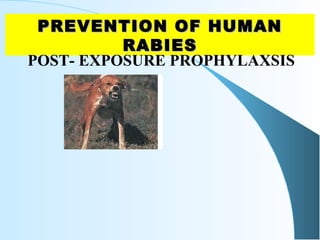
POST- EXPOSURE PROPHYLAXSIS
A) if the animal shows signs of rabies orA) if the animal shows signs of rabies or
dies within 10 days of observation.dies within 10 days of observation.
B) If the biting animal can not be tracedB) If the biting animal can not be traced
oror identified .identified .
In general if a biting dog does not die
with in 10 days, Rabies is unlikely.
RABID DOG
PEP
Post-exposure prophylaxis (PEP)
•Local treatment of the wound.
•Initiated as soon as possible after exposure; a
course of potent and effective rabies vaccine that
meets WHO recommendations.
•Administration of rabies immunoglobulin, if
indicated.
A) POST EXPOSURE
PROPHYLAXSIS
LOCAL TREATMENT OF WOUND
A. Mechanical removal By
1. Soap and water :
using copious amounts of solution
2. Virucidal solution :
1% povidone-Iodine or 70% alcohol
B. Suturing : not done
C. Anti biotics & Antitetanus measures.
IMMUNIZATIONIMMUNIZATION
1. ACTIVE IMMUNIZATION
VACCINE
2. PASSIVE IMMUNIZATION
IMMUNE GLOBULIN
1. Human rabies immune globulin
2. Equine rabies immune globulin
VACCINE TYPESVACCINE TYPES
NERVOUS TISSUE VACCINE (NTV)
a- Antigenicity was poor
b- Multiple Injections were required.
c- Post vaccination Encephalitis was frequent problem.
This vaccines are still in use in
many
places in the world.
Human diploid cellsHuman diploid cells
vaccinevaccine
(HDCV)(HDCV)
1.1. ACTIVEACTIVE
IMMUNIZATIONIMMUNIZATION
Human Diploid Cells VACCINEHuman Diploid Cells VACCINE
(HDCV)(HDCV)
A. No. of doses : 05A. No. of doses : 05
Day 0, 3, 7, 14 and 28Day 0, 3, 7, 14 and 28
B. Quantity :B. Quantity : 1 ml1 ml
C. Route : Intra-muscular (Arms)C. Route : Intra-muscular (Arms)
Standard intramuscular regimen. One
dose into deltoid on each of days:
Essential intramuscular Regimen
WHO Recommended PEP
Schedule
5 vials
5 visits
day 0 3 7 14 28
Rabies immunoglobulin
2. PASSIVE IMMUNIZATION2. PASSIVE IMMUNIZATION
IMMUNE GLOBULINIMMUNE GLOBULIN
Human rabies immune globulin
A. No. of doses : 01 as soon as possible
B. Quantity : 20 IU / Kg
C. Route : Half dose Intra-muscular (Arms)
Half dose subcutaneously
around the bite site
If Person having weight 60 KgIf Person having weight 60 Kg
Human rabies immune globulinHuman rabies immune globulin
20 IU / Kg20 IU / Kg
20 x 60 = 1200 IU20 x 60 = 1200 IU
600 IU I/M & 600 IU S/C around the600 IU I/M & 600 IU S/C around the
bite site.bite site.
EQUINE RABIES IMMUNE GLOBULINEQUINE RABIES IMMUNE GLOBULIN
A. No. of doses : 01 as soon as possibleA. No. of doses : 01 as soon as possible
B. Quantity : 40 IU / KgB. Quantity : 40 IU / Kg
C. Route : Half dose Intra-muscular (Arms)C. Route : Half dose Intra-muscular (Arms)
Half dose subcutaneouslyHalf dose subcutaneously
around the bite sitearound the bite site
after test doseafter test dose
Anaphylaxis is a rare.Anaphylaxis is a rare.
If Person having weight 60 KgIf Person having weight 60 Kg
EquineEquine rabies immune globulinrabies immune globulin
40 IU / Kg40 IU / Kg
40 x 60 = 2400 IU40 x 60 = 2400 IU
1200 IU I/M & 1200 IU S/C around the1200 IU I/M & 1200 IU S/C around the
bite site.bite site.
HYDROPHOBIA ?HYDROPHOBIA ?
Destruction of brain stemDestruction of brain stem
neurons inhibitory to theneurons inhibitory to the
neurons of the nucleusneurons of the nucleus
ambiguous which controlambiguous which control
Inspiration.Inspiration.
Why Hydrophobia doesWhy Hydrophobia does
not occur in othernot occur in other
diseases ?diseases ?
Only Rabies combinesOnly Rabies combines
brain stem Encephalitisbrain stem Encephalitis
with an intact Cortex andwith an intact Cortex and
maintenance ofmaintenance of
consciousnessconsciousness

Dog bite (rabies)

  • 1.
    RABIESRABIESEPIDEMIOLOGY & PREVENTION DR. SYEDSANOWAR ALI ASSOCIATE PROFSSOR CHS, UMDC
  • 2.
    EPIDEMIOLOGYEPIDEMIOLOGY The study oftheThe study of the DISTRIBUTION andand DETERMINANTS of health-relatedof health-related states or events in specified populationstates or events in specified population and application of this study to theand application of this study to the control of health problemscontrol of health problems
  • 3.
    1. DISTRIBUTION OF DISEASE A.When (time) B. Who (person) C. Where (place) Descriptive EpidemiologyEpidemiology
  • 4.
    2. DETERMINANTS OF2.DETERMINANTS OF DISEASEDISEASE A. Why B. How Analytical Epidemiology
  • 5.
    DEFINITION Human Rabies isa viral infection of the CNS usually transmitted by contamination of a wound with saliva from a rabid animal and is virtually 100%fatal once symptoms develop.
  • 6.
    • Rabies isa zoonotic disease (a disease that is transmitted to humans from animals) that is caused by a virus.
  • 8.
    GEOGRAPHIC DISTRIBUTION* Rabies FreeArea in which no case has occurred in human or any animal species for 2 years. * Rabies is a major public problem in areas in which Dogs are uncontrolled. * Rabies is present on all continents with the exception of Antarctica, but more than 95% of human deaths occur in Asia and Africa. Once symptoms of the disease develop, rabies is nearly always fatal.
  • 9.
    Rabies Human DeathsRabiesHuman Deaths Annual human deaths worldwide are approximately 55,000; every 15 minutes a patient dies of rabies. In the United States, there has been a mean of 3 deaths per year since 1990.
  • 10.
    PAKISTANPAKISTAN • In Pakistan2000 - 5000 cases / yr. • Rabies is endemic in Pakistan. • Human rabies is not a notifiable disease in Pakistan • The main vector for rabies in Pakistan is the domestic dog
  • 11.
    KEY FACTS • Rabiesis a vaccine-preventable viral disease which occurs in more than 150 countries and territories. • Infection causes tens of thousands of deaths every year, mostly in Asia and Africa. • 40% of people who are bitten by suspect rabid animals are children under 15 years of age. • Dogs are the source of the vast majority of human rabies deaths.
  • 12.
    • Immediate woundcleansing and immunization within a few hours after contact with a suspect rabid animal can prevent the onset of rabies and death. • Every year, more than 15 million people worldwide receive a post-exposure vaccination to prevent the disease – this is estimated to prevent hundreds of thousands of rabies deaths annually. KEY FACTS
  • 13.
    INCUBATION PERIODINCUBATION PERIOD Highlyvariable usually 20 – 180 days, peak at 30 – 60 days
  • 14.
    MODE OFMODE OF TRANSMISSIONTRANSMISSION A-ANIMAL BITES : through rabid dog bites and the saliva of the biting animal contain the virus. B- LICKS : licks on abraded skin and mucosa transmit the disease.
  • 15.
    Who is mostat risk? •Dog rabies potentially threatens over 3 billion people in Asia and Africa. •Poor people are at a higher risk (cost = US$ 49 in Asia) •Although all age groups are susceptible, rabies is most common in children aged under 15 & majority are male.
  • 16.
    Rabies attacks theRabiesattacks the Central NervousCentral Nervous SystemSystem  Watch as the rabies virus from an exposure on the leg spreads up the spinal cord to the brain and throughout the rest of the body. Rabies virus entering the body.
  • 17.
    Headache, fever, sorethroat Nervousness, confusion Pain or tingling at the site of the bite Hallucinations – Seeing things that are not really there Hydrophobia – “Fear of water" due to spasms in the throat Paralysis – Unable to move parts of the body Coma and death Signs / SymptomsSigns / Symptoms Clinical DiagnosisClinical Diagnosis
  • 18.
  • 19.
  • 20.
    Pre-exposure immunization in people •Travellersspending a lot of time outdoors, especially in rural areas. •People in certain high-risk occupations such as laboratory workers dealing with live rabies virus and other rabies-related viruses. •People involved in any activities that might bring them professionally or otherwise into direct contact with Dogs. •Children. •Living in or visiting high risk areas.
  • 21.
    PRE- EXPOSUREPRE- EXPOSURE PROPHYLAXSISPROPHYLAXSIS 1.Vaccination of domestic dogs1. Vaccination of domestic dogs 2. Elimination of stray dogs2. Elimination of stray dogs 3. Eliminating rabies in dogs3. Eliminating rabies in dogs 4. Active Immunization Doses:4. Active Immunization Doses: Day 0,7 and 28 (100% response)Day 0,7 and 28 (100% response)
  • 22.
    WHO Recommended Pre-exposure 3-doseseries intramuscular Pre-exposure Exposure: No Rabies immunoglobulin needed day 0 7 21 or 28 3 Vaccine should never be administered in the gluteal region.
  • 23.
    Was There AnExposure?Was There An Exposure? A bite (penetration of the skin by teeth) from a known or suspect rabid animal Scratches, abrasions, open wounds (bleeding within 24 hrs), or mucous membranes (eyes) contaminated with saliva or other potentially infectious material from a known or suspect rabid animal Other contact - such as petting an animal or contact with urine, feces - does NOT constitute an exposure
  • 24.
    10 Day Confinement10Day Confinement & Observation Period& Observation Period Clinical course usually less than 7 days - animal dead before end of 10 days
  • 25.
    Rabies Vaccination StatusofRabies Vaccination Status of AnimalAnimal Lower risk if animal has been regularly vaccinated But NO vaccine is 100% effective Put as much weight on animal behavior & health status
  • 26.
    PREVENTION OF HUMANPREVENTIONOF HUMAN RABIESRABIES POST- EXPOSURE PROPHYLAXSIS
  • 27.
    A) if theanimal shows signs of rabies orA) if the animal shows signs of rabies or dies within 10 days of observation.dies within 10 days of observation. B) If the biting animal can not be tracedB) If the biting animal can not be traced oror identified .identified . In general if a biting dog does not die with in 10 days, Rabies is unlikely. RABID DOG
  • 28.
    PEP Post-exposure prophylaxis (PEP) •Localtreatment of the wound. •Initiated as soon as possible after exposure; a course of potent and effective rabies vaccine that meets WHO recommendations. •Administration of rabies immunoglobulin, if indicated.
  • 29.
    A) POST EXPOSURE PROPHYLAXSIS LOCALTREATMENT OF WOUND A. Mechanical removal By 1. Soap and water : using copious amounts of solution 2. Virucidal solution : 1% povidone-Iodine or 70% alcohol B. Suturing : not done C. Anti biotics & Antitetanus measures.
  • 30.
    IMMUNIZATIONIMMUNIZATION 1. ACTIVE IMMUNIZATION VACCINE 2.PASSIVE IMMUNIZATION IMMUNE GLOBULIN 1. Human rabies immune globulin 2. Equine rabies immune globulin
  • 31.
    VACCINE TYPESVACCINE TYPES NERVOUSTISSUE VACCINE (NTV) a- Antigenicity was poor b- Multiple Injections were required. c- Post vaccination Encephalitis was frequent problem. This vaccines are still in use in many places in the world.
  • 32.
    Human diploid cellsHumandiploid cells vaccinevaccine (HDCV)(HDCV)
  • 33.
    1.1. ACTIVEACTIVE IMMUNIZATIONIMMUNIZATION Human DiploidCells VACCINEHuman Diploid Cells VACCINE (HDCV)(HDCV) A. No. of doses : 05A. No. of doses : 05 Day 0, 3, 7, 14 and 28Day 0, 3, 7, 14 and 28 B. Quantity :B. Quantity : 1 ml1 ml C. Route : Intra-muscular (Arms)C. Route : Intra-muscular (Arms)
  • 34.
    Standard intramuscular regimen.One dose into deltoid on each of days: Essential intramuscular Regimen WHO Recommended PEP Schedule 5 vials 5 visits day 0 3 7 14 28 Rabies immunoglobulin
  • 35.
    2. PASSIVE IMMUNIZATION2.PASSIVE IMMUNIZATION IMMUNE GLOBULINIMMUNE GLOBULIN Human rabies immune globulin A. No. of doses : 01 as soon as possible B. Quantity : 20 IU / Kg C. Route : Half dose Intra-muscular (Arms) Half dose subcutaneously around the bite site
  • 36.
    If Person havingweight 60 KgIf Person having weight 60 Kg Human rabies immune globulinHuman rabies immune globulin 20 IU / Kg20 IU / Kg 20 x 60 = 1200 IU20 x 60 = 1200 IU 600 IU I/M & 600 IU S/C around the600 IU I/M & 600 IU S/C around the bite site.bite site.
  • 37.
    EQUINE RABIES IMMUNEGLOBULINEQUINE RABIES IMMUNE GLOBULIN A. No. of doses : 01 as soon as possibleA. No. of doses : 01 as soon as possible B. Quantity : 40 IU / KgB. Quantity : 40 IU / Kg C. Route : Half dose Intra-muscular (Arms)C. Route : Half dose Intra-muscular (Arms) Half dose subcutaneouslyHalf dose subcutaneously around the bite sitearound the bite site after test doseafter test dose Anaphylaxis is a rare.Anaphylaxis is a rare.
  • 38.
    If Person havingweight 60 KgIf Person having weight 60 Kg EquineEquine rabies immune globulinrabies immune globulin 40 IU / Kg40 IU / Kg 40 x 60 = 2400 IU40 x 60 = 2400 IU 1200 IU I/M & 1200 IU S/C around the1200 IU I/M & 1200 IU S/C around the bite site.bite site.
  • 39.
  • 40.
    Destruction of brainstemDestruction of brain stem neurons inhibitory to theneurons inhibitory to the neurons of the nucleusneurons of the nucleus ambiguous which controlambiguous which control Inspiration.Inspiration.
  • 41.
    Why Hydrophobia doesWhyHydrophobia does not occur in othernot occur in other diseases ?diseases ?
  • 42.
    Only Rabies combinesOnlyRabies combines brain stem Encephalitisbrain stem Encephalitis with an intact Cortex andwith an intact Cortex and maintenance ofmaintenance of consciousnessconsciousness

Editor's Notes

  • #17 What is the Central Nervous System (continued)? Watch as an exposure (possibly a bite from a rabid animal) on the leg causes the rabies virus to spread up the spinal cord to the brain and throughout the rest of the body. NOTE TO TEACHER: the image should light up when it is shown in “slide show” format. Resources: http://www.cdc.gov/ncidod/dvrd/kidsrabies/TheVirus/rabvir.htm
  • #18 Symptoms of rabies virus infection The “incubation period” of rabies can vary from person to person (This is the time between exposure and actually getting symptoms). It may take several weeks to months after an exposure, before people become sick with rabies. The symptoms can include: The symptoms start with a headache, fever, and sore throat. Nervousness and confusion develops. The patient may experience pain or tingling at the site of the bite. Many patients have hallucinations which means they see things that are not really there. Case report: One parent of a patient said the patient was, “Cowering in the corner like a caged animal.” Hydrophobia is also a symptom. Hydrophobia, or the fear of water, is due to spasms in the throat. Case report: One patient said, “I throw up every time I try to eat or drink something. I can’t swallow my spit” Paralysis or the inability to move parts of the body will develop later in the infection. Eventually, the patient experiences a coma and ultimately death.
  • #23 Persons who have completed the PEP series or the preexpsoure protocol are considered ‘pre-immunized’. No HRIG is administered Two doses of vaccine administered on days 0 and 3. Dosage: 1.0 ml administered IM in the upper deltoid
  • #35 Start of administration = Day 0 (day treatment is first initiated) HRIG – administer on Day 0 at a dosage of 20 IU/kg -Infiltrate as much as possible into and around the wound(s) -Remaining HRIG – give IM at an anatomical site distant from the vaccine