
Dr. Hira Shoaib Hashmi
Lecturer, Dept. CHS
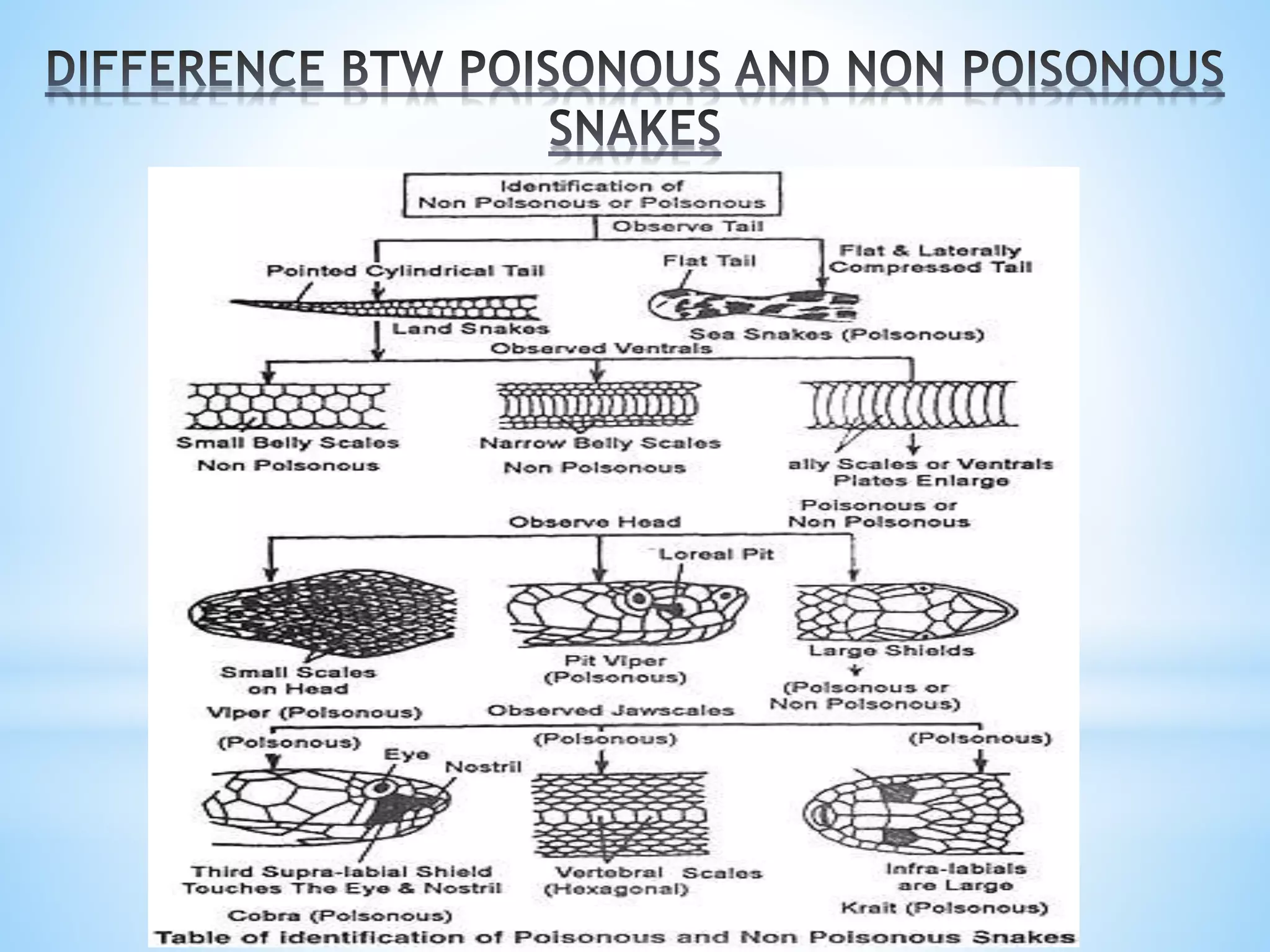
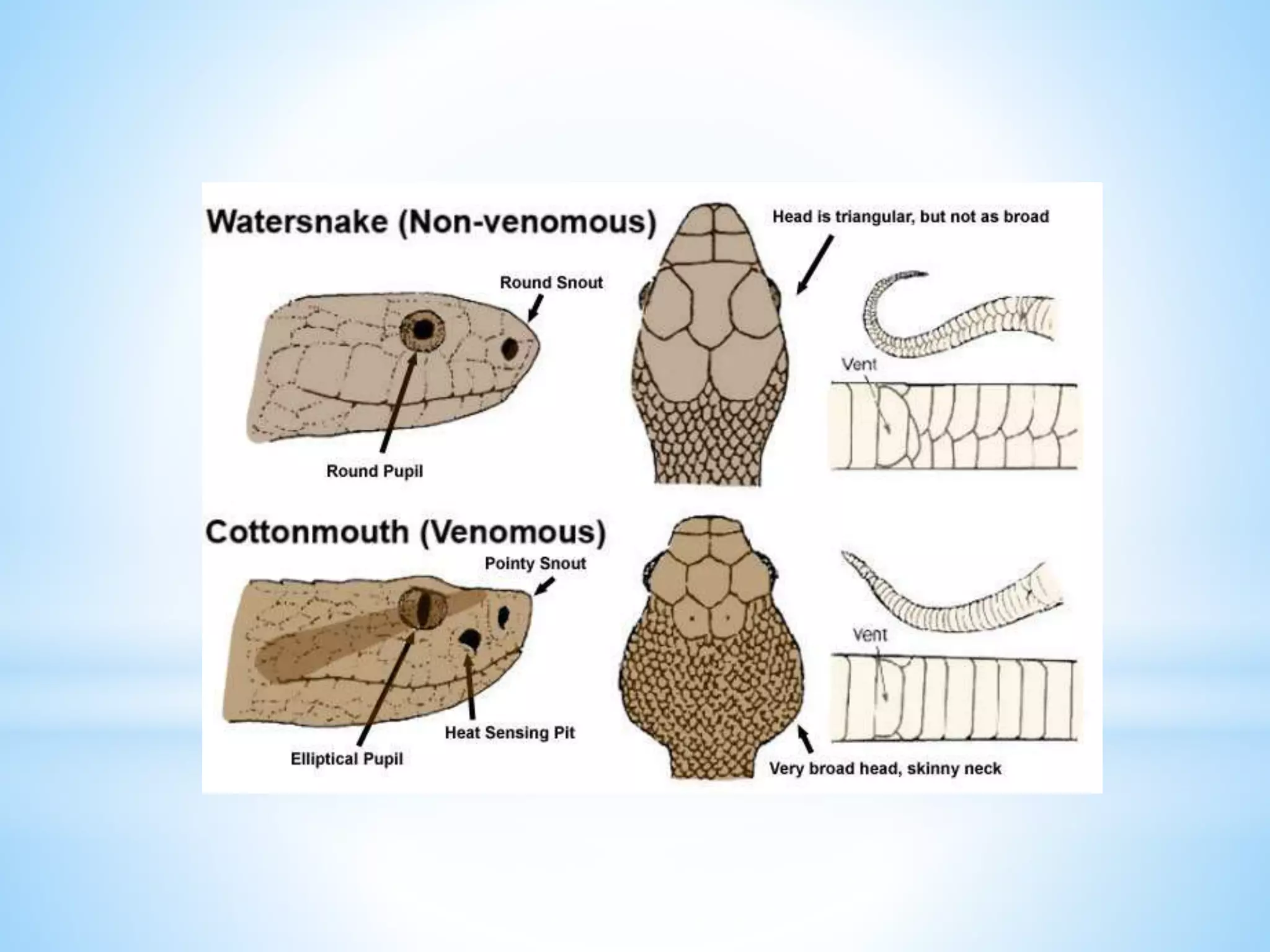
To know the difference between poisonous and non
poisonous snakes.
To know how to manage a patient with snake bite.
To learn how to prevent snake bite.
To know the areas in Pakistan where snake bite is
prevalent.
At least 421,000 envenomings and 20,000
deaths from snakebites occur each year,
especially in South and South East Asia and sub-
Saharan Africa.(1)
 3000 species
Broadly Divided into:
Poisonous Snakes
Non Poisonous Snakes
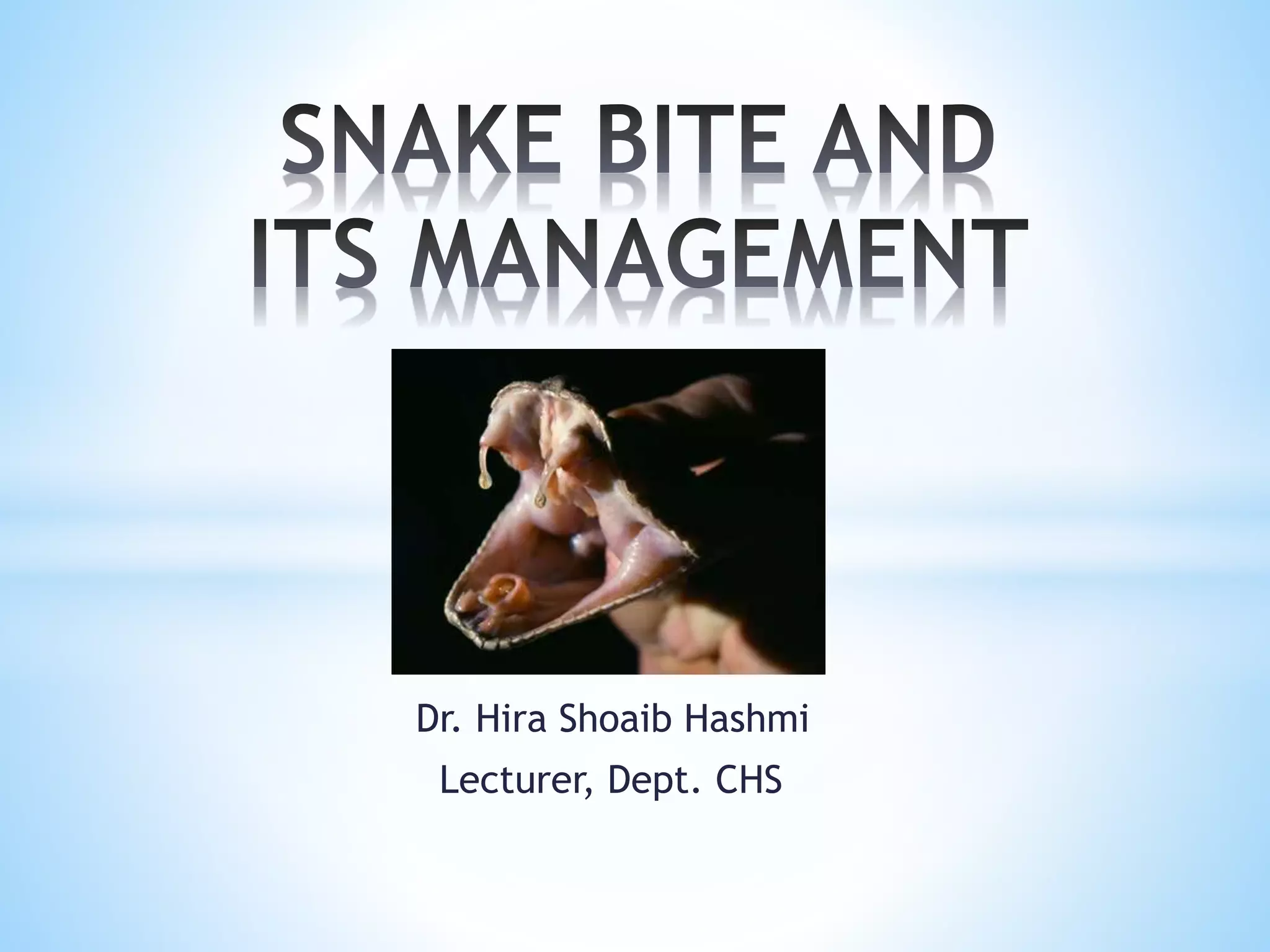
It is toxic saliva produced by parotid glands of snakes mostly water
with enzymatic proteins.
Constituents
Proteinases
Fibrinolysin
Phospholipase A,B,C & D
Neurotoxins
Cholinesterases
Haemolysins etc.
Produced from the time of birth and injected in response to a prey or
self defense
One in five snake bites are dry.
More venom injected when attacking prey.
A major public health problem because:
Agricultural country-70% population lives in rural areas and
works in fields
Lack of basic education
Snakes abundant
Weather conditions favorable
Peak incidence: June to August
• Due to floods and rain with migration to highlands
• Sleeping outside in summers
• Monsoon season is breeding season
• Snake cold blooded more active in summers
• Venom yield high in summers
Common in agricultural fields, Thar and Baluchistan.
Haemotoxic Venom:
Attacks blood vessels, serum escapes into
surroundings, clotting factors are activated. Severe
swelling, pain and discoloration and shock ensues with
DIC.
Neurotoxic venom:
Much less local symptoms, affects remote nerves,
cause tingling, drooping of eyelids and respiratory
arrest.
Myotoxic Venom:
Affects muscles with stiffness and paralysis
Appearance of myoglobin in urine
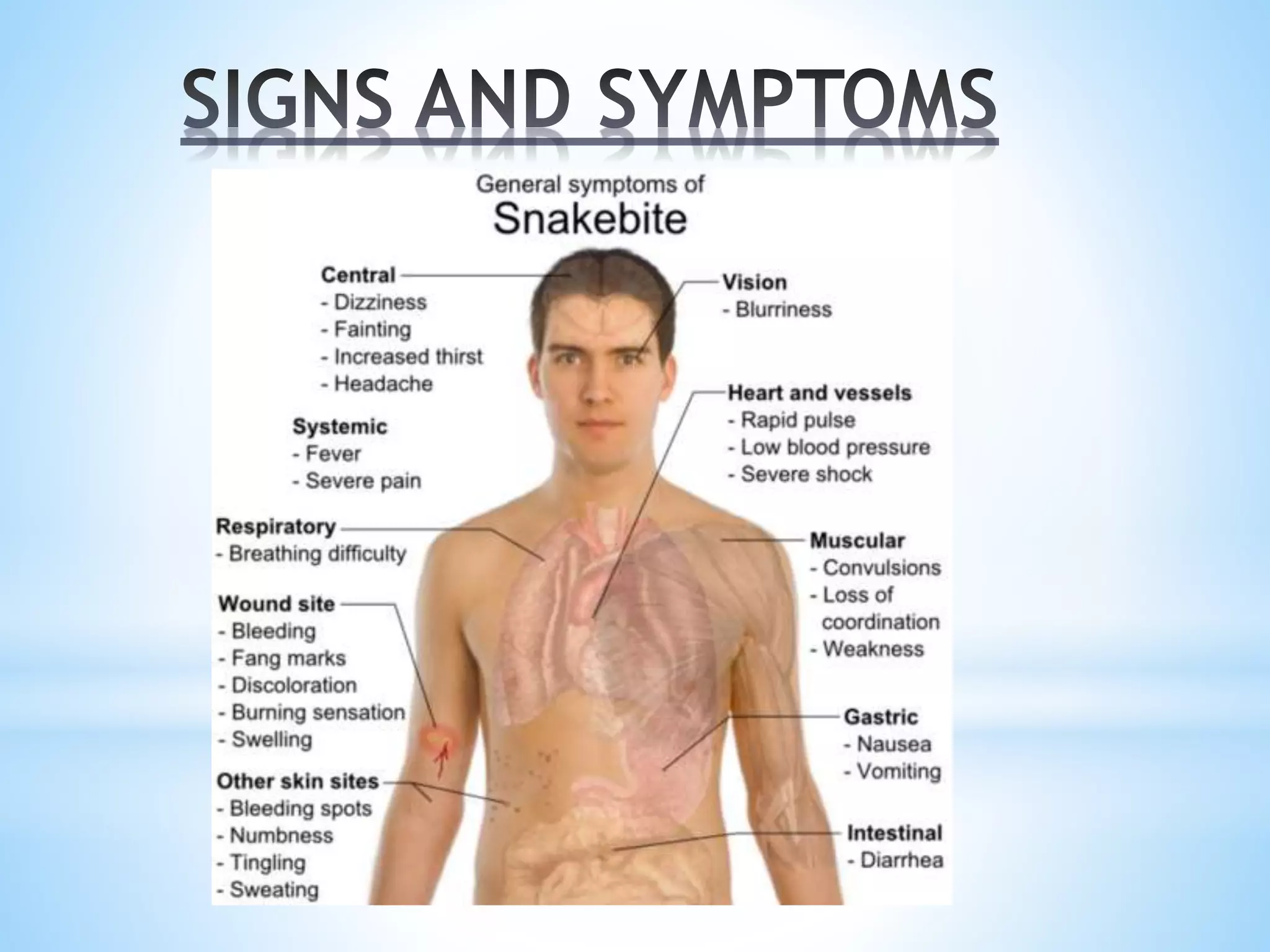
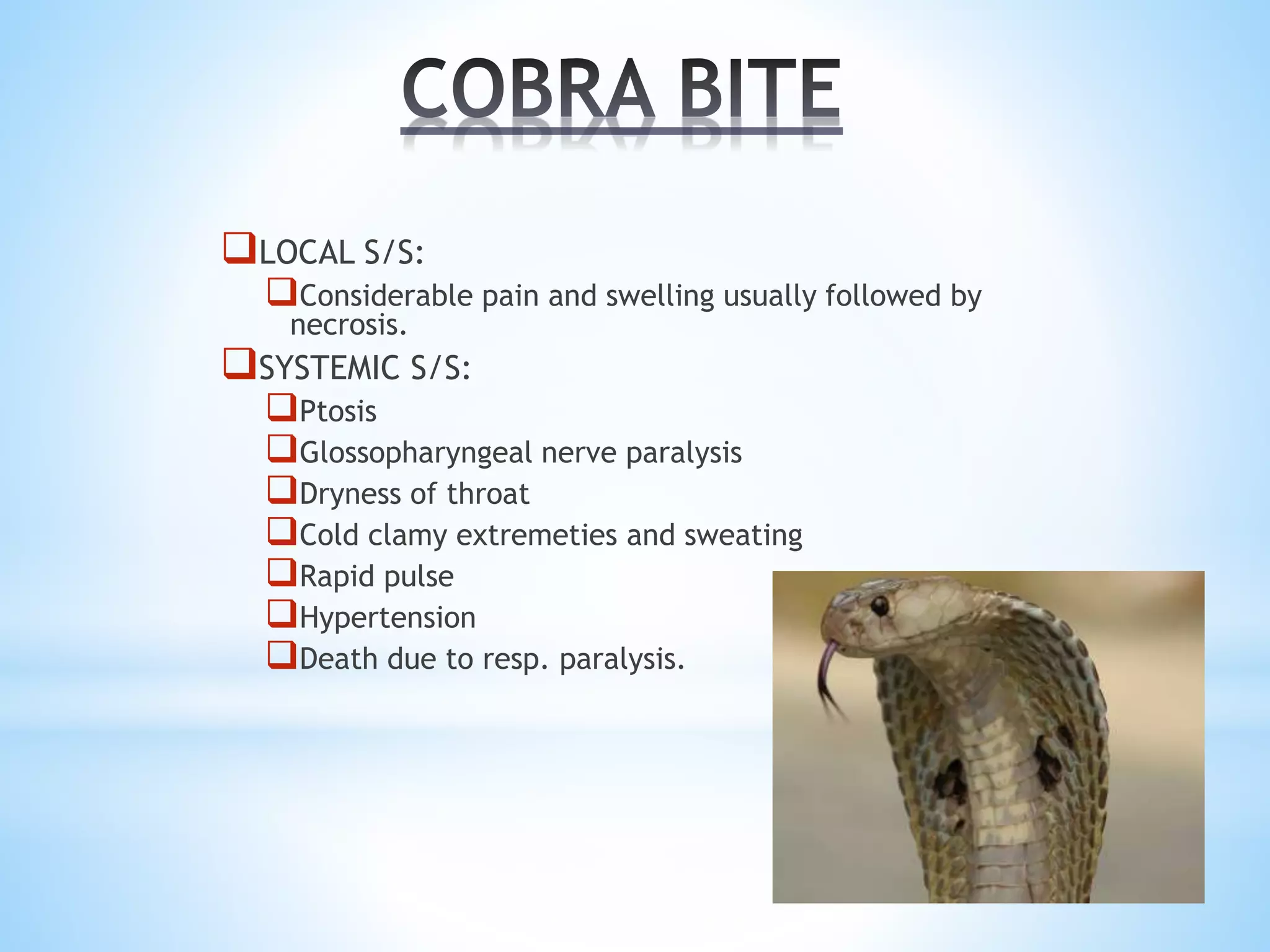
LOCAL S/S:
Considerable pain and swelling usually followed by
necrosis.
SYSTEMIC S/S:
Ptosis
Glossopharyngeal nerve paralysis
Dryness of throat
Cold clamy extremeties and sweating
Rapid pulse
Hypertension
Death due to resp. paralysis.
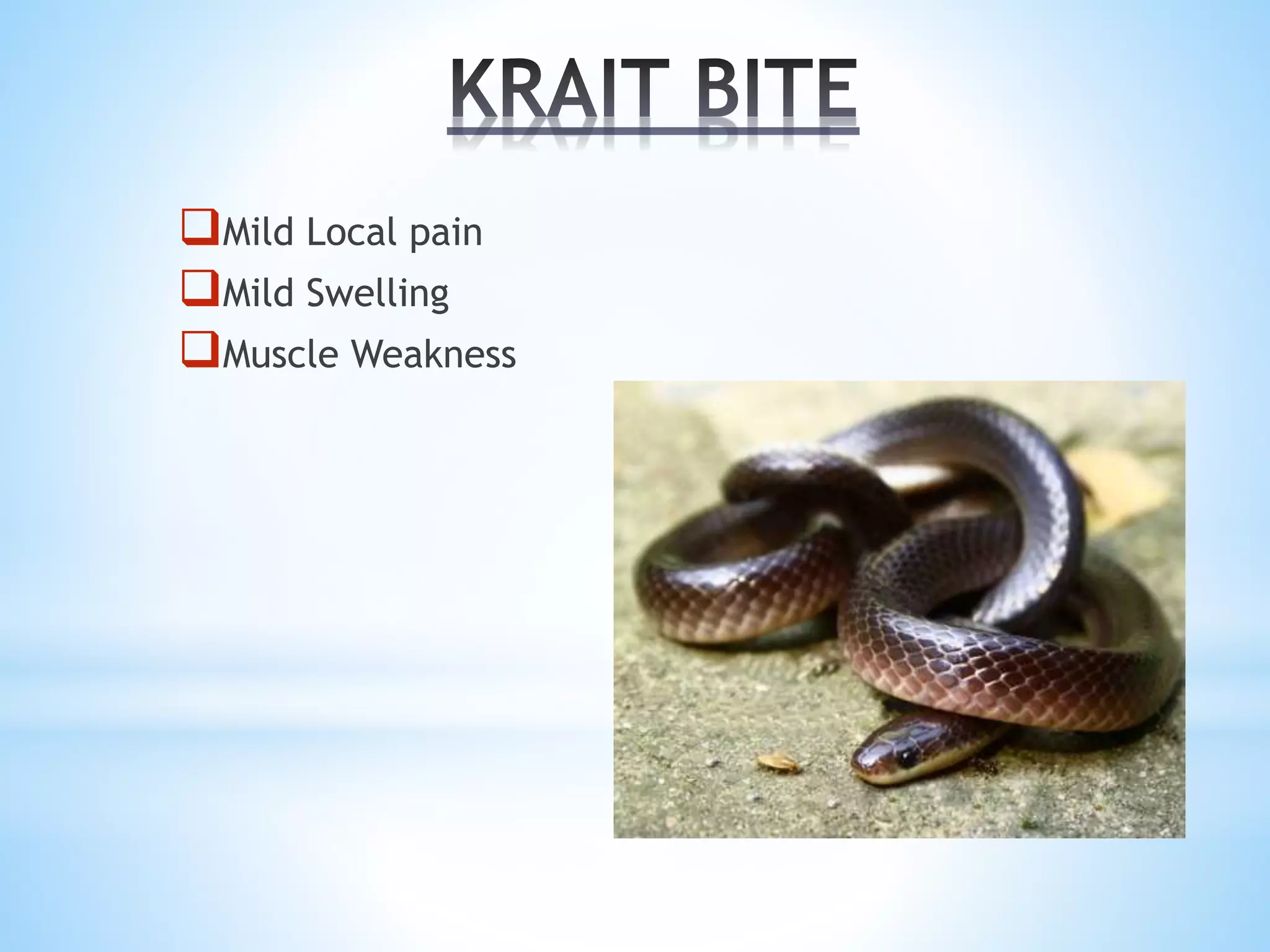
Mild Local pain
Mild Swelling
Muscle Weakness
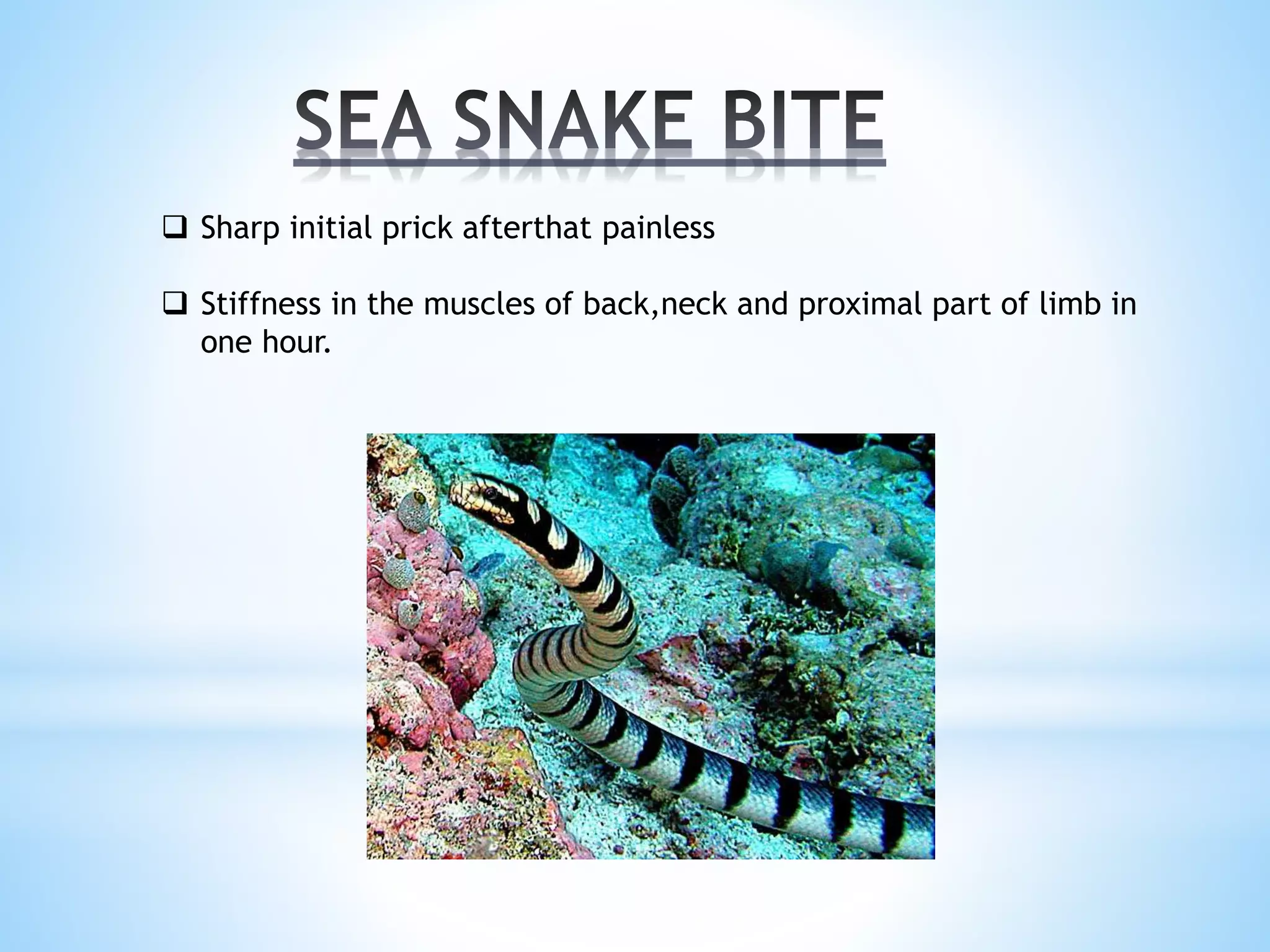
 Sharp initial prick afterthat painless
 Stiffness in the muscles of back,neck and proximal part of limb in
one hour.
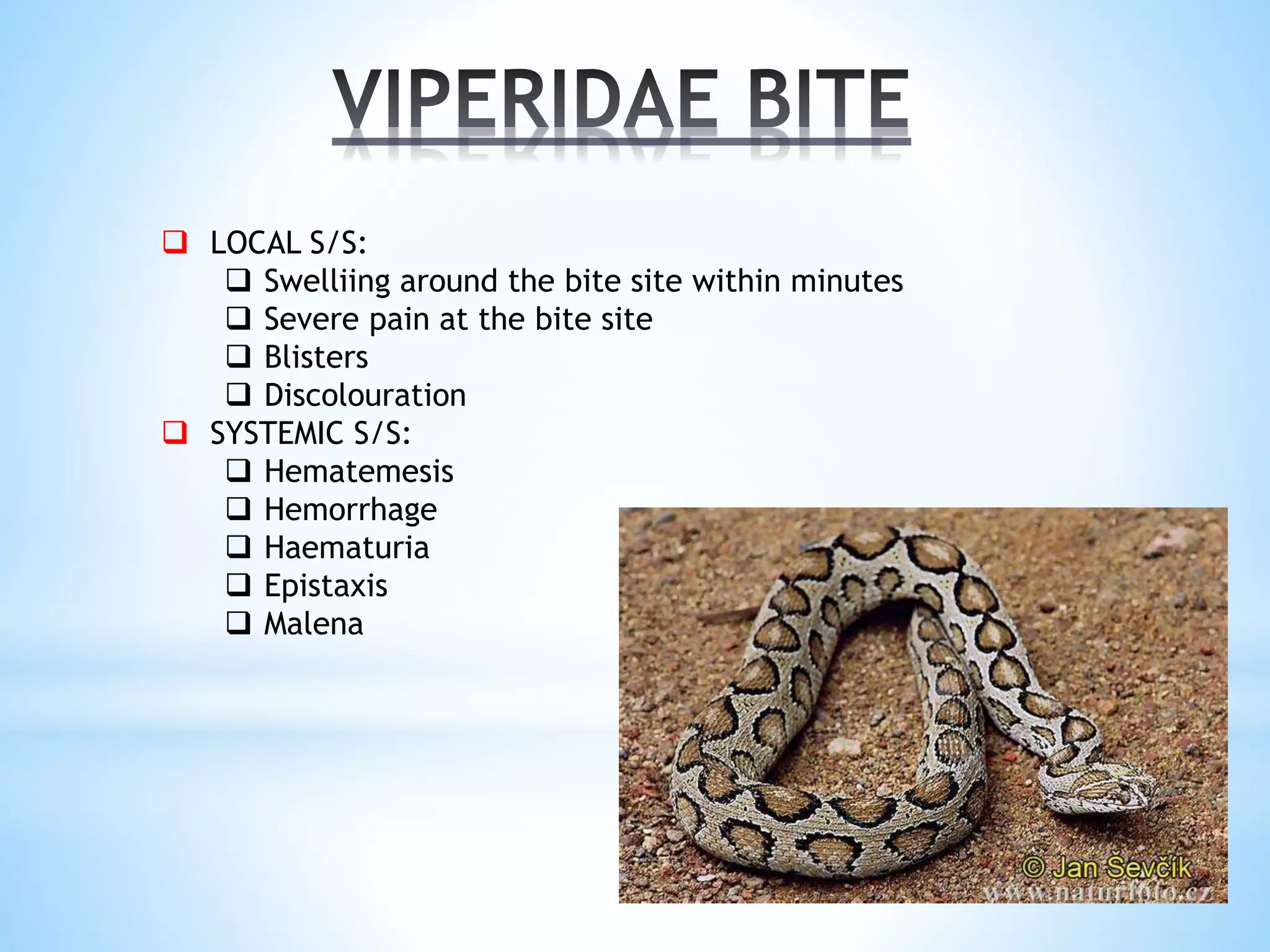
 LOCAL S/S:
 Swelliing around the bite site within minutes
 Severe pain at the bite site
 Blisters
 Discolouration
 SYSTEMIC S/S:
 Hematemesis
 Hemorrhage
 Haematuria
 Epistaxis
 Malena
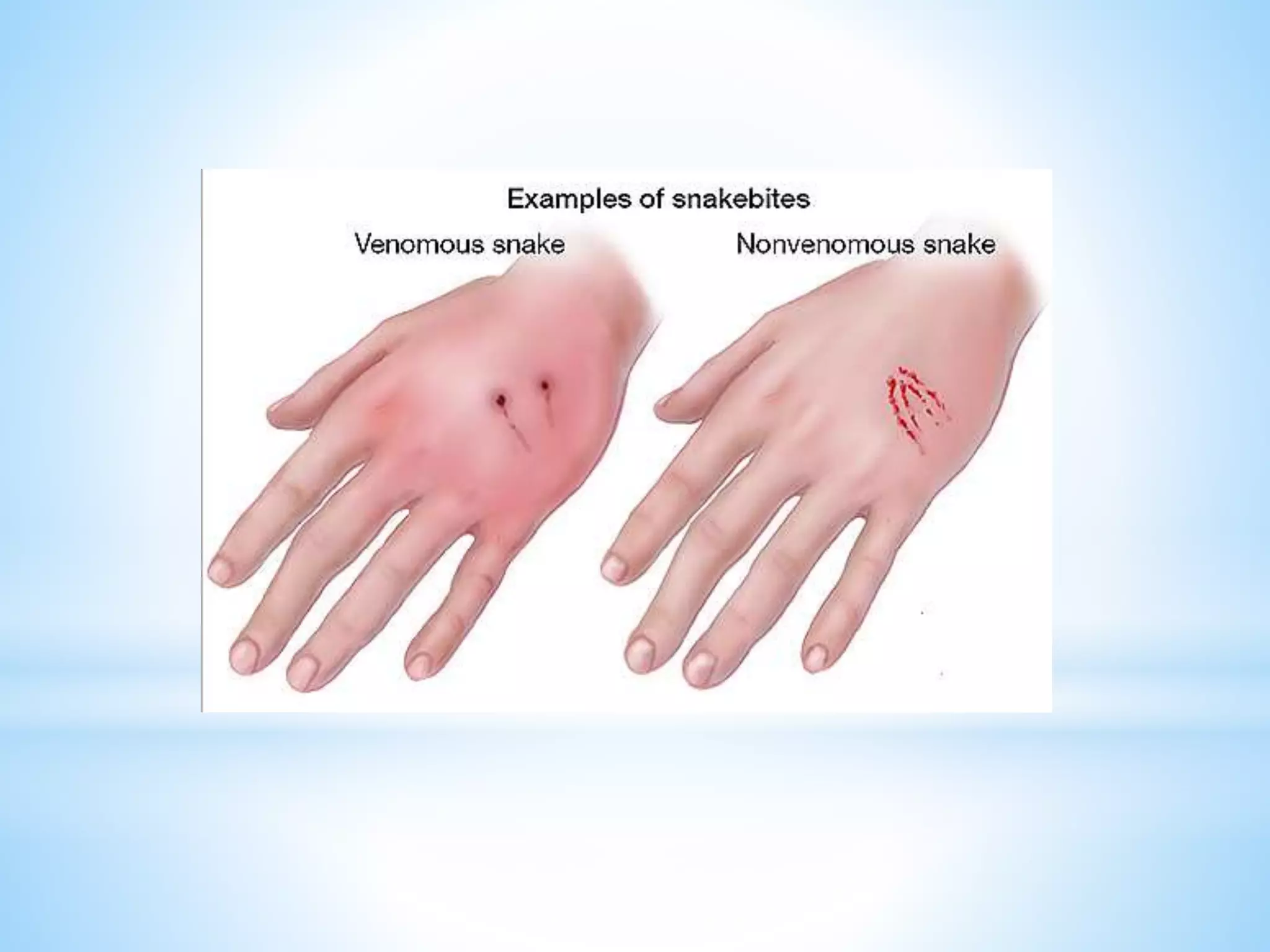
 Finding fang marks
 S/S
 Lab Tests on aqueous washings from the bite site:
 Cholinesterase-Elapid Bites
 Thromboplastin-Viper bite
 Hyperkalemia on ECG – Sea Snake bite
 Prolonging of CLOTTING and BLEDDING TIME
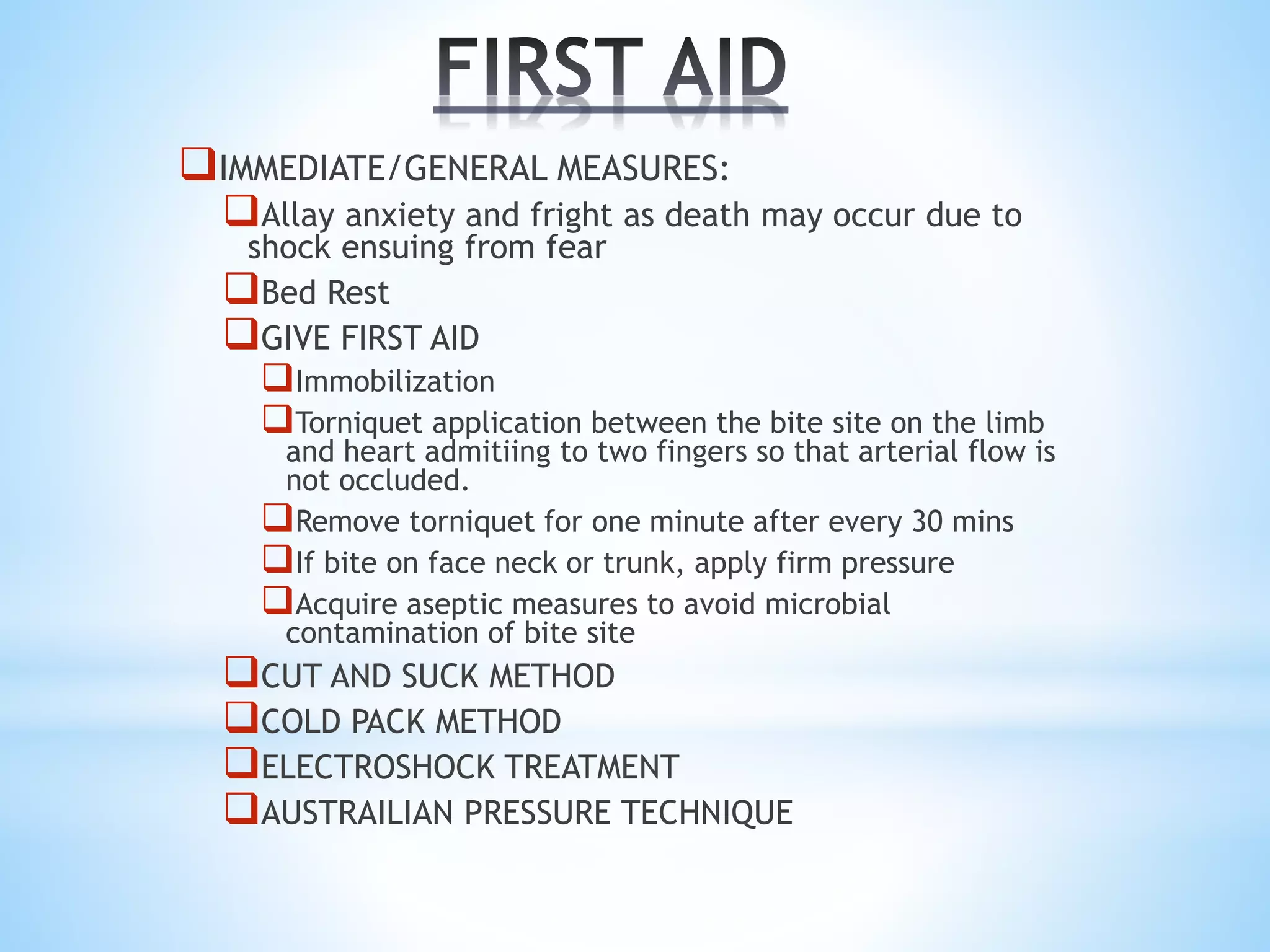
IMMEDIATE/GENERAL MEASURES:
Allay anxiety and fright as death may occur due to
shock ensuing from fear
Bed Rest
GIVE FIRST AID
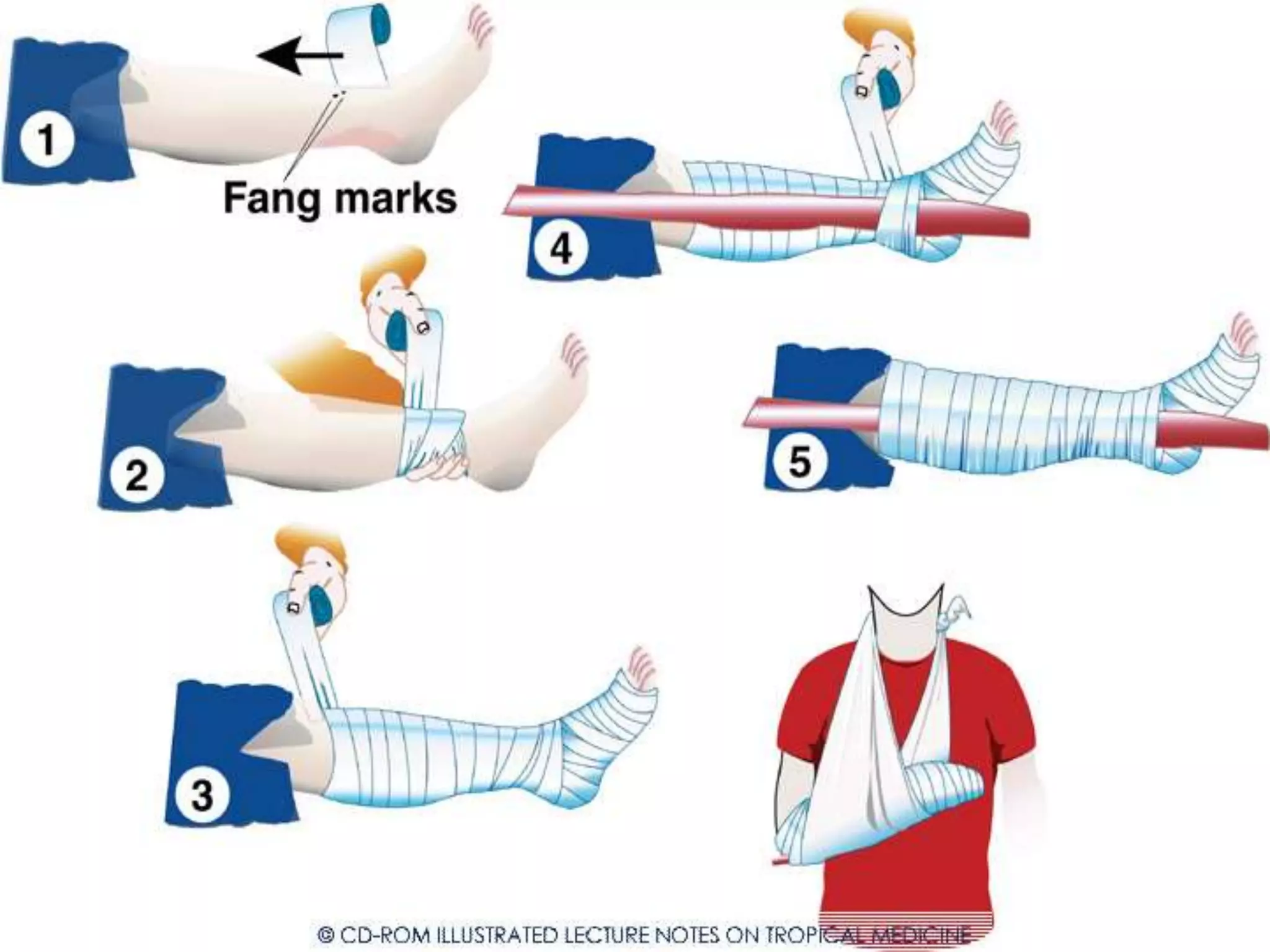
Immobilization
Torniquet application between the bite site on the limb
and heart admitiing to two fingers so that arterial flow is
not occluded.
Remove torniquet for one minute after every 30 mins
If bite on face neck or trunk, apply firm pressure
Acquire aseptic measures to avoid microbial
contamination of bite site
CUT AND SUCK METHOD
COLD PACK METHOD
ELECTROSHOCK TREATMENT
AUSTRAILIAN PRESSURE TECHNIQUE
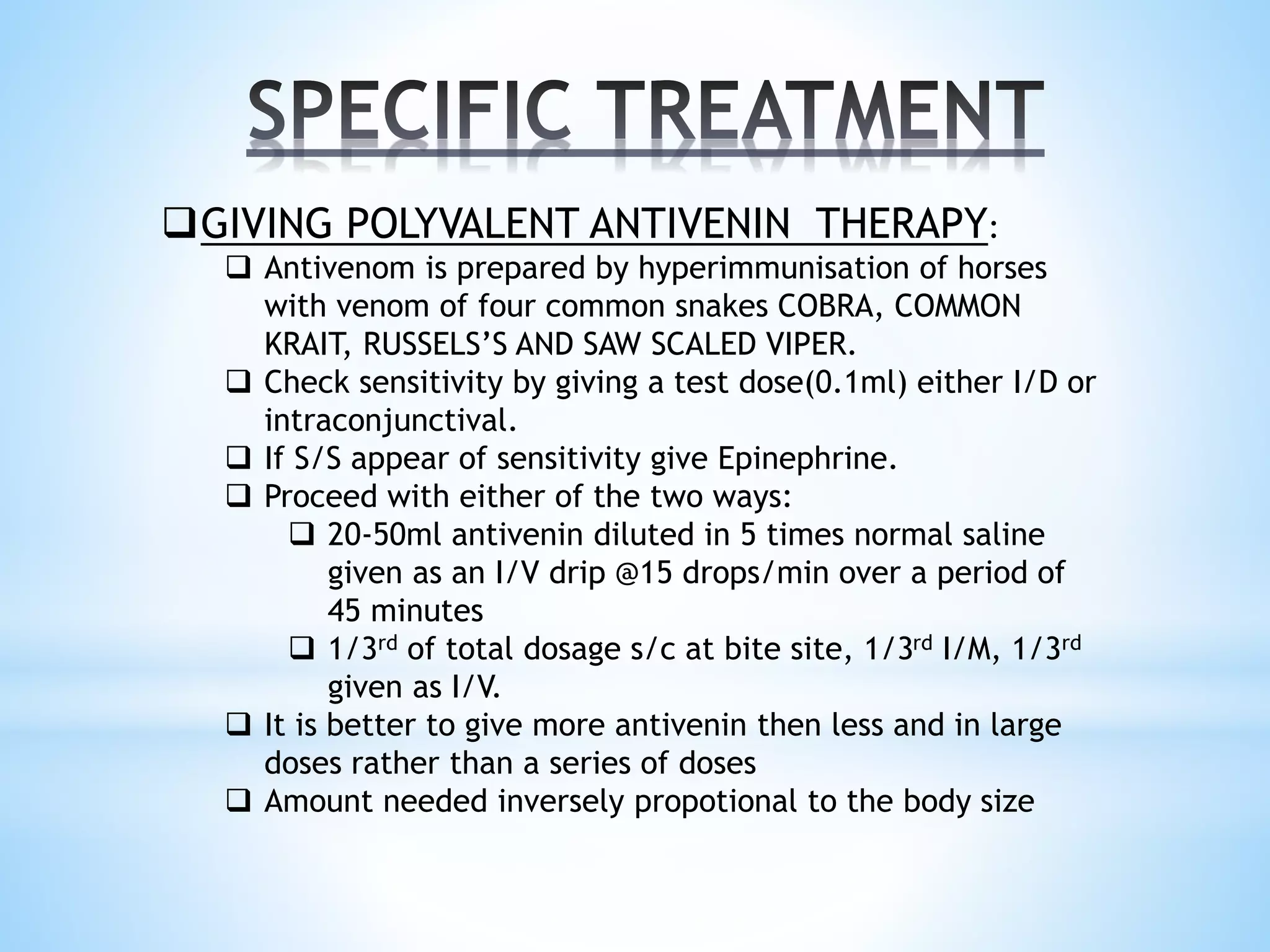
GIVING POLYVALENT ANTIVENIN THERAPY:
 Antivenom is prepared by hyperimmunisation of horses
with venom of four common snakes COBRA, COMMON
KRAIT, RUSSELS’S AND SAW SCALED VIPER.
 Check sensitivity by giving a test dose(0.1ml) either I/D or
intraconjunctival.
 If S/S appear of sensitivity give Epinephrine.
 Proceed with either of the two ways:
 20-50ml antivenin diluted in 5 times normal saline
given as an I/V drip @15 drops/min over a period of
45 minutes
 1/3rd of total dosage s/c at bite site, 1/3rd I/M, 1/3rd
given as I/V.
 It is better to give more antivenin then less and in large
doses rather than a series of doses
 Amount needed inversely propotional to the body size
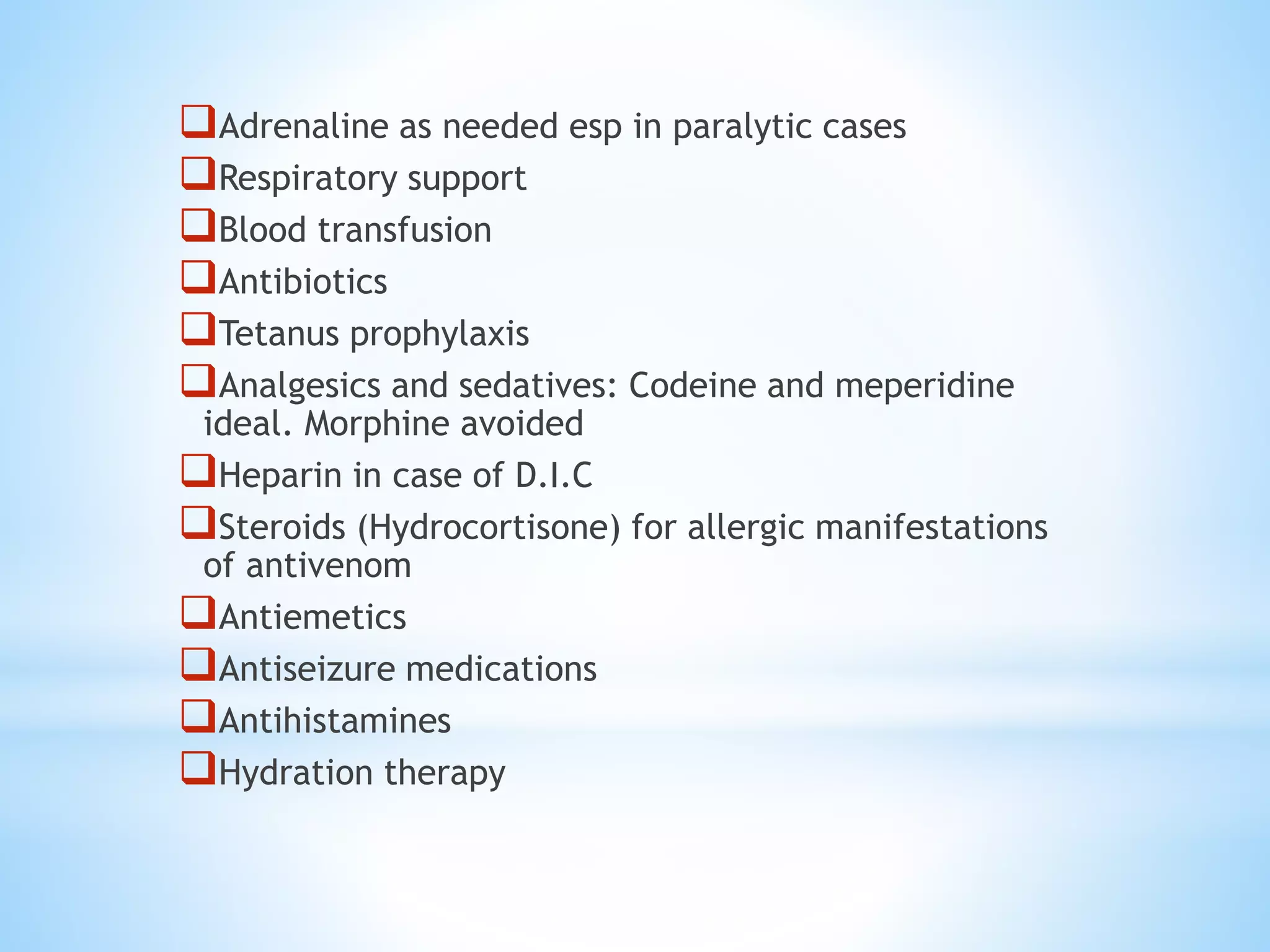
Adrenaline as needed esp in paralytic cases
Respiratory support
Blood transfusion
Antibiotics
Tetanus prophylaxis
Analgesics and sedatives: Codeine and meperidine
ideal. Morphine avoided
Heparin in case of D.I.C
Steroids (Hydrocortisone) for allergic manifestations
of antivenom
Antiemetics
Antiseizure medications
Antihistamines
Hydration therapy
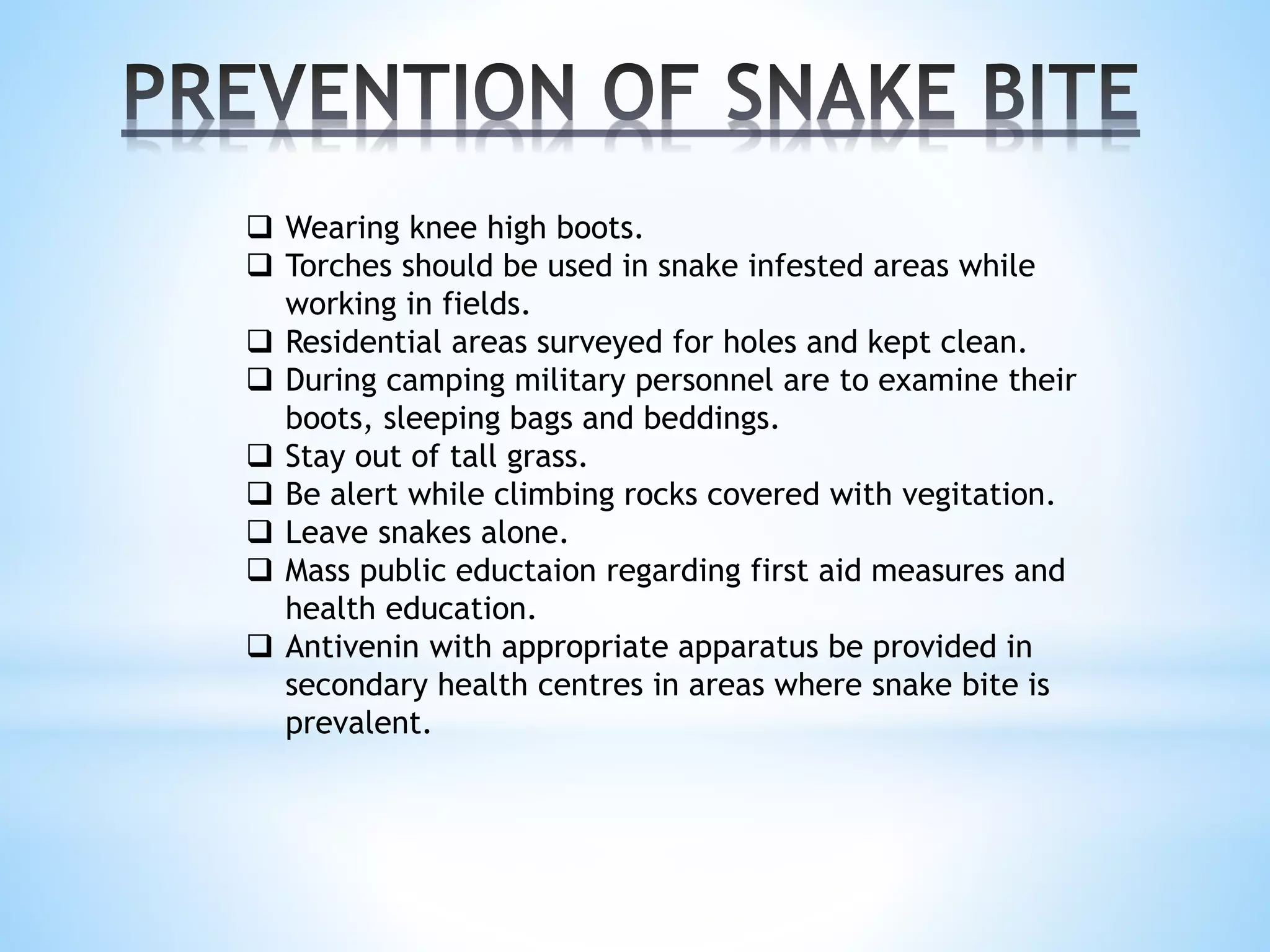
 Wearing knee high boots.
 Torches should be used in snake infested areas while
working in fields.
 Residential areas surveyed for holes and kept clean.
 During camping military personnel are to examine their
boots, sleeping bags and beddings.
 Stay out of tall grass.
 Be alert while climbing rocks covered with vegitation.
 Leave snakes alone.
 Mass public eductaion regarding first aid measures and
health education.
 Antivenin with appropriate apparatus be provided in
secondary health centres in areas where snake bite is
prevalent.
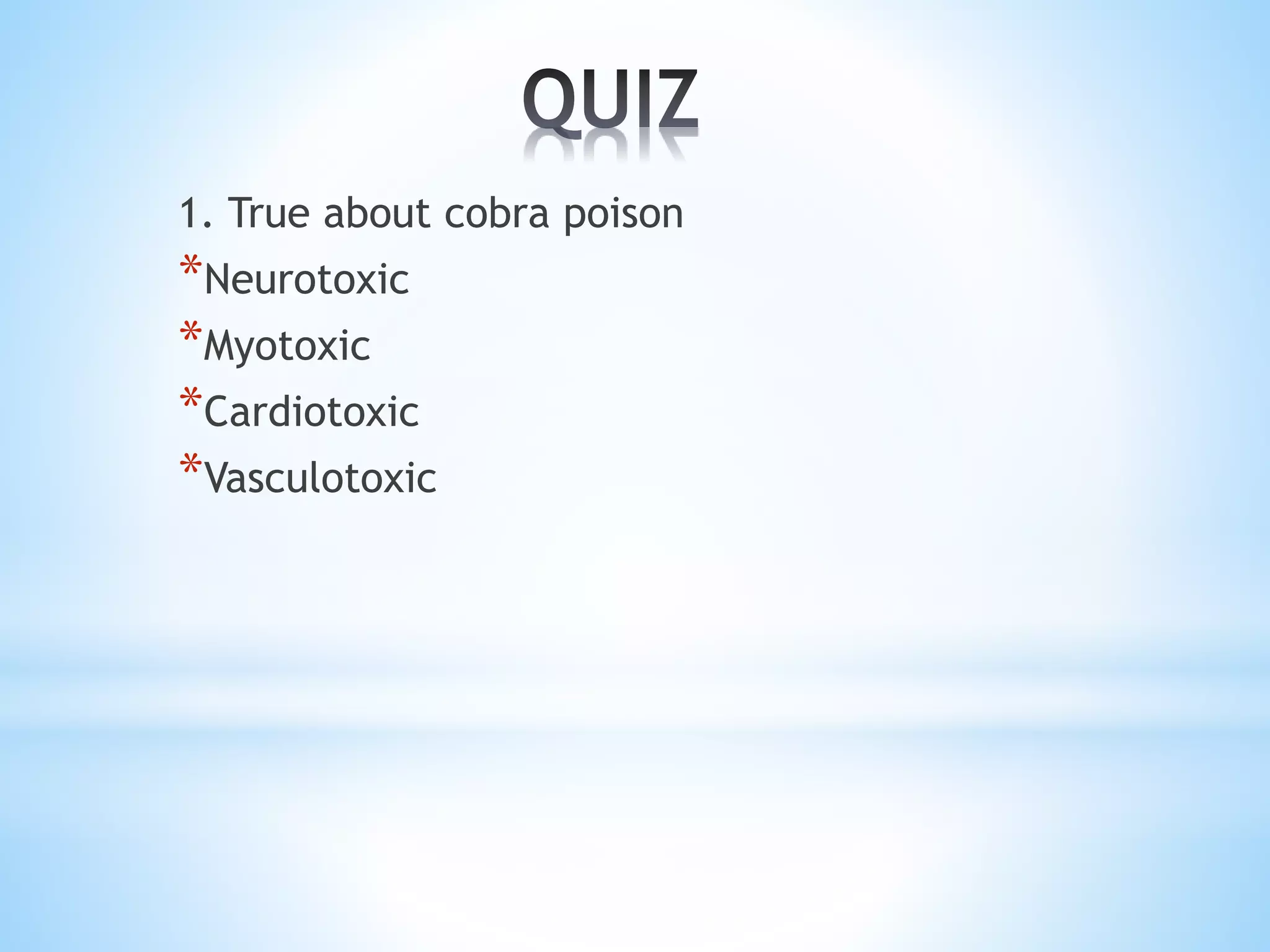
1. True about cobra poison
*Neurotoxic
*Myotoxic
*Cardiotoxic
*Vasculotoxic
2.Cholinesterase is present in
*Elapid
*Viper
*Sea snakes
*All
3.Muscle paralysis is caused by
*Sea snakes
*Mamba
*Krait
*python
4. Most characteristic feature of elapidae snake
envenomation
*Bleeding manifestation
*Neuro-paralytic symptoms
*Rhabdomyolysis
*Cardiotoxicity
1.http://www.who.int/neglected_diseases/integ
rated_media_snakebite/en/
2. Ilyaas Textbook-Public health and community
medicine
THANK YOU

Snake bite and its management

  • 2.
    Dr. Hira ShoaibHashmi Lecturer, Dept. CHS
  • 3.
    To know thedifference between poisonous and non poisonous snakes. To know how to manage a patient with snake bite. To learn how to prevent snake bite. To know the areas in Pakistan where snake bite is prevalent.
  • 5.
    At least 421,000envenomings and 20,000 deaths from snakebites occur each year, especially in South and South East Asia and sub- Saharan Africa.(1)  3000 species Broadly Divided into: Poisonous Snakes Non Poisonous Snakes
  • 6.
    It is toxicsaliva produced by parotid glands of snakes mostly water with enzymatic proteins. Constituents Proteinases Fibrinolysin Phospholipase A,B,C & D Neurotoxins Cholinesterases Haemolysins etc. Produced from the time of birth and injected in response to a prey or self defense One in five snake bites are dry. More venom injected when attacking prey.
  • 7.
    A major publichealth problem because: Agricultural country-70% population lives in rural areas and works in fields Lack of basic education Snakes abundant Weather conditions favorable Peak incidence: June to August • Due to floods and rain with migration to highlands • Sleeping outside in summers • Monsoon season is breeding season • Snake cold blooded more active in summers • Venom yield high in summers Common in agricultural fields, Thar and Baluchistan.
  • 8.
    Haemotoxic Venom: Attacks bloodvessels, serum escapes into surroundings, clotting factors are activated. Severe swelling, pain and discoloration and shock ensues with DIC. Neurotoxic venom: Much less local symptoms, affects remote nerves, cause tingling, drooping of eyelids and respiratory arrest. Myotoxic Venom: Affects muscles with stiffness and paralysis Appearance of myoglobin in urine
  • 13.
    LOCAL S/S: Considerable painand swelling usually followed by necrosis. SYSTEMIC S/S: Ptosis Glossopharyngeal nerve paralysis Dryness of throat Cold clamy extremeties and sweating Rapid pulse Hypertension Death due to resp. paralysis.
  • 14.
    Mild Local pain MildSwelling Muscle Weakness
  • 15.
     Sharp initialprick afterthat painless  Stiffness in the muscles of back,neck and proximal part of limb in one hour.
  • 16.
     LOCAL S/S: Swelliing around the bite site within minutes  Severe pain at the bite site  Blisters  Discolouration  SYSTEMIC S/S:  Hematemesis  Hemorrhage  Haematuria  Epistaxis  Malena
  • 17.
     Finding fangmarks  S/S  Lab Tests on aqueous washings from the bite site:  Cholinesterase-Elapid Bites  Thromboplastin-Viper bite  Hyperkalemia on ECG – Sea Snake bite  Prolonging of CLOTTING and BLEDDING TIME
  • 18.
    IMMEDIATE/GENERAL MEASURES: Allay anxietyand fright as death may occur due to shock ensuing from fear Bed Rest GIVE FIRST AID Immobilization Torniquet application between the bite site on the limb and heart admitiing to two fingers so that arterial flow is not occluded. Remove torniquet for one minute after every 30 mins If bite on face neck or trunk, apply firm pressure Acquire aseptic measures to avoid microbial contamination of bite site CUT AND SUCK METHOD COLD PACK METHOD ELECTROSHOCK TREATMENT AUSTRAILIAN PRESSURE TECHNIQUE
  • 20.
    GIVING POLYVALENT ANTIVENINTHERAPY:  Antivenom is prepared by hyperimmunisation of horses with venom of four common snakes COBRA, COMMON KRAIT, RUSSELS’S AND SAW SCALED VIPER.  Check sensitivity by giving a test dose(0.1ml) either I/D or intraconjunctival.  If S/S appear of sensitivity give Epinephrine.  Proceed with either of the two ways:  20-50ml antivenin diluted in 5 times normal saline given as an I/V drip @15 drops/min over a period of 45 minutes  1/3rd of total dosage s/c at bite site, 1/3rd I/M, 1/3rd given as I/V.  It is better to give more antivenin then less and in large doses rather than a series of doses  Amount needed inversely propotional to the body size
  • 21.
    Adrenaline as neededesp in paralytic cases Respiratory support Blood transfusion Antibiotics Tetanus prophylaxis Analgesics and sedatives: Codeine and meperidine ideal. Morphine avoided Heparin in case of D.I.C Steroids (Hydrocortisone) for allergic manifestations of antivenom Antiemetics Antiseizure medications Antihistamines Hydration therapy
  • 23.
     Wearing kneehigh boots.  Torches should be used in snake infested areas while working in fields.  Residential areas surveyed for holes and kept clean.  During camping military personnel are to examine their boots, sleeping bags and beddings.  Stay out of tall grass.  Be alert while climbing rocks covered with vegitation.  Leave snakes alone.  Mass public eductaion regarding first aid measures and health education.  Antivenin with appropriate apparatus be provided in secondary health centres in areas where snake bite is prevalent.
  • 25.
    1. True aboutcobra poison *Neurotoxic *Myotoxic *Cardiotoxic *Vasculotoxic
  • 26.
    2.Cholinesterase is presentin *Elapid *Viper *Sea snakes *All
  • 27.
    3.Muscle paralysis iscaused by *Sea snakes *Mamba *Krait *python
  • 28.
    4. Most characteristicfeature of elapidae snake envenomation *Bleeding manifestation *Neuro-paralytic symptoms *Rhabdomyolysis *Cardiotoxicity
  • 29.