Carlos Amade, 2013
Epidemiology
“the study of the distribution and
determinants of health-related
states or events in specified
populations, and the application of
this study to the prevention and
control of health problems”
(BONITA 2006)
Prevention of disease
The outcome of any investigation
on risk is to determine what can
be done to reduce health risks
within populations
Prevention of disease
• The decline in death rates that occurred
during the 19th century in high-income
countries was principally due to a decrease
in deaths from infectious disease.
 Most of the decline in mortality took place
before specific disease prevention
interventions and has been attributed to
improvements in nutrition, housing,
sanitation and other environmental health
Prevention of disease
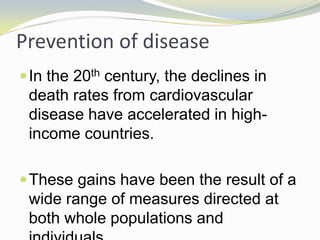
In the 20th century, the declines in
death rates from cardiovascular
disease have accelerated in high-
income countries.
These gains have been the result of a
wide range of measures directed at
both whole populations and
Preventive potential
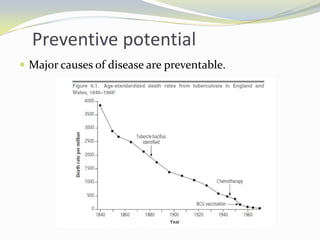
 Major causes of disease are preventable.
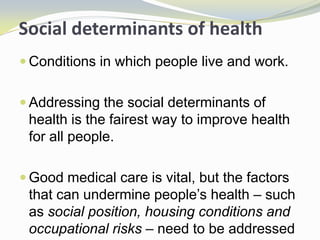
Social determinants of health
 Conditions in which people live and work.
 Addressing the social determinants of
health is the fairest way to improve health
for all people.
 Good medical care is vital, but the factors
that can undermine people’s health – such
as social position, housing conditions and
occupational risks – need to be addressed
Who should practice preventive Medicine?
 Public health nurses, medical sociologists,
psychologists, health economists, sanitary
engineers, pollution control experts and
occupational hygienists are all involved in
disease-prevention efforts.
 All people!!!!!!!!!
Levels of prevention
 Four levels
 Each level targets conditions which have an
established role in causing disease.
 Approaches to prevention overlap and merge
 Primordial and primary prevention contribute most to
the health of the whole population
 Secondary and tertiary prevention are generally
focused on people who already have signs of disease
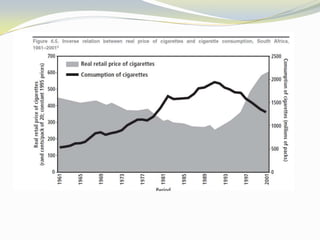
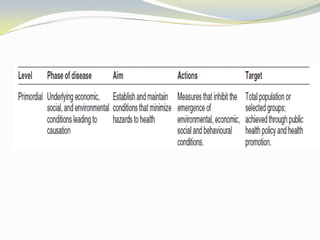
Primordial prevention
Avoid the emergence and
establishment of the social,
economic and cultural patterns of
living that are known to contribute
to an elevated risk of disease.
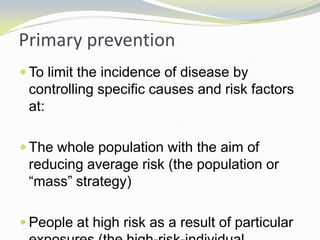
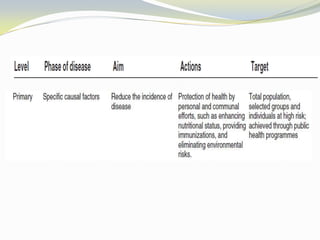
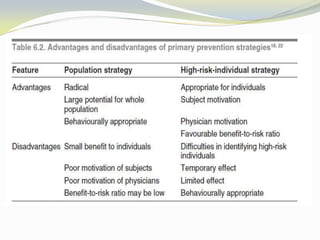
Primary prevention
 To limit the incidence of disease by
controlling specific causes and risk factors
at:
 The whole population with the aim of
reducing average risk (the population or
“mass” strategy)
 People at high risk as a result of particular
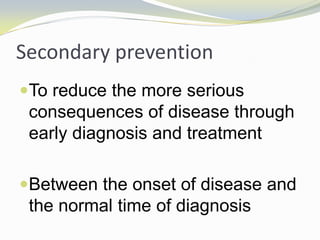
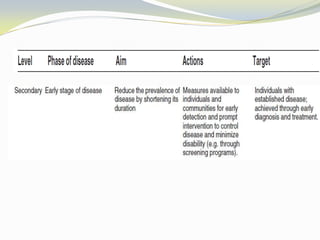
Secondary prevention
To reduce the more serious
consequences of disease through
early diagnosis and treatment
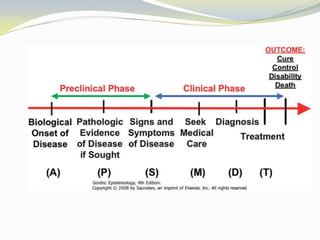
Between the onset of disease and
the normal time of diagnosis
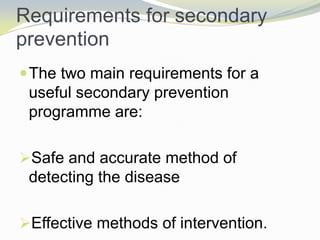
Requirements for secondary
prevention
The two main requirements for a
useful secondary prevention
programme are:
Safe and accurate method of
detecting the disease
Effective methods of intervention.
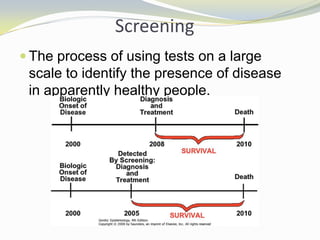
Screening
 The process of using tests on a large
scale to identify the presence of disease
in apparently healthy people.
Types of screening
 Mass screening = for the whole population
(or subset)
 Multiple or multiphasic screening uses
several screening tests at the same time
 Targeted screening of groups with specific
exposures
 Case-finding or opportunistic screening = at
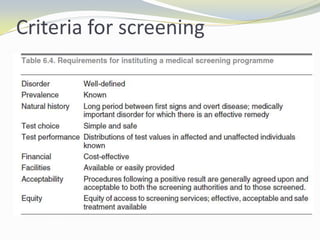
Criteria for screening
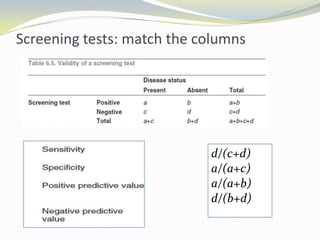
Screening tests: match the columns
d/(c+d)
a/(a+c)
a/(a+b)
d/(b+d)
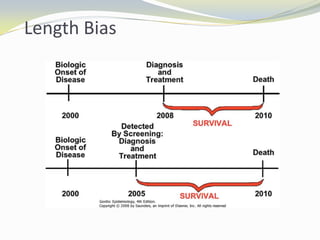
Length Bias
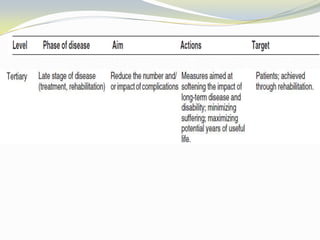
Tertiary prevention
 To reduce the progress or complications of
established disease
 Important aspect of therapeutic and
rehabilitation medicine.
 Consists of the measures intended to
reduce impairments and disabilities,
minimize suffering caused by poor health
Thank you

Preventive medicine

  • 1.
  • 2.
    Epidemiology “the study ofthe distribution and determinants of health-related states or events in specified populations, and the application of this study to the prevention and control of health problems” (BONITA 2006)
  • 3.
    Prevention of disease Theoutcome of any investigation on risk is to determine what can be done to reduce health risks within populations
  • 4.
    Prevention of disease •The decline in death rates that occurred during the 19th century in high-income countries was principally due to a decrease in deaths from infectious disease.  Most of the decline in mortality took place before specific disease prevention interventions and has been attributed to improvements in nutrition, housing, sanitation and other environmental health
  • 5.
    Prevention of disease Inthe 20th century, the declines in death rates from cardiovascular disease have accelerated in high- income countries. These gains have been the result of a wide range of measures directed at both whole populations and
  • 6.
    Preventive potential  Majorcauses of disease are preventable.
  • 7.
    Social determinants ofhealth  Conditions in which people live and work.  Addressing the social determinants of health is the fairest way to improve health for all people.  Good medical care is vital, but the factors that can undermine people’s health – such as social position, housing conditions and occupational risks – need to be addressed
  • 8.
    Who should practicepreventive Medicine?  Public health nurses, medical sociologists, psychologists, health economists, sanitary engineers, pollution control experts and occupational hygienists are all involved in disease-prevention efforts.  All people!!!!!!!!!
  • 9.
    Levels of prevention Four levels  Each level targets conditions which have an established role in causing disease.  Approaches to prevention overlap and merge  Primordial and primary prevention contribute most to the health of the whole population  Secondary and tertiary prevention are generally focused on people who already have signs of disease
  • 11.
    Primordial prevention Avoid theemergence and establishment of the social, economic and cultural patterns of living that are known to contribute to an elevated risk of disease.
  • 14.
    Primary prevention  Tolimit the incidence of disease by controlling specific causes and risk factors at:  The whole population with the aim of reducing average risk (the population or “mass” strategy)  People at high risk as a result of particular
  • 17.
    Secondary prevention To reducethe more serious consequences of disease through early diagnosis and treatment Between the onset of disease and the normal time of diagnosis
  • 19.
    Requirements for secondary prevention Thetwo main requirements for a useful secondary prevention programme are: Safe and accurate method of detecting the disease Effective methods of intervention.
  • 20.
    Screening  The processof using tests on a large scale to identify the presence of disease in apparently healthy people.
  • 21.
    Types of screening Mass screening = for the whole population (or subset)  Multiple or multiphasic screening uses several screening tests at the same time  Targeted screening of groups with specific exposures  Case-finding or opportunistic screening = at
  • 22.
  • 23.
    Screening tests: matchthe columns d/(c+d) a/(a+c) a/(a+b) d/(b+d)
  • 24.
  • 25.
    Tertiary prevention  Toreduce the progress or complications of established disease  Important aspect of therapeutic and rehabilitation medicine.  Consists of the measures intended to reduce impairments and disabilities, minimize suffering caused by poor health
  • 27.