Col Zulfiquer Ahmed Amin
M Phil (HHM), MPH (HM), PGD (Health Economics), MBBS
Armed Forces Medical Institute (AFMI)
‘Health Promotion’ as a term was used for the first time by
Marc Lalonde in 1974 and quickly became an umbrella term
for a wide range of strategies designed to tackle the wider
determinants of health.
After reviewing the evidence, the Lalonde Report suggested
that health care services were not the most important
determinant of health and there were four “health fields”–
lifestyle, environment, health care organization, human
biology—and that major improvements in health would
result primarily from improvements in lifestyle, environment
and our knowledge of human biology.
Health promotion is about raising the health status of
individuals and communities. Promotion in the health context
means improving, advancing, supporting, encouraging and
placing health higher on personal and public agendas. Given that
major socioeconomic determinants of health are often outside
individual or even collective control, a fundamental aspect of
health promotion is that it aims to empower people to have
more control over aspects of their lives that affect their health.
These twin elements of improving health and having more
control over it are fundamental to the aims and processes of
health promotion.
Definition:
‘Health promotion is the process of enabling people to increase
control over, and to improve, their health’.
It moves beyond a focus on individual behaviour towards a wide
range of social and environmental interventions.
It is a positive concept emphasizing personal, social, political and
institutional resources, as well as physical capacities.
WHO (1990)
Health Promotion is any combination of health, education,
economic, political, spiritual or organizational initiative to bring
about positive attitudinal, behavioral, social, or environmental
changes conducive to improving the health of population.
Health Promotion is directed towards action on the
determinants or causes of health.
Health Promotion, therefore, requires a close co-operation of
sectors beyond health services, reflecting the diversity of
conditions which influence health.
Govt at both local and national levels has a unique responsibility
to act appropriately and in timely way to ensure that the ‘total’
environment, which is beyond the control of individuals and
groups, is conducive to health
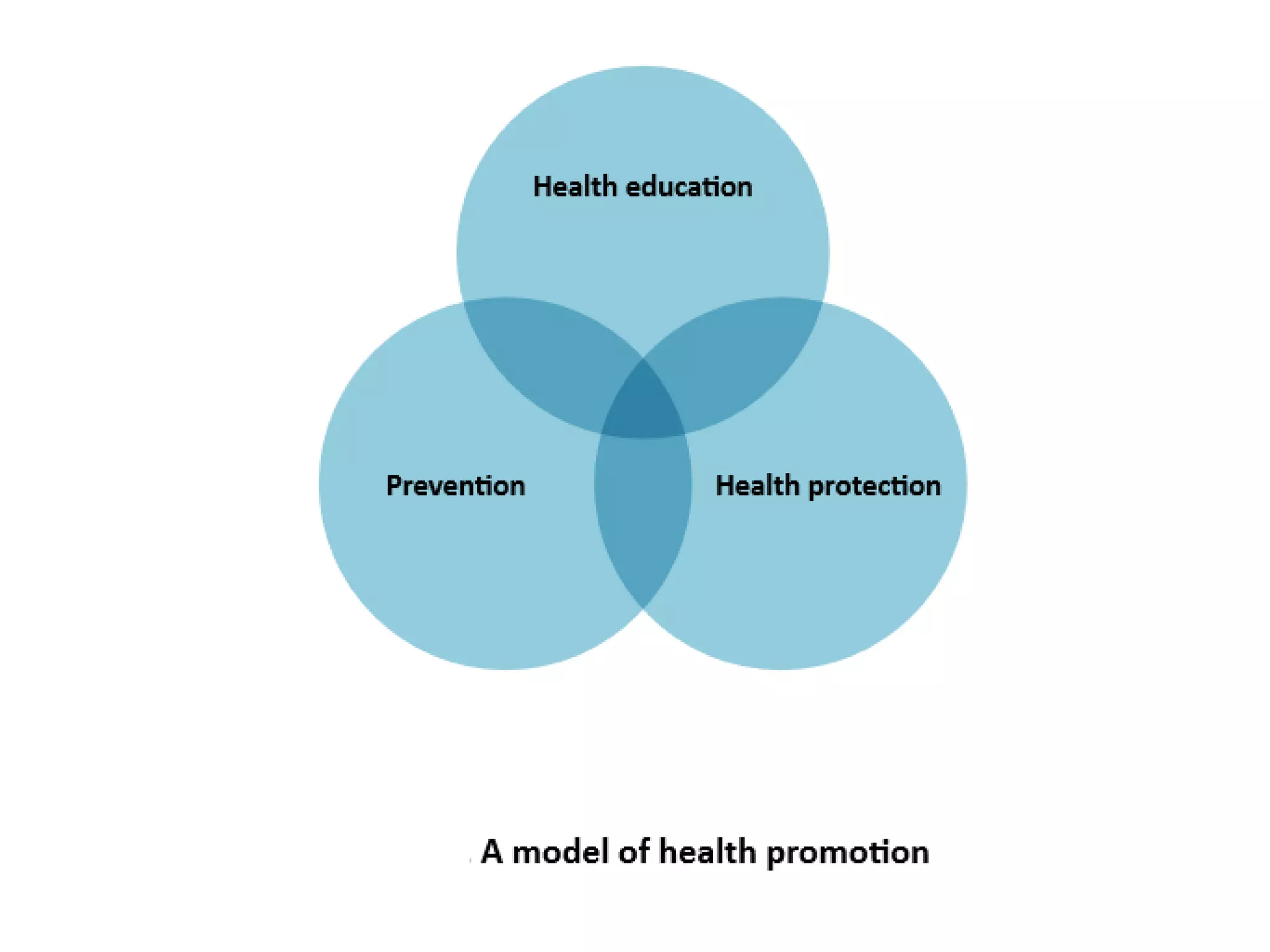
Health education is a process which informs, motivate and
helps people to adopt and maintain healthy practices and life
styles; advocates environmental changes as needed to facilitate
this goal and conducts professional training and research to the
same end. - The National Conference on Preventive Medicine
[USA]
Health protection is the branch of public health concerned with
policies and practice to improve the prevention and control of
diseases and other environmental threats to the health of the
population.
Disease prevention covers measures not only to prevent the
occurrence of disease, such as risk factor reduction, but also to
arrest its progress and reduce its consequences once
established.
Health Education vs Health Promotion
Health education involves giving information and teaching
individuals and communities how to achieve better health.
Health education seeks to motivate individuals to accept a
process of behavioral change through directly influencing their
values, beliefs, and attitude systems”.
In contrast, health promotion “involves social, economic, and
political change to ensure the environment is conducive to
health .
The two concepts, Health Education and Health Promotion are
symbiotic strategies. This means that they are closely associated
or related and that they benefit from each other.
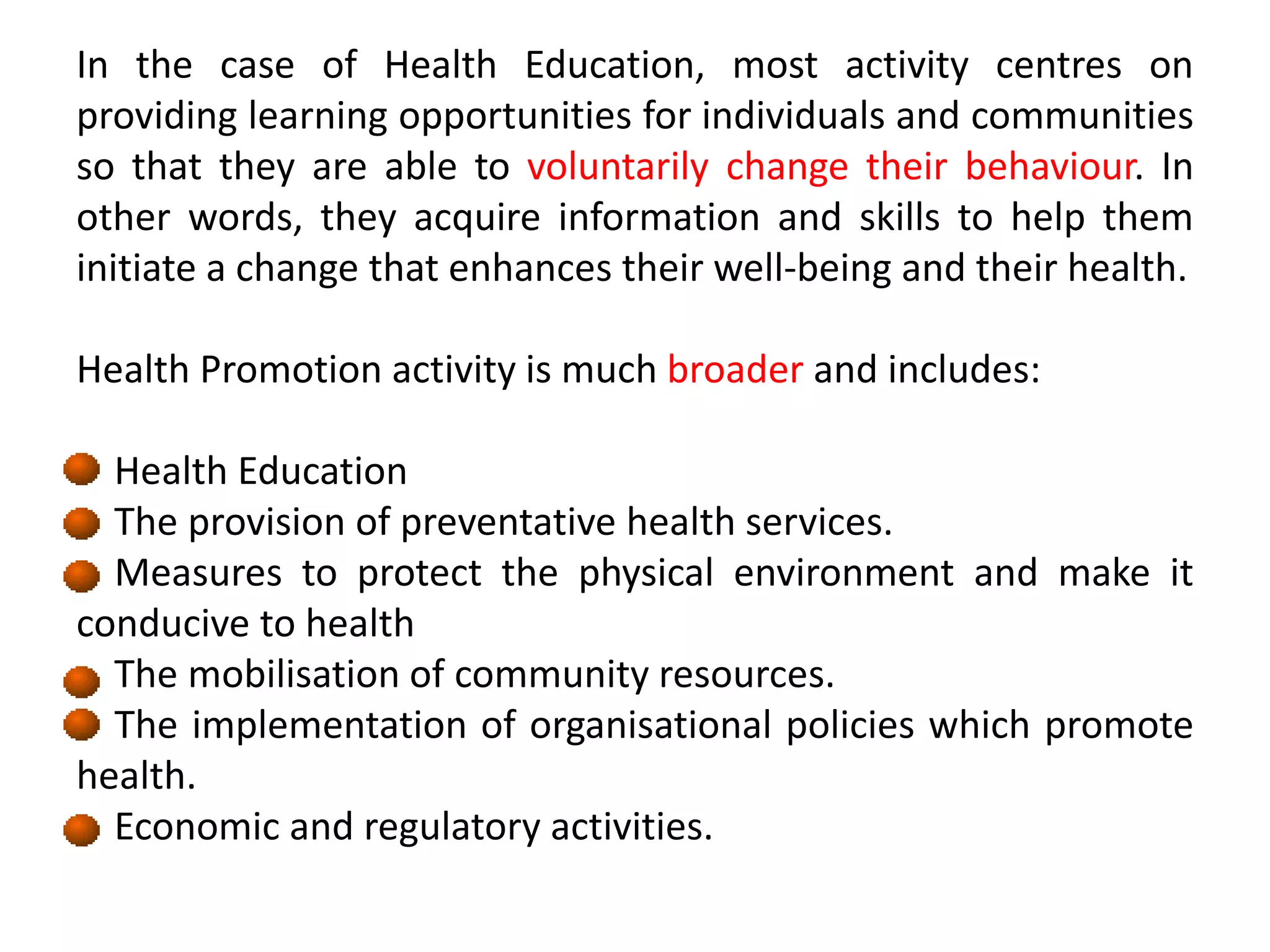
In the case of Health Education, most activity centres on
providing learning opportunities for individuals and communities
so that they are able to voluntarily change their behaviour. In
other words, they acquire information and skills to help them
initiate a change that enhances their well-being and their health.
Health Promotion activity is much broader and includes:
Health Education
The provision of preventative health services.
Measures to protect the physical environment and make it
conducive to health
The mobilisation of community resources.
The implementation of organisational policies which promote
health.
Economic and regulatory activities.
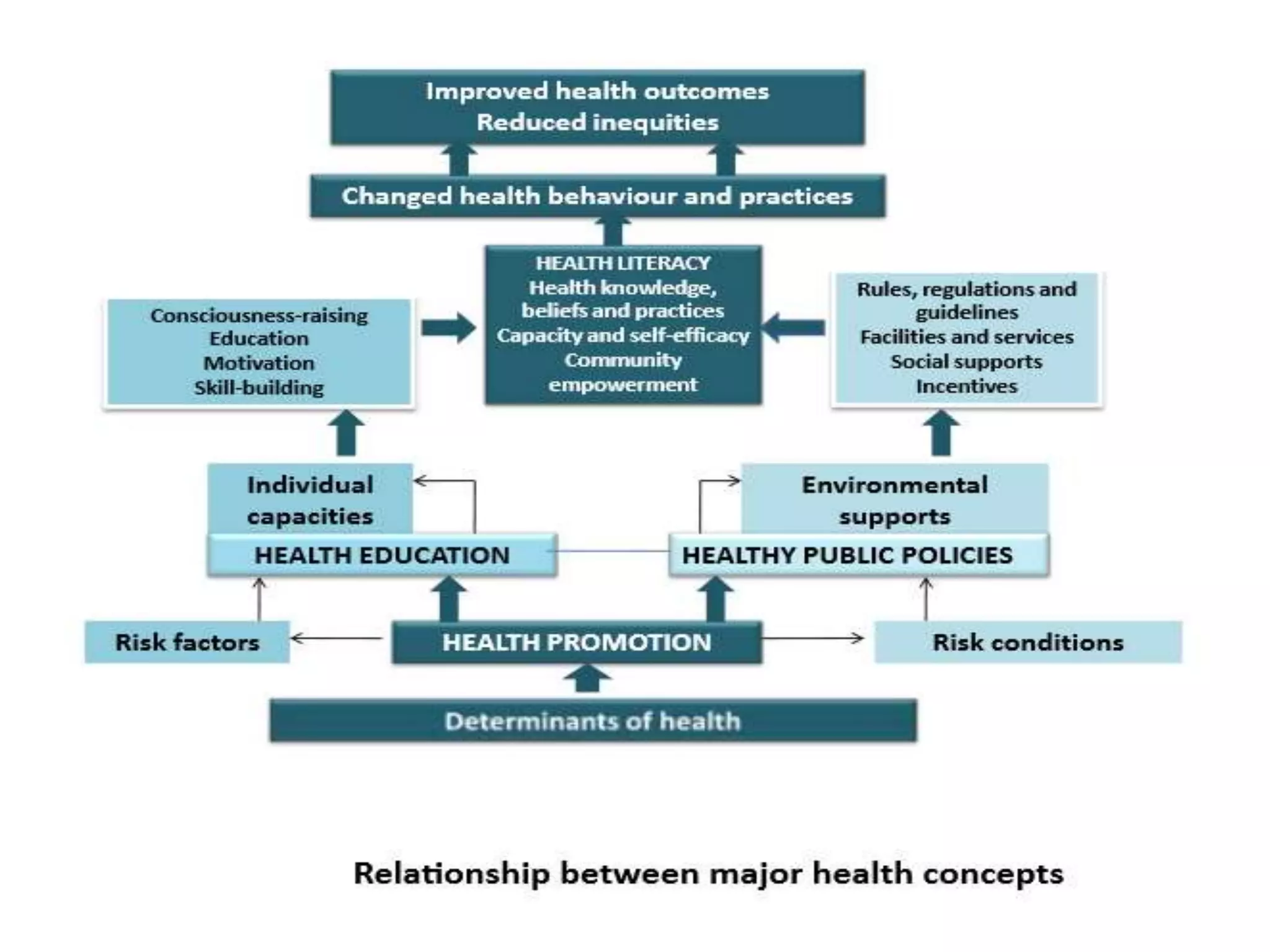
A key feature that distinguishes Health Promotion from Health
Education is that Health Promotion involves environmental and
political action. Similarly, it is possible to distil the concept of
Health Promotion into an essential formula:
Health Promotion = Health Education x Healthy Public Policy
(Tones and Tilford, 1994)
Example of HP:
A popular example of successful health promotion is the warning
label that now exists on cigarettes. Historically, cigarettes were
considered socially acceptable, and commonly sold without any
warning about the risk to the health of the user. However, health
experts noted the increased incidence of disease and began to
educate the public on the risks of smoking and tobacco use.
Eventually, these health promotion activities led to a change in
public policy, which now requires the manufactures to add a
warning label directly to the package.
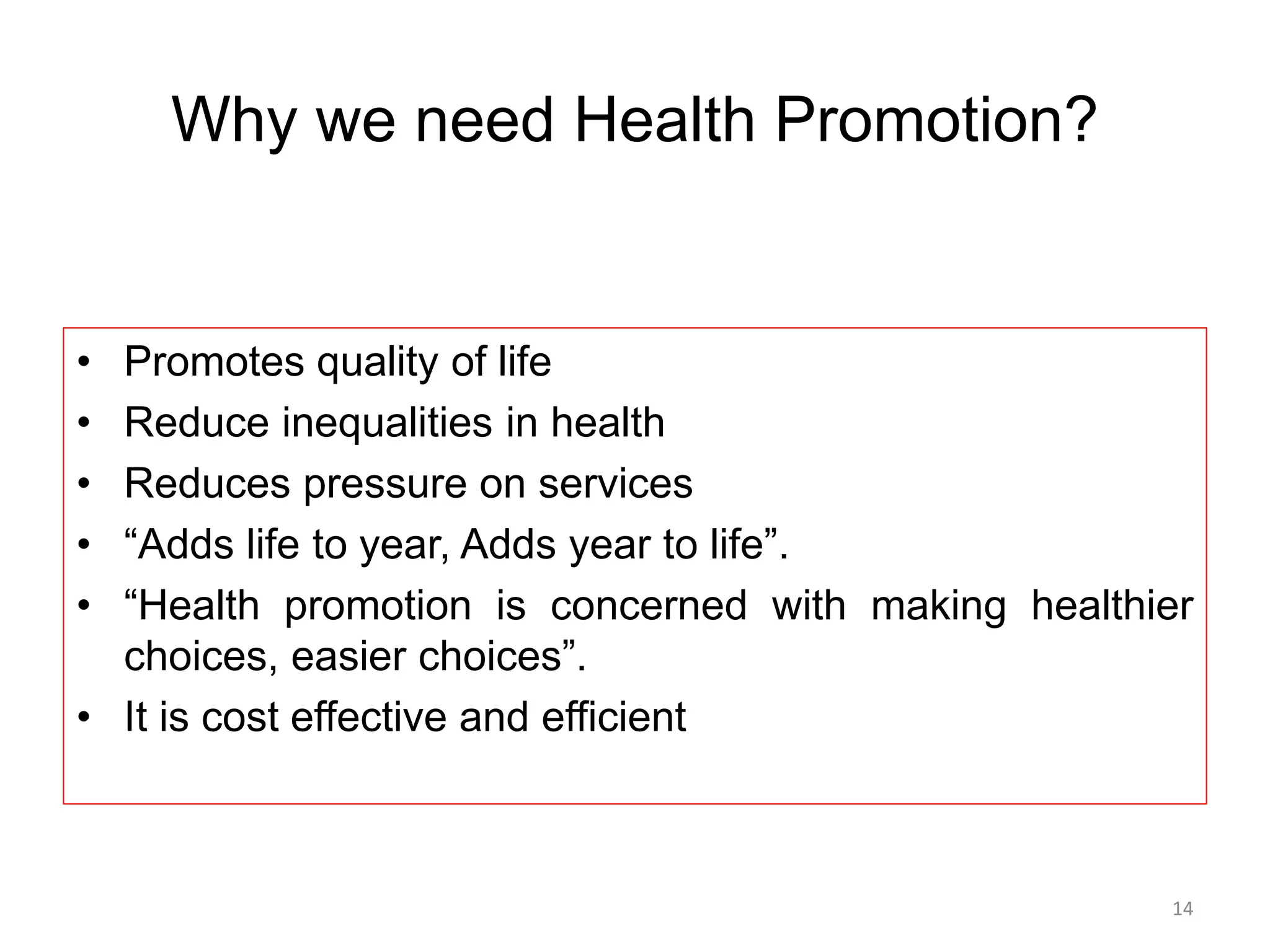
Why we need Health Promotion?
14
• Promotes quality of life
• Reduce inequalities in health
• Reduces pressure on services
• “Adds life to year, Adds year to life”.
• “Health promotion is concerned with making healthier
choices, easier choices”.
• It is cost effective and efficient
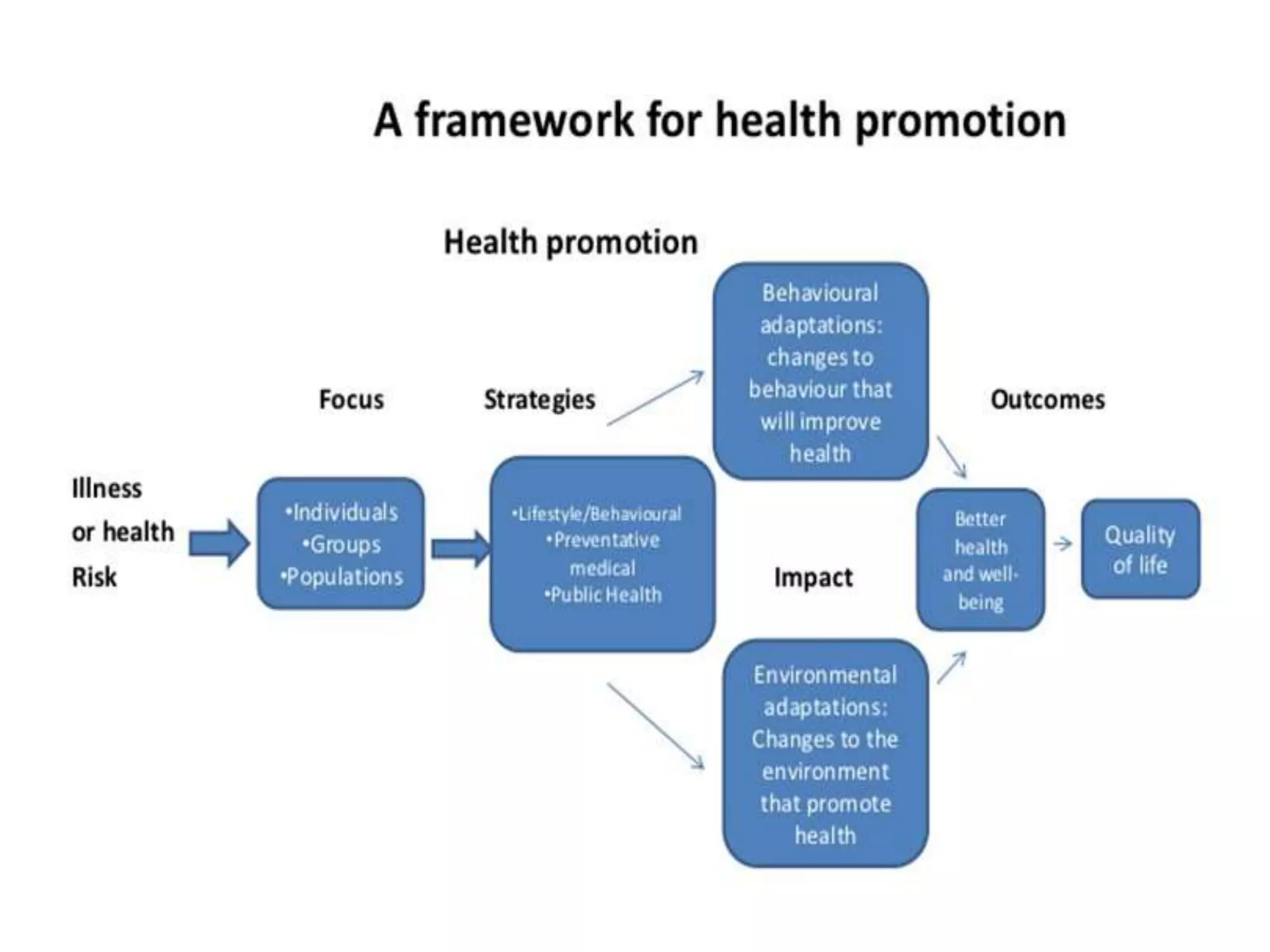
FOCUS STRATEGIES IMPACT OUTCOMES
Individuals
Groups
Population
Education
counseling
Economic change
Legislative
change
Policy or
organization
change
Behavioural
educational
change
Social, economic
and environment
change
Better
Health
Quality of
life
THE PROCESS OF HEALTH PROMOTION
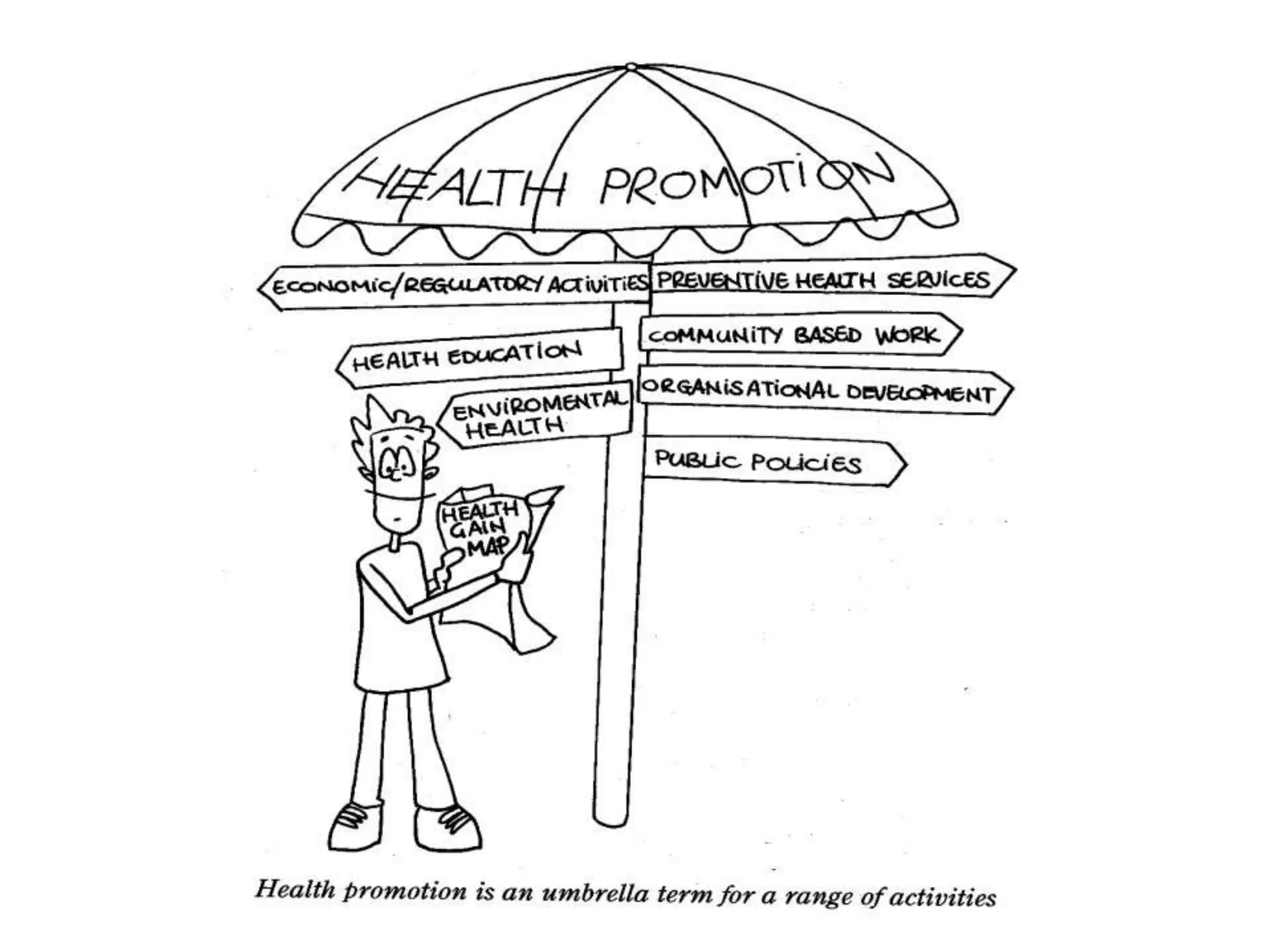
A FRAMEWORK FOR HEALTH PROMOTION
ACTIVITIES
AREAS OF
HEALTH
PROMOTION
ACTIVITY
Preventive health
services(Primary,
secondary, tertiary
Community-based
work
Organisation
developmentHealthy
Public Policy
Environmental
health measures
Economic and
regulatory
activities
Health education
programmes
18
The 5 key principles of health promotion as determined by WHO are as
follows:
Health promotion involves the population as a whole in the context of
their everyday life, rather than focusing on people at risk from specific
diseases.
Health promotion is directed towards action on the determinants or
cause of health. This requires a close co-operation between sectors
beyond health care reflecting the diversity of conditions which influence
health.
Health promotion aims particularly at effective and concrete public
participation. This requires the further development of problem-defining
and decision-making life skills, both individually and collectively, and the
promotion of effective participation mechanisms.
PRINCIPLES OF HEALTH
PROMOTION
19
Health promotion combines diverse, but complementary methods
or approaches including communication, education, legislation,
fiscal measures, organizational change, community change,
community development and spontaneous local activities against
health hazards.
Health promotion is primarily a societal and political venture and
not medical service, although health professionals have an
important role in advocating and enabling health promotion.
PRINCIPLES OF HEALTH
PROMOTION
GLOBAL CONFERENCES ON HEALTH PROMOTION
Conference Venue Year
Ottawa Charter of Health promotion Canada 1986
Adelaide Recommendation on Health Public Policy Australia 1988
Sundsvall Statement on Supportive Environment for
Health
Sweden 1991
Jakarta Declaration on Leading Health Promotion into
the 21st Century
Indonesia 1997
Mexico Ministerial Statement for the Promotion of
Health
Mexico 2000
Bangkok Charter for Health Promotion in a Globalized
World
Thailand 2005
Global Conference on Health Promotion, Nairobi Kenya 2009
Global Conference on Health Promotion, Helsinki Finland 2013
Global Conference on Health Promotion, Shanghai China 2016
International Conference on Health Promotion, Ottawa,
Ontario, Canada (1986)
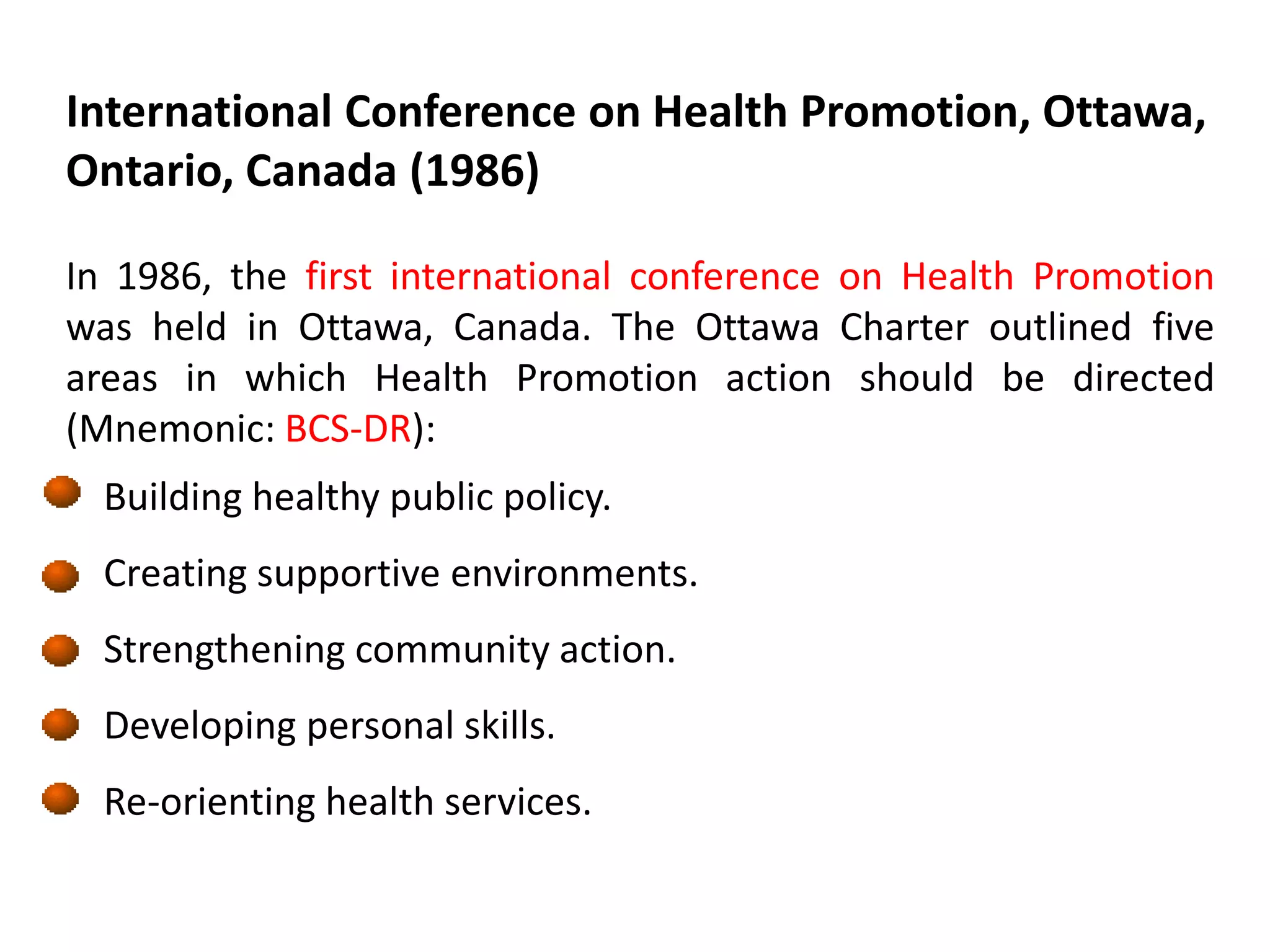
In 1986, the first international conference on Health Promotion
was held in Ottawa, Canada. The Ottawa Charter outlined five
areas in which Health Promotion action should be directed
(Mnemonic: BCS-DR):
Building healthy public policy.
Creating supportive environments.
Strengthening community action.
Developing personal skills.
Re-orienting health services.
22
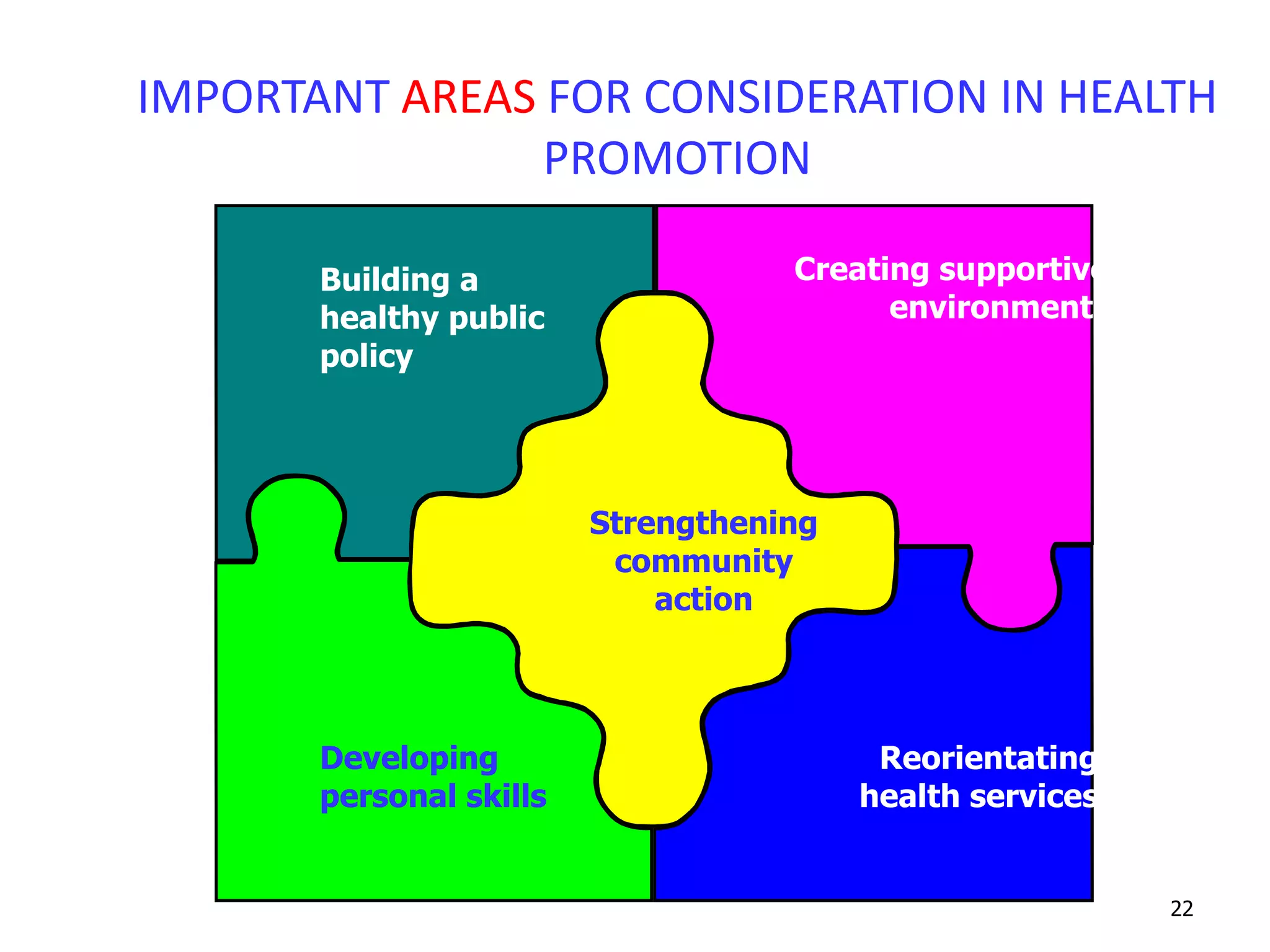
Building a
healthy public
policy
Creating supportive
environments
Developing
personal skills
Strengthening
community
action
Reorientating
health services
IMPORTANT AREAS FOR CONSIDERATION IN HEALTH
PROMOTION
HEALTHY PUBLIC POLICY (HPP)
Healthy public policy is clearly desirable, and it should satisfy
following two conditions:
The health consequences of different policy options have to be
correctly predicted; and
The policy process has to be influenced so that health
consequences are considered.
Example: Policies to discourage smoking were initially opposed on
the grounds that they would reduce exchequer income and
thereby the ability to provide health and welfare services (Pollock,
1999). Reducing tobacco sales has been opposed on the grounds
that it would increase unemployment but Godfrey et al.
demonstrated that redirecting expenditure from tobacco to other
goods was likely to increase employment (Godfrey et al., 1995).
 A Healthy Public Policy is characterized by a concern for
health and equity and an accountability for health impact.
 Health should be made a priority item on the agenda of
policy-makers in all sectors.
 Policy-makers should be made aware of the health
consequences of their decisions. They should create pro-
health policies, whether in the area of development,
legislation, taxation etc.
 All relevant government sectors like agriculture, trade,
education, industry and finance need to give important
consideration to health as an essential factor during their
policy formulation.
1. Healthy Public Policy
 The overall guiding principle is the need to encourage
reciprocal maintenance - to take care of each other, our
communities and our natural environment.
 Supportive environments cover the physical, social,
economic, and political environment.
 Supportive environments encompass where people live,
work and play.
 All development activities should aim for a healthy
environment – healthy buildings, roads, workplaces,
homes, surroundings and schools.
2. Create Supportive Environment
 Community participation is a social process whereby
groups with shared needs living in a defined geographic
area actively pursue identification of their needs, take
decisions and establish mechanisms to meet these needs
 Full community participation occurs when communities
participate in equal partnership with health professionals
as stakeholders in setting the health agenda.
 At the heart of this process is the empowerment of
communities - their ownership and control of their own
endeavours and destinies.
 This requires full and continuous access to information,
learning opportunities for health, as well as funding
support.
3. Strengthen Community Action: Community Participation
 Skills which can promote an individual’s health include
those pertaining to identifying, selecting and applying
healthy options in daily life.
 Health promotion supports personal and social
development through providing information, education for
health, and enhancing life skills. By so doing, it increases
the options available to people to exercise more control
over their own health and over their environments, and to
make choices conducive to health.
 Enabling people to learn, throughout life, to prepare
themselves for all of its stages and to cope with chronic
illness and injuries.
4. Develop Personal Skills
Developing /increasing personal health
skills
• Information and education for personal and family health.
• Take account of values, beliefs and customs of the
community.
• Continuous process at all stages of life.
• Guided and supported in developing skills (not imposed
on them).
• Build on existing knowledge and attitudes.
 Reorienting health services is primarily about the health
sector changing from focusing primarily on clinical and
curative services to increasingly focus on health promotion
and prevention.
 Health care system must be equitable and client-centered.
 Reorienting health services challenges the medical
approach to health, which focuses only on treatments for
disease and illness. It recognizes the impacts of all the
determinants upon health and views health as more than
just absence of disease, but a positive state which should
be actively pursued.
5. Reorient Health Services
Some non-health sectors with an input into
Health Promotion
• Education/ schools
• Agriculture
• Community Services
• Sport
• Media
• Non-Governmental Organizations (NGO’s)
• Community groups
• Youth
• Private sector
• Legal
• Public Works
• Housing
• Water Authority
• Religion (Mosques, Churches etc)
• Alternative medicine
Health sectors with an input into Health
Promotion
• Environmental Health
• Nutrition
• Community nursing
• Mental Health
• Dental
• Epidemiology
• Hospital (secondary) care
• School of Nursing
• Occupational therapy
The Ottawa Charter also outlined a set of nine pre-requisites or
fundamental conditions deemed necessary in order to improve health.
Following are Prerequisites for Health:
Peace,
Shelter,
Education,
Food,
Income,
Stable eco-system,
Sustainable resources,
Social justice, and
Equity.
Ottawa Charter identified three ways (or strategies) in which health could
be promoted, namely through:
Advocacy
Enablement
Mediation
Ways/ Strategies of health promotion
Enable
Health promotion focuses on achieving equity in health. Health
promotion action aims at reducing differences in current health
status and ensuring equal opportunities and resources to enable
all people to achieve their fullest health potential. This includes a
secure foundation in a supportive environment, access to
information, life skills and opportunities for making healthy
choices.
Mediate
The prerequisites and prospects for health cannot be
ensured by the health sector alone. More importantly, health
promotion demands coordinated action by all concerned: by
governments, by health and other social and economic
sectors, by non-governmental and voluntary organizations,
by local authorities, by industry and by the media. People in
all walks of life are involved as individuals, families and
communities. Professional and social groups and health
personnel have a major responsibility to mediate between
differing interests in society for the pursuit of health.
Advocate
Advocacy is the act of “taking a position on an issue, and
initiating actions in a deliberate attempt to influence private
and public policy choices”. Health advocacy encompasses
direct service to the individual or family as well as activities
that promote health and access to health care in
communities and the larger public. Example: Request to
City Council to construct clear-way bicycle lane in local
community, so that people will be able to ride their bicycle
safely.
5 approaches to Health Promotion
1. Medical or preventive
2. Behaviour change
3. Educational
4. Empowerment
5. Social change
1. Medical or Preventive Approach
Aim:
To reduce morbidity and premature mortality.
To ensure freedom from disease and disability.
‡
Activity:
Uses medical intervention to prevent ill-health or
premature death.
‡ Based on scientific methods
Eg. - Immunization, screening, fluoridation.
‡
Expert-led, top down.
Emphasizes compliance.
‡
Does not focus on positive health.
‡
Ignores social and environmental dimensions.
‡
Evaluation: Reduction in disease rates & associated
mortality.
2. Behaviour Change Approach
• Behavioural risk factors are the leading causes of the occurrence of,
and morbidity and mortality due to, chronic health conditions and
injuries in the world
• Behaviour Change Approach aims to encourage individuals to adopt
“healthy” behaviours that are regarded as key to improving health.
• Such approaches seek to educate the individual so that they change
their lifestyle or a particular behaviour to help improve their health.
This may be to stop partaking in a risk behaviour or to start enjoying
some protective behaviours. Either way, the aim is to change the
person’s lifestyle or behaviour.
3. Educational Approach
• Strongly linked to health education.
• Seeks to provide knowledge and information, and to
develop the necessary skills so that people can make
informed decisions about their behaviour.
Assumption
• Increasing knowledge may change in attitudes, that may
result in changed behaviour.
Weakness:
● Assumes that by increasing knowledge, there will be
an attitudinal change, which leads to behavioural change.
● Ignores the constraints that social, economic and
environmental factors place on voluntary change.
‡
Evaluation:
● Knowledge, attitude and practice
4. Empowerment or Client Centred Approach
Aim:
• Helps people to identify their own needs and concerns, and
gain the necessary skills and confidence to act upon them.
• So-called bottom up approach - idea is premised on
helping people or communities to identify their own health
concerns, gain the skills and make changes to their lives
accordingly .
• Professional acts as a facilitator rather than expert.
Two types of empowerment:
1. Self-empowerment: Based on counseling and aimed at increasing
peoples’ control over their own lives.
2. Community empowerment: Related to community development to
create active, participating communities which are able to change the
world about them through a program of action.
Methods:
● Client-centred, including counseling, community development and
advocacy.
● Health advocacy refers to the action of health professionals to
influence and shape the decisions and actions of decision- and policy-
makers who have some control over the resources which affect or
influence health
● Promoting public involvement and participation in decision-making on
health-related issues.
‡
5. Social Change Approach
• Targets groups and populations, top down method of
working.
• Sometimes known as radical health promotion and is
underlined by a belief that socio-economic circumstances
determine health status.
• Its focus is at the policy or environmental level.
• Aims is to bring about physical, social, economic,
legislative and environmental changes.
Aim:
• To bring about changes in physical, social, and economic
environment which enables people to enjoy better
health.
• Radical health promotion - makes the environment
supportive of health.
• To make the healthy choice the easier choice.
• The focus is on changing society, not on changing the
behaviour of individuals.
• Approach is based on the notion that to promote positive
health it is necessary to tackle and diminish social and
health inequalities.
Methods:
● Focus on shaping the health environment
‡
● Lobbying/advocacy
‡
● Development of healthy public policies and legislation
‡
● Fiscal measures: In economics and political science, fiscal
policy is the use of government revenue collection (mainly taxes)
and expenditure (spending) to influence the economy.
‡
● Creating supportive social and physical environments
EXAMPLE OF FIVE APPROACHES OF HEALTH
PROMOTION TO ADDRESS SMOKING
Approach Aim Activity
Medical Free from Lung Diseases.
Heart Diseases, other
Smoking related disorders
Encourage people to seek
early detection and treatment
of smoking related disorder
Behavioral
Change
Behavior change from
smoking to not-smoking
● Prevent non-smoker from
starting smoking
● Persuade smokers to stop
Education Clients understand effect of
smoking and will make a
decision whether to smoke
or not and act on that
decision
● Giving information about
effects of smoking
● Helping them explore their
values and attitudes and
come to a decision
● Helping them learn how to
stop smoking; if they want
Approach Aim Activity
Empowerm
ent
Anti-Smoking issue is
considered only if clients
identify it as a concern
Clients identify what, if
anything they want to know
and do about it
Social
Change
Make smoking socially
unacceptable, so it is
easier not to smoke than to
smoke
● No smoking policy at public
places
● Cigarette sales less
accessible
● Promotion of non-smoking
s a social norm
● Limiting and challenging
tobacco advertisement and
sports sponsorship
Key Agenda in ICHPs
• Conference strongly recommends that the WHO
continue the dynamic health promotion through the five
strategies described in Ottawa Charter.
• Conference identified four key areas as priorities:
- Supporting the health of women
- Elimination of hunger and malnutrition
- Through healthy public policy to counter
health hazards of alcohol and tobacco abuse
- Creating supporting environment.
Adelaide Recommendation on HPP, 1988
Sundsvall Statement on Supportive
Environment for Health, 1991
• Issues of health, environment and human
development can not be separated.
• Development must imply improvement in the
quality of life and health, while preserving the
sustainability of the environment.
Jakarta Declaration on Leading Health
Promotion into 21st Century, 1997
Jakarta Declaration included five priorities for
Health Promotion in 21st century:
● Promote social responsibility for health
● Increase investment for health development
● Consolidate and expand partnership for health
● Increase community capacity and empower
the individual
● Secure an infrastructure for health promotion
Mexico Ministerial Statement for
Promotion of health, 2000
• Attainment of the highest possible standard of
health is a positive asset, for enjoyment of life
and necessary for social and economic
development and equality
Bangkok Charter for Health Promotion
in a globalized world, 2005
• Make the promotion of health central to the
global development agenda.
• Make promotion of health a core
responsibility for all of government.
• Make the promotion of health a key focus of
communities and civil society.
Global Conference on Health
Promotion, Nairobi, Kenya, 2009
Global Conference on Health
Promotion, Helsinki, 2013
Global Conference on Health
Promotion, Shanghai, 2016
NEXT CLASS ON HEALTH PROMOTION (HP) - MODEL/ HISTORY OF HE-HP
Health Promotion:   Introduction

Health Promotion: Introduction

  • 1.
    Col Zulfiquer AhmedAmin M Phil (HHM), MPH (HM), PGD (Health Economics), MBBS Armed Forces Medical Institute (AFMI)
  • 2.
    ‘Health Promotion’ asa term was used for the first time by Marc Lalonde in 1974 and quickly became an umbrella term for a wide range of strategies designed to tackle the wider determinants of health. After reviewing the evidence, the Lalonde Report suggested that health care services were not the most important determinant of health and there were four “health fields”– lifestyle, environment, health care organization, human biology—and that major improvements in health would result primarily from improvements in lifestyle, environment and our knowledge of human biology.
  • 3.
    Health promotion isabout raising the health status of individuals and communities. Promotion in the health context means improving, advancing, supporting, encouraging and placing health higher on personal and public agendas. Given that major socioeconomic determinants of health are often outside individual or even collective control, a fundamental aspect of health promotion is that it aims to empower people to have more control over aspects of their lives that affect their health. These twin elements of improving health and having more control over it are fundamental to the aims and processes of health promotion.
  • 4.
    Definition: ‘Health promotion isthe process of enabling people to increase control over, and to improve, their health’. It moves beyond a focus on individual behaviour towards a wide range of social and environmental interventions. It is a positive concept emphasizing personal, social, political and institutional resources, as well as physical capacities. WHO (1990)
  • 5.
    Health Promotion isany combination of health, education, economic, political, spiritual or organizational initiative to bring about positive attitudinal, behavioral, social, or environmental changes conducive to improving the health of population. Health Promotion is directed towards action on the determinants or causes of health. Health Promotion, therefore, requires a close co-operation of sectors beyond health services, reflecting the diversity of conditions which influence health. Govt at both local and national levels has a unique responsibility to act appropriately and in timely way to ensure that the ‘total’ environment, which is beyond the control of individuals and groups, is conducive to health
  • 7.
    Health education isa process which informs, motivate and helps people to adopt and maintain healthy practices and life styles; advocates environmental changes as needed to facilitate this goal and conducts professional training and research to the same end. - The National Conference on Preventive Medicine [USA] Health protection is the branch of public health concerned with policies and practice to improve the prevention and control of diseases and other environmental threats to the health of the population. Disease prevention covers measures not only to prevent the occurrence of disease, such as risk factor reduction, but also to arrest its progress and reduce its consequences once established.
  • 9.
    Health Education vsHealth Promotion Health education involves giving information and teaching individuals and communities how to achieve better health. Health education seeks to motivate individuals to accept a process of behavioral change through directly influencing their values, beliefs, and attitude systems”. In contrast, health promotion “involves social, economic, and political change to ensure the environment is conducive to health . The two concepts, Health Education and Health Promotion are symbiotic strategies. This means that they are closely associated or related and that they benefit from each other.
  • 10.
    In the caseof Health Education, most activity centres on providing learning opportunities for individuals and communities so that they are able to voluntarily change their behaviour. In other words, they acquire information and skills to help them initiate a change that enhances their well-being and their health. Health Promotion activity is much broader and includes: Health Education The provision of preventative health services. Measures to protect the physical environment and make it conducive to health The mobilisation of community resources. The implementation of organisational policies which promote health. Economic and regulatory activities.
  • 12.
    A key featurethat distinguishes Health Promotion from Health Education is that Health Promotion involves environmental and political action. Similarly, it is possible to distil the concept of Health Promotion into an essential formula: Health Promotion = Health Education x Healthy Public Policy (Tones and Tilford, 1994)
  • 13.
    Example of HP: Apopular example of successful health promotion is the warning label that now exists on cigarettes. Historically, cigarettes were considered socially acceptable, and commonly sold without any warning about the risk to the health of the user. However, health experts noted the increased incidence of disease and began to educate the public on the risks of smoking and tobacco use. Eventually, these health promotion activities led to a change in public policy, which now requires the manufactures to add a warning label directly to the package.
  • 14.
    Why we needHealth Promotion? 14 • Promotes quality of life • Reduce inequalities in health • Reduces pressure on services • “Adds life to year, Adds year to life”. • “Health promotion is concerned with making healthier choices, easier choices”. • It is cost effective and efficient
  • 15.
    FOCUS STRATEGIES IMPACTOUTCOMES Individuals Groups Population Education counseling Economic change Legislative change Policy or organization change Behavioural educational change Social, economic and environment change Better Health Quality of life THE PROCESS OF HEALTH PROMOTION
  • 17.
    A FRAMEWORK FORHEALTH PROMOTION ACTIVITIES AREAS OF HEALTH PROMOTION ACTIVITY Preventive health services(Primary, secondary, tertiary Community-based work Organisation developmentHealthy Public Policy Environmental health measures Economic and regulatory activities Health education programmes
  • 18.
    18 The 5 keyprinciples of health promotion as determined by WHO are as follows: Health promotion involves the population as a whole in the context of their everyday life, rather than focusing on people at risk from specific diseases. Health promotion is directed towards action on the determinants or cause of health. This requires a close co-operation between sectors beyond health care reflecting the diversity of conditions which influence health. Health promotion aims particularly at effective and concrete public participation. This requires the further development of problem-defining and decision-making life skills, both individually and collectively, and the promotion of effective participation mechanisms. PRINCIPLES OF HEALTH PROMOTION
  • 19.
    19 Health promotion combinesdiverse, but complementary methods or approaches including communication, education, legislation, fiscal measures, organizational change, community change, community development and spontaneous local activities against health hazards. Health promotion is primarily a societal and political venture and not medical service, although health professionals have an important role in advocating and enabling health promotion. PRINCIPLES OF HEALTH PROMOTION
  • 20.
    GLOBAL CONFERENCES ONHEALTH PROMOTION Conference Venue Year Ottawa Charter of Health promotion Canada 1986 Adelaide Recommendation on Health Public Policy Australia 1988 Sundsvall Statement on Supportive Environment for Health Sweden 1991 Jakarta Declaration on Leading Health Promotion into the 21st Century Indonesia 1997 Mexico Ministerial Statement for the Promotion of Health Mexico 2000 Bangkok Charter for Health Promotion in a Globalized World Thailand 2005 Global Conference on Health Promotion, Nairobi Kenya 2009 Global Conference on Health Promotion, Helsinki Finland 2013 Global Conference on Health Promotion, Shanghai China 2016
  • 21.
    International Conference onHealth Promotion, Ottawa, Ontario, Canada (1986) In 1986, the first international conference on Health Promotion was held in Ottawa, Canada. The Ottawa Charter outlined five areas in which Health Promotion action should be directed (Mnemonic: BCS-DR): Building healthy public policy. Creating supportive environments. Strengthening community action. Developing personal skills. Re-orienting health services.
  • 22.
    22 Building a healthy public policy Creatingsupportive environments Developing personal skills Strengthening community action Reorientating health services IMPORTANT AREAS FOR CONSIDERATION IN HEALTH PROMOTION
  • 23.
    HEALTHY PUBLIC POLICY(HPP) Healthy public policy is clearly desirable, and it should satisfy following two conditions: The health consequences of different policy options have to be correctly predicted; and The policy process has to be influenced so that health consequences are considered. Example: Policies to discourage smoking were initially opposed on the grounds that they would reduce exchequer income and thereby the ability to provide health and welfare services (Pollock, 1999). Reducing tobacco sales has been opposed on the grounds that it would increase unemployment but Godfrey et al. demonstrated that redirecting expenditure from tobacco to other goods was likely to increase employment (Godfrey et al., 1995).
  • 24.
     A HealthyPublic Policy is characterized by a concern for health and equity and an accountability for health impact.  Health should be made a priority item on the agenda of policy-makers in all sectors.  Policy-makers should be made aware of the health consequences of their decisions. They should create pro- health policies, whether in the area of development, legislation, taxation etc.  All relevant government sectors like agriculture, trade, education, industry and finance need to give important consideration to health as an essential factor during their policy formulation. 1. Healthy Public Policy
  • 25.
     The overallguiding principle is the need to encourage reciprocal maintenance - to take care of each other, our communities and our natural environment.  Supportive environments cover the physical, social, economic, and political environment.  Supportive environments encompass where people live, work and play.  All development activities should aim for a healthy environment – healthy buildings, roads, workplaces, homes, surroundings and schools. 2. Create Supportive Environment
  • 26.
     Community participationis a social process whereby groups with shared needs living in a defined geographic area actively pursue identification of their needs, take decisions and establish mechanisms to meet these needs  Full community participation occurs when communities participate in equal partnership with health professionals as stakeholders in setting the health agenda.  At the heart of this process is the empowerment of communities - their ownership and control of their own endeavours and destinies.  This requires full and continuous access to information, learning opportunities for health, as well as funding support. 3. Strengthen Community Action: Community Participation
  • 27.
     Skills whichcan promote an individual’s health include those pertaining to identifying, selecting and applying healthy options in daily life.  Health promotion supports personal and social development through providing information, education for health, and enhancing life skills. By so doing, it increases the options available to people to exercise more control over their own health and over their environments, and to make choices conducive to health.  Enabling people to learn, throughout life, to prepare themselves for all of its stages and to cope with chronic illness and injuries. 4. Develop Personal Skills
  • 28.
    Developing /increasing personalhealth skills • Information and education for personal and family health. • Take account of values, beliefs and customs of the community. • Continuous process at all stages of life. • Guided and supported in developing skills (not imposed on them). • Build on existing knowledge and attitudes.
  • 29.
     Reorienting healthservices is primarily about the health sector changing from focusing primarily on clinical and curative services to increasingly focus on health promotion and prevention.  Health care system must be equitable and client-centered.  Reorienting health services challenges the medical approach to health, which focuses only on treatments for disease and illness. It recognizes the impacts of all the determinants upon health and views health as more than just absence of disease, but a positive state which should be actively pursued. 5. Reorient Health Services
  • 30.
    Some non-health sectorswith an input into Health Promotion • Education/ schools • Agriculture • Community Services • Sport • Media • Non-Governmental Organizations (NGO’s) • Community groups • Youth • Private sector • Legal • Public Works • Housing • Water Authority • Religion (Mosques, Churches etc) • Alternative medicine
  • 31.
    Health sectors withan input into Health Promotion • Environmental Health • Nutrition • Community nursing • Mental Health • Dental • Epidemiology • Hospital (secondary) care • School of Nursing • Occupational therapy
  • 32.
    The Ottawa Charteralso outlined a set of nine pre-requisites or fundamental conditions deemed necessary in order to improve health. Following are Prerequisites for Health: Peace, Shelter, Education, Food, Income, Stable eco-system, Sustainable resources, Social justice, and Equity.
  • 33.
    Ottawa Charter identifiedthree ways (or strategies) in which health could be promoted, namely through: Advocacy Enablement Mediation
  • 35.
    Ways/ Strategies ofhealth promotion Enable Health promotion focuses on achieving equity in health. Health promotion action aims at reducing differences in current health status and ensuring equal opportunities and resources to enable all people to achieve their fullest health potential. This includes a secure foundation in a supportive environment, access to information, life skills and opportunities for making healthy choices.
  • 36.
    Mediate The prerequisites andprospects for health cannot be ensured by the health sector alone. More importantly, health promotion demands coordinated action by all concerned: by governments, by health and other social and economic sectors, by non-governmental and voluntary organizations, by local authorities, by industry and by the media. People in all walks of life are involved as individuals, families and communities. Professional and social groups and health personnel have a major responsibility to mediate between differing interests in society for the pursuit of health.
  • 37.
    Advocate Advocacy is theact of “taking a position on an issue, and initiating actions in a deliberate attempt to influence private and public policy choices”. Health advocacy encompasses direct service to the individual or family as well as activities that promote health and access to health care in communities and the larger public. Example: Request to City Council to construct clear-way bicycle lane in local community, so that people will be able to ride their bicycle safely.
  • 38.
    5 approaches toHealth Promotion 1. Medical or preventive 2. Behaviour change 3. Educational 4. Empowerment 5. Social change
  • 39.
    1. Medical orPreventive Approach Aim: To reduce morbidity and premature mortality. To ensure freedom from disease and disability. ‡ Activity: Uses medical intervention to prevent ill-health or premature death. ‡ Based on scientific methods Eg. - Immunization, screening, fluoridation.
  • 40.
    ‡ Expert-led, top down. Emphasizescompliance. ‡ Does not focus on positive health. ‡ Ignores social and environmental dimensions. ‡ Evaluation: Reduction in disease rates & associated mortality.
  • 41.
    2. Behaviour ChangeApproach • Behavioural risk factors are the leading causes of the occurrence of, and morbidity and mortality due to, chronic health conditions and injuries in the world • Behaviour Change Approach aims to encourage individuals to adopt “healthy” behaviours that are regarded as key to improving health. • Such approaches seek to educate the individual so that they change their lifestyle or a particular behaviour to help improve their health. This may be to stop partaking in a risk behaviour or to start enjoying some protective behaviours. Either way, the aim is to change the person’s lifestyle or behaviour.
  • 42.
    3. Educational Approach •Strongly linked to health education. • Seeks to provide knowledge and information, and to develop the necessary skills so that people can make informed decisions about their behaviour. Assumption • Increasing knowledge may change in attitudes, that may result in changed behaviour.
  • 43.
    Weakness: ● Assumes thatby increasing knowledge, there will be an attitudinal change, which leads to behavioural change. ● Ignores the constraints that social, economic and environmental factors place on voluntary change. ‡ Evaluation: ● Knowledge, attitude and practice
  • 44.
    4. Empowerment orClient Centred Approach Aim: • Helps people to identify their own needs and concerns, and gain the necessary skills and confidence to act upon them. • So-called bottom up approach - idea is premised on helping people or communities to identify their own health concerns, gain the skills and make changes to their lives accordingly . • Professional acts as a facilitator rather than expert.
  • 45.
    Two types ofempowerment: 1. Self-empowerment: Based on counseling and aimed at increasing peoples’ control over their own lives. 2. Community empowerment: Related to community development to create active, participating communities which are able to change the world about them through a program of action. Methods: ● Client-centred, including counseling, community development and advocacy. ● Health advocacy refers to the action of health professionals to influence and shape the decisions and actions of decision- and policy- makers who have some control over the resources which affect or influence health ● Promoting public involvement and participation in decision-making on health-related issues. ‡
  • 46.
    5. Social ChangeApproach • Targets groups and populations, top down method of working. • Sometimes known as radical health promotion and is underlined by a belief that socio-economic circumstances determine health status. • Its focus is at the policy or environmental level. • Aims is to bring about physical, social, economic, legislative and environmental changes.
  • 47.
    Aim: • To bringabout changes in physical, social, and economic environment which enables people to enjoy better health. • Radical health promotion - makes the environment supportive of health. • To make the healthy choice the easier choice. • The focus is on changing society, not on changing the behaviour of individuals. • Approach is based on the notion that to promote positive health it is necessary to tackle and diminish social and health inequalities.
  • 48.
    Methods: ● Focus onshaping the health environment ‡ ● Lobbying/advocacy ‡ ● Development of healthy public policies and legislation ‡ ● Fiscal measures: In economics and political science, fiscal policy is the use of government revenue collection (mainly taxes) and expenditure (spending) to influence the economy. ‡ ● Creating supportive social and physical environments
  • 49.
    EXAMPLE OF FIVEAPPROACHES OF HEALTH PROMOTION TO ADDRESS SMOKING Approach Aim Activity Medical Free from Lung Diseases. Heart Diseases, other Smoking related disorders Encourage people to seek early detection and treatment of smoking related disorder Behavioral Change Behavior change from smoking to not-smoking ● Prevent non-smoker from starting smoking ● Persuade smokers to stop Education Clients understand effect of smoking and will make a decision whether to smoke or not and act on that decision ● Giving information about effects of smoking ● Helping them explore their values and attitudes and come to a decision ● Helping them learn how to stop smoking; if they want
  • 50.
    Approach Aim Activity Empowerm ent Anti-Smokingissue is considered only if clients identify it as a concern Clients identify what, if anything they want to know and do about it Social Change Make smoking socially unacceptable, so it is easier not to smoke than to smoke ● No smoking policy at public places ● Cigarette sales less accessible ● Promotion of non-smoking s a social norm ● Limiting and challenging tobacco advertisement and sports sponsorship
  • 51.
    Key Agenda inICHPs • Conference strongly recommends that the WHO continue the dynamic health promotion through the five strategies described in Ottawa Charter. • Conference identified four key areas as priorities: - Supporting the health of women - Elimination of hunger and malnutrition - Through healthy public policy to counter health hazards of alcohol and tobacco abuse - Creating supporting environment. Adelaide Recommendation on HPP, 1988
  • 52.
    Sundsvall Statement onSupportive Environment for Health, 1991 • Issues of health, environment and human development can not be separated. • Development must imply improvement in the quality of life and health, while preserving the sustainability of the environment.
  • 53.
    Jakarta Declaration onLeading Health Promotion into 21st Century, 1997 Jakarta Declaration included five priorities for Health Promotion in 21st century: ● Promote social responsibility for health ● Increase investment for health development ● Consolidate and expand partnership for health ● Increase community capacity and empower the individual ● Secure an infrastructure for health promotion
  • 54.
    Mexico Ministerial Statementfor Promotion of health, 2000 • Attainment of the highest possible standard of health is a positive asset, for enjoyment of life and necessary for social and economic development and equality
  • 55.
    Bangkok Charter forHealth Promotion in a globalized world, 2005 • Make the promotion of health central to the global development agenda. • Make promotion of health a core responsibility for all of government. • Make the promotion of health a key focus of communities and civil society.
  • 56.
    Global Conference onHealth Promotion, Nairobi, Kenya, 2009
  • 57.
    Global Conference onHealth Promotion, Helsinki, 2013
  • 58.
    Global Conference onHealth Promotion, Shanghai, 2016
  • 59.
    NEXT CLASS ONHEALTH PROMOTION (HP) - MODEL/ HISTORY OF HE-HP