Concepts of Prevention and
Control
(I) Prevention
• The goals of medicine are to promote
health, to preserve health, to restore
health when it is impaired, and to
minimize suffering and distress.
• These goals are embodied in the word
"prevention"
Prevention; Definition and Concept
• Actions aimed at eradicating, eliminating or
minimizing the impact of disease and disability, or if
none of these are feasible, retarding the progress of
the disease and disability.
• The concept of prevention is best defined in the
context of levels, traditionally called primary,
secondary and tertiary prevention. A fourth level,
called primordial prevention, was later added.
Determinants of Prevention
• Successful prevention depends upon:
– a knowledge of causation,
– dynamics of transmission,
– identification of risk factors and risk groups,
– availability of prophylactic or early detection and
treatment measures,
– an organization for applying these measures to
appropriate persons or groups, and
– continuous evaluation of and development of procedures
applied
Preventable Causes of Disease
BEINGS
• Biological factors and Behavioral Factors
• Environmental factors
• Immunologic factors
• Nutritional factors
• Genetic factors
• Services, Social factors, and Spiritual
factors
• [JF Jekel, Epidemiology, Biostatistics, and Preventive Medicine, 1996]
Leavell’s Levels of Prevention
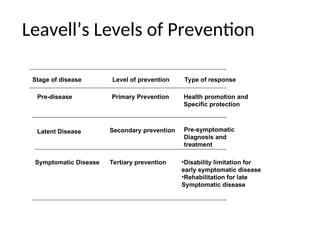
Stage of disease Level of prevention Type of response
Pre-disease Primary Prevention Health promotion and
Specific protection
Latent Disease Secondary prevention Pre-symptomatic
Diagnosis and
treatment
Symptomatic Disease Tertiary prevention •Disability limitation for
early symptomatic disease
•Rehabilitation for late
Symptomatic disease
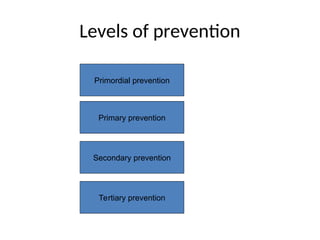
Levels of prevention
Primordial prevention
Primary prevention
Secondary prevention
Tertiary prevention
Primordial prevention
• Primordial prevention consists of actions and
measures that inhibit the emergence of risk
factors in the form of environmental,
economic, social, and behavioral conditions
and cultural patterns of living etc.
Primordial prevention (cont.)
• It is the prevention of the emergence or
development of risk factors in countries or
population groups in which they have not yet
appeared
• For example, many adult health problems (e.g.,
obesity, hypertension) have their early origins
in childhood, because this is the time when
lifestyles are formed (for example, smoking,
eating patterns, physical exercise).
Primordial prevention (cont.)
• In primordial prevention, efforts are directed
towards discouraging children from adopting
harmful lifestyles
• The main intervention in primordial
prevention is through individual and mass
education
Primary prevention
• Primary prevention can be defined as the action
taken prior to the onset of disease, which removes
the possibility that the disease will ever occur.
• It signifies intervention in the pre-pathogenesis
phase of a disease or health problem.
• Primary prevention may be accomplished by
measures of “Health promotion” and “specific
protection”
Primary prevention (cont.)
• It includes the concept of "positive health", a
concept that encourages achievement and
maintenance of "an acceptable level of health that
will enable every individual to lead a socially and
economically productive life".
• Primary prevention may be accomplished by
measures designed to promote general health and
well-being, and quality of life of people or by specific
protective measures.
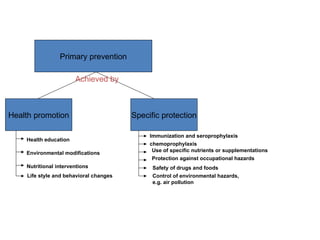
Primary prevention
Specific protection
Health promotion
Achieved by
Health education
Environmental modifications
Nutritional interventions
Life style and behavioral changes
Immunization and seroprophylaxis
chemoprophylaxis
Use of specific nutrients or supplementations
Protection against occupational hazards
Safety of drugs and foods
Control of environmental hazards,
e.g. air pollution
Health promotion
• Health promotion is “ the process of enabling
people to increase control over the
determinants of health and thereby improve
their health”.
Approaches for Primary Prevention
• The WHO has recommended the following
approaches for the primary prevention of
chronic diseases where the risk factors are
established:
– a. Population (mass) strategy
– b. High -risk strategy
Population (mass) strategy
• “Population strategy" is directed at the whole population
irrespective of individual risk levels.
• For example, studies have shown that even a small reduction
in the average blood pressure or serum cholesterol of a
population would produce a large reduction in the incidence
of cardiovascular disease
• The population approach is directed towards socio-economic,
behavioral and lifestyle changes
High -risk strategy
• The high -risk strategy aims to bring
preventive care to individuals at special risk.
• This requires detection of individuals at high
risk by the optimum use of clinical methods.
Secondary prevention
• It is defined as “ action which halts the progress of a disease at its
incipient stage and prevents complications.”
• The specific interventions are: early diagnosis (e.g. screening tests, and
case finding programs….) and adequate treatment.
• Secondary prevention attempts to arrest the disease process, restore
health by seeking out unrecognized disease and treating it before
irreversible pathological changes take place, and reverse communicability
of infectious diseases.
• It thus protects others from in the community from acquiring the
infection and thus provide at once secondary prevention for the infected
ones and primary prevention for their potential contacts.
Secondary prevention (cont.)
• Secondary prevention attempts to arrest the disease
process, restore health by seeking out unrecognized
disease and treating it before irreversible
pathological changes take place, and reverse
communicability of infectious diseases.
• It thus protects others from in the community from
acquiring the infection and thus provide at once
secondary prevention for the infected ones and
primary prevention for their potential contacts.
Early diagnosis and treatment
• WHO Expert Committee in 1973 defined early
detection of health disorders as “ the detection of
disturbances of homoeostatic and compensatory
mechanism while biochemical, morphological and
functional changes are still reversible.”
• The earlier the disease is diagnosed, and treated the
better it is for prognosis of the case and in the
prevention of the occurrence of other secondary
cases.
Tertiary prevention
• It is used when the disease process has advanced
beyond its early stages.
• It is defined as “all the measures available to reduce
or limit impairments and disabilities, and to promote
the patients’ adjustment to irremediable conditions.”
• Intervention that should be accomplished in the
stage of tertiary prevention are disability limitation,
and rehabilitation.
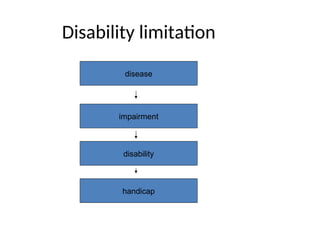
Disability limitation
disease
impairment
disability
handicap
Impairment
• Impairment is “any loss or abnormality of
psychological, physiological or anatomical
structure or function.”
Disability
• Disability is “any restriction or lack of ability to
perform an activity in the manner or within
the range considered normal for the human
being.”
Handicap
• Handicap is termed as “a disadvantage for a
given individual, resulting from an impairment
or disability, that limits or prevents the
fulfillment of a role in the community that is
normal (depending on age, sex, and social and
cultural factors) for that individual.”
Rehabilitation
• Rehabilitation is “ the combined and
coordinated use of medical, social,
educational, and vocational measures for
training and retraining the individual to the
highest possible level of functional ability.”
Rehabilitation
Medical
rehabilitation
Vocational
rehabilitation
Social
rehabilitation
Psychological
rehabilitation
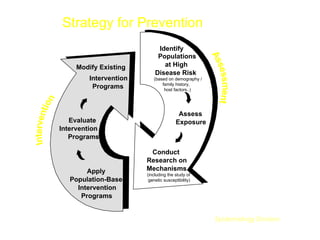
Strategy for Prevention
Assess
Exposure
Identify
Populations
at High
Disease Risk
(based on demography /
family history,
host factors..)
Conduct
Research on
Mechanisms
(including the study of
genetic susceptibility)
Apply
Population-Based
Intervention
Programs
Evaluate
Intervention
Programs
Modify Existing
Intervention
Programs
I
n
t
e
r
v
e
n
t
i
o
n
A
s
s
e
s
s
m
e
n
t
Epidemiology Division
–(II) Control
Control
• Concept of control:
The term disease control describes ongoing operations
aimed at reducing:
– The incidence of disease
– The duration of disease and consequently the risk of
transmission
– The effects of infection, including both the physical and
psychosocial complications
– The financial burden to the community.
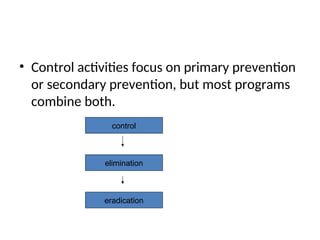
• Control activities focus on primary prevention
or secondary prevention, but most programs
combine both.
control
elimination
eradication
Disease Elimination
• Between control and eradication, an intermediate
goal has been described, called "regional
elimination"
• The term "elimination" is used to describe
interruption of transmission of disease, as for
example, elimination of measles, polio and
diphtheria from large geographic regions or areas
• Regional elimination is now seen as an important
precursor of eradication
Disease Eradication
• Eradication literally means to "tear out by roots".
• It is the process of “Termination of all transmission of
infection by extermination of the infectious agent
through surveillance and containment”.
• Eradication is an absolute process, an "all or none"
phenomenon, restricted to termination of an infection
from the whole world. It implies that disease will no
longer occur in a population.
• To-date, only one disease has been eradicated, that is
smallpox.
Monitoring
• Monitoring is "the performance and analysis of
routine measurements aimed at detecting changes in
the environment or health status of population"
(Thus we have monitoring of air pollution, water
quality, growth and nutritional status, etc).
• It also refers to on -going measurement of
performance of a health service or a health
professional, or of the extent to which patients
comply with or adhere to advice from health
professionals.
Surveillance
• surveillance means to watch over with great
attention, authority and often with suspicion
• According to another, surveillance is defined as "the
continuous scrutiny (inspection) of the factors that
determine the occurrence and distribution of disease
and other conditions of ill-health"
Objectives of Surveillance
• The main objectives of surveillance are:
– (a) to provide information about new and changing trends in
the health status of a population, e.g., morbidity, mortality,
nutritional status or other indicators and environmental
hazards, health practices and other factors that may affect
health
– (b) to provide feed-back which may be expected to modify the
policy and the system itself and lead to redefinition of
objectives, and
– (c) provide timely warning of public health disasters so that
interventions can be mobilized.
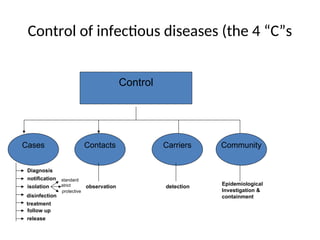
Control of infectious diseases (the 4 “C”s
Control
Cases Contacts Carriers Community
Diagnosis
notification
isolation
disinfection
treatment
follow up
release
observation detection Epidemiological
Investigation &
containment
standard
strict
protective
Evaluation of control
• Evaluation is the process by which results are compared with the
intended objectives, or more simply the assessment of how well a
program is performing.
•
• Evaluation should always be considered during the planning and
implementation stages of a program or activity.
• Evaluation may be crucial in identifying the health benefits
derived (impact on morbidity, mortality, sequelae, patient
satisfaction).
• Evaluation can be useful inidentifying performance difficulties.
• Evaluation studies may also be carried out to generate
information for other purposes, e.g., to attract attention to a
problem, extension of control activities, training and patient
management, etc.
To summarize
• The goals of medicine are to promote health, to preserve health,
to restore health when it is impaired, and to minimize suffering
and distress.
• These goals are embodied in the word "prevention"
• Successful prevention depends upon a knowledge of causation,
dynamics of transmission, identification of risk factors and risk
groups, availability of prophylactic or early detection and
treatment measures, an organization for applying these measures
to appropriate persons or groups, and continuous evaluation of
and development of procedures applied
• The objective of preventive medicine is to intercept or oppose the
"cause" and thereby the disease process. This epidemiological
concept permits the inclusion of treatment as one of the modes
of intervention
Quiz
• Match the following statements. Each option may be
selected once, more than once, or not at all:
• (a) performing carotid endarterectomy in a patient
with transient ischemic attack
• (b) recommending regular physical activity to a patient
with no known medical problem
• (C) vaccinating a health care worker against hepatitis B
• (d) giving isoniazid for 1 yr to a 28-year-old medical
student with a positive PPD tuberculin skin test.
• 1. primary prevention 2. secondary prevention
• 3. tertiary prevention 4. health promotion
Thank You

Unit 4a Diseases Preventionnnnnnn (1).ppt

  • 1.
  • 2.
  • 3.
    • The goalsof medicine are to promote health, to preserve health, to restore health when it is impaired, and to minimize suffering and distress. • These goals are embodied in the word "prevention"
  • 4.
    Prevention; Definition andConcept • Actions aimed at eradicating, eliminating or minimizing the impact of disease and disability, or if none of these are feasible, retarding the progress of the disease and disability. • The concept of prevention is best defined in the context of levels, traditionally called primary, secondary and tertiary prevention. A fourth level, called primordial prevention, was later added.
  • 5.
    Determinants of Prevention •Successful prevention depends upon: – a knowledge of causation, – dynamics of transmission, – identification of risk factors and risk groups, – availability of prophylactic or early detection and treatment measures, – an organization for applying these measures to appropriate persons or groups, and – continuous evaluation of and development of procedures applied
  • 6.
    Preventable Causes ofDisease BEINGS • Biological factors and Behavioral Factors • Environmental factors • Immunologic factors • Nutritional factors • Genetic factors • Services, Social factors, and Spiritual factors • [JF Jekel, Epidemiology, Biostatistics, and Preventive Medicine, 1996]
  • 7.
    Leavell’s Levels ofPrevention Stage of disease Level of prevention Type of response Pre-disease Primary Prevention Health promotion and Specific protection Latent Disease Secondary prevention Pre-symptomatic Diagnosis and treatment Symptomatic Disease Tertiary prevention •Disability limitation for early symptomatic disease •Rehabilitation for late Symptomatic disease
  • 8.
    Levels of prevention Primordialprevention Primary prevention Secondary prevention Tertiary prevention
  • 9.
    Primordial prevention • Primordialprevention consists of actions and measures that inhibit the emergence of risk factors in the form of environmental, economic, social, and behavioral conditions and cultural patterns of living etc.
  • 10.
    Primordial prevention (cont.) •It is the prevention of the emergence or development of risk factors in countries or population groups in which they have not yet appeared • For example, many adult health problems (e.g., obesity, hypertension) have their early origins in childhood, because this is the time when lifestyles are formed (for example, smoking, eating patterns, physical exercise).
  • 11.
    Primordial prevention (cont.) •In primordial prevention, efforts are directed towards discouraging children from adopting harmful lifestyles • The main intervention in primordial prevention is through individual and mass education
  • 12.
    Primary prevention • Primaryprevention can be defined as the action taken prior to the onset of disease, which removes the possibility that the disease will ever occur. • It signifies intervention in the pre-pathogenesis phase of a disease or health problem. • Primary prevention may be accomplished by measures of “Health promotion” and “specific protection”
  • 13.
    Primary prevention (cont.) •It includes the concept of "positive health", a concept that encourages achievement and maintenance of "an acceptable level of health that will enable every individual to lead a socially and economically productive life". • Primary prevention may be accomplished by measures designed to promote general health and well-being, and quality of life of people or by specific protective measures.
  • 14.
    Primary prevention Specific protection Healthpromotion Achieved by Health education Environmental modifications Nutritional interventions Life style and behavioral changes Immunization and seroprophylaxis chemoprophylaxis Use of specific nutrients or supplementations Protection against occupational hazards Safety of drugs and foods Control of environmental hazards, e.g. air pollution
  • 15.
    Health promotion • Healthpromotion is “ the process of enabling people to increase control over the determinants of health and thereby improve their health”.
  • 16.
    Approaches for PrimaryPrevention • The WHO has recommended the following approaches for the primary prevention of chronic diseases where the risk factors are established: – a. Population (mass) strategy – b. High -risk strategy
  • 17.
    Population (mass) strategy •“Population strategy" is directed at the whole population irrespective of individual risk levels. • For example, studies have shown that even a small reduction in the average blood pressure or serum cholesterol of a population would produce a large reduction in the incidence of cardiovascular disease • The population approach is directed towards socio-economic, behavioral and lifestyle changes
  • 18.
    High -risk strategy •The high -risk strategy aims to bring preventive care to individuals at special risk. • This requires detection of individuals at high risk by the optimum use of clinical methods.
  • 19.
    Secondary prevention • Itis defined as “ action which halts the progress of a disease at its incipient stage and prevents complications.” • The specific interventions are: early diagnosis (e.g. screening tests, and case finding programs….) and adequate treatment. • Secondary prevention attempts to arrest the disease process, restore health by seeking out unrecognized disease and treating it before irreversible pathological changes take place, and reverse communicability of infectious diseases. • It thus protects others from in the community from acquiring the infection and thus provide at once secondary prevention for the infected ones and primary prevention for their potential contacts.
  • 20.
    Secondary prevention (cont.) •Secondary prevention attempts to arrest the disease process, restore health by seeking out unrecognized disease and treating it before irreversible pathological changes take place, and reverse communicability of infectious diseases. • It thus protects others from in the community from acquiring the infection and thus provide at once secondary prevention for the infected ones and primary prevention for their potential contacts.
  • 21.
    Early diagnosis andtreatment • WHO Expert Committee in 1973 defined early detection of health disorders as “ the detection of disturbances of homoeostatic and compensatory mechanism while biochemical, morphological and functional changes are still reversible.” • The earlier the disease is diagnosed, and treated the better it is for prognosis of the case and in the prevention of the occurrence of other secondary cases.
  • 22.
    Tertiary prevention • Itis used when the disease process has advanced beyond its early stages. • It is defined as “all the measures available to reduce or limit impairments and disabilities, and to promote the patients’ adjustment to irremediable conditions.” • Intervention that should be accomplished in the stage of tertiary prevention are disability limitation, and rehabilitation.
  • 23.
  • 24.
    Impairment • Impairment is“any loss or abnormality of psychological, physiological or anatomical structure or function.”
  • 25.
    Disability • Disability is“any restriction or lack of ability to perform an activity in the manner or within the range considered normal for the human being.”
  • 26.
    Handicap • Handicap istermed as “a disadvantage for a given individual, resulting from an impairment or disability, that limits or prevents the fulfillment of a role in the community that is normal (depending on age, sex, and social and cultural factors) for that individual.”
  • 27.
    Rehabilitation • Rehabilitation is“ the combined and coordinated use of medical, social, educational, and vocational measures for training and retraining the individual to the highest possible level of functional ability.”
  • 28.
  • 29.
    Strategy for Prevention Assess Exposure Identify Populations atHigh Disease Risk (based on demography / family history, host factors..) Conduct Research on Mechanisms (including the study of genetic susceptibility) Apply Population-Based Intervention Programs Evaluate Intervention Programs Modify Existing Intervention Programs I n t e r v e n t i o n A s s e s s m e n t Epidemiology Division
  • 30.
  • 31.
    Control • Concept ofcontrol: The term disease control describes ongoing operations aimed at reducing: – The incidence of disease – The duration of disease and consequently the risk of transmission – The effects of infection, including both the physical and psychosocial complications – The financial burden to the community.
  • 32.
    • Control activitiesfocus on primary prevention or secondary prevention, but most programs combine both. control elimination eradication
  • 33.
    Disease Elimination • Betweencontrol and eradication, an intermediate goal has been described, called "regional elimination" • The term "elimination" is used to describe interruption of transmission of disease, as for example, elimination of measles, polio and diphtheria from large geographic regions or areas • Regional elimination is now seen as an important precursor of eradication
  • 34.
    Disease Eradication • Eradicationliterally means to "tear out by roots". • It is the process of “Termination of all transmission of infection by extermination of the infectious agent through surveillance and containment”. • Eradication is an absolute process, an "all or none" phenomenon, restricted to termination of an infection from the whole world. It implies that disease will no longer occur in a population. • To-date, only one disease has been eradicated, that is smallpox.
  • 35.
    Monitoring • Monitoring is"the performance and analysis of routine measurements aimed at detecting changes in the environment or health status of population" (Thus we have monitoring of air pollution, water quality, growth and nutritional status, etc). • It also refers to on -going measurement of performance of a health service or a health professional, or of the extent to which patients comply with or adhere to advice from health professionals.
  • 36.
    Surveillance • surveillance meansto watch over with great attention, authority and often with suspicion • According to another, surveillance is defined as "the continuous scrutiny (inspection) of the factors that determine the occurrence and distribution of disease and other conditions of ill-health"
  • 37.
    Objectives of Surveillance •The main objectives of surveillance are: – (a) to provide information about new and changing trends in the health status of a population, e.g., morbidity, mortality, nutritional status or other indicators and environmental hazards, health practices and other factors that may affect health – (b) to provide feed-back which may be expected to modify the policy and the system itself and lead to redefinition of objectives, and – (c) provide timely warning of public health disasters so that interventions can be mobilized.
  • 38.
    Control of infectiousdiseases (the 4 “C”s Control Cases Contacts Carriers Community Diagnosis notification isolation disinfection treatment follow up release observation detection Epidemiological Investigation & containment standard strict protective
  • 39.
    Evaluation of control •Evaluation is the process by which results are compared with the intended objectives, or more simply the assessment of how well a program is performing. • • Evaluation should always be considered during the planning and implementation stages of a program or activity. • Evaluation may be crucial in identifying the health benefits derived (impact on morbidity, mortality, sequelae, patient satisfaction). • Evaluation can be useful inidentifying performance difficulties. • Evaluation studies may also be carried out to generate information for other purposes, e.g., to attract attention to a problem, extension of control activities, training and patient management, etc.
  • 40.
    To summarize • Thegoals of medicine are to promote health, to preserve health, to restore health when it is impaired, and to minimize suffering and distress. • These goals are embodied in the word "prevention" • Successful prevention depends upon a knowledge of causation, dynamics of transmission, identification of risk factors and risk groups, availability of prophylactic or early detection and treatment measures, an organization for applying these measures to appropriate persons or groups, and continuous evaluation of and development of procedures applied • The objective of preventive medicine is to intercept or oppose the "cause" and thereby the disease process. This epidemiological concept permits the inclusion of treatment as one of the modes of intervention
  • 41.
    Quiz • Match thefollowing statements. Each option may be selected once, more than once, or not at all: • (a) performing carotid endarterectomy in a patient with transient ischemic attack • (b) recommending regular physical activity to a patient with no known medical problem • (C) vaccinating a health care worker against hepatitis B • (d) giving isoniazid for 1 yr to a 28-year-old medical student with a positive PPD tuberculin skin test. • 1. primary prevention 2. secondary prevention • 3. tertiary prevention 4. health promotion
  • 42.