Panel regression
Lecture 5
Devesh Roy
IFPRI-ICAR Training
September 21, 2015
Economics 20 - Prof. Anderson 2
Panel Data Methods
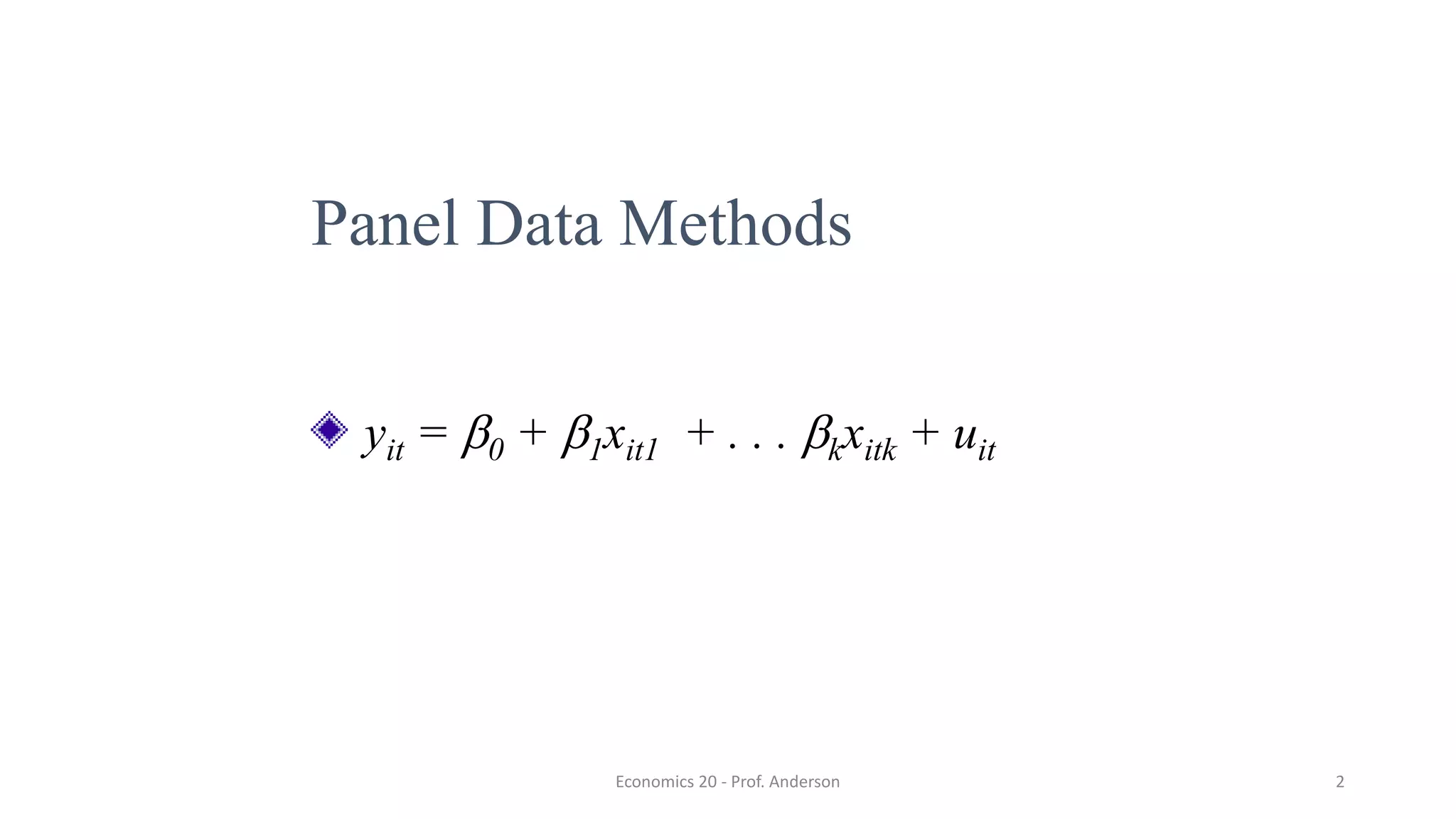
yit = b0 + b1xit1 + . . . bkxitk + uit
Economics 20 - Prof. Anderson 3
A True Panel vs.
A Pooled Cross Section
• Often loosely use the term panel data to refer to any data set that
has both a cross-sectional dimension and a time-series dimension
• More precisely it’s only data following the same cross-section units
over time
• Otherwise it’s a pooled cross-section
Economics 20 - Prof. Anderson 4
Pooled Cross Sections
• We may want to pool cross sections just to get bigger sample sizes
• We may want to pool cross sections to investigate the effect of time
• We may want to pool cross sections to investigate whether
relationships have changed over time
Economics 20 - Prof. Anderson 5
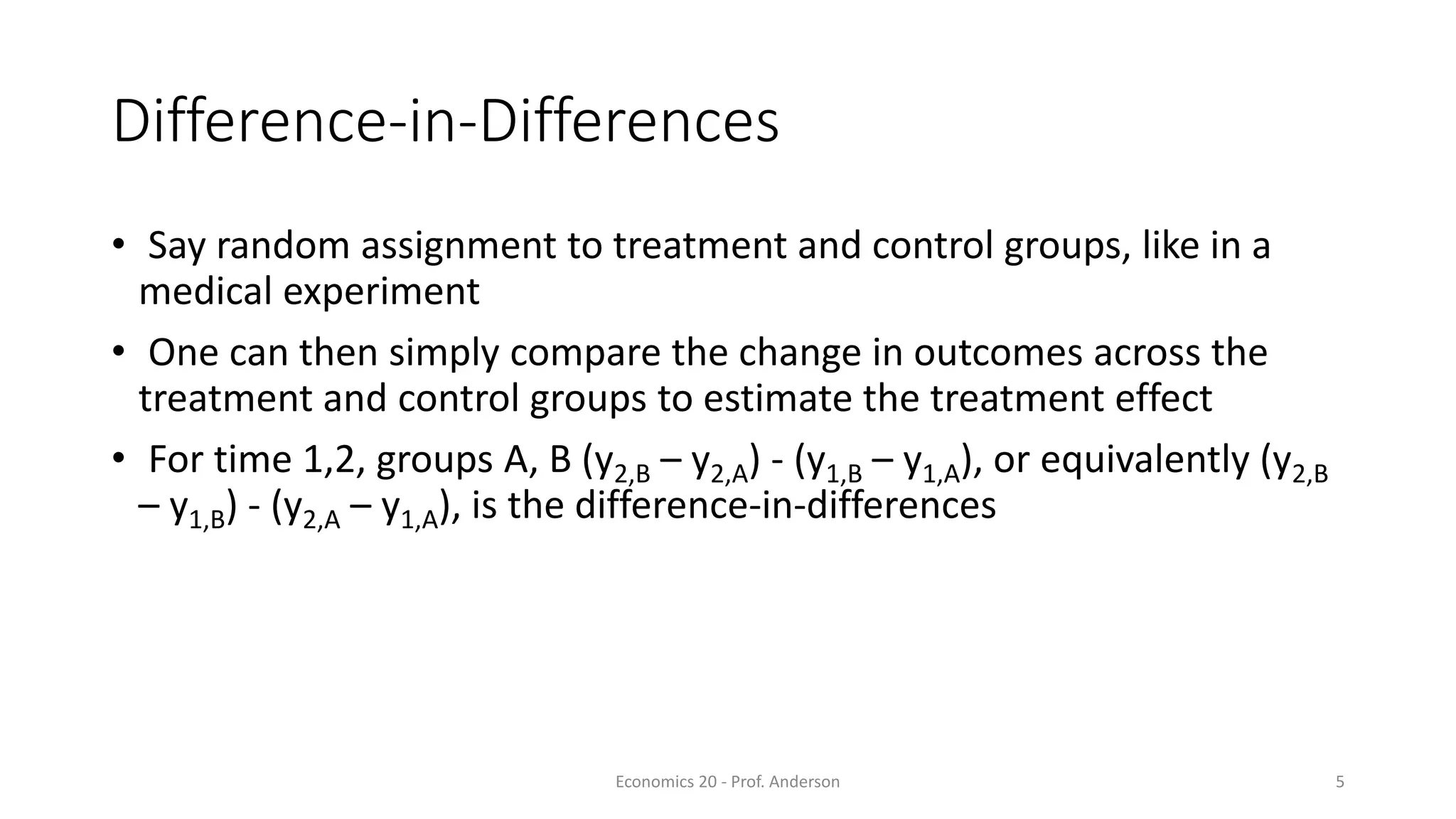
Difference-in-Differences
• Say random assignment to treatment and control groups, like in a
medical experiment
• One can then simply compare the change in outcomes across the
treatment and control groups to estimate the treatment effect
• For time 1,2, groups A, B (y2,B – y2,A) - (y1,B – y1,A), or equivalently (y2,B
– y1,B) - (y2,A – y1,A), is the difference-in-differences
Economics 20 - Prof. Anderson 6
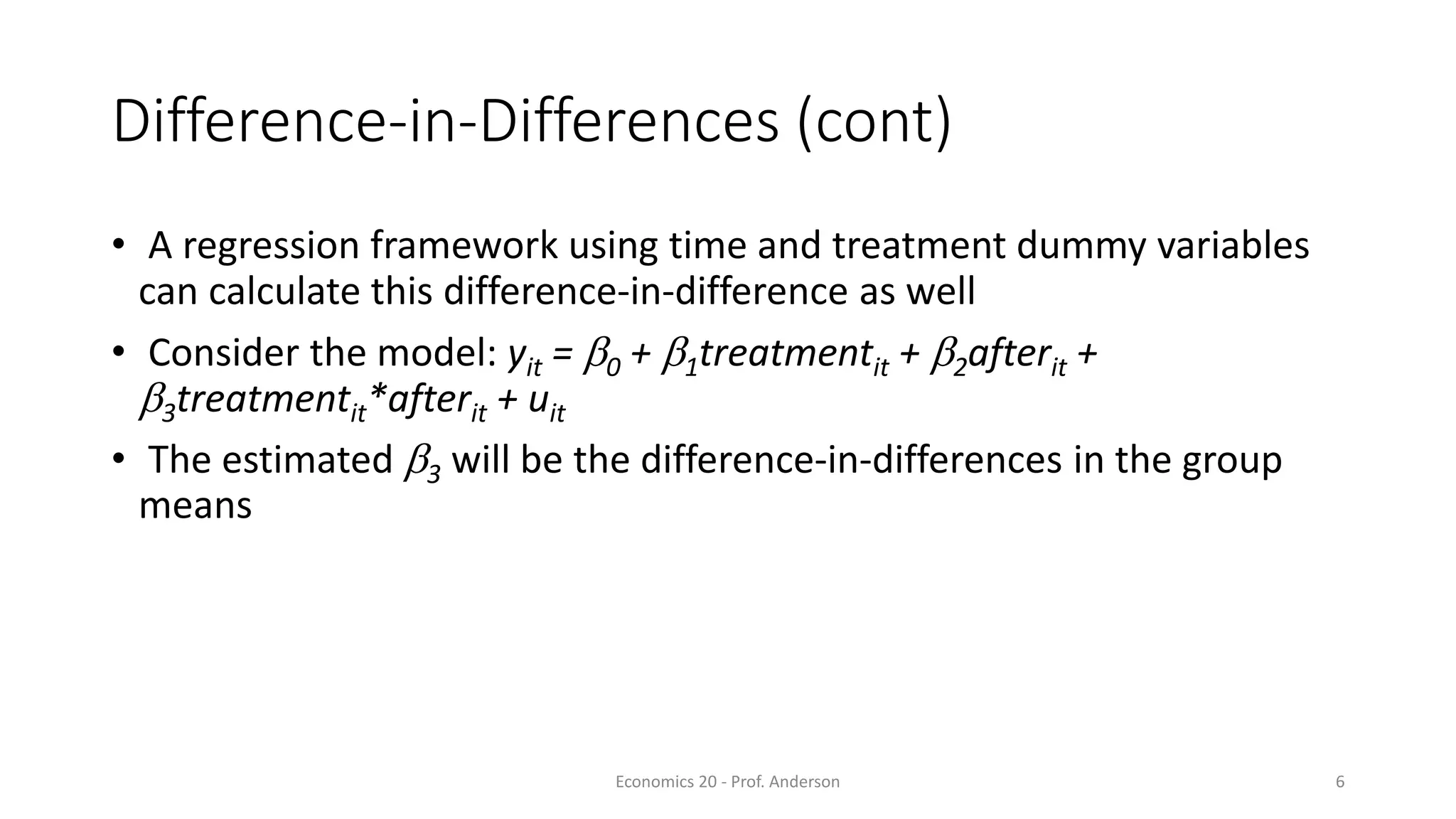
Difference-in-Differences (cont)
• A regression framework using time and treatment dummy variables
can calculate this difference-in-difference as well
• Consider the model: yit = b0 + b1treatmentit + b2afterit +
b3treatmentit*afterit + uit
• The estimated b3 will be the difference-in-differences in the group
means
Economics 20 - Prof. Anderson 7
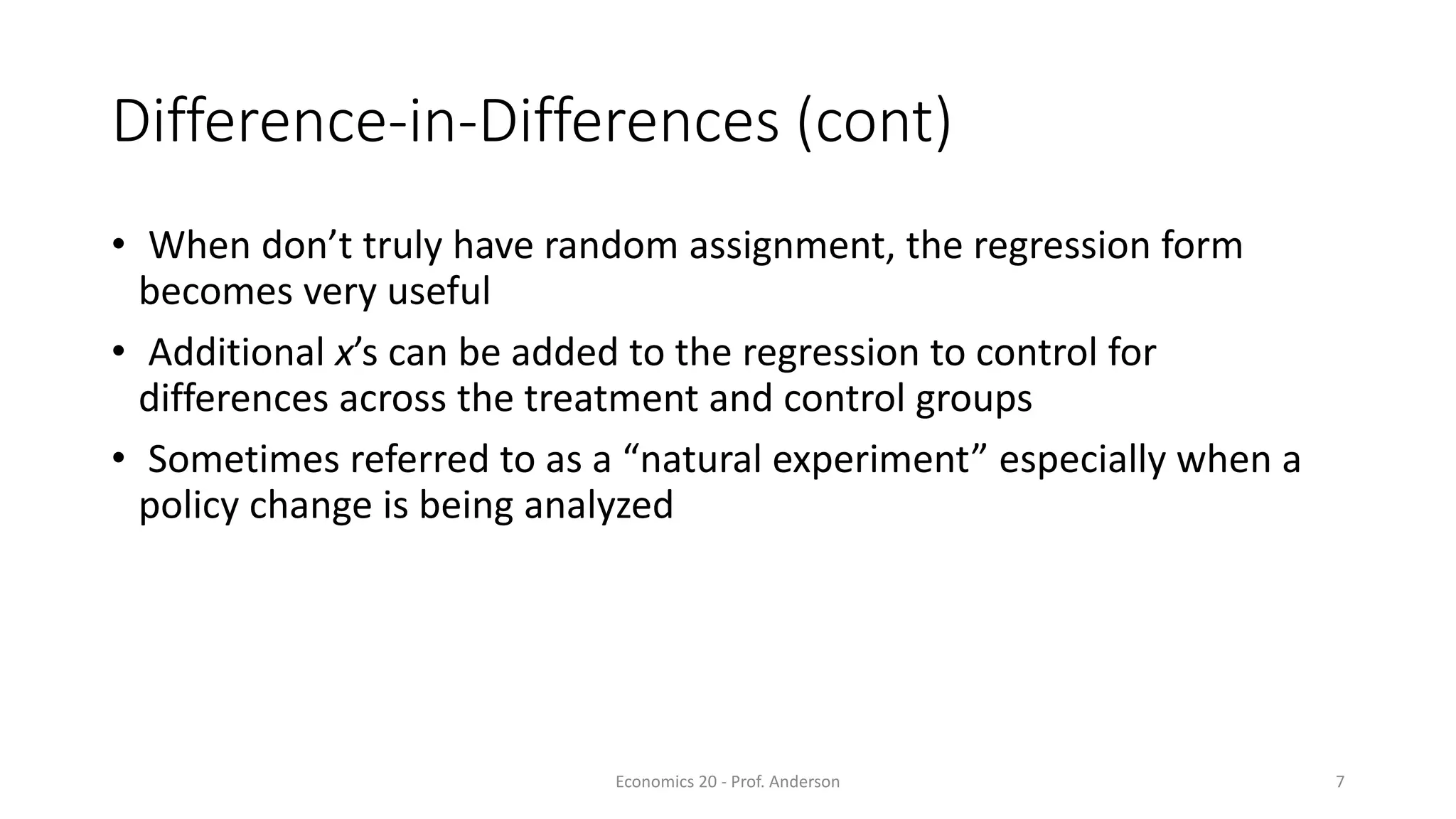
Difference-in-Differences (cont)
• When don’t truly have random assignment, the regression form
becomes very useful
• Additional x’s can be added to the regression to control for
differences across the treatment and control groups
• Sometimes referred to as a “natural experiment” especially when a
policy change is being analyzed
Economics 20 - Prof. Anderson 8
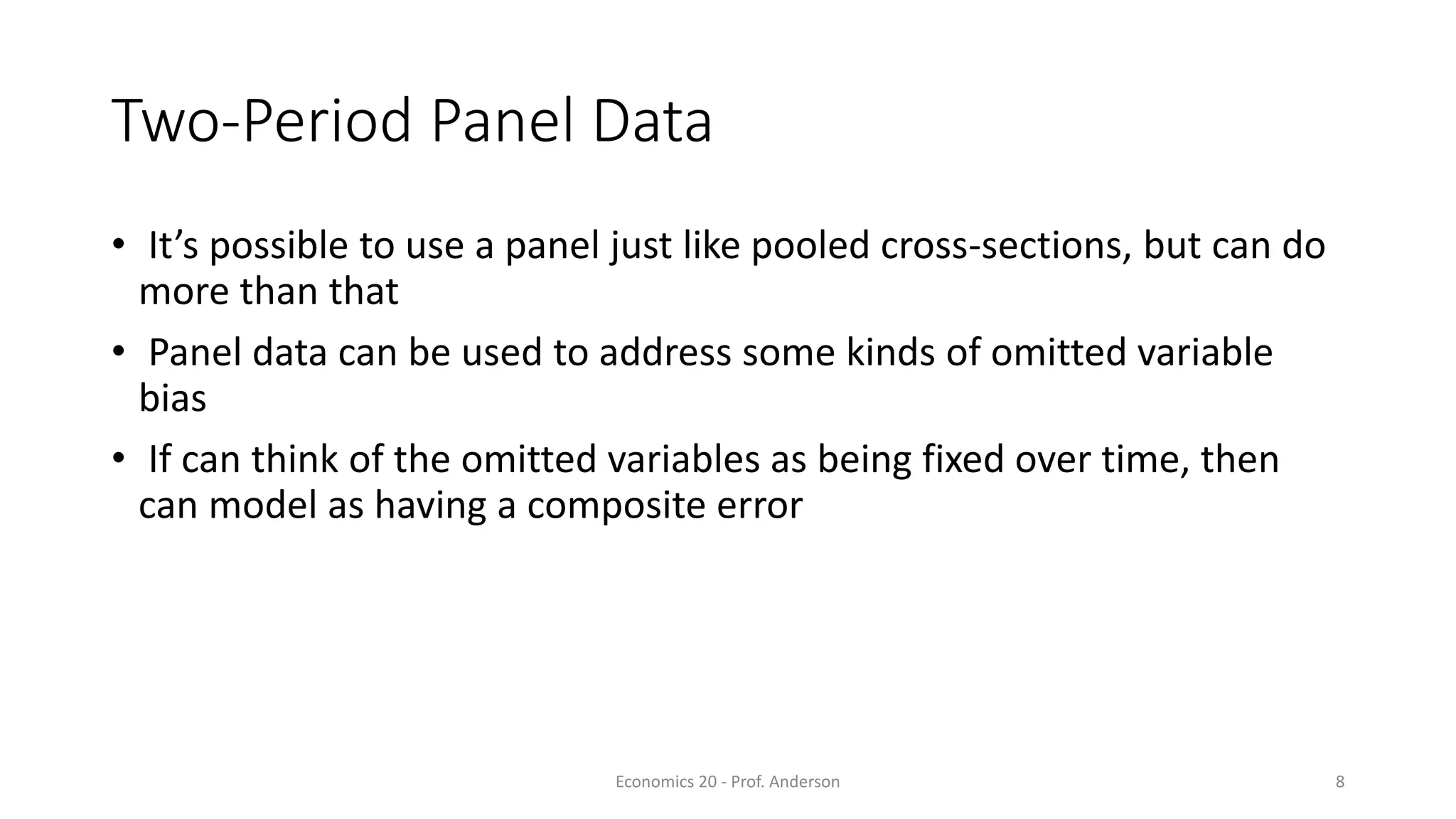
Two-Period Panel Data
• It’s possible to use a panel just like pooled cross-sections, but can do
more than that
• Panel data can be used to address some kinds of omitted variable
bias
• If can think of the omitted variables as being fixed over time, then
can model as having a composite error
Economics 20 - Prof. Anderson 9
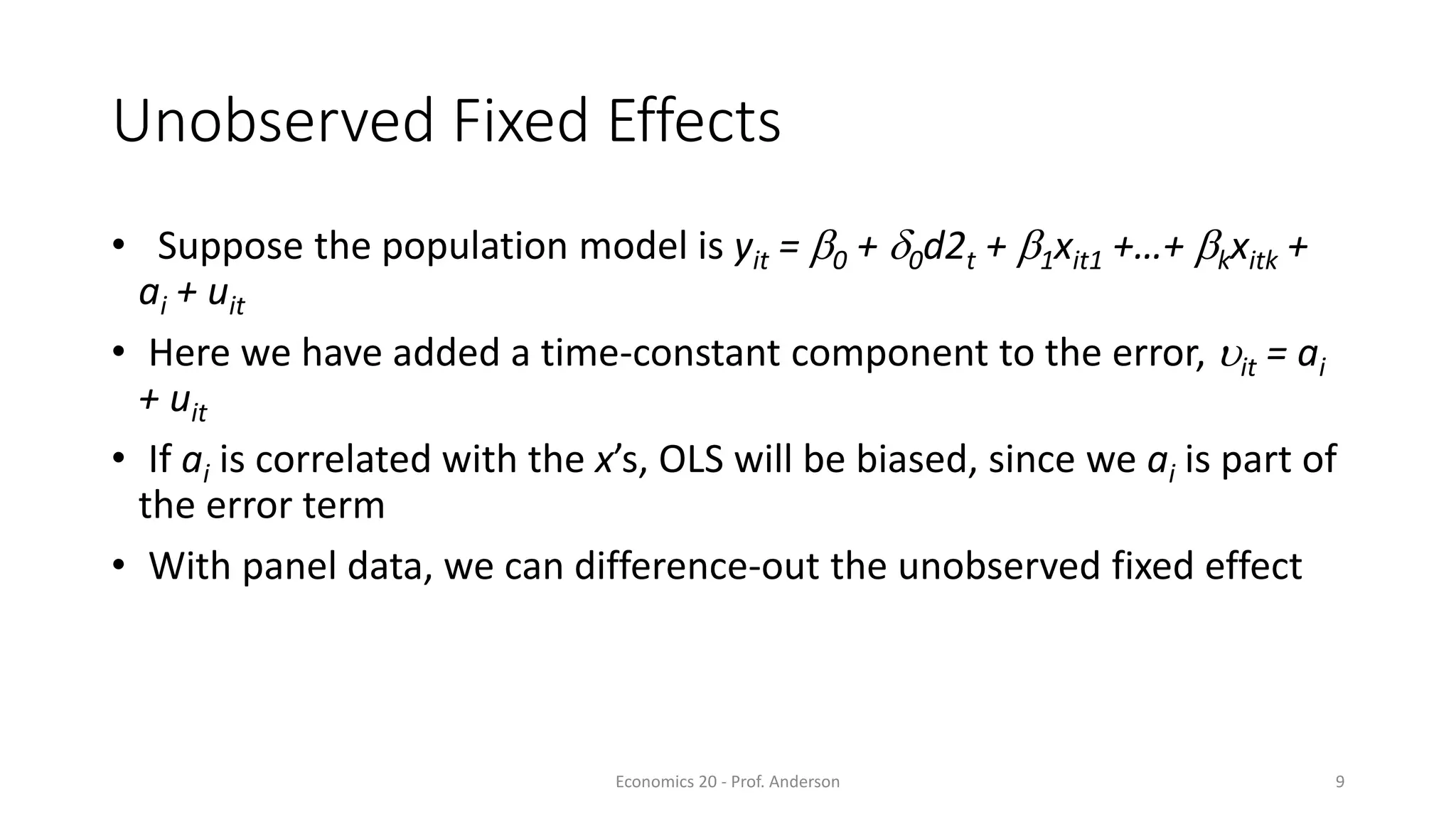
Unobserved Fixed Effects
• Suppose the population model is yit = b0 + d0d2t + b1xit1 +…+ bkxitk +
ai + uit
• Here we have added a time-constant component to the error, uit = ai
+ uit
• If ai is correlated with the x’s, OLS will be biased, since we ai is part of
the error term
• With panel data, we can difference-out the unobserved fixed effect
Economics 20 - Prof. Anderson 10
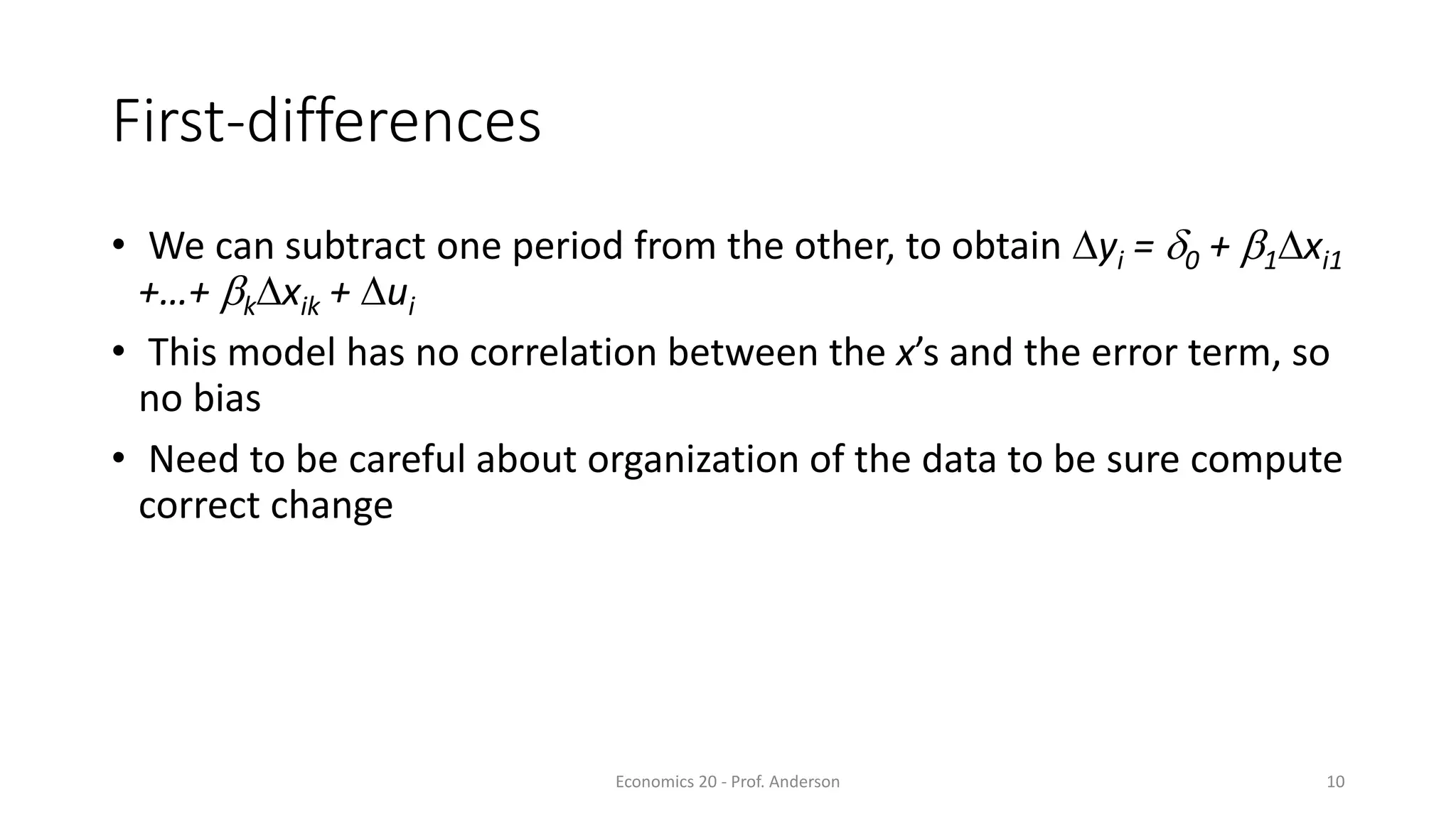
First-differences
• We can subtract one period from the other, to obtain Dyi = d0 + b1Dxi1
+…+ bkDxik + Dui
• This model has no correlation between the x’s and the error term, so
no bias
• Need to be careful about organization of the data to be sure compute
correct change
Economics 20 - Prof. Anderson 11
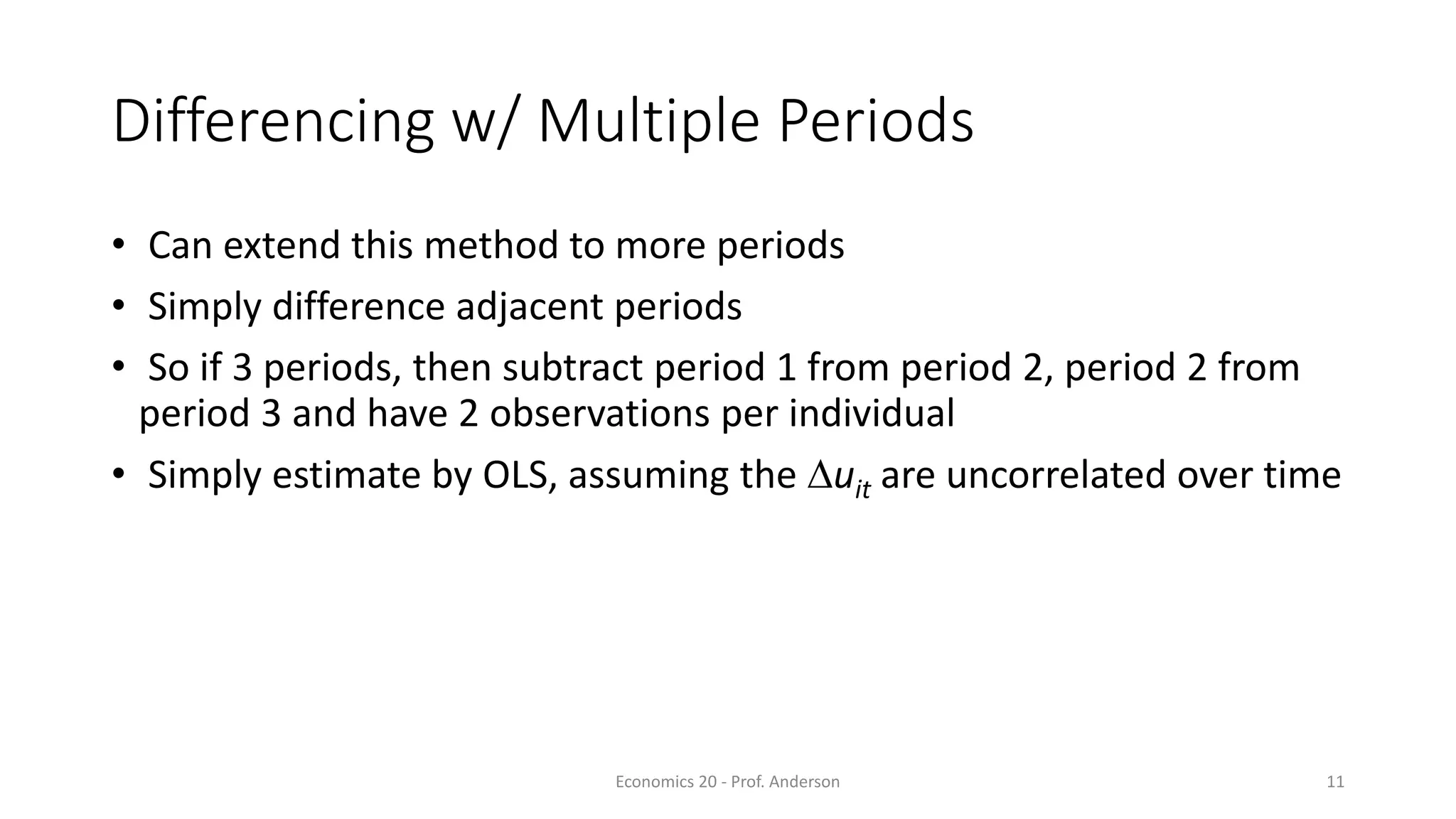
Differencing w/ Multiple Periods
• Can extend this method to more periods
• Simply difference adjacent periods
• So if 3 periods, then subtract period 1 from period 2, period 2 from
period 3 and have 2 observations per individual
• Simply estimate by OLS, assuming the Duit are uncorrelated over time
Economics 20 - Prof. Anderson 12
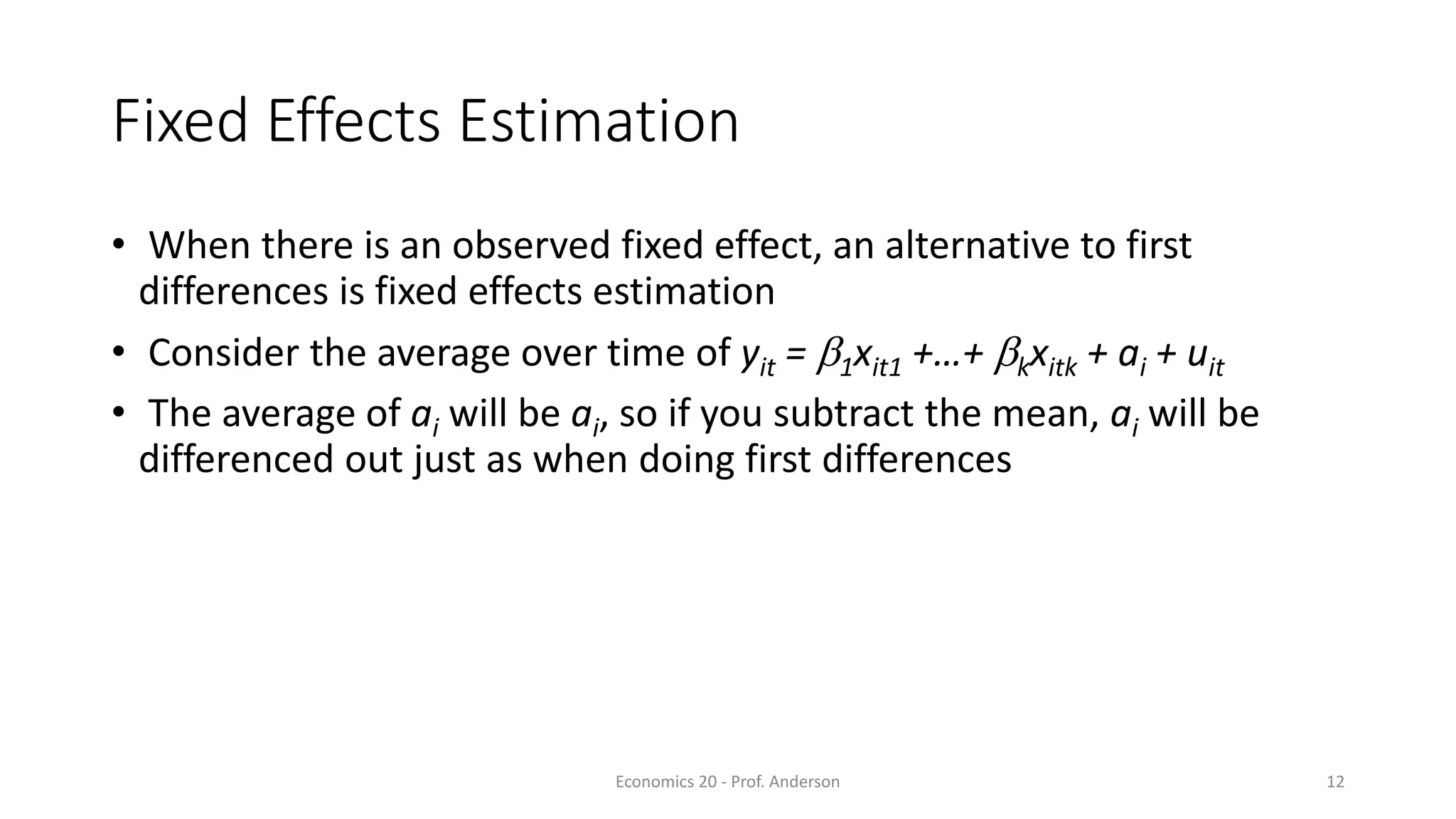
Fixed Effects Estimation
• When there is an observed fixed effect, an alternative to first
differences is fixed effects estimation
• Consider the average over time of yit = b1xit1 +…+ bkxitk + ai + uit
• The average of ai will be ai, so if you subtract the mean, ai will be
differenced out just as when doing first differences
Economics 20 - Prof. Anderson 13
Fixed Effects Estimation (cont)
• If we were to do this estimation by hand, we’d need to be careful
because we’d think that df = NT – k, but really is N(T – 1) – k because
we used up dfs calculating means
• Luckily, Stata (and most other packages) will do fixed effects
estimation for you
• This method is also identical to including a separate intercept or
every individual
Economics 20 - Prof. Anderson 14
First Differences vs Fixed Effects
• First Differences and Fixed Effects will be exactly the same when T = 2
• For T > 2, the two methods are different
• Probably see fixed effects estimation more often than differences –
probably more because it’s easier than that it’s better
• Fixed effects easily implemented for unbalanced panels, not just
balanced panels
Economics 20 - Prof. Anderson 15
Random Effects
• Start with the same basic model with a composite error, yit = b0 +
b1xit1 + . . . bkxitk + ai + uit
• Previously we’ve assumed that ai was correlated with the x’s, but
what if it’s not?
• OLS would be consistent in that case, but composite error will be
serially correlated
Economics 20 - Prof. Anderson 16
Random Effects (continued)
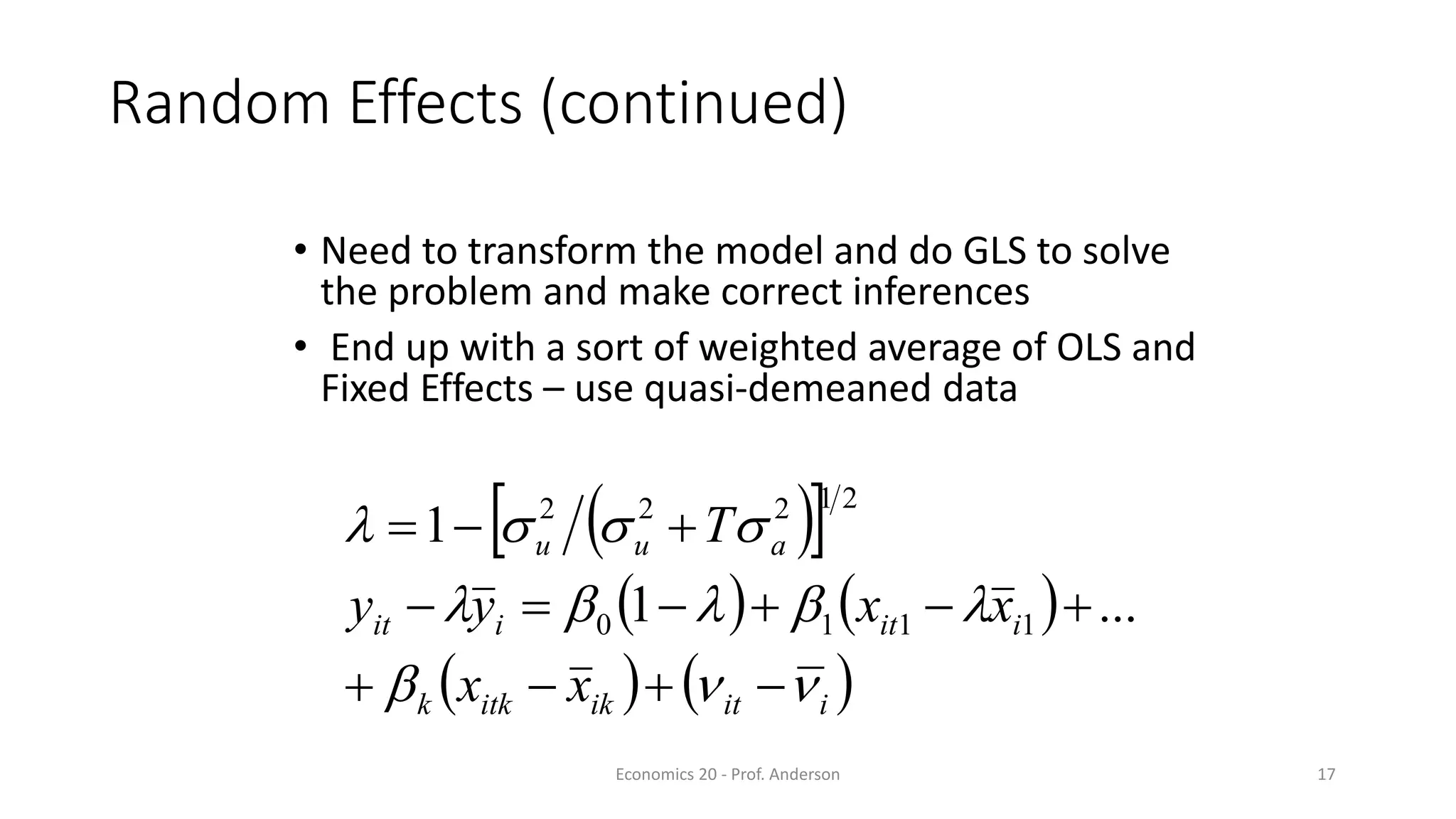
• Need to transform the model and do GLS to solve the problem and
make correct inferences
• Idea is to do quasi-differencing with the
Economics 20 - Prof. Anderson 17
Random Effects (continued)
• Need to transform the model and do GLS to solve
the problem and make correct inferences
• End up with a sort of weighted average of OLS and
Fixed Effects – use quasi-demeaned data
  
   
   iitikitkk
iitiit
auu
xx
xxyy
T
b
bb




...1
1
1110
21222
Economics 20 - Prof. Anderson 18
Random Effects (continued)
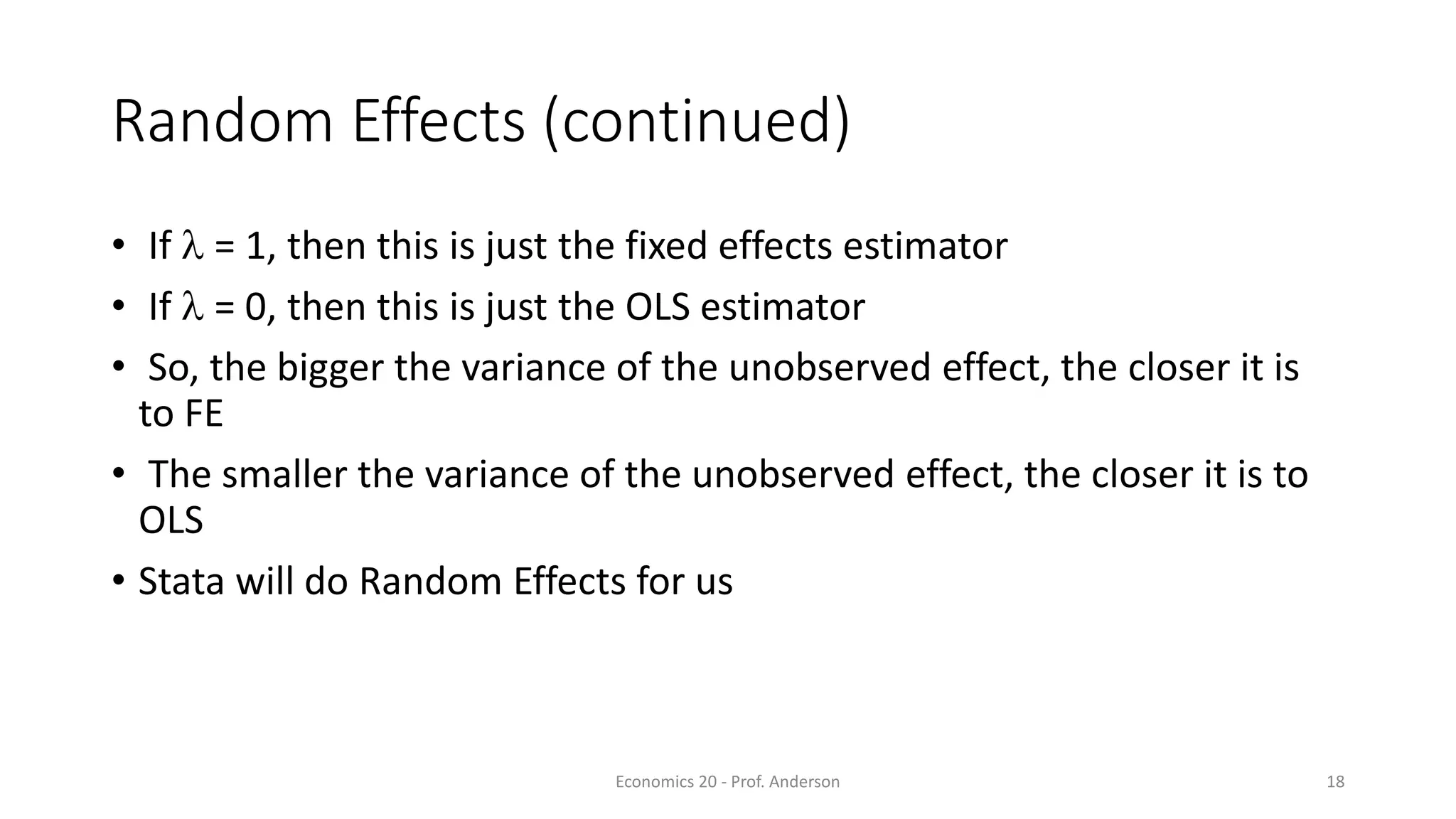
• If  = 1, then this is just the fixed effects estimator
• If  = 0, then this is just the OLS estimator
• So, the bigger the variance of the unobserved effect, the closer it is
to FE
• The smaller the variance of the unobserved effect, the closer it is to
OLS
• Stata will do Random Effects for us
Economics 20 - Prof. Anderson 19
Fixed Effects or Random?
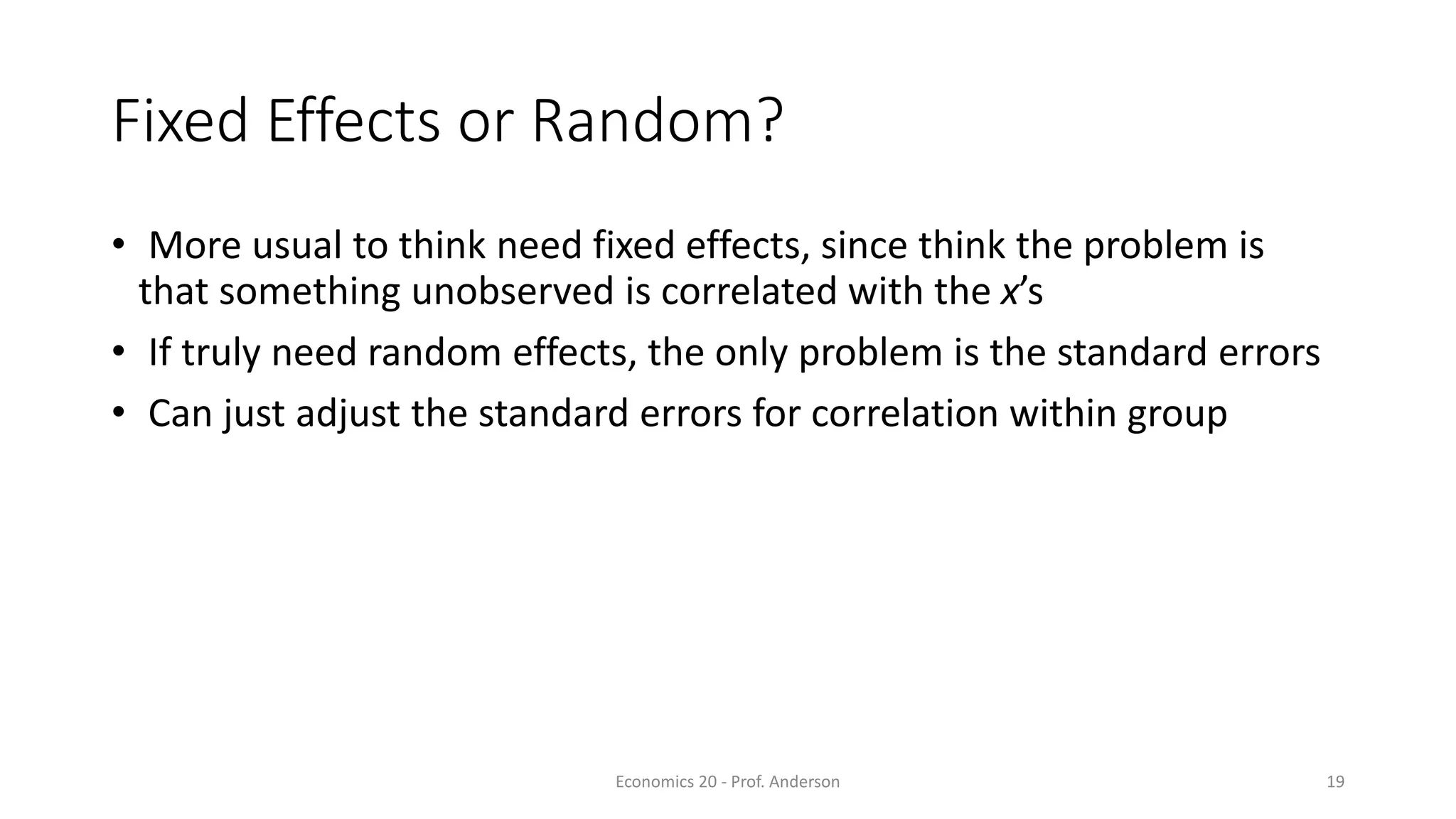
• More usual to think need fixed effects, since think the problem is
that something unobserved is correlated with the x’s
• If truly need random effects, the only problem is the standard errors
• Can just adjust the standard errors for correlation within group
Economics 20 - Prof. Anderson 20
Other Uses of Panel Methods
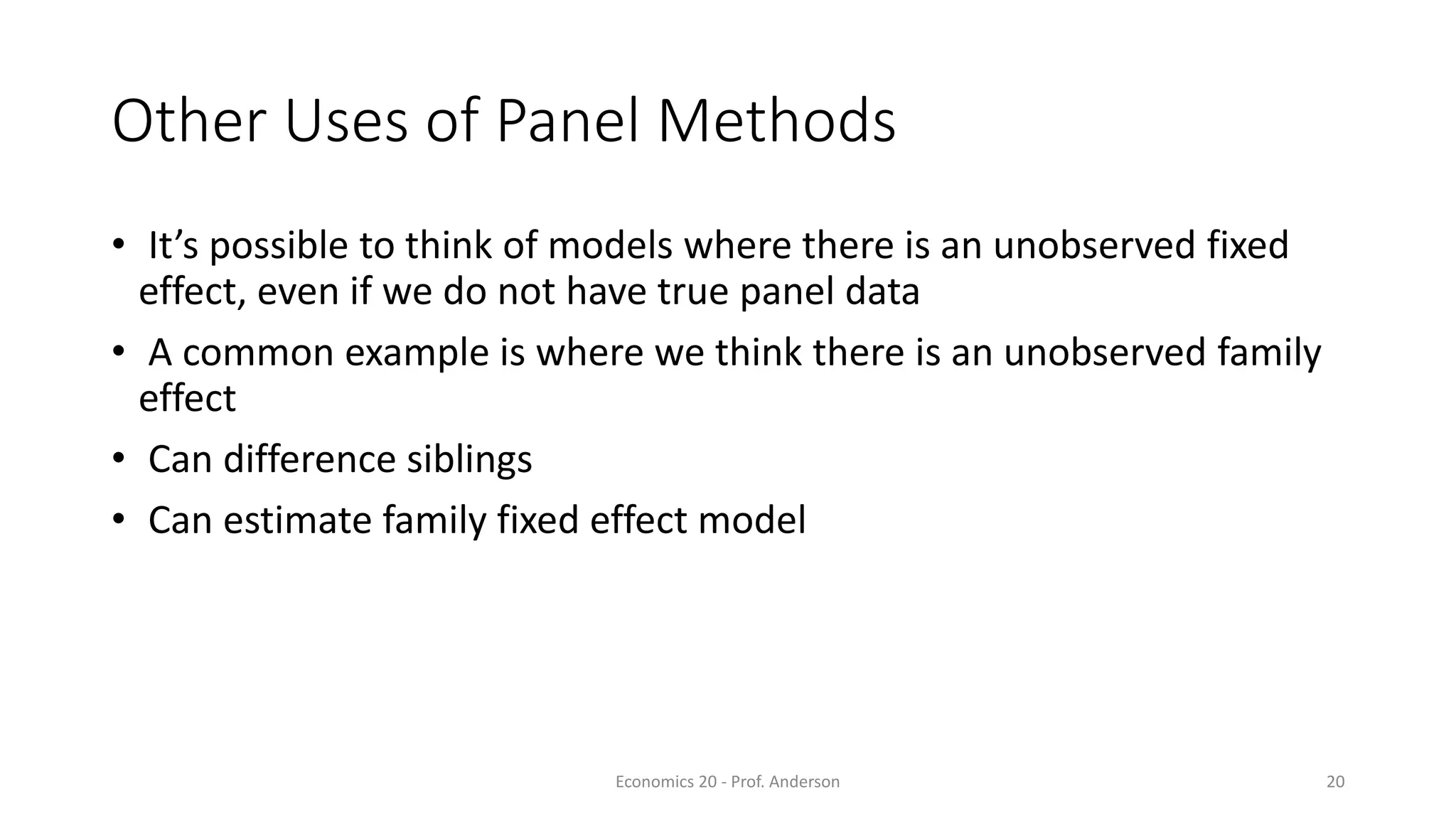
• It’s possible to think of models where there is an unobserved fixed
effect, even if we do not have true panel data
• A common example is where we think there is an unobserved family
effect
• Can difference siblings
• Can estimate family fixed effect model
Economics 20 - Prof. Anderson 21
Additional Issues
• Many of the things we already know about both cross section and
time series data can be applied with panel data
• Can test and correct for serial correlation in the errors
• Can test and correct for heteroskedasticity
• Can estimate standard errors robust to both

ICAR-IFPRI: Panel regression lecture 5 Devesh Roy

  • 1.
    Panel regression Lecture 5 DeveshRoy IFPRI-ICAR Training September 21, 2015
  • 2.
    Economics 20 -Prof. Anderson 2 Panel Data Methods yit = b0 + b1xit1 + . . . bkxitk + uit
  • 3.
    Economics 20 -Prof. Anderson 3 A True Panel vs. A Pooled Cross Section • Often loosely use the term panel data to refer to any data set that has both a cross-sectional dimension and a time-series dimension • More precisely it’s only data following the same cross-section units over time • Otherwise it’s a pooled cross-section
  • 4.
    Economics 20 -Prof. Anderson 4 Pooled Cross Sections • We may want to pool cross sections just to get bigger sample sizes • We may want to pool cross sections to investigate the effect of time • We may want to pool cross sections to investigate whether relationships have changed over time
  • 5.
    Economics 20 -Prof. Anderson 5 Difference-in-Differences • Say random assignment to treatment and control groups, like in a medical experiment • One can then simply compare the change in outcomes across the treatment and control groups to estimate the treatment effect • For time 1,2, groups A, B (y2,B – y2,A) - (y1,B – y1,A), or equivalently (y2,B – y1,B) - (y2,A – y1,A), is the difference-in-differences
  • 6.
    Economics 20 -Prof. Anderson 6 Difference-in-Differences (cont) • A regression framework using time and treatment dummy variables can calculate this difference-in-difference as well • Consider the model: yit = b0 + b1treatmentit + b2afterit + b3treatmentit*afterit + uit • The estimated b3 will be the difference-in-differences in the group means
  • 7.
    Economics 20 -Prof. Anderson 7 Difference-in-Differences (cont) • When don’t truly have random assignment, the regression form becomes very useful • Additional x’s can be added to the regression to control for differences across the treatment and control groups • Sometimes referred to as a “natural experiment” especially when a policy change is being analyzed
  • 8.
    Economics 20 -Prof. Anderson 8 Two-Period Panel Data • It’s possible to use a panel just like pooled cross-sections, but can do more than that • Panel data can be used to address some kinds of omitted variable bias • If can think of the omitted variables as being fixed over time, then can model as having a composite error
  • 9.
    Economics 20 -Prof. Anderson 9 Unobserved Fixed Effects • Suppose the population model is yit = b0 + d0d2t + b1xit1 +…+ bkxitk + ai + uit • Here we have added a time-constant component to the error, uit = ai + uit • If ai is correlated with the x’s, OLS will be biased, since we ai is part of the error term • With panel data, we can difference-out the unobserved fixed effect
  • 10.
    Economics 20 -Prof. Anderson 10 First-differences • We can subtract one period from the other, to obtain Dyi = d0 + b1Dxi1 +…+ bkDxik + Dui • This model has no correlation between the x’s and the error term, so no bias • Need to be careful about organization of the data to be sure compute correct change
  • 11.
    Economics 20 -Prof. Anderson 11 Differencing w/ Multiple Periods • Can extend this method to more periods • Simply difference adjacent periods • So if 3 periods, then subtract period 1 from period 2, period 2 from period 3 and have 2 observations per individual • Simply estimate by OLS, assuming the Duit are uncorrelated over time
  • 12.
    Economics 20 -Prof. Anderson 12 Fixed Effects Estimation • When there is an observed fixed effect, an alternative to first differences is fixed effects estimation • Consider the average over time of yit = b1xit1 +…+ bkxitk + ai + uit • The average of ai will be ai, so if you subtract the mean, ai will be differenced out just as when doing first differences
  • 13.
    Economics 20 -Prof. Anderson 13 Fixed Effects Estimation (cont) • If we were to do this estimation by hand, we’d need to be careful because we’d think that df = NT – k, but really is N(T – 1) – k because we used up dfs calculating means • Luckily, Stata (and most other packages) will do fixed effects estimation for you • This method is also identical to including a separate intercept or every individual
  • 14.
    Economics 20 -Prof. Anderson 14 First Differences vs Fixed Effects • First Differences and Fixed Effects will be exactly the same when T = 2 • For T > 2, the two methods are different • Probably see fixed effects estimation more often than differences – probably more because it’s easier than that it’s better • Fixed effects easily implemented for unbalanced panels, not just balanced panels
  • 15.
    Economics 20 -Prof. Anderson 15 Random Effects • Start with the same basic model with a composite error, yit = b0 + b1xit1 + . . . bkxitk + ai + uit • Previously we’ve assumed that ai was correlated with the x’s, but what if it’s not? • OLS would be consistent in that case, but composite error will be serially correlated
  • 16.
    Economics 20 -Prof. Anderson 16 Random Effects (continued) • Need to transform the model and do GLS to solve the problem and make correct inferences • Idea is to do quasi-differencing with the
  • 17.
    Economics 20 -Prof. Anderson 17 Random Effects (continued) • Need to transform the model and do GLS to solve the problem and make correct inferences • End up with a sort of weighted average of OLS and Fixed Effects – use quasi-demeaned data           iitikitkk iitiit auu xx xxyy T b bb     ...1 1 1110 21222
  • 18.
    Economics 20 -Prof. Anderson 18 Random Effects (continued) • If  = 1, then this is just the fixed effects estimator • If  = 0, then this is just the OLS estimator • So, the bigger the variance of the unobserved effect, the closer it is to FE • The smaller the variance of the unobserved effect, the closer it is to OLS • Stata will do Random Effects for us
  • 19.
    Economics 20 -Prof. Anderson 19 Fixed Effects or Random? • More usual to think need fixed effects, since think the problem is that something unobserved is correlated with the x’s • If truly need random effects, the only problem is the standard errors • Can just adjust the standard errors for correlation within group
  • 20.
    Economics 20 -Prof. Anderson 20 Other Uses of Panel Methods • It’s possible to think of models where there is an unobserved fixed effect, even if we do not have true panel data • A common example is where we think there is an unobserved family effect • Can difference siblings • Can estimate family fixed effect model
  • 21.
    Economics 20 -Prof. Anderson 21 Additional Issues • Many of the things we already know about both cross section and time series data can be applied with panel data • Can test and correct for serial correlation in the errors • Can test and correct for heteroskedasticity • Can estimate standard errors robust to both