Multidimensional Panel Data modelling - A 
Concise Overview 
Abstract 
This document reports preliminary research on statistical modelling using three dimensional panel data. It 
starts with basic panel data model with restrictive assumptions and proceed by relaxing those to arrive at more 
robust models. Then extends these to three dimensional panel data framework. All through only conceptual 
ideas without getting into details are discussed. Finally some of the modelling issues encountered when using 
our multidimensional , vintage panel data are described. 
Contents 
1 Basic Panel Data Models 1 
1.1 Pooled OLS estimation . . . . . . . . . . . . . . . . . . . . . . . . . . . . . . . . . . . . . . . . . . . . . . . . . . . . . . . 1 
1.2 Random Effects Estimation . . . . . . . . . . . . . . . . . . . . . . . . . . . . . . . . . . . . . . . . . . . . . . . . . . . . . 2 
1.3 Fixed Effects Estimation . . . . . . . . . . . . . . . . . . . . . . . . . . . . . . . . . . . . . . . . . . . . . . . . . . . . . . . 2 
1.4 Fixed Difference Estimation . . . . . . . . . . . . . . . . . . . . . . . . . . . . . . . . . . . . . . . . . . . . . . . . . . . . 3 
1.5 Models without Strict Exogeneity Restriction . . . . . . . . . . . . . . . . . . . . . . . . . . . . . . . . . . . . . . . . . 3 
1.6 Hausman Taylor Type models . . . . . . . . . . . . . . . . . . . . . . . . . . . . . . . . . . . . . . . . . . . . . . . . . . . 3 
2 Multi Dimensional Panel Data Models 3 
2.1 Multidimensional Vintage Panel Data of Pools . . . . . . . . . . . . . . . . . . . . . . . . . . . . . . . . . . . . . . . . 4 
3 Issues of Modelling Approach with our Data 4 
3.1 2D or 3D Panel data . . . . . . . . . . . . . . . . . . . . . . . . . . . . . . . . . . . . . . . . . . . . . . . . . . . . . . . . . 4 
3.2 Too many dummies in 2D panel . . . . . . . . . . . . . . . . . . . . . . . . . . . . . . . . . . . . . . . . . . . . . . . . . . 4 
3.3 Error structure in 3D panel . . . . . . . . . . . . . . . . . . . . . . . . . . . . . . . . . . . . . . . . . . . . . . . . . . . . . 4 
3.4 Implementation for 3D panel . . . . . . . . . . . . . . . . . . . . . . . . . . . . . . . . . . . . . . . . . . . . . . . . . . . . 4 
4 References 4 
1. Basic Panel Data Models 
The motivation behind using panel data for estimation is to deal with the problem of omitted variables. As we 
cannot observe all factors which effect our dependent variable, we explicitly try to model all those unknown factors 
as unobserved variables specific to the individual observation or time or some other dimension of interest. Then 
we use linear transformations along with required assumptions to arrive at an estimable equation. 
The population of interest is a cross-section observed over time “T”, which has joint probability distribution 
given by Pr(Y;X;C). All that we want to do is estimate a function f(X;C) for predicting Y. Each observation is a 
realization of random variables with this joint distribution. So yit , xit and ci are all realizations of random variables. 
Our basic unobserved effects model for a particular observation unit “i” is given by1, 
yit = xitβ +ci+uit ; t = 1;2; :::T 
where, xit is 1×K vector of covariates. Here ci represents individual unobserved features of “i” which could effect 
“yit” and which do not change with “t” for a particular “i”. Now based on the assumptions we are willing to make, 
we will have different estimable models for the basic unobserved effects model. 
1.1 Pooled OLS estimation 
In this model we tuck in unobserved effect into the error term and is assumed to be uncorrelated with the observed 
covariates. Basic model is given by, 
yit = xitβ +vit ; t = 1;2; :::T 
where, vit = ci+uit is a composite error. Underlying assumptions are as given below, 
Assumptions: 
1. E(x′ 
ituit ) = 0 
1this document exactly follows the notation used in Wooldridge book
2. E(x′ 
itci) = 0 
First assumption is true by definition if we have correctly specified the conditional expectation function. This is 
also called no contemporaneous correlation assumption. Second assumption is rather restrictive. Under these as-sumptions 
we can just use pooled OLS estimation i.e., looking at observations as pooled across “i” and “t”. But due 
to serial correlation in “vit” (which is because of ci), we have to use robust Var-Cov matrix estimator for inference. 
1.2 Random Effects Estimation 
In this model also we put “ci” into the error term but we explicitly assume an error structure accounting for the un-observed 
component and more restrictive assumption of strict exogeneity so that we can use GLS (generalized least squares) 
estimation approach. Thus resulting in more efficient estimates. First assumption in this model is, 
R.E Assumption 1: 
a. E(uit |xi;ci) = 0; t = 1;2; :::T 
b. E(ci|xi) = 0 
where xi is (xi1;xi2; :::xiT ). First part is the strict exogeneity assumption i.e., any of the covariates are not corre-lated 
with error at any “t”. Second part of the assumption is what restricts random effects model when compared to 
β 
other models, →it assumes orthogonality between unobserved effect and observable covariates. Our model is given 
by, 
yit = xitβ +vit ; t = 1;2; :::T 
where, vit = ci+uit is a composite error. 
This in −turn can be written in vector form for each individual as, 
yi = Xi 
+vi 
where yi, vi are vectors and Ω = E(viv′ 
i) is the Var-Cov matrix of the error term which is same for each individual. 
Additional assumptions required for the estimation and inference are as given below, 
R.E Assumption 2: 
Rank[E(X′ 
iΩXi)] = K 
This is standard no-perfect collinearity assumption. 
R.E Assumption 3: 
a. E(uiu′ 
i 
|xi;ci) =σ 2 
u IT 
b. E 
( 
c2i 
|Xi 
) 
=σ 2 
c 
Assuming particular error structure of no-correlation across time periods and constant variance for unobservables 
and error, we get the random effects error structure given by, 
Ω = E(viv′ 
i) = 
 
σ 2 
c +σ 2 
u σ 2 
c 
 
· · · σ 2 
c 
σ 2 
c σ 2 
c +σu · · · σ 2 
c 
... 
... 
. . . 
... 
σ 2 
c : · · · σ 2 
c +σ 2 
u 
 
 
Finally random effects estimate of β is given by(this is same projection formula used in normal regression extended to vectors); 
ˆβ 
RE = 
( 
ΣNi 
iΩˆ −1Xi 
=1X′ 
)−1 ( 
=1X′ 
ΣNi 
i Ωˆ −1Yi 
) 
where, Ωˆ −1 is obtained by estimating σˆv 
2 and σˆc 
2. 
If we don’t want to make assumptions about error structure, we can use robust variance matrix for inference. 
A more general estimator of Ω can be used in FGLS framework with, 
Ωˆ = N−1ΣNi 
=1 
ˆˆV 
i 
ˆˆV 
′ 
i 
where, ˆˆV 
i is pooled OLS residual. 
1.3 Fixed Effects Estimation 
Random effects estimation puts “ci” into the error term and then assumes no correlation between unobservable 
and observable covariates. But the whole point of panel data is to allow for “ci” to be arbitrarily correlated with 
the xit . Fixed effects analysis achieves this purpose explicitly. 
Basic model is given by, 
yi = Xiβ +cijT +ui, for some observation i. 
F.E Assumption 1: 
E(uit |xi;ci) = 0; t = 1;2; :::T 
where xi is (xi1;xi2; :::xiT ).
This is strict exogeneity assumption and we don’t put any restriction on the correlation betweeen unobservable 
and observable covariates. Note that we can’t have time invariant covariates because we can’t distinguish its effect 
from that of ci. 
The idea of estimating “β ” is to transform the equation to eliminate “ci”. As the linear transformation doesn’t 
change the statistical properties of unbiasedness and consistency of “β ”, the resulting estimates have the same 
properties as original model. 
The famous within transformation is given by, 
(yit − ¯ yi) = (xit − ¯ xi)β +(uit − ¯ ui) 
where ¯ yi = T−1ΣTi 
=1 yit ; ¯ xi = T−1ΣTi 
=1 xit and ¯ ui = T−1ΣTi 
=1 uit . 
or 
¨yit = ¨xitβ + ¨uit 
Here we can show that E(¨x′ 
it ¨uit ) = 0; t = 1;2; :::T holds and so can use pooled ols estimation to get “ˆβ 
FE”. Thus 
we have pooled [ 
( 
OLS regression of yit ¨ on xit ¨ , t = 1;2; :::N:With an additional assumption of no perfect collinearity 
i.e., rank 
E 
¨X 
′ 
i ¨X 
i 
)] 
= K, fixed effect estimate of β is given by, 
ˆβ 
FE = 
( 
ΣNi 
=1 ¨X 
′ 
i ¨X 
i 
)−1 ( 
=1 ¨X 
ΣNi 
′ 
i ¨Y 
i 
) 
For inference we assume homoskedastic error structure for each i across time series dimension. And if we suspect 
serial correlation we can use robust Var-Cov matrix for inference. If we choose not to assume any error structure 
then feasible GLS estimator can be directly used to get efficient estimator2. 
1.4 Fixed Difference Estimation 
If we want to assume that errors across “T” follow random walk, then F.D is more palatable . The analysis and 
assumptions are very similar to that of F.E estimation. All the assumptions of strict exogeneity, rank condition for 
no-perfect collinearity and error structure for inference are all valid for this case also. 
1.5 Models without Strict Exogeneity Restriction 
So far we have assumed strict exogeneity of explanatory variables conditional on unobserved effects (in case of 
F.E and F.D). This rules out the feedback from yit to future values of xit . Generally R.E, F.E and F.D estimates are 
inconsistent if the explanatory variables in some time period is correlated with uit . While the size of inconsistency 
might be small in some cases it can be substantial in others. Thus it is important to deduce consistent estimates 
when this assumption is relaxed. To be specific we assume that xit are sequentially exogenous conditional on the 
unobserved effect i.e., 
E(uit |xit ;xit−1; :::xi1;ci) = o , t = 1,2,...T. 
This implies that no past values of xit affect the expected value of yit once xit and ci are accounted for. Thus we 
are allowing for correlation between uit and future values of xit . These models can be estimated using suitable 
instruments in the transformed equation( whether it is fixed difference or fixed effects). 
1.6 Hausman Taylor Type models 
When we want to include time-invariant factors and also allow for arbitrary correlation between unobserved factor 
and observable covariates we use H.T type models. Basic idea here is to find suitable instruments and use GMM 
to estimate the parameters of the model. 
2. Multi Dimensional Panel Data Models 
In basic Panel data, data is observed over two dimensions( typically, time and cross-section). A multidimensional 
panel data has observations uniquely identified with one or more indexes apart from the usual time and cross-section. 
As an example, consider three-way trade panel data. Each observation is a trade deal of a country from 
a cross-section of countries at a particular time with a particular country. An observation has both dependent 
variable and many independent variables. Many interesting fixed effects can be modelled with multidimensional 
panel data. For example, 
yi jt = xi jtβ +ci+djt +εi jt 
With suitable transformations and assumptions about errors across different dimensions. we can arrive at estimates 
of parameters as we do it in two dimensional panel. 
2Please refer Econometric analysis of cross-section and Panel data by Wooldridge for further details
2.1 Multidimensional Vintage Panel Data of Pools 
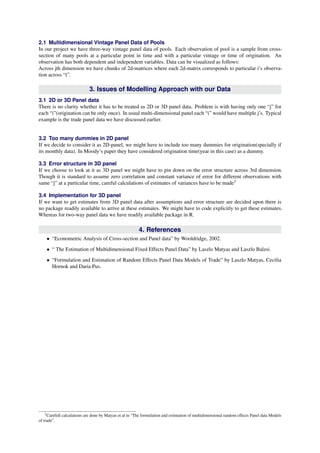
In our project we have three-way vintage panel data of pools. Each observation of pool is a sample from cross- 
section of many pools at a particular point in time and with a particular vintage or time of origination. An 
observation has both dependent and independent variables. Data can be visualized as follows: 
Across jth dimension we have chunks of 2d-matrices where each 2d-matrix corresponds to particular i’s observa- 
tion across “t”. 
3. Issues of Modelling Approach with our Data 
3.1 2D or 3D Panel data 
There is no clarity whether it has to be treated as 2D or 3D panel data. Problem is with having only one “j” for 
each “i”(origination can be only once). In usual multi-dimensional panel each “i” would have multiple j’s. Typical 
example is the trade panel data we have discussed earlier. 
3.2 Too many dummies in 2D panel 
If we decide to consider it as 2D-panel, we might have to include too many dummies for origination(specially if 
its monthly data). In Moody’s paper they have considered origination time(year in this case) as a dummy. 
3.3 Error structure in 3D panel 
If we choose to look at it as 3D panel we might have to pin down on the error structure across 3rd dimension. 
Though it is standard to assume zero correlation and constant variance of error for different observations with 
same “j” at a particular time, careful calculations of estimates of variances have to be made3 
3.4 Implementation for 3D panel 
If we want to get estimates from 3D panel data after assumptions and error structure are decided upon there is 
no package readily available to arrive at these estimates. We might have to code explicitly to get these estimates. 
Whereas for two-way panel data we have readily available package in R. 
4. References 
• “Econometric Analysis of Cross-section and Panel data” by Wooldridge, 2002. 
• “ The Estimation of Multidimensional Fixed Effects Panel Data” by Laszlo Matyas and Laszlo Balzsi. 
• “Formulation and Estimation of Random Effects Panel Data Models of Trade” by Laszlo Matyas, Cecilia 
Hornok and Daria Pus. 
3Carefull calculations are done by Matyas et al in “The formulation and estimation of multidimensional random effects Panel data Models 
of trade”.

Priliminary Research on Multi-Dimensional Panel Data Modeling

  • 1.
    Multidimensional Panel Datamodelling - A Concise Overview Abstract This document reports preliminary research on statistical modelling using three dimensional panel data. It starts with basic panel data model with restrictive assumptions and proceed by relaxing those to arrive at more robust models. Then extends these to three dimensional panel data framework. All through only conceptual ideas without getting into details are discussed. Finally some of the modelling issues encountered when using our multidimensional , vintage panel data are described. Contents 1 Basic Panel Data Models 1 1.1 Pooled OLS estimation . . . . . . . . . . . . . . . . . . . . . . . . . . . . . . . . . . . . . . . . . . . . . . . . . . . . . . . 1 1.2 Random Effects Estimation . . . . . . . . . . . . . . . . . . . . . . . . . . . . . . . . . . . . . . . . . . . . . . . . . . . . . 2 1.3 Fixed Effects Estimation . . . . . . . . . . . . . . . . . . . . . . . . . . . . . . . . . . . . . . . . . . . . . . . . . . . . . . . 2 1.4 Fixed Difference Estimation . . . . . . . . . . . . . . . . . . . . . . . . . . . . . . . . . . . . . . . . . . . . . . . . . . . . 3 1.5 Models without Strict Exogeneity Restriction . . . . . . . . . . . . . . . . . . . . . . . . . . . . . . . . . . . . . . . . . 3 1.6 Hausman Taylor Type models . . . . . . . . . . . . . . . . . . . . . . . . . . . . . . . . . . . . . . . . . . . . . . . . . . . 3 2 Multi Dimensional Panel Data Models 3 2.1 Multidimensional Vintage Panel Data of Pools . . . . . . . . . . . . . . . . . . . . . . . . . . . . . . . . . . . . . . . . 4 3 Issues of Modelling Approach with our Data 4 3.1 2D or 3D Panel data . . . . . . . . . . . . . . . . . . . . . . . . . . . . . . . . . . . . . . . . . . . . . . . . . . . . . . . . . 4 3.2 Too many dummies in 2D panel . . . . . . . . . . . . . . . . . . . . . . . . . . . . . . . . . . . . . . . . . . . . . . . . . . 4 3.3 Error structure in 3D panel . . . . . . . . . . . . . . . . . . . . . . . . . . . . . . . . . . . . . . . . . . . . . . . . . . . . . 4 3.4 Implementation for 3D panel . . . . . . . . . . . . . . . . . . . . . . . . . . . . . . . . . . . . . . . . . . . . . . . . . . . . 4 4 References 4 1. Basic Panel Data Models The motivation behind using panel data for estimation is to deal with the problem of omitted variables. As we cannot observe all factors which effect our dependent variable, we explicitly try to model all those unknown factors as unobserved variables specific to the individual observation or time or some other dimension of interest. Then we use linear transformations along with required assumptions to arrive at an estimable equation. The population of interest is a cross-section observed over time “T”, which has joint probability distribution given by Pr(Y;X;C). All that we want to do is estimate a function f(X;C) for predicting Y. Each observation is a realization of random variables with this joint distribution. So yit , xit and ci are all realizations of random variables. Our basic unobserved effects model for a particular observation unit “i” is given by1, yit = xitβ +ci+uit ; t = 1;2; :::T where, xit is 1×K vector of covariates. Here ci represents individual unobserved features of “i” which could effect “yit” and which do not change with “t” for a particular “i”. Now based on the assumptions we are willing to make, we will have different estimable models for the basic unobserved effects model. 1.1 Pooled OLS estimation In this model we tuck in unobserved effect into the error term and is assumed to be uncorrelated with the observed covariates. Basic model is given by, yit = xitβ +vit ; t = 1;2; :::T where, vit = ci+uit is a composite error. Underlying assumptions are as given below, Assumptions: 1. E(x′ ituit ) = 0 1this document exactly follows the notation used in Wooldridge book
  • 2.
    2. E(x′ itci)= 0 First assumption is true by definition if we have correctly specified the conditional expectation function. This is also called no contemporaneous correlation assumption. Second assumption is rather restrictive. Under these as-sumptions we can just use pooled OLS estimation i.e., looking at observations as pooled across “i” and “t”. But due to serial correlation in “vit” (which is because of ci), we have to use robust Var-Cov matrix estimator for inference. 1.2 Random Effects Estimation In this model also we put “ci” into the error term but we explicitly assume an error structure accounting for the un-observed component and more restrictive assumption of strict exogeneity so that we can use GLS (generalized least squares) estimation approach. Thus resulting in more efficient estimates. First assumption in this model is, R.E Assumption 1: a. E(uit |xi;ci) = 0; t = 1;2; :::T b. E(ci|xi) = 0 where xi is (xi1;xi2; :::xiT ). First part is the strict exogeneity assumption i.e., any of the covariates are not corre-lated with error at any “t”. Second part of the assumption is what restricts random effects model when compared to β other models, →it assumes orthogonality between unobserved effect and observable covariates. Our model is given by, yit = xitβ +vit ; t = 1;2; :::T where, vit = ci+uit is a composite error. This in −turn can be written in vector form for each individual as, yi = Xi +vi where yi, vi are vectors and Ω = E(viv′ i) is the Var-Cov matrix of the error term which is same for each individual. Additional assumptions required for the estimation and inference are as given below, R.E Assumption 2: Rank[E(X′ iΩXi)] = K This is standard no-perfect collinearity assumption. R.E Assumption 3: a. E(uiu′ i |xi;ci) =σ 2 u IT b. E ( c2i |Xi ) =σ 2 c Assuming particular error structure of no-correlation across time periods and constant variance for unobservables and error, we get the random effects error structure given by, Ω = E(viv′ i) =  σ 2 c +σ 2 u σ 2 c  · · · σ 2 c σ 2 c σ 2 c +σu · · · σ 2 c ... ... . . . ... σ 2 c : · · · σ 2 c +σ 2 u   Finally random effects estimate of β is given by(this is same projection formula used in normal regression extended to vectors); ˆβ RE = ( ΣNi iΩˆ −1Xi =1X′ )−1 ( =1X′ ΣNi i Ωˆ −1Yi ) where, Ωˆ −1 is obtained by estimating σˆv 2 and σˆc 2. If we don’t want to make assumptions about error structure, we can use robust variance matrix for inference. A more general estimator of Ω can be used in FGLS framework with, Ωˆ = N−1ΣNi =1 ˆˆV i ˆˆV ′ i where, ˆˆV i is pooled OLS residual. 1.3 Fixed Effects Estimation Random effects estimation puts “ci” into the error term and then assumes no correlation between unobservable and observable covariates. But the whole point of panel data is to allow for “ci” to be arbitrarily correlated with the xit . Fixed effects analysis achieves this purpose explicitly. Basic model is given by, yi = Xiβ +cijT +ui, for some observation i. F.E Assumption 1: E(uit |xi;ci) = 0; t = 1;2; :::T where xi is (xi1;xi2; :::xiT ).
  • 3.
    This is strictexogeneity assumption and we don’t put any restriction on the correlation betweeen unobservable and observable covariates. Note that we can’t have time invariant covariates because we can’t distinguish its effect from that of ci. The idea of estimating “β ” is to transform the equation to eliminate “ci”. As the linear transformation doesn’t change the statistical properties of unbiasedness and consistency of “β ”, the resulting estimates have the same properties as original model. The famous within transformation is given by, (yit − ¯ yi) = (xit − ¯ xi)β +(uit − ¯ ui) where ¯ yi = T−1ΣTi =1 yit ; ¯ xi = T−1ΣTi =1 xit and ¯ ui = T−1ΣTi =1 uit . or ¨yit = ¨xitβ + ¨uit Here we can show that E(¨x′ it ¨uit ) = 0; t = 1;2; :::T holds and so can use pooled ols estimation to get “ˆβ FE”. Thus we have pooled [ ( OLS regression of yit ¨ on xit ¨ , t = 1;2; :::N:With an additional assumption of no perfect collinearity i.e., rank E ¨X ′ i ¨X i )] = K, fixed effect estimate of β is given by, ˆβ FE = ( ΣNi =1 ¨X ′ i ¨X i )−1 ( =1 ¨X ΣNi ′ i ¨Y i ) For inference we assume homoskedastic error structure for each i across time series dimension. And if we suspect serial correlation we can use robust Var-Cov matrix for inference. If we choose not to assume any error structure then feasible GLS estimator can be directly used to get efficient estimator2. 1.4 Fixed Difference Estimation If we want to assume that errors across “T” follow random walk, then F.D is more palatable . The analysis and assumptions are very similar to that of F.E estimation. All the assumptions of strict exogeneity, rank condition for no-perfect collinearity and error structure for inference are all valid for this case also. 1.5 Models without Strict Exogeneity Restriction So far we have assumed strict exogeneity of explanatory variables conditional on unobserved effects (in case of F.E and F.D). This rules out the feedback from yit to future values of xit . Generally R.E, F.E and F.D estimates are inconsistent if the explanatory variables in some time period is correlated with uit . While the size of inconsistency might be small in some cases it can be substantial in others. Thus it is important to deduce consistent estimates when this assumption is relaxed. To be specific we assume that xit are sequentially exogenous conditional on the unobserved effect i.e., E(uit |xit ;xit−1; :::xi1;ci) = o , t = 1,2,...T. This implies that no past values of xit affect the expected value of yit once xit and ci are accounted for. Thus we are allowing for correlation between uit and future values of xit . These models can be estimated using suitable instruments in the transformed equation( whether it is fixed difference or fixed effects). 1.6 Hausman Taylor Type models When we want to include time-invariant factors and also allow for arbitrary correlation between unobserved factor and observable covariates we use H.T type models. Basic idea here is to find suitable instruments and use GMM to estimate the parameters of the model. 2. Multi Dimensional Panel Data Models In basic Panel data, data is observed over two dimensions( typically, time and cross-section). A multidimensional panel data has observations uniquely identified with one or more indexes apart from the usual time and cross-section. As an example, consider three-way trade panel data. Each observation is a trade deal of a country from a cross-section of countries at a particular time with a particular country. An observation has both dependent variable and many independent variables. Many interesting fixed effects can be modelled with multidimensional panel data. For example, yi jt = xi jtβ +ci+djt +εi jt With suitable transformations and assumptions about errors across different dimensions. we can arrive at estimates of parameters as we do it in two dimensional panel. 2Please refer Econometric analysis of cross-section and Panel data by Wooldridge for further details
  • 4.
    2.1 Multidimensional VintagePanel Data of Pools In our project we have three-way vintage panel data of pools. Each observation of pool is a sample from cross- section of many pools at a particular point in time and with a particular vintage or time of origination. An observation has both dependent and independent variables. Data can be visualized as follows: Across jth dimension we have chunks of 2d-matrices where each 2d-matrix corresponds to particular i’s observa- tion across “t”. 3. Issues of Modelling Approach with our Data 3.1 2D or 3D Panel data There is no clarity whether it has to be treated as 2D or 3D panel data. Problem is with having only one “j” for each “i”(origination can be only once). In usual multi-dimensional panel each “i” would have multiple j’s. Typical example is the trade panel data we have discussed earlier. 3.2 Too many dummies in 2D panel If we decide to consider it as 2D-panel, we might have to include too many dummies for origination(specially if its monthly data). In Moody’s paper they have considered origination time(year in this case) as a dummy. 3.3 Error structure in 3D panel If we choose to look at it as 3D panel we might have to pin down on the error structure across 3rd dimension. Though it is standard to assume zero correlation and constant variance of error for different observations with same “j” at a particular time, careful calculations of estimates of variances have to be made3 3.4 Implementation for 3D panel If we want to get estimates from 3D panel data after assumptions and error structure are decided upon there is no package readily available to arrive at these estimates. We might have to code explicitly to get these estimates. Whereas for two-way panel data we have readily available package in R. 4. References • “Econometric Analysis of Cross-section and Panel data” by Wooldridge, 2002. • “ The Estimation of Multidimensional Fixed Effects Panel Data” by Laszlo Matyas and Laszlo Balzsi. • “Formulation and Estimation of Random Effects Panel Data Models of Trade” by Laszlo Matyas, Cecilia Hornok and Daria Pus. 3Carefull calculations are done by Matyas et al in “The formulation and estimation of multidimensional random effects Panel data Models of trade”.