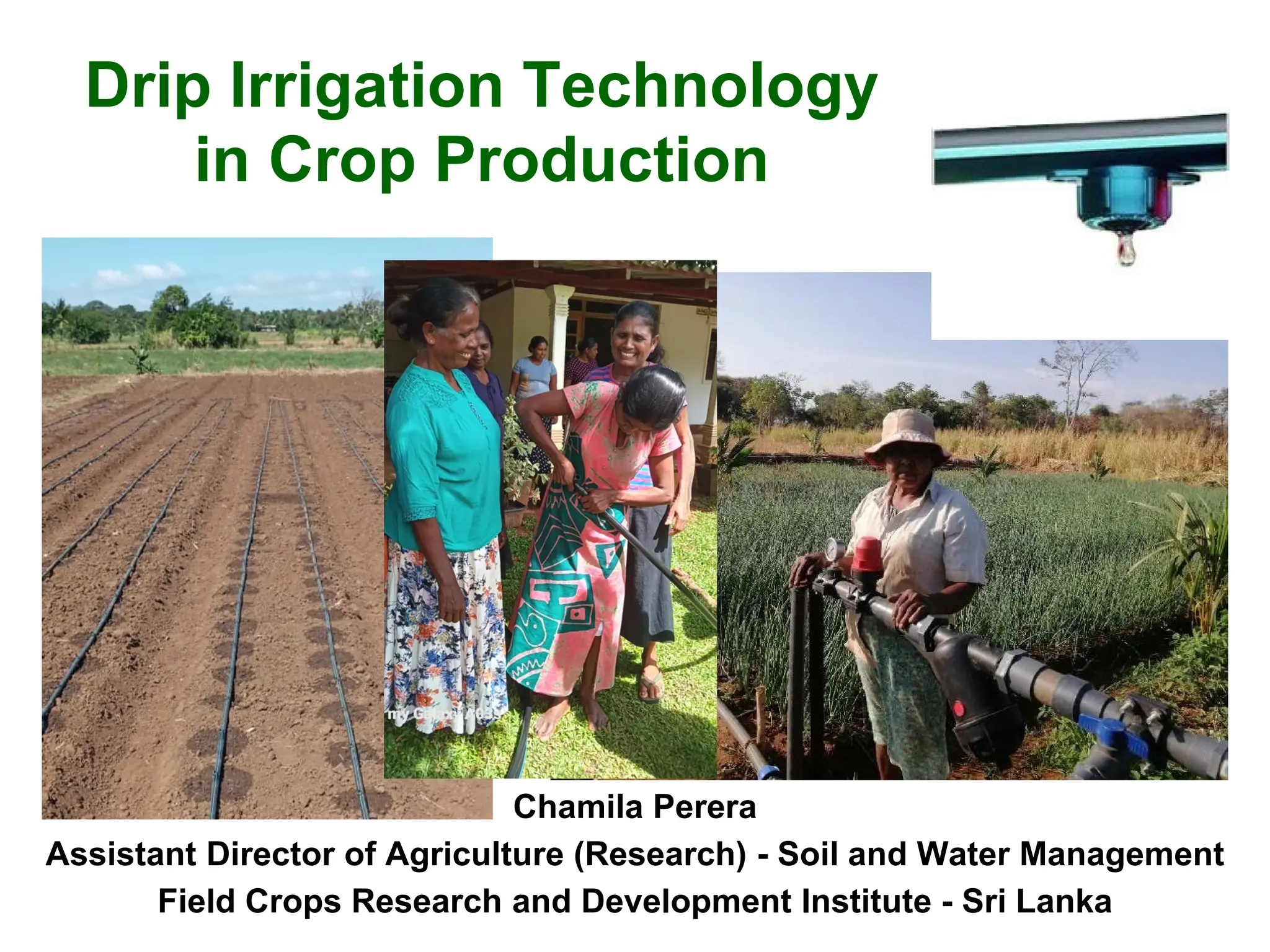
Drip Irrigation Technology
in Crop Production
Chamila Perera
Assistant Director of Agriculture (Research) - Soil and Water Management
Field Crops Research and Development Institute - Sri Lanka
Content
▪ Importance of drip irrigation
▪ Different types of drip irrigation
▪ Components of drip irrigation systems
▪ Maintenance of drip systems
▪ Drip irrigation based crop
management packages
▪ Further developments
▪ Technology dissemination
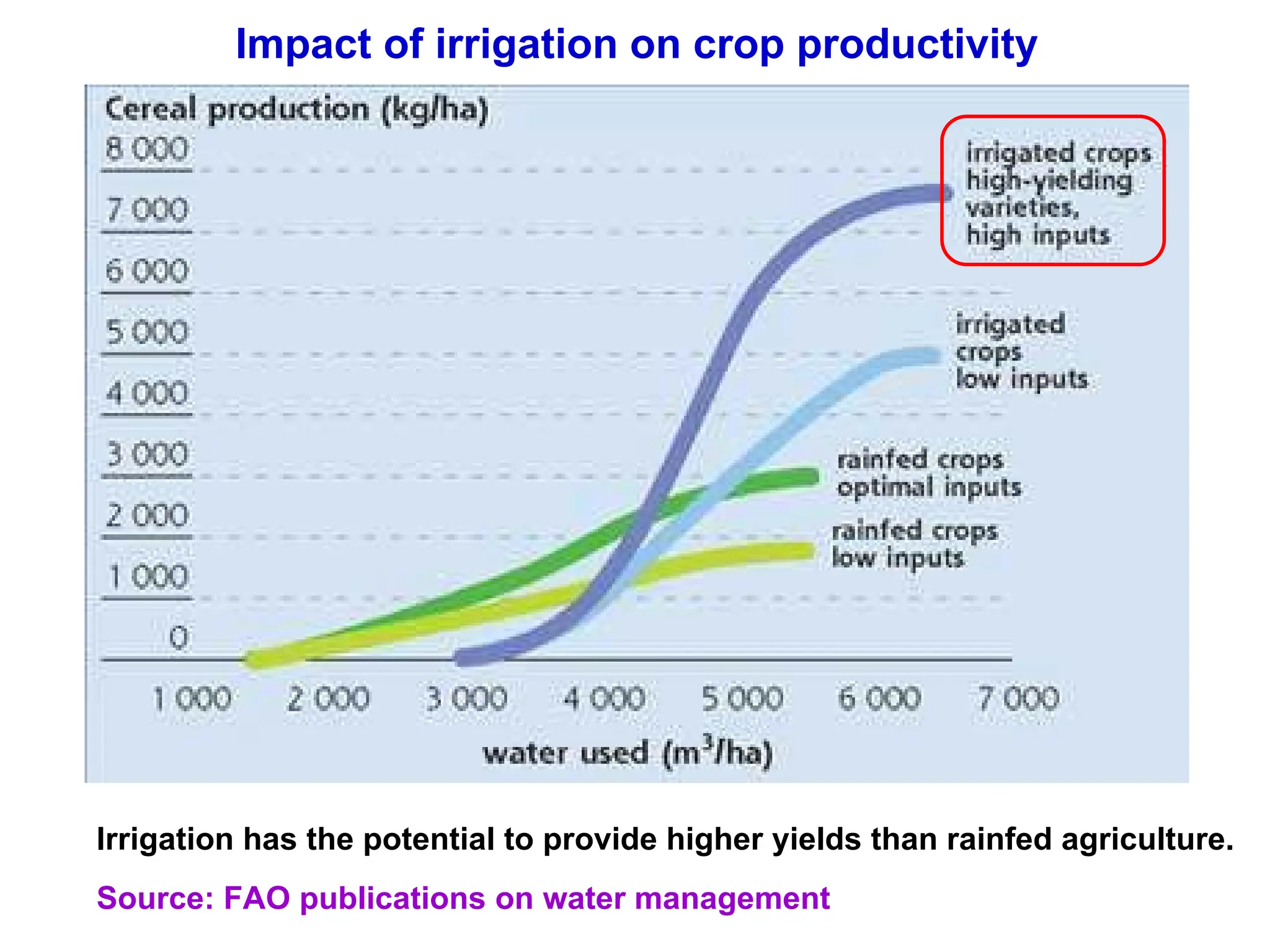
Irrigation has the potential to provide higher yields than rainfed agriculture.
Source: FAO publications on water management
Impact of irrigation on crop productivity
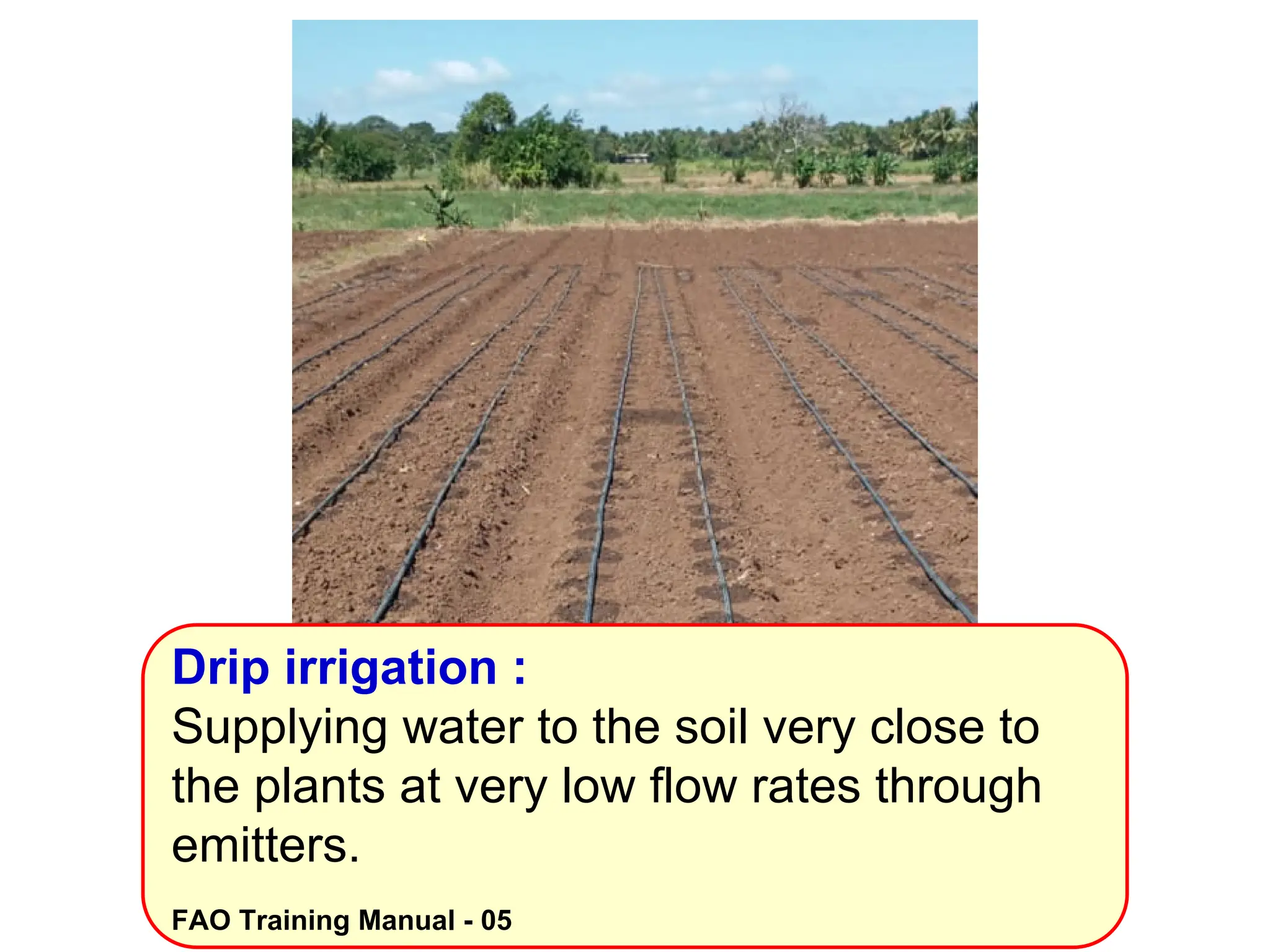
Drip irrigation :
Supplying water to the soil very close to
the plants at very low flow rates through
emitters.
FAO Training Manual - 05
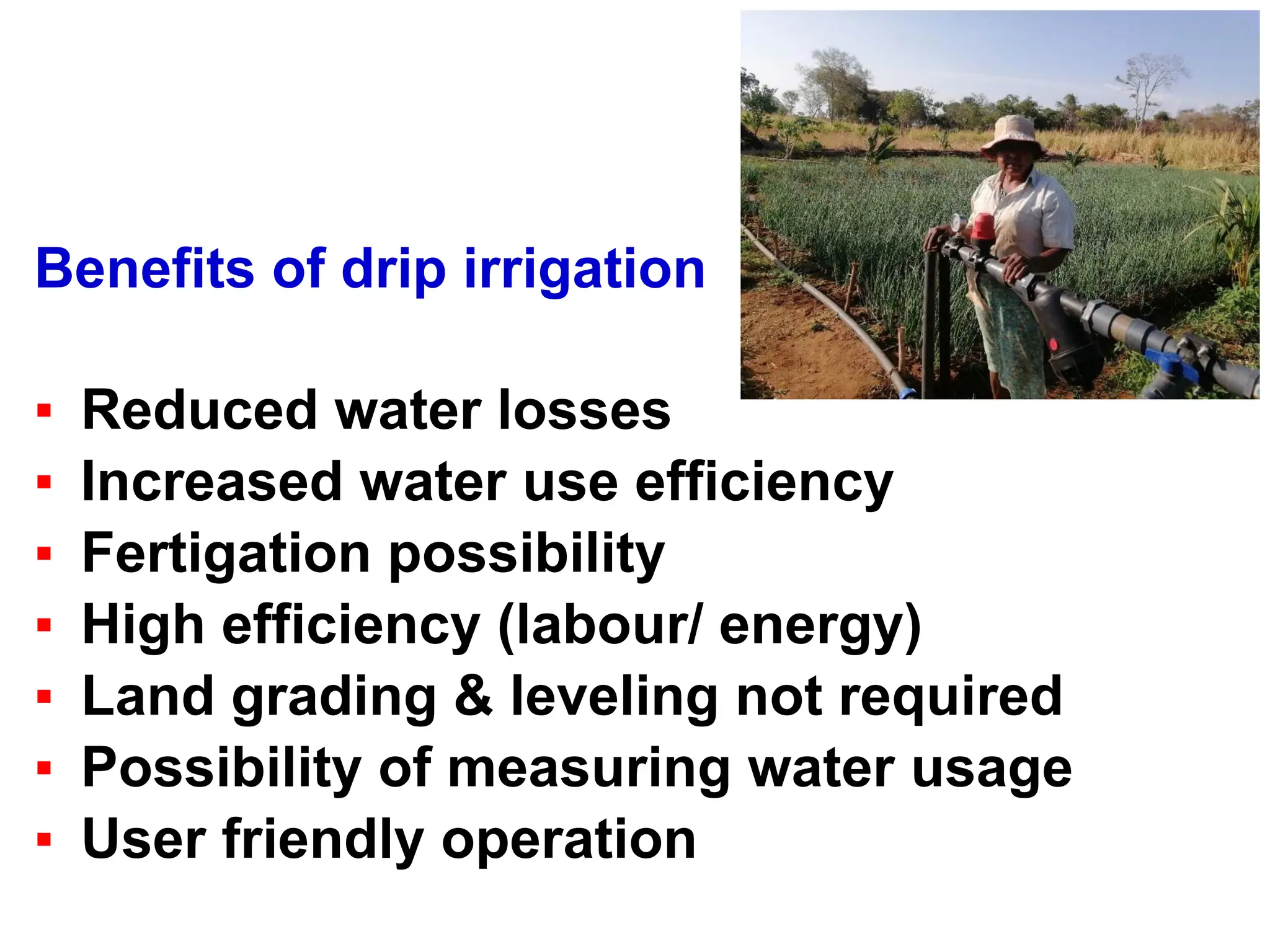
Benefits of drip irrigation
▪ Reduced water losses
▪ Increased water use efficiency
▪ Fertigation possibility
▪ High efficiency (labour/ energy)
▪ Land grading & leveling not required
▪ Possibility of measuring water usage
▪ User friendly operation
Component
Efficiency (%)
Surface Sprinkler Drip
Conveyance
40-50 (canal)
60-70 (well)
100 100
Application 60-70 70-80 90
Overall 30-35 50-60 80-90
Irrigation efficiencies
Different types of drip/ trickle irrigation
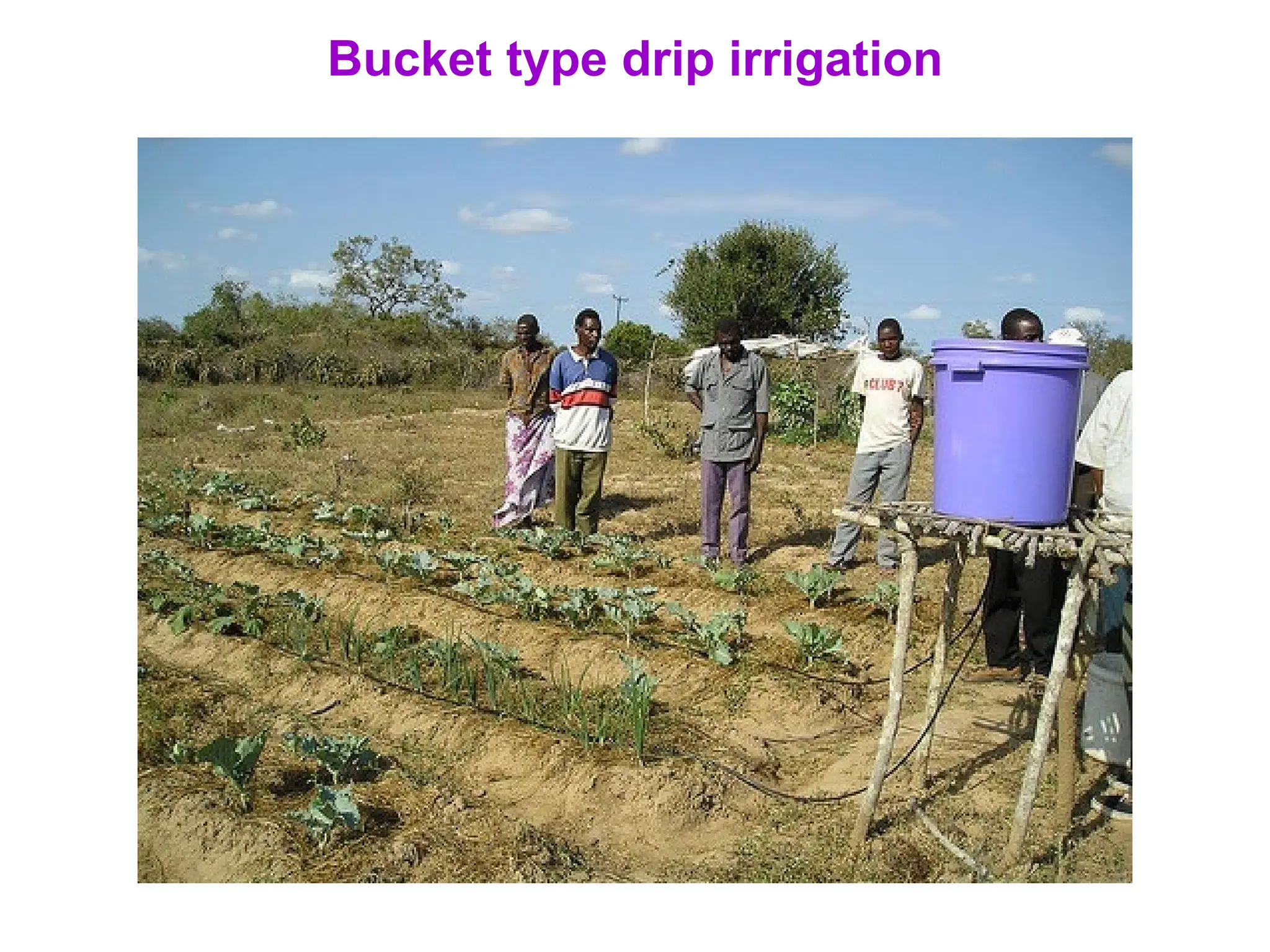
Bucket type drip irrigation
Low head drip irrigation
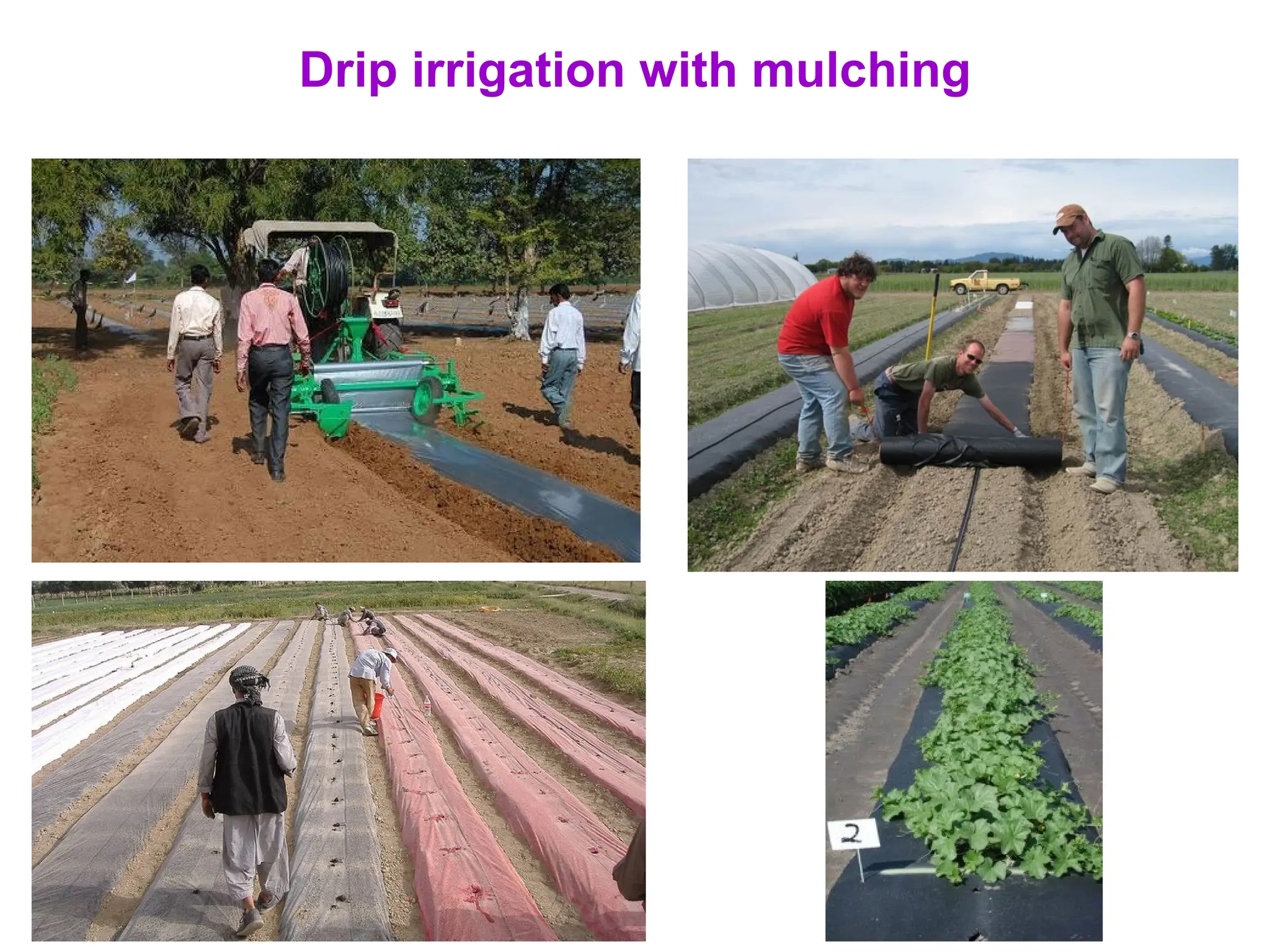
Drip irrigation with mulching
Drip irrigation under greenhouses
Drip irrigation under protected plant houses
Automatic irrigation with fertigation
Components of a typical drip irrigation system
▪ Water source
▪ Water pump
▪ Head controlling unit -
Filter/ Fertigation unit/ Air relief valve/ Pressure gauge/ Controlling
valves
▪ Field irrigation system
Drip tapes
▪ Lower cost
▪ Lesser durability
▪ Fixed emitter spacing
Polyethylene tubes with Inline emitters
▪ Fixed emitter spacing
▪ Higher durability compared to the drip tapes
Polyethylene tubes with
Online emitting devices
▪ Customized emitter spacing
▪ Replaceable
Technology Development
Inline drippers Inline NPC drippers Inline PC drippers
Online drippers Online NPC drippers Online PC drippers
Online PC
Self Flushing
drippers
▪ Suitable for potted plants
Stake drippers
Other localized irrigation types
Bubblers
▪ Discharge - Approx. 25 - 40 LPH
▪ Suitable for orchard crops
Spray - jets
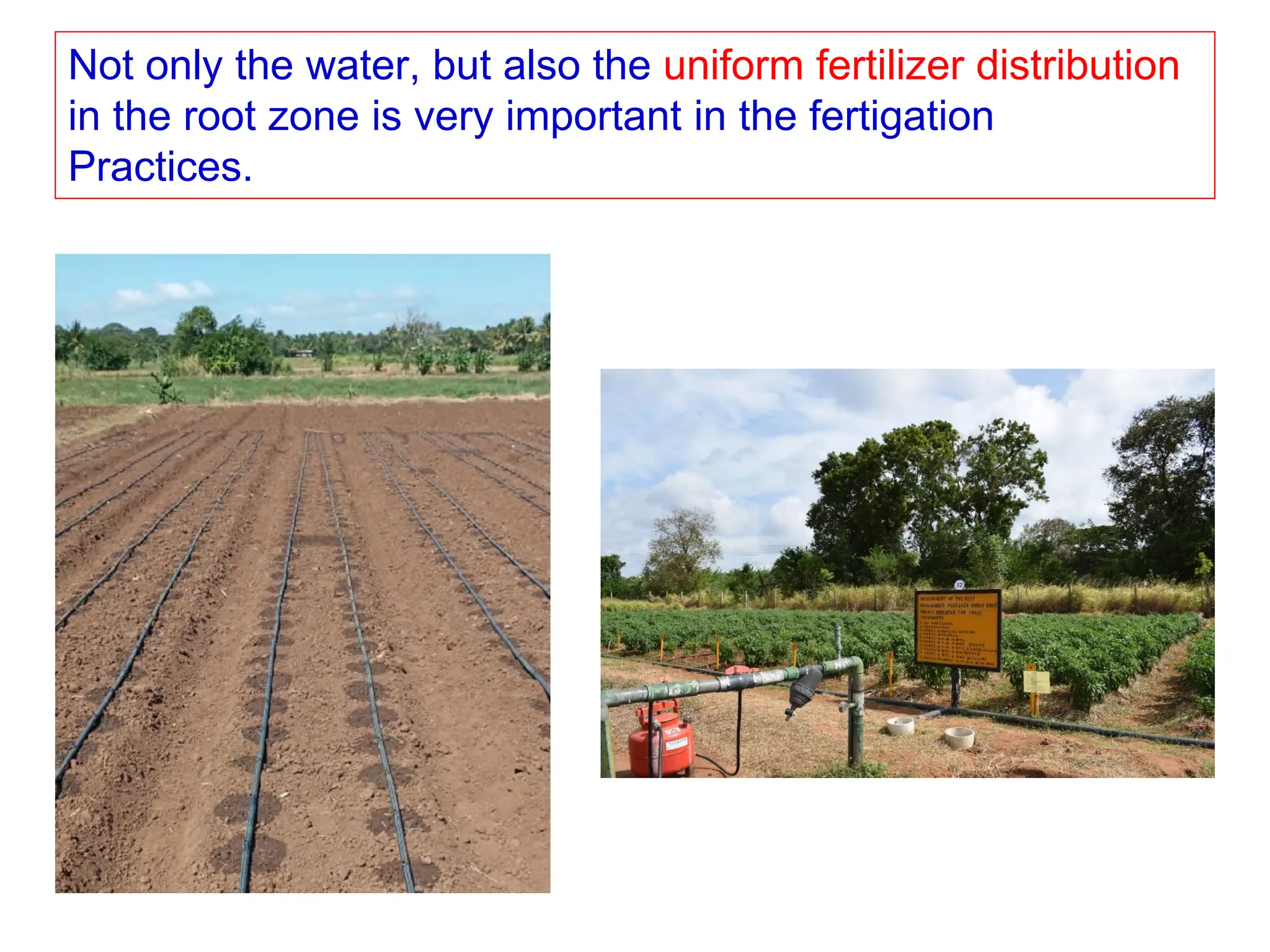
Not only the water, but also the uniform fertilizer distribution
in the root zone is very important in the fertigation
Practices.
Selecting the appropriate emitter type
A
B
C
0.2 bar 0.6 bar 1.0 bar
Source:
Drip
Research
Technology
Solutions
(DRTS)
PC: Pressure
compensated
Non-PC: Non pressure
compensated
PCND: Pressure
compensated non
drained
Water distribution in different soil types
under drip irrigation
Ideal
distribution pattern
Designing an appropriate layout for a drip system
- Clay soils
Planting bed
Designing an appropriate layout for a drip system
- Excessively well drained soils
Planting bed
Accessories for
the drip irrigation systems
Disk filters
▪ More efficient in filtration
▪ Suitable for small scale drip irrigation
Filters
Screen filters
▪ A commonly used filter type
▪ Suitable for small scale sprinkler irrigation systems
Sand media filters
Hydro cyclone flirters
▪ Suitable for large scale irrigation systems
Fertilizer tanks Fertigation equipments
▪ Higher durability
▪ Suitable for large scale irrigation systems
Venturi injectors
▪ Suitable for small scale
irrigation systems
Ball valves
Valve
s
▪ Release trapped air in the system
▪ Control water flow
Air release valves
Control valves
Other fittings
Maintenance of the
drip irrigation systems
Water source :
Agro-well
▪ Water quality
▪ Runoff blocking
▪ Cement lining
▪ Covering with nets
▪ Cleaning
Water class
Electrical
conductivity
(dS/ m)
Salt
concentration
(mg/ l)
Type of water
Non-saline < 0.7 < 500 Drinking and irrigation water
Slightly saline 0.7 - 2 500 - 1500 Irrigation water
Moderately saline 2 - 10 1500 - 7000
Primary drainage water and
groundwater
Highly saline 10 - 25 7000 - 15 000
Secondary drainage water
and groundwater
Very highly saline 25 - 45 15 000 - 35 000 Very saline groundwater
Brine > 45 > 45 000 Seawater
Source: FAO Irrigation and drainage paper - 48
Water quality
▪ Filter cleaning
▪ Emitter cleaning
- Physically
- Chemically
- Acids - For salts (Phosphoric acid)
- Chlorination - For algae
▪ Flushing the pipes
▪ Storage in off season
▪ Security - Rodents/ Dogs
Other maintenance
Component
Head requirement
Bar Feet
Minimum inlet pressure 0.50 16.5
Average depth of the water table commonly observed in the
shallow wells in Sri Lanka (15 - 20 feet)
0.60 20.0
Average vertical elevation differences from the surface level of
the shallow well and the field level
0.30 10.0
For the disk filter and the venturi system in the drip system 0.30 10.0
Average head losses in the pipe system (around 50 m long) 0.15 5.0
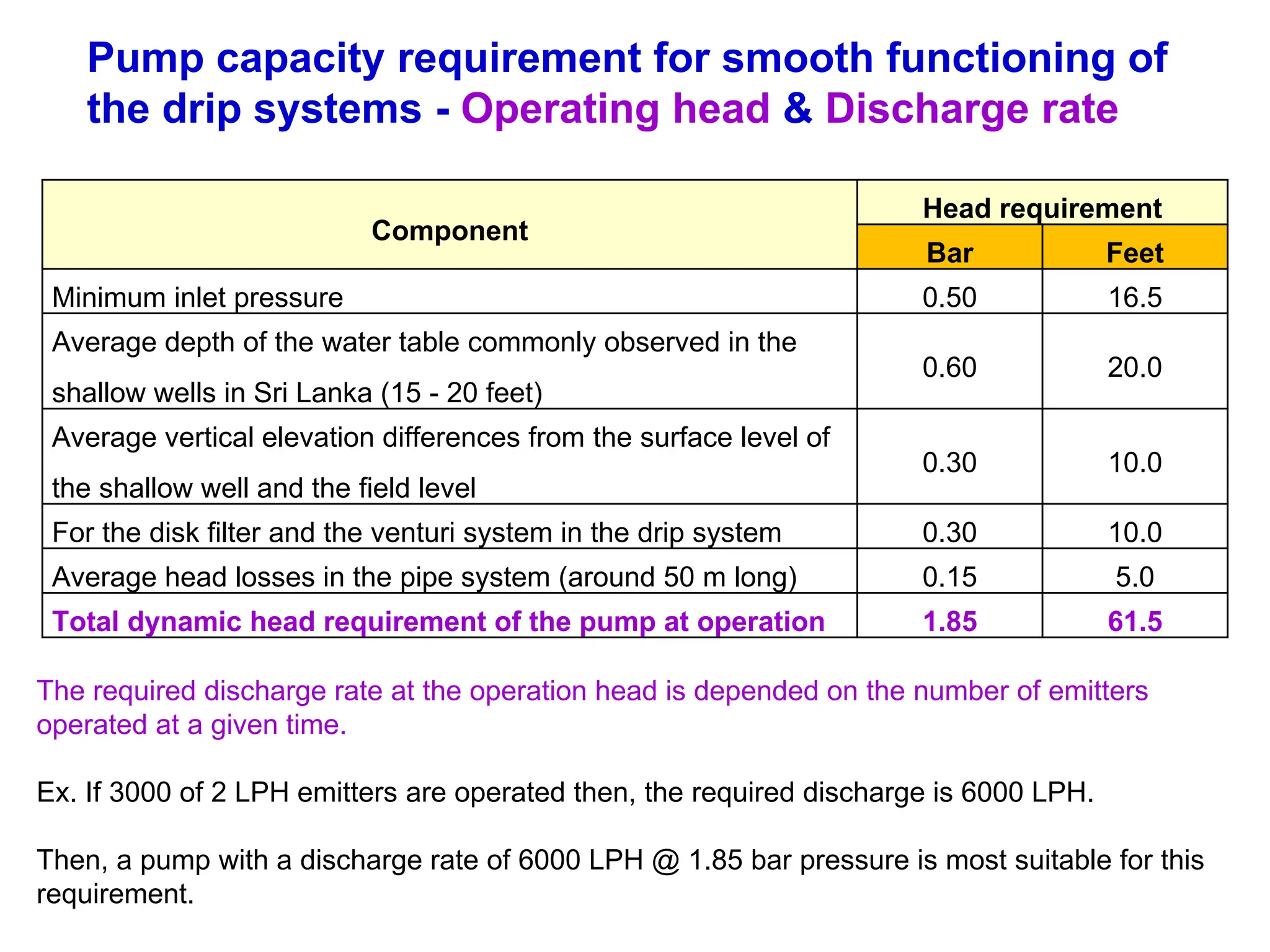
Total dynamic head requirement of the pump at operation 1.85 61.5
Pump capacity requirement for smooth functioning of
the drip systems - Operating head & Discharge rate
The required discharge rate at the operation head is depended on the number of emitters
operated at a given time.
Ex. If 3000 of 2 LPH emitters are operated then, the required discharge is 6000 LPH.
Then, a pump with a discharge rate of 6000 LPH @ 1.85 bar pressure is most suitable for this
requirement.
Drip irrigation based
crop management packages
-
Experiences in Sri Lanka
Realizable potential yields of crops
Farmer average yields of crops
Agronomic
best
management
packages
While
conserving
natural
resources -
soil
water
Challenge
Increased crop productivity of crops
Fertigation
Split
application
of fertilizer
Micro
nutrients
Components of micro irrigation system based
agronomic management packages
Mulching
Raised beds
Micro irrigation - Drip systems
High yielding
varieties
Organic
matter
Agronomic
management
package for chilli
under drip irrigation
▪ Yields - Around 45 t/ ha of green chilli from hybrids
▪ Water productivity - 50 % increase compared to surface irrig.
▪ Labour saving - Irrigation and Weeding
▪ Energy saving in irrigation
Package
▪ Drip irrigation
▪ Cattle manure - 15 t/ ha
▪ Straw mulching - 5 t/ ha
▪ Split application of
fertilizer through
fertigation
Smartness in agriculture
Drip based
management
package
Water smart √
Energy smart √
Carbon smart √
Nitrogen/ Nutrient smart √
Weather smart √
Knowledge smart √
Smart Agriculture technologies/ practices
Case study -
Drip irrigation based chilli cultivation package
Area: Anuradhapura
Pick
number
Yield
(kg)
Price
(LKR)/ Kg
Income
(LKR)
1st 248 360 89280
2nd 621 380 235,980
3rd 583 450 262,350
4th 256 280 71,680
5th 378 400 151,200
6th 540 320 172,800
7th 320 260 83,200
8th 380 550 209,000
9th 365 500 182,500
10th 450 460 207,000
11th 320 550 176,000
12th 300 850 255,000
13th 270 830 224,100
14th 210 760 159,600
15th 180 700 126,000
16th 90 800 72,000
Total 5,511 - 2,677,690 USD 1 = LKR 300
Unit area: 0.25 ac
Yields and the income
Component LKR
Total cost 665,500.00
Total income 2,677,690.00
Profit 2,012,190.00
Profit with the
depreciated cost for the
drip system*
2,282,190.00
* The drip system will be used for 10 seasons
and thus the cost of the drip system per
season is LKR 30,000.00
Costs - Benefits
USD 1 = LKR 300
Yield (t/ ha) - 11 months
(35 - 40 picks)
Max. Min. Average
65 30 45
Agriculture Sector Modernization Project
- ASMP
Smallholder Agribusiness Partnership
Programme - SAPP
Average yield :
50 - 60 t/ ha
Agronomic
management
packages for onion
under drip irrigation
▪ Yields - Around 40 t/ ha
▪ Water productivity - 50 % increase compared to surface irrig.
▪ Labour saving - Irrigation and Weeding
▪ Energy saving in irrigation
Package
▪ Drip irrigation
▪ Cattle manure - 15 t/ ha
▪ Straw mulching - 5 t/ ha
▪ Split application of
fertilizer through
fertigation
Farmer adoption -
▪ Interprovincial Agriculture Extension Service
▪ Provincial Department of Agriculture - Central
Province
▪ Mahaweli Authority of Sri Lanka
▪ Agriculture Sector Modernization Project
Yala 2021 - Yala
2023
• Majority of farmers obtained - > 30 t/ ha yields
• Some have achieved - 40 t/ ha
• Average profits - > LKR 300 000/ 0.25 ac.
• Some have obtained - > LKR 500 000/ 0.25 ac.
Programme Unit area (ac.) Number
Demonstrations 0.25 28
ASMP 0.25 50
Sayubhagya 0.25 259
Sayubhagya 0.5 38
Total 375
USD 1 = LKR 300
Big onion true seed production under drip irrigation
Other crops grown -
▪ Cabbage
▪ Radish
▪ Capsicum
▪ Tomato
▪ Beet
▪ Knol khol
▪ Chilli
Private sector involvement
Keels Pvt. Ltd./ Cargills Pvt. Ltd.
20 different types of crops
Further developments
Water pump
Controlling unit
Soil moisture sensors
Irrigation system - Crop
Automated irrigated systems
Solar power for irrigation - Sustainable green energy
in agriculture
Factors to be considered -
▪ Capacity - Head/ Discharge
▪ Durability
▪ Efficiency -
• Operating under low light intensity
(DC/ Brushless)
Usage of the micro irrigation in the region
FAO Waters Reports - 37
Irrigation in Southern and East Asia in Figures - 2011
Technology dissemination strategies
▪ Field demonstrations
▪ Visits on successful farm fields
▪ Video/ Audio programmes (TV/ Radio/ You
Tube)
▪ Social media (FB/ WhatsApp groups)
▪ Leaflets/ Booklets
▪ Street drama
▪ Individual meetings with farmers
▪ Hands on training
Thank You

Drip Irrigation - Climate Smart Agriculture

  • 1.
    Drip Irrigation Technology inCrop Production Chamila Perera Assistant Director of Agriculture (Research) - Soil and Water Management Field Crops Research and Development Institute - Sri Lanka
  • 2.
    Content ▪ Importance ofdrip irrigation ▪ Different types of drip irrigation ▪ Components of drip irrigation systems ▪ Maintenance of drip systems ▪ Drip irrigation based crop management packages ▪ Further developments ▪ Technology dissemination
  • 3.
    Irrigation has thepotential to provide higher yields than rainfed agriculture. Source: FAO publications on water management Impact of irrigation on crop productivity
  • 4.
    Drip irrigation : Supplyingwater to the soil very close to the plants at very low flow rates through emitters. FAO Training Manual - 05
  • 5.
    Benefits of dripirrigation ▪ Reduced water losses ▪ Increased water use efficiency ▪ Fertigation possibility ▪ High efficiency (labour/ energy) ▪ Land grading & leveling not required ▪ Possibility of measuring water usage ▪ User friendly operation
  • 6.
    Component Efficiency (%) Surface SprinklerDrip Conveyance 40-50 (canal) 60-70 (well) 100 100 Application 60-70 70-80 90 Overall 30-35 50-60 80-90 Irrigation efficiencies
  • 7.
    Different types ofdrip/ trickle irrigation
  • 8.
    Bucket type dripirrigation
  • 9.
    Low head dripirrigation
  • 10.
  • 11.
  • 12.
    Drip irrigation underprotected plant houses
  • 13.
  • 14.
    Components of atypical drip irrigation system ▪ Water source ▪ Water pump ▪ Head controlling unit - Filter/ Fertigation unit/ Air relief valve/ Pressure gauge/ Controlling valves ▪ Field irrigation system
  • 15.
    Drip tapes ▪ Lowercost ▪ Lesser durability ▪ Fixed emitter spacing
  • 16.
    Polyethylene tubes withInline emitters ▪ Fixed emitter spacing ▪ Higher durability compared to the drip tapes
  • 17.
    Polyethylene tubes with Onlineemitting devices ▪ Customized emitter spacing ▪ Replaceable
  • 18.
    Technology Development Inline drippersInline NPC drippers Inline PC drippers Online drippers Online NPC drippers Online PC drippers Online PC Self Flushing drippers
  • 19.
    ▪ Suitable forpotted plants Stake drippers
  • 20.
  • 21.
    Bubblers ▪ Discharge -Approx. 25 - 40 LPH ▪ Suitable for orchard crops
  • 22.
  • 23.
    Not only thewater, but also the uniform fertilizer distribution in the root zone is very important in the fertigation Practices.
  • 24.
    Selecting the appropriateemitter type A B C 0.2 bar 0.6 bar 1.0 bar Source: Drip Research Technology Solutions (DRTS) PC: Pressure compensated Non-PC: Non pressure compensated PCND: Pressure compensated non drained
  • 25.
    Water distribution indifferent soil types under drip irrigation Ideal distribution pattern
  • 26.
    Designing an appropriatelayout for a drip system - Clay soils Planting bed
  • 27.
    Designing an appropriatelayout for a drip system - Excessively well drained soils Planting bed
  • 28.
    Accessories for the dripirrigation systems
  • 29.
    Disk filters ▪ Moreefficient in filtration ▪ Suitable for small scale drip irrigation Filters
  • 30.
    Screen filters ▪ Acommonly used filter type ▪ Suitable for small scale sprinkler irrigation systems
  • 31.
    Sand media filters Hydrocyclone flirters ▪ Suitable for large scale irrigation systems
  • 32.
    Fertilizer tanks Fertigationequipments ▪ Higher durability ▪ Suitable for large scale irrigation systems
  • 33.
    Venturi injectors ▪ Suitablefor small scale irrigation systems
  • 34.
    Ball valves Valve s ▪ Releasetrapped air in the system ▪ Control water flow Air release valves Control valves
  • 35.
  • 36.
    Maintenance of the dripirrigation systems
  • 37.
    Water source : Agro-well ▪Water quality ▪ Runoff blocking ▪ Cement lining ▪ Covering with nets ▪ Cleaning
  • 38.
    Water class Electrical conductivity (dS/ m) Salt concentration (mg/l) Type of water Non-saline < 0.7 < 500 Drinking and irrigation water Slightly saline 0.7 - 2 500 - 1500 Irrigation water Moderately saline 2 - 10 1500 - 7000 Primary drainage water and groundwater Highly saline 10 - 25 7000 - 15 000 Secondary drainage water and groundwater Very highly saline 25 - 45 15 000 - 35 000 Very saline groundwater Brine > 45 > 45 000 Seawater Source: FAO Irrigation and drainage paper - 48 Water quality
  • 39.
    ▪ Filter cleaning ▪Emitter cleaning - Physically - Chemically - Acids - For salts (Phosphoric acid) - Chlorination - For algae ▪ Flushing the pipes ▪ Storage in off season ▪ Security - Rodents/ Dogs Other maintenance
  • 40.
    Component Head requirement Bar Feet Minimuminlet pressure 0.50 16.5 Average depth of the water table commonly observed in the shallow wells in Sri Lanka (15 - 20 feet) 0.60 20.0 Average vertical elevation differences from the surface level of the shallow well and the field level 0.30 10.0 For the disk filter and the venturi system in the drip system 0.30 10.0 Average head losses in the pipe system (around 50 m long) 0.15 5.0 Total dynamic head requirement of the pump at operation 1.85 61.5 Pump capacity requirement for smooth functioning of the drip systems - Operating head & Discharge rate The required discharge rate at the operation head is depended on the number of emitters operated at a given time. Ex. If 3000 of 2 LPH emitters are operated then, the required discharge is 6000 LPH. Then, a pump with a discharge rate of 6000 LPH @ 1.85 bar pressure is most suitable for this requirement.
  • 41.
    Drip irrigation based cropmanagement packages - Experiences in Sri Lanka
  • 42.
    Realizable potential yieldsof crops Farmer average yields of crops Agronomic best management packages While conserving natural resources - soil water Challenge
  • 43.
    Increased crop productivityof crops Fertigation Split application of fertilizer Micro nutrients Components of micro irrigation system based agronomic management packages Mulching Raised beds Micro irrigation - Drip systems High yielding varieties Organic matter
  • 44.
    Agronomic management package for chilli underdrip irrigation ▪ Yields - Around 45 t/ ha of green chilli from hybrids ▪ Water productivity - 50 % increase compared to surface irrig. ▪ Labour saving - Irrigation and Weeding ▪ Energy saving in irrigation Package ▪ Drip irrigation ▪ Cattle manure - 15 t/ ha ▪ Straw mulching - 5 t/ ha ▪ Split application of fertilizer through fertigation
  • 45.
    Smartness in agriculture Dripbased management package Water smart √ Energy smart √ Carbon smart √ Nitrogen/ Nutrient smart √ Weather smart √ Knowledge smart √ Smart Agriculture technologies/ practices
  • 46.
    Case study - Dripirrigation based chilli cultivation package Area: Anuradhapura
  • 47.
    Pick number Yield (kg) Price (LKR)/ Kg Income (LKR) 1st 248360 89280 2nd 621 380 235,980 3rd 583 450 262,350 4th 256 280 71,680 5th 378 400 151,200 6th 540 320 172,800 7th 320 260 83,200 8th 380 550 209,000 9th 365 500 182,500 10th 450 460 207,000 11th 320 550 176,000 12th 300 850 255,000 13th 270 830 224,100 14th 210 760 159,600 15th 180 700 126,000 16th 90 800 72,000 Total 5,511 - 2,677,690 USD 1 = LKR 300 Unit area: 0.25 ac Yields and the income
  • 48.
    Component LKR Total cost665,500.00 Total income 2,677,690.00 Profit 2,012,190.00 Profit with the depreciated cost for the drip system* 2,282,190.00 * The drip system will be used for 10 seasons and thus the cost of the drip system per season is LKR 30,000.00 Costs - Benefits USD 1 = LKR 300
  • 49.
    Yield (t/ ha)- 11 months (35 - 40 picks) Max. Min. Average 65 30 45 Agriculture Sector Modernization Project - ASMP
  • 50.
    Smallholder Agribusiness Partnership Programme- SAPP Average yield : 50 - 60 t/ ha
  • 51.
    Agronomic management packages for onion underdrip irrigation ▪ Yields - Around 40 t/ ha ▪ Water productivity - 50 % increase compared to surface irrig. ▪ Labour saving - Irrigation and Weeding ▪ Energy saving in irrigation Package ▪ Drip irrigation ▪ Cattle manure - 15 t/ ha ▪ Straw mulching - 5 t/ ha ▪ Split application of fertilizer through fertigation
  • 52.
    Farmer adoption - ▪Interprovincial Agriculture Extension Service ▪ Provincial Department of Agriculture - Central Province ▪ Mahaweli Authority of Sri Lanka ▪ Agriculture Sector Modernization Project
  • 53.
    Yala 2021 -Yala 2023 • Majority of farmers obtained - > 30 t/ ha yields • Some have achieved - 40 t/ ha • Average profits - > LKR 300 000/ 0.25 ac. • Some have obtained - > LKR 500 000/ 0.25 ac. Programme Unit area (ac.) Number Demonstrations 0.25 28 ASMP 0.25 50 Sayubhagya 0.25 259 Sayubhagya 0.5 38 Total 375 USD 1 = LKR 300
  • 54.
    Big onion trueseed production under drip irrigation
  • 55.
    Other crops grown- ▪ Cabbage ▪ Radish ▪ Capsicum ▪ Tomato ▪ Beet ▪ Knol khol ▪ Chilli
  • 56.
    Private sector involvement KeelsPvt. Ltd./ Cargills Pvt. Ltd. 20 different types of crops
  • 57.
  • 58.
    Water pump Controlling unit Soilmoisture sensors Irrigation system - Crop Automated irrigated systems
  • 59.
    Solar power forirrigation - Sustainable green energy in agriculture Factors to be considered - ▪ Capacity - Head/ Discharge ▪ Durability ▪ Efficiency - • Operating under low light intensity (DC/ Brushless)
  • 60.
    Usage of themicro irrigation in the region FAO Waters Reports - 37 Irrigation in Southern and East Asia in Figures - 2011
  • 61.
    Technology dissemination strategies ▪Field demonstrations ▪ Visits on successful farm fields ▪ Video/ Audio programmes (TV/ Radio/ You Tube) ▪ Social media (FB/ WhatsApp groups) ▪ Leaflets/ Booklets ▪ Street drama ▪ Individual meetings with farmers ▪ Hands on training
  • 62.