Data Analysis, Statistics, 
and Probability Review 
The SAT doesn’t include 
computation of standard deviation
Data Interpretation 
• interpret information in graphs, tables, or 
charts 
• then compare quantities, recognize trends 
and changes in the data 
• perform calculations based on the 
information you have found
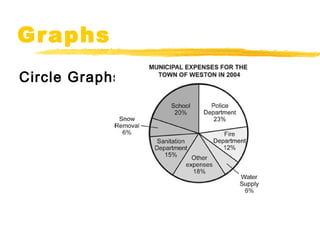
Graphs 
Circle Graphs
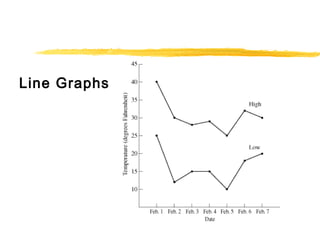
Line Graphs
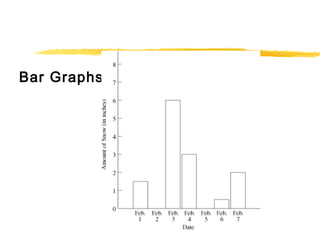
Bar Graphs
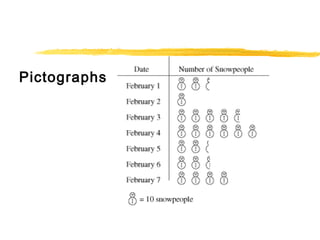
Pictographs
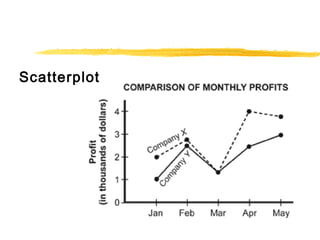
Scatterplot
Data Interpretation 
Questions 
When working with data interpretation questions: 
• Look at the graph, table, or chart to make sure 
you understand it. 
• Make sure you know what type of information is 
being displayed. 
• Read the labels. 
• Make sure you know the units. 
• Make sure you understand what is happening to 
the data as you move through the table, graph, 
or chart. 
• Read the question carefully.
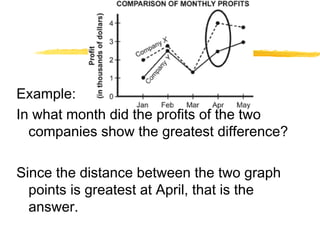
Example: 
In what month did the profits of the two 
companies show the greatest difference? 
Since the distance between the two graph 
points is greatest at April, that is the 
answer.
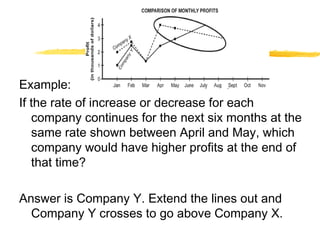
Example: 
If the rate of increase or decrease for each 
company continues for the next six months at the 
same rate shown between April and May, which 
company would have higher profits at the end of 
that time? 
Answer is Company Y. Extend the lines out and 
Company Y crosses to go above Company X.
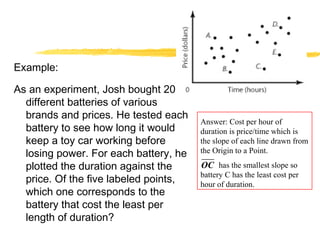
Example: 
As an experiment, Josh bought 20 
different batteries of various 
brands and prices. He tested each 
battery to see how long it would 
keep a toy car working before 
losing power. For each battery, he 
plotted the duration against the 
price. Of the five labeled points, 
which one corresponds to the 
battery that cost the least per 
length of duration? 
Answer: Cost per hour of 
duration is price/time which is 
the slope of each line drawn from 
the Origin to a Point. 
has the smallest slope so 
OC 
battery C has the least cost per 
hour of duration.
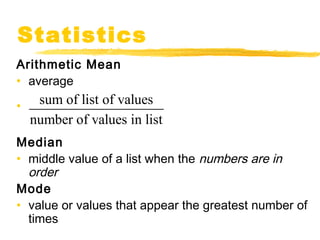
Statistics 
Arithmetic Mean 
• average 
• 
sum of list of values 
number of values in list 
Median 
• middle value of a list when the numbers are in 
order 
Mode 
• value or values that appear the greatest number of 
times
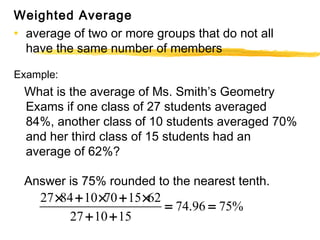
Weighted Average 
• average of two or more groups that do not all 
have the same number of members 
Example: 
What is the average of Ms. Smith’s Geometry 
Exams if one class of 27 students averaged 
84%, another class of 10 students averaged 70% 
and her third class of 15 students had an 
average of 62%? 
Answer is 75% rounded to the nearest tenth. 
´ + ´ + ´ = = 
27 84 10 70 15 62 74.96 75% 
+ + 
27 10 15
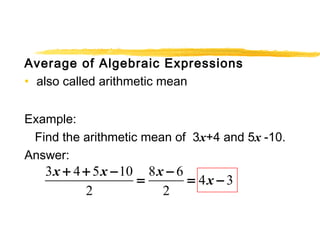
Average of Algebraic Expressions 
• also called arithmetic mean 
Example: 
Find the arithmetic mean of 3x+4 and 5x -10. 
Answer: 
x + + x - = x - = x - 
3 4 5 10 8 6 4 3 
2 2
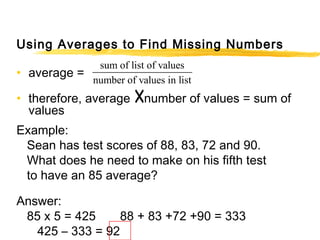
Using Averages to Find Missing Numbers 
• average = 
sum of list of values 
number of • therefore, average ´ 
values in list number of values = sum of 
values 
Example: 
Sean has test scores of 88, 83, 72 and 90. 
What does he need to make on his fifth test 
to have an 85 average? 
Answer: 
85 x 5 = 425 88 + 83 +72 +90 = 333 
425 – 333 = 92
Probability 
Probability of Event 
• number between 0 and 1, inclusive 
• if an event is certain, it has probability 1 
• if an event is impossible, it has probability 0 
Independent Events 
• the outcome of either event has no effect on the 
other 
• to find the probability of two or more independent 
events occurring together, multiply the 
probabilities of the individual events
Dependent Events 
• the outcome of one event affects the 
probability of another event 
• use logical reasoning to help figure out 
probabilities involving dependent events
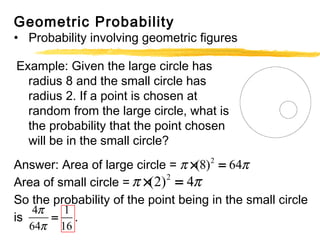
Geometric Probability 
• Probability involving geometric figures 
Example: Given the large circle has 
radius 8 and the small circle has 
radius 2. If a point is chosen at 
random from the large circle, what is 
the probability that the point chosen 
will be in the small circle? 
p ´(8)2 = 64p 
Answer: Area of large circle = 
Area of small circle = 
p ´(2)2 = 4p 
So the probability of the point being in the small circle 
is . 
p 
p 
4 = 
1 
64 16
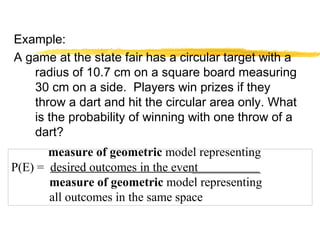
Example: 
A game at the state fair has a circular target with a 
radius of 10.7 cm on a square board measuring 
30 cm on a side. Players win prizes if they 
throw a dart and hit the circular area only. What 
is the probability of winning with one throw of a 
dart? 
measure of geometric model representing 
P(E) = desired outcomes in the event 
measure of geometric model representing 
all outcomes in the same space
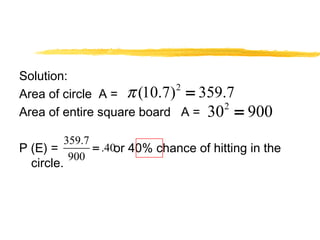
Solution: 
Area of circle A = 
Area of entire square board A = 
p (10.7)2 = 359.7 
302 = 900 
359.7 .40 
900 
P (E) = = 
or 40% chance of hitting in the 
circle.

Data analysis, statistics, and probability review

  • 1.
    Data Analysis, Statistics, and Probability Review The SAT doesn’t include computation of standard deviation
  • 2.
    Data Interpretation •interpret information in graphs, tables, or charts • then compare quantities, recognize trends and changes in the data • perform calculations based on the information you have found
  • 3.
  • 4.
  • 5.
  • 6.
  • 7.
  • 8.
    Data Interpretation Questions When working with data interpretation questions: • Look at the graph, table, or chart to make sure you understand it. • Make sure you know what type of information is being displayed. • Read the labels. • Make sure you know the units. • Make sure you understand what is happening to the data as you move through the table, graph, or chart. • Read the question carefully.
  • 9.
    Example: In whatmonth did the profits of the two companies show the greatest difference? Since the distance between the two graph points is greatest at April, that is the answer.
  • 10.
    Example: If therate of increase or decrease for each company continues for the next six months at the same rate shown between April and May, which company would have higher profits at the end of that time? Answer is Company Y. Extend the lines out and Company Y crosses to go above Company X.
  • 11.
    Example: As anexperiment, Josh bought 20 different batteries of various brands and prices. He tested each battery to see how long it would keep a toy car working before losing power. For each battery, he plotted the duration against the price. Of the five labeled points, which one corresponds to the battery that cost the least per length of duration? Answer: Cost per hour of duration is price/time which is the slope of each line drawn from the Origin to a Point. has the smallest slope so OC battery C has the least cost per hour of duration.
  • 12.
    Statistics Arithmetic Mean • average • sum of list of values number of values in list Median • middle value of a list when the numbers are in order Mode • value or values that appear the greatest number of times
  • 13.
    Weighted Average •average of two or more groups that do not all have the same number of members Example: What is the average of Ms. Smith’s Geometry Exams if one class of 27 students averaged 84%, another class of 10 students averaged 70% and her third class of 15 students had an average of 62%? Answer is 75% rounded to the nearest tenth. ´ + ´ + ´ = = 27 84 10 70 15 62 74.96 75% + + 27 10 15
  • 14.
    Average of AlgebraicExpressions • also called arithmetic mean Example: Find the arithmetic mean of 3x+4 and 5x -10. Answer: x + + x - = x - = x - 3 4 5 10 8 6 4 3 2 2
  • 15.
    Using Averages toFind Missing Numbers • average = sum of list of values number of • therefore, average ´ values in list number of values = sum of values Example: Sean has test scores of 88, 83, 72 and 90. What does he need to make on his fifth test to have an 85 average? Answer: 85 x 5 = 425 88 + 83 +72 +90 = 333 425 – 333 = 92
  • 16.
    Probability Probability ofEvent • number between 0 and 1, inclusive • if an event is certain, it has probability 1 • if an event is impossible, it has probability 0 Independent Events • the outcome of either event has no effect on the other • to find the probability of two or more independent events occurring together, multiply the probabilities of the individual events
  • 17.
    Dependent Events •the outcome of one event affects the probability of another event • use logical reasoning to help figure out probabilities involving dependent events
  • 18.
    Geometric Probability •Probability involving geometric figures Example: Given the large circle has radius 8 and the small circle has radius 2. If a point is chosen at random from the large circle, what is the probability that the point chosen will be in the small circle? p ´(8)2 = 64p Answer: Area of large circle = Area of small circle = p ´(2)2 = 4p So the probability of the point being in the small circle is . p p 4 = 1 64 16
  • 19.
    Example: A gameat the state fair has a circular target with a radius of 10.7 cm on a square board measuring 30 cm on a side. Players win prizes if they throw a dart and hit the circular area only. What is the probability of winning with one throw of a dart? measure of geometric model representing P(E) = desired outcomes in the event measure of geometric model representing all outcomes in the same space
  • 20.
    Solution: Area ofcircle A = Area of entire square board A = p (10.7)2 = 359.7 302 = 900 359.7 .40 900 P (E) = = or 40% chance of hitting in the circle.