© 2015 IBM Corporation
IBM	
  Analy*cs	
  
IBM	
  Internet	
  of	
  Things	
  -­‐	
  Architecture	
  and	
  
Capabili*es	
  
Kevin	
  Brown	
  –	
  Informix	
  CTO,	
  IoT	
  Solu7ons	
  and	
  Services	
  
August	
  17,	
  2015	
  
Agenda
•  IoT Architectural Components Overview
•  Informix for the Intelligent Gateway
•  Informix for the Cloud
•  IoT Partners and Platforms
2
3
IoT Architectural Components
Overview
4
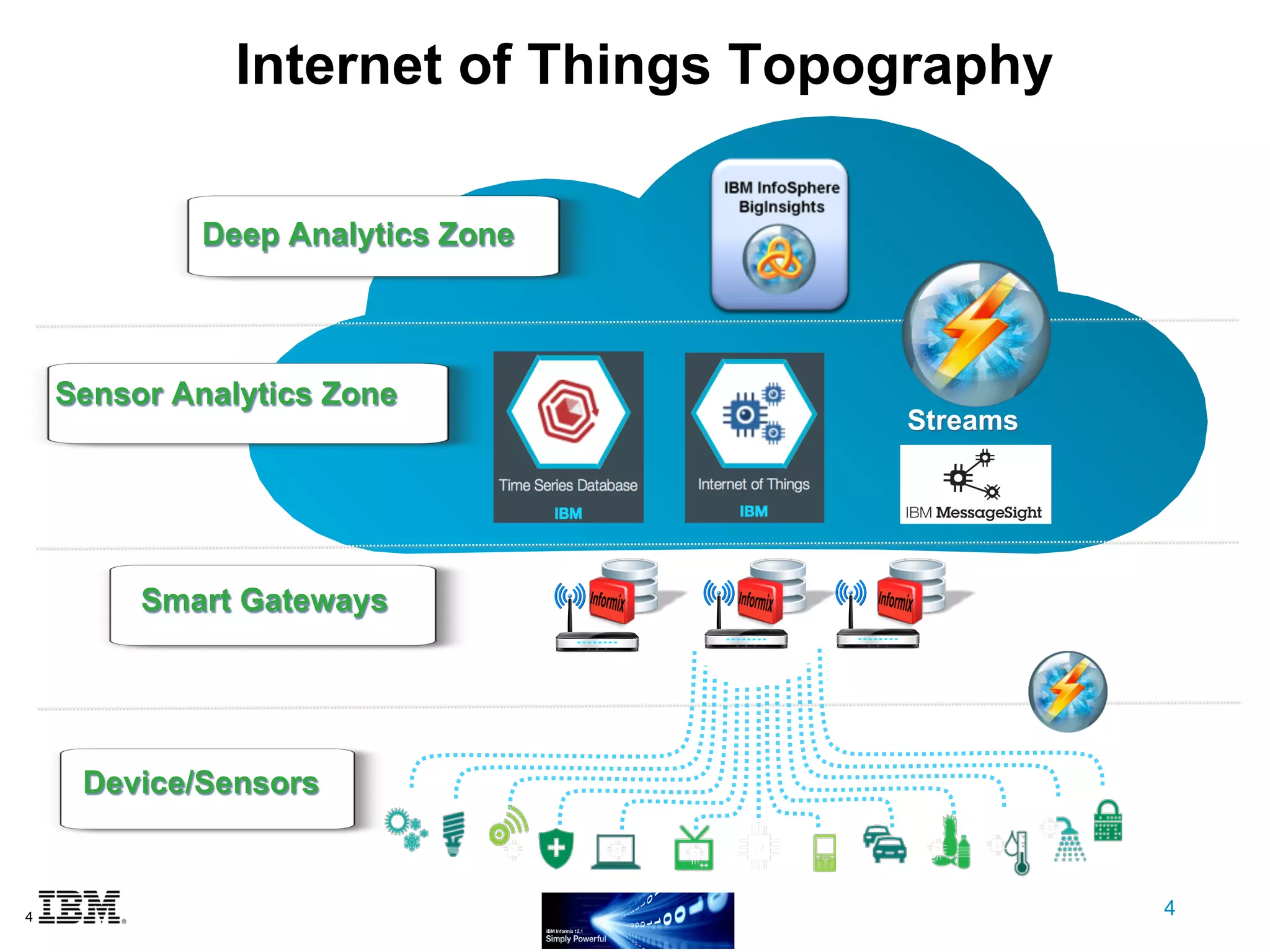
Internet of Things Topography
Streams
Deep Analytics Zone
Device/Sensors
Smart Gateways
Sensor Analytics Zone
4
Simplified IoT Data Flow
Sensor Data History
Sensors
In-memory Analytics
Predictive
Analytics
Publish /
Subscribe
Cloud
Infrastructure
Real-time Analytics
Real-time Analytics Operational Analytics
Big Data
Analytics
(no gateway)
(Gateways)
HDFS / Hadoop
Big Data
Analytics
MessageSight
/ MQTT
Gateways for
local analytics
InfoSphere
Streams
Informix / Cloudant /
IOT Foundation
Service / TimeSeries
Service
Informix Warehouse
Accelerator / DashDB
PMQ / SPSS /
Cognos
Softlayer / BluMix
Watson / DashDB /
BigSQL
Informix /
Node-Red
•  Gateways can reduce the cost of the backend cloud
•  Reduces cloud storage by filtering/aggregating/analyzing data locally
•  Reduces cloud CPU requirements by precomputing values
•  Reduces latency since actions can be taken immediately
•  Intelligent gateways can detect and respond to local events as they
happen rather than waiting for transfer to the cloud
•  Some users are not comfortable putting all their data in the cloud
•  Gateways allow customers to capture and get value from their sensors
without sending data to the cloud
•  Protocol Consolidation
•  Cloud does not need to implement the 100’s of IoT protocols
Over time more and more of the processing will move from the cloud
to gateway devices
How Do Gateways Help IoT Solutions?
6
What are the Requirements for a Gateway Database?
•  The database management system must:
▪  Have a small install footprint, less than 100 MB
▪  Run with low memory requirements – less than 256 MB
▪  Use lossless compression or other techniques to minimize
storage space
▪  Have built-in support for common types of IoT data like time series
and spatial/GIS data
▪  Simple application development supporting both NoSQL and SQL
▪  Driverless, easy access to the data
▪  Require absolutely no administration
▪  Ideally should be able to network multiple gateways together to
create a single distributed database
7
The database must be powerful enough to ingest, process and
analyze data in real-time
IBM Informix: The Ideal Database for Gateways
Simple to use
▪  Hands-Free operation – No administration
▪  Supports popular interfaces such as REST and Mongo as well
as ODBC/JDBC
▪  Handles SQL and JSON data in the same database
Performance
▪  One of a kind support for Time Series and Spatial data
▪  Stream data continuously into the database
▪  Run analytics as data arrives
▪  Dynamically add and update analytics when needed
▪  Storage is typically 1/3 the size compared to other vendors
Invisible
Agile
8
Informix is the only database management system
perfectly suited to run in Gateways
Sensor Data is Time Series Data
•  What is a Time Series?
▪  A logically connected set of records ordered by time
•  What are the Key Strengths of Informix TimeSeries?
▪  Much less space required
• Typically about 1/3 the space required by other vendors
▪  Queries run orders of magnitude faster
• Unique optimized storage means codes paths are shorter and more
data fits in memory
▪  Purpose built streaming data loader for sensor data
• Automatically run analytic and/or aggregate functions on new data
▪  Can store structured (SQL) or unstructured (JSON) data for quick
application development
• REST/ODBC/JDBC/JSON interfaces available
▪  100’s of functions predefined
• Programming APIs available to create your own analytics
9
Traditional Table Approach
Informix TimeSeries Approach
Meter_ID Time KWH Voltage ColN
1 1-1-11 12:00 Value 1 Value 2 ……… Value N
2 1-1-11 12:00 Value 1 Value 2 ……… Value N
3 1-1-11 12:00 Value 1 Value 2 ……… Value N
… … … … ……… …
1 1-1-11 12:15 Value 1 Value 2 ……… Value N
2 1-1-11 12:15 Value 1 Value 2 ……… Value N
3 1-1-11 12:15 Value 1 Value 2 ……… Value N
… … … … ……… …
Meter_ID Series
1 [(1-1-11 12:00, value 1, value 2,…, value N), (1-1-11 12:15, value 1, value 2, …, value N), …]
2 [(1-1-11 12:00, value 1, value 2,…, value N), (1-1-11 12:15, value 1, value 2, …, value N), …]
3 [(1-1-11 12:00, value 1, value 2,…, value N), (1-1-11 12:15, value 1, value 2, …, value N), …]
4 [(1-1-11 12:00, value 1, value 2,…, value N), (1-1-11 12:15, value 1, value 2, …, value N), …]
…
Traditional Sensor data storage vs Informix TimeSeries
Storage
10
IoT Requirements for SpatioTemporal Data
•  Many IoT applications have a spatial
component to them
▪  Vehicles, cell phones, even pets…
tracking is common
•  In these cases both location and
time is important
▪  Show me the vehicles that have
passed by location X in the last
hour
▪  Where has my car been over the last
few hours?
•  Informix allows you to combine Time
series and Spatial data in the same
query
11
12
Both Structured and Unstructured Data is
Common in IoT Environments
JSON
Collection
SQL Driver
NoSQL Driver
SQL Data
Join Data
•  Informix can store SQL and JSON data in the same database
•  Write programs using SQL drivers or Mongo/NoSQL drivers
•  SQL data automatically transformed into JSON documents when needed
•  NoSQL data automatically transformed into SQL when needed
Embedded Device
or Database
server
Horizontal
Scale-out
with Shards
Informix Data Access Options
13
MongoDB
Client
REST Client
SQLI Client
DRDA Client
Informix
DBMS
Informix NoSQL
Listener
Informix
•  NoSQL ↔ SQL Translation
•  REST, MongoDB Protocol
Support
•  SQLI, DRDA Protocol Support
•  Relational, Collection, Time
Series, and Spatial Data
Support
Spatial
Time Series
JSON Collection
Relational Table
A	
  REST	
  client	
  is	
  any	
  
program	
  capable	
  of	
  
making	
  a	
  HTTP	
  request	
  
Informix Data Access Options
14
MongoDB
Client
REST Client
SQLI Client
DRDA Client
Informix
DBMS
Informix NoSQL
Listener
Informix
•  NoSQL ↔ SQL Translation
•  REST, MongoDB Protocol
Support
•  SQLI, DRDA Protocol
Support
•  Relational, Collection, Time
Series, and Spatial Data
Support
Spatial
Time Series
JSON Collection
Relational Table
You	
  can	
  use	
  all	
  the	
  client	
  
drivers	
  that	
  are	
  available	
  
for	
  MongoDB	
  with	
  the	
  
NoSQL	
  Listener	
  
•  Rapid Development
•  Simple use with JSON
•  Simple REST
•  Simple MQTT and other adapters
•  Contributor Nodes – simple to use other services
15
Use Node-Red for Quick Gateway App. Development
Node-RED
16
IBM IoT Smart Gateway Kit
1.  Login as installing user.
▪  Ex: pi
2.  mkdir iot-gateway-kit-depend
3.  Run git clone https://github.com/ibm-iot/iot-gateway-kit.git
4.  cd iot-gateway-kit
5.  Run ./iot_install
17
IBM IoT Smart Gateway Kit
•  The iot-gateway-kit will install the following:
▪  Node.js
▪  Node-red
▪  Timeseries nodes
▪  Bluetooth node.js application sample
18
Smart Gateway Kit – TI Sensor Tag
19
1.  IoT gateway Kit
Designed using node-
red/node.js to work with
the TI Sensor Tag"
2.  Stores data in the
Timeseries database"
3.  Aggregate data and
push to the cloud"
4.  IoT Foundation or other."
IoT Developers - Get Started!
•  Gateway starter - https://ibm.biz/BdXr2W
•  Code samples - https://ibm.biz/BdX4QV
•  Github - https://github.com/IBM-IoT/
20
Informix on Docker Hub
https://registry.hub.docker.com/u/ibmcom/informix-innovator-c/
•  IBM Informix Innovator-C
•  12.10.FC4
21
Docker Hub
$docker pull ibmcom/informix-innovator-c!
22
Informix for the Cloud and
Operational Zone
23
What are the IoT Requirements for the Cloud?
•  Requirements - similar to gateways (but for different reasons):
•  Potentially 1000’s of servers means zero administration is a must
•  Data volume adds up very quickly so low storage overhead is required
•  Data flows into the cloud continuously and must be processed in real-time
•  Must be able to handle time series, spatial, and NoSQL data natively
•  Additional requirements
•  Must be able to scale-out
•  Must be available as a service
The database must be able to ingest, process and analyze
data in real-time
24
Why use Informix in the “Operational Zone”?
Simple to use
•  Hands-Free operation
•  Supports REST and Mongo APIs as well as ODBC/JDBC
•  Stores SQL and JSON database in the same database
Highly Available
•  Close to zero down time
•  Partition or Hash your data across servers in the cloud
•  Dynamically add/remove additional servers
Performance
•  Continuous High Performance Analytics
•  Specialized support for Time Series and Spatial data
Invisible
Agile
Resilient
25
Shards: Scale-out your Database across Servers or
Gateways
•  Distribute data among servers by
range or hash partitioning
•  Each shard can have an associated
secondary server for high
availability
•  Run queries across all shards or
a subset of the shards
•  Only shards that could qualify are
searched
•  Shards are searched in parallel
•  Ignores shards that are offline
Shards in a
Cloud
26
IoT Analytics - Operational and
Big Data Analytics
•  Operational Analytics
•  Needed when results are required in (near) real-time
•  Real-time monitoring, situational detection, correlation of events, e.g.
•  Dynamic advertising based on customer movement
•  Real-time equipment failure prediction
•  Operational analytics are required in gateways as well as the cloud
•  Gateways need to aggregate, filter, monitor for conditions
•  Analytics must run efficiently while new data is being loaded
•  Must be able to dynamically add and update analytics in the cloud
and gateways
•  Big Data analytics are required when you have the time to do
“Deeper/Wider” analysis
•  Latency between data arrival and results not an issue
•  Efficient ETL process from the operational repository is a must
27
TCP/IP
Bulk Loader
SQL Queries (from apps)
Informix Warehouse Accelerator
Compressed
DB partition
Query
Processor
Data Warehouse
Informix SQL
Query Router Results
Informix Warehouse Accelerator:
•  Connects to Informix via TCP/IP & DRDA
•  Analyzes, compresses, and loads to memory
•  Copy of (portion of) warehouse
•  Processes routed SQL query and
•  returns answer to Informix
Use Informix Warehouse Accelerator for
Mixed Operational/Analytic Workloads
Informix:
•  Routes SQL queries to accelerator
•  User need not change SQL or apps.
•  Can always run query in Informix
•  Too short an est. execution time
28
TimeSeries Service on BlueMix
Every IoT deployment will need to store time series data and possibly spatial data
•  Provides REST, JSON, ODBC/JDBC based services to:
•  Store, retrieve, and join time series, spatial, relational, and NoSQL data
•  Built-in time series analytics
•  Multi-tenancy support
•  Scales out automatically as needed
•  No Administration needed
IoT Foundation Service on BlueMix
BlueMix Cloud Services
•  Quickly and simply add new sensors
•  Interface for continuously loading sensor data
•  Adapters for MQTT and MessageSight
IoT Partners &
Performance
29
IBM Informix and Intel Deliver Leading Edge Solutions for IoT
	
  
▪  Informix	
  support	
  for	
  Intel’s	
  
new	
  Quark	
  processor,	
  now	
  
suppor*ng	
  Intel	
  family,	
  from	
  
Quark	
  to	
  Xeon.	
  	
  
▪  Quark	
  port	
  in	
  the	
  free	
  
Informix	
  Developer	
  Edi*on	
  
▪  Informix	
  Developer	
  Edi*on	
  
available	
  as	
  part	
  of	
  standard	
  
Intel	
  Gateway	
  developer	
  SDK	
  
Combining	
  IBM	
  and	
  Intel’s	
  strength	
  at	
  the	
  Edge,	
  Gateway	
  and	
  in	
  the	
  Cloud	
  provides	
  
an	
  intelligent,	
  e2e	
  IoT	
  solu7on	
  for	
  rapid	
  7me	
  to	
  market.	
  	
  
Intel® Quark™ SoC / Intel®
Atom™ / Intel® Xeon™
Windriver
McAfee Security
Supports OSGI/TR69
Informix Database
30
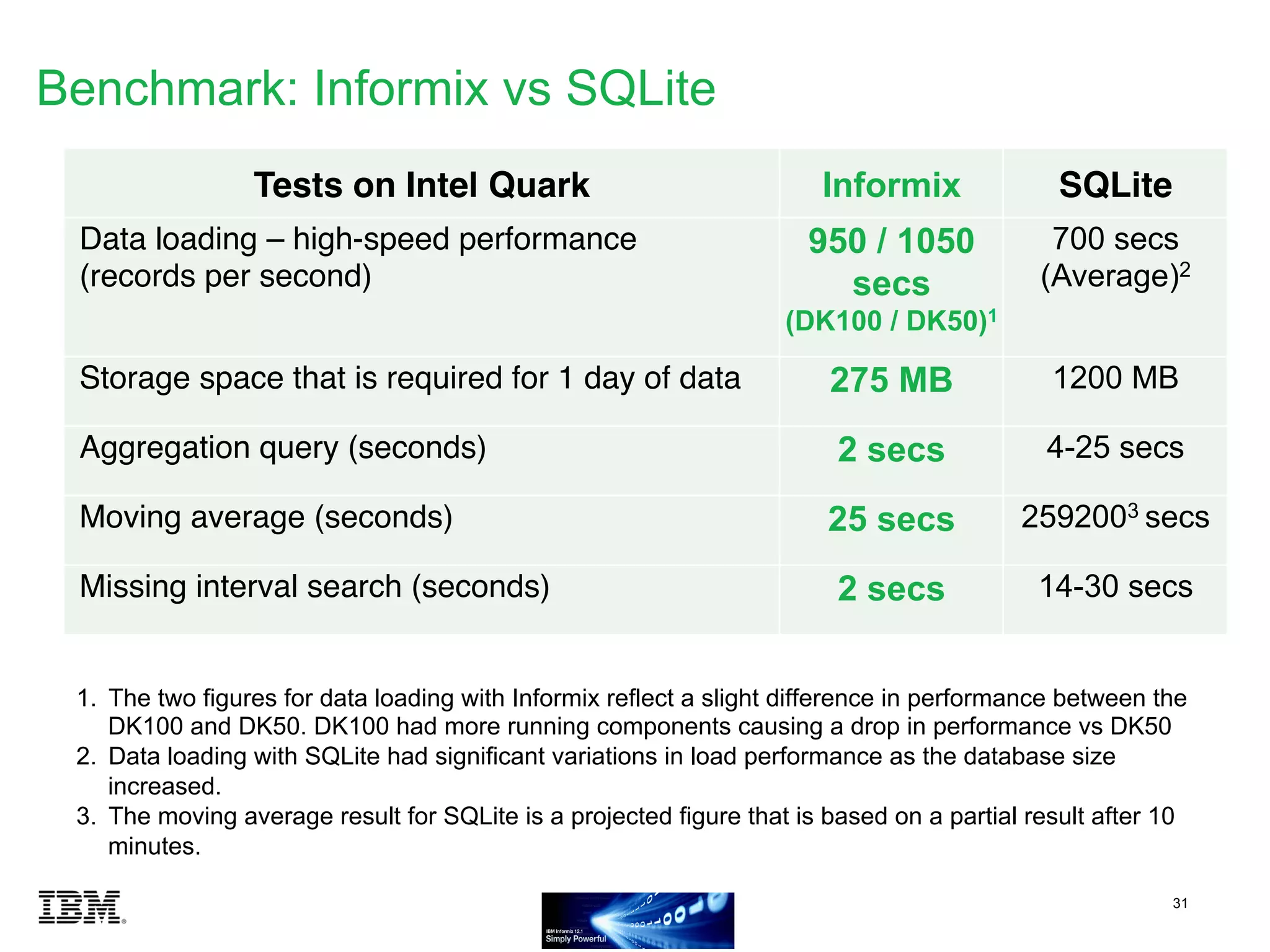
Benchmark: Informix vs SQLite
31
Tests on Intel Quark Informix SQLite
Data loading – high-speed performance
(records per second)
950 / 1050
secs
(DK100 / DK50)1
700 secs
(Average)2
Storage space that is required for 1 day of data 275 MB 1200 MB
Aggregation query (seconds) 2 secs 4-25 secs
Moving average (seconds) 25 secs 2592003 secs
Missing interval search (seconds) 2 secs 14-30 secs
1.  The two figures for data loading with Informix reflect a slight difference in performance between the
DK100 and DK50. DK100 had more running components causing a drop in performance vs DK50
2.  Data loading with SQLite had significant variations in load performance as the database size
increased.
3.  The moving average result for SQLite is a projected figure that is based on a partial result after 10
minutes.
32
Metric Competitor Informix
Daily processing time
Maximum number of cores used
11 hours
62
5 hour 50 min
32
Maximum amount of memory used 192GB 192GB
Size of database per month of data 15TB 5TB
# Records processed each day 2.88 Billion 2.88 Billion
Billing determinants creation (1/21 of
the total meter population)
51,322 ~2 million reads
per second
TimeSeries Meter Data Management Benchmark
- 30 million smart meters sending data every 15 minutes
- 2.88 billion records inserted each day
- Workload: data Ingestion, data cleanup, and a daily billing cycle
Summary
•  IBM Informix - best fit for IoT architecture
•  IoT gateway
•  IoT cloud analytics
•  Supported on a wide array of platforms
•  Best in class embeddability
•  Native support for sensor data - TimeSeries & Spatial data
•  Native support for unstructured (JSON) data
•  Ease of application development - REST access
•  High availability and dynamic scaling
33
34
Kevin Brown – kbrown3@us.ibm.com

IBM Internet-of-Things architecture and capabilities

  • 1.
    © 2015 IBMCorporation IBM  Analy*cs   IBM  Internet  of  Things  -­‐  Architecture  and   Capabili*es   Kevin  Brown  –  Informix  CTO,  IoT  Solu7ons  and  Services   August  17,  2015  
  • 2.
    Agenda •  IoT ArchitecturalComponents Overview •  Informix for the Intelligent Gateway •  Informix for the Cloud •  IoT Partners and Platforms 2
  • 3.
  • 4.
    4 Internet of ThingsTopography Streams Deep Analytics Zone Device/Sensors Smart Gateways Sensor Analytics Zone 4
  • 5.
    Simplified IoT DataFlow Sensor Data History Sensors In-memory Analytics Predictive Analytics Publish / Subscribe Cloud Infrastructure Real-time Analytics Real-time Analytics Operational Analytics Big Data Analytics (no gateway) (Gateways) HDFS / Hadoop Big Data Analytics MessageSight / MQTT Gateways for local analytics InfoSphere Streams Informix / Cloudant / IOT Foundation Service / TimeSeries Service Informix Warehouse Accelerator / DashDB PMQ / SPSS / Cognos Softlayer / BluMix Watson / DashDB / BigSQL Informix / Node-Red
  • 6.
    •  Gateways canreduce the cost of the backend cloud •  Reduces cloud storage by filtering/aggregating/analyzing data locally •  Reduces cloud CPU requirements by precomputing values •  Reduces latency since actions can be taken immediately •  Intelligent gateways can detect and respond to local events as they happen rather than waiting for transfer to the cloud •  Some users are not comfortable putting all their data in the cloud •  Gateways allow customers to capture and get value from their sensors without sending data to the cloud •  Protocol Consolidation •  Cloud does not need to implement the 100’s of IoT protocols Over time more and more of the processing will move from the cloud to gateway devices How Do Gateways Help IoT Solutions? 6
  • 7.
    What are theRequirements for a Gateway Database? •  The database management system must: ▪  Have a small install footprint, less than 100 MB ▪  Run with low memory requirements – less than 256 MB ▪  Use lossless compression or other techniques to minimize storage space ▪  Have built-in support for common types of IoT data like time series and spatial/GIS data ▪  Simple application development supporting both NoSQL and SQL ▪  Driverless, easy access to the data ▪  Require absolutely no administration ▪  Ideally should be able to network multiple gateways together to create a single distributed database 7 The database must be powerful enough to ingest, process and analyze data in real-time
  • 8.
    IBM Informix: TheIdeal Database for Gateways Simple to use ▪  Hands-Free operation – No administration ▪  Supports popular interfaces such as REST and Mongo as well as ODBC/JDBC ▪  Handles SQL and JSON data in the same database Performance ▪  One of a kind support for Time Series and Spatial data ▪  Stream data continuously into the database ▪  Run analytics as data arrives ▪  Dynamically add and update analytics when needed ▪  Storage is typically 1/3 the size compared to other vendors Invisible Agile 8 Informix is the only database management system perfectly suited to run in Gateways
  • 9.
    Sensor Data isTime Series Data •  What is a Time Series? ▪  A logically connected set of records ordered by time •  What are the Key Strengths of Informix TimeSeries? ▪  Much less space required • Typically about 1/3 the space required by other vendors ▪  Queries run orders of magnitude faster • Unique optimized storage means codes paths are shorter and more data fits in memory ▪  Purpose built streaming data loader for sensor data • Automatically run analytic and/or aggregate functions on new data ▪  Can store structured (SQL) or unstructured (JSON) data for quick application development • REST/ODBC/JDBC/JSON interfaces available ▪  100’s of functions predefined • Programming APIs available to create your own analytics 9
  • 10.
    Traditional Table Approach InformixTimeSeries Approach Meter_ID Time KWH Voltage ColN 1 1-1-11 12:00 Value 1 Value 2 ……… Value N 2 1-1-11 12:00 Value 1 Value 2 ……… Value N 3 1-1-11 12:00 Value 1 Value 2 ……… Value N … … … … ……… … 1 1-1-11 12:15 Value 1 Value 2 ……… Value N 2 1-1-11 12:15 Value 1 Value 2 ……… Value N 3 1-1-11 12:15 Value 1 Value 2 ……… Value N … … … … ……… … Meter_ID Series 1 [(1-1-11 12:00, value 1, value 2,…, value N), (1-1-11 12:15, value 1, value 2, …, value N), …] 2 [(1-1-11 12:00, value 1, value 2,…, value N), (1-1-11 12:15, value 1, value 2, …, value N), …] 3 [(1-1-11 12:00, value 1, value 2,…, value N), (1-1-11 12:15, value 1, value 2, …, value N), …] 4 [(1-1-11 12:00, value 1, value 2,…, value N), (1-1-11 12:15, value 1, value 2, …, value N), …] … Traditional Sensor data storage vs Informix TimeSeries Storage 10
  • 11.
    IoT Requirements forSpatioTemporal Data •  Many IoT applications have a spatial component to them ▪  Vehicles, cell phones, even pets… tracking is common •  In these cases both location and time is important ▪  Show me the vehicles that have passed by location X in the last hour ▪  Where has my car been over the last few hours? •  Informix allows you to combine Time series and Spatial data in the same query 11
  • 12.
    12 Both Structured andUnstructured Data is Common in IoT Environments JSON Collection SQL Driver NoSQL Driver SQL Data Join Data •  Informix can store SQL and JSON data in the same database •  Write programs using SQL drivers or Mongo/NoSQL drivers •  SQL data automatically transformed into JSON documents when needed •  NoSQL data automatically transformed into SQL when needed Embedded Device or Database server Horizontal Scale-out with Shards
  • 13.
    Informix Data AccessOptions 13 MongoDB Client REST Client SQLI Client DRDA Client Informix DBMS Informix NoSQL Listener Informix •  NoSQL ↔ SQL Translation •  REST, MongoDB Protocol Support •  SQLI, DRDA Protocol Support •  Relational, Collection, Time Series, and Spatial Data Support Spatial Time Series JSON Collection Relational Table A  REST  client  is  any   program  capable  of   making  a  HTTP  request  
  • 14.
    Informix Data AccessOptions 14 MongoDB Client REST Client SQLI Client DRDA Client Informix DBMS Informix NoSQL Listener Informix •  NoSQL ↔ SQL Translation •  REST, MongoDB Protocol Support •  SQLI, DRDA Protocol Support •  Relational, Collection, Time Series, and Spatial Data Support Spatial Time Series JSON Collection Relational Table You  can  use  all  the  client   drivers  that  are  available   for  MongoDB  with  the   NoSQL  Listener  
  • 15.
    •  Rapid Development • Simple use with JSON •  Simple REST •  Simple MQTT and other adapters •  Contributor Nodes – simple to use other services 15 Use Node-Red for Quick Gateway App. Development
  • 16.
  • 17.
    IBM IoT SmartGateway Kit 1.  Login as installing user. ▪  Ex: pi 2.  mkdir iot-gateway-kit-depend 3.  Run git clone https://github.com/ibm-iot/iot-gateway-kit.git 4.  cd iot-gateway-kit 5.  Run ./iot_install 17
  • 18.
    IBM IoT SmartGateway Kit •  The iot-gateway-kit will install the following: ▪  Node.js ▪  Node-red ▪  Timeseries nodes ▪  Bluetooth node.js application sample 18
  • 19.
    Smart Gateway Kit– TI Sensor Tag 19 1.  IoT gateway Kit Designed using node- red/node.js to work with the TI Sensor Tag" 2.  Stores data in the Timeseries database" 3.  Aggregate data and push to the cloud" 4.  IoT Foundation or other."
  • 20.
    IoT Developers -Get Started! •  Gateway starter - https://ibm.biz/BdXr2W •  Code samples - https://ibm.biz/BdX4QV •  Github - https://github.com/IBM-IoT/ 20
  • 21.
    Informix on DockerHub https://registry.hub.docker.com/u/ibmcom/informix-innovator-c/ •  IBM Informix Innovator-C •  12.10.FC4 21 Docker Hub $docker pull ibmcom/informix-innovator-c!
  • 22.
    22 Informix for theCloud and Operational Zone
  • 23.
    23 What are theIoT Requirements for the Cloud? •  Requirements - similar to gateways (but for different reasons): •  Potentially 1000’s of servers means zero administration is a must •  Data volume adds up very quickly so low storage overhead is required •  Data flows into the cloud continuously and must be processed in real-time •  Must be able to handle time series, spatial, and NoSQL data natively •  Additional requirements •  Must be able to scale-out •  Must be available as a service The database must be able to ingest, process and analyze data in real-time
  • 24.
    24 Why use Informixin the “Operational Zone”? Simple to use •  Hands-Free operation •  Supports REST and Mongo APIs as well as ODBC/JDBC •  Stores SQL and JSON database in the same database Highly Available •  Close to zero down time •  Partition or Hash your data across servers in the cloud •  Dynamically add/remove additional servers Performance •  Continuous High Performance Analytics •  Specialized support for Time Series and Spatial data Invisible Agile Resilient
  • 25.
    25 Shards: Scale-out yourDatabase across Servers or Gateways •  Distribute data among servers by range or hash partitioning •  Each shard can have an associated secondary server for high availability •  Run queries across all shards or a subset of the shards •  Only shards that could qualify are searched •  Shards are searched in parallel •  Ignores shards that are offline Shards in a Cloud
  • 26.
    26 IoT Analytics -Operational and Big Data Analytics •  Operational Analytics •  Needed when results are required in (near) real-time •  Real-time monitoring, situational detection, correlation of events, e.g. •  Dynamic advertising based on customer movement •  Real-time equipment failure prediction •  Operational analytics are required in gateways as well as the cloud •  Gateways need to aggregate, filter, monitor for conditions •  Analytics must run efficiently while new data is being loaded •  Must be able to dynamically add and update analytics in the cloud and gateways •  Big Data analytics are required when you have the time to do “Deeper/Wider” analysis •  Latency between data arrival and results not an issue •  Efficient ETL process from the operational repository is a must
  • 27.
    27 TCP/IP Bulk Loader SQL Queries(from apps) Informix Warehouse Accelerator Compressed DB partition Query Processor Data Warehouse Informix SQL Query Router Results Informix Warehouse Accelerator: •  Connects to Informix via TCP/IP & DRDA •  Analyzes, compresses, and loads to memory •  Copy of (portion of) warehouse •  Processes routed SQL query and •  returns answer to Informix Use Informix Warehouse Accelerator for Mixed Operational/Analytic Workloads Informix: •  Routes SQL queries to accelerator •  User need not change SQL or apps. •  Can always run query in Informix •  Too short an est. execution time
  • 28.
    28 TimeSeries Service onBlueMix Every IoT deployment will need to store time series data and possibly spatial data •  Provides REST, JSON, ODBC/JDBC based services to: •  Store, retrieve, and join time series, spatial, relational, and NoSQL data •  Built-in time series analytics •  Multi-tenancy support •  Scales out automatically as needed •  No Administration needed IoT Foundation Service on BlueMix BlueMix Cloud Services •  Quickly and simply add new sensors •  Interface for continuously loading sensor data •  Adapters for MQTT and MessageSight
  • 29.
  • 30.
    IBM Informix andIntel Deliver Leading Edge Solutions for IoT   ▪  Informix  support  for  Intel’s   new  Quark  processor,  now   suppor*ng  Intel  family,  from   Quark  to  Xeon.     ▪  Quark  port  in  the  free   Informix  Developer  Edi*on   ▪  Informix  Developer  Edi*on   available  as  part  of  standard   Intel  Gateway  developer  SDK   Combining  IBM  and  Intel’s  strength  at  the  Edge,  Gateway  and  in  the  Cloud  provides   an  intelligent,  e2e  IoT  solu7on  for  rapid  7me  to  market.     Intel® Quark™ SoC / Intel® Atom™ / Intel® Xeon™ Windriver McAfee Security Supports OSGI/TR69 Informix Database 30
  • 31.
    Benchmark: Informix vsSQLite 31 Tests on Intel Quark Informix SQLite Data loading – high-speed performance (records per second) 950 / 1050 secs (DK100 / DK50)1 700 secs (Average)2 Storage space that is required for 1 day of data 275 MB 1200 MB Aggregation query (seconds) 2 secs 4-25 secs Moving average (seconds) 25 secs 2592003 secs Missing interval search (seconds) 2 secs 14-30 secs 1.  The two figures for data loading with Informix reflect a slight difference in performance between the DK100 and DK50. DK100 had more running components causing a drop in performance vs DK50 2.  Data loading with SQLite had significant variations in load performance as the database size increased. 3.  The moving average result for SQLite is a projected figure that is based on a partial result after 10 minutes.
  • 32.
    32 Metric Competitor Informix Dailyprocessing time Maximum number of cores used 11 hours 62 5 hour 50 min 32 Maximum amount of memory used 192GB 192GB Size of database per month of data 15TB 5TB # Records processed each day 2.88 Billion 2.88 Billion Billing determinants creation (1/21 of the total meter population) 51,322 ~2 million reads per second TimeSeries Meter Data Management Benchmark - 30 million smart meters sending data every 15 minutes - 2.88 billion records inserted each day - Workload: data Ingestion, data cleanup, and a daily billing cycle
  • 33.
    Summary •  IBM Informix- best fit for IoT architecture •  IoT gateway •  IoT cloud analytics •  Supported on a wide array of platforms •  Best in class embeddability •  Native support for sensor data - TimeSeries & Spatial data •  Native support for unstructured (JSON) data •  Ease of application development - REST access •  High availability and dynamic scaling 33
  • 34.
    34 Kevin Brown –kbrown3@us.ibm.com