Introduction to
Convolutional
Neural Network
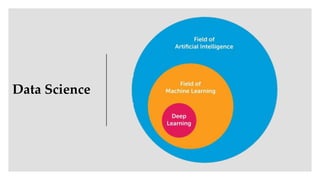
Data Science
Applications
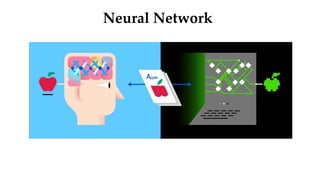
Neural Network
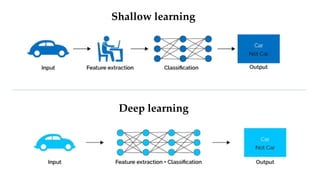
Shallow learning
Deep learning
Neural Network
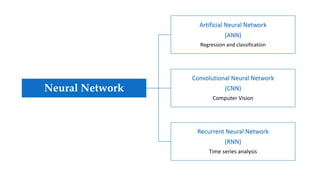
Artificial Neural Network
(ANN)
Regression and classification
Convolutional Neural Network
(CNN)
Computer Vision
Recurrent Neural Network
(RNN)
Time series analysis
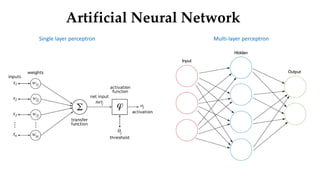
Artificial Neural Network
Single layer perceptron Multi-layer perceptron
Convolutional
Neural
Network
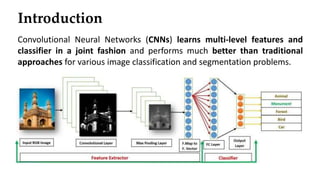
Convolutional Neural Networks (CNNs) learns multi-level features and
classifier in a joint fashion and performs much better than traditional
approaches for various image classification and segmentation problems.
Introduction
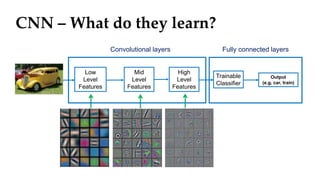
Low
Level
Features
Mid
Level
Features
Output
(e.g. car, train)
High
Level
Features
Trainable
Classifier
CNN – What do they learn?
Convolutional layers Fully connected layers
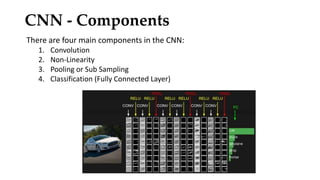
There are four main components in the CNN:
1. Convolution
2. Non-Linearity
3. Pooling or Sub Sampling
4. Classification (Fully Connected Layer)
CNN - Components
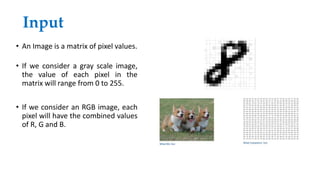
Input
• An Image is a matrix of pixel values.
• If we consider a gray scale image,
the value of each pixel in the
matrix will range from 0 to 255.
• If we consider an RGB image, each
pixel will have the combined values
of R, G and B.
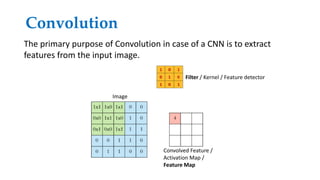
Convolution
The primary purpose of Convolution in case of a CNN is to extract
features from the input image.
Convolved Feature /
Activation Map /
Feature Map
Image
Filter / Kernel / Feature detector
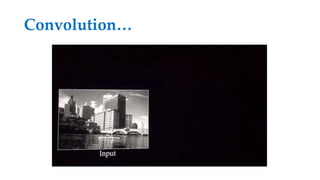
Convolution…
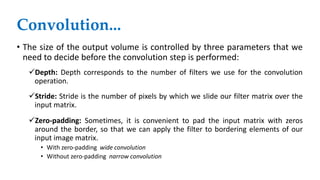
• The size of the output volume is controlled by three parameters that we
need to decide before the convolution step is performed:
Depth: Depth corresponds to the number of filters we use for the convolution
operation.
Stride: Stride is the number of pixels by which we slide our filter matrix over the
input matrix.
Zero-padding: Sometimes, it is convenient to pad the input matrix with zeros
around the border, so that we can apply the filter to bordering elements of our
input image matrix.
• With zero-padding wide convolution
• Without zero-padding narrow convolution
Convolution...
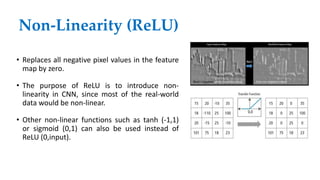
• Replaces all negative pixel values in the feature
map by zero.
• The purpose of ReLU is to introduce non-
linearity in CNN, since most of the real-world
data would be non-linear.
• Other non-linear functions such as tanh (-1,1)
or sigmoid (0,1) can also be used instead of
ReLU (0,input).
Non-Linearity (ReLU)
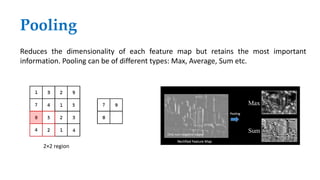
Pooling
Reduces the dimensionality of each feature map but retains the most important
information. Pooling can be of different types: Max, Average, Sum etc.
2×2 region
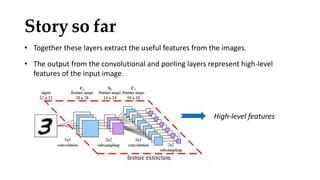
• Together these layers extract the useful features from the images.
• The output from the convolutional and pooling layers represent high-level
features of the input image.
Story so far
High-level features
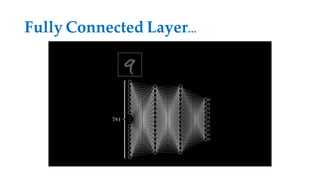
• A traditional Multi-Layer Perceptron.
• The term “Fully Connected” implies that every neuron in the previous layer is
connected to every neuron on the next layer.
• Their activations can hence be computed with a matrix multiplication followed by a
bias offset.
• The purpose of the Fully Connected layer is to use the high-level features for
classifying the input image into various classes based on the training dataset.
Fully Connected Layer
Fully Connected Layer…
Introduction to
Convolutional
Neural Network
Overall CNN Architecture
Putting it all together – Training using Backpropagation
• Step 1: We initialize all filters and parameters / weights with random values.
• Step 2: The network takes a training image as input, goes through the forward
propagation step (convolution, ReLU and pooling operations along with forward
propagation in the Fully Connected layer) and finds the output
probabilities for each class.
• Let’s say the output probabilities for the boat image above are [0.2, 0.4, 0.1, 0.3].
• Since weights are randomly assigned for the first training example, output probabilities are also
random.
• Step 3: Calculate the total error at the output layer (summation over all 4
classes).
• Step 4: Use Backpropagation to calculate the gradients of the error with respect to
all weights in the network and use gradient descent to update all filter values/
weights and parameter values to minimize the output error.
• The weights are adjusted in proportion to their contribution to the total error.
• When the same image is input again, output probabilities might now be [0.1, 0.1, 0.7, 0.1], which is
closer to the target vector [0, 0, 1, 0].
• This means that the network has learnt to classify this particular image correctly by adjusting its
weights / filters such that the output error is reduced.
• Parameters like number of filters, filter sizes, architecture of the network etc. have all been fixed
before Step 1 and do not change during training process – only the values of the filter matrix and
connection weights get updated.
• Step 5: Repeat steps 2-4 with all images in the training set.
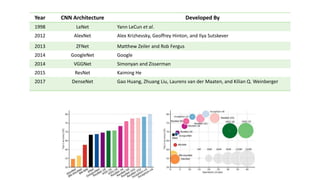
CNN Architectures
Year CNN Architecture Developed By
1998 LeNet Yann LeCun et al.
2012 AlexNet Alex Krizhevsky, Geoffrey Hinton, and Ilya Sutskever
2013 ZFNet Matthew Zeiler and Rob Fergus
2014 GoogleNet Google
2014 VGGNet Simonyan and Zisserman
2015 ResNet Kaiming He
2017 DenseNet Gao Huang, Zhuang Liu, Laurens van der Maaten, and Kilian Q. Weinberger
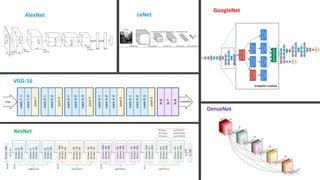
AlexNet LeNet
GoogleNet
ResNet
VGG-16
DenseNet
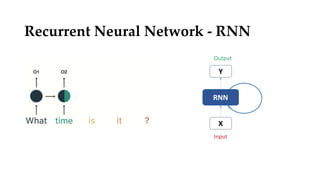
Recurrent Neural Network - RNN
What are the differences among ANN, CNN and RNN?
Visualizing a CNN
• Adam Harley created amazing visualizations of a Convolutional Neural
Network trained on the MNIST Database of handwritten digits
• 2D Visualisation of a CNN - http://scs.ryerson.ca/~aharley/vis/conv/flat.html
• 3D Visualisation of a CNN - http://scs.ryerson.ca/~aharley/vis/conv/
Thank You!

Cnn

  • 1.
  • 2.
  • 3.
  • 4.
  • 5.
  • 6.
    Neural Network Artificial NeuralNetwork (ANN) Regression and classification Convolutional Neural Network (CNN) Computer Vision Recurrent Neural Network (RNN) Time series analysis
  • 7.
    Artificial Neural Network Singlelayer perceptron Multi-layer perceptron
  • 8.
  • 9.
    Convolutional Neural Networks(CNNs) learns multi-level features and classifier in a joint fashion and performs much better than traditional approaches for various image classification and segmentation problems. Introduction
  • 10.
  • 11.
    There are fourmain components in the CNN: 1. Convolution 2. Non-Linearity 3. Pooling or Sub Sampling 4. Classification (Fully Connected Layer) CNN - Components
  • 12.
    Input • An Imageis a matrix of pixel values. • If we consider a gray scale image, the value of each pixel in the matrix will range from 0 to 255. • If we consider an RGB image, each pixel will have the combined values of R, G and B.
  • 13.
    Convolution The primary purposeof Convolution in case of a CNN is to extract features from the input image. Convolved Feature / Activation Map / Feature Map Image Filter / Kernel / Feature detector
  • 14.
  • 15.
    • The sizeof the output volume is controlled by three parameters that we need to decide before the convolution step is performed: Depth: Depth corresponds to the number of filters we use for the convolution operation. Stride: Stride is the number of pixels by which we slide our filter matrix over the input matrix. Zero-padding: Sometimes, it is convenient to pad the input matrix with zeros around the border, so that we can apply the filter to bordering elements of our input image matrix. • With zero-padding wide convolution • Without zero-padding narrow convolution Convolution...
  • 16.
    • Replaces allnegative pixel values in the feature map by zero. • The purpose of ReLU is to introduce non- linearity in CNN, since most of the real-world data would be non-linear. • Other non-linear functions such as tanh (-1,1) or sigmoid (0,1) can also be used instead of ReLU (0,input). Non-Linearity (ReLU)
  • 17.
    Pooling Reduces the dimensionalityof each feature map but retains the most important information. Pooling can be of different types: Max, Average, Sum etc. 2×2 region
  • 18.
    • Together theselayers extract the useful features from the images. • The output from the convolutional and pooling layers represent high-level features of the input image. Story so far High-level features
  • 19.
    • A traditionalMulti-Layer Perceptron. • The term “Fully Connected” implies that every neuron in the previous layer is connected to every neuron on the next layer. • Their activations can hence be computed with a matrix multiplication followed by a bias offset. • The purpose of the Fully Connected layer is to use the high-level features for classifying the input image into various classes based on the training dataset. Fully Connected Layer
  • 20.
  • 21.
  • 22.
  • 23.
    Putting it alltogether – Training using Backpropagation • Step 1: We initialize all filters and parameters / weights with random values. • Step 2: The network takes a training image as input, goes through the forward propagation step (convolution, ReLU and pooling operations along with forward propagation in the Fully Connected layer) and finds the output probabilities for each class. • Let’s say the output probabilities for the boat image above are [0.2, 0.4, 0.1, 0.3]. • Since weights are randomly assigned for the first training example, output probabilities are also random. • Step 3: Calculate the total error at the output layer (summation over all 4 classes).
  • 24.
    • Step 4:Use Backpropagation to calculate the gradients of the error with respect to all weights in the network and use gradient descent to update all filter values/ weights and parameter values to minimize the output error. • The weights are adjusted in proportion to their contribution to the total error. • When the same image is input again, output probabilities might now be [0.1, 0.1, 0.7, 0.1], which is closer to the target vector [0, 0, 1, 0]. • This means that the network has learnt to classify this particular image correctly by adjusting its weights / filters such that the output error is reduced. • Parameters like number of filters, filter sizes, architecture of the network etc. have all been fixed before Step 1 and do not change during training process – only the values of the filter matrix and connection weights get updated. • Step 5: Repeat steps 2-4 with all images in the training set.
  • 25.
  • 26.
    Year CNN ArchitectureDeveloped By 1998 LeNet Yann LeCun et al. 2012 AlexNet Alex Krizhevsky, Geoffrey Hinton, and Ilya Sutskever 2013 ZFNet Matthew Zeiler and Rob Fergus 2014 GoogleNet Google 2014 VGGNet Simonyan and Zisserman 2015 ResNet Kaiming He 2017 DenseNet Gao Huang, Zhuang Liu, Laurens van der Maaten, and Kilian Q. Weinberger
  • 27.
  • 28.
  • 29.
    What are thedifferences among ANN, CNN and RNN?
  • 30.
    Visualizing a CNN •Adam Harley created amazing visualizations of a Convolutional Neural Network trained on the MNIST Database of handwritten digits • 2D Visualisation of a CNN - http://scs.ryerson.ca/~aharley/vis/conv/flat.html • 3D Visualisation of a CNN - http://scs.ryerson.ca/~aharley/vis/conv/
  • 31.