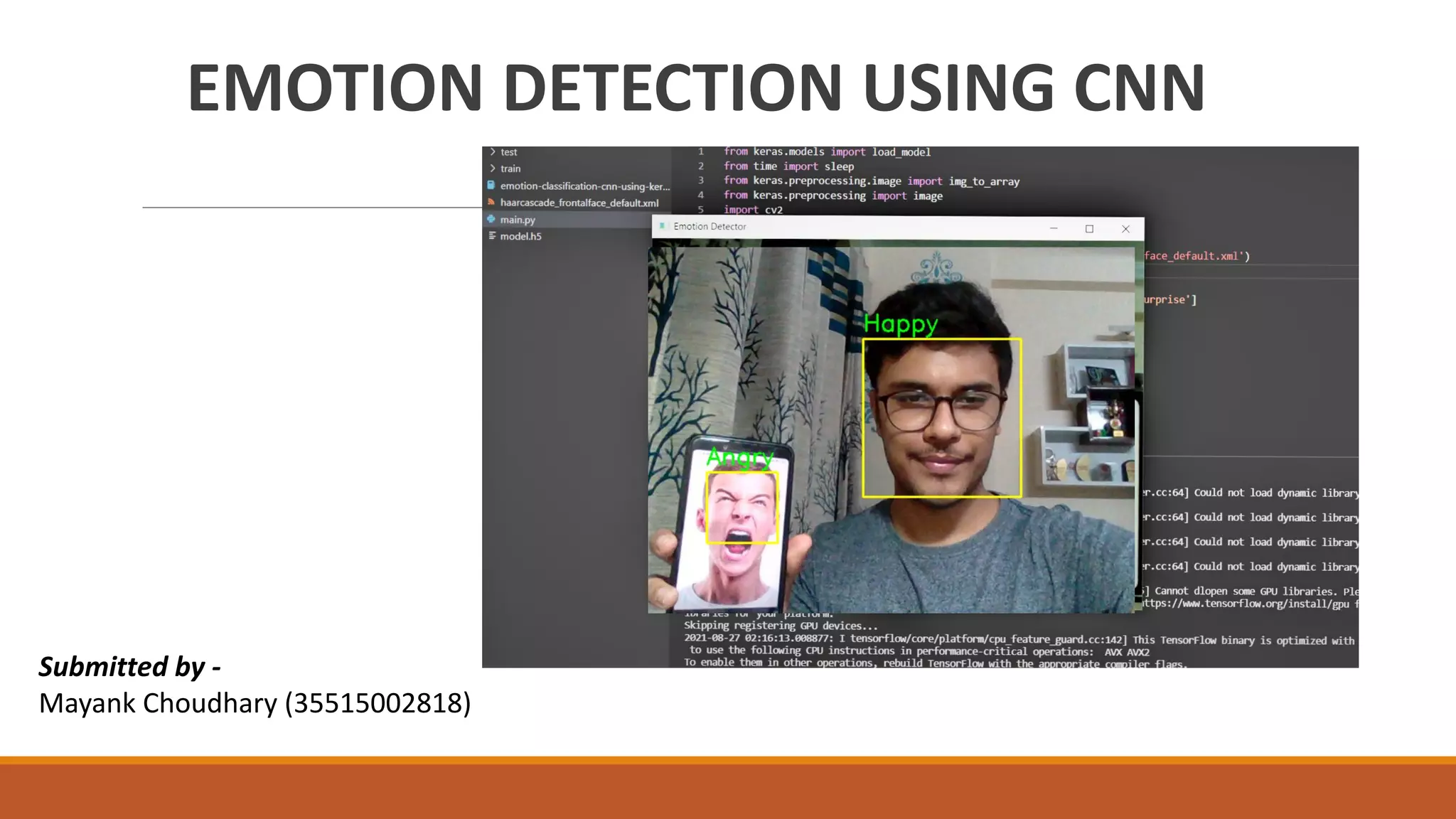
EMOTION DETECTION USING CNN
Submitted by -
Mayank Choudhary (35515002818)
TABLE OF CONTENTS
1. Introduction
2. Literature Survey
3. Research Gaps
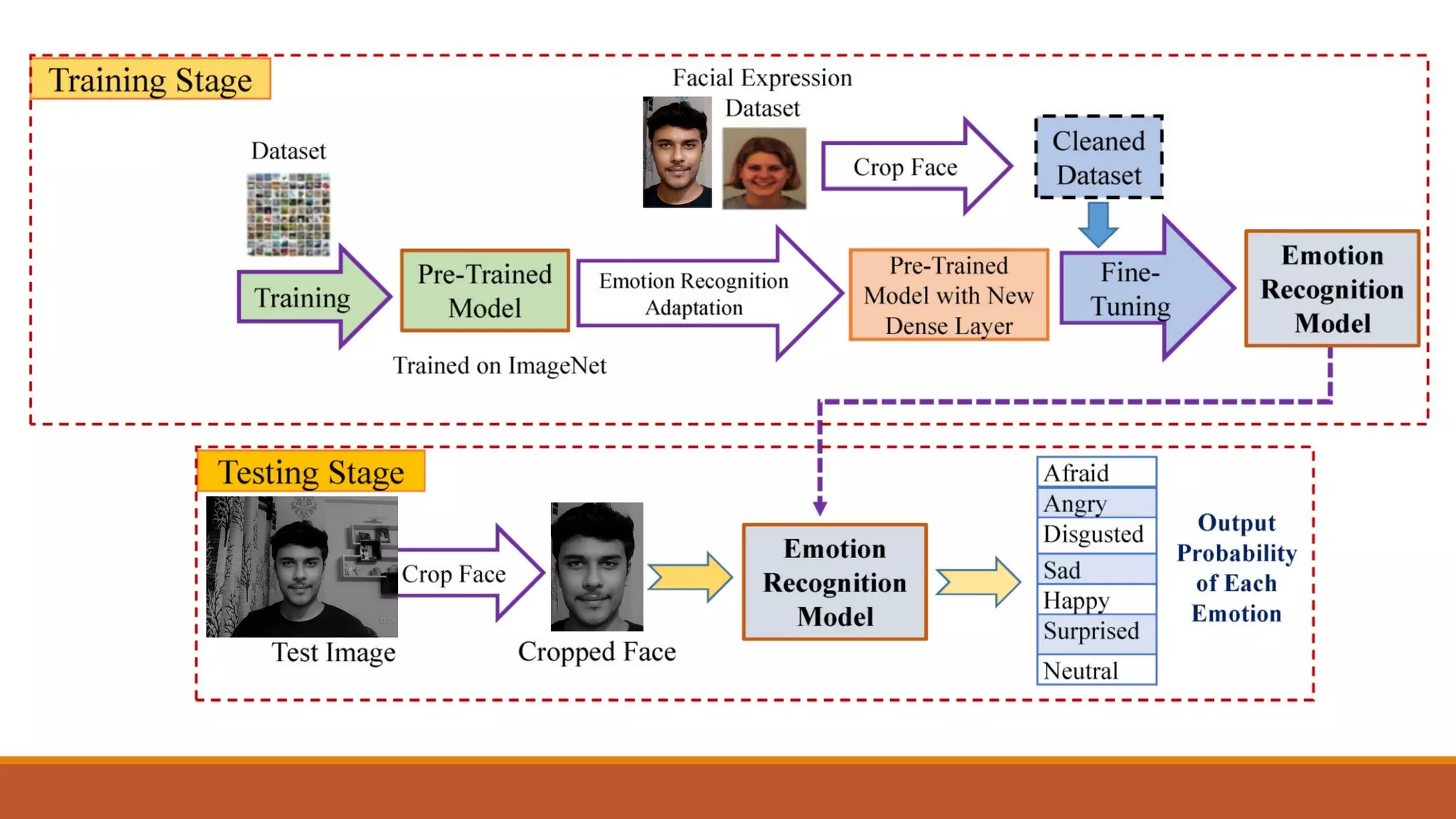
4. Proposed Methodology
5. Expected Outcome
6. References
INTRODUCTION
The objective is to classify each face based on the emotion shown in the facial
expression into one of seven categories. We have used 7 emotions namely -
'Angry'😠, 'Disgust'🤢, 'Fear'😱, 'Happy'😇, 'Neutral'😐, 'Sad'☹, 'Surprise'😲 to train
and test our algorithm using Convolution Neural Networks.
You will use OpenCV to automatically detect faces in images and draw bounding
boxes around them. Once you have trained, saved, and exported the CNN, you will
directly serve the trained model to a web interface and perform real-time facial
expression recognition on video and image data.
For this project, you’ll get instant access to a cloud desktop with Python, Jupyter, and
Keras pre-installed.
DIFFERENT EMOTIONS DATASET
LITERATURE SURVEY
Emotion Recognition is an important area of work to improve the interaction between human and machine.
Complexity of emotion makes the acquisition task more difficult. More recently, inception to the idea of
multimodal emotion recognition has increased the accuracy rate of the detection of the machine. Moreover, deep
learning technique with neural network extended the success ratio of machine in respect of emotion recognition.
Recent works with deep learning technique has been performed with different kinds of input of human behavior
such as facial expressions and body gestures. Still many aspects in this area to work on to improve and make a
robust system will detect and classify emotions more accurately. In this paper, we tried to explore the relevant
significant works, their techniques, and the effectiveness of the methods and the scope of the improvement of
the results.
RESEARCH GAPS
Deep learning usually requires big data, with respect to both volume and variety. However, most
remote sensing applications only have limited training data, of which a small subset is labeled.
Having analyzed both the current state of machine learning education as well as the skills needed
to create important applied machine learning systems, we now comment on the gap between the
two sides. Based on what classes cover and what applications require, it is clear that students are
not taught enough about how to properly manage the data they are working with.
TIMELINE
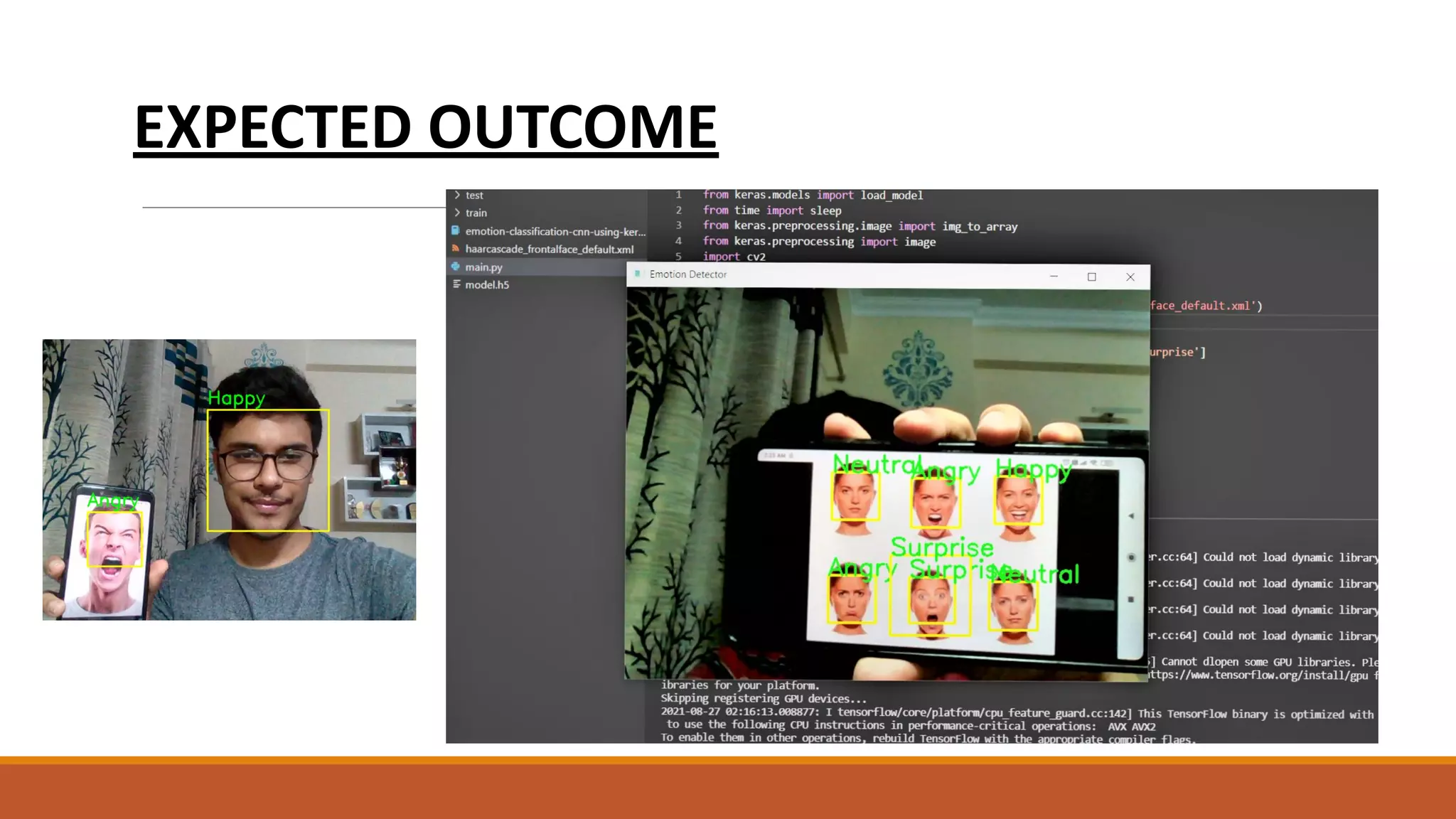
EXPECTED OUTCOME
Programming Language - Python 3.x
Convolution NN Algorithm
Image Processing - Open CV, tensorflow
Open-source software library - Keras
REFERENCES -
● Coursera - Convolution Neural Networks
● Kaggle Kernel
● Google Images
● towarsdatascience
● github
Thankyou

Emotion detection using cnn.pptx

  • 1.
    EMOTION DETECTION USINGCNN Submitted by - Mayank Choudhary (35515002818)
  • 2.
    TABLE OF CONTENTS 1.Introduction 2. Literature Survey 3. Research Gaps 4. Proposed Methodology 5. Expected Outcome 6. References
  • 3.
    INTRODUCTION The objective isto classify each face based on the emotion shown in the facial expression into one of seven categories. We have used 7 emotions namely - 'Angry'😠, 'Disgust'🤢, 'Fear'😱, 'Happy'😇, 'Neutral'😐, 'Sad'☹, 'Surprise'😲 to train and test our algorithm using Convolution Neural Networks. You will use OpenCV to automatically detect faces in images and draw bounding boxes around them. Once you have trained, saved, and exported the CNN, you will directly serve the trained model to a web interface and perform real-time facial expression recognition on video and image data. For this project, you’ll get instant access to a cloud desktop with Python, Jupyter, and Keras pre-installed.
  • 4.
  • 5.
    LITERATURE SURVEY Emotion Recognitionis an important area of work to improve the interaction between human and machine. Complexity of emotion makes the acquisition task more difficult. More recently, inception to the idea of multimodal emotion recognition has increased the accuracy rate of the detection of the machine. Moreover, deep learning technique with neural network extended the success ratio of machine in respect of emotion recognition. Recent works with deep learning technique has been performed with different kinds of input of human behavior such as facial expressions and body gestures. Still many aspects in this area to work on to improve and make a robust system will detect and classify emotions more accurately. In this paper, we tried to explore the relevant significant works, their techniques, and the effectiveness of the methods and the scope of the improvement of the results.
  • 6.
    RESEARCH GAPS Deep learningusually requires big data, with respect to both volume and variety. However, most remote sensing applications only have limited training data, of which a small subset is labeled. Having analyzed both the current state of machine learning education as well as the skills needed to create important applied machine learning systems, we now comment on the gap between the two sides. Based on what classes cover and what applications require, it is clear that students are not taught enough about how to properly manage the data they are working with.
  • 7.
  • 8.
  • 10.
    Programming Language -Python 3.x Convolution NN Algorithm Image Processing - Open CV, tensorflow Open-source software library - Keras REFERENCES - ● Coursera - Convolution Neural Networks ● Kaggle Kernel ● Google Images ● towarsdatascience ● github
  • 11.