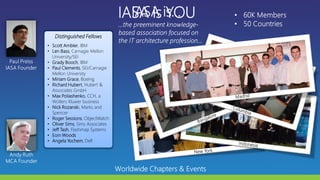
Distinguished Fellows
• Scott Ambler, IBM
• Len Bass, Carnagie Mellon
University/SEI
• Grady Booch, IBM
• Paul Clements, SEI/Carnagie
Mellon University
• Miriam Grace, Boeing
• Richard Hubert, Hubert &
Associates GmbH
• Max Poliashenko, CCH, a
Wolters Kluwer business
• Nick Rozanski, Marks and
Spencer
• Roger Sessions, ObjectWatch
• Oliver Sims, Sims Associates
• Jeff Tash, Flashmap Systems
• Eoin Woods
• Angela Yochem, Dell
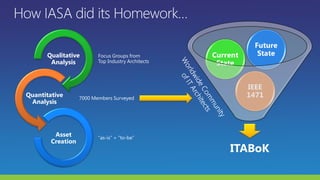
ITABoK
IEEE
1471
Current
State
Future
StateFocus Groups from
Top Industry Architects
Qualitative
Analysis
7000 Members Surveyed
Quantitative
Analysis
“as-is” + “to-be”
Asset
Creation
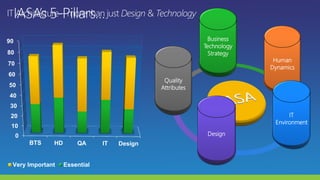
Business
Technology
Strategy
Human
Dynamics
IT
Environment
Design
Quality
Attributes
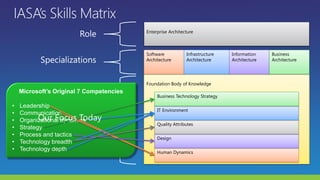
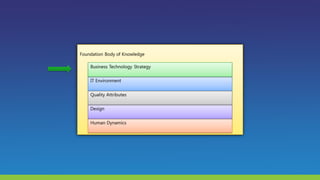
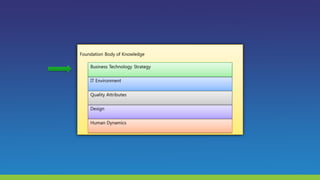
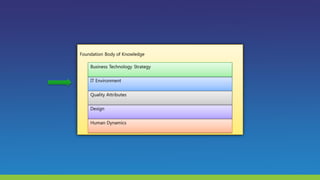
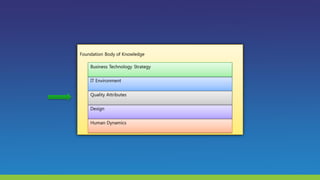
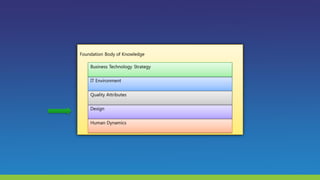
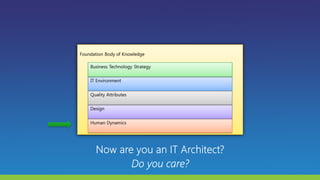
Foundation Body of Knowledge
Human Dynamics
Design
Quality Attributes
IT Environment
Business Technology Strategy
Software
Architecture
Infrastructure
Architecture
Information
Architecture
Business
ArchitectureSpecializations
Foundation
(5-Pillars)
Enterprise Architecture
Role
Our Focus Today
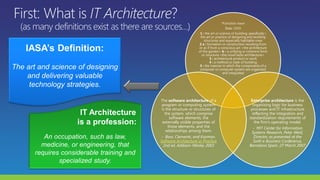
*Function: noun
Date: 1555
1 : the art or science of building; specifically :
the art or practice of designing and building
structures and especially habitable ones
2 a : formation or construction resulting from
or as if from a conscious act <the architecture
of the garden> b : a unifying or coherent form
or structure <the novel lacks architecture>
3 : architectural product or work
4 : a method or style of building
5 : the manner in which the components of a
computer or computer system are organized
and integrated
Enterprise architecture is the
organizing logic for business
processes and IT infrastructure
reflecting the integration and
standardization requirements of
the firm’s operating model.
- MIT Center for Information
Systems Research, Peter Weill,
Director, as presented at the
Sixth e-Business Conference,
Barcelona Spain, 27 March 2007
The software architecture of a
program or computing system
is the structure or structures of
the system, which comprise
software elements, the
externally visible properties of
those elements, and the
relationships among them.
- Bass, Clements, and Kazman.
Software Architecture in Practice
2nd ed, Addison-Wesley 2003
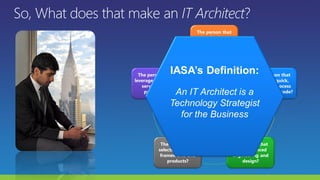
The person that
does business
modeling from an
IT perspective?
The person that
drives a quick,
iterative process
for creating code?
The person that
does advanced
engineering and
design?
The person that
selects a project’s
frameworks and
products?
The person that
leverages the right
services and
providers?
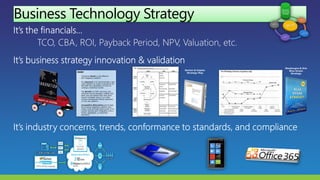
Business Technology Strategy
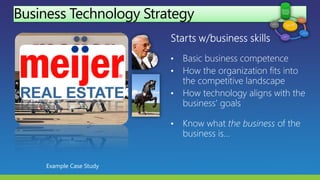
Example Case Study
Business Technology Strategy
IT Environment
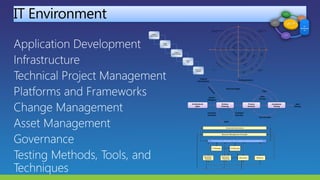
IT Environment
Establish
Requirements
Design
Creation
Program
Implementation
System
Test
Release to
Customer
Budget 1 Prototype 1Budget 2Budget 3 Prototype 2 Prototype 3 Prototype 4
Determine Goals, Alternatives,
and Constraints
Evaluate Alternatives
and Risks
Develop and
Test Plan
Plan
Budget 4
Architectural
Spike
Release
Planning
Process
Iteration
Acceptance
Testing
Next
Release
Voice of
the Customer
Uncertain
Estimates
System
Metaphor
NewUserInputs
TestingScenarios
Bugs
New
Version
NextIteration
Spike
Confident
Estimates
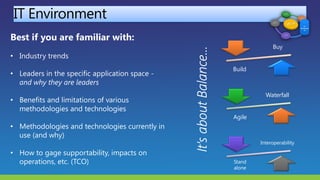
IT Environment
Waterfall
Agile
Buy
Build
Interoperability
Stand
alone
Best if you are familiar with:
• Industry trends
• Leaders in the specific application space -
and why they are leaders
• Benefits and limitations of various
methodologies and technologies
• Methodologies and technologies currently in
use (and why)
• How to gage supportability, impacts on
operations, etc. (TCO)
Quality Attributes
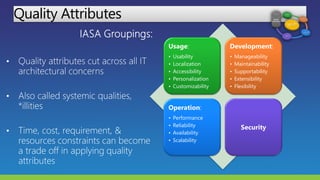
Quality Attributes
Usage:
• Usability
• Localization
• Accessibility
• Personalization
• Customizability
Development:
• Manageability
• Maintainability
• Supportability
• Extensibility
• Flexibility
Operation:
• Performance
• Reliability
• Availability
• Scalability
Security
Quality Attributes
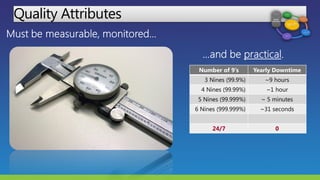
Number of 9’s Yearly Downtime
3 Nines (99.9%) ~9 hours
4 Nines (99.99%) ~1 hour
5 Nines (99.999%) ~ 5 minutes
6 Nines (999.999%) ~31 seconds
24/7 0
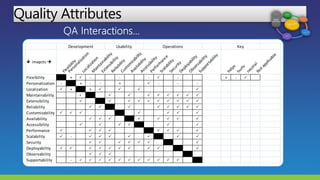
Quality Attributes
KeyDevelopment Usability Operations
Ü imapcts Ú Flexibility
Personalization
Localization
M
aintainability
Extensibility
ReliabilityCustom
izability
Availability
Accessibility
Perform
ance
ScalabilitySecurityDeployability
Observability
Supportability
helps
hurts
neutralNotapplicable
Flexibility + P - - - P - + - P
Personalization - + - - + P - - -
Localization P + + P P P P
Maintainability P P P P P P P P P
Extensibility P P P P P P P P P P
Reliability P P P P P P P P
Customizability P P P P P P P
Availability P P P P P P P P
Accessibility P P P P P P
Performance P P P P P P P P
Scalability P - P P P P P P P
Security P P P P P P P
Deployability P P P P P P P P P P
Observability P P P
Supportability - P P P P P P P P P P P
Design
Design
Design
Human Dynamics
Human Dynamics
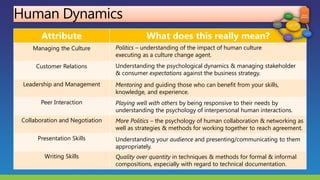
Attribute What does this really mean?
Managing the Culture
Customer Relations
Leadership and Management
Peer Interaction
Collaboration and Negotiation
Presentation Skills
Writing Skills
Politics – understanding of the impact of human culture
executing as a culture change agent.
Understanding the psychological dynamics & managing stakeholder
& consumer expectations against the business strategy.
Mentoring and guiding those who can benefit from your skills,
knowledge, and experience.
Playing well with others by being responsive to their needs by
understanding the psychology of interpersonal human interactions.
More Politics – the psychology of human collaboration & networking as
well as strategies & methods for working together to reach agreement.
Understanding your audience and presenting/communicating to them
appropriately.
Quality over quantity in techniques & methods for formal & informal
compositions, especially with regard to technical documentation.
Human Dynamics
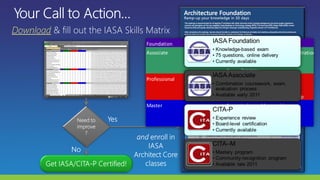
Download
Foundation 1 Awareness
Associate 2 Basic Information Demonstration
3 Individualized Knowledge
4 Practice
Professional 5 Delivery
6 Connectivity of Ideas
7 Enterprise Level Leadership
Master 8 Industry Mentorship
9 Research
10 Industry Leadership
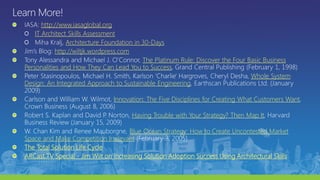
http://www.iasaglobal.org
IT Architect Skills Assessment
Architecture Foundation in 30-Days
http://wiltjk.wordpress.com
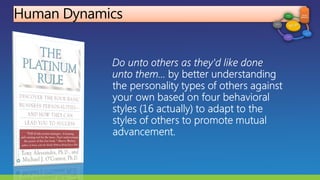
The Platinum Rule: Discover the Four Basic Business
Personalities and How They Can Lead You to Success
Peter Stasinopoulos, Michael H. Smith, Karlson 'Charlie' Hargroves, Cheryl Desha, Whole System
Design: An Integrated Approach to Sustainable Engineering, Earthscan Publications Ltd. (January
2009)
Innovation: The Five Disciplines for Creating What Customers Want
Having Trouble with Your Strategy? Then Map It
Blue Ocean Strategy: How to Create Uncontested Market
Space and Make Competition Irrelevant
The Total Solution Life Cycle
ARCast.TV Special - Jim Wilt on Increasing Solution Adoption Success Using Architectural Skills
Iasa Five Pillars Presentation

Iasa Five Pillars Presentation

  • 4.
    Distinguished Fellows • ScottAmbler, IBM • Len Bass, Carnagie Mellon University/SEI • Grady Booch, IBM • Paul Clements, SEI/Carnagie Mellon University • Miriam Grace, Boeing • Richard Hubert, Hubert & Associates GmbH • Max Poliashenko, CCH, a Wolters Kluwer business • Nick Rozanski, Marks and Spencer • Roger Sessions, ObjectWatch • Oliver Sims, Sims Associates • Jeff Tash, Flashmap Systems • Eoin Woods • Angela Yochem, Dell
  • 5.
    ITABoK IEEE 1471 Current State Future StateFocus Groups from TopIndustry Architects Qualitative Analysis 7000 Members Surveyed Quantitative Analysis “as-is” + “to-be” Asset Creation
  • 6.
  • 7.
    Foundation Body ofKnowledge Human Dynamics Design Quality Attributes IT Environment Business Technology Strategy Software Architecture Infrastructure Architecture Information Architecture Business ArchitectureSpecializations Foundation (5-Pillars) Enterprise Architecture Role Our Focus Today
  • 8.
    *Function: noun Date: 1555 1: the art or science of building; specifically : the art or practice of designing and building structures and especially habitable ones 2 a : formation or construction resulting from or as if from a conscious act <the architecture of the garden> b : a unifying or coherent form or structure <the novel lacks architecture> 3 : architectural product or work 4 : a method or style of building 5 : the manner in which the components of a computer or computer system are organized and integrated Enterprise architecture is the organizing logic for business processes and IT infrastructure reflecting the integration and standardization requirements of the firm’s operating model. - MIT Center for Information Systems Research, Peter Weill, Director, as presented at the Sixth e-Business Conference, Barcelona Spain, 27 March 2007 The software architecture of a program or computing system is the structure or structures of the system, which comprise software elements, the externally visible properties of those elements, and the relationships among them. - Bass, Clements, and Kazman. Software Architecture in Practice 2nd ed, Addison-Wesley 2003
  • 9.
    The person that doesbusiness modeling from an IT perspective? The person that drives a quick, iterative process for creating code? The person that does advanced engineering and design? The person that selects a project’s frameworks and products? The person that leverages the right services and providers?
  • 12.
  • 13.
  • 14.
  • 16.
  • 17.
    IT Environment Establish Requirements Design Creation Program Implementation System Test Release to Customer Budget1 Prototype 1Budget 2Budget 3 Prototype 2 Prototype 3 Prototype 4 Determine Goals, Alternatives, and Constraints Evaluate Alternatives and Risks Develop and Test Plan Plan Budget 4 Architectural Spike Release Planning Process Iteration Acceptance Testing Next Release Voice of the Customer Uncertain Estimates System Metaphor NewUserInputs TestingScenarios Bugs New Version NextIteration Spike Confident Estimates
  • 18.
    IT Environment Waterfall Agile Buy Build Interoperability Stand alone Best ifyou are familiar with: • Industry trends • Leaders in the specific application space - and why they are leaders • Benefits and limitations of various methodologies and technologies • Methodologies and technologies currently in use (and why) • How to gage supportability, impacts on operations, etc. (TCO)
  • 20.
  • 21.
    Quality Attributes Usage: • Usability •Localization • Accessibility • Personalization • Customizability Development: • Manageability • Maintainability • Supportability • Extensibility • Flexibility Operation: • Performance • Reliability • Availability • Scalability Security
  • 22.
    Quality Attributes Number of9’s Yearly Downtime 3 Nines (99.9%) ~9 hours 4 Nines (99.99%) ~1 hour 5 Nines (99.999%) ~ 5 minutes 6 Nines (999.999%) ~31 seconds 24/7 0
  • 23.
    Quality Attributes KeyDevelopment UsabilityOperations Ü imapcts Ú Flexibility Personalization Localization M aintainability Extensibility ReliabilityCustom izability Availability Accessibility Perform ance ScalabilitySecurityDeployability Observability Supportability helps hurts neutralNotapplicable Flexibility + P - - - P - + - P Personalization - + - - + P - - - Localization P + + P P P P Maintainability P P P P P P P P P Extensibility P P P P P P P P P P Reliability P P P P P P P P Customizability P P P P P P P Availability P P P P P P P P Accessibility P P P P P P Performance P P P P P P P P Scalability P - P P P P P P P Security P P P P P P P Deployability P P P P P P P P P P Observability P P P Supportability - P P P P P P P P P P P
  • 25.
  • 26.
  • 27.
  • 29.
  • 30.
    Human Dynamics Attribute Whatdoes this really mean? Managing the Culture Customer Relations Leadership and Management Peer Interaction Collaboration and Negotiation Presentation Skills Writing Skills Politics – understanding of the impact of human culture executing as a culture change agent. Understanding the psychological dynamics & managing stakeholder & consumer expectations against the business strategy. Mentoring and guiding those who can benefit from your skills, knowledge, and experience. Playing well with others by being responsive to their needs by understanding the psychology of interpersonal human interactions. More Politics – the psychology of human collaboration & networking as well as strategies & methods for working together to reach agreement. Understanding your audience and presenting/communicating to them appropriately. Quality over quantity in techniques & methods for formal & informal compositions, especially with regard to technical documentation.
  • 31.
  • 34.
    Download Foundation 1 Awareness Associate2 Basic Information Demonstration 3 Individualized Knowledge 4 Practice Professional 5 Delivery 6 Connectivity of Ideas 7 Enterprise Level Leadership Master 8 Industry Mentorship 9 Research 10 Industry Leadership
  • 35.
    http://www.iasaglobal.org IT Architect SkillsAssessment Architecture Foundation in 30-Days http://wiltjk.wordpress.com The Platinum Rule: Discover the Four Basic Business Personalities and How They Can Lead You to Success Peter Stasinopoulos, Michael H. Smith, Karlson 'Charlie' Hargroves, Cheryl Desha, Whole System Design: An Integrated Approach to Sustainable Engineering, Earthscan Publications Ltd. (January 2009) Innovation: The Five Disciplines for Creating What Customers Want Having Trouble with Your Strategy? Then Map It Blue Ocean Strategy: How to Create Uncontested Market Space and Make Competition Irrelevant The Total Solution Life Cycle ARCast.TV Special - Jim Wilt on Increasing Solution Adoption Success Using Architectural Skills