Information
Technology
Architecture
2
PRESENTATION FORMAT
 Introduction
 Architectural Approach
 The Enterprise Mobility Viewpoint
 Conclusions
3
Architectural approach
INTRODUCTION
 Enterprises and IT systems are complex
 Modeling of enterprise and IT architectures is a
complex process
 Teaching architectures is a challenge
 Consists of a hierarchy of architectural models
 Technical architectures modeled from various
perspectives
 Several approaches, frameworks, methodologies,
process models
 There is a comprehensive Body of Knowledge
4
Definitions
Several definitions used for
 Enterprise architecture
 IT (technical, technology) architecture
 Viewpoints, Views
 Framework
5
Definitions - Enterprise Architecture
USA Federal CIO Council: “Enterprise architecture is a strategic
information asset base which defines the business mission,
the information necessary to perform the mission, and the
transitional processes for implementing new technologies
in response to the changing mission needs”.
Meta Group: “Enterprise architecture is the holistic expression
of an organization’s key business, information, application
and technology strategies and their impact on business
functions and processes”.
The Open Group: “Enterprise architecture is about
understanding all of the different elements that go to make
up the enterprise and how those elements inter-relate”.
6
Definition - Architecture
IEEE P1471-2000 Definition:
“An architecture is the fundamental
organization of a system embodied in its
components, their relationships to each
other, and to the environment, and the
principles guiding its design and evolution”.
7
IT architecture
A pragmatic, coherent, and elegant structuring of a
collection of IT components that support business
processes the “user”, in conformance with factors
such as:
External constraints
User/Client requirements
Internal constraints
Technological constraints
Financial constraints
Legal constraints
8
IT System
An IT system consists of a combination of
IT resources (HW, SW, infrastructure) and
the services they deliver for an enterprise
Developed following the systems approach
which focuses on the system as a whole
A system is a set of elements so connected or
related as to perform a unique function not
performable by the elements alone
9
ARCHITECTURE APPROACH
The IT architecture must
 Meet the strategic goals and objectives of the
enterprise
 Represent the IT strategy of the enterprise
 Enable the organization to respond to new trends,
drivers, technologies, i.e. be agile
 Be designed based on sound principles
 Must be well documented
10
ARCHITECTURE APPROACH
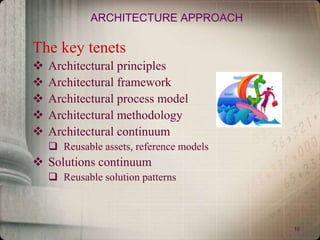
The key tenets
 Architectural principles
 Architectural framework
 Architectural process model
 Architectural methodology
 Architectural continuum
 Reusable assets, reference models
 Solutions continuum
 Reusable solution patterns
11
Key Tenet 1
ARCHITECTURAL PRINCIPLES
 Enterprise principles (overarching) provide basis for decision-
making
 Derived from enterprise mission, goals
 Influenced by external constraints, trends
 Existing systems and technology
 Guides the enterprise strategy
 Used to define the architecture governance process
 Apply to all architectural projects
 Examples:
 Interoperability
 Vendor independence
 Manageability
 Scalability
 Commonality of applications
12
Architectural Principles
Principles
Enterprise Architecture
Strategic
Plans
Business
Needs
IT Vision
Requirements &
Practices
Implications Actions
EA Policies &
Guidelines
-Development
-Use
-Maintenance
-Compliance
Systems Life Cycle
-Systems Migration
-Technology Insertion
-Dual Operations
-Deployment Plans
Capital Planning &
Investment Control
-Project Selection
-Project Control
-Project Evaluation
-Return on Investment
13
IT ARCHITECTURE PRINCIPLES
 Provide guidance on use and deployment of all IT
resources and assets across enterprise
 Viewpoint specific principles
 Apply when designing the architectural views for the
viewpoints of concern
 TOGAF template for principles
 Name
 Statement
 Rationale
 Implications
 Criteria of sound principles
14
Key Tenet 2
ARCHITECTURE FRAMEWORK
A comprehensive analytical model that facilitates
consideration of all relevant factors when modeling
architectures
 The enterprise viewpoint: principles, concerns, standards, guidelines,
stakeholders/actors
 Architecture viewpoints:
 Application
 Data
 Infrastructure
 Communications Engineering
 Enterprise Quality of Service
 Enterprise Security
 Enterprise Mobility
15
ARCHITECTURE FRAMEWORK
Model
Portfolio
Modeling
language
Purpose Concern/
Principle
Stake-
holder
Content Layer Aspect Standard Tool
Application
Data
Infra-
structure
Comm.
Eng
Quality
Security
Mobility
15
16
The Views
 Purpose- whether it aids by Informing, for Deciding, or for
Designing.
 Content - characterized by the three abstraction levels
where it resides: Details, Coherence, and Overview.
 Layer - where the view fits: Business, Application, and
Technology.
 Aspect - what the view depicts: Structure, Behavior, and
Information.
 Viewpoint language - the modeling notation or
representation scheme used.
 Standards - the best practices adopted when modeling a
view.
 Tool - automated capability used to model a view.
17
TOGAF 8.1 ADM Process Model
18
Strategic Planning and Architecture Processes
19
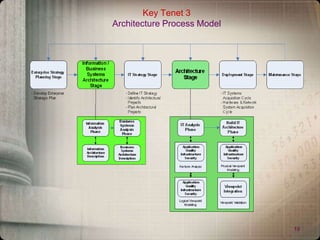
Key Tenet 3
Architecture Process Model
20
mapping between TOGAF 8.1 ADM and APM
TOGAF 8.1 ADM Stage (APM) Stage
Preliminary: Framework and
Principles
Pre-architectural
Architecture Vision IT Strategy
Business Architecture Information / Business Systems
Architecture
Information Systems
Architecture
Information / Business Systems
Architecture
Technical Architecture Architecture:
IT Analysis Phase
Build IT Architecture Phase
Opportunities and Solutions Architecture: IT Analysis Phase
Migration Planning Deployment
Implementation Governance IT Strategy, Deployment
Architecture Change
Management
Maintenance
21
Key Tenet 4
IT ARCHITECTURE METHODOLOGY
 Methods, techniques, procedures to support the
architectural processes
 Methodology prescribes representation schemes,
notations for modeling respective viewpoints for
Technical Architecture
 Context
 Structure
 Behavior
22
TEACHING IT SYSTEMS ARCHITECTURES
 The Pedagogy – suited to adult learners; working
professionals
 Measurable goals and objectives
 Objectives
 Explore leading edge approaches to development of
architectures
 Encourage awareness of de jure standards
 Enhance systemic thinking skills
 Enhance problem solving through systematic application of an
architectural approach
 Assure quality of architecture
 Align project-level outcomes with strategic IT objectives
 Theoretical and practical outcomes
23
SUMMARY
Key outcomes of pedagogy
 Understand and apply architecture approach
 Technical modeling competencies
 Enhanced managerial skills
 Improved interpersonal communication and collaborative
skills
 Ability to plan and develop an integrated architectural
solution to a complex real-world problem
24
Team Projects
 Applied Architecture Approach
 Adopt Team approach
 Based on real world case studies
 Project Sponsor
 Teams have developed several viewpoints
 Information
 Business Systems
 Application
 Physical IT Infrastructure
 Communications engineering viewpoint
 Enterprise Data
 Quality of Service
 Research on Enterprise Mobility Viewpoint
The Enterprise
Mobility Viewpoint
26
Agenda
 Introduction
 Enterprise Mobility
 The Enterprise Mobility Viewpoint
 Mobile Enterprise Architecture Research
 Conclusions
27
Introduction
North
America
Europe APAC
Latin
America
Number
teleworkers1 28M
W. Europe
19M
Japan 9M
APAC 11M
NA
Number
mobile
subscribers2
193M 551M 549M 162.3M
Mobile phone
penetration1 58% US
98% UK
45% Russia
76% S Korea
25% China
37% Brazil
Avaya, Data for 2004
28
Mobile Enterprise Vision
LAN
Enterprise LAN
Workstation
VPN Gateway
Authentication Server DHCP
Enterprise System
Mobile Application Servers
Firewall
DMZ Firewall
Database
Database
Web Server
Enterprise Wired/
Wireless LAN
Local Mobile Clients
Internet
Remote Wireless
LAN
Public Hotspot
Mobile Client
Carrier Network
Wireless Gateway
Mobile Clients
Enterprise
29
What is Enterprise Mobility ?
Is it a softphone ? Is it a hot desk ?
Is it a laptop ?
Is it a PDA?
Is it a mobile phone ? Is it speech access ?
Enterprise mobility is all the above, and more
Roaming
Nomadic
Deskbound Teleworking
80-90% of employees are mobile
to varying degrees
Fixed Mobile
Semi-
Mobile
Less than 20%
deskbound
Less than 30%
road warriors
30
VME Mobile Systems
31
Conceptual MEA Model
Updated from IEEE P1471-2000
32
Problem Modeler
-Stakeholder Concerns
Mobile
Business
Users,
Planners,
Business Management
Mobile
Data
Database Designers,
Administrators,
System Engineers
Mobile
Application
System and
Software Engineers
Mobile
Infrastructure
Acquirers, Operators,
Administrators,
Managers
33
The ME Viewpoints and Views
Stakeholders Users,
Planners,
Business Management
Database Designers,
Administrators,
System Engineers
System and
Software Engineers
Acquirers,
Operators,
Administrators,
Managers
Mobility Sub-
Viewpoints
m-Business
Sub-Viewpoint
m-Data
Sub-Viewpoint
m-Applications
Sub-Viewpoint
m-Infrastructure
Sub-Viewpoint
Views Strategy Objectives
and Goals
Process, Workflow,
Function, Services,
Location, Usability
Performance
Rules, Events
m-Information
m-Communication
People (enterprise
chart), Finance
m-Data Entity, m-Data
Flow (Mobile
Enterprise Data Use),
Logical Data
Software
Engineering,
m-Applications
Interoperability,
Software
Distribution
Mobile
Computing/
Hardware,
m-
Communication
Engineering,
Processing, Cost
Special
Viewpoints
m-Security Viewpoint
m-Quality Viewpoint
34
Research on MEAF
35
TOGAF ADM and MEAF
36
Mobility TRM
Modified Technical Reference Model from TOGAF
Gra
phic
s &
Ima
m-
Dat
a
m-
Dat
a
Syst
em
&
Net
wor
Glo
bal
Roa
Loc
atio
n &
Dire
m-
Sec
Mob
ile
Use
r
Tra
nsa
ctio
m-Infrastructure
Applications
m-Business
Applications
Soft
war
e
m-Application Programming Interface
Mobile
Graphics
&
Imaging
Services
m-Data
Management
Services
Mobile Network Services
Mobile Operating Systems
m-Communication Infrastructure Interface
m-Communication Infrastructure
m-Data
Interchange
Services
Global
Roaming
Services
Mobile
User
Interface
(MUI)
Services
Location
&
Directory
Services
Mobile
Transaction
Processing
Services
Mobile
System
&
Network
Management
Mobile
Security
Software
Engineering
Services
37
MEA Models
MEA Requirements Models
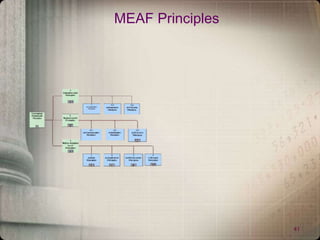
MEAF Principles
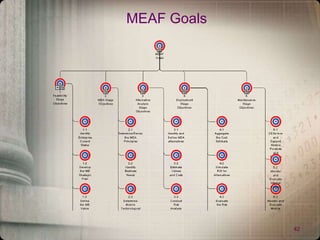
MEAF Goals
Five Stage MEA Process Model
MEA Value Web
MEA Deployment Models
MEAF Deliverables
MEA Stage Activities
MEA Mobile Initiative Process
More Models Created in Proforma ProVision
38
Requirement Modeler
-VME System Requirements
39
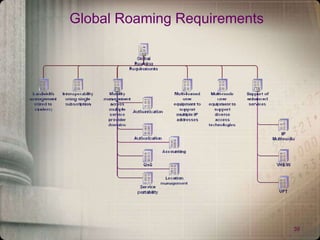
Global Roaming Requirements
40
Mobile Technology Requirements
41
MEAF Principles
42
MEAF Goals
43
Five Stage MEA Process Model
44
MEA Value Web
Employees Customers
Partners Suppliers
ENTERPRISE
ENTERPRISE
45
MEA Stage Activities
46
MEA Deployment Model
47
VME m-Information Criteria
48
m-Business Process Improvement Pilot Project
49
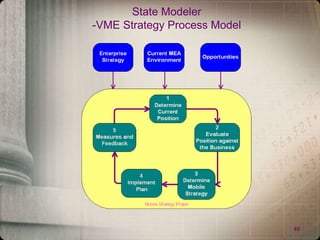
State Modeler
-VME Strategy Process Model
50
Strategy Modeler
- m-Business Process Improvement Pilot Project
51
Problem Modeler
-Mobile Solution Variances
52
MEAF Deliverables
53
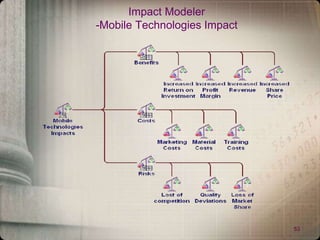
Impact Modeler
-Mobile Technologies Impact
54
MEA Mobile Initiative Process
55
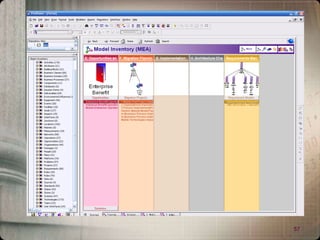
Modeling Tool – Proforma ProVision
56
57

MIS.ppt

  • 1.
  • 2.
    2 PRESENTATION FORMAT  Introduction Architectural Approach  The Enterprise Mobility Viewpoint  Conclusions
  • 3.
    3 Architectural approach INTRODUCTION  Enterprisesand IT systems are complex  Modeling of enterprise and IT architectures is a complex process  Teaching architectures is a challenge  Consists of a hierarchy of architectural models  Technical architectures modeled from various perspectives  Several approaches, frameworks, methodologies, process models  There is a comprehensive Body of Knowledge
  • 4.
    4 Definitions Several definitions usedfor  Enterprise architecture  IT (technical, technology) architecture  Viewpoints, Views  Framework
  • 5.
    5 Definitions - EnterpriseArchitecture USA Federal CIO Council: “Enterprise architecture is a strategic information asset base which defines the business mission, the information necessary to perform the mission, and the transitional processes for implementing new technologies in response to the changing mission needs”. Meta Group: “Enterprise architecture is the holistic expression of an organization’s key business, information, application and technology strategies and their impact on business functions and processes”. The Open Group: “Enterprise architecture is about understanding all of the different elements that go to make up the enterprise and how those elements inter-relate”.
  • 6.
    6 Definition - Architecture IEEEP1471-2000 Definition: “An architecture is the fundamental organization of a system embodied in its components, their relationships to each other, and to the environment, and the principles guiding its design and evolution”.
  • 7.
    7 IT architecture A pragmatic,coherent, and elegant structuring of a collection of IT components that support business processes the “user”, in conformance with factors such as: External constraints User/Client requirements Internal constraints Technological constraints Financial constraints Legal constraints
  • 8.
    8 IT System An ITsystem consists of a combination of IT resources (HW, SW, infrastructure) and the services they deliver for an enterprise Developed following the systems approach which focuses on the system as a whole A system is a set of elements so connected or related as to perform a unique function not performable by the elements alone
  • 9.
    9 ARCHITECTURE APPROACH The ITarchitecture must  Meet the strategic goals and objectives of the enterprise  Represent the IT strategy of the enterprise  Enable the organization to respond to new trends, drivers, technologies, i.e. be agile  Be designed based on sound principles  Must be well documented
  • 10.
    10 ARCHITECTURE APPROACH The keytenets  Architectural principles  Architectural framework  Architectural process model  Architectural methodology  Architectural continuum  Reusable assets, reference models  Solutions continuum  Reusable solution patterns
  • 11.
    11 Key Tenet 1 ARCHITECTURALPRINCIPLES  Enterprise principles (overarching) provide basis for decision- making  Derived from enterprise mission, goals  Influenced by external constraints, trends  Existing systems and technology  Guides the enterprise strategy  Used to define the architecture governance process  Apply to all architectural projects  Examples:  Interoperability  Vendor independence  Manageability  Scalability  Commonality of applications
  • 12.
    12 Architectural Principles Principles Enterprise Architecture Strategic Plans Business Needs ITVision Requirements & Practices Implications Actions EA Policies & Guidelines -Development -Use -Maintenance -Compliance Systems Life Cycle -Systems Migration -Technology Insertion -Dual Operations -Deployment Plans Capital Planning & Investment Control -Project Selection -Project Control -Project Evaluation -Return on Investment
  • 13.
    13 IT ARCHITECTURE PRINCIPLES Provide guidance on use and deployment of all IT resources and assets across enterprise  Viewpoint specific principles  Apply when designing the architectural views for the viewpoints of concern  TOGAF template for principles  Name  Statement  Rationale  Implications  Criteria of sound principles
  • 14.
    14 Key Tenet 2 ARCHITECTUREFRAMEWORK A comprehensive analytical model that facilitates consideration of all relevant factors when modeling architectures  The enterprise viewpoint: principles, concerns, standards, guidelines, stakeholders/actors  Architecture viewpoints:  Application  Data  Infrastructure  Communications Engineering  Enterprise Quality of Service  Enterprise Security  Enterprise Mobility
  • 15.
    15 ARCHITECTURE FRAMEWORK Model Portfolio Modeling language Purpose Concern/ Principle Stake- holder ContentLayer Aspect Standard Tool Application Data Infra- structure Comm. Eng Quality Security Mobility 15
  • 16.
    16 The Views  Purpose-whether it aids by Informing, for Deciding, or for Designing.  Content - characterized by the three abstraction levels where it resides: Details, Coherence, and Overview.  Layer - where the view fits: Business, Application, and Technology.  Aspect - what the view depicts: Structure, Behavior, and Information.  Viewpoint language - the modeling notation or representation scheme used.  Standards - the best practices adopted when modeling a view.  Tool - automated capability used to model a view.
  • 17.
    17 TOGAF 8.1 ADMProcess Model
  • 18.
    18 Strategic Planning andArchitecture Processes
  • 19.
  • 20.
    20 mapping between TOGAF8.1 ADM and APM TOGAF 8.1 ADM Stage (APM) Stage Preliminary: Framework and Principles Pre-architectural Architecture Vision IT Strategy Business Architecture Information / Business Systems Architecture Information Systems Architecture Information / Business Systems Architecture Technical Architecture Architecture: IT Analysis Phase Build IT Architecture Phase Opportunities and Solutions Architecture: IT Analysis Phase Migration Planning Deployment Implementation Governance IT Strategy, Deployment Architecture Change Management Maintenance
  • 21.
    21 Key Tenet 4 ITARCHITECTURE METHODOLOGY  Methods, techniques, procedures to support the architectural processes  Methodology prescribes representation schemes, notations for modeling respective viewpoints for Technical Architecture  Context  Structure  Behavior
  • 22.
    22 TEACHING IT SYSTEMSARCHITECTURES  The Pedagogy – suited to adult learners; working professionals  Measurable goals and objectives  Objectives  Explore leading edge approaches to development of architectures  Encourage awareness of de jure standards  Enhance systemic thinking skills  Enhance problem solving through systematic application of an architectural approach  Assure quality of architecture  Align project-level outcomes with strategic IT objectives  Theoretical and practical outcomes
  • 23.
    23 SUMMARY Key outcomes ofpedagogy  Understand and apply architecture approach  Technical modeling competencies  Enhanced managerial skills  Improved interpersonal communication and collaborative skills  Ability to plan and develop an integrated architectural solution to a complex real-world problem
  • 24.
    24 Team Projects  AppliedArchitecture Approach  Adopt Team approach  Based on real world case studies  Project Sponsor  Teams have developed several viewpoints  Information  Business Systems  Application  Physical IT Infrastructure  Communications engineering viewpoint  Enterprise Data  Quality of Service  Research on Enterprise Mobility Viewpoint
  • 25.
  • 26.
    26 Agenda  Introduction  EnterpriseMobility  The Enterprise Mobility Viewpoint  Mobile Enterprise Architecture Research  Conclusions
  • 27.
    27 Introduction North America Europe APAC Latin America Number teleworkers1 28M W.Europe 19M Japan 9M APAC 11M NA Number mobile subscribers2 193M 551M 549M 162.3M Mobile phone penetration1 58% US 98% UK 45% Russia 76% S Korea 25% China 37% Brazil Avaya, Data for 2004
  • 28.
    28 Mobile Enterprise Vision LAN EnterpriseLAN Workstation VPN Gateway Authentication Server DHCP Enterprise System Mobile Application Servers Firewall DMZ Firewall Database Database Web Server Enterprise Wired/ Wireless LAN Local Mobile Clients Internet Remote Wireless LAN Public Hotspot Mobile Client Carrier Network Wireless Gateway Mobile Clients Enterprise
  • 29.
    29 What is EnterpriseMobility ? Is it a softphone ? Is it a hot desk ? Is it a laptop ? Is it a PDA? Is it a mobile phone ? Is it speech access ? Enterprise mobility is all the above, and more Roaming Nomadic Deskbound Teleworking 80-90% of employees are mobile to varying degrees Fixed Mobile Semi- Mobile Less than 20% deskbound Less than 30% road warriors
  • 30.
  • 31.
    31 Conceptual MEA Model Updatedfrom IEEE P1471-2000
  • 32.
    32 Problem Modeler -Stakeholder Concerns Mobile Business Users, Planners, BusinessManagement Mobile Data Database Designers, Administrators, System Engineers Mobile Application System and Software Engineers Mobile Infrastructure Acquirers, Operators, Administrators, Managers
  • 33.
    33 The ME Viewpointsand Views Stakeholders Users, Planners, Business Management Database Designers, Administrators, System Engineers System and Software Engineers Acquirers, Operators, Administrators, Managers Mobility Sub- Viewpoints m-Business Sub-Viewpoint m-Data Sub-Viewpoint m-Applications Sub-Viewpoint m-Infrastructure Sub-Viewpoint Views Strategy Objectives and Goals Process, Workflow, Function, Services, Location, Usability Performance Rules, Events m-Information m-Communication People (enterprise chart), Finance m-Data Entity, m-Data Flow (Mobile Enterprise Data Use), Logical Data Software Engineering, m-Applications Interoperability, Software Distribution Mobile Computing/ Hardware, m- Communication Engineering, Processing, Cost Special Viewpoints m-Security Viewpoint m-Quality Viewpoint
  • 34.
  • 35.
  • 36.
    36 Mobility TRM Modified TechnicalReference Model from TOGAF Gra phic s & Ima m- Dat a m- Dat a Syst em & Net wor Glo bal Roa Loc atio n & Dire m- Sec Mob ile Use r Tra nsa ctio m-Infrastructure Applications m-Business Applications Soft war e m-Application Programming Interface Mobile Graphics & Imaging Services m-Data Management Services Mobile Network Services Mobile Operating Systems m-Communication Infrastructure Interface m-Communication Infrastructure m-Data Interchange Services Global Roaming Services Mobile User Interface (MUI) Services Location & Directory Services Mobile Transaction Processing Services Mobile System & Network Management Mobile Security Software Engineering Services
  • 37.
    37 MEA Models MEA RequirementsModels MEAF Principles MEAF Goals Five Stage MEA Process Model MEA Value Web MEA Deployment Models MEAF Deliverables MEA Stage Activities MEA Mobile Initiative Process More Models Created in Proforma ProVision
  • 38.
  • 39.
  • 40.
  • 41.
  • 42.
  • 43.
    43 Five Stage MEAProcess Model
  • 44.
    44 MEA Value Web EmployeesCustomers Partners Suppliers ENTERPRISE ENTERPRISE
  • 45.
  • 46.
  • 47.
  • 48.
  • 49.
  • 50.
    50 Strategy Modeler - m-BusinessProcess Improvement Pilot Project
  • 51.
  • 52.
  • 53.
  • 54.
  • 55.
    55 Modeling Tool –Proforma ProVision
  • 56.
  • 57.