CONSULTINGEnterprise ArchitectureThe Business Analysts RoadmapImre Hegedus© ImreHegedus Consulting 2011Business Analyst World – MELBOURNE – June 2011
Presentation OutlineIntroduction – roles and perspectivesEnterprise Architecture – Description and BenefitsWorking TogetherBusiness Analysts, Enterprise Architects and EAThe EA PracticeElements and FactorsMaturityQuestions and Discussion2© Imre Hegedus Consulting – All Rights ReservedBA World - June 2011 - MELBOURNE
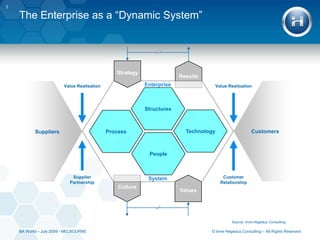
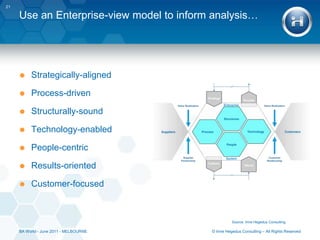
3© Imre Hegedus Consulting – All Rights ReservedThe Enterprise as a “Dynamic System”StrategyResultsCustomersEnterpriseSystem     SuppliersValue RealisationValue Realisation     SuppliersCustomersStructuresTechnologyProcessPeopleSupplierPartnershipCustomerRelationshipCultureValuesSource: Imre Hegedus ConsultingBA World – July 2009 - MELBOURNE
Role of the Business Analyst“Business Analysis as a term provides a collective umbrella for professionals working in the areas of Commercial, Process, Technical and Systems Analysis.”www.abaa.org.au“Reviews, analyses and evaluates business requirements, user needs and functions, using accredited methodologies and supporting software, with the objective of improving business processes and procedures.”www.youthcentral.vic.gov.au"A business analyst works as a liaison among stakeholders in order to elicit, analyze, communicate and validate requirements for changes to business processes, policies and information systems. The business analyst understands business problems and opportunities in the context of the requirements and recommends solutions that enable the organization to achieve its goals.“www.iiba.org4© Imre Hegedus Consulting – All Rights ReservedBA World – July 2009 - MELBOURNE
Role of the Enterprise Architect“Enterprise Architects work with stakeholders, both leadership and subject matter experts, to build a holistic view of the organisation’s strategy, processes, information, and information technology assets. The role of the Enterprise Architect is to take this knowledge and ensure that the business and IT are in alignment.”www.wikipedia.org“The role of the architect can be summarised as to:“Understand and interpret requirementsCreate a useful modelValidate, refine, and expand the modelManage the architecture.”TOGAF v9 ”An EA’s role is to translate business requirements into capabilities that can be cost-effectively implemented, predictably managed, and reliably controlled.“www.zapthink.com5© ImreHegedus Consulting – All Rights ReservedBA World – July 2009 - MELBOURNE
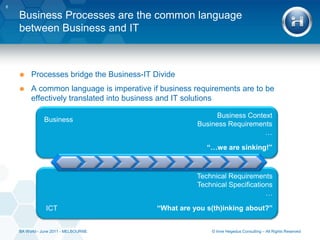
Business Processes are the common language between Business and IT6© Imre Hegedus Consulting – All Rights ReservedBA World - June 2011 - MELBOURNEProcesses bridge the Business-IT Divide
A common language is imperative if business requirements are to be effectively translated into business and IT solutionsBusiness ContextBusiness Requirements…“…we are sinking!”BusinessTechnical RequirementsTechnical Specifications…“What are you s(th)inking about?”ICT
Enterprise architectureThe Enterprise as a Dynamic System7BA World - June 2011 - MELBOURNE© Imre Hegedus Consulting – All Rights Reserved
Enterprise Architecture“A rigorous description of the structure of an enterprise, which comprises enterprise component, the externally visible properties of those components, and the relationships between them. This description is comprehensive, including enterprise goals, business process, roles, organisational structures, organisationalbehaviours, bsuiness information, software applications, and computer systems.”www.wikipedia.org“The fundamental organisation of a system, embodied in its components, their relationships to each other and the environment, and the principles governing its design and evolution.”ISO/IEC 42010:2007TOGAF embraces and extends this definition:1.A formal description of a system, or a detailed plan of the system at a component level to guide its implementation2.The structure of components, their inter-relationships, and the principles and guidelines governing their design and evolution over time8© Imre Hegedus Consulting – All Rights ReservedBA World – July 2009 - MELBOURNE
Enterprise Architecture BenefitsBusiness and IT AlignmentImproves Interoperability and IntegrationEnables AgilityReduces CostsImproves SecurityReduces Technical Risk…the impact of change can be easier to articulate and can be achieved with a much faster turnaround than traditional methods for impact assessment and gap analysis…An EA provides the blueprint of the current state, helps to identify the specific areas most affected by the change and then sets up a blueprint to transition to the future state.Ross and Petley (2006)9© ImreHegedus Consulting – All Rights ReservedBA World - June 2011 - MELBOURNE
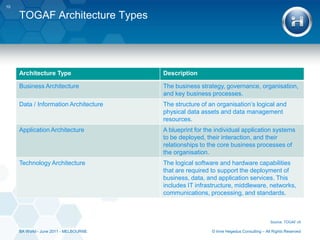
TOGAF Architecture Types10© Imre Hegedus Consulting – All Rights ReservedBA World - June 2011 - MELBOURNESource: TOGAF v9
Working togetherImproving and Managing the Enterprise11BA World - June 2011 - MELBOURNE© Imre Hegedus Consulting – All Rights Reserved
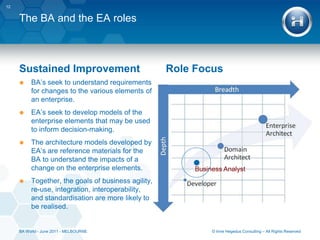
The BA and the EA rolesSustained ImprovementBA’s seek to understand requirements for changes to the various elements of an enterprise.EA’s seek to develop models of the enterprise elements that may be used to inform decision-making.The architecture models developed by EA’s are reference materials for the BA to understand the impacts of a change on the enterprise elements.Together, the goals of business agility, re-use, integration, interoperability, and standardisation are more likely to be realised.Role Focus12BA World - June 2011 - MELBOURNE© Imre Hegedus Consulting – All Rights ReservedBusiness Analyst
The BA and the EA together…“Most organizations separate the roles of the BA and EA. However, organizations that are looking to maximize the benefit they receive from SOA and other architecturally-driven IT efforts should think more holistically about either combining the EA and BA responsibilities in the business or creating a new organizational structure that puts the business analysis and enterprise architecture roles into more intimate contact.”“The Business Analyst vs. the Enterprise Architect” by Ronald Schmelzer (2008) 13© Imre Hegedus Consulting – All Rights ReservedBA World - June 2011 - MELBOURNE
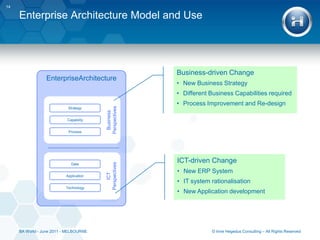
Enterprise Architecture Model and Use14© Imre Hegedus Consulting – All Rights ReservedBA World - June 2011 - MELBOURNEBusiness-driven ChangeNew Business Strategy
Different Business Capabilities required
Process Improvement and Re-designEnterpriseArchitectureBusinessPerspectives StrategyCapabilityProcessICTPerspectivesICT-driven ChangeNew ERP System
IT system rationalisation
New Application developmentDataApplicationTechnology
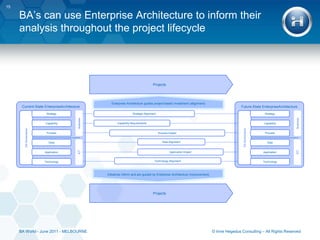
BA’s can use Enterprise Architecture to inform their analysis throughout the project lifecycle15© Imre Hegedus Consulting – All Rights ReservedBA World - June 2011 - MELBOURNEEnterprise Architecture guides project-based investment (alignment)ProjectsInitiatives inform and are guided by Enterprise Architecture (improvement)Future-State EnterpriseArchitectureCurrent-State EnterpriseArchitectureStrategyStrategyBusiness Business CapabilityCapabilityProcessProcessEA GovernanceEA GovernanceDataDataICTICTApplicationApplicationStrategic AlignmentTechnologyTechnologyCapability RequirementsProcess ImpactProjectsData AlignmentApplication ImpactTechnology Alignment
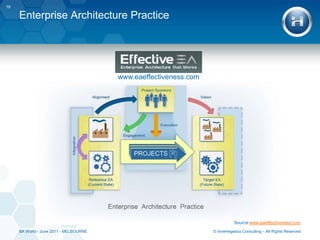
The EA PracticeEffective Enterprise Architecture16BA World - June 2011 - MELBOURNE© Imre Hegedus Consulting – All Rights Reserved
EA Practice ElementsCurrent-State EAThe EA artifacts including both he Business and Technology layersFuture-State EAViews of the target architecture at different horizonsEA GovernanceGovernance of the EA domains and layers to ensure vertical integrationIntegrated Program ManagementInitiatives that are managed to inform and be informed by the current-state and future-state architectural viewsEA Practice GovernanceGovernance of the EA models in line with the Enterprise works program17© Imre Hegedus Consulting – All Rights ReservedBA World - June 2011 - MELBOURNE
EA Practice FactorsIntegrationIntegration of the Enterprise Architecture elements themselvesAlignmentAlignment between Enterprise Architecture and the needs of the Project SponsorsEngagementUse of Enterprise Architecture in decision-making by Project SponsorsVisionDegree to which initiatives consciously move toward an agreed future-state Enterprise ArchitectureExecutionUse of Enterprise Architecture throughout the projects themselves18© ImreHegedus Consulting – All Rights ReservedBA World - June 2011 - MELBOURNE

BA World Presentation - Melb June 2011

  • 1.
    CONSULTINGEnterprise ArchitectureThe BusinessAnalysts RoadmapImre Hegedus© ImreHegedus Consulting 2011Business Analyst World – MELBOURNE – June 2011
  • 2.
    Presentation OutlineIntroduction –roles and perspectivesEnterprise Architecture – Description and BenefitsWorking TogetherBusiness Analysts, Enterprise Architects and EAThe EA PracticeElements and FactorsMaturityQuestions and Discussion2© Imre Hegedus Consulting – All Rights ReservedBA World - June 2011 - MELBOURNE
  • 3.
    3© Imre HegedusConsulting – All Rights ReservedThe Enterprise as a “Dynamic System”StrategyResultsCustomersEnterpriseSystem SuppliersValue RealisationValue Realisation SuppliersCustomersStructuresTechnologyProcessPeopleSupplierPartnershipCustomerRelationshipCultureValuesSource: Imre Hegedus ConsultingBA World – July 2009 - MELBOURNE
  • 4.
    Role of theBusiness Analyst“Business Analysis as a term provides a collective umbrella for professionals working in the areas of Commercial, Process, Technical and Systems Analysis.”www.abaa.org.au“Reviews, analyses and evaluates business requirements, user needs and functions, using accredited methodologies and supporting software, with the objective of improving business processes and procedures.”www.youthcentral.vic.gov.au"A business analyst works as a liaison among stakeholders in order to elicit, analyze, communicate and validate requirements for changes to business processes, policies and information systems. The business analyst understands business problems and opportunities in the context of the requirements and recommends solutions that enable the organization to achieve its goals.“www.iiba.org4© Imre Hegedus Consulting – All Rights ReservedBA World – July 2009 - MELBOURNE
  • 5.
    Role of theEnterprise Architect“Enterprise Architects work with stakeholders, both leadership and subject matter experts, to build a holistic view of the organisation’s strategy, processes, information, and information technology assets. The role of the Enterprise Architect is to take this knowledge and ensure that the business and IT are in alignment.”www.wikipedia.org“The role of the architect can be summarised as to:“Understand and interpret requirementsCreate a useful modelValidate, refine, and expand the modelManage the architecture.”TOGAF v9 ”An EA’s role is to translate business requirements into capabilities that can be cost-effectively implemented, predictably managed, and reliably controlled.“www.zapthink.com5© ImreHegedus Consulting – All Rights ReservedBA World – July 2009 - MELBOURNE
  • 6.
    Business Processes arethe common language between Business and IT6© Imre Hegedus Consulting – All Rights ReservedBA World - June 2011 - MELBOURNEProcesses bridge the Business-IT Divide
  • 7.
    A common languageis imperative if business requirements are to be effectively translated into business and IT solutionsBusiness ContextBusiness Requirements…“…we are sinking!”BusinessTechnical RequirementsTechnical Specifications…“What are you s(th)inking about?”ICT
  • 8.
    Enterprise architectureThe Enterpriseas a Dynamic System7BA World - June 2011 - MELBOURNE© Imre Hegedus Consulting – All Rights Reserved
  • 9.
    Enterprise Architecture“A rigorousdescription of the structure of an enterprise, which comprises enterprise component, the externally visible properties of those components, and the relationships between them. This description is comprehensive, including enterprise goals, business process, roles, organisational structures, organisationalbehaviours, bsuiness information, software applications, and computer systems.”www.wikipedia.org“The fundamental organisation of a system, embodied in its components, their relationships to each other and the environment, and the principles governing its design and evolution.”ISO/IEC 42010:2007TOGAF embraces and extends this definition:1.A formal description of a system, or a detailed plan of the system at a component level to guide its implementation2.The structure of components, their inter-relationships, and the principles and guidelines governing their design and evolution over time8© Imre Hegedus Consulting – All Rights ReservedBA World – July 2009 - MELBOURNE
  • 10.
    Enterprise Architecture BenefitsBusinessand IT AlignmentImproves Interoperability and IntegrationEnables AgilityReduces CostsImproves SecurityReduces Technical Risk…the impact of change can be easier to articulate and can be achieved with a much faster turnaround than traditional methods for impact assessment and gap analysis…An EA provides the blueprint of the current state, helps to identify the specific areas most affected by the change and then sets up a blueprint to transition to the future state.Ross and Petley (2006)9© ImreHegedus Consulting – All Rights ReservedBA World - June 2011 - MELBOURNE
  • 11.
    TOGAF Architecture Types10©Imre Hegedus Consulting – All Rights ReservedBA World - June 2011 - MELBOURNESource: TOGAF v9
  • 12.
    Working togetherImproving andManaging the Enterprise11BA World - June 2011 - MELBOURNE© Imre Hegedus Consulting – All Rights Reserved
  • 13.
    The BA andthe EA rolesSustained ImprovementBA’s seek to understand requirements for changes to the various elements of an enterprise.EA’s seek to develop models of the enterprise elements that may be used to inform decision-making.The architecture models developed by EA’s are reference materials for the BA to understand the impacts of a change on the enterprise elements.Together, the goals of business agility, re-use, integration, interoperability, and standardisation are more likely to be realised.Role Focus12BA World - June 2011 - MELBOURNE© Imre Hegedus Consulting – All Rights ReservedBusiness Analyst
  • 14.
    The BA andthe EA together…“Most organizations separate the roles of the BA and EA. However, organizations that are looking to maximize the benefit they receive from SOA and other architecturally-driven IT efforts should think more holistically about either combining the EA and BA responsibilities in the business or creating a new organizational structure that puts the business analysis and enterprise architecture roles into more intimate contact.”“The Business Analyst vs. the Enterprise Architect” by Ronald Schmelzer (2008) 13© Imre Hegedus Consulting – All Rights ReservedBA World - June 2011 - MELBOURNE
  • 15.
    Enterprise Architecture Modeland Use14© Imre Hegedus Consulting – All Rights ReservedBA World - June 2011 - MELBOURNEBusiness-driven ChangeNew Business Strategy
  • 16.
  • 17.
    Process Improvement andRe-designEnterpriseArchitectureBusinessPerspectives StrategyCapabilityProcessICTPerspectivesICT-driven ChangeNew ERP System
  • 18.
  • 19.
  • 20.
    BA’s can useEnterprise Architecture to inform their analysis throughout the project lifecycle15© Imre Hegedus Consulting – All Rights ReservedBA World - June 2011 - MELBOURNEEnterprise Architecture guides project-based investment (alignment)ProjectsInitiatives inform and are guided by Enterprise Architecture (improvement)Future-State EnterpriseArchitectureCurrent-State EnterpriseArchitectureStrategyStrategyBusiness Business CapabilityCapabilityProcessProcessEA GovernanceEA GovernanceDataDataICTICTApplicationApplicationStrategic AlignmentTechnologyTechnologyCapability RequirementsProcess ImpactProjectsData AlignmentApplication ImpactTechnology Alignment
  • 21.
    The EA PracticeEffectiveEnterprise Architecture16BA World - June 2011 - MELBOURNE© Imre Hegedus Consulting – All Rights Reserved
  • 22.
    EA Practice ElementsCurrent-StateEAThe EA artifacts including both he Business and Technology layersFuture-State EAViews of the target architecture at different horizonsEA GovernanceGovernance of the EA domains and layers to ensure vertical integrationIntegrated Program ManagementInitiatives that are managed to inform and be informed by the current-state and future-state architectural viewsEA Practice GovernanceGovernance of the EA models in line with the Enterprise works program17© Imre Hegedus Consulting – All Rights ReservedBA World - June 2011 - MELBOURNE
  • 23.
    EA Practice FactorsIntegrationIntegrationof the Enterprise Architecture elements themselvesAlignmentAlignment between Enterprise Architecture and the needs of the Project SponsorsEngagementUse of Enterprise Architecture in decision-making by Project SponsorsVisionDegree to which initiatives consciously move toward an agreed future-state Enterprise ArchitectureExecutionUse of Enterprise Architecture throughout the projects themselves18© ImreHegedus Consulting – All Rights ReservedBA World - June 2011 - MELBOURNE