Introduction to Enterprise
Architecture
EA Presentation
prepared By
Mohammed Omar Abdulrahman
Topics:
 Introduction.
 Enterprise Architecture definition.
 Enterprise Architecture frameworks.
 Enterprise Architecture Lifecycle.
 Enterprise Architecture benefits
 Enterprise Architecture challenges
 Enterprise Architecture driven
approach for IT strategy.
Introduction
Any Enterprise can achieve good Maturity level in its IT
operation and services if they have the following
1. The clear mission and vision that adopt ICT as success
factor
2. Management support and commitment to the Enterprise
mission and vision
3. The adoption of an Enterprise Architecture standard
framework (TOGAF ,Zachman,…..)
What is Enterprise
Architecture ?
There are many definitions of enterprise architecture. Most focus
on structure and organization. Two definitions are given below
 The organizing logic for business processes and IT
infrastructure reflecting the integration and standardization
requirements of the firm’s operating model.
 A conceptual blueprint that defines the structure and
operation of an organization. The intent of an enterprise
architecture is to determine how an organization can most
effectively achieve its current and future objectives.
Why do we Need Enterprise
Architecture?
The purpose of enterprise architecture is to optimize
across the enterprise the often fragmented legacy of
processes (both manual and automated) into an integrated
environment
. Effective management and exploitation of information
through IT is a key factor to business success, and An
enterprise architecture addresses this need, by providing a
strategic direction for IT activities.
Enterprise Architecture
frameworks
 What is an Architecture Framework?
 It is a tool that can be used for developing a broad range of
different architectures. It should describe a method for
designing an information system in terms of a set of
building blocks, and for showing how the building blocks
fit together.
 There are many enterprise-architecture frameworks none of
the enterprise-architecture methodologies is really
complete. Each has its strengths and weaknesses.
 Examples : TOGAF , ARIS , ZACHMAN ,CIMOSA
, DoD
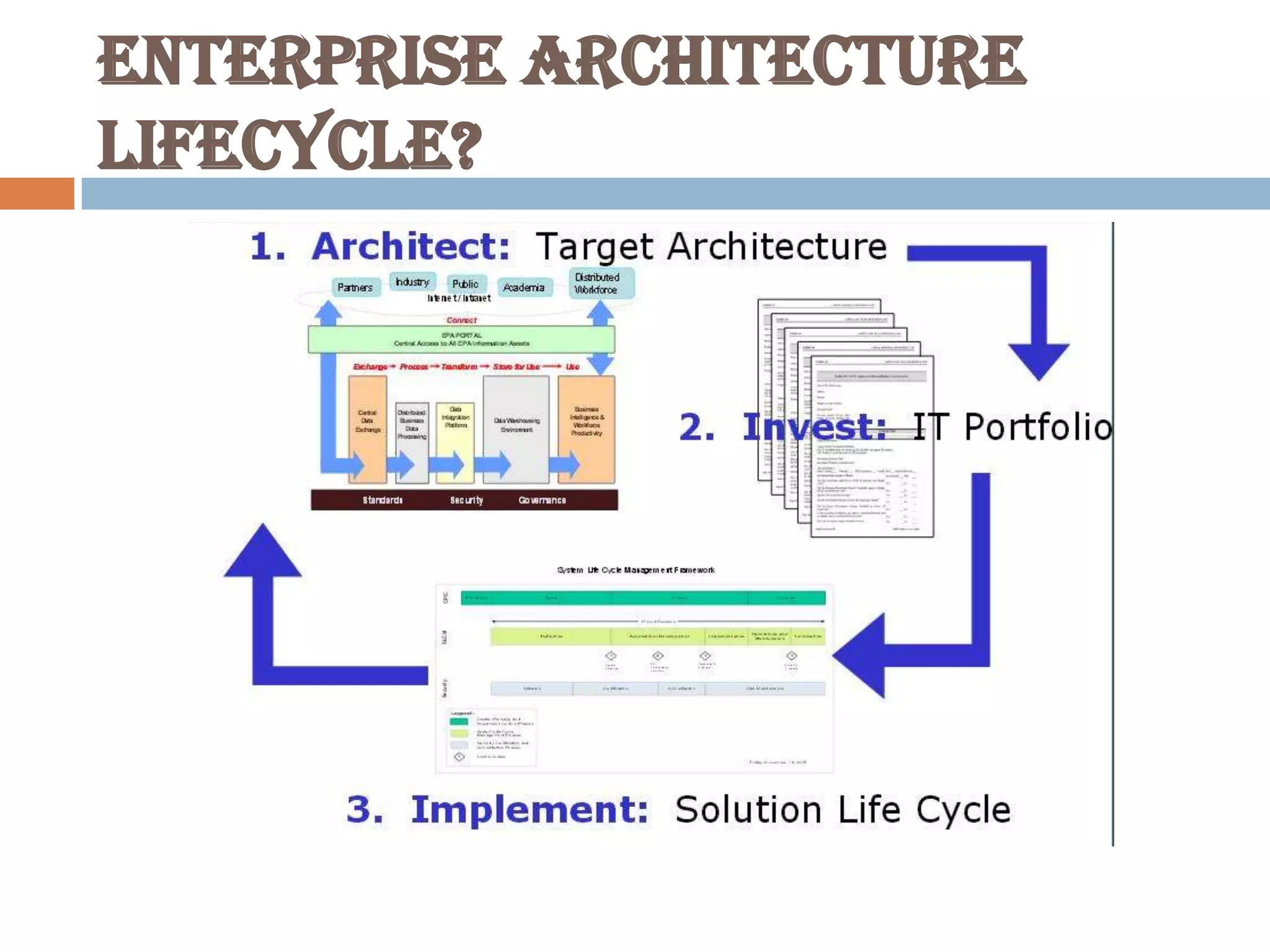
Enterprise Architecture
Lifecycle?
Enterprise Architecture
benefits
 Align IT with business
 efficient IT operation
 Better return on existing investment
 reduced risk for future investment
 Faster, simpler, and cheaper procurement
Enterprise Architecture
challenges
 Many EA frameworks , how to choose best fit?
 Lack of senior management support
 Lack of training
 Lack of patience, EA is ongoing iterative cycles.
EA driven approach for IT
strategy.
 IT strategy should be derived or inherited from business
strategic plan which help to achieve IT / Business alignment
To do so an enterprise must develop a mature Enterprise
Architecture roadmap which help in specifying IT future
needs.
Thank You

Introduction to Enterprise Architecture

  • 1.
    Introduction to Enterprise Architecture EAPresentation prepared By Mohammed Omar Abdulrahman
  • 2.
    Topics:  Introduction.  EnterpriseArchitecture definition.  Enterprise Architecture frameworks.  Enterprise Architecture Lifecycle.  Enterprise Architecture benefits  Enterprise Architecture challenges  Enterprise Architecture driven approach for IT strategy.
  • 3.
    Introduction Any Enterprise canachieve good Maturity level in its IT operation and services if they have the following 1. The clear mission and vision that adopt ICT as success factor 2. Management support and commitment to the Enterprise mission and vision 3. The adoption of an Enterprise Architecture standard framework (TOGAF ,Zachman,…..)
  • 4.
    What is Enterprise Architecture? There are many definitions of enterprise architecture. Most focus on structure and organization. Two definitions are given below  The organizing logic for business processes and IT infrastructure reflecting the integration and standardization requirements of the firm’s operating model.  A conceptual blueprint that defines the structure and operation of an organization. The intent of an enterprise architecture is to determine how an organization can most effectively achieve its current and future objectives.
  • 5.
    Why do weNeed Enterprise Architecture? The purpose of enterprise architecture is to optimize across the enterprise the often fragmented legacy of processes (both manual and automated) into an integrated environment . Effective management and exploitation of information through IT is a key factor to business success, and An enterprise architecture addresses this need, by providing a strategic direction for IT activities.
  • 6.
    Enterprise Architecture frameworks  Whatis an Architecture Framework?  It is a tool that can be used for developing a broad range of different architectures. It should describe a method for designing an information system in terms of a set of building blocks, and for showing how the building blocks fit together.  There are many enterprise-architecture frameworks none of the enterprise-architecture methodologies is really complete. Each has its strengths and weaknesses.  Examples : TOGAF , ARIS , ZACHMAN ,CIMOSA , DoD
  • 7.
  • 8.
    Enterprise Architecture benefits  AlignIT with business  efficient IT operation  Better return on existing investment  reduced risk for future investment  Faster, simpler, and cheaper procurement
  • 9.
    Enterprise Architecture challenges  ManyEA frameworks , how to choose best fit?  Lack of senior management support  Lack of training  Lack of patience, EA is ongoing iterative cycles.
  • 10.
    EA driven approachfor IT strategy.  IT strategy should be derived or inherited from business strategic plan which help to achieve IT / Business alignment To do so an enterprise must develop a mature Enterprise Architecture roadmap which help in specifying IT future needs.
  • 11.