ENTERPRISE ARCHITECTURE
Presented by: PRASHANTH B PANDURANGA
DIRECTOR OF TECHNOLOGY
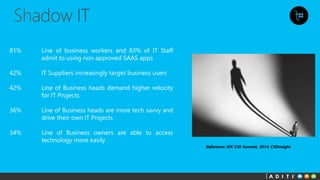
81% Line of business workers and 83% of IT Staff
admit to using non approved SAAS apps
42% IT Suppliers increasingly target business users
42% Line of Business heads demand higher velocity
for IT Projects
36% Line of Business heads are more tech savvy and
drive their own IT Projects
34% Line of Business owners are able to access
technology more easily
Reference: IDC CIO Summit, 2014, CIOInsight
4
5
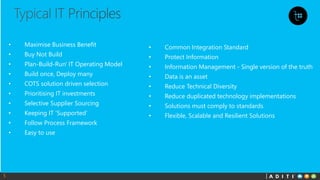
• Maximise Business Benefit
• Buy Not Build
• Plan-Build-Run' IT Operating Model
• Build once, Deploy many
• COTS solution driven selection
• Prioritising IT investments
• Selective Supplier Sourcing
• Keeping IT 'Supported’
• Follow Process Framework
• Easy to use
• Common Integration Standard
• Protect Information
• Information Management - Single version of the truth
• Data is an asset
• Reduce Technical Diversity
• Reduce duplicated technology implementations
• Solutions must comply to standards
• Flexible, Scalable and Resilient Solutions
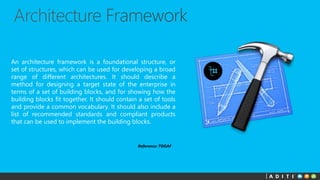
An architecture framework is a foundational structure, or
set of structures, which can be used for developing a broad
range of different architectures. It should describe a
method for designing a target state of the enterprise in
terms of a set of building blocks, and for showing how the
building blocks fit together. It should contain a set of tools
and provide a common vocabulary. It should also include a
list of recommended standards and compliant products
that can be used to implement the building blocks.
Reference: TOGAF
7
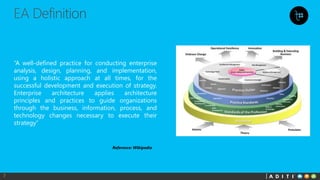
“A well-defined practice for conducting enterprise
analysis, design, planning, and implementation,
using a holistic approach at all times, for the
successful development and execution of strategy.
Enterprise architecture applies architecture
principles and practices to guide organizations
through the business, information, process, and
technology changes necessary to execute their
strategy”
Reference: Wikipedia
8
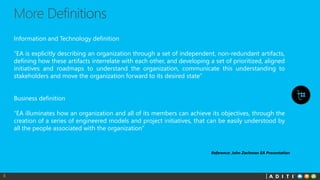
Information and Technology definition
“EA is explicitly describing an organization through a set of independent, non-redundant artifacts,
defining how these artifacts interrelate with each other, and developing a set of prioritized, aligned
initiatives and roadmaps to understand the organization, communicate this understanding to
stakeholders and move the organization forward to its desired state”
Business definition
“EA illuminates how an organization and all of its members can achieve its objectives, through the
creation of a series of engineered models and project initiatives, that can be easily understood by
all the people associated with the organization”
Reference: John Zachman EA Presentation
9
10
11
• Increase IT operation efficiency
• Better return on existing investment, reduced risk for
future investment
• Faster, simpler, and cheaper procurement
• Improve Performance and embrace emerging
technologies that support the business
• Business-IT Alignment
• Reduced time to market
• Reduced decision risk
• Take advantage of new technology innovations
• Service-Oriented architecture
• Technology R & D
• Technology rationalization
• Enable technology reuse
• Reduce Technology cost
• Reduce Project or service redundancy
• Business process harmonization
• Business partner integration
• Business adaptability
• Technical adaptability
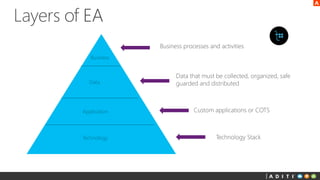
Business
Data
Application
Technology
13
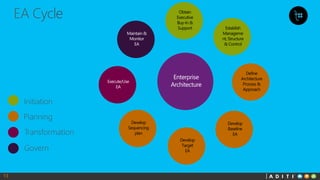
Obtain
Executive
Buy-In &
Support Establish
Manageme
nt, Structure
& Control
Develop
Target
EA
Execute/Use
EA
Maintain &
Monitor
EA
Define
Architecture
Process &
Approach
Develop
Baseline
EA
Develop
Sequencing
plan
14
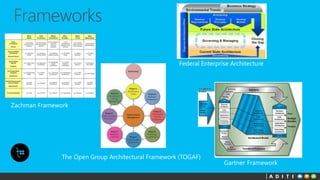
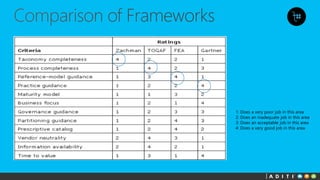
Zachman Framework
The Open Group Architectural Framework (TOGAF)
Federal Enterprise Architecture
Gartner Framework
1: Does a very poor job in this area
2: Does an inadequate job in this area
3: Does an acceptable job in this area
4: Does a very good job in this area
19
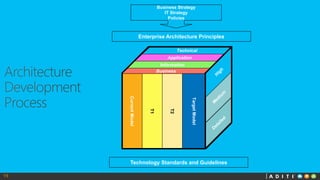
Current
Model
T1
T2
Target
Model
Application
Information
Technical
Business
Business Strategy
IT Strategy
Policies
Enterprise Architecture Principles
Technology Standards and Guidelines
20
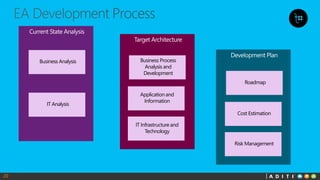
Business Analysis
IT Analysis
Business Process
Analysis and
Development
Application and
Information
IT Infrastructure and
Technology
Roadmap
Cost Estimation
Risk Management
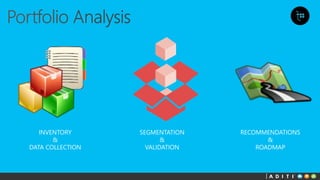
INVENTORY
&
DATA COLLECTION
SEGMENTATION
&
VALIDATION
RECOMMENDATIONS
&
ROADMAP
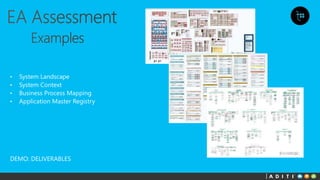
• System Landscape
• System Context
• Business Process Mapping
• Application Master Registry
DEMO: DELIVERABLES
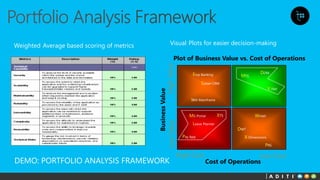
Cost of Operations
Business
Value
High Cost Low Cost
Low
Value
High
Value
MTS
DDM
V-Net
Siebel-CRM
DWT
Wintel
IBM-Mainframe
MS-Portal
Pay App
Leave Planner
X-Dimensions
Emp Banking
XTS
PRS
Plot of Business Value vs. Cost of Operations
Weighted Average based scoring of metrics Visual Plots for easier decision-making
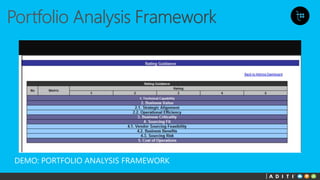
DEMO: PORTFOLIO ANALYSIS FRAMEWORK
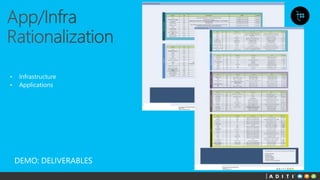
• Infrastructure
• Applications
DEMO: DELIVERABLES
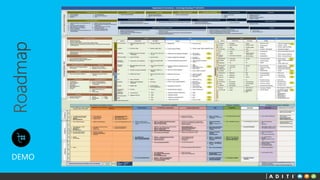
DEMO
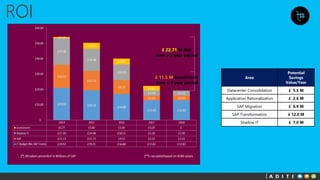
Area
Potential
Savings
Value/Year
Datacenter Consolidation £ 5.5 M
Application Rationalization £ 2.6 M
SAP Migration £ 6.9 M
SAP Transformation £ 12.0 M
Shadow IT £ 7.0 M
£ 11.5 M Investment
over a 3 year period
£ 22.71 M ROI
over a 3 year period
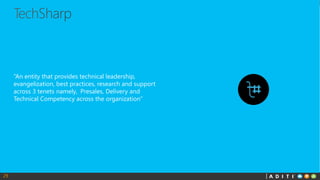
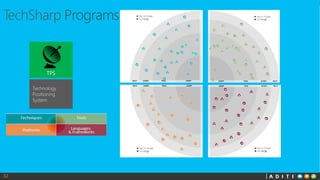
TechSharp
29
“An entity that provides technical leadership,
evangelization, best practices, research and support
across 3 tenets namely, Presales, Delivery and
Technical Competency across the organization”
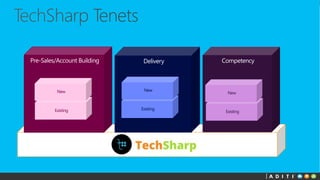
30
Existing
New
Existing
New
Existing
New
32
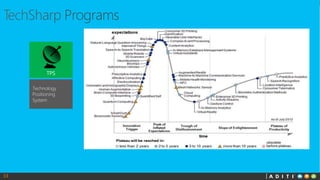
TPS
Technology
Positioning
System
33
TPS
Technology
Positioning
System
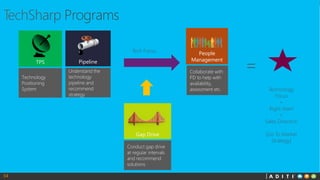
People
Management
Collaborate with
PD to help with
availability,
assessment etc.
34
Gap Drive
Pipeline
Conduct gap drive
at regular intervals
and recommend
solutions
Understand the
technology
pipeline and
recommend
strategy
TPS
Technology
Positioning
System
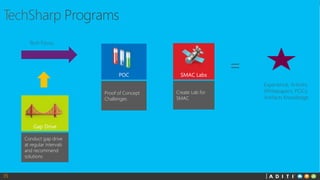
35
Gap Drive
Conduct gap drive
at regular intervals
and recommend
solutions
SMAC Labs
Create Lab for
SMAC
POC
Proof of Concept
Challenges
Roadmap
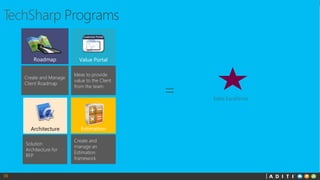
Create and Manage
Client Roadmap
36
Value Portal
Ideas to provide
value to the Client
from the team
Estimation
Create and
manage an
Estimation
framework
Architecture
Solution
Architecture for
RFP
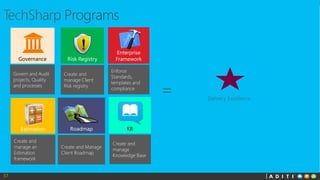
Roadmap
Governance
Enterprise
Framework
Risk Registry
Create and Manage
Client Roadmap
Govern and Audit
projects, Quality
and processes
Create and
manage Client
Risk registry
Enforce
Standards,
templates and
compliance
37
Estimation
Create and
manage an
Estimation
framework
KB
Create and
manage
Knowledge Base
Social Presence
Create awareness
of social presence
and drive the
change
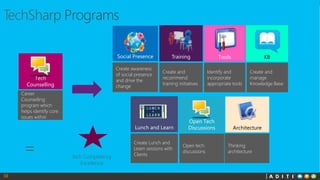
38
Tech
Counselling
Tools
Training KB
Career
Counselling
program which
helps identify core
issues within
Create and
recommend
training initiatives
Identify and
incorporate
appropriate tools
Create and
manage
Knowledge Base
Lunch and Learn
Open Tech
Discussions Architecture
Create Lunch and
Learn sessions with
Clients
Open tech
discussions
Thinking
architecture
39
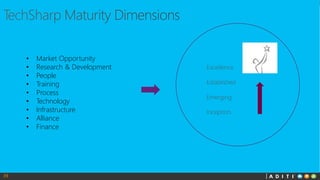
• Market Opportunity
• Research & Development
• People
• Training
• Process
• Technology
• Infrastructure
• Alliance
• Finance
40
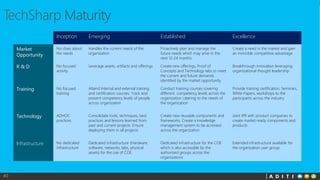
Inception Emerging Established Excellence
Market
Opportunity
No clues about
the needs
Handles the current needs of the
organization
Proactively plan and manage the
future needs which may arise in the
next 12-24 months
Create a need in the market and gain
an invincible competitive advantage
R & D No focused
activity
Leverage assets, artifacts and offerings Create new offerings, Proof of
Concepts and Technology labs to meet
the current and future demands
identified by the market opportunity
Breakthrough innovation leveraging
organizational thought leadership
Training No focused
training
Attend Internal and external training
and certification courses. Track and
present competency levels of people
across organization
Conduct training courses covering
different competency levels across the
organization catering to the needs of
the organization
Provide training certification, Seminars,
White Papers, workshops to the
participants across the industry
Technology ADHOC
practices
Consolidate tools, techniques, best
practices and lessons learned from
past and current projects. Ensure
deploying them in all projects
Create new reusable components and
frameworks. Create a knowledge
management system to be accessed
across the organization
Joint IPR with product companies to
create market ready components and
products
Infrastructure No dedicated
infrastructure
Dedicated infrastructure (Hardware,
software, networks, labs, physical
assets) for the use of COE
Dedicated infrastructure for the COE
which is also accessible by the
authorized groups across the
organizations
Extended infrastructure available for
the organization user group
41
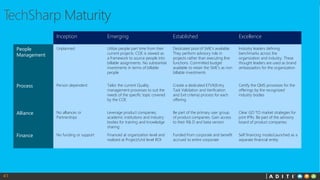
Inception Emerging Established Excellence
People
Management
Unplanned Utilize people part time from their
current projects. COE is viewed as
a framework to source people into
billable assignments. No substantial
investments in terms of billable
people
Dedicated pool of SME's available.
They perform advisory role in
projects rather than executing line
functions. Committed budget
available to retain the SME's as non
billable investments
Industry leaders defining
benchmarks across the
organization and industry. These
thought leaders are used as brand
ambassadors for the organization
Process Person dependent Tailor the current Quality
management processes to suit the
needs of the specific topic covered
by the COE
Create a dedicated ETVX(Entry
Task Validation and Verification
and Exit criteria) process for each
offering
Certify the QMS processes for the
offerings by the recognized
industry bodies
Alliance No alliances or
Partnerships
Leverage product companies,
academic institutions and industry
bodies for training and knowledge
sharing
Be part of the primary user group
of product companies. Gain access
to their R& D and beta version
Clear GO TO market strategies for
joint IPRs. Be part of the advisory
board of product companies
Finance No funding or support Financed at organization level and
realized at Project/Unit level ROI
Funded from corporate and benefit
accrued to entire corporate
Self financing mode/Launched as a
separate financial entity
42
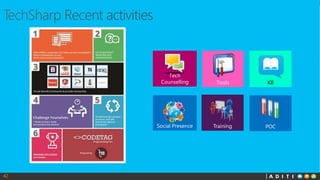
Tech
Counselling
Social Presence
Tools
Training
KB
POC
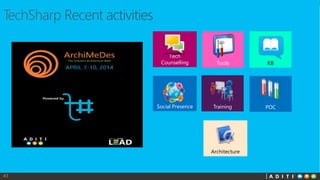
43
Tech
Counselling
Social Presence
Tools
Training
KB
POC
Architecture
Lesson 1.pdf

Lesson 1.pdf

  • 1.
    ENTERPRISE ARCHITECTURE Presented by:PRASHANTH B PANDURANGA DIRECTOR OF TECHNOLOGY
  • 2.
    81% Line ofbusiness workers and 83% of IT Staff admit to using non approved SAAS apps 42% IT Suppliers increasingly target business users 42% Line of Business heads demand higher velocity for IT Projects 36% Line of Business heads are more tech savvy and drive their own IT Projects 34% Line of Business owners are able to access technology more easily Reference: IDC CIO Summit, 2014, CIOInsight
  • 4.
  • 5.
    5 • Maximise BusinessBenefit • Buy Not Build • Plan-Build-Run' IT Operating Model • Build once, Deploy many • COTS solution driven selection • Prioritising IT investments • Selective Supplier Sourcing • Keeping IT 'Supported’ • Follow Process Framework • Easy to use • Common Integration Standard • Protect Information • Information Management - Single version of the truth • Data is an asset • Reduce Technical Diversity • Reduce duplicated technology implementations • Solutions must comply to standards • Flexible, Scalable and Resilient Solutions
  • 6.
    An architecture frameworkis a foundational structure, or set of structures, which can be used for developing a broad range of different architectures. It should describe a method for designing a target state of the enterprise in terms of a set of building blocks, and for showing how the building blocks fit together. It should contain a set of tools and provide a common vocabulary. It should also include a list of recommended standards and compliant products that can be used to implement the building blocks. Reference: TOGAF
  • 7.
    7 “A well-defined practicefor conducting enterprise analysis, design, planning, and implementation, using a holistic approach at all times, for the successful development and execution of strategy. Enterprise architecture applies architecture principles and practices to guide organizations through the business, information, process, and technology changes necessary to execute their strategy” Reference: Wikipedia
  • 8.
    8 Information and Technologydefinition “EA is explicitly describing an organization through a set of independent, non-redundant artifacts, defining how these artifacts interrelate with each other, and developing a set of prioritized, aligned initiatives and roadmaps to understand the organization, communicate this understanding to stakeholders and move the organization forward to its desired state” Business definition “EA illuminates how an organization and all of its members can achieve its objectives, through the creation of a series of engineered models and project initiatives, that can be easily understood by all the people associated with the organization” Reference: John Zachman EA Presentation
  • 9.
  • 10.
  • 11.
    11 • Increase IToperation efficiency • Better return on existing investment, reduced risk for future investment • Faster, simpler, and cheaper procurement • Improve Performance and embrace emerging technologies that support the business • Business-IT Alignment • Reduced time to market • Reduced decision risk • Take advantage of new technology innovations • Service-Oriented architecture • Technology R & D • Technology rationalization • Enable technology reuse • Reduce Technology cost • Reduce Project or service redundancy • Business process harmonization • Business partner integration • Business adaptability • Technical adaptability
  • 12.
  • 13.
    13 Obtain Executive Buy-In & Support Establish Manageme nt,Structure & Control Develop Target EA Execute/Use EA Maintain & Monitor EA Define Architecture Process & Approach Develop Baseline EA Develop Sequencing plan
  • 14.
  • 15.
    Zachman Framework The OpenGroup Architectural Framework (TOGAF) Federal Enterprise Architecture Gartner Framework
  • 16.
    1: Does avery poor job in this area 2: Does an inadequate job in this area 3: Does an acceptable job in this area 4: Does a very good job in this area
  • 19.
  • 20.
    20 Business Analysis IT Analysis BusinessProcess Analysis and Development Application and Information IT Infrastructure and Technology Roadmap Cost Estimation Risk Management
  • 21.
  • 22.
    • System Landscape •System Context • Business Process Mapping • Application Master Registry DEMO: DELIVERABLES
  • 23.
    Cost of Operations Business Value HighCost Low Cost Low Value High Value MTS DDM V-Net Siebel-CRM DWT Wintel IBM-Mainframe MS-Portal Pay App Leave Planner X-Dimensions Emp Banking XTS PRS Plot of Business Value vs. Cost of Operations Weighted Average based scoring of metrics Visual Plots for easier decision-making DEMO: PORTFOLIO ANALYSIS FRAMEWORK
  • 24.
  • 25.
  • 26.
  • 27.
    Area Potential Savings Value/Year Datacenter Consolidation £5.5 M Application Rationalization £ 2.6 M SAP Migration £ 6.9 M SAP Transformation £ 12.0 M Shadow IT £ 7.0 M £ 11.5 M Investment over a 3 year period £ 22.71 M ROI over a 3 year period
  • 28.
  • 29.
    29 “An entity thatprovides technical leadership, evangelization, best practices, research and support across 3 tenets namely, Presales, Delivery and Technical Competency across the organization”
  • 30.
  • 31.
  • 32.
  • 33.
  • 34.
    People Management Collaborate with PD tohelp with availability, assessment etc. 34 Gap Drive Pipeline Conduct gap drive at regular intervals and recommend solutions Understand the technology pipeline and recommend strategy TPS Technology Positioning System
  • 35.
    35 Gap Drive Conduct gapdrive at regular intervals and recommend solutions SMAC Labs Create Lab for SMAC POC Proof of Concept Challenges
  • 36.
    Roadmap Create and Manage ClientRoadmap 36 Value Portal Ideas to provide value to the Client from the team Estimation Create and manage an Estimation framework Architecture Solution Architecture for RFP
  • 37.
    Roadmap Governance Enterprise Framework Risk Registry Create andManage Client Roadmap Govern and Audit projects, Quality and processes Create and manage Client Risk registry Enforce Standards, templates and compliance 37 Estimation Create and manage an Estimation framework KB Create and manage Knowledge Base
  • 38.
    Social Presence Create awareness ofsocial presence and drive the change 38 Tech Counselling Tools Training KB Career Counselling program which helps identify core issues within Create and recommend training initiatives Identify and incorporate appropriate tools Create and manage Knowledge Base Lunch and Learn Open Tech Discussions Architecture Create Lunch and Learn sessions with Clients Open tech discussions Thinking architecture
  • 39.
    39 • Market Opportunity •Research & Development • People • Training • Process • Technology • Infrastructure • Alliance • Finance
  • 40.
    40 Inception Emerging EstablishedExcellence Market Opportunity No clues about the needs Handles the current needs of the organization Proactively plan and manage the future needs which may arise in the next 12-24 months Create a need in the market and gain an invincible competitive advantage R & D No focused activity Leverage assets, artifacts and offerings Create new offerings, Proof of Concepts and Technology labs to meet the current and future demands identified by the market opportunity Breakthrough innovation leveraging organizational thought leadership Training No focused training Attend Internal and external training and certification courses. Track and present competency levels of people across organization Conduct training courses covering different competency levels across the organization catering to the needs of the organization Provide training certification, Seminars, White Papers, workshops to the participants across the industry Technology ADHOC practices Consolidate tools, techniques, best practices and lessons learned from past and current projects. Ensure deploying them in all projects Create new reusable components and frameworks. Create a knowledge management system to be accessed across the organization Joint IPR with product companies to create market ready components and products Infrastructure No dedicated infrastructure Dedicated infrastructure (Hardware, software, networks, labs, physical assets) for the use of COE Dedicated infrastructure for the COE which is also accessible by the authorized groups across the organizations Extended infrastructure available for the organization user group
  • 41.
    41 Inception Emerging EstablishedExcellence People Management Unplanned Utilize people part time from their current projects. COE is viewed as a framework to source people into billable assignments. No substantial investments in terms of billable people Dedicated pool of SME's available. They perform advisory role in projects rather than executing line functions. Committed budget available to retain the SME's as non billable investments Industry leaders defining benchmarks across the organization and industry. These thought leaders are used as brand ambassadors for the organization Process Person dependent Tailor the current Quality management processes to suit the needs of the specific topic covered by the COE Create a dedicated ETVX(Entry Task Validation and Verification and Exit criteria) process for each offering Certify the QMS processes for the offerings by the recognized industry bodies Alliance No alliances or Partnerships Leverage product companies, academic institutions and industry bodies for training and knowledge sharing Be part of the primary user group of product companies. Gain access to their R& D and beta version Clear GO TO market strategies for joint IPRs. Be part of the advisory board of product companies Finance No funding or support Financed at organization level and realized at Project/Unit level ROI Funded from corporate and benefit accrued to entire corporate Self financing mode/Launched as a separate financial entity
  • 42.
  • 43.