Solution Architecture –
Approach to Rapidly Scoping
The Initial Solution Options
Alan McSweeney
Objective
• Describe an approach to creating a high-level architecture
for a complete end-to-end solution design
06 January 2015 2
A Solution Is ...
• ... An answer to a business problem
• The solution will generally consist of some or all of:
− New system(s)
− Changes to existing systems
− Changes to existing data model and data storage
− Data migration/conversion
− System and data interfaces
− New business processes
− Documentation
− User training
− Changes to existing business processes
− Operational infrastructure
− Operational and support processes
• A solution very, very rarely consists of a single stand-alone,
newly-developed system
306 January 2015
4
Solution Architecture Is …
− Description of the structure, characteristics and behaviour of a
solution
− The means by which the solution is defined, delivered, managed
and operated
• A solution is an answer to a business problem that may or
may not include a technology component
• Solution architecture is concerned with identifying that
solution or set of solution options and their components
• Generally there are many potential solutions to a problem
with varying suitability
• All solutions are subject to constraints
06 January 2015
Solution Architecture
• Solution architecture involves identifying the scope of the
entire solution including all its components and the
required technology and operational changes
• Multi-stage process to define the solution
• Solution architecture needs to take account of all solution
components in order to quantify the true scope of the
effort needed to implement the solution
• Without the complete, end-to-end view, the project to
implement the solution and transfer it to operations will
experience problems
506 January 2015
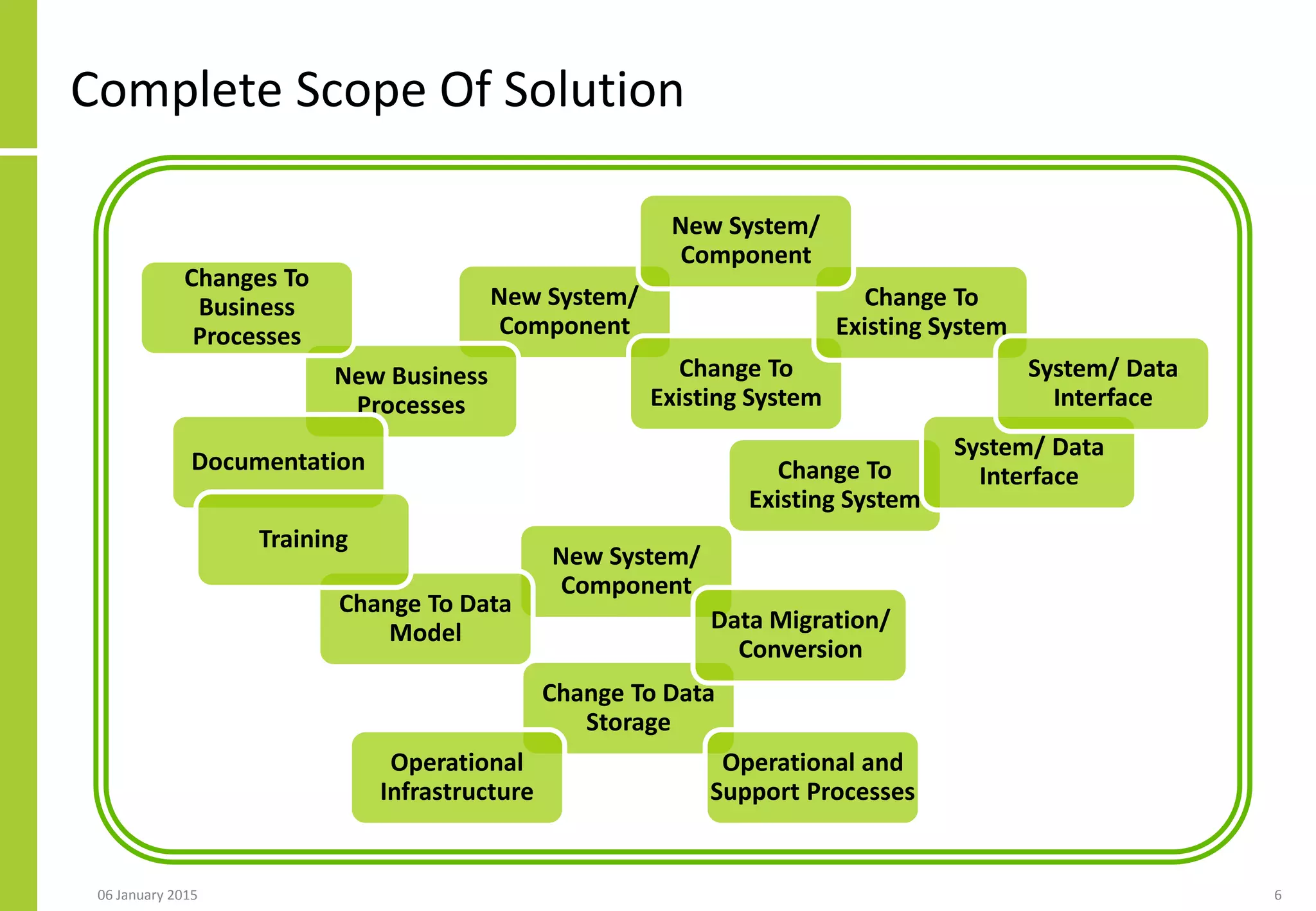
Complete Scope Of Solution
06 January 2015 6
New System/
Component
New System/
Component
Change To
Existing System
Change To
Existing System
Change To
Existing System
Change To Data
Model
Change To Data
Storage
Data Migration/
Conversion
System/ Data
Interface
System/ Data
Interface
New Business
Processes
Changes To
Business
Processes
Documentation
Training
Operational
Infrastructure
Operational and
Support Processes
New System/
Component
Complete Scope Of Solution
• You need this end-to-end view to comprehend fully what
solution delivery effort you are likely to incur, what
resources are required, what are the likely costs and how
long the implementation will take
• You can make informed decisions to include/exclude
components and understand the consequences of these
decisions
• You can engage at an early stage with the potential
complexity of the solution
• You can assess the potential organisational impact
06 January 2015 7
Solution Architecture In The Context Of The Overall
Solution Delivery
• Previously covered this subject in
http://www.slideshare.net/alanmcsweeney/integrated-
project-and-solution-delivery-and-business-engagement-
model
• Solution architecture needs to be involved at the early
stage of the project to allow effective decision-making and
to ensure that the complete effort and resources required
are identified early
• Solution architecture is involved throughout the delivery of
the solution, from initial concept to detailed functional
design
806 January 2015
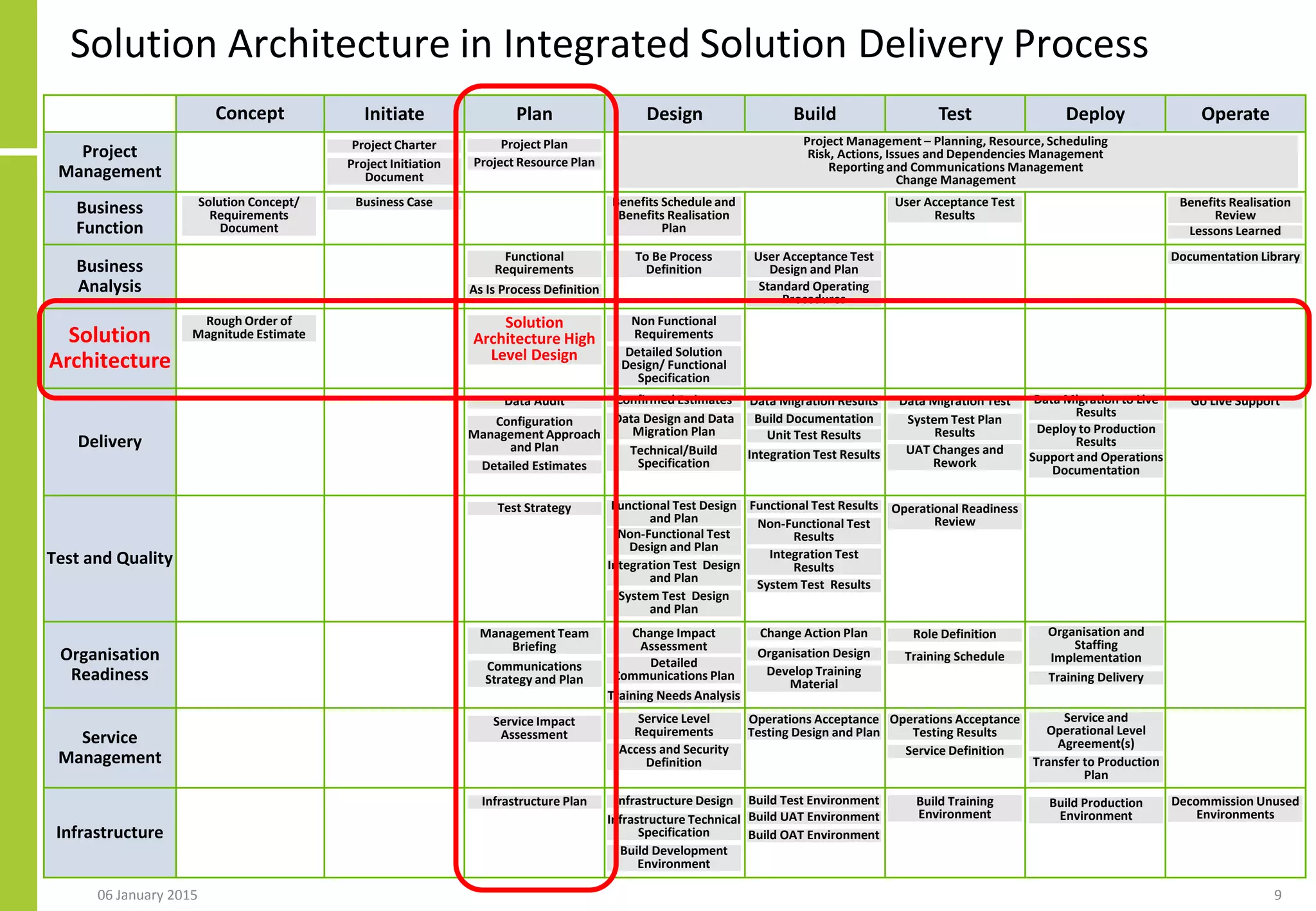
Solution Architecture in Integrated Solution Delivery Process
Concept Initiate Plan Design Build Test Deploy Operate
Project
Management
Business
Function
Business
Analysis
Solution
Architecture
Delivery
Test and Quality
Organisation
Readiness
Service
Management
Infrastructure
Solution Concept/
Requirements
Document
Rough Order of
Magnitude Estimate
Project Charter
Project Initiation
Document
Business Case
Project Plan
Project Resource Plan
Functional
Requirements
As Is Process Definition
Benefits Schedule and
Benefits Realisation
Plan
User Acceptance Test
Results
Benefits Realisation
Review
Lessons Learned
To Be Process
Definition
User Acceptance Test
Design and Plan
Standard Operating
Procedures
Documentation Library
Solution
Architecture High
Level Design
Non Functional
Requirements
Detailed Solution
Design/ Functional
Specification
Data Audit
Data Design and Data
Migration Plan
Data Migration Results Data Migration Test Data Migration to Live
Results
Go Live Support
Configuration
Management Approach
and Plan Technical/Build
Specification
Build Documentation
Unit Test Results
Integration Test Results
System Test Plan
Results
UAT Changes and
Rework
Deploy to Production
Results
Support and Operations
Documentation
Test Strategy Functional Test Design
and Plan
Non-Functional Test
Design and Plan
Integration Test
Results
System Test Results
Operational Readiness
Review
Management Team
Briefing
Communications
Strategy and Plan
Change Impact
Assessment
Organisation Design
Develop Training
Material
Detailed
Communications Plan
Training Needs Analysis
Change Action Plan Role Definition
Training Schedule
Organisation and
Staffing
Implementation
Training Delivery
Service Impact
Assessment
Service Level
Requirements
Access and Security
Definition
Operations Acceptance
Testing Design and Plan
Operations Acceptance
Testing Results
Service Definition
Functional Test Results
Non-Functional Test
Results
Integration Test Design
and Plan
System Test Design
and Plan
Service and
Operational Level
Agreement(s)
Transfer to Production
Plan
Infrastructure Plan Infrastructure Design
Infrastructure Technical
Specification
Build Development
Environment
Build Test Environment
Build UAT Environment
Build OAT Environment
Build Training
Environment
Build Production
Environment
Decommission Unused
Environments
Detailed Estimates
Confirmed Estimates
Project Management – Planning, Resource, Scheduling
Risk, Actions, Issues and Dependencies Management
Reporting and Communications Management
Change Management
906 January 2015
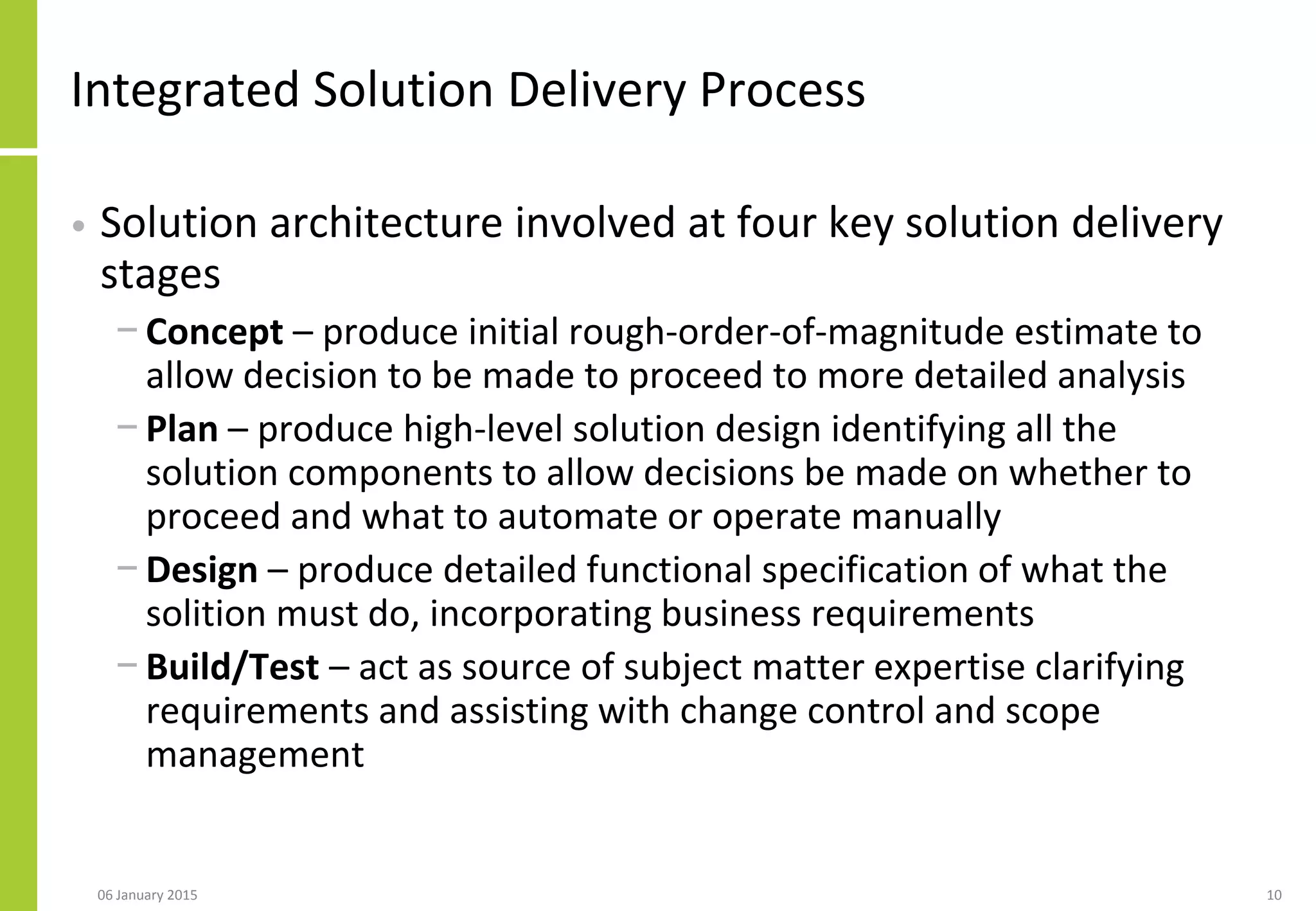
Integrated Solution Delivery Process
• Solution architecture involved at four key solution delivery
stages
− Concept – produce initial rough-order-of-magnitude estimate to
allow decision to be made to proceed to more detailed analysis
− Plan – produce high-level solution design identifying all the
solution components to allow decisions be made on whether to
proceed and what to automate or operate manually
− Design – produce detailed functional specification of what the
solition must do, incorporating business requirements
− Build/Test – act as source of subject matter expertise clarifying
requirements and assisting with change control and scope
management
06 January 2015 10
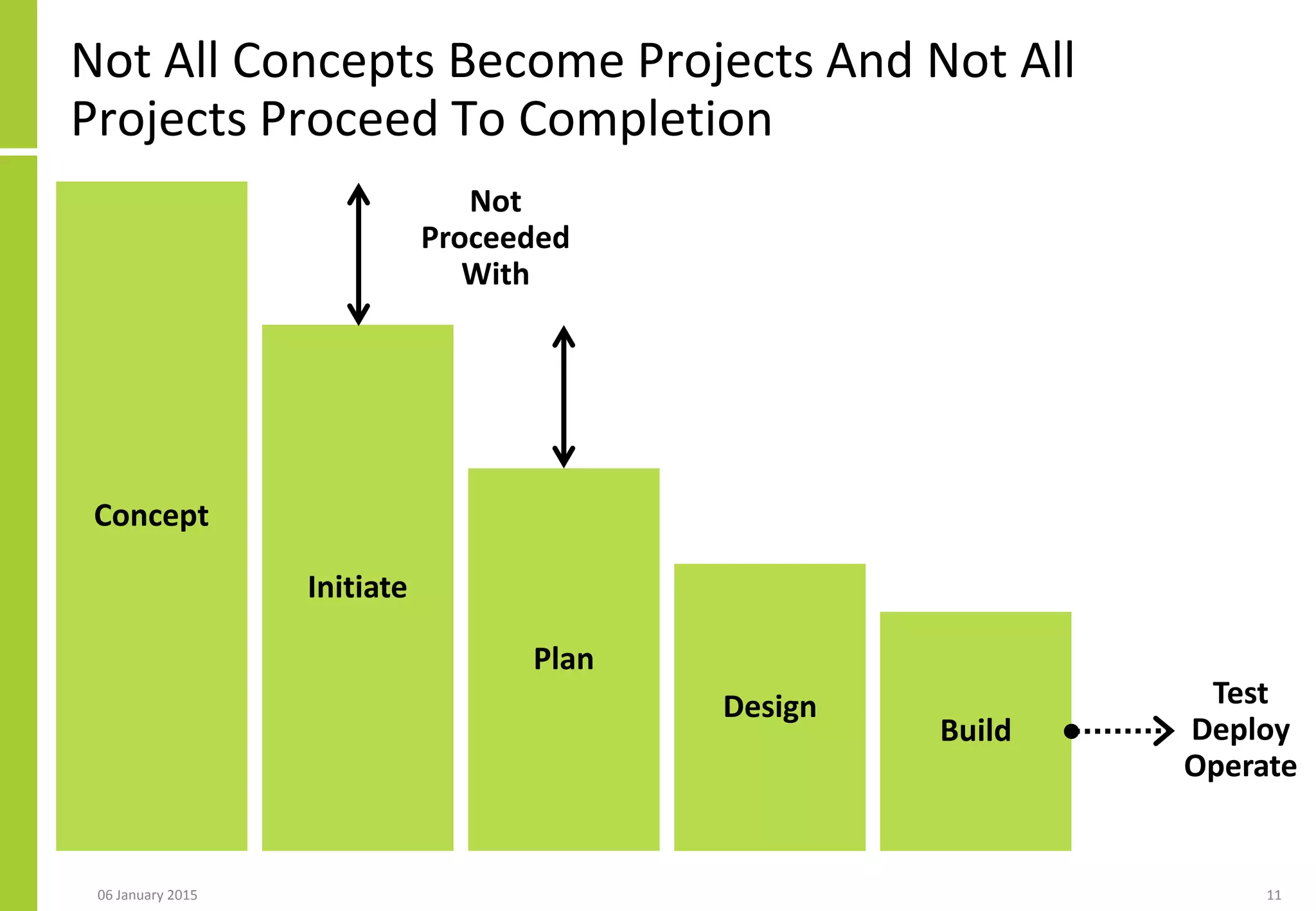
Not All Concepts Become Projects And Not All
Projects Proceed To Completion
11
Concept
Initiate
Plan
Design
Build
Test
Deploy
Operate
Not
Proceeded
With
06 January 2015
Not All Concepts Become Projects And Not All
Projects Proceed To Completion
• There is an inevitable cancellation/postponement/decision
not to proceed with projects during the solution selection
and elaboration process
06 January 2015 12
Not All Concepts Become Solutions And Not All
Solutions Proceed To Completion
• Need to identify feasible, worthwhile, justified concepts to
develop into projects and to eliminate those that are not cost-
effective
• Solution architecture plays an important role in identifying
solutions worth implementing and in quantifying the effort
• Need to involve solution architecture at an early stage to
understand the full scope of the solution and its
implementation
• Enable decisions to be made on whether to proceed and what
will be included in the scope
• Create initial high-level solution architecture that can be
expanded on if the solution is being proceeded with
• Minimise the work done while maximising the information
gathered and processed and results obtained
06 January 2015 13
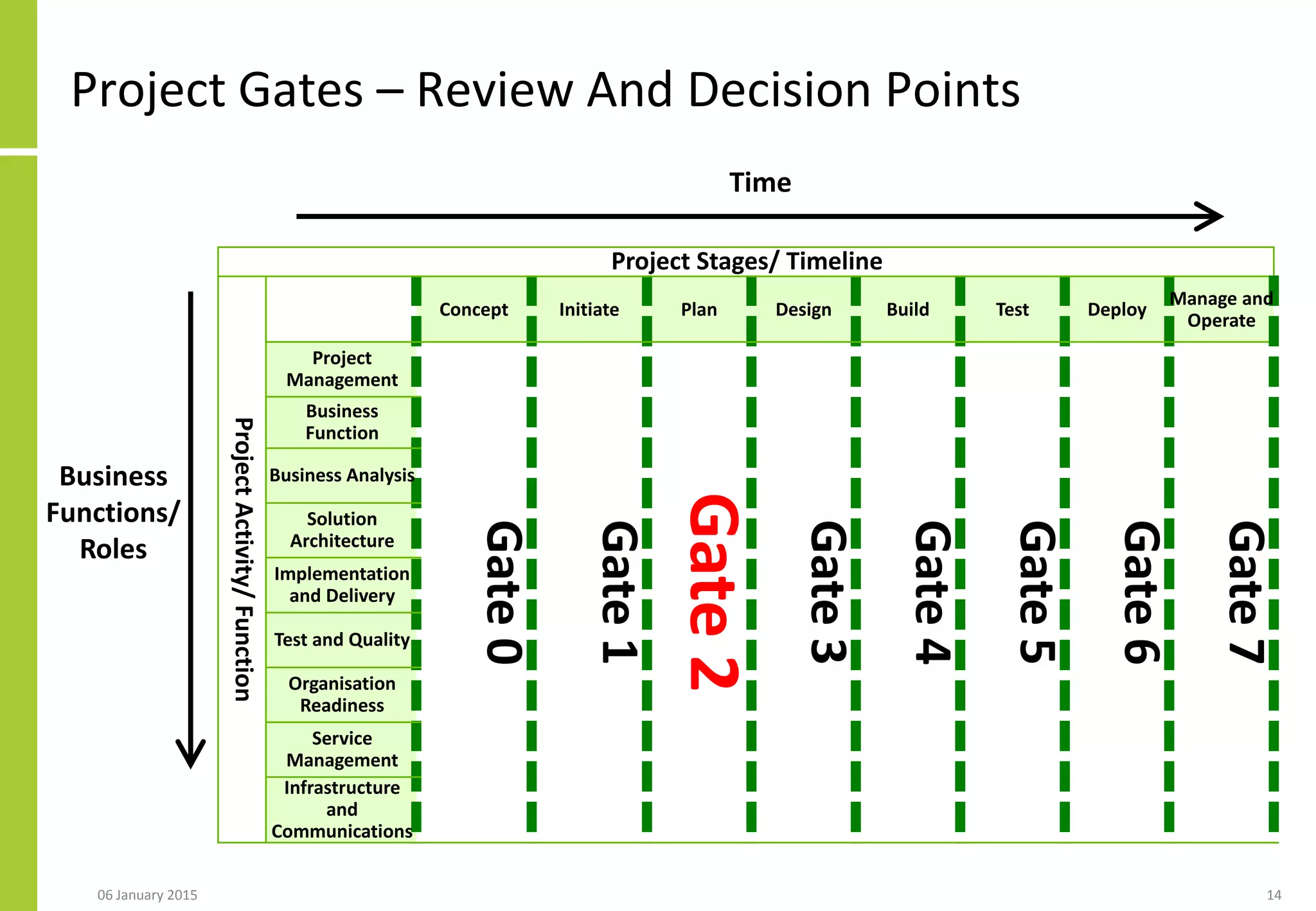
Project Gates – Review And Decision Points
Project Stages/ Timeline
ProjectActivity/Function
Concept Initiate Plan Design Build Test Deploy
Manage and
Operate
Project
Management
Gate0
Gate1
Gate2
Gate3
Gate4
Gate5
Gate6
Gate7
Business
Function
Business Analysis
Solution
Architecture
Implementation
and Delivery
Test and Quality
Organisation
Readiness
Service
Management
Infrastructure
and
Communications
Time
Business
Functions/
Roles
1406 January 2015
Project Gates – Review And Decision Points for High
Level Solution Architecture
• Gate 2 is the point where the high-level solution
archtecture is reviewed, assessed and decisions are made
on whether to proceed and what is being proceeded with
06 January 2015 15
Find The Information Saddle Point
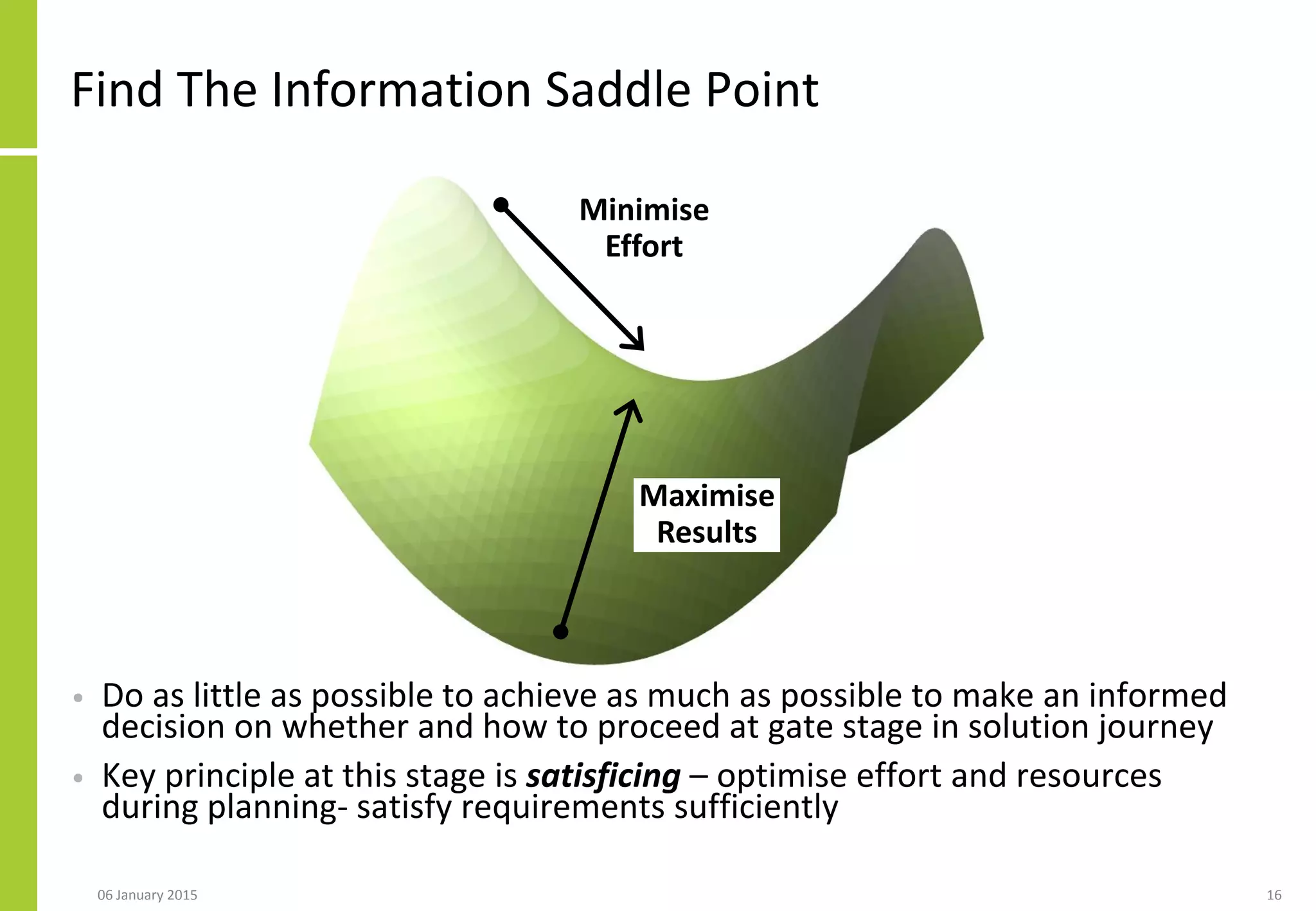
• Do as little as possible to achieve as much as possible to make an informed
decision on whether and how to proceed at gate stage in solution journey
• Key principle at this stage is satisficing – optimise effort and resources
during planning- satisfy requirements sufficiently
06 January 2015 16
Minimise
Effort
Maximise
Results
Structured Approach To Solution Architecture
• Previously covered this subject in
http://www.slideshare.net/alanmcsweeney/structured-
approach-to-solution-architecture
• Objective of structured approach is to ensure consistency
in solution architecture design options
• Ensure solution addresses all business requirements
• Provide checklist to validate solution design options
• Design realistic and achievable solutions that meet the
business needs
06 January 2015 17
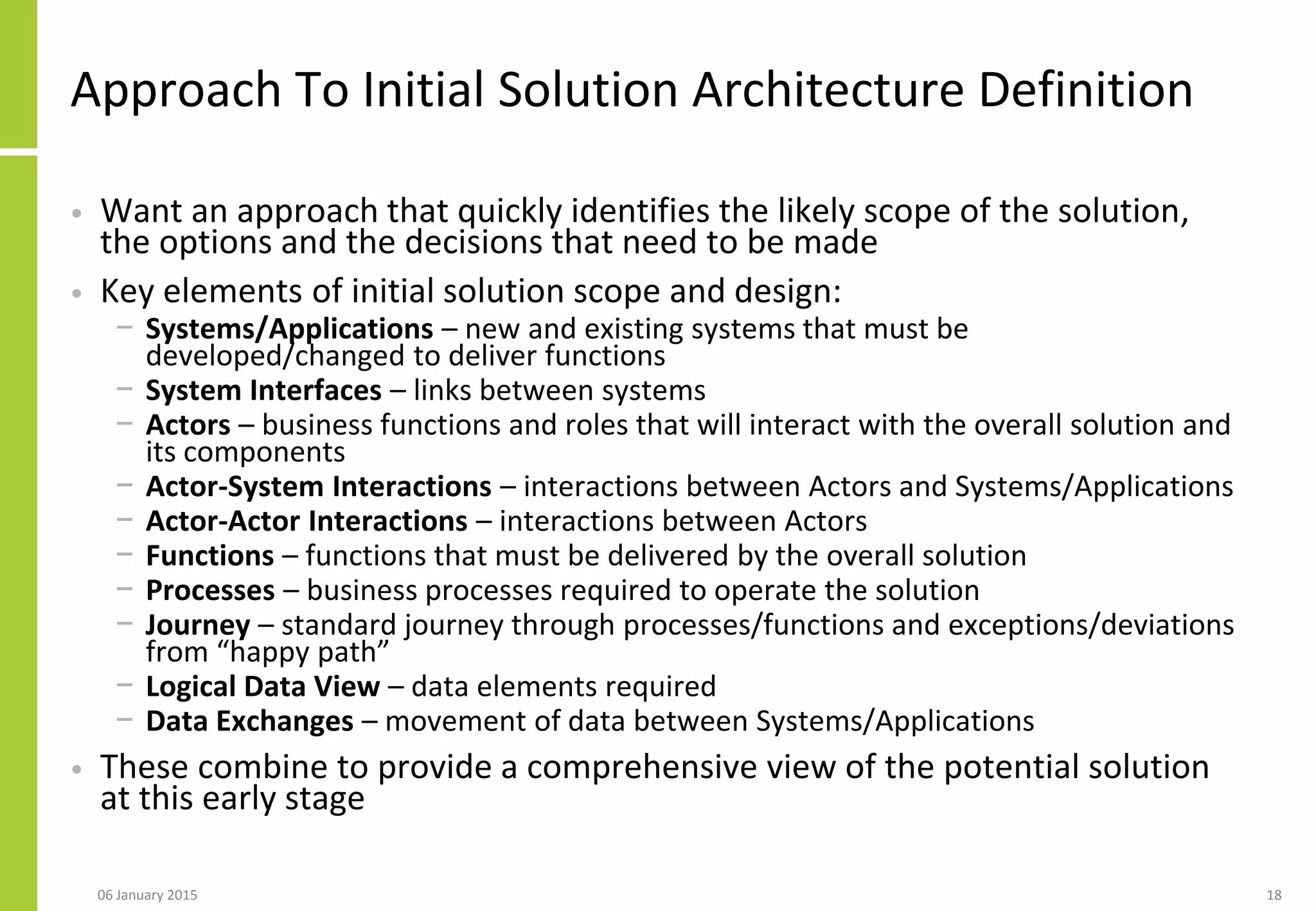
Approach To Initial Solution Architecture Definition
• Want an approach that quickly identifies the likely scope of the solution,
the options and the decisions that need to be made
• Key elements of initial solution scope and design:
− Systems/Applications – new and existing systems that must be
developed/changed to deliver functions
− System Interfaces – links between systems
− Actors – business functions and roles that will interact with the overall solution and
its components
− Actor-System Interactions – interactions between Actors and Systems/Applications
− Actor-Actor Interactions – interactions between Actors
− Functions – functions that must be delivered by the overall solution
− Processes – business processes required to operate the solution
− Journey – standard journey through processes/functions and exceptions/deviations
from “happy path”
− Logical Data View – data elements required
− Data Exchanges – movement of data between Systems/Applications
• These combine to provide a comprehensive view of the potential solution
at this early stage
06 January 2015 18
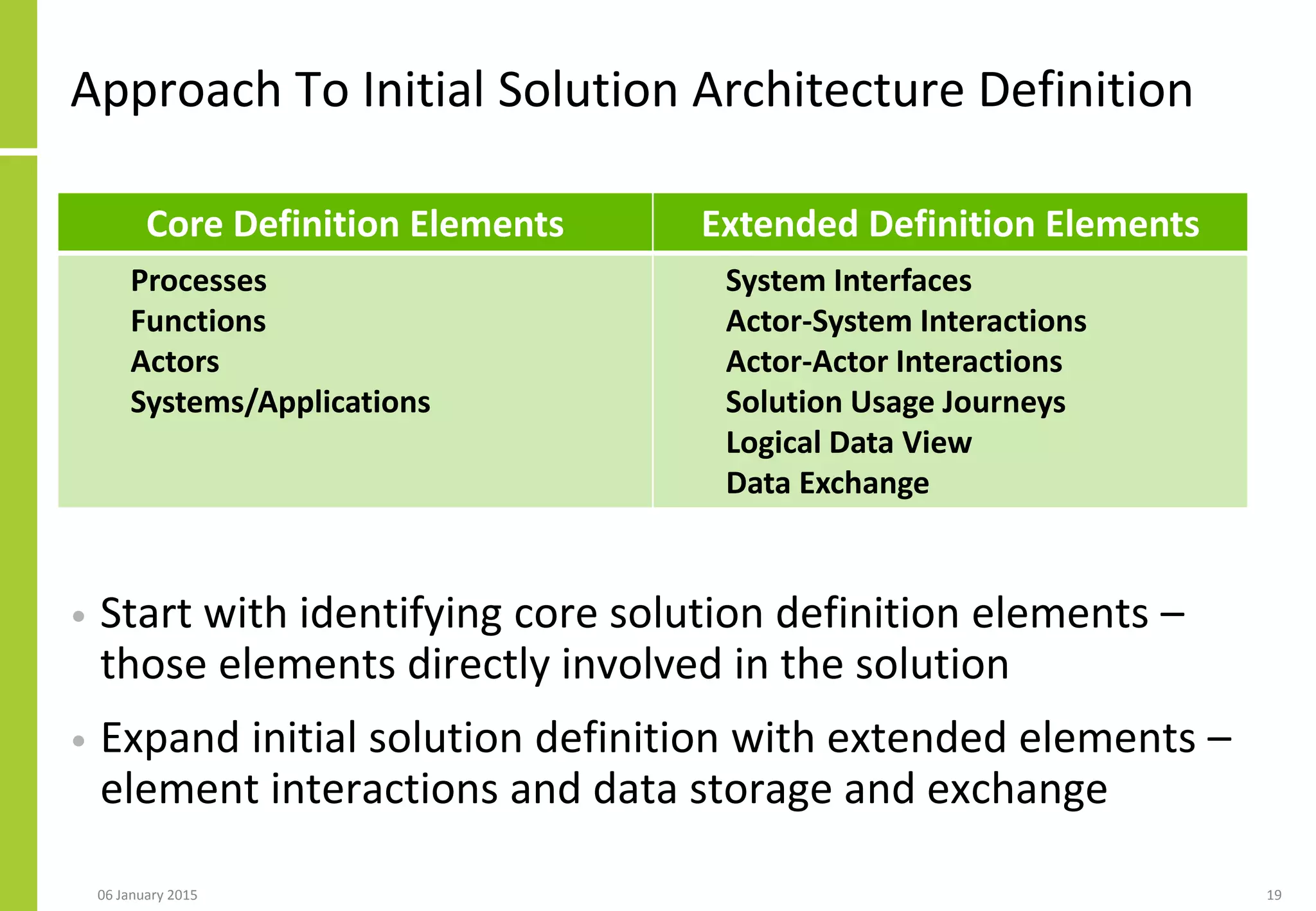
Approach To Initial Solution Architecture Definition
• Start with identifying core solution definition elements –
those elements directly involved in the solution
• Expand initial solution definition with extended elements –
element interactions and data storage and exchange
06 January 2015 19
Core Definition Elements Extended Definition Elements
Processes
Functions
Actors
Systems/Applications
System Interfaces
Actor-System Interactions
Actor-Actor Interactions
Solution Usage Journeys
Logical Data View
Data Exchange
Initial Solution Architecture Definition
• This allows:
− System changes and developments required to be defined
− Potential options for reuse of existing systems to be determined
− Options for manual or automated operation to be pinpointed
− Effort to be estimated
− Organisational impact to be quantified including staffing, training,
support, cutover, parallel run and documentation
− Dependencies to be identified
− Informed decision to proceed to be made
• Provides a worklist/table of contents of further work if
decision to continue is made
06 January 2015 20
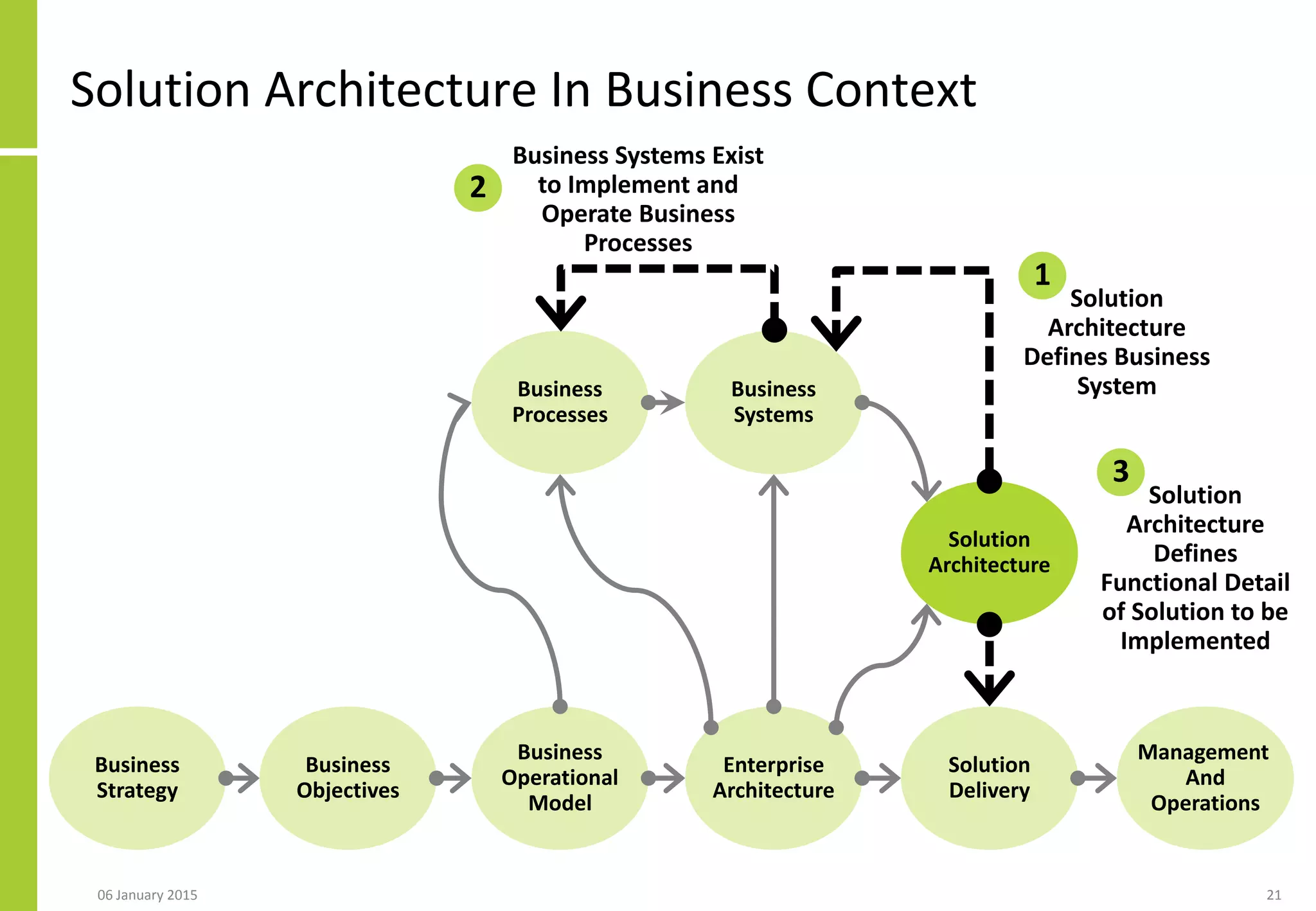
Solution Architecture In Business Context
Business
Objectives
Business
Operational
Model
Enterprise
Architecture
Solution
Delivery
Management
And
Operations
Business
Processes
Business
Systems
Business
Strategy
Solution
Architecture
Solution
Architecture
Defines Business
System
1
Business Systems Exist
to Implement and
Operate Business
Processes
2
Solution
Architecture
Defines
Functional Detail
of Solution to be
Implemented
3
06 January 2015 21
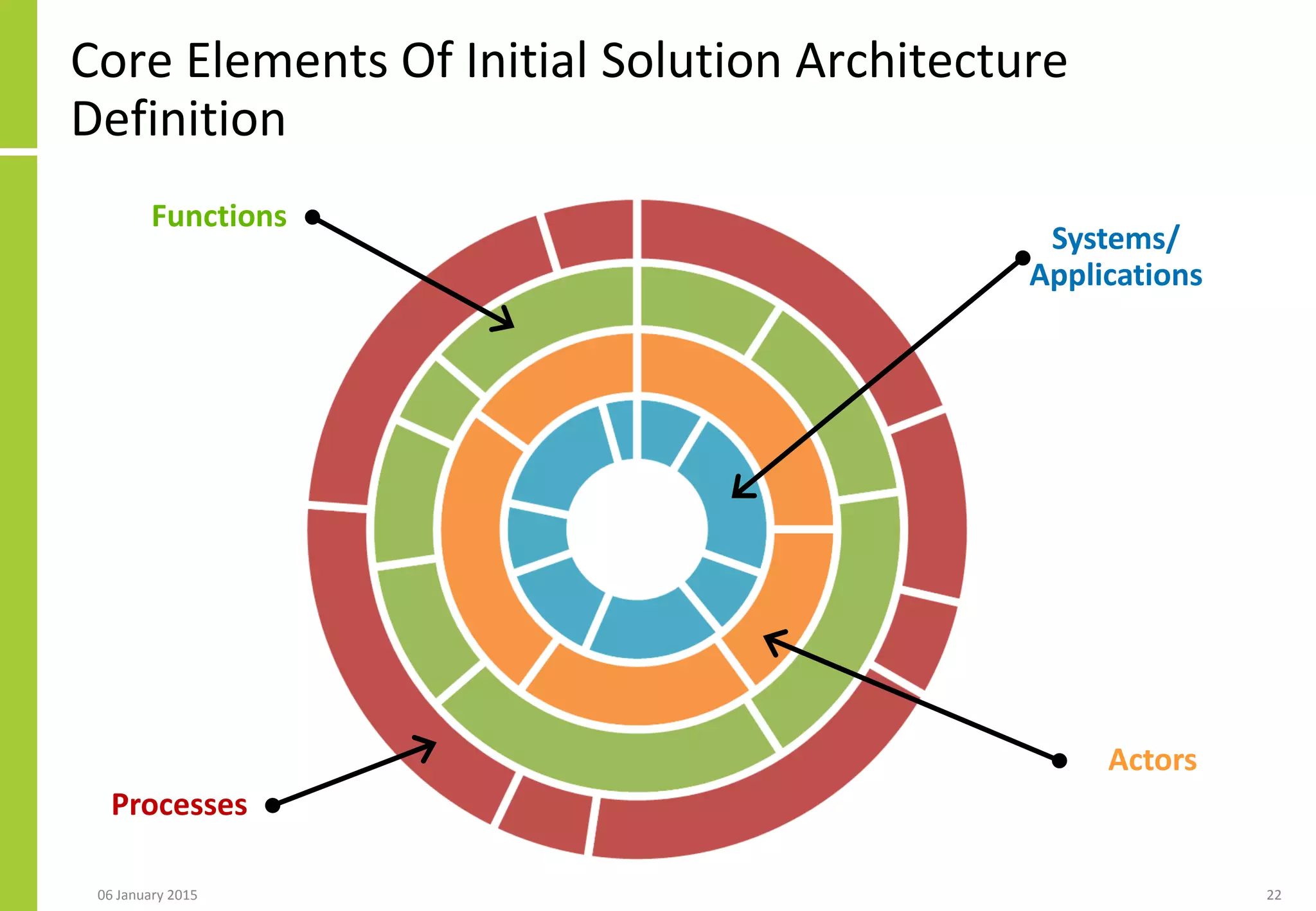
Core Elements Of Initial Solution Architecture
Definition
06 January 2015 22
Systems/
Applications
Actors
Functions
Processes
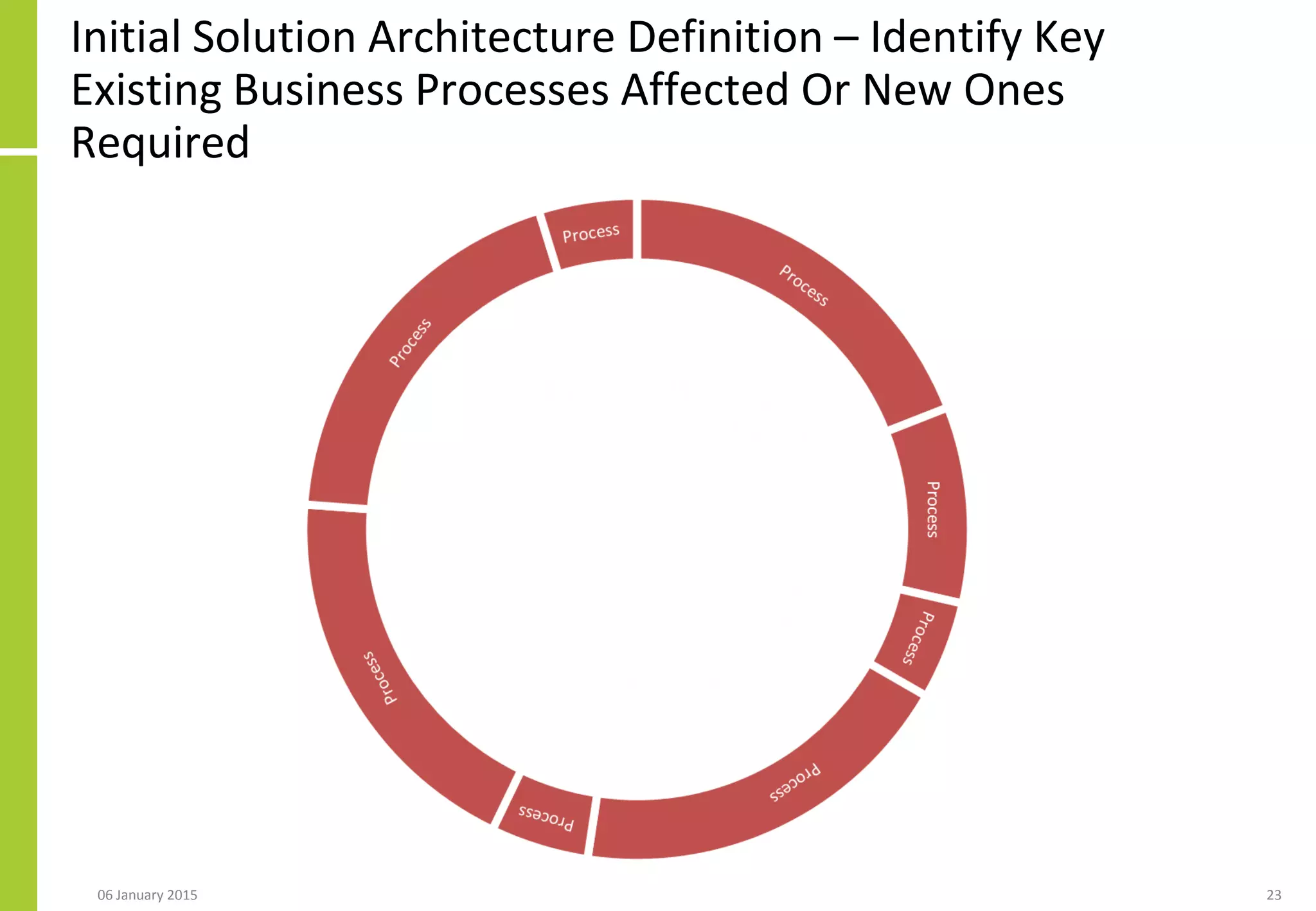
Initial Solution Architecture Definition – Identify Key
Existing Business Processes Affected Or New Ones
Required
06 January 2015 23
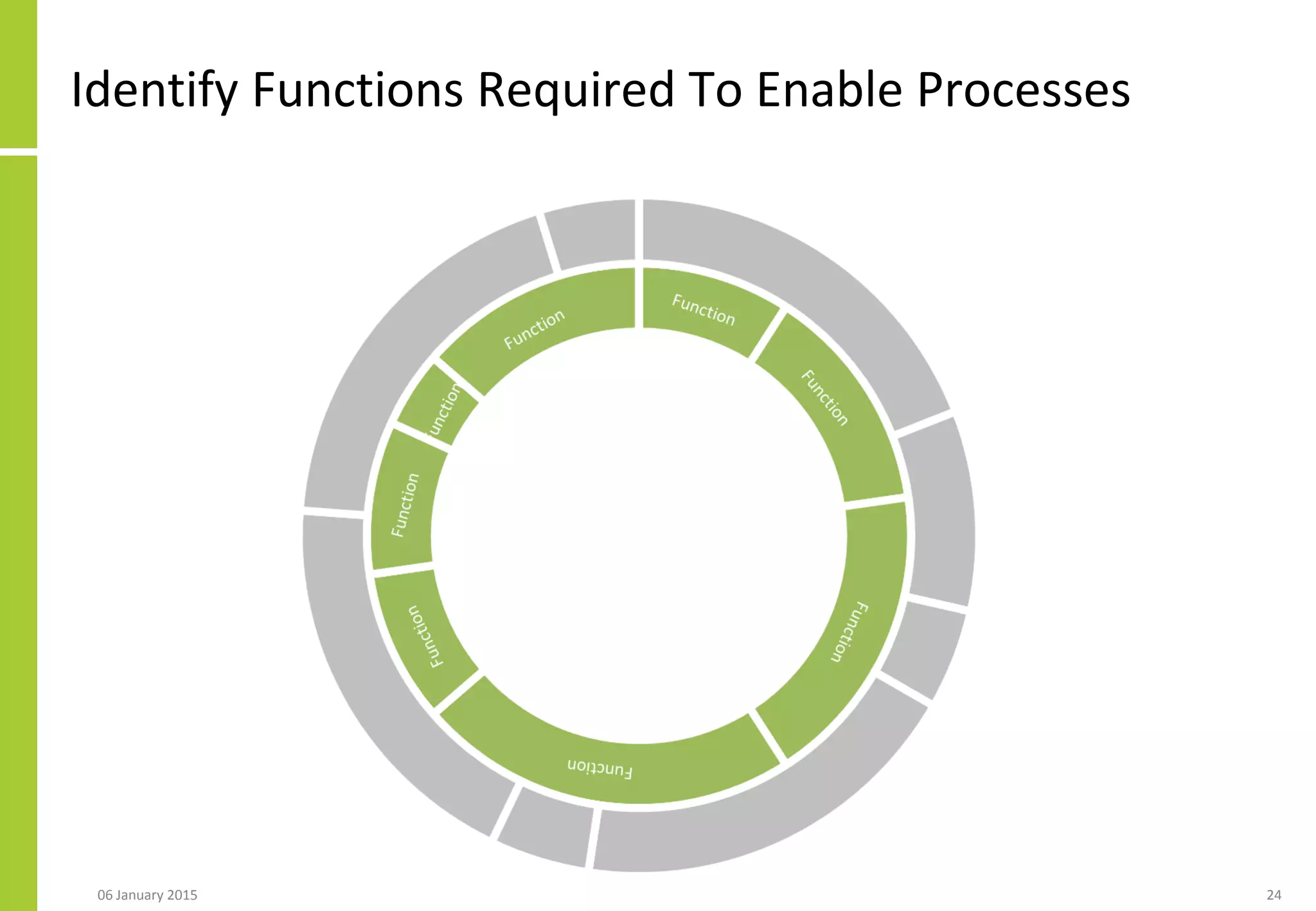
Identify Functions Required To Enable Processes
06 January 2015 24
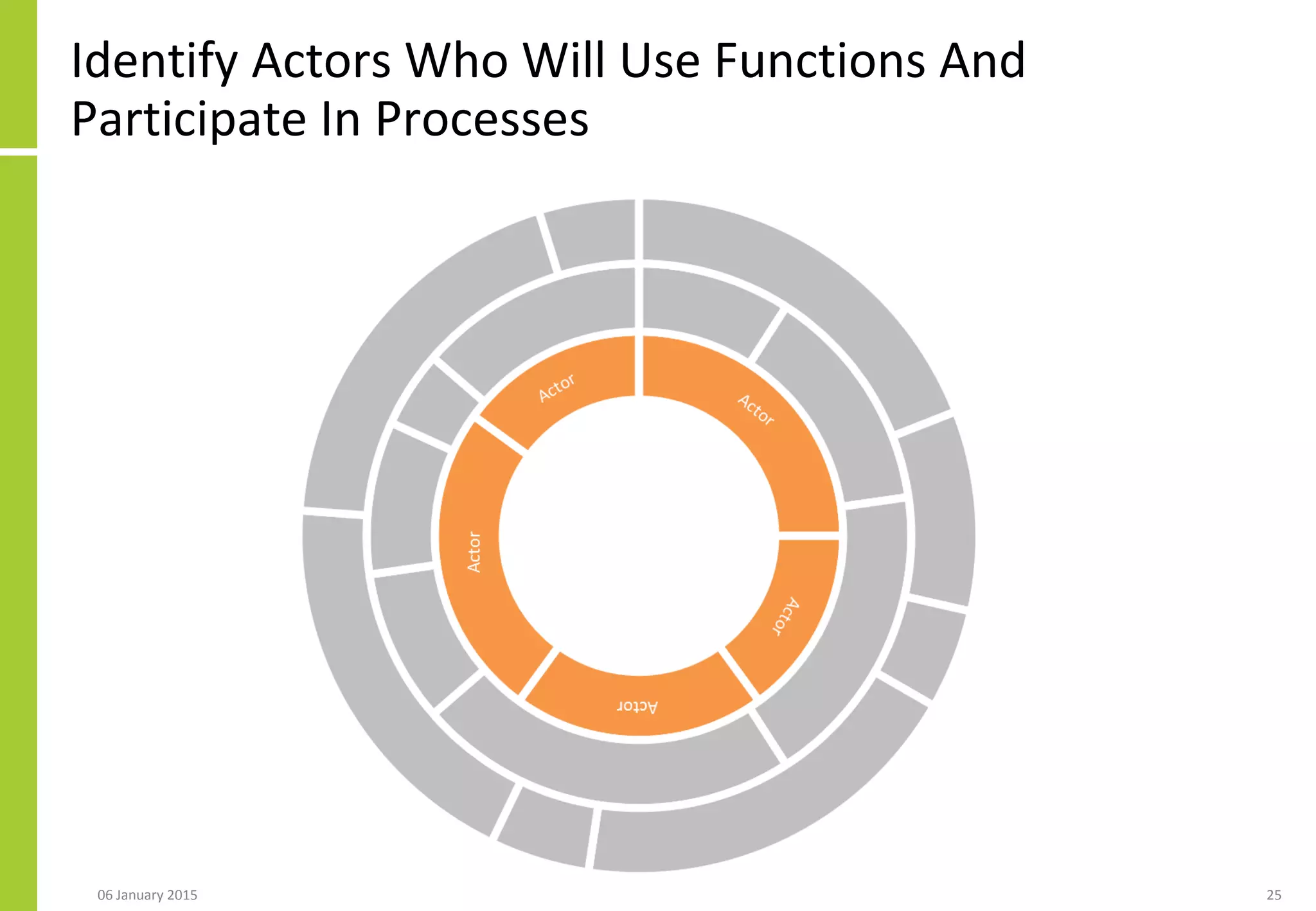
Identify Actors Who Will Use Functions And
Participate In Processes
06 January 2015 25
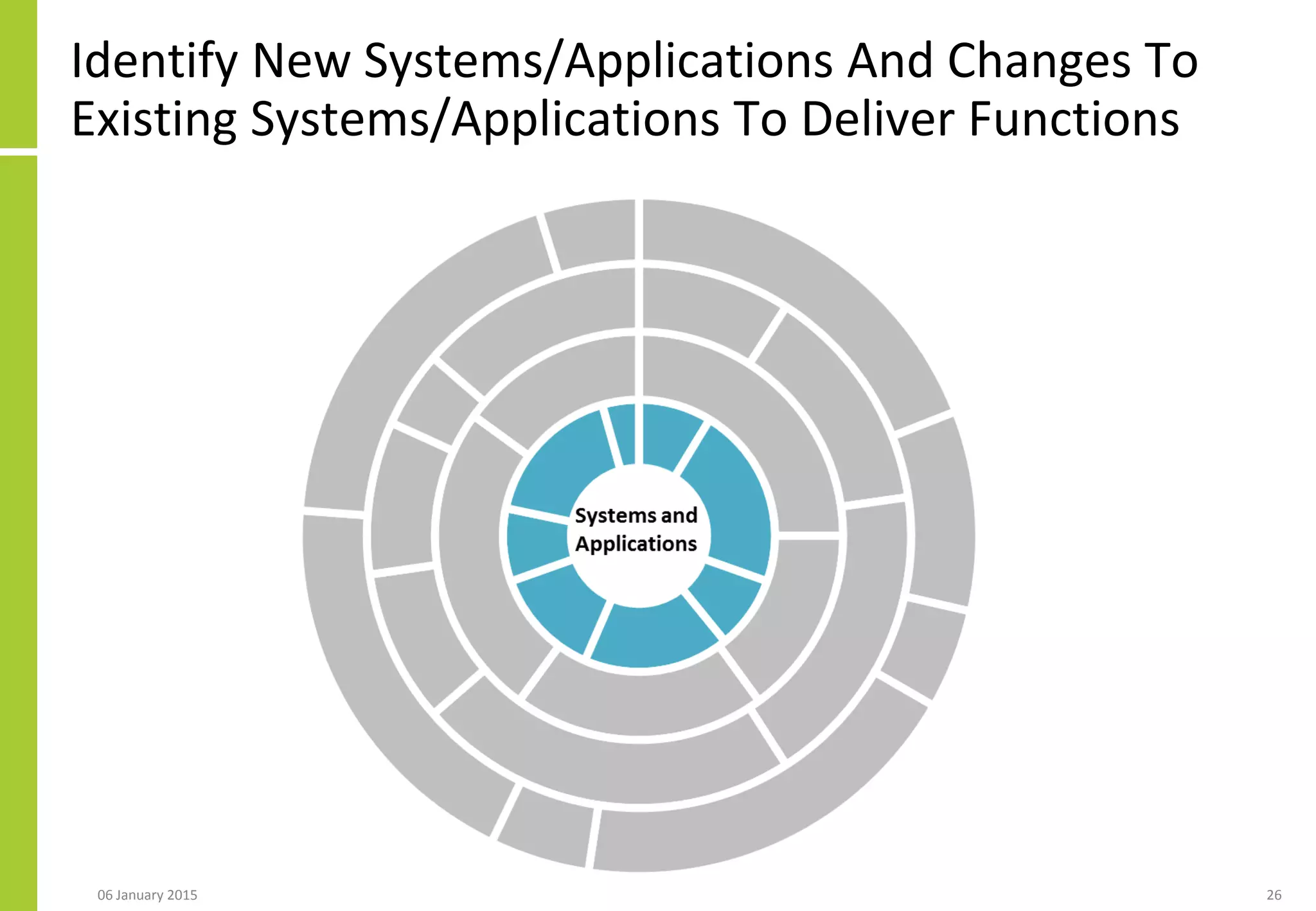
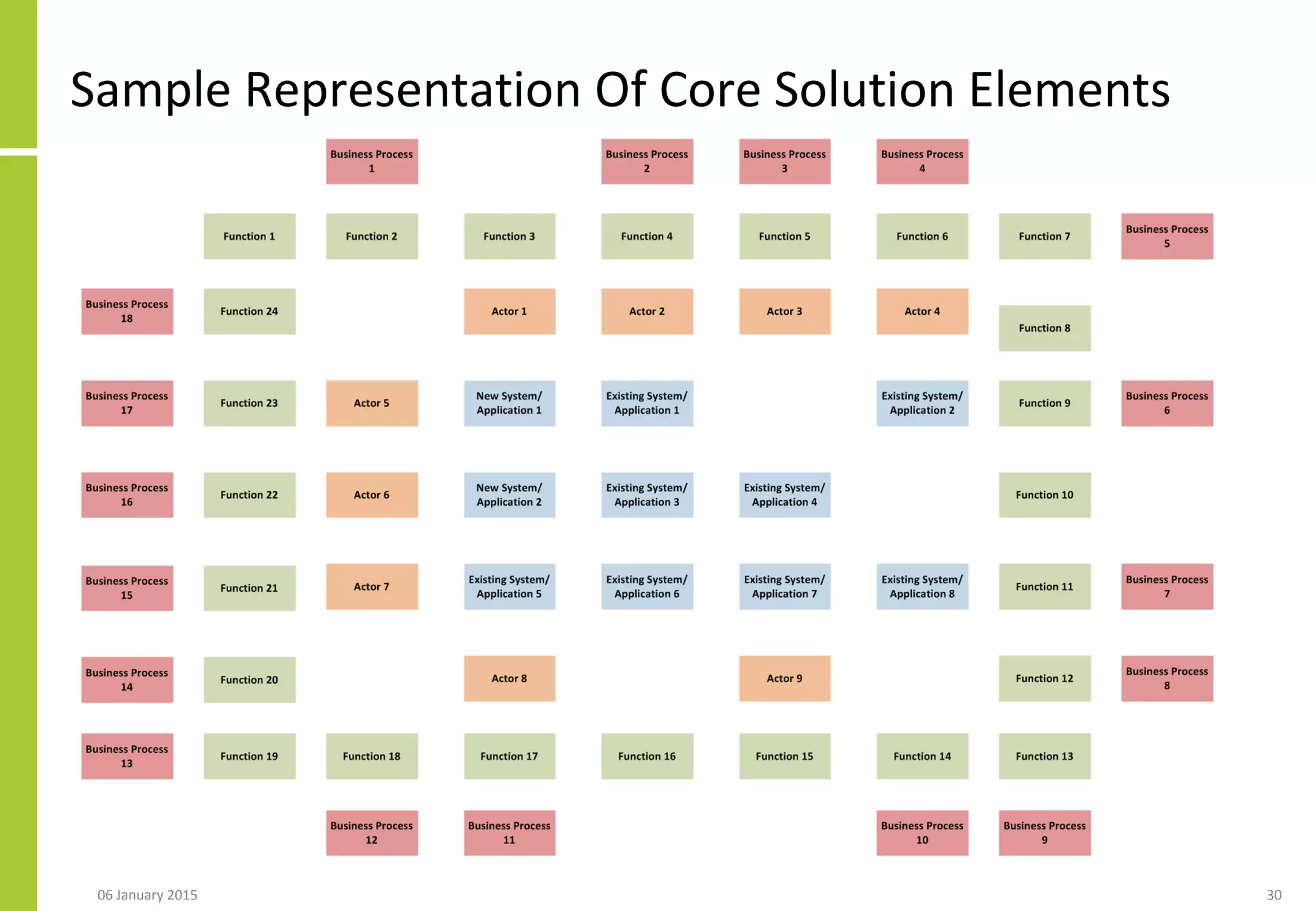
Identify New Systems/Applications And Changes To
Existing Systems/Applications To Deliver Functions
06 January 2015 26
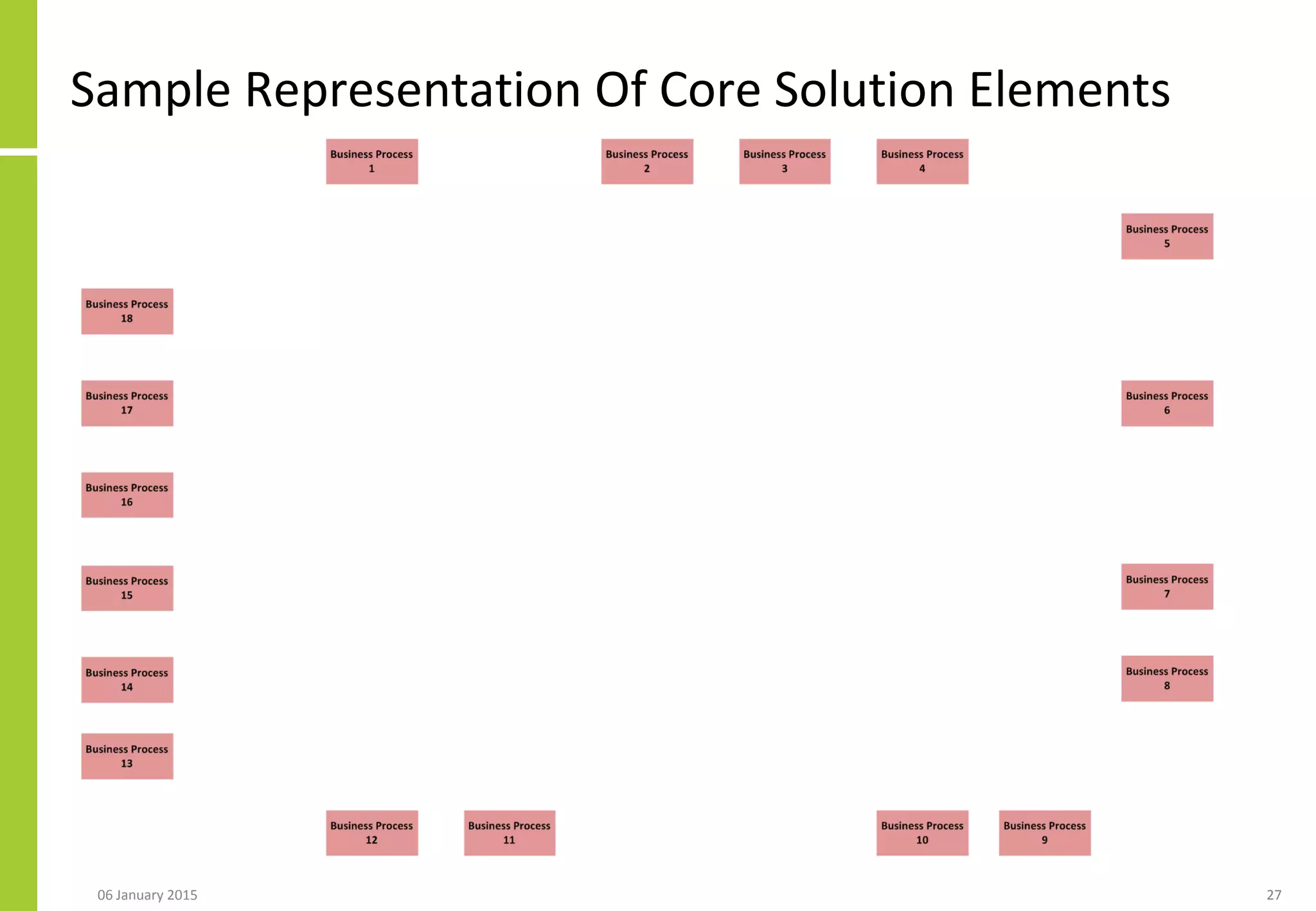
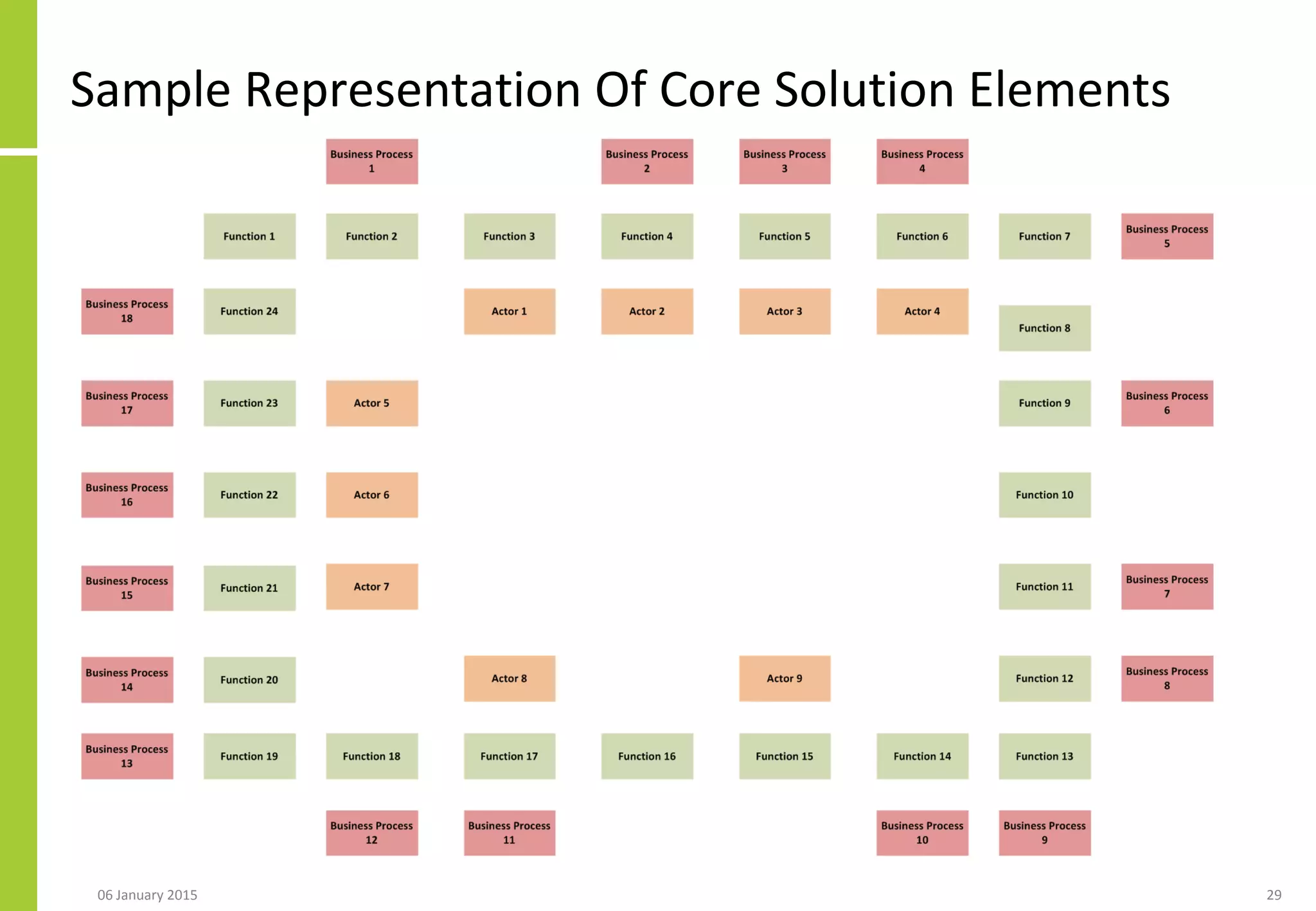
Sample Representation Of Core Solution Elements
06 January 2015 27
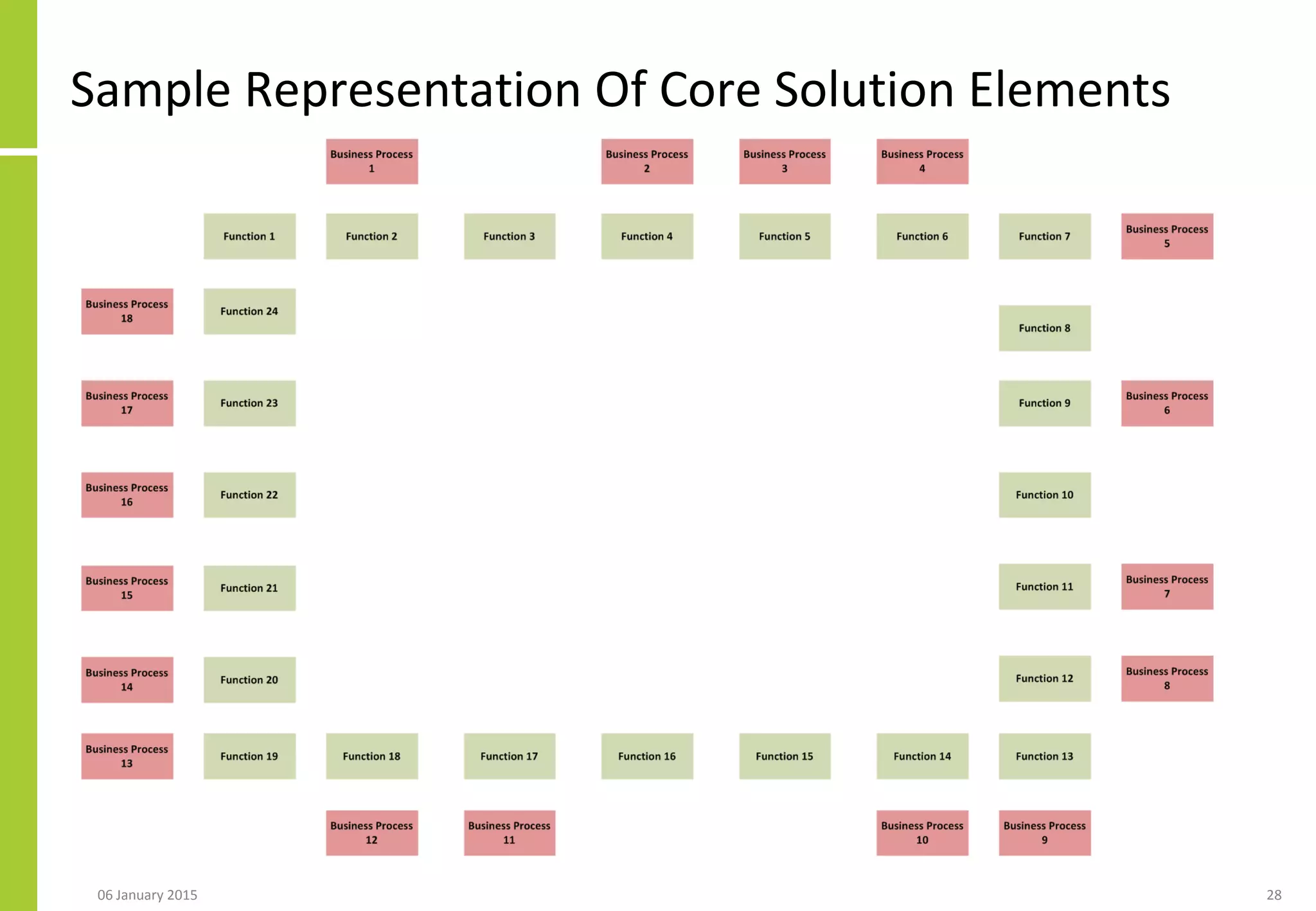
Sample Representation Of Core Solution Elements
06 January 2015 28
Sample Representation Of Core Solution Elements
06 January 2015 29
Sample Representation Of Core Solution Elements
06 January 2015 30
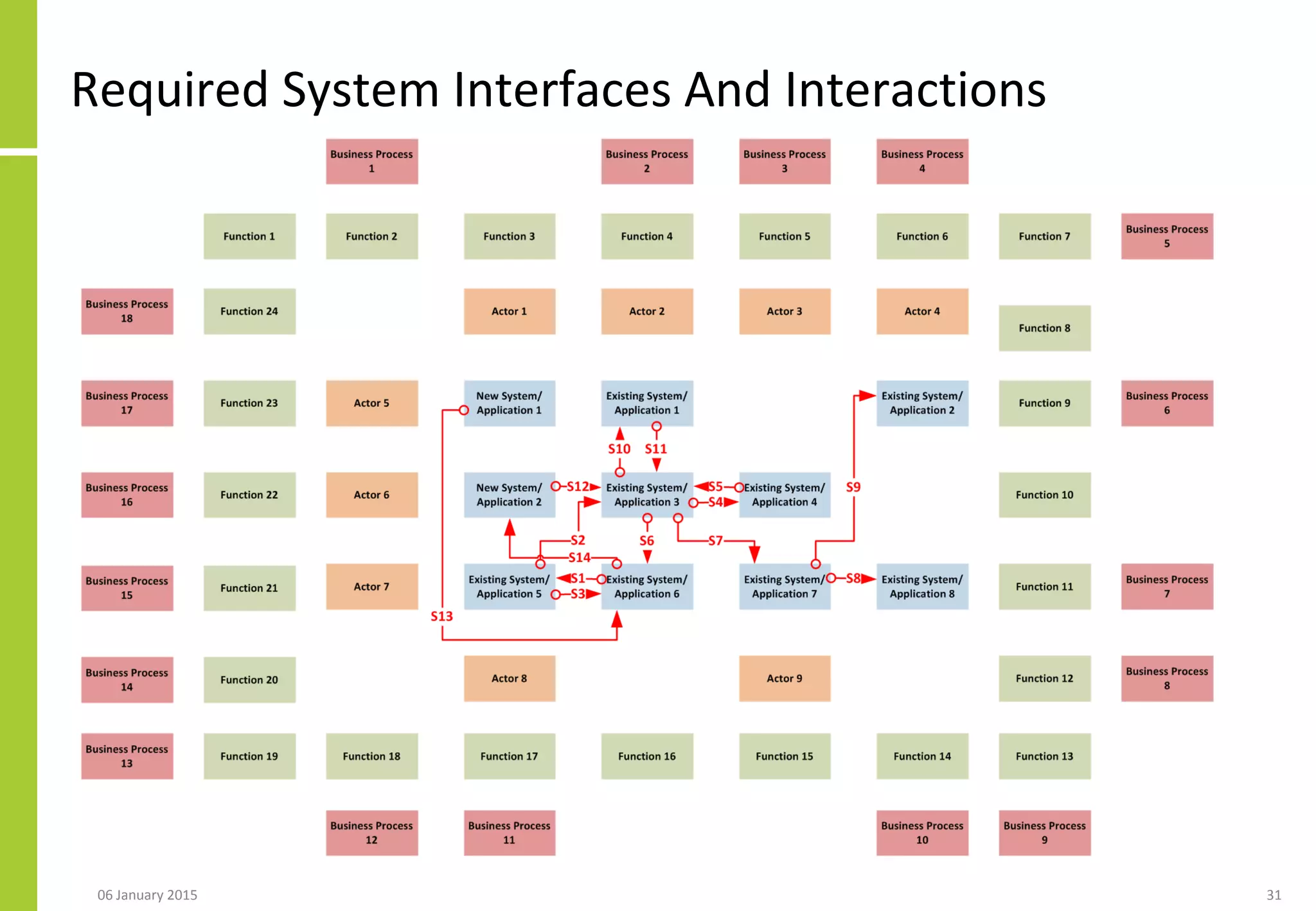
Required System Interfaces And Interactions
06 January 2015 31
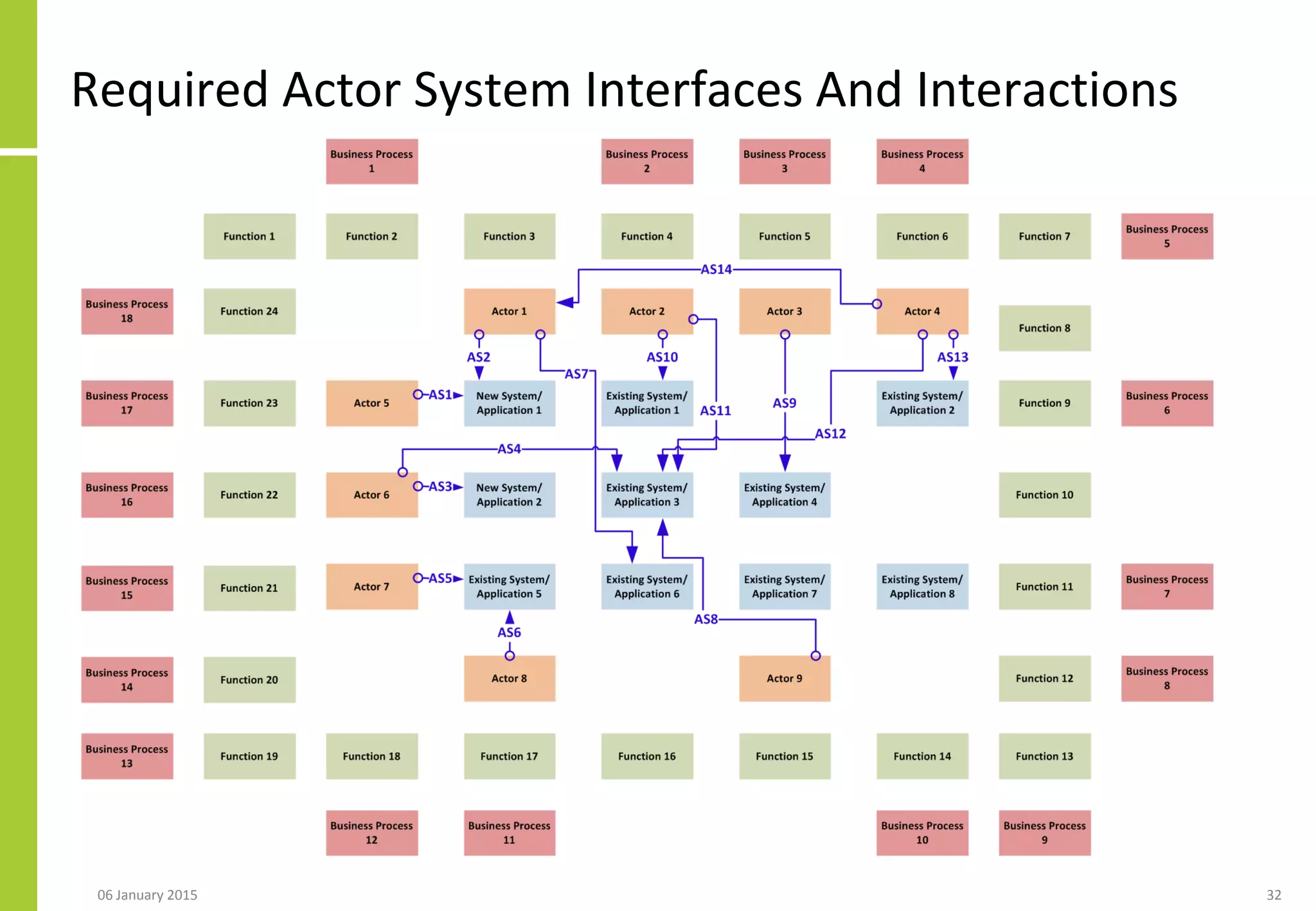
Required Actor System Interfaces And Interactions
06 January 2015 32
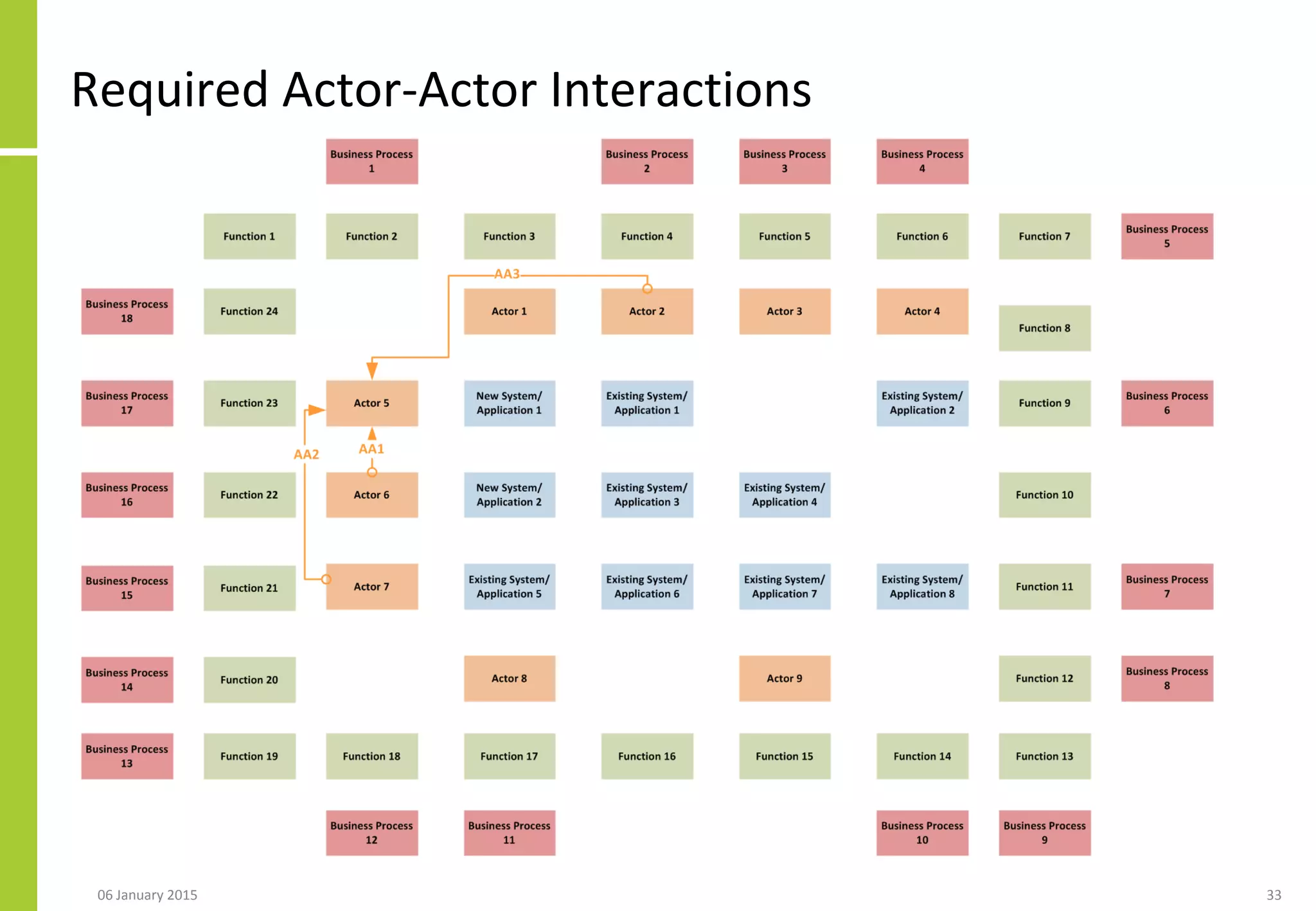
Required Actor-Actor Interactions
06 January 2015 33
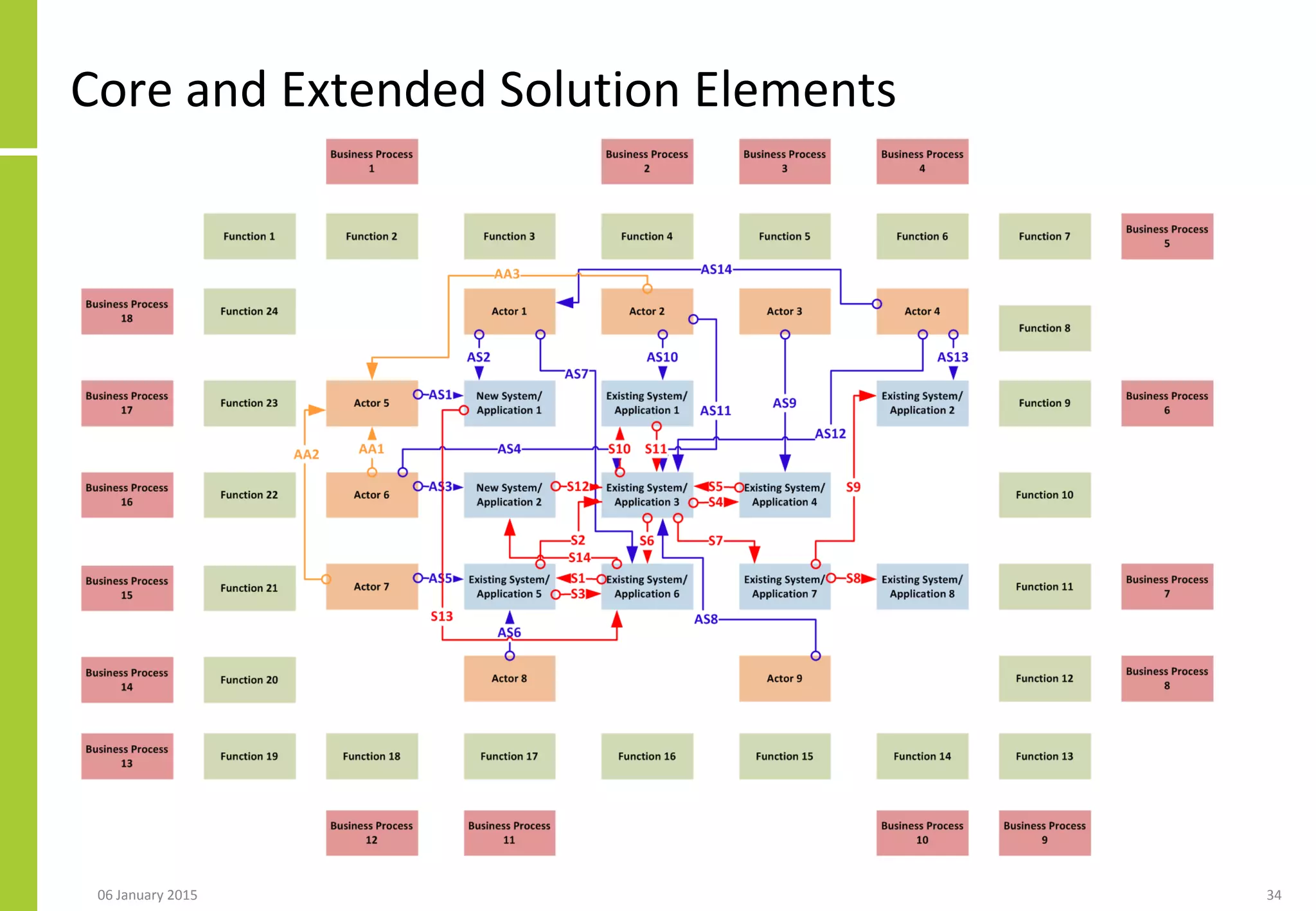
Core and Extended Solution Elements
06 January 2015 34
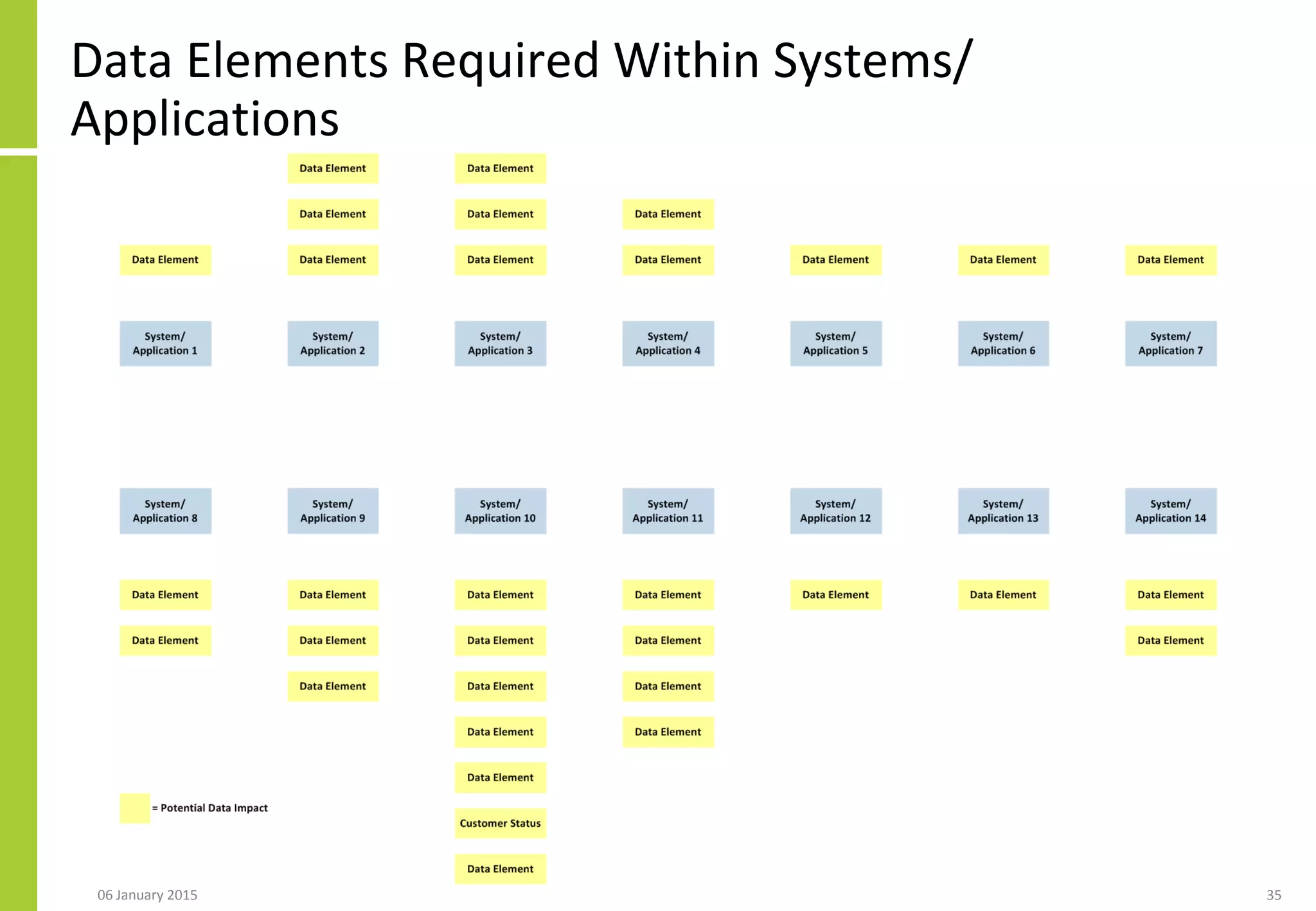
Data Elements Required Within Systems/
Applications
06 January 2015 35
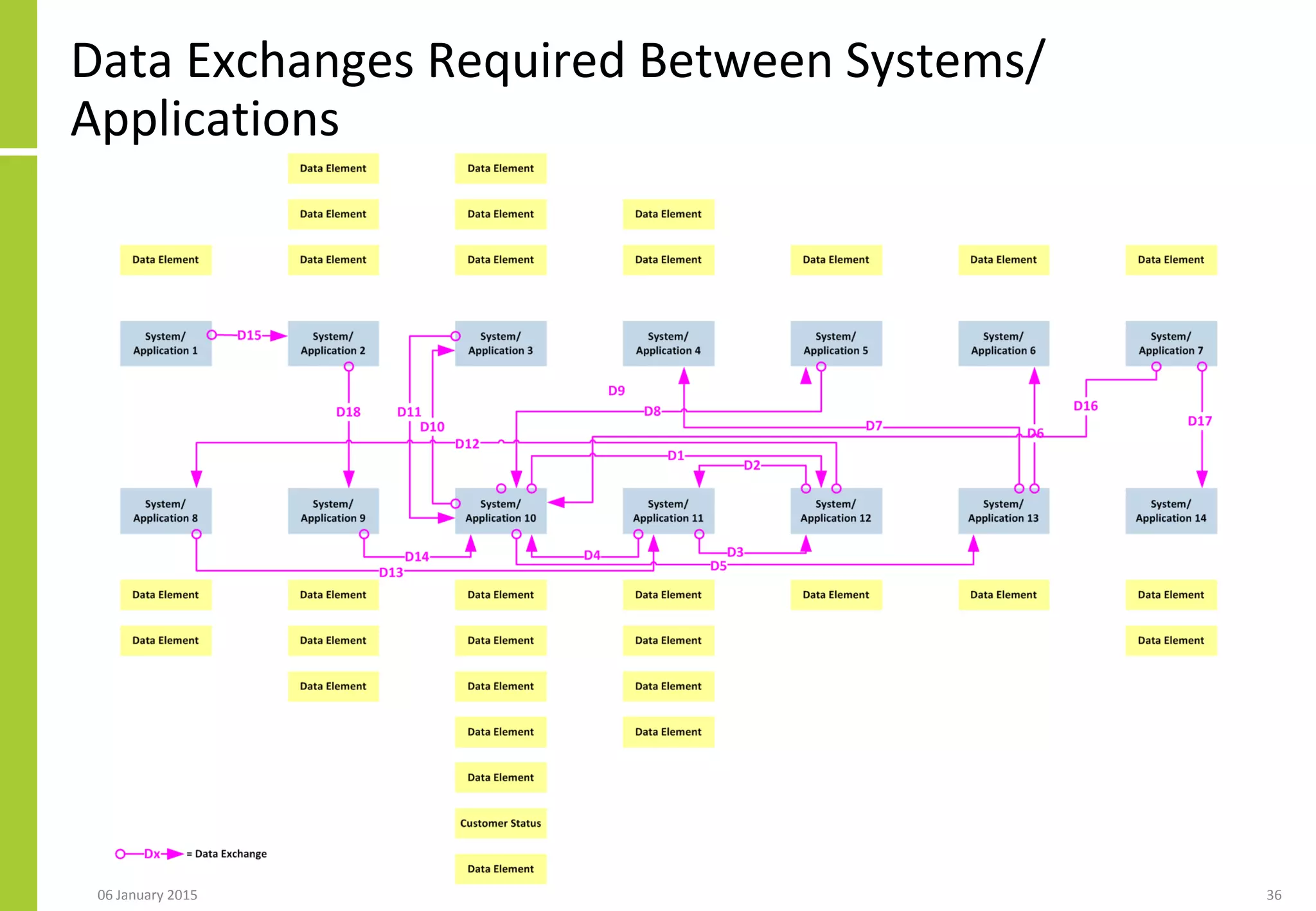
Data Exchanges Required Between Systems/
Applications
06 January 2015 36
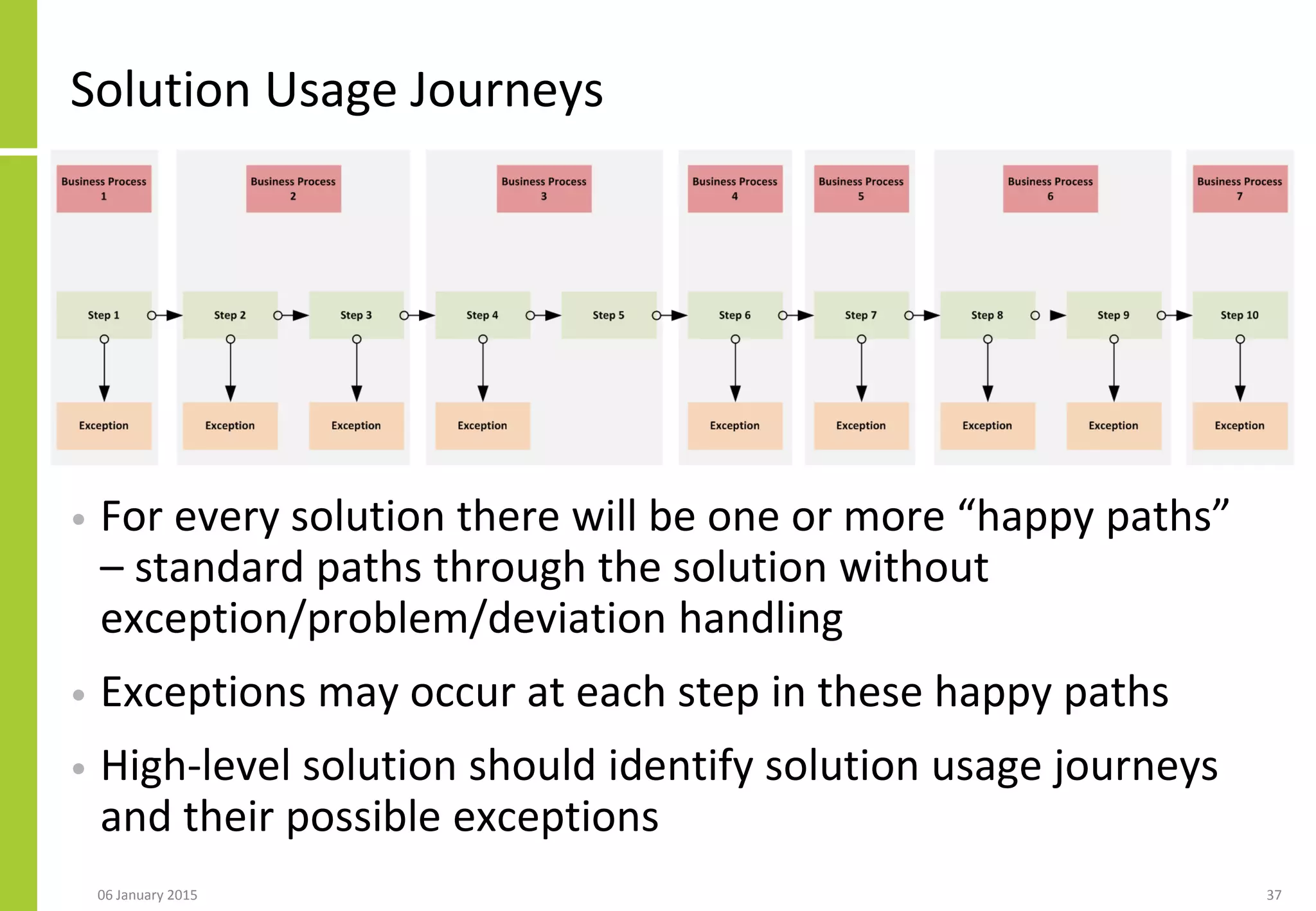
Solution Usage Journeys
• For every solution there will be one or more “happy paths”
– standard paths through the solution without
exception/problem/deviation handling
• Exceptions may occur at each step in these happy paths
• High-level solution should identify solution usage journeys
and their possible exceptions
06 January 2015 37
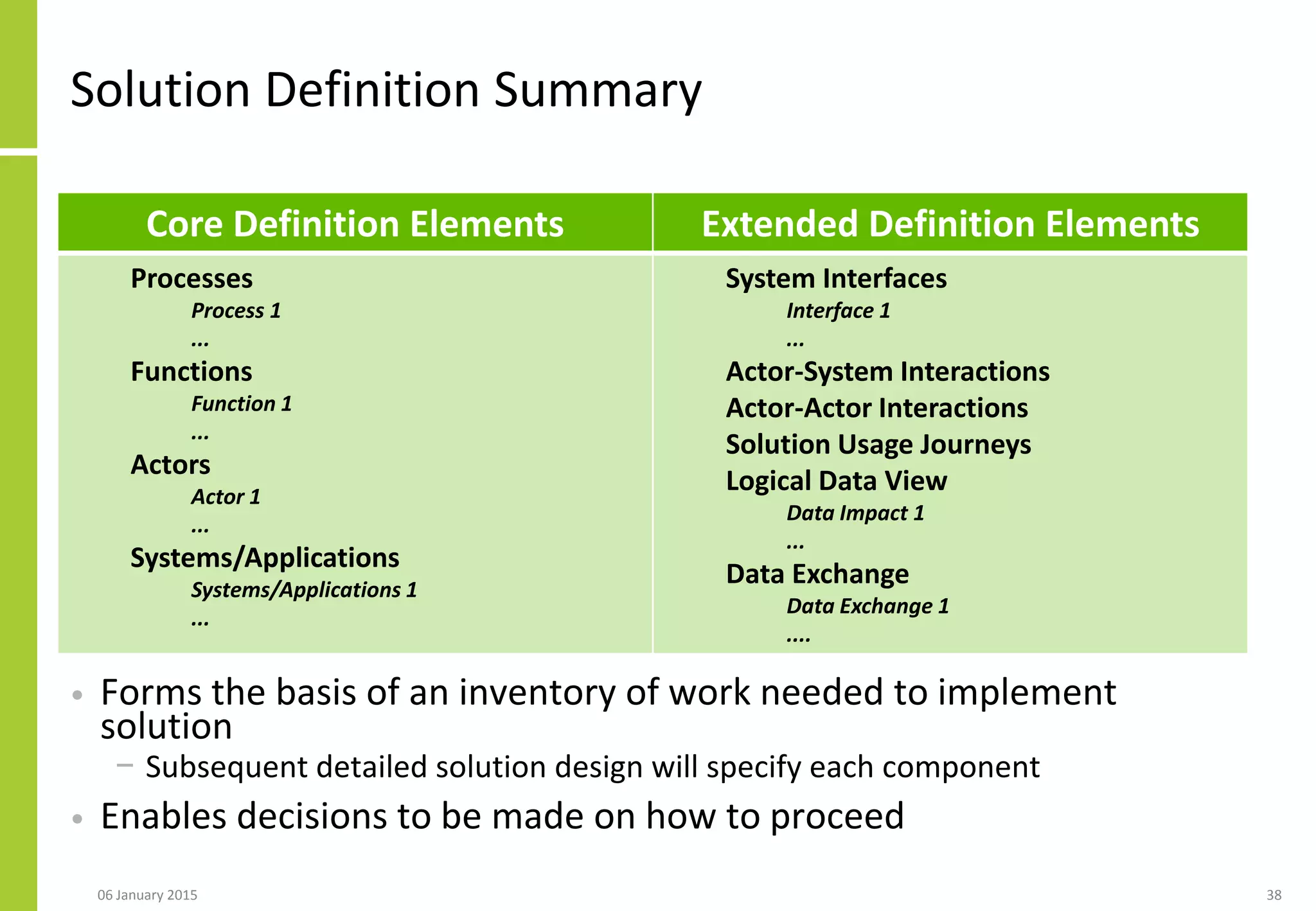
Solution Definition Summary
• Forms the basis of an inventory of work needed to implement
solution
− Subsequent detailed solution design will specify each component
• Enables decisions to be made on how to proceed
06 January 2015 38
Core Definition Elements Extended Definition Elements
Processes
Process 1
...
Functions
Function 1
...
Actors
Actor 1
...
Systems/Applications
Systems/Applications 1
...
System Interfaces
Interface 1
...
Actor-System Interactions
Actor-Actor Interactions
Solution Usage Journeys
Logical Data View
Data Impact 1
...
Data Exchange
Data Exchange 1
....
Solution Options
• Explore options for manual and automated operation
• What functions can be omitted
• What existing and available functionality can be reused
06 January 2015 39
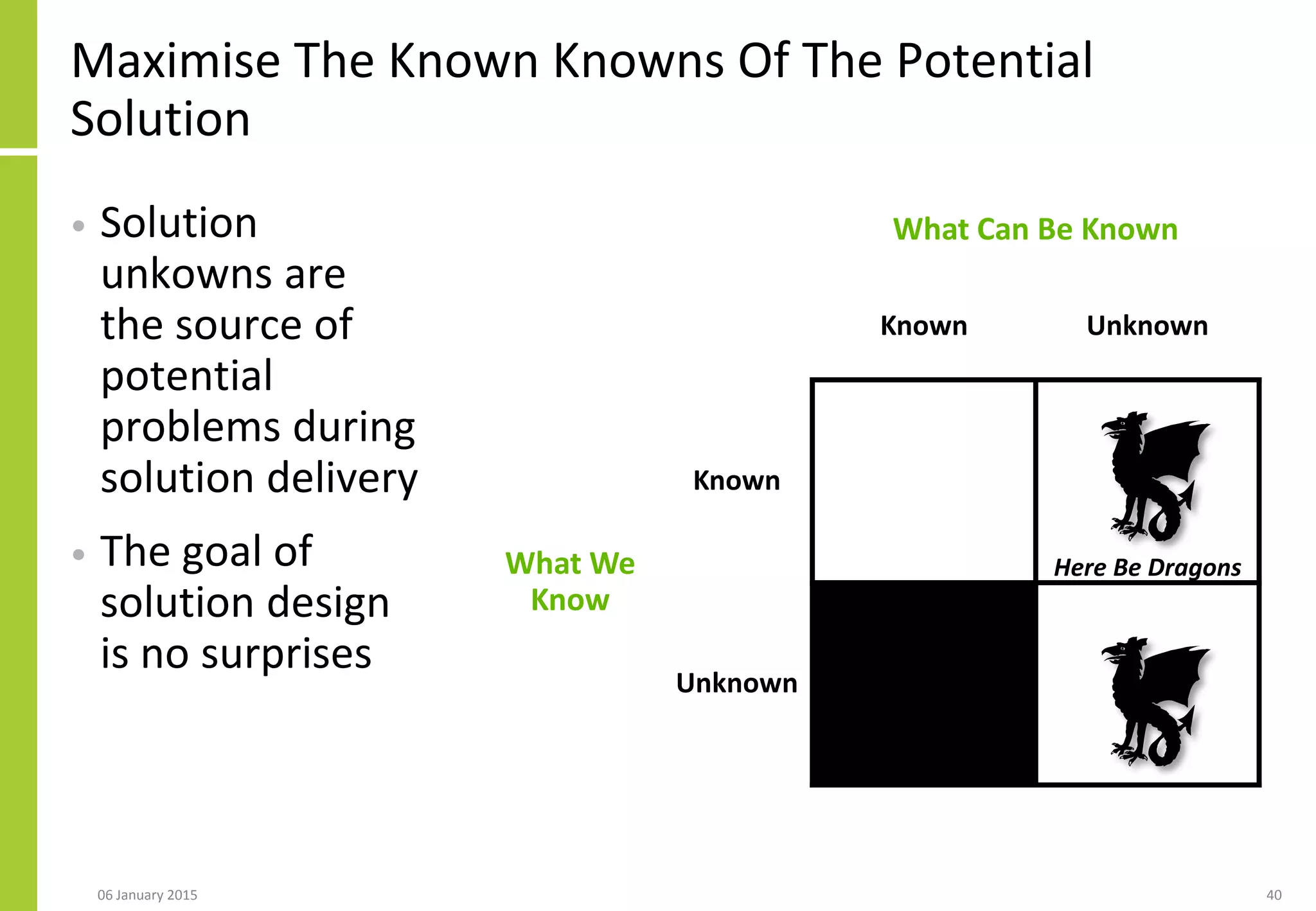
Maximise The Known Knowns Of The Potential
Solution
• Solution
unkowns are
the source of
potential
problems during
solution delivery
• The goal of
solution design
is no surprises
06 January 2015 40
What Can Be Known
Known Unknown
What We
Know
Known
Here Be Dragons
Unknown
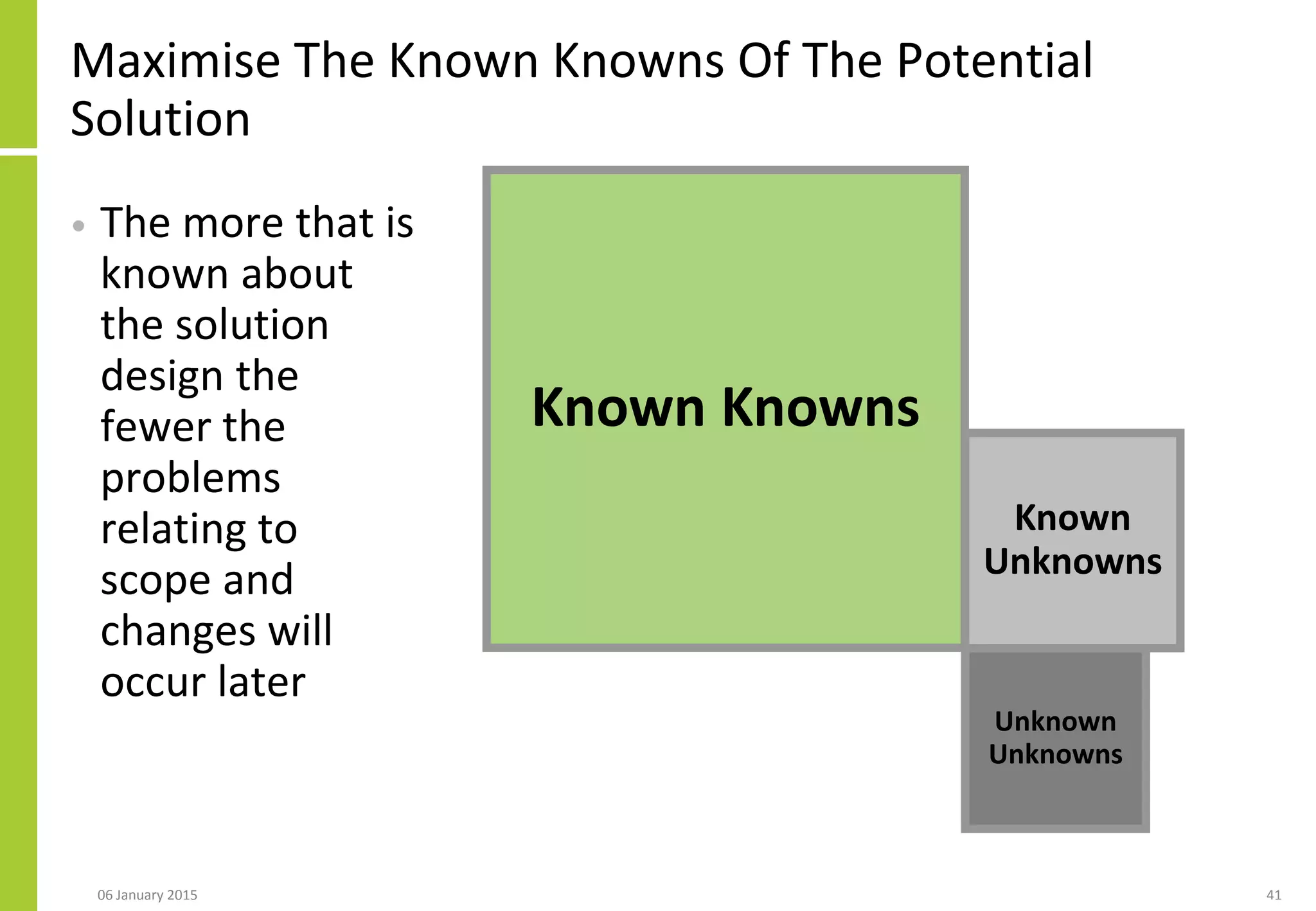
Maximise The Known Knowns Of The Potential
Solution
06 January 2015 41
Known Knowns
Known
Unknowns
Unknown
Unknowns
• The more that is
known about
the solution
design the
fewer the
problems
relating to
scope and
changes will
occur later
Benefits Of High-Level Solution Architecture
Definition Approach
• Provides an initial, high-level view of complete end-to-end
solution with all elements required to implement
• Not concerned with constraints or technical
implementation concerns at this stage
• Creates a a standardised repeatable approach to solution
architecture
• Covers all elements that comprise the solution
• Detailed design follows later
06 January 2015 42
Summary
• End-to-end solution architecture approach provides
sufficient information at the planning stage to make
informed decisions
• Provides realistic view of what is needed
• Balances effort required with results achieved
• Maximises available information and accuracy of decisions
• Contributes to the success of any solution delivery
06 January 2015 43
More Information
Alan McSweeney
http://ie.linkedin.com/in/alanmcsweeney
06 January 2015 44

Solution Architecture – Approach to Rapidly Scoping The Initial Solution Options

  • 1.
    Solution Architecture – Approachto Rapidly Scoping The Initial Solution Options Alan McSweeney
  • 2.
    Objective • Describe anapproach to creating a high-level architecture for a complete end-to-end solution design 06 January 2015 2
  • 3.
    A Solution Is... • ... An answer to a business problem • The solution will generally consist of some or all of: − New system(s) − Changes to existing systems − Changes to existing data model and data storage − Data migration/conversion − System and data interfaces − New business processes − Documentation − User training − Changes to existing business processes − Operational infrastructure − Operational and support processes • A solution very, very rarely consists of a single stand-alone, newly-developed system 306 January 2015
  • 4.
    4 Solution Architecture Is… − Description of the structure, characteristics and behaviour of a solution − The means by which the solution is defined, delivered, managed and operated • A solution is an answer to a business problem that may or may not include a technology component • Solution architecture is concerned with identifying that solution or set of solution options and their components • Generally there are many potential solutions to a problem with varying suitability • All solutions are subject to constraints 06 January 2015
  • 5.
    Solution Architecture • Solutionarchitecture involves identifying the scope of the entire solution including all its components and the required technology and operational changes • Multi-stage process to define the solution • Solution architecture needs to take account of all solution components in order to quantify the true scope of the effort needed to implement the solution • Without the complete, end-to-end view, the project to implement the solution and transfer it to operations will experience problems 506 January 2015
  • 6.
    Complete Scope OfSolution 06 January 2015 6 New System/ Component New System/ Component Change To Existing System Change To Existing System Change To Existing System Change To Data Model Change To Data Storage Data Migration/ Conversion System/ Data Interface System/ Data Interface New Business Processes Changes To Business Processes Documentation Training Operational Infrastructure Operational and Support Processes New System/ Component
  • 7.
    Complete Scope OfSolution • You need this end-to-end view to comprehend fully what solution delivery effort you are likely to incur, what resources are required, what are the likely costs and how long the implementation will take • You can make informed decisions to include/exclude components and understand the consequences of these decisions • You can engage at an early stage with the potential complexity of the solution • You can assess the potential organisational impact 06 January 2015 7
  • 8.
    Solution Architecture InThe Context Of The Overall Solution Delivery • Previously covered this subject in http://www.slideshare.net/alanmcsweeney/integrated- project-and-solution-delivery-and-business-engagement- model • Solution architecture needs to be involved at the early stage of the project to allow effective decision-making and to ensure that the complete effort and resources required are identified early • Solution architecture is involved throughout the delivery of the solution, from initial concept to detailed functional design 806 January 2015
  • 9.
    Solution Architecture inIntegrated Solution Delivery Process Concept Initiate Plan Design Build Test Deploy Operate Project Management Business Function Business Analysis Solution Architecture Delivery Test and Quality Organisation Readiness Service Management Infrastructure Solution Concept/ Requirements Document Rough Order of Magnitude Estimate Project Charter Project Initiation Document Business Case Project Plan Project Resource Plan Functional Requirements As Is Process Definition Benefits Schedule and Benefits Realisation Plan User Acceptance Test Results Benefits Realisation Review Lessons Learned To Be Process Definition User Acceptance Test Design and Plan Standard Operating Procedures Documentation Library Solution Architecture High Level Design Non Functional Requirements Detailed Solution Design/ Functional Specification Data Audit Data Design and Data Migration Plan Data Migration Results Data Migration Test Data Migration to Live Results Go Live Support Configuration Management Approach and Plan Technical/Build Specification Build Documentation Unit Test Results Integration Test Results System Test Plan Results UAT Changes and Rework Deploy to Production Results Support and Operations Documentation Test Strategy Functional Test Design and Plan Non-Functional Test Design and Plan Integration Test Results System Test Results Operational Readiness Review Management Team Briefing Communications Strategy and Plan Change Impact Assessment Organisation Design Develop Training Material Detailed Communications Plan Training Needs Analysis Change Action Plan Role Definition Training Schedule Organisation and Staffing Implementation Training Delivery Service Impact Assessment Service Level Requirements Access and Security Definition Operations Acceptance Testing Design and Plan Operations Acceptance Testing Results Service Definition Functional Test Results Non-Functional Test Results Integration Test Design and Plan System Test Design and Plan Service and Operational Level Agreement(s) Transfer to Production Plan Infrastructure Plan Infrastructure Design Infrastructure Technical Specification Build Development Environment Build Test Environment Build UAT Environment Build OAT Environment Build Training Environment Build Production Environment Decommission Unused Environments Detailed Estimates Confirmed Estimates Project Management – Planning, Resource, Scheduling Risk, Actions, Issues and Dependencies Management Reporting and Communications Management Change Management 906 January 2015
  • 10.
    Integrated Solution DeliveryProcess • Solution architecture involved at four key solution delivery stages − Concept – produce initial rough-order-of-magnitude estimate to allow decision to be made to proceed to more detailed analysis − Plan – produce high-level solution design identifying all the solution components to allow decisions be made on whether to proceed and what to automate or operate manually − Design – produce detailed functional specification of what the solition must do, incorporating business requirements − Build/Test – act as source of subject matter expertise clarifying requirements and assisting with change control and scope management 06 January 2015 10
  • 11.
    Not All ConceptsBecome Projects And Not All Projects Proceed To Completion 11 Concept Initiate Plan Design Build Test Deploy Operate Not Proceeded With 06 January 2015
  • 12.
    Not All ConceptsBecome Projects And Not All Projects Proceed To Completion • There is an inevitable cancellation/postponement/decision not to proceed with projects during the solution selection and elaboration process 06 January 2015 12
  • 13.
    Not All ConceptsBecome Solutions And Not All Solutions Proceed To Completion • Need to identify feasible, worthwhile, justified concepts to develop into projects and to eliminate those that are not cost- effective • Solution architecture plays an important role in identifying solutions worth implementing and in quantifying the effort • Need to involve solution architecture at an early stage to understand the full scope of the solution and its implementation • Enable decisions to be made on whether to proceed and what will be included in the scope • Create initial high-level solution architecture that can be expanded on if the solution is being proceeded with • Minimise the work done while maximising the information gathered and processed and results obtained 06 January 2015 13
  • 14.
    Project Gates –Review And Decision Points Project Stages/ Timeline ProjectActivity/Function Concept Initiate Plan Design Build Test Deploy Manage and Operate Project Management Gate0 Gate1 Gate2 Gate3 Gate4 Gate5 Gate6 Gate7 Business Function Business Analysis Solution Architecture Implementation and Delivery Test and Quality Organisation Readiness Service Management Infrastructure and Communications Time Business Functions/ Roles 1406 January 2015
  • 15.
    Project Gates –Review And Decision Points for High Level Solution Architecture • Gate 2 is the point where the high-level solution archtecture is reviewed, assessed and decisions are made on whether to proceed and what is being proceeded with 06 January 2015 15
  • 16.
    Find The InformationSaddle Point • Do as little as possible to achieve as much as possible to make an informed decision on whether and how to proceed at gate stage in solution journey • Key principle at this stage is satisficing – optimise effort and resources during planning- satisfy requirements sufficiently 06 January 2015 16 Minimise Effort Maximise Results
  • 17.
    Structured Approach ToSolution Architecture • Previously covered this subject in http://www.slideshare.net/alanmcsweeney/structured- approach-to-solution-architecture • Objective of structured approach is to ensure consistency in solution architecture design options • Ensure solution addresses all business requirements • Provide checklist to validate solution design options • Design realistic and achievable solutions that meet the business needs 06 January 2015 17
  • 18.
    Approach To InitialSolution Architecture Definition • Want an approach that quickly identifies the likely scope of the solution, the options and the decisions that need to be made • Key elements of initial solution scope and design: − Systems/Applications – new and existing systems that must be developed/changed to deliver functions − System Interfaces – links between systems − Actors – business functions and roles that will interact with the overall solution and its components − Actor-System Interactions – interactions between Actors and Systems/Applications − Actor-Actor Interactions – interactions between Actors − Functions – functions that must be delivered by the overall solution − Processes – business processes required to operate the solution − Journey – standard journey through processes/functions and exceptions/deviations from “happy path” − Logical Data View – data elements required − Data Exchanges – movement of data between Systems/Applications • These combine to provide a comprehensive view of the potential solution at this early stage 06 January 2015 18
  • 19.
    Approach To InitialSolution Architecture Definition • Start with identifying core solution definition elements – those elements directly involved in the solution • Expand initial solution definition with extended elements – element interactions and data storage and exchange 06 January 2015 19 Core Definition Elements Extended Definition Elements Processes Functions Actors Systems/Applications System Interfaces Actor-System Interactions Actor-Actor Interactions Solution Usage Journeys Logical Data View Data Exchange
  • 20.
    Initial Solution ArchitectureDefinition • This allows: − System changes and developments required to be defined − Potential options for reuse of existing systems to be determined − Options for manual or automated operation to be pinpointed − Effort to be estimated − Organisational impact to be quantified including staffing, training, support, cutover, parallel run and documentation − Dependencies to be identified − Informed decision to proceed to be made • Provides a worklist/table of contents of further work if decision to continue is made 06 January 2015 20
  • 21.
    Solution Architecture InBusiness Context Business Objectives Business Operational Model Enterprise Architecture Solution Delivery Management And Operations Business Processes Business Systems Business Strategy Solution Architecture Solution Architecture Defines Business System 1 Business Systems Exist to Implement and Operate Business Processes 2 Solution Architecture Defines Functional Detail of Solution to be Implemented 3 06 January 2015 21
  • 22.
    Core Elements OfInitial Solution Architecture Definition 06 January 2015 22 Systems/ Applications Actors Functions Processes
  • 23.
    Initial Solution ArchitectureDefinition – Identify Key Existing Business Processes Affected Or New Ones Required 06 January 2015 23
  • 24.
    Identify Functions RequiredTo Enable Processes 06 January 2015 24
  • 25.
    Identify Actors WhoWill Use Functions And Participate In Processes 06 January 2015 25
  • 26.
    Identify New Systems/ApplicationsAnd Changes To Existing Systems/Applications To Deliver Functions 06 January 2015 26
  • 27.
    Sample Representation OfCore Solution Elements 06 January 2015 27
  • 28.
    Sample Representation OfCore Solution Elements 06 January 2015 28
  • 29.
    Sample Representation OfCore Solution Elements 06 January 2015 29
  • 30.
    Sample Representation OfCore Solution Elements 06 January 2015 30
  • 31.
    Required System InterfacesAnd Interactions 06 January 2015 31
  • 32.
    Required Actor SystemInterfaces And Interactions 06 January 2015 32
  • 33.
  • 34.
    Core and ExtendedSolution Elements 06 January 2015 34
  • 35.
    Data Elements RequiredWithin Systems/ Applications 06 January 2015 35
  • 36.
    Data Exchanges RequiredBetween Systems/ Applications 06 January 2015 36
  • 37.
    Solution Usage Journeys •For every solution there will be one or more “happy paths” – standard paths through the solution without exception/problem/deviation handling • Exceptions may occur at each step in these happy paths • High-level solution should identify solution usage journeys and their possible exceptions 06 January 2015 37
  • 38.
    Solution Definition Summary •Forms the basis of an inventory of work needed to implement solution − Subsequent detailed solution design will specify each component • Enables decisions to be made on how to proceed 06 January 2015 38 Core Definition Elements Extended Definition Elements Processes Process 1 ... Functions Function 1 ... Actors Actor 1 ... Systems/Applications Systems/Applications 1 ... System Interfaces Interface 1 ... Actor-System Interactions Actor-Actor Interactions Solution Usage Journeys Logical Data View Data Impact 1 ... Data Exchange Data Exchange 1 ....
  • 39.
    Solution Options • Exploreoptions for manual and automated operation • What functions can be omitted • What existing and available functionality can be reused 06 January 2015 39
  • 40.
    Maximise The KnownKnowns Of The Potential Solution • Solution unkowns are the source of potential problems during solution delivery • The goal of solution design is no surprises 06 January 2015 40 What Can Be Known Known Unknown What We Know Known Here Be Dragons Unknown
  • 41.
    Maximise The KnownKnowns Of The Potential Solution 06 January 2015 41 Known Knowns Known Unknowns Unknown Unknowns • The more that is known about the solution design the fewer the problems relating to scope and changes will occur later
  • 42.
    Benefits Of High-LevelSolution Architecture Definition Approach • Provides an initial, high-level view of complete end-to-end solution with all elements required to implement • Not concerned with constraints or technical implementation concerns at this stage • Creates a a standardised repeatable approach to solution architecture • Covers all elements that comprise the solution • Detailed design follows later 06 January 2015 42
  • 43.
    Summary • End-to-end solutionarchitecture approach provides sufficient information at the planning stage to make informed decisions • Provides realistic view of what is needed • Balances effort required with results achieved • Maximises available information and accuracy of decisions • Contributes to the success of any solution delivery 06 January 2015 43
  • 44.