Page 1 / 79
Confidentiality and Intellectual Property
These materials have been prepared by Gartner Inc. and/or its affiliates (“Gartner”) for the exclusive and individual use of our clients. These materials contain valuable confidential and
proprietary information belonging to Gartner, and they may not be shared with any third party (including independent contractors and consultants) without the prior approval of Gartner.
Gartner retains any and all intellectual property rights in these materials and requires retention of the copyright mark on all pages reproduced.
Legal Caveat
These materials have been prepared by Gartner Inc. and/or its affiliates (“Gartner”) for the exclusive and individual use of our clients. These materials contain valuable confidential and
proprietary information belonging to Gartner, and they may not be shared with any third party (including independent contractors and consultants) without the prior approval of Gartner.
Gartner retains any and all intellectual property rights in these materials and requires retention of the copyright mark on all pages reproduced.
Disclaimer
Unless otherwise set forth in your Service Description or marked expressly for external use, these items may be downloaded and customized for internal noncommercial use by the Client.
The items contained in this report may not be repackaged or resold. Gartner makes no representations or warranties as to the suitability of this report for any particular purpose, and
disclaims all liability for any damage or loss, whether direct, consequential, incidental or special, arising out of the use of or inability to use this material or the information provided herein.
Introduction Executive Summary Path to Maturity Next Steps Appendix
Report Roadmap
Page 2 / 79
Introduction Executive Summary Path to Maturity Next Steps Appendix
Report Roadmap
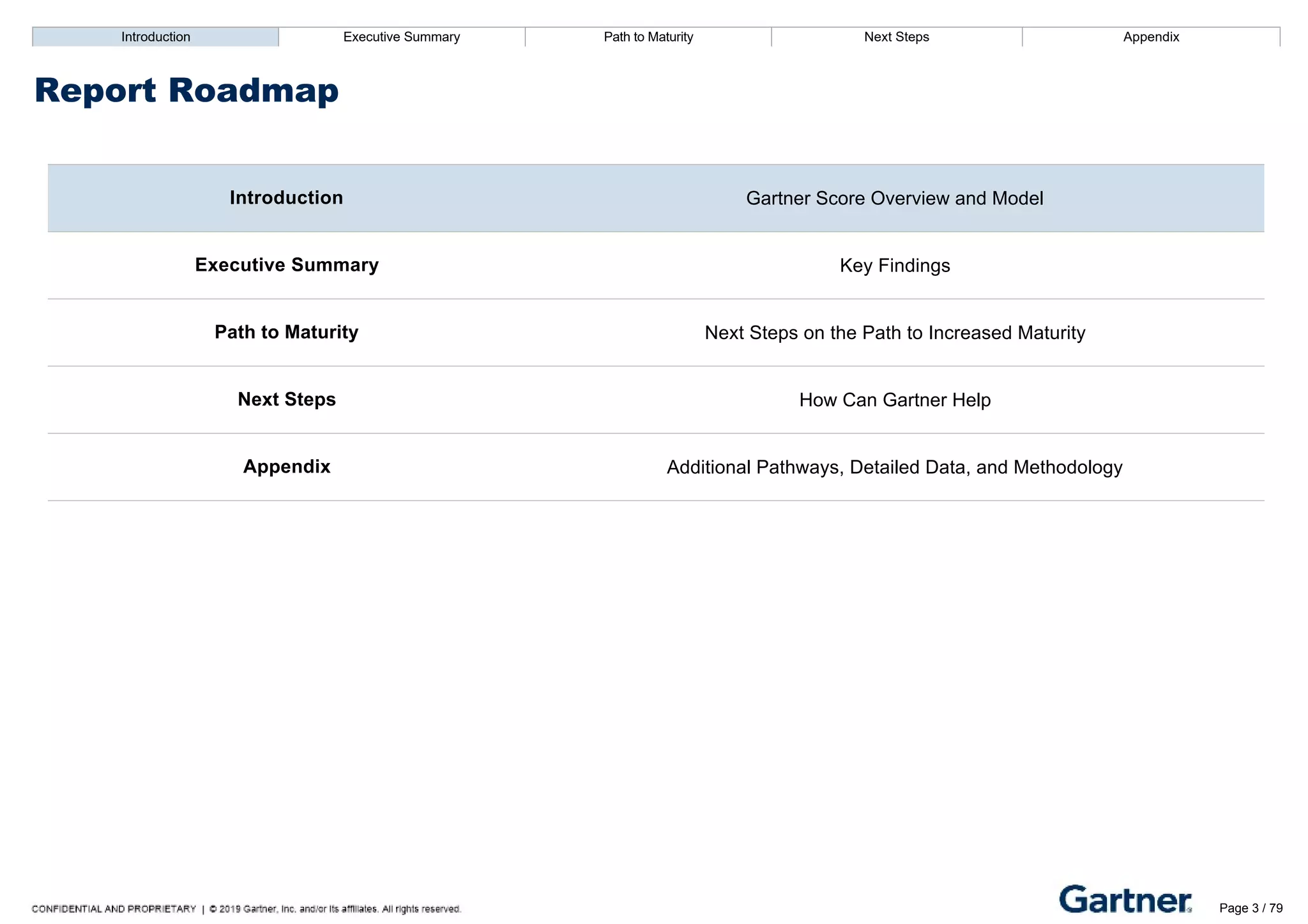
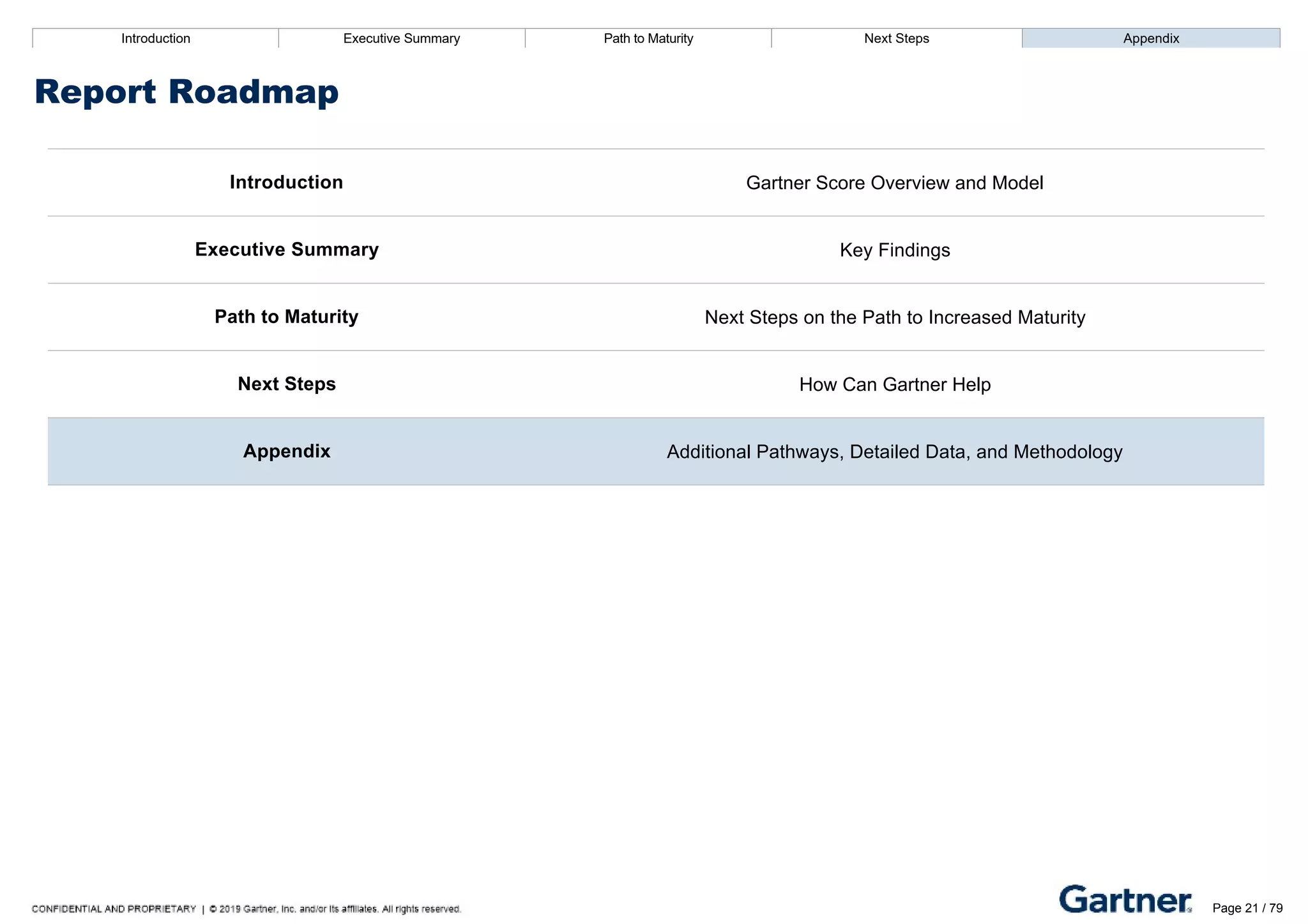
Introduction Gartner Score Overview and Model
Executive Summary Key Findings
Path to Maturity Next Steps on the Path to Increased Maturity
Next Steps How Can Gartner Help
Appendix Additional Pathways, Detailed Data, and Methodology
Introduction Executive Summary Path to Maturity Next Steps Appendix
Gartner Score Overview
Introduction to Gartner Score
Gartner Score enables organizations to improve functional performance by assessing their performance across a broad set of functional activities. The diagnostic
Page 3 / 79
Introduction Executive Summary Path to Maturity Next Steps Appendix
Gartner Score Overview
Introduction to Gartner Score
Gartner Score enables organizations to improve functional performance by assessing their performance across a broad set of functional activities. The diagnostic
measures two primary dimensions: maturity and importance.
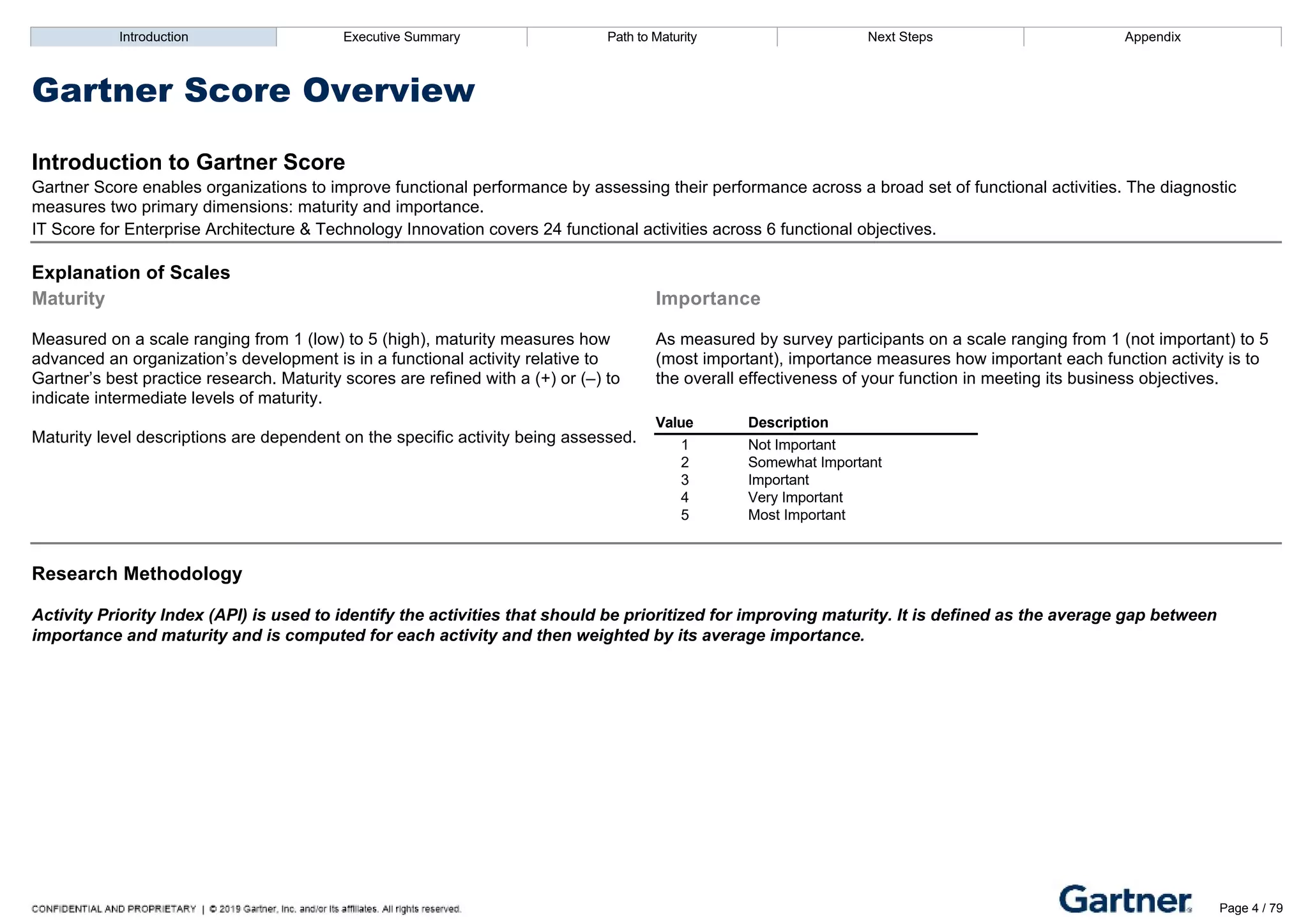
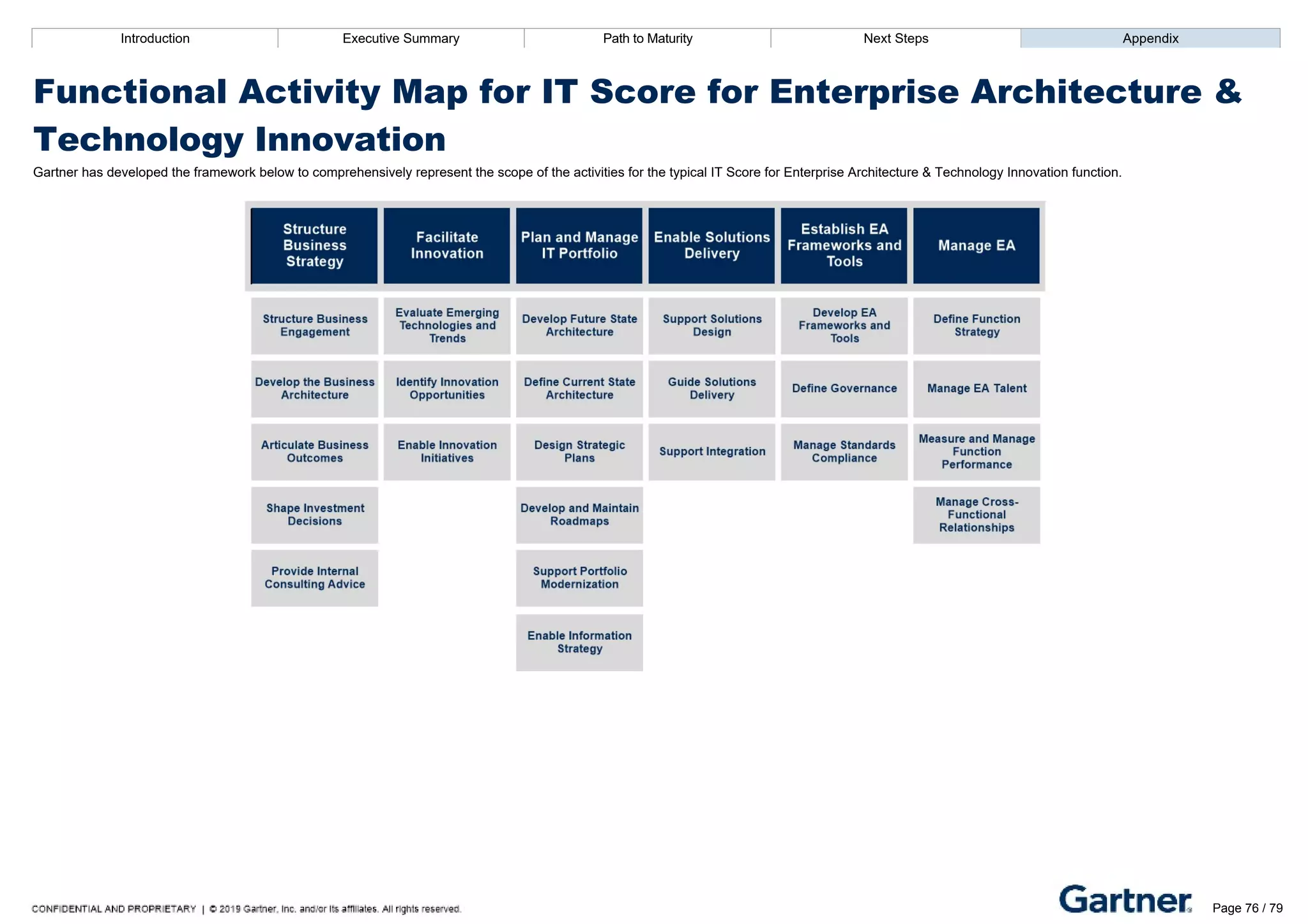
IT Score for Enterprise Architecture & Technology Innovation covers 24 functional activities across 6 functional objectives.
Explanation of Scales
Maturity Importance
Measured on a scale ranging from 1 (low) to 5 (high), maturity measures how
advanced an organization’s development is in a functional activity relative to
Gartner’s best practice research. Maturity scores are refined with a (+) or (–) to
indicate intermediate levels of maturity.
Maturity level descriptions are dependent on the specific activity being assessed.
As measured by survey participants on a scale ranging from 1 (not important) to 5
(most important), importance measures how important each function activity is to
the overall effectiveness of your function in meeting its business objectives.
Value Description
1
2
3
4
5
Not Important
Somewhat Important
Important
Very Important
Most Important
Research Methodology
Activity Priority Index (API) is used to identify the activities that should be prioritized for improving maturity. It is defined as the average gap between
importance and maturity and is computed for each activity and then weighted by its average importance.
Introduction Executive Summary Path to Maturity Next Steps Appendix
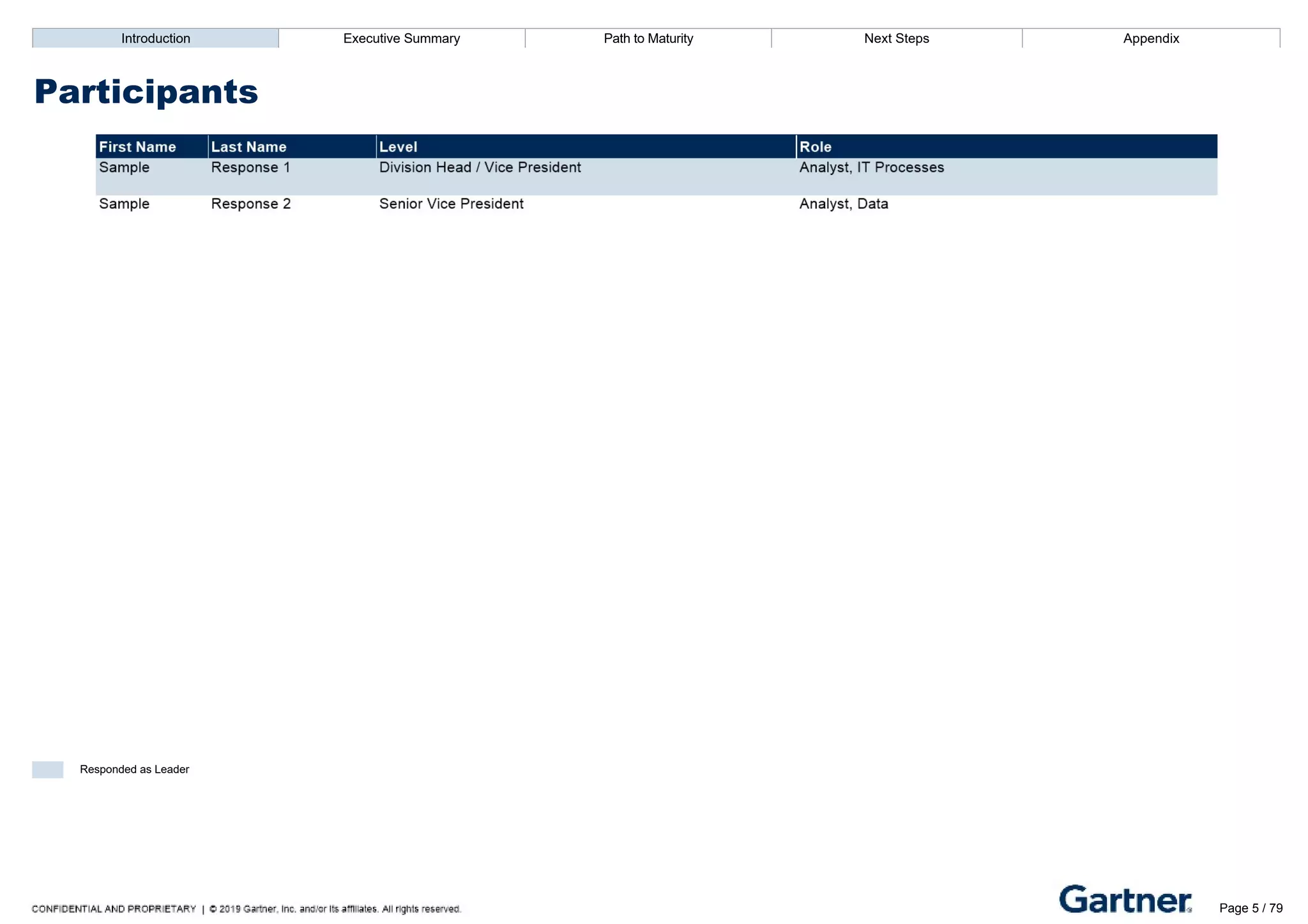
Participants
Page 4 / 79
Introduction Executive Summary Path to Maturity Next Steps Appendix
Participants
Responded as Leader
Introduction Executive Summary Path to Maturity Next Steps Appendix
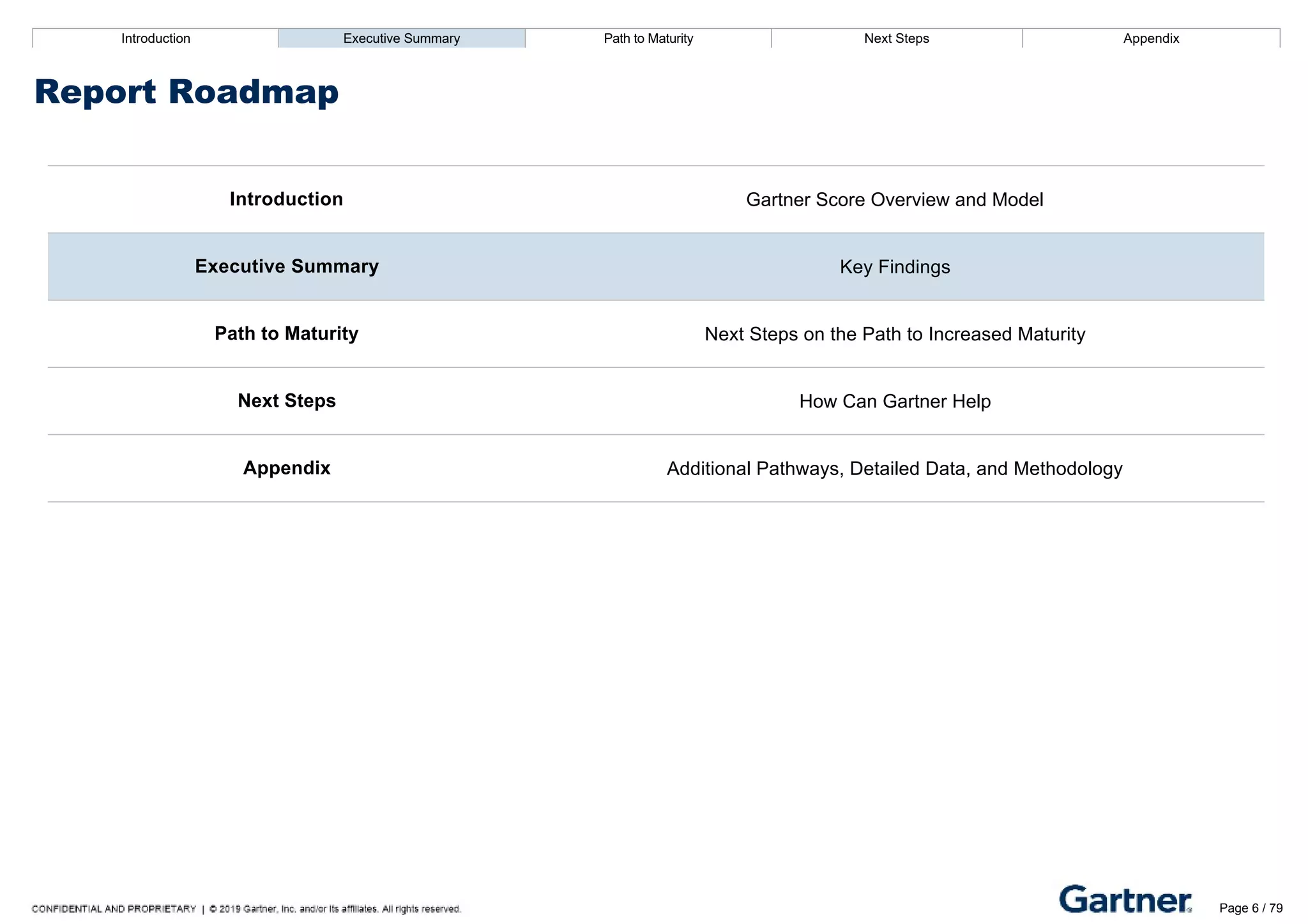
Report Roadmap
Page 5 / 79
Responded as Leader
Introduction Executive Summary Path to Maturity Next Steps Appendix
Report Roadmap
Introduction Gartner Score Overview and Model
Executive Summary Key Findings
Path to Maturity Next Steps on the Path to Increased Maturity
Next Steps How Can Gartner Help
Appendix Additional Pathways, Detailed Data, and Methodology
Introduction Executive Summary Path to Maturity Next Steps Appendix
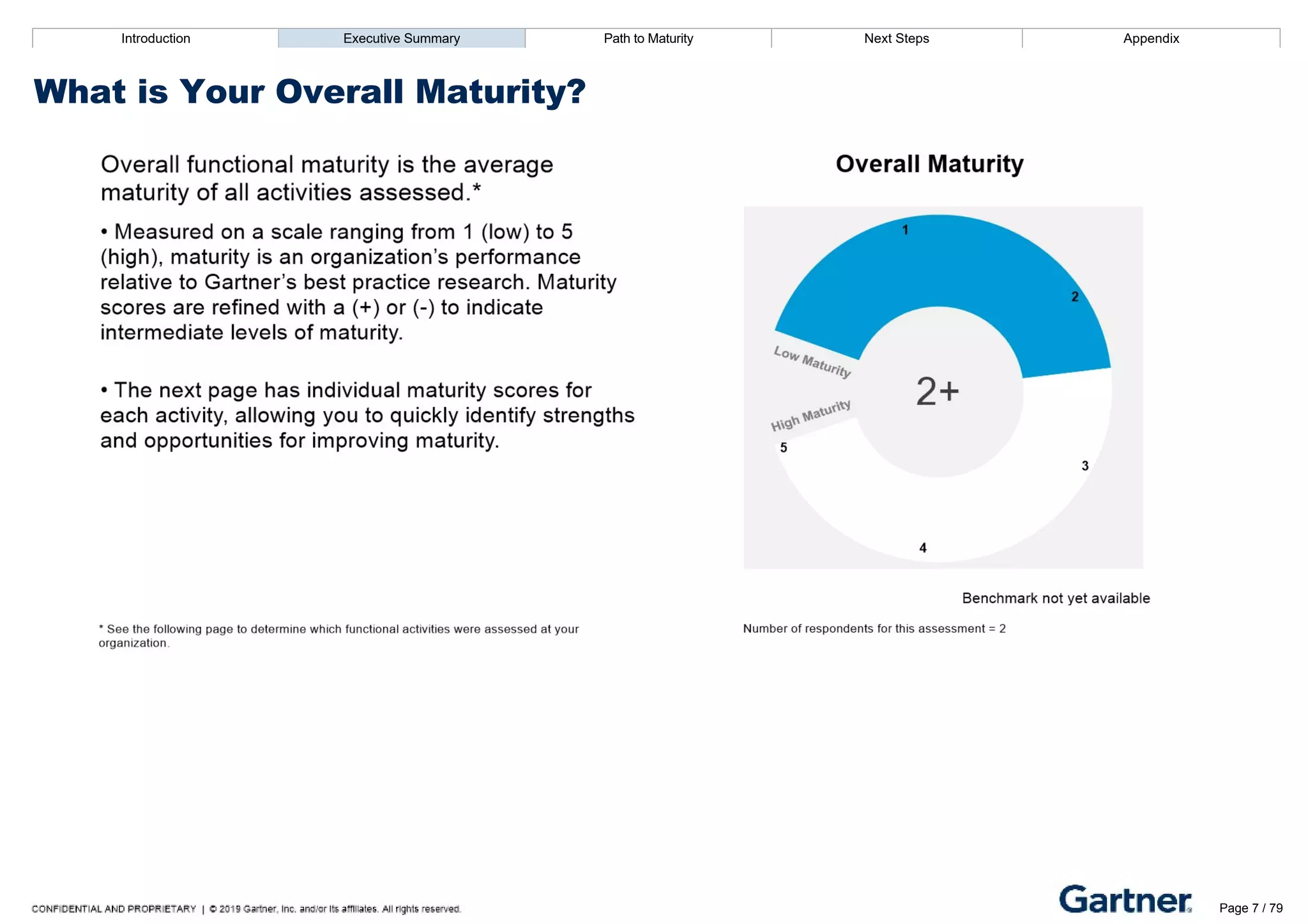
What is Your Overall Maturity?
Page 6 / 79
Introduction Executive Summary Path to Maturity Next Steps Appendix
What is Your Overall Maturity?
Introduction Executive Summary Path to Maturity Next Steps Appendix
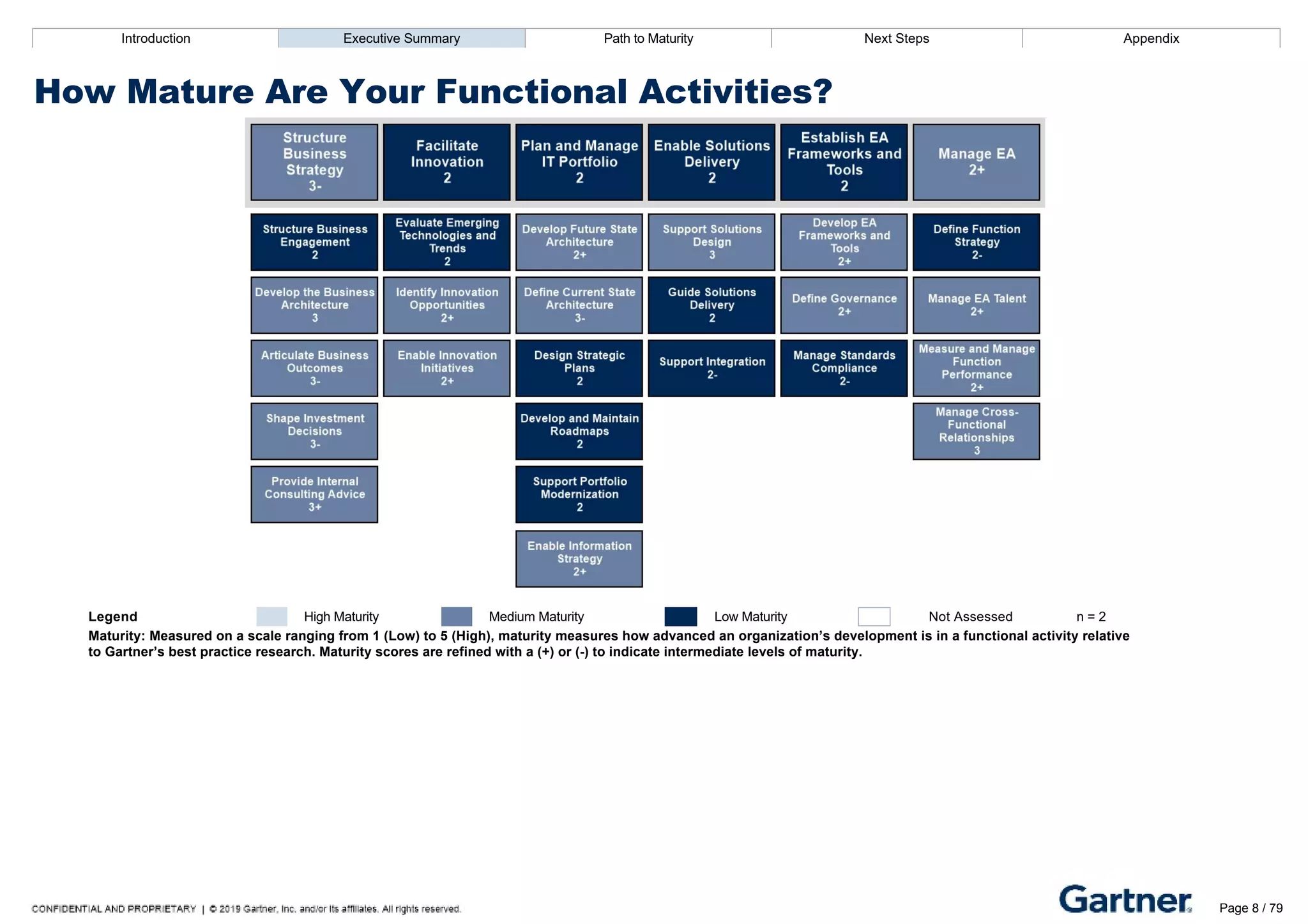
How Mature Are Your Functional Activities?
Page 7 / 79
Introduction Executive Summary Path to Maturity Next Steps Appendix
How Mature Are Your Functional Activities?
Legend High Maturity Medium Maturity Low Maturity Not Assessed n = 2
Maturity: Measured on a scale ranging from 1 (Low) to 5 (High), maturity measures how advanced an organization’s development is in a functional activity relative
to Gartner’s best practice research. Maturity scores are refined with a (+) or (­) to indicate intermediate levels of maturity.
Introduction Executive Summary Path to Maturity Next Steps Appendix
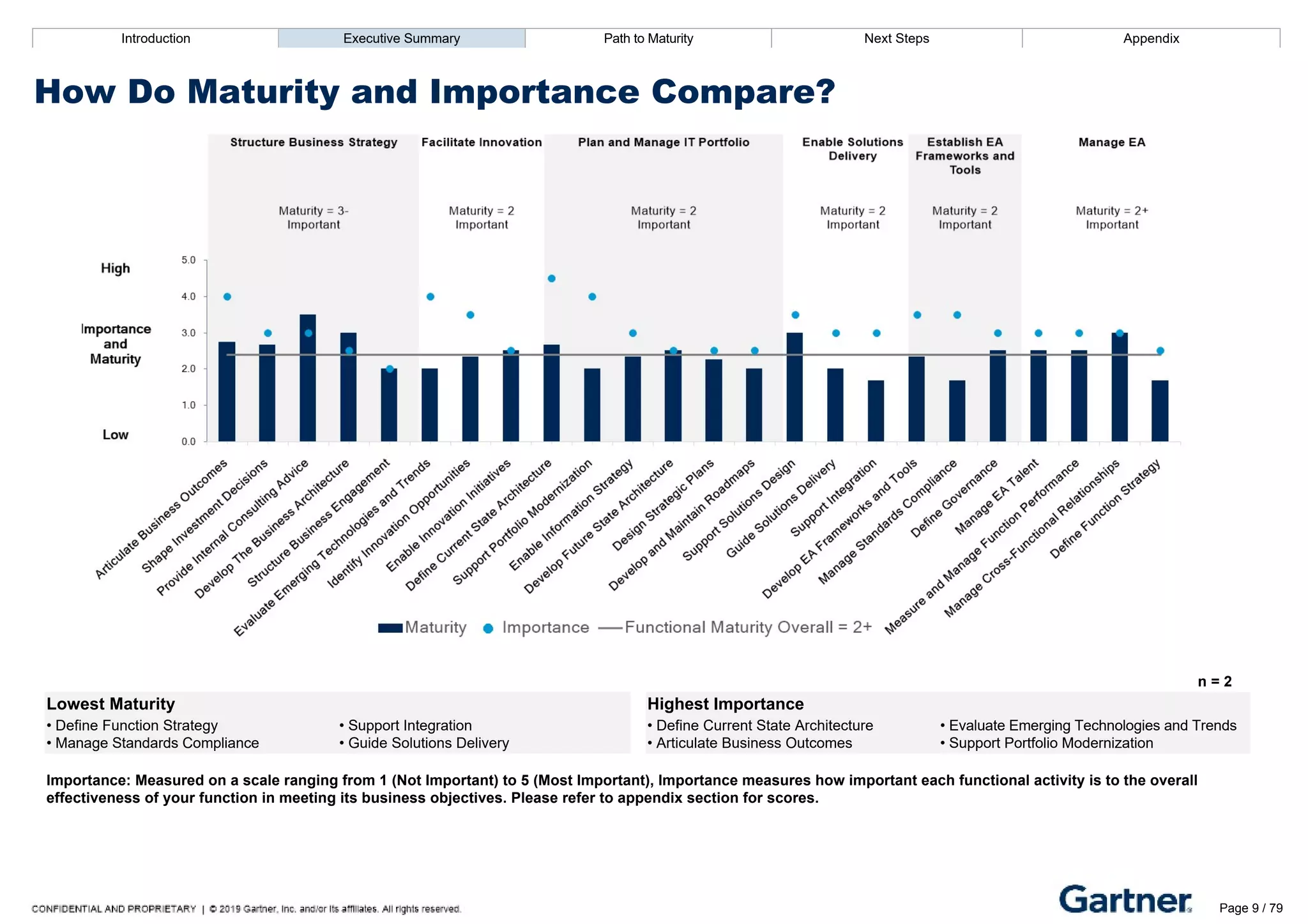
How Do Maturity and Importance Compare?
Page 8 / 79
to Gartner’s best practice research. Maturity scores are refined with a (+) or (­) to indicate intermediate levels of maturity.
Introduction Executive Summary Path to Maturity Next Steps Appendix
How Do Maturity and Importance Compare?
n = 2
Lowest Maturity Highest Importance
• Define Function Strategy
• Manage Standards Compliance
• Support Integration
• Guide Solutions Delivery
• Define Current State Architecture
• Articulate Business Outcomes
• Evaluate Emerging Technologies and Trends
• Support Portfolio Modernization
Importance: Measured on a scale ranging from 1 (Not Important) to 5 (Most Important), Importance measures how important each functional activity is to the overall
effectiveness of your function in meeting its business objectives. Please refer to appendix section for scores.
Introduction Executive Summary Path to Maturity Next Steps Appendix
What are the High Priority Areas for Your Function? Page 9 / 79
effectiveness of your function in meeting its business objectives. Please refer to appendix section for scores.
Introduction Executive Summary Path to Maturity Next Steps Appendix
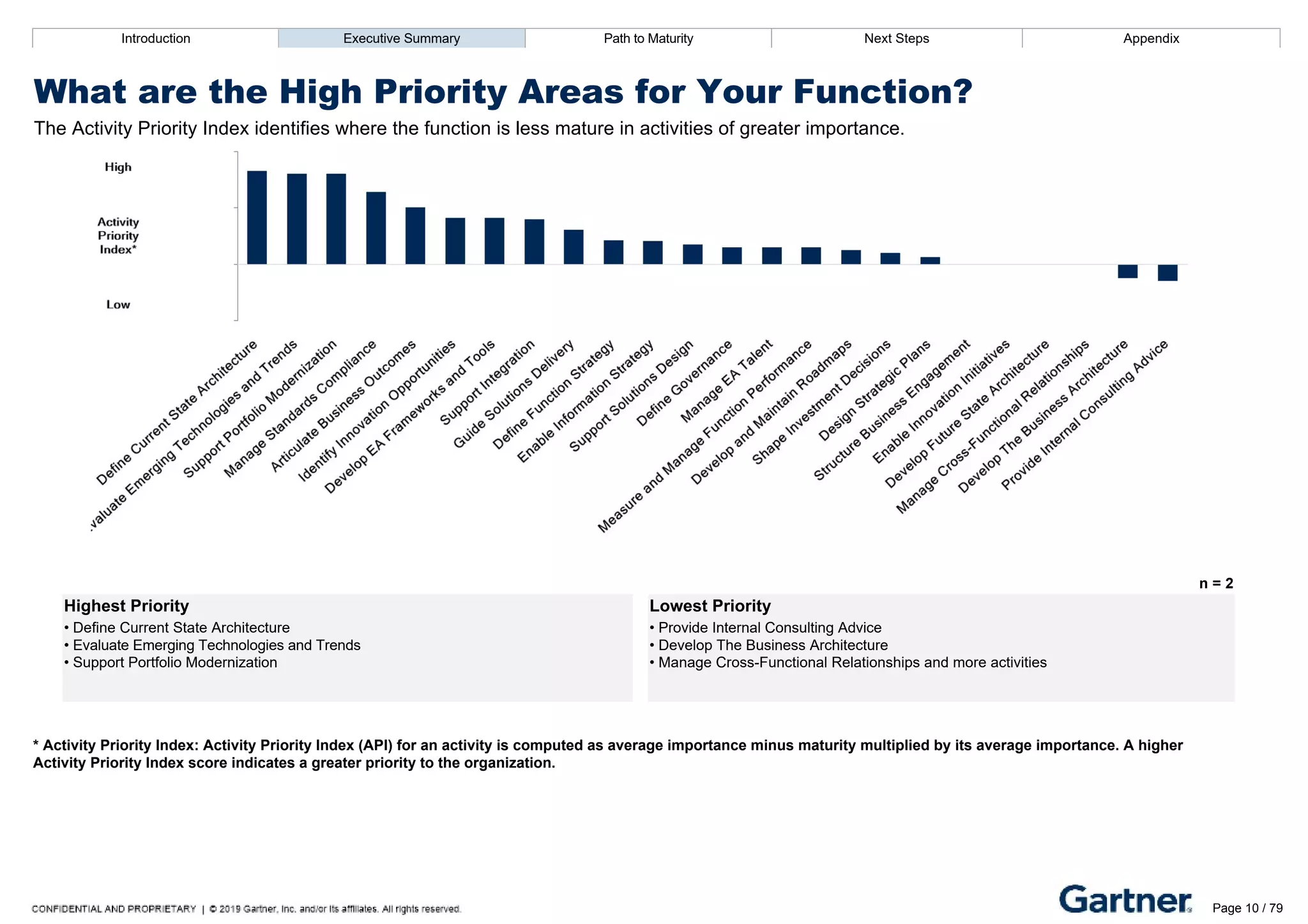
What are the High Priority Areas for Your Function?
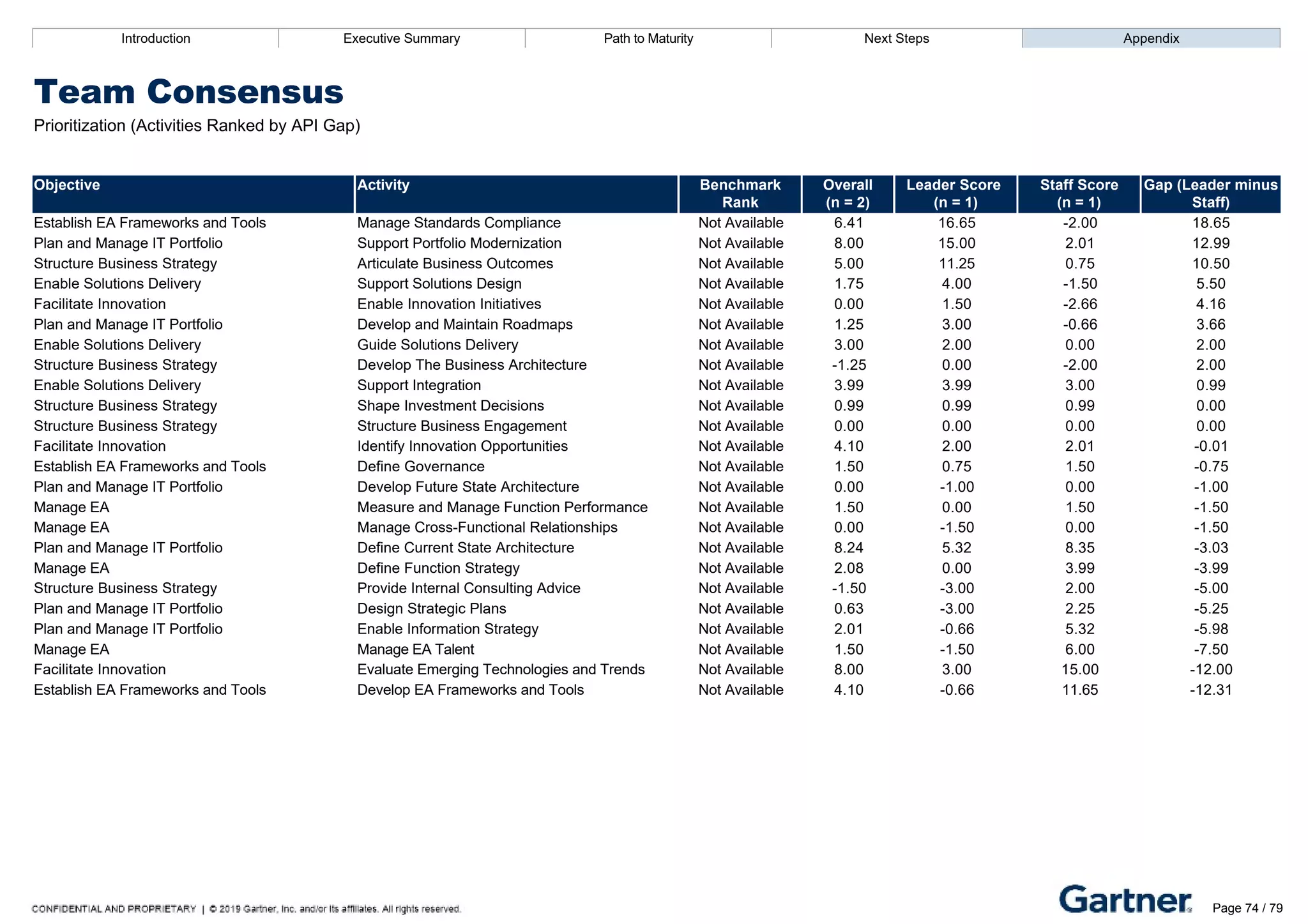
The Activity Priority Index identifies where the function is less mature in activities of greater importance.
n = 2
Highest Priority Lowest Priority
• Define Current State Architecture
• Evaluate Emerging Technologies and Trends
• Support Portfolio Modernization
• Provide Internal Consulting Advice
• Develop The Business Architecture
• Manage Cross­Functional Relationships and more activities
* Activity Priority Index: Activity Priority Index (API) for an activity is computed as average importance minus maturity multiplied by its average importance. A higher
Activity Priority Index score indicates a greater priority to the organization.
Introduction Executive Summary Path to Maturity Next Steps Appendix
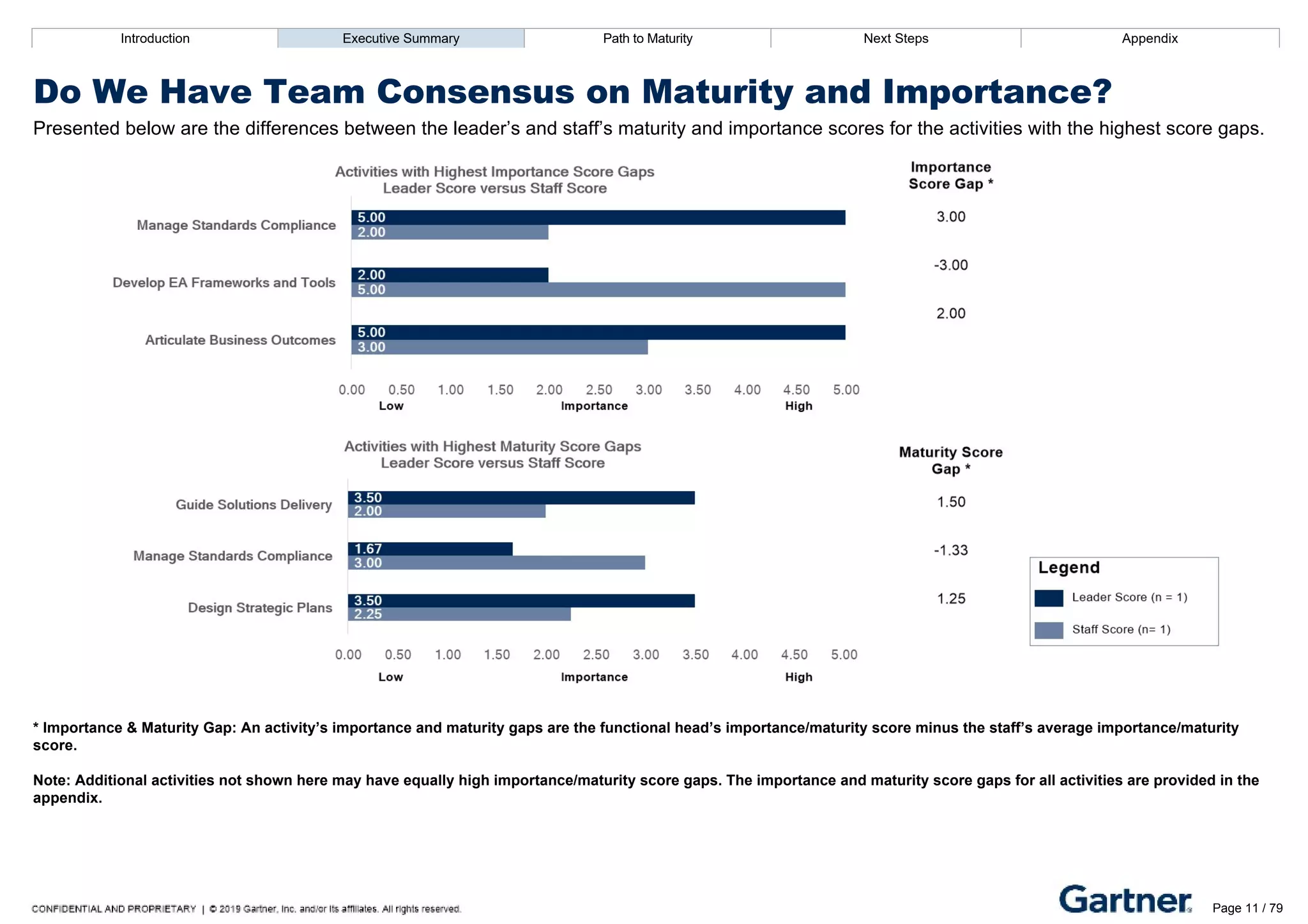
Do We Have Team Consensus on Maturity and Importance?
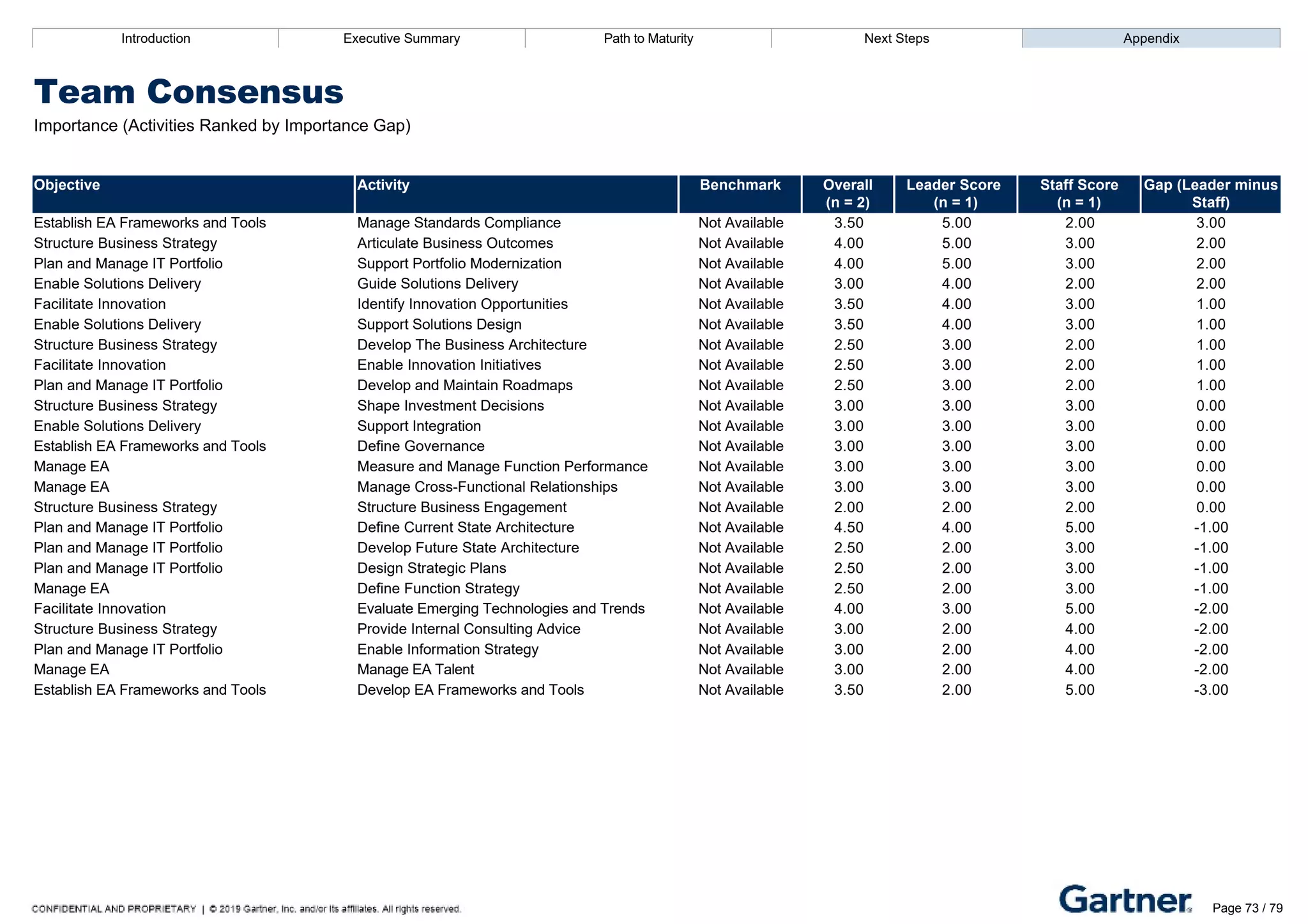
Presented below are the differences between the leader’s and staff’s maturity and importance scores for the activities with the highest score gaps.
Page 10 / 79
Activity Priority Index score indicates a greater priority to the organization.
Introduction Executive Summary Path to Maturity Next Steps Appendix
Do We Have Team Consensus on Maturity and Importance?
Presented below are the differences between the leader’s and staff’s maturity and importance scores for the activities with the highest score gaps.
* Importance & Maturity Gap: An activity’s importance and maturity gaps are the functional head’s importance/maturity score minus the staff’s average importance/maturity
score.
Note: Additional activities not shown here may have equally high importance/maturity score gaps. The importance and maturity score gaps for all activities are provided in the
appendix.
Introduction Executive Summary Path to Maturity Next Steps Appendix
Report Roadmap Page 11 / 79
appendix.
Introduction Executive Summary Path to Maturity Next Steps Appendix
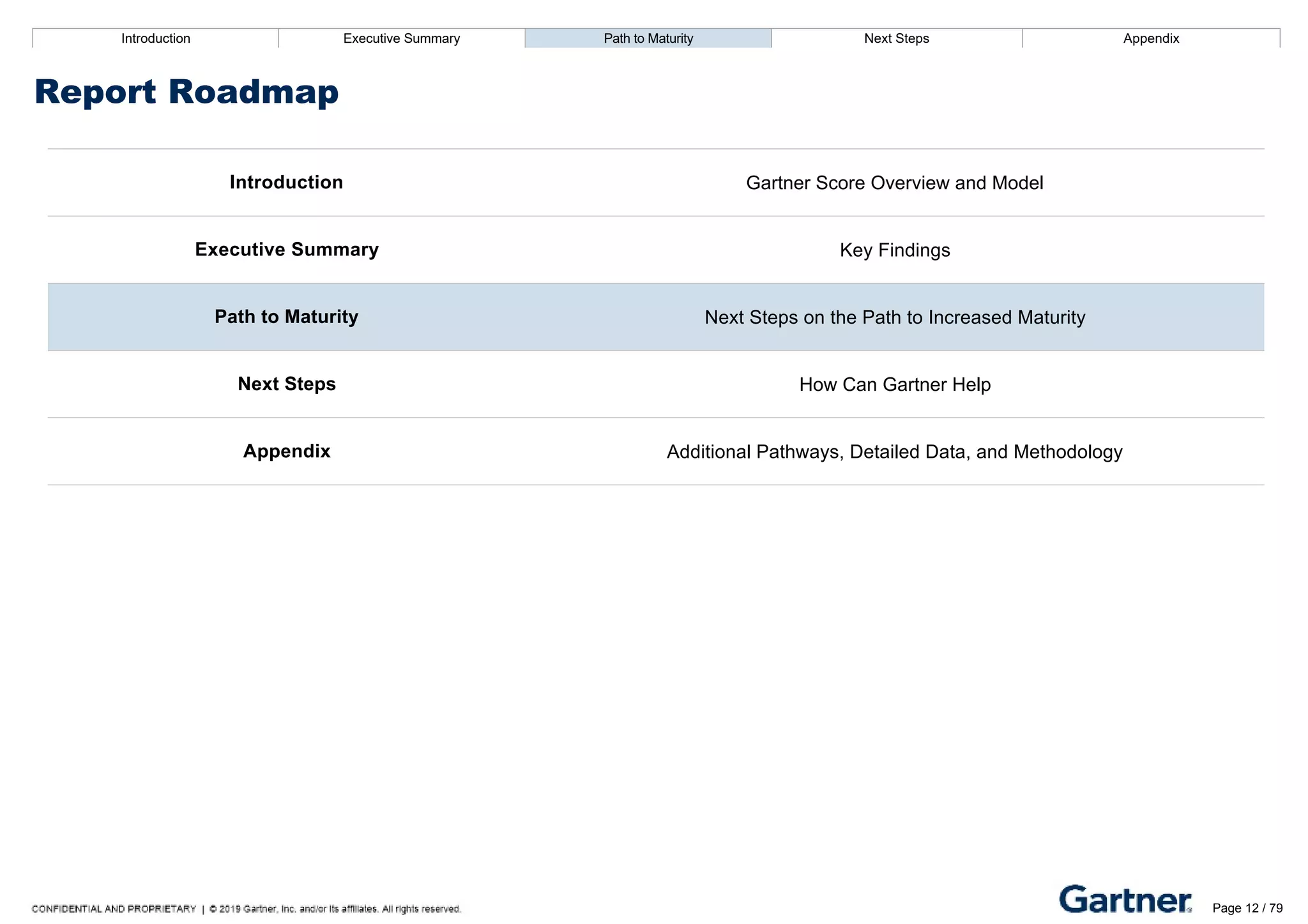
Report Roadmap
Introduction Gartner Score Overview and Model
Executive Summary Key Findings
Path to Maturity Next Steps on the Path to Increased Maturity
Next Steps How Can Gartner Help
Appendix Additional Pathways, Detailed Data, and Methodology
Introduction Executive Summary Path to Maturity Next Steps Appendix
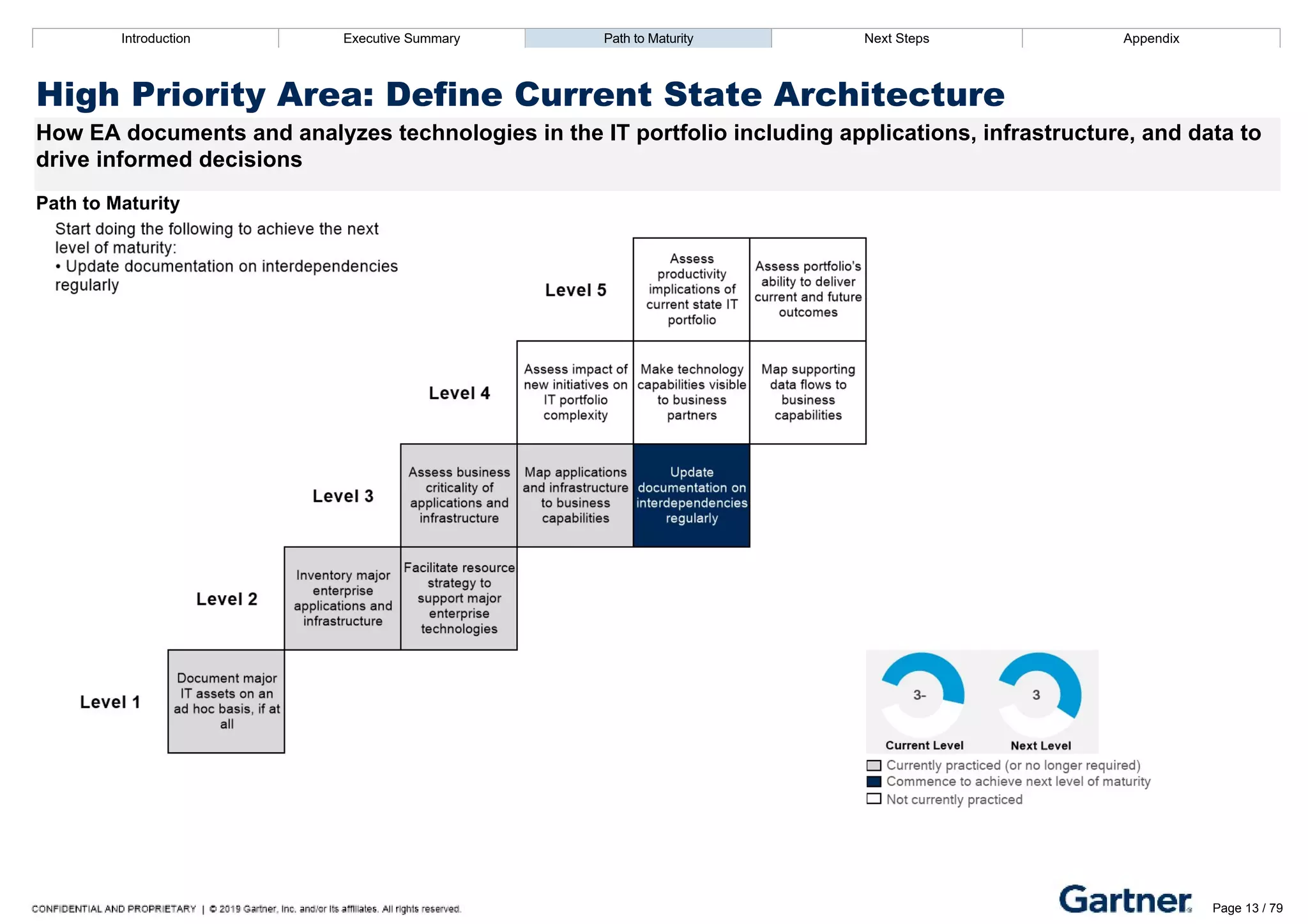
High Priority Area: Define Current State Architecture
How EA documents and analyzes technologies in the IT portfolio including applications, infrastructure, and data to
drive informed decisions
Path to Maturity
Page 12 / 79
Introduction Executive Summary Path to Maturity Next Steps Appendix
High Priority Area: Define Current State Architecture
How EA documents and analyzes technologies in the IT portfolio including applications, infrastructure, and data to
drive informed decisions
Path to Maturity
Introduction Executive Summary Path to Maturity Next Steps Appendix
Page 13 / 79
Introduction Executive Summary Path to Maturity Next Steps Appendix
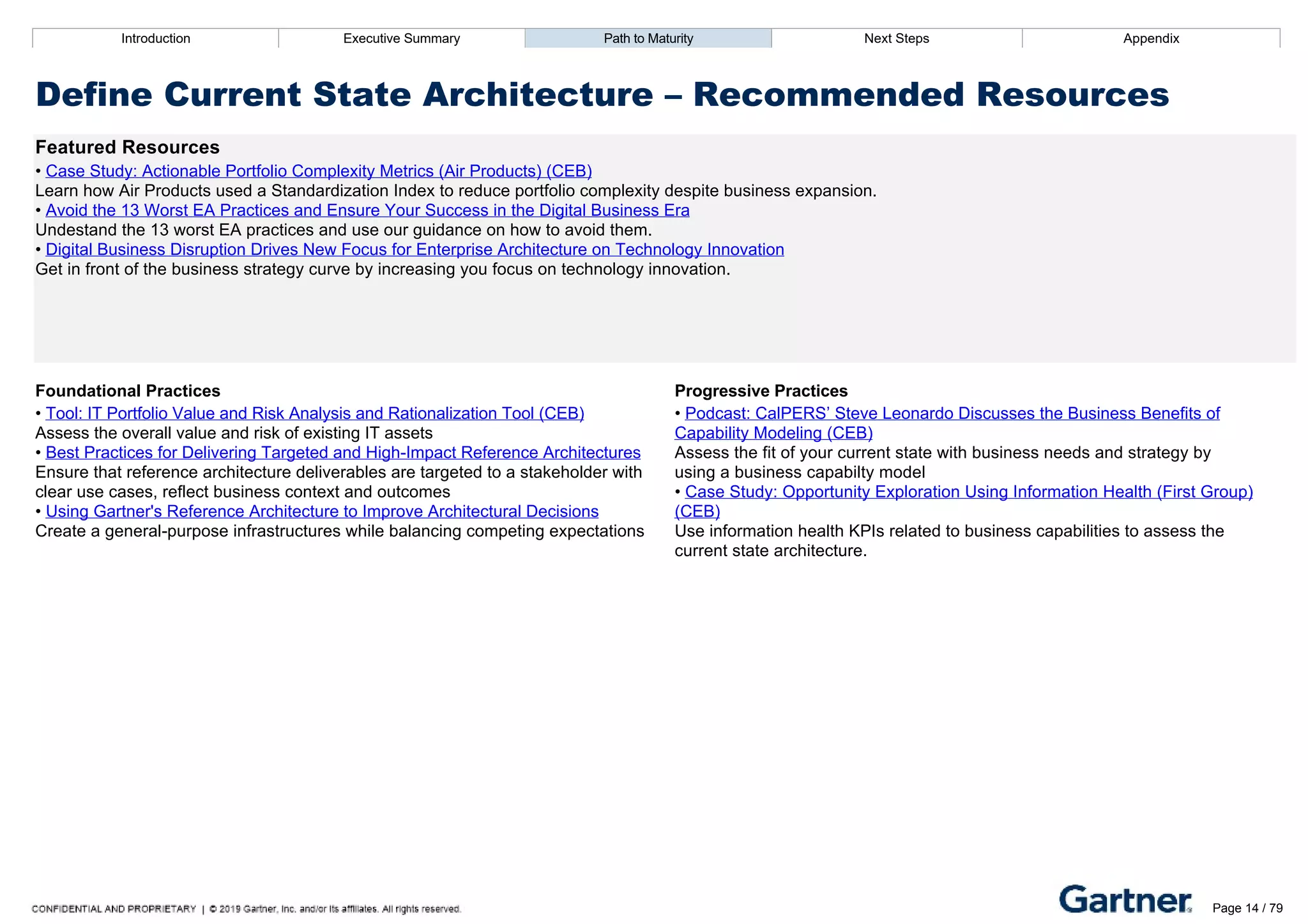
Define Current State Architecture – Recommended Resources
Featured Resources
• Case Study: Actionable Portfolio Complexity Metrics (Air Products) (CEB)
Learn how Air Products used a Standardization Index to reduce portfolio complexity despite business expansion.
• Avoid the 13 Worst EA Practices and Ensure Your Success in the Digital Business Era
Undestand the 13 worst EA practices and use our guidance on how to avoid them.
• Digital Business Disruption Drives New Focus for Enterprise Architecture on Technology Innovation
Get in front of the business strategy curve by increasing you focus on technology innovation.
Foundational Practices Progressive Practices
• Tool: IT Portfolio Value and Risk Analysis and Rationalization Tool (CEB)
Assess the overall value and risk of existing IT assets
• Best Practices for Delivering Targeted and High­Impact Reference Architectures
Ensure that reference architecture deliverables are targeted to a stakeholder with
clear use cases, reflect business context and outcomes
• Using Gartner's Reference Architecture to Improve Architectural Decisions
Create a general­purpose infrastructures while balancing competing expectations
• Podcast: CalPERS’ Steve Leonardo Discusses the Business Benefits of
Capability Modeling (CEB)
Assess the fit of your current state with business needs and strategy by
using a business capabilty model
• Case Study: Opportunity Exploration Using Information Health (First Group)
(CEB)
Use information health KPIs related to business capabilities to assess the
current state architecture.
Introduction Executive Summary Path to Maturity Next Steps Appendix
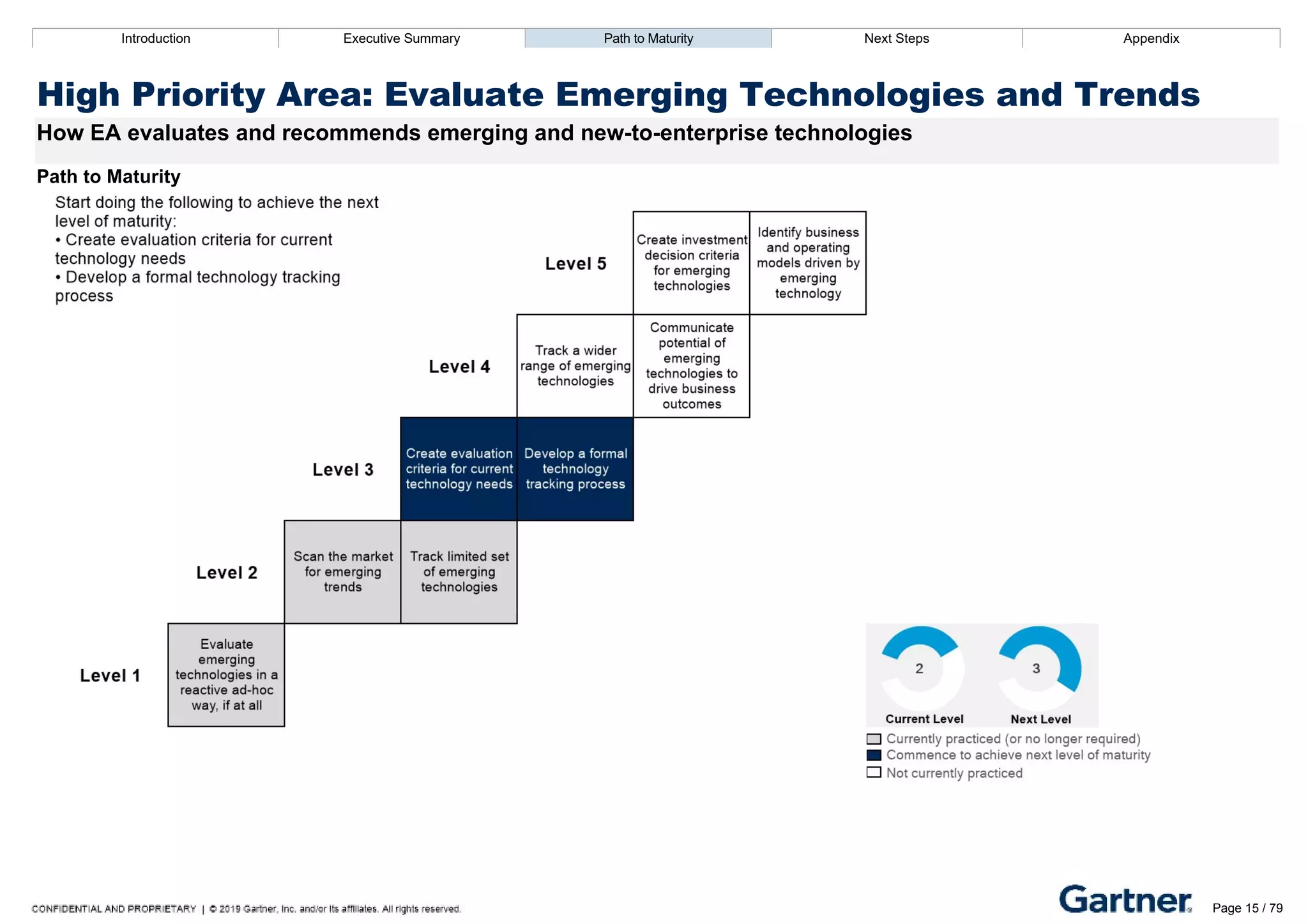
High Priority Area: Evaluate Emerging Technologies and Trends
How EA evaluates and recommends emerging and new­to­enterprise technologies
Path to Maturity
Page 14 / 79
Introduction Executive Summary Path to Maturity Next Steps Appendix
High Priority Area: Evaluate Emerging Technologies and Trends
How EA evaluates and recommends emerging and new­to­enterprise technologies
Path to Maturity
Introduction Executive Summary Path to Maturity Next Steps Appendix
Evaluate Emerging Technologies and Trends – Recommended Page 15 / 79
Introduction Executive Summary Path to Maturity Next Steps Appendix
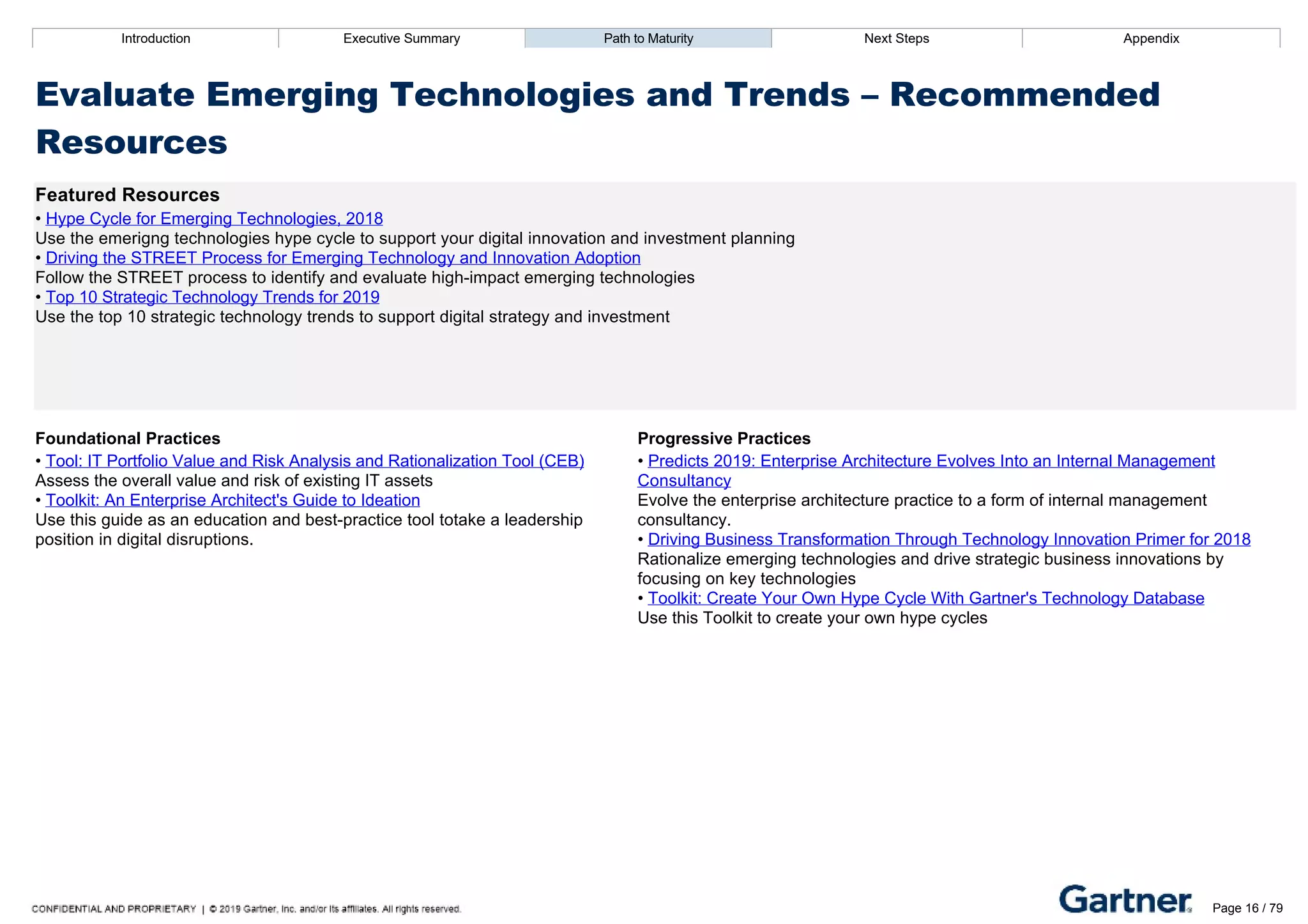
Evaluate Emerging Technologies and Trends – Recommended
Resources
Featured Resources
• Hype Cycle for Emerging Technologies, 2018
Use the emerigng technologies hype cycle to support your digital innovation and investment planning
• Driving the STREET Process for Emerging Technology and Innovation Adoption
Follow the STREET process to identify and evaluate high­impact emerging technologies
• Top 10 Strategic Technology Trends for 2019
Use the top 10 strategic technology trends to support digital strategy and investment
Foundational Practices Progressive Practices
• Tool: IT Portfolio Value and Risk Analysis and Rationalization Tool (CEB)
Assess the overall value and risk of existing IT assets
• Toolkit: An Enterprise Architect's Guide to Ideation
Use this guide as an education and best­practice tool totake a leadership
position in digital disruptions.
• Predicts 2019: Enterprise Architecture Evolves Into an Internal Management
Consultancy
Evolve the enterprise architecture practice to a form of internal management
consultancy.
• Driving Business Transformation Through Technology Innovation Primer for 2018
Rationalize emerging technologies and drive strategic business innovations by
focusing on key technologies
• Toolkit: Create Your Own Hype Cycle With Gartner's Technology Database
Use this Toolkit to create your own hype cycles
Introduction Executive Summary Path to Maturity Next Steps Appendix
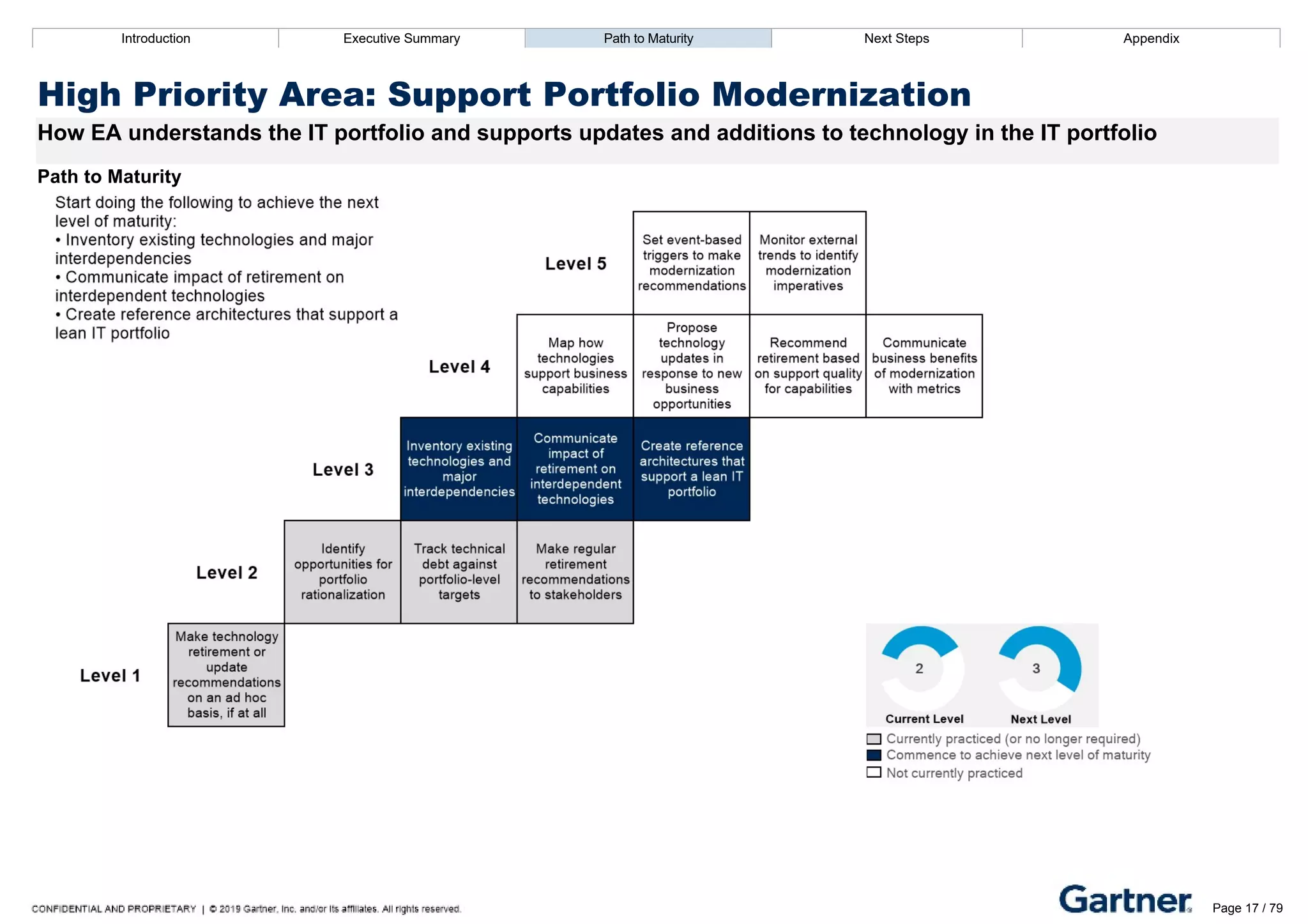
High Priority Area: Support Portfolio Modernization
How EA understands the IT portfolio and supports updates and additions to technology in the IT portfolio
Page 16 / 79
Introduction Executive Summary Path to Maturity Next Steps Appendix
High Priority Area: Support Portfolio Modernization
How EA understands the IT portfolio and supports updates and additions to technology in the IT portfolio
Path to Maturity
Introduction Executive Summary Path to Maturity Next Steps Appendix
Support Portfolio Modernization – Recommended Resources Page 17 / 79
Introduction Executive Summary Path to Maturity Next Steps Appendix
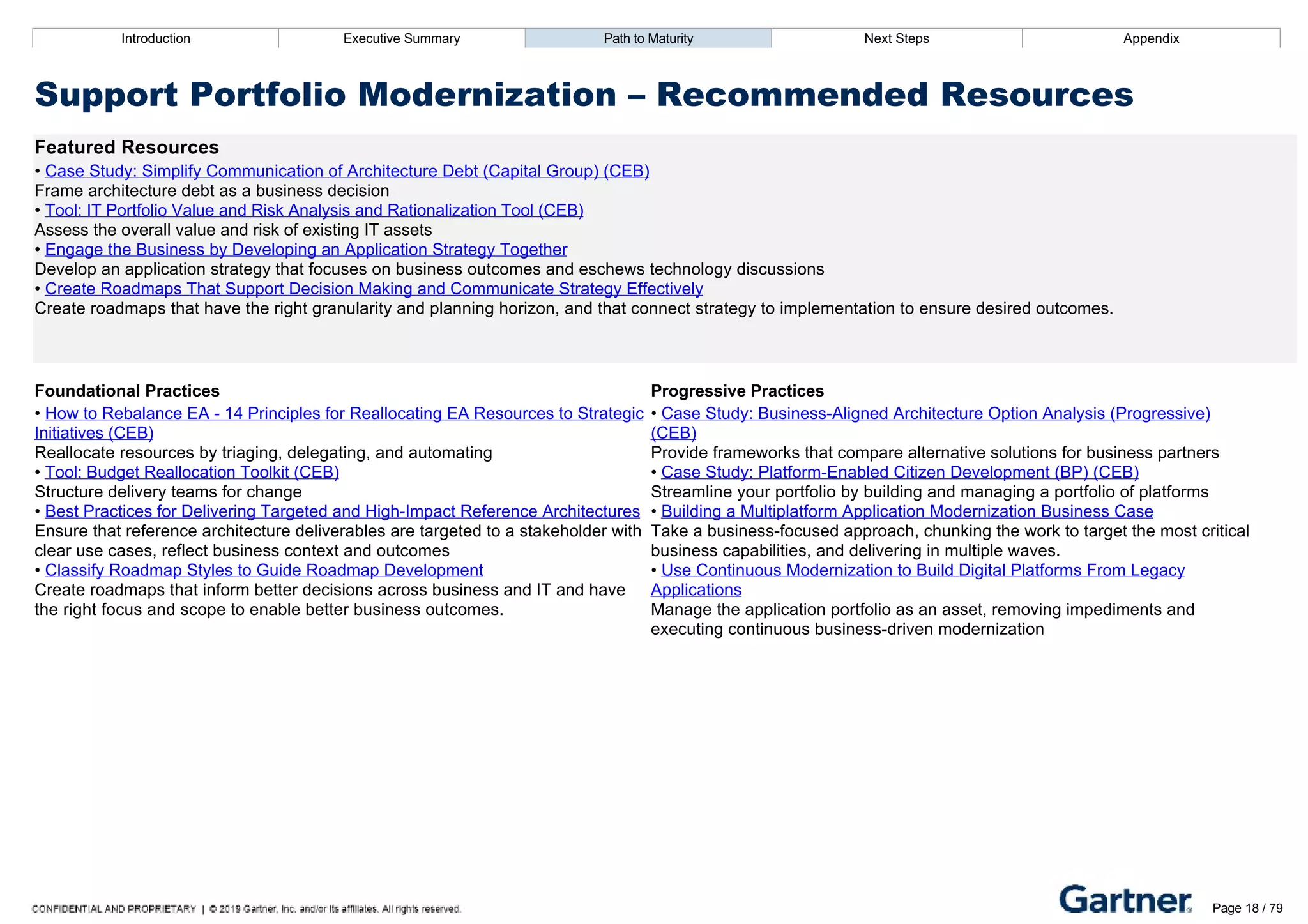
Support Portfolio Modernization – Recommended Resources
Featured Resources
• Case Study: Simplify Communication of Architecture Debt (Capital Group) (CEB)
Frame architecture debt as a business decision
• Tool: IT Portfolio Value and Risk Analysis and Rationalization Tool (CEB)
Assess the overall value and risk of existing IT assets
• Engage the Business by Developing an Application Strategy Together
Develop an application strategy that focuses on business outcomes and eschews technology discussions
• Create Roadmaps That Support Decision Making and Communicate Strategy Effectively
Create roadmaps that have the right granularity and planning horizon, and that connect strategy to implementation to ensure desired outcomes.
Foundational Practices Progressive Practices
• How to Rebalance EA ­ 14 Principles for Reallocating EA Resources to Strategic
Initiatives (CEB)
Reallocate resources by triaging, delegating, and automating
• Tool: Budget Reallocation Toolkit (CEB)
Structure delivery teams for change
• Best Practices for Delivering Targeted and High­Impact Reference Architectures
Ensure that reference architecture deliverables are targeted to a stakeholder with
clear use cases, reflect business context and outcomes
• Classify Roadmap Styles to Guide Roadmap Development
Create roadmaps that inform better decisions across business and IT and have
the right focus and scope to enable better business outcomes.
• Case Study: Business­Aligned Architecture Option Analysis (Progressive)
(CEB)
Provide frameworks that compare alternative solutions for business partners
• Case Study: Platform­Enabled Citizen Development (BP) (CEB)
Streamline your portfolio by building and managing a portfolio of platforms
• Building a Multiplatform Application Modernization Business Case
Take a business­focused approach, chunking the work to target the most critical
business capabilities, and delivering in multiple waves.
• Use Continuous Modernization to Build Digital Platforms From Legacy
Applications
Manage the application portfolio as an asset, removing impediments and
executing continuous business­driven modernization
Introduction Executive Summary Path to Maturity Next Steps Appendix
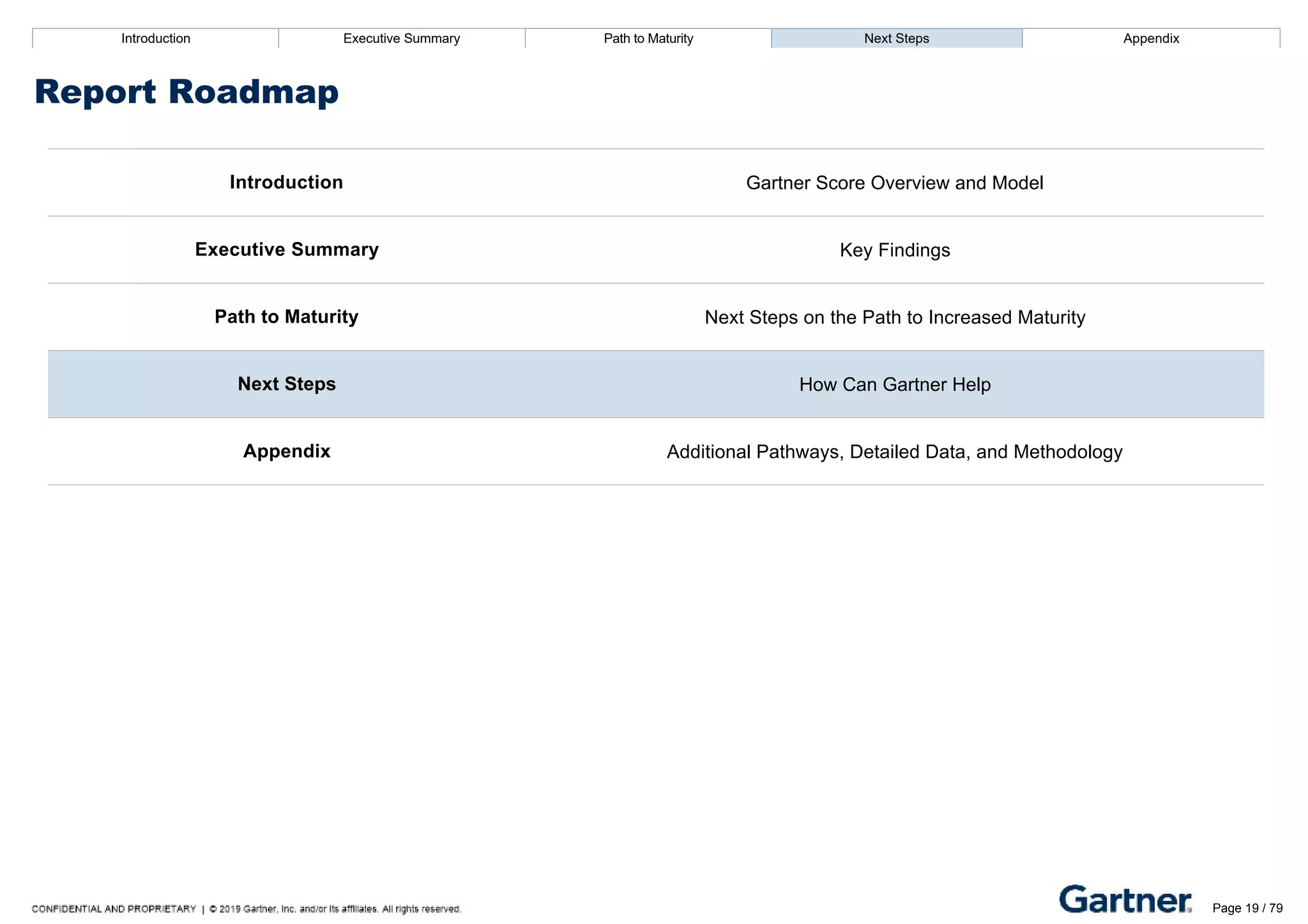
Report Roadmap
Introduction Gartner Score Overview and Model
Page 18 / 79
Introduction Executive Summary Path to Maturity Next Steps Appendix
Report Roadmap
Introduction Gartner Score Overview and Model
Executive Summary Key Findings
Path to Maturity Next Steps on the Path to Increased Maturity
Next Steps How Can Gartner Help
Appendix Additional Pathways, Detailed Data, and Methodology
Introduction Executive Summary Path to Maturity Next Steps Appendix
How Can Gartner Help Us?
Gartner Resources and Membership Support Key Takeaways to review with Gartner
Page 19 / 79
Introduction Executive Summary Path to Maturity Next Steps Appendix
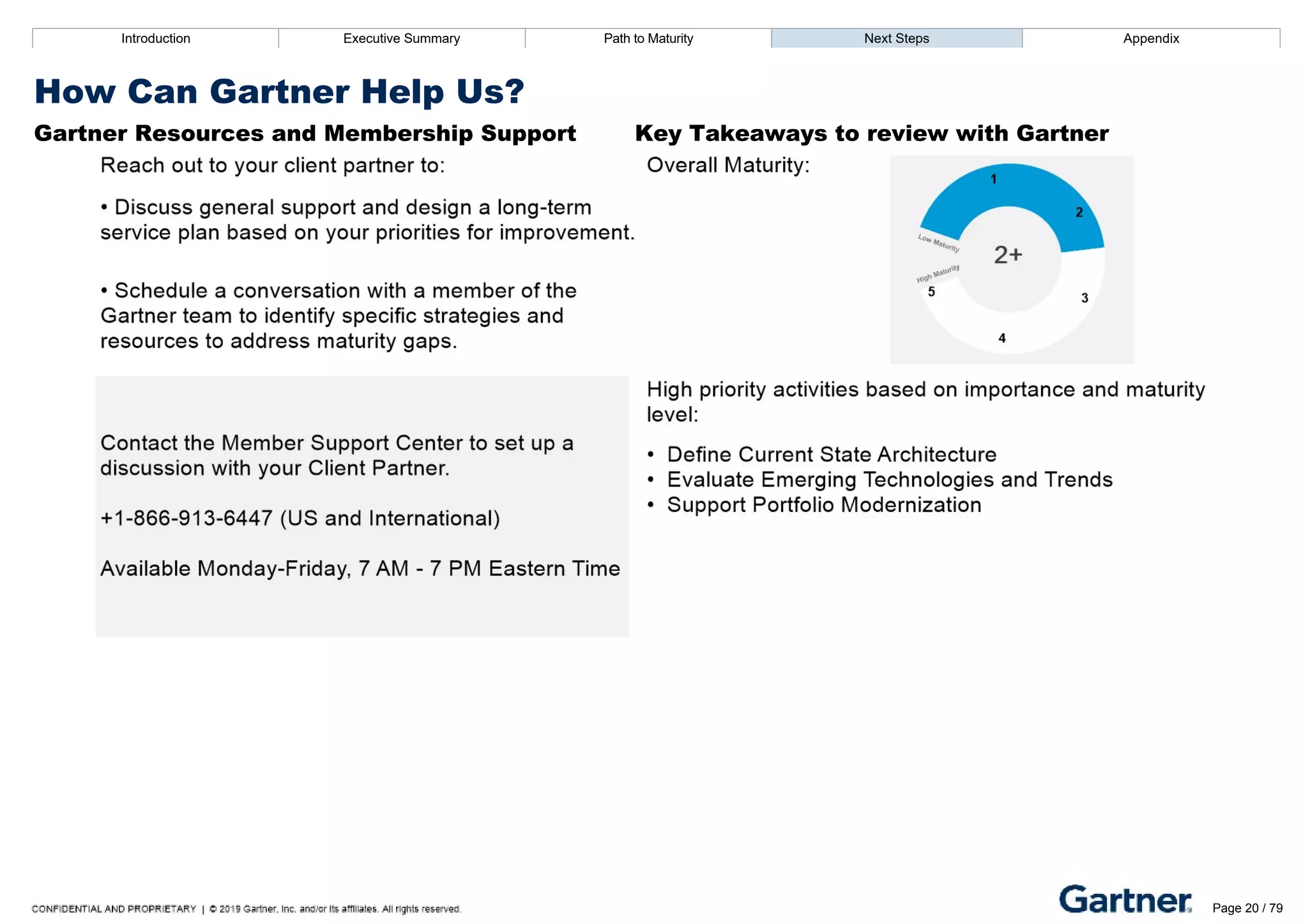
How Can Gartner Help Us?
Gartner Resources and Membership Support Key Takeaways to review with Gartner
Introduction Executive Summary Path to Maturity Next Steps Appendix
Report Roadmap
Introduction Gartner Score Overview and Model
Executive Summary Key Findings
Page 20 / 79
Introduction Executive Summary Path to Maturity Next Steps Appendix
Report Roadmap
Introduction Gartner Score Overview and Model
Executive Summary Key Findings
Path to Maturity Next Steps on the Path to Increased Maturity
Next Steps How Can Gartner Help
Appendix Additional Pathways, Detailed Data, and Methodology
Introduction Executive Summary Path to Maturity Next Steps Appendix
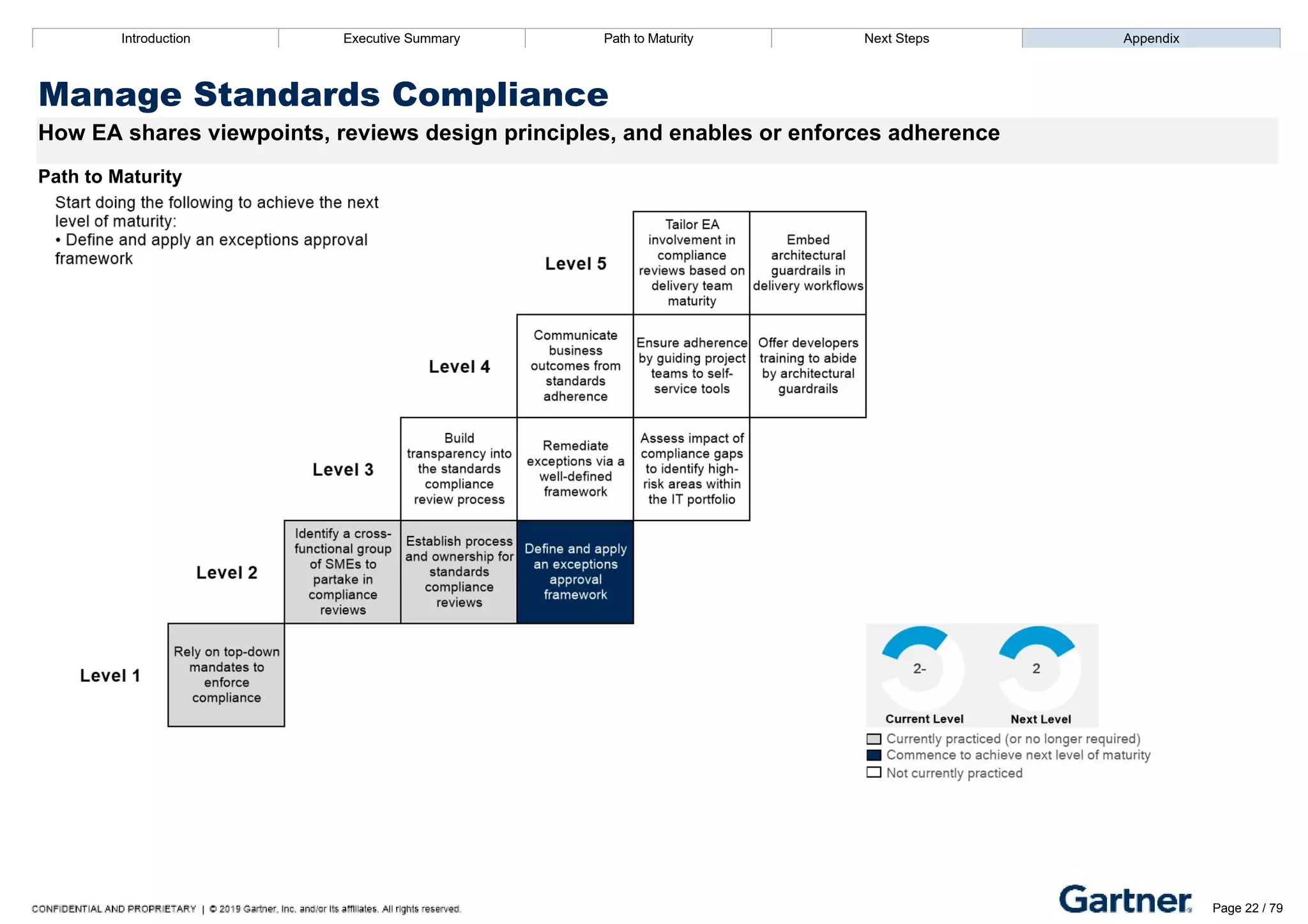
Manage Standards Compliance
How EA shares viewpoints, reviews design principles, and enables or enforces adherence
Path to Maturity
Page 21 / 79
Introduction Executive Summary Path to Maturity Next Steps Appendix
Manage Standards Compliance
How EA shares viewpoints, reviews design principles, and enables or enforces adherence
Path to Maturity
Introduction Executive Summary Path to Maturity Next Steps Appendix
Manage Standards Compliance – Recommended Resources Page 22 / 79
Introduction Executive Summary Path to Maturity Next Steps Appendix
Manage Standards Compliance – Recommended Resources
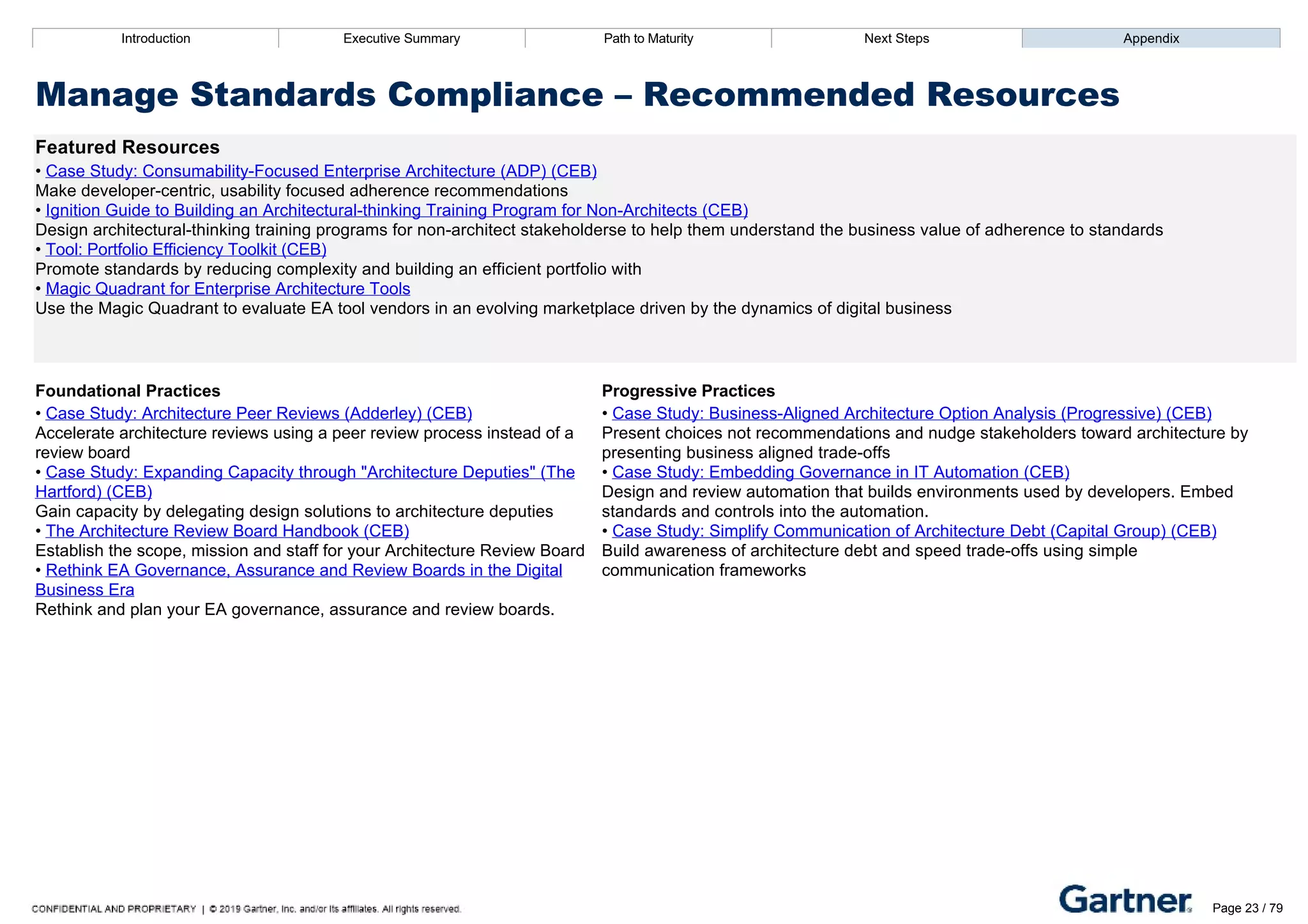
Featured Resources
• Case Study: Consumability­Focused Enterprise Architecture (ADP) (CEB)
Make developer­centric, usability focused adherence recommendations
• Ignition Guide to Building an Architectural­thinking Training Program for Non­Architects (CEB)
Design architectural­thinking training programs for non­architect stakeholderse to help them understand the business value of adherence to standards
• Tool: Portfolio Efficiency Toolkit (CEB)
Promote standards by reducing complexity and building an efficient portfolio with
• Magic Quadrant for Enterprise Architecture Tools
Use the Magic Quadrant to evaluate EA tool vendors in an evolving marketplace driven by the dynamics of digital business
Foundational Practices Progressive Practices
• Case Study: Architecture Peer Reviews (Adderley) (CEB)
Accelerate architecture reviews using a peer review process instead of a
review board
• Case Study: Expanding Capacity through "Architecture Deputies" (The
Hartford) (CEB)
Gain capacity by delegating design solutions to architecture deputies
• The Architecture Review Board Handbook (CEB)
Establish the scope, mission and staff for your Architecture Review Board
• Rethink EA Governance, Assurance and Review Boards in the Digital
Business Era
Rethink and plan your EA governance, assurance and review boards.
• Case Study: Business­Aligned Architecture Option Analysis (Progressive) (CEB)
Present choices not recommendations and nudge stakeholders toward architecture by
presenting business aligned trade­offs
• Case Study: Embedding Governance in IT Automation (CEB)
Design and review automation that builds environments used by developers. Embed
standards and controls into the automation.
• Case Study: Simplify Communication of Architecture Debt (Capital Group) (CEB)
Build awareness of architecture debt and speed trade­offs using simple
communication frameworks
Introduction Executive Summary Path to Maturity Next Steps Appendix
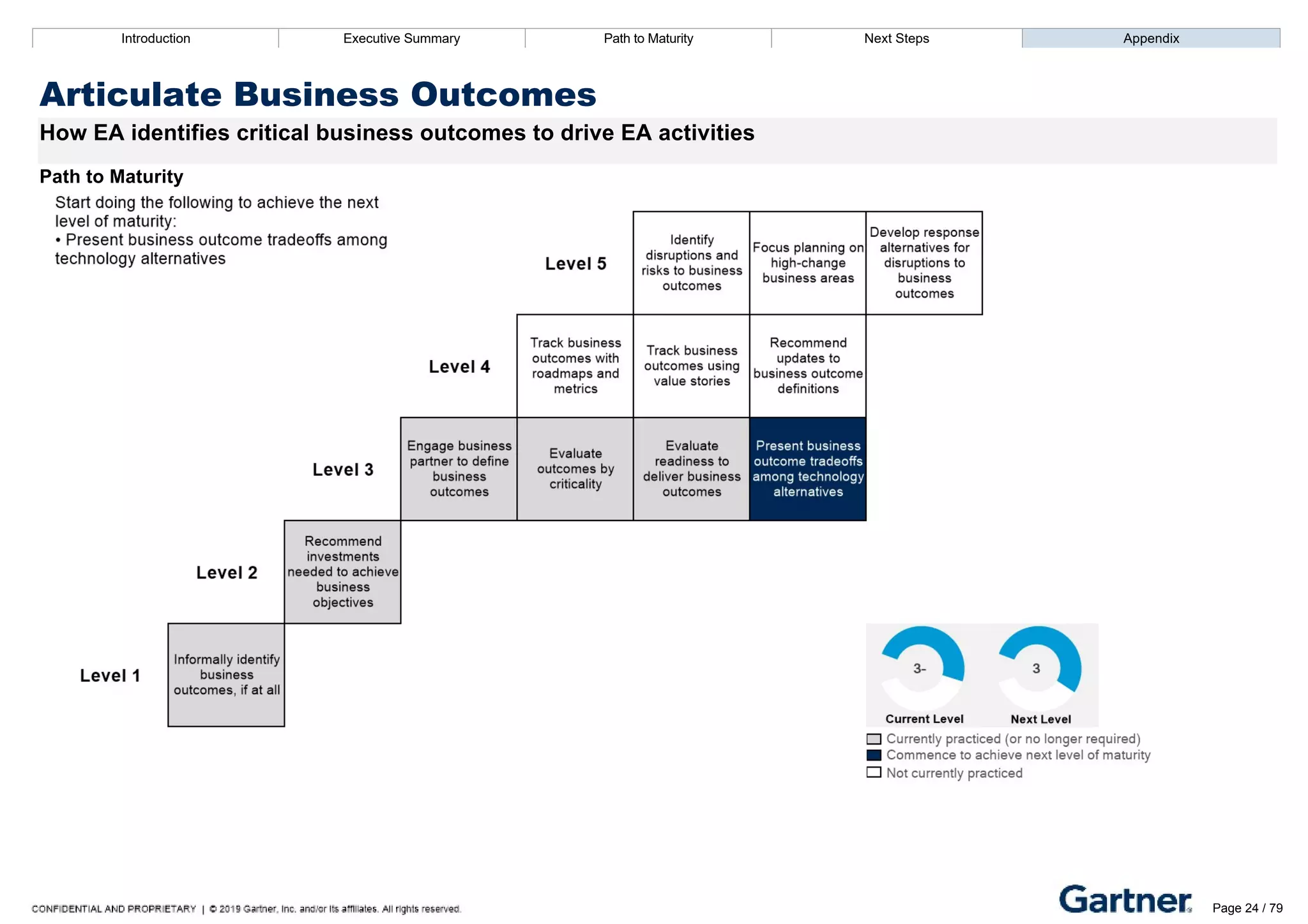
Articulate Business Outcomes
How EA identifies critical business outcomes to drive EA activities
Path to Maturity
Page 23 / 79
Introduction Executive Summary Path to Maturity Next Steps Appendix
Articulate Business Outcomes
How EA identifies critical business outcomes to drive EA activities
Path to Maturity
Introduction Executive Summary Path to Maturity Next Steps Appendix
Articulate Business Outcomes – Recommended Resources Page 24 / 79
Introduction Executive Summary Path to Maturity Next Steps Appendix
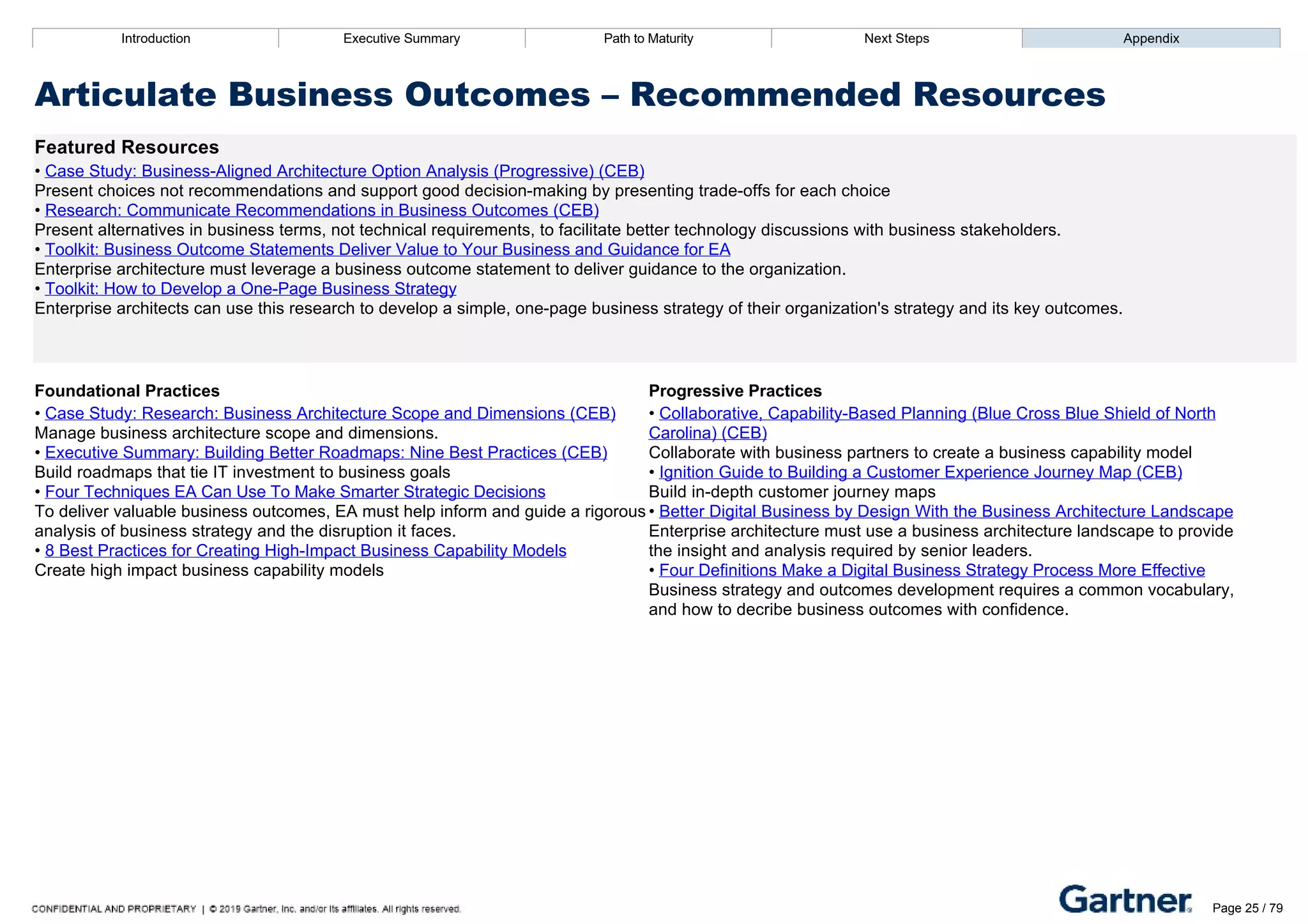
Articulate Business Outcomes – Recommended Resources
Featured Resources
• Case Study: Business­Aligned Architecture Option Analysis (Progressive) (CEB)
Present choices not recommendations and support good decision­making by presenting trade­offs for each choice
• Research: Communicate Recommendations in Business Outcomes (CEB)
Present alternatives in business terms, not technical requirements, to facilitate better technology discussions with business stakeholders.
• Toolkit: Business Outcome Statements Deliver Value to Your Business and Guidance for EA
Enterprise architecture must leverage a business outcome statement to deliver guidance to the organization.
• Toolkit: How to Develop a One­Page Business Strategy
Enterprise architects can use this research to develop a simple, one­page business strategy of their organization's strategy and its key outcomes.
Foundational Practices Progressive Practices
• Case Study: Research: Business Architecture Scope and Dimensions (CEB)
Manage business architecture scope and dimensions.
• Executive Summary: Building Better Roadmaps: Nine Best Practices (CEB)
Build roadmaps that tie IT investment to business goals
• Four Techniques EA Can Use To Make Smarter Strategic Decisions
To deliver valuable business outcomes, EA must help inform and guide a rigorous
analysis of business strategy and the disruption it faces.
• 8 Best Practices for Creating High­Impact Business Capability Models
Create high impact business capability models
• Collaborative, Capability­Based Planning (Blue Cross Blue Shield of North
Carolina) (CEB)
Collaborate with business partners to create a business capability model
• Ignition Guide to Building a Customer Experience Journey Map (CEB)
Build in­depth customer journey maps
• Better Digital Business by Design With the Business Architecture Landscape
Enterprise architecture must use a business architecture landscape to provide
the insight and analysis required by senior leaders.
• Four Definitions Make a Digital Business Strategy Process More Effective
Business strategy and outcomes development requires a common vocabulary,
and how to decribe business outcomes with confidence.
Introduction Executive Summary Path to Maturity Next Steps Appendix
Identify Innovation Opportunities
How EA collaborates with stakeholders to source ideas for innovation
Path to Maturity
Page 25 / 79
Introduction Executive Summary Path to Maturity Next Steps Appendix
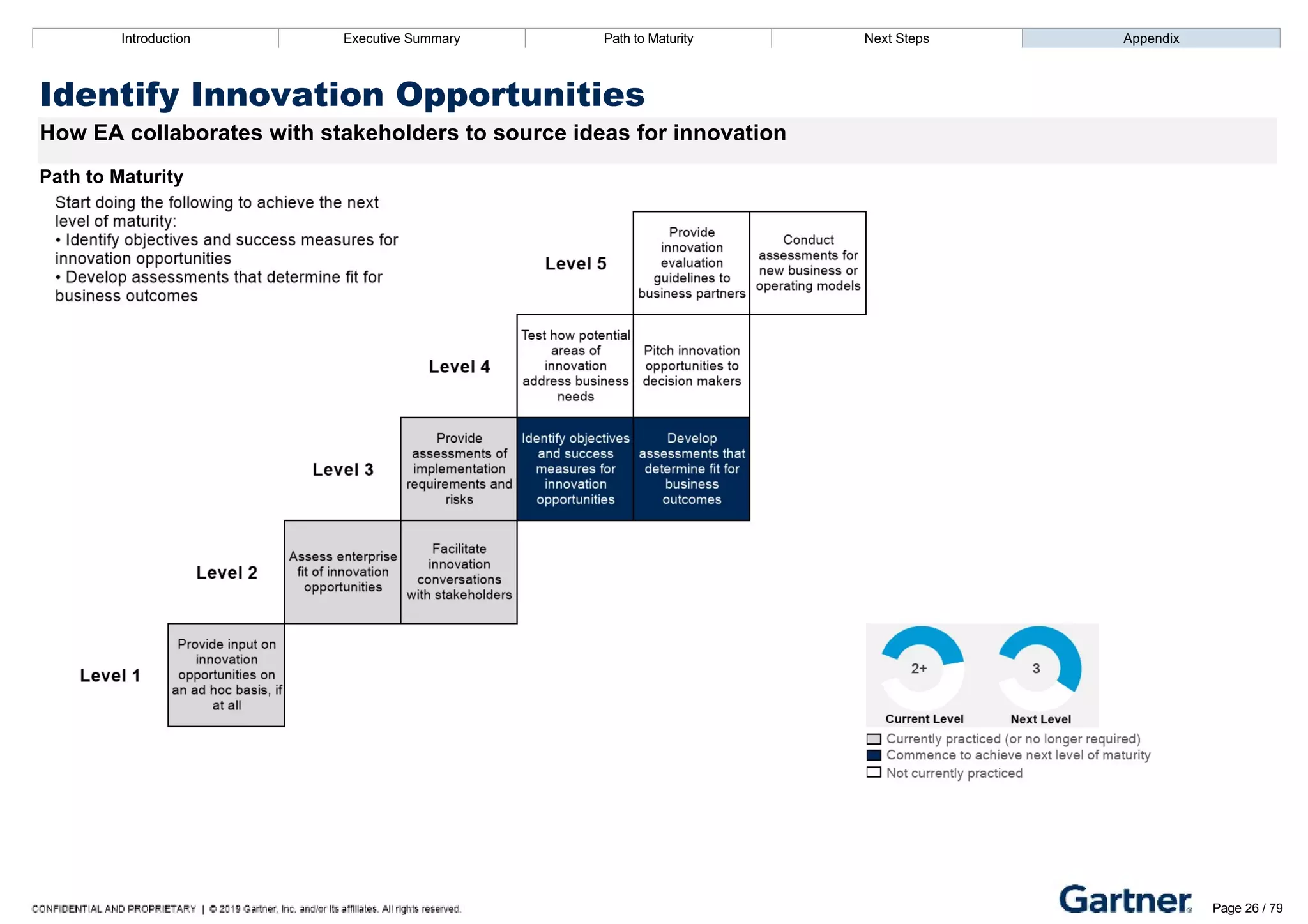
Identify Innovation Opportunities
How EA collaborates with stakeholders to source ideas for innovation
Path to Maturity
Introduction Executive Summary Path to Maturity Next Steps Appendix
Identify Innovation Opportunities – Recommended Resources Page 26 / 79
Introduction Executive Summary Path to Maturity Next Steps Appendix
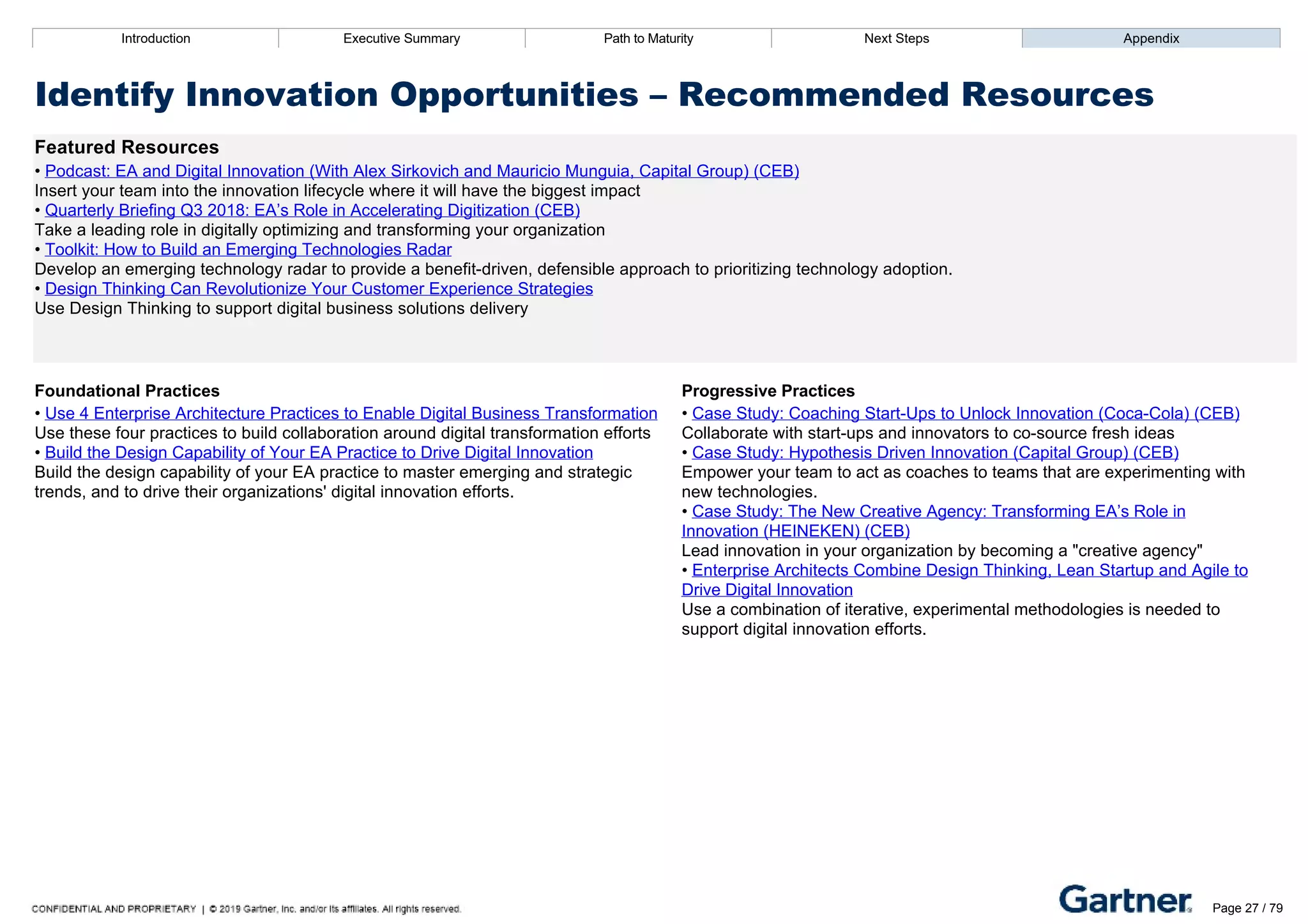
Identify Innovation Opportunities – Recommended Resources
Featured Resources
• Podcast: EA and Digital Innovation (With Alex Sirkovich and Mauricio Munguia, Capital Group) (CEB)
Insert your team into the innovation lifecycle where it will have the biggest impact
• Quarterly Briefing Q3 2018: EA’s Role in Accelerating Digitization (CEB)
Take a leading role in digitally optimizing and transforming your organization
• Toolkit: How to Build an Emerging Technologies Radar
Develop an emerging technology radar to provide a benefit­driven, defensible approach to prioritizing technology adoption.
• Design Thinking Can Revolutionize Your Customer Experience Strategies
Use Design Thinking to support digital business solutions delivery
Foundational Practices Progressive Practices
• Use 4 Enterprise Architecture Practices to Enable Digital Business Transformation
Use these four practices to build collaboration around digital transformation efforts
• Build the Design Capability of Your EA Practice to Drive Digital Innovation
Build the design capability of your EA practice to master emerging and strategic
trends, and to drive their organizations' digital innovation efforts.
• Case Study: Coaching Start­Ups to Unlock Innovation (Coca­Cola) (CEB)
Collaborate with start­ups and innovators to co­source fresh ideas
• Case Study: Hypothesis Driven Innovation (Capital Group) (CEB)
Empower your team to act as coaches to teams that are experimenting with
new technologies.
• Case Study: The New Creative Agency: Transforming EA’s Role in
Innovation (HEINEKEN) (CEB)
Lead innovation in your organization by becoming a "creative agency"
• Enterprise Architects Combine Design Thinking, Lean Startup and Agile to
Drive Digital Innovation
Use a combination of iterative, experimental methodologies is needed to
support digital innovation efforts.
Introduction Executive Summary Path to Maturity Next Steps Appendix
Develop EA Frameworks and Tools
How EA selects and uses architecture frameworks and EA tools to support IT and business objectives
Path to Maturity
Page 27 / 79
Introduction Executive Summary Path to Maturity Next Steps Appendix
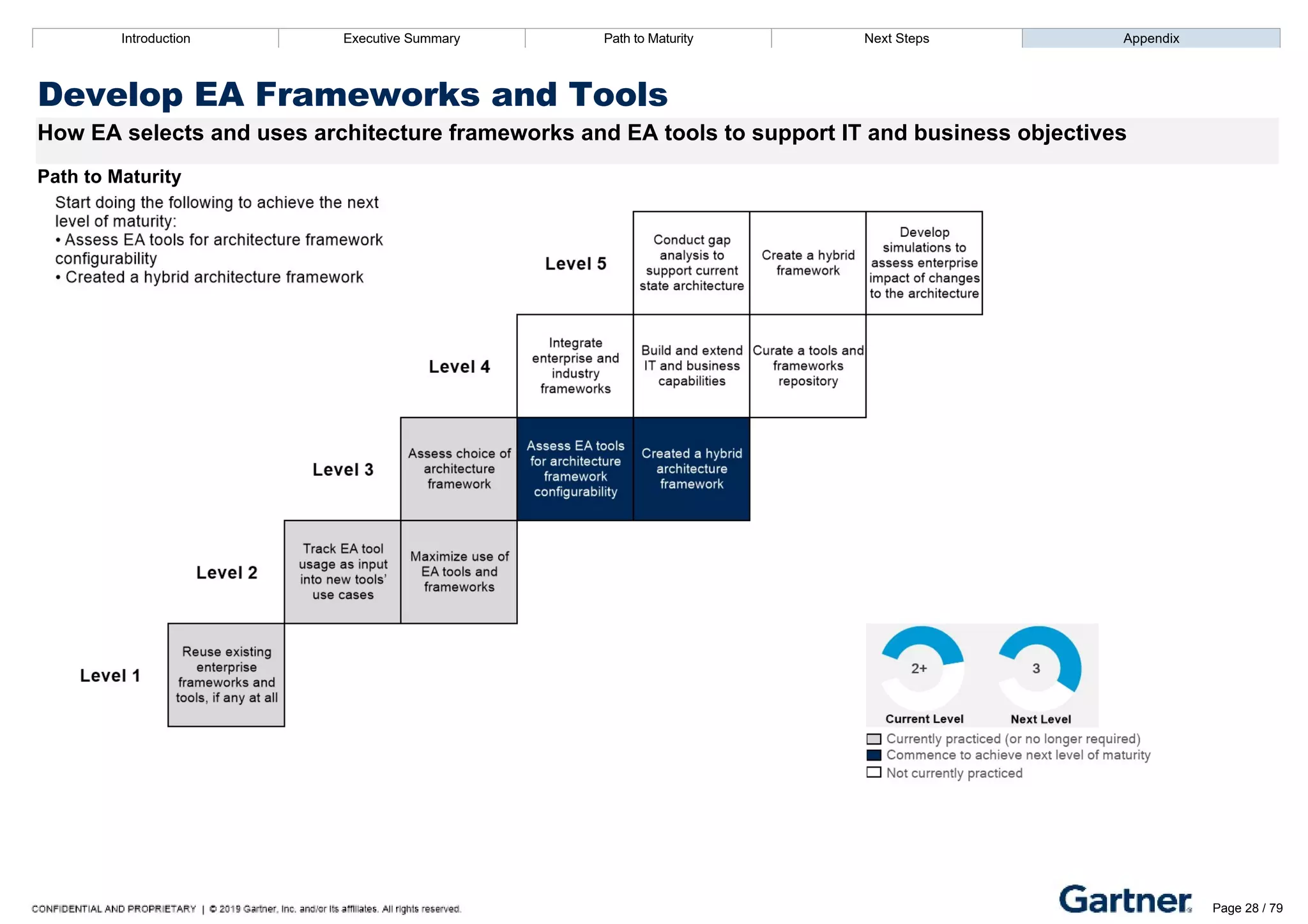
Develop EA Frameworks and Tools
How EA selects and uses architecture frameworks and EA tools to support IT and business objectives
Path to Maturity
Introduction Executive Summary Path to Maturity Next Steps Appendix
Develop EA Frameworks and Tools – Recommended Resources Page 28 / 79
Introduction Executive Summary Path to Maturity Next Steps Appendix
Develop EA Frameworks and Tools – Recommended Resources
Featured Resources
• Tool: EA Tool Evaluation Template (CEB)
Evaluate six commonly used tools based on your organization's priorities and compare tools with others in the marketplace
• Determine the Critical Capabilities That Distinguish EA Tool Offerings
Understand these critical capabilities to assess and differentiate vendors and their respective offerings, leading to smarter purchasing decisions.
• Understand the Eight Core Capabilities of an Enterprise Architecture Tool
Use the eight core capabilities of an EA tool to better understand their own tool requirements for designing use cases and selecting EA tools
• Critical Capabilities for Enterprise Architecture Tools
Assess the tool performance versus specific enterprise use cases
Foundational Practices Progressive Practices
• Research: EA Frameworks Advice From Enterprise Adopters (CEB)
Learn key lessons from enterprise framework adopters ­ adoption
assessment included
• Research: EA Tools Implementation Playbook (CEB)
Learn how to overcome the most difficult obstacles to successful tool
adoption.
• Hype Cycle for Enterprise Architecture, 2018
Use the emerigng technologies hype cycle to support your digital
innovation and investment planning
• Toolkit: How to Build an Emerging Technologies Radar
Develop an emerging technology radar to provide a benefit­driven, defensible
approach to prioritizing technology adoption.
• Market Guide for Strategy Execution Management Software
Evaluate strategy execution tools to create shared objectives and business value
measure for business strategists and those executing the change
• Market Guide for Strategy and Innovation Roadmapping Tools
Use the Market Guide for Strategy and Innovation Roadmapping Tools to understand
the trends and representitive vendors
• Market Guide for Business Ecosystem Modeling and Analysis Software
Use the Market Guide for Business Ecosystem Modeling and Analysis to assess
vendors and their offerings
Introduction Executive Summary Path to Maturity Next Steps Appendix
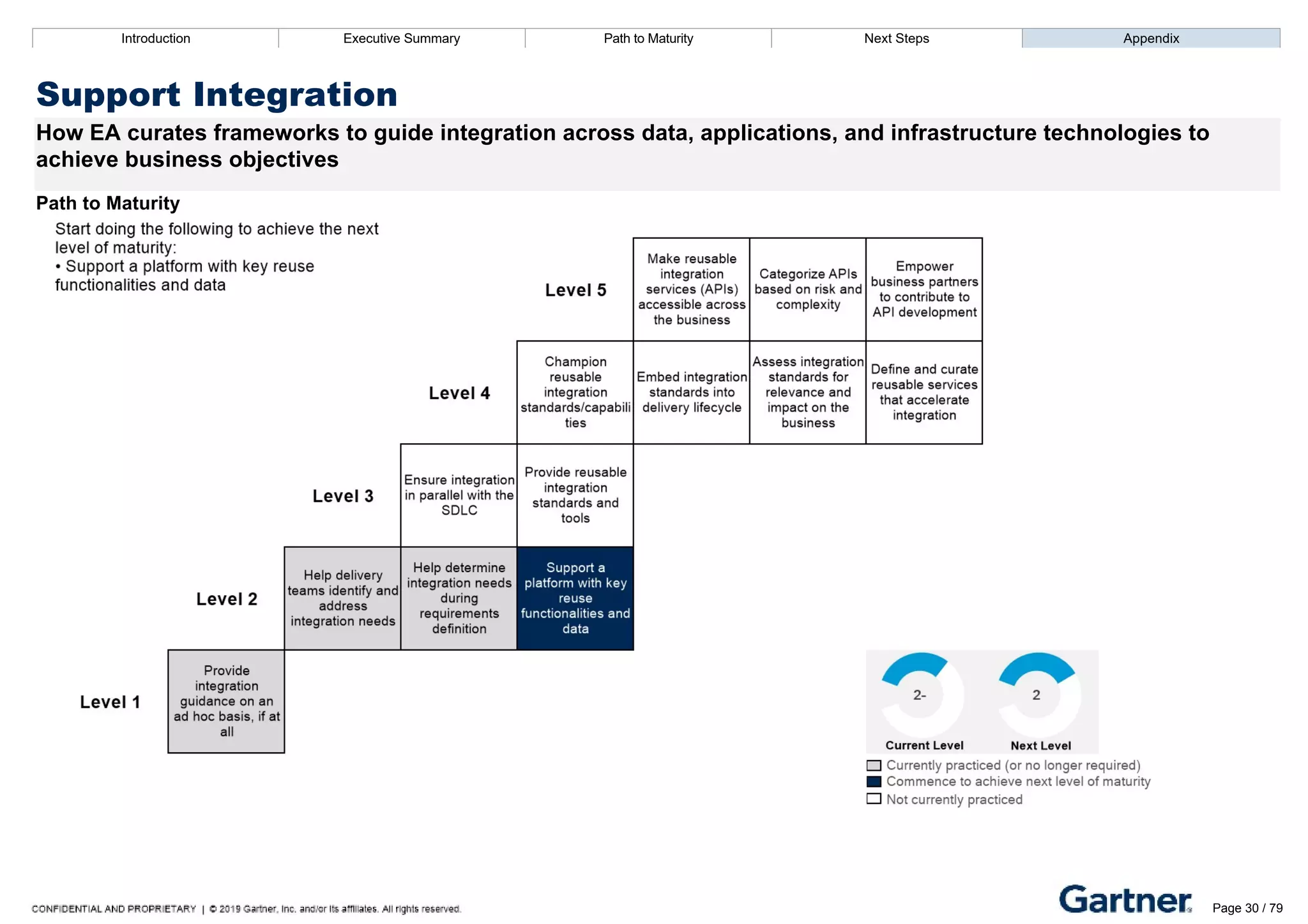
Support Integration
How EA curates frameworks to guide integration across data, applications, and infrastructure technologies to
achieve business objectives
Path to Maturity Page 29 / 79
Introduction Executive Summary Path to Maturity Next Steps Appendix
Support Integration
How EA curates frameworks to guide integration across data, applications, and infrastructure technologies to
achieve business objectives
Path to Maturity
Introduction Executive Summary Path to Maturity Next Steps Appendix
Page 30 / 79
Introduction Executive Summary Path to Maturity Next Steps Appendix
Support Integration – Recommended Resources
Featured Resources
• Podcast: Establishing an API Marketplace (A Conversation with Brad Fedosoff, CIBC) (CEB)
Learn about how CIBC pulled together an API platform from open source components while still meeting their regulatory needs.
• Create Roadmaps That Support Decision Making and Communicate Strategy Effectively
Create roadmaps that have the right granularity and planning horizon, and that connect strategy to implementation to ensure desired outcomes.
• The Distinction Between EA and Application Architecture Makes a Difference to Business Outcomes
Engage application architects to clarify boundaries, provide context and enable line of sight between strategy and execution
• Best Practices for Modeling Business Ecosystems
Use these seven best practices to develop business ecosystem models and build a world­class EA capability.
Foundational Practices Progressive Practices
• Research: Flexible Interfaces, Foundational Services (CEB)
Develop robust integration services using flexible interfaces
• The Five Talents Enterprise Architects Need to Support Digital Innovation
Adopt these five talents to support digital innovation and transform
everything from culture through to technologies.
• Stage Planning a Business­Outcome­Driven Enterprise Architecture
Create a stage plan to provide the structure to guide building a world­class
EA capability.
• EA Business­Value Metrics You Must Have Today
Use these examples of metrics that enterprise architecture and technology
innovation leaders must use to define and track the business value of EA.
• Must­Have Critical Project Assurance Metrics for Enterprise Architecture
Use these simple project assurance metrics that can support predicting the impact of
more advanced measurements.
Introduction Executive Summary Path to Maturity Next Steps Appendix
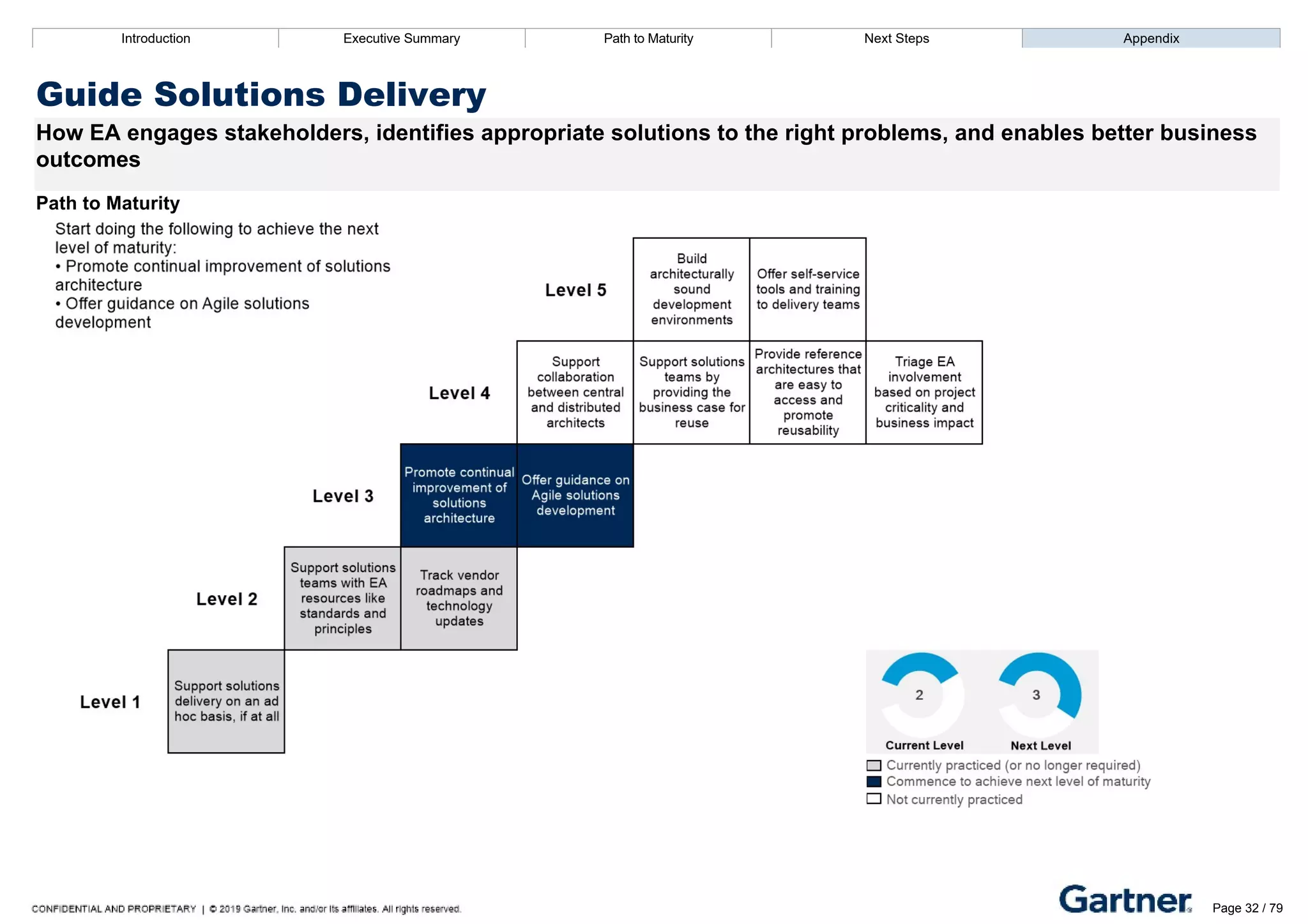
Guide Solutions Delivery
How EA engages stakeholders, identifies appropriate solutions to the right problems, and enables better business
outcomes
Path to Maturity Page 31 / 79
Introduction Executive Summary Path to Maturity Next Steps Appendix
Guide Solutions Delivery
How EA engages stakeholders, identifies appropriate solutions to the right problems, and enables better business
outcomes
Path to Maturity
Introduction Executive Summary Path to Maturity Next Steps Appendix
Page 32 / 79
Introduction Executive Summary Path to Maturity Next Steps Appendix
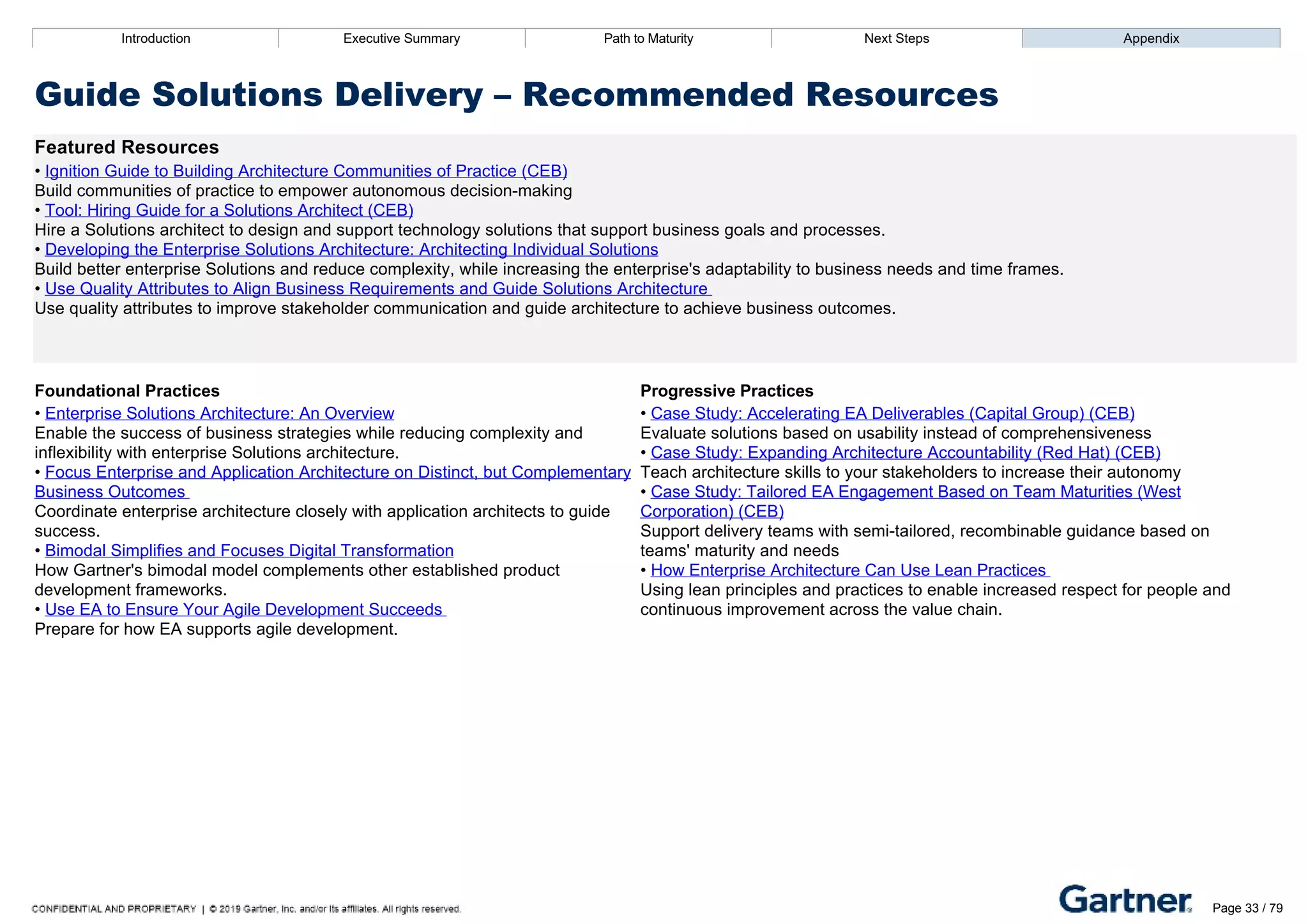
Guide Solutions Delivery – Recommended Resources
Featured Resources
• Ignition Guide to Building Architecture Communities of Practice (CEB)
Build communities of practice to empower autonomous decision­making
• Tool: Hiring Guide for a Solutions Architect (CEB)
Hire a Solutions architect to design and support technology solutions that support business goals and processes.
• Developing the Enterprise Solutions Architecture: Architecting Individual Solutions
Build better enterprise Solutions and reduce complexity, while increasing the enterprise's adaptability to business needs and time frames.
• Use Quality Attributes to Align Business Requirements and Guide Solutions Architecture
Use quality attributes to improve stakeholder communication and guide architecture to achieve business outcomes.
Foundational Practices Progressive Practices
• Enterprise Solutions Architecture: An Overview
Enable the success of business strategies while reducing complexity and
inflexibility with enterprise Solutions architecture.
• Focus Enterprise and Application Architecture on Distinct, but Complementary
Business Outcomes
Coordinate enterprise architecture closely with application architects to guide
success.
• Bimodal Simplifies and Focuses Digital Transformation
How Gartner's bimodal model complements other established product
development frameworks.
• Use EA to Ensure Your Agile Development Succeeds
Prepare for how EA supports agile development.
• Case Study: Accelerating EA Deliverables (Capital Group) (CEB)
Evaluate solutions based on usability instead of comprehensiveness
• Case Study: Expanding Architecture Accountability (Red Hat) (CEB)
Teach architecture skills to your stakeholders to increase their autonomy
• Case Study: Tailored EA Engagement Based on Team Maturities (West
Corporation) (CEB)
Support delivery teams with semi­tailored, recombinable guidance based on
teams' maturity and needs
• How Enterprise Architecture Can Use Lean Practices
Using lean principles and practices to enable increased respect for people and
continuous improvement across the value chain.
Introduction Executive Summary Path to Maturity Next Steps Appendix
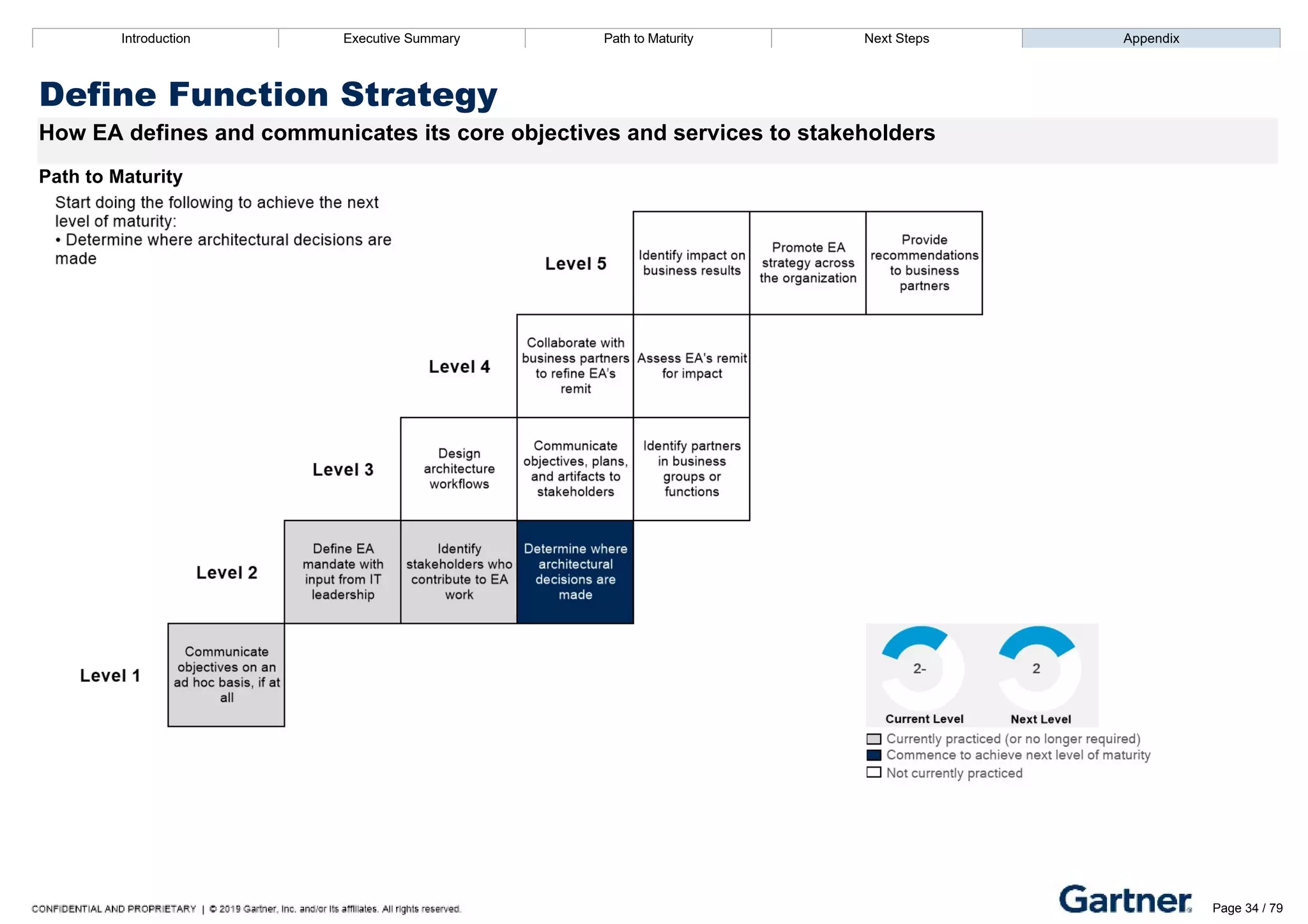
Define Function Strategy
How EA defines and communicates its core objectives and services to stakeholders
Path to Maturity
Page 33 / 79
Introduction Executive Summary Path to Maturity Next Steps Appendix
Define Function Strategy
How EA defines and communicates its core objectives and services to stakeholders
Path to Maturity
Introduction Executive Summary Path to Maturity Next Steps Appendix
Define Function Strategy – Recommended Resources Page 34 / 79
Introduction Executive Summary Path to Maturity Next Steps Appendix
Define Function Strategy – Recommended Resources
Featured Resources
• Research: Re­Envisioning EA's Role for the Digitization Era (CEB)
Design EA to support a digital enterprise.
• Tool: Presentation Template ­ Reinventing Enterprise Architecture (CEB)
Imagine and communicate the reinvention of enterprise architecture
• The Enterprise Architect's First 100 Days
Develop your 100 day plan to build the EA practice
• Business Architecture Is Not Optional for Business­Outcome­Driven EA
Develp business architecture as an integral part of EA to develop a clear understanding of the strategy and its impact on business and IT
Foundational Practices Progressive Practices
• Case Study: Gaining Support from EA’s Critical Stakeholders (Dayson) (CEB)
Prioritize your engagement with stakeholders based on relevance to your objectives
• Avoid the 13 Worst EA Practices and Ensure Your Success in the Digital Business
Era
Undestand the 13 worst EA practices and use our guidance on how to avoid them.
• Toolkit: Determining Your Business Scope and Focus for Enterprise Architecture
Use this Toolkit to communicate the value and impact of EA, given the allocation of
work efforts today and the tasks planned for the future
• Toolkit: How to Create an EA Charter, and Why
Use an EA charter to establish the basis for understanding and purpose within the
EA team, across the organization and with management
• Case Study: Building a Business Outcome­Focused Architecture Team
(BMO) (CEB)
Shift incentives to encourage an "advisor" mindset
• Tool: Enterprise Architecture Activity Guidebook (CEB)
Define EA's role in the digital enterprise.
• Ignition Guide to Designing and Managing EA Activities as Products
Design and develop EA deliverables as 'products' to support deliver of
business outcomes
• Top Five Attributes of a World­Class EA Discipline
Adopt these top five differentiating attributesto improve the value proposition
and impact of their EA efforts.
Introduction Executive Summary Path to Maturity Next Steps Appendix
Enable Information Strategy
How EA participates in the enablement and support of information management strategy
Path to Maturity
Page 35 / 79
Introduction Executive Summary Path to Maturity Next Steps Appendix
Enable Information Strategy
How EA participates in the enablement and support of information management strategy
Path to Maturity
Introduction Executive Summary Path to Maturity Next Steps Appendix
Enable Information Strategy – Recommended Resources Page 36 / 79
Introduction Executive Summary Path to Maturity Next Steps Appendix
Enable Information Strategy – Recommended Resources
Featured Resources
• Case Study: On­Demand Analytics (MetLife) (CEB)
Design data standards to feed on­demand analytics
• Tool: Hiring Guide for an Information Architect (CEB)
Hire an information architect to provide technical leadership and strategy for standards and processes for information across the enterprise.
• Tool: Information Management Strategy on a Page (CEB)
Develop a concise strategy that is easy to communicate and measure.
• Developing Strategic Plans: A Practical Guide to Getting Started
Develop impactful IT strategic plans by orienting to business strategy and redesigning the strategic planning process
Foundational Practices Progressive Practices
• Case Study: Identify Data Breakpoints and Monitor Data Quality (Intel) (CEB)
Map data flows to identify data sources, owners, and points of potential disruption.
Monitor metrics to measure the quality of critical data.
• Case Study: Targeted Information Asset Strategy (Gryphon Bank) (CEB)
Identify the most important enterprise information assets and build governance
structures to ensure accountable business ownership.
• Toolkit: The Gartner Execution Model
Use this Toolkit to provide a structured method for communicating initiatives and
cross­functional metrics of success
• How to Create an Information and Technology Strategic Plan
Enable enterprise business outcomes and capabilities through unified information
and technology planning.
• Executive Summary: Unlocking a DIY Approach to Big Data Analytics
(CEB)
Use data access as a core design principle
• Massively Disruptive Events Require a Nonlinear Approach to Enterprise
Architecture
Evolve the EA practice to dynamically reflect the changing nature of a
massive business disruption
Introduction Executive Summary Path to Maturity Next Steps Appendix
Support Solutions Design
How EA assists delivery teams with standards, reference architectures, and the assessment of architecture fit to
aid project design
Path to Maturity Page 37 / 79
Introduction Executive Summary Path to Maturity Next Steps Appendix
Support Solutions Design
How EA assists delivery teams with standards, reference architectures, and the assessment of architecture fit to
aid project design
Path to Maturity
Introduction Executive Summary Path to Maturity Next Steps Appendix
Page 38 / 79
Introduction Executive Summary Path to Maturity Next Steps Appendix
Support Solutions Design – Recommended Resources
Featured Resources
• Research: Architecting for Cost, Quality, and Speed (CEB)
Design for cost, quality, and speed
• Use Quality Attributes to Align Business Requirements and Guide Solutions Architecture
Create formal quality assurance practices that ensure a consistent approach , improve stakeholder communication and achieve business outcomes.
• Best Practices for Delivering Targeted and High­Impact Reference Architectures
Ensure that reference architecture deliverables are targeted to a stakeholder with clear use cases, reflect business context and outcomes
• Five Best Practices to Increase Stakeholder Engagement and Support in the Digital Era
Follow five best practices to increase stakeholder engagement and retain business support
Foundational Practices Progressive Practices
• Case Study: Consumability­Focused Enterprise Architecture (ADP) (CEB)
Design architecture from the perspective of the user
• Case Study: Reference Architecture Management Framework (American Express)
(CEB)
Manage reference architecture to enable SMEs to build RAs in a consistent
framework and lease them to consumers in the enterprise
• Design Thinking Can Revolutionize Your Customer Experience Strategies
Use Design Thinking to support digital business solutions delivery
• Use EA to Ensure Your Agile Development Succeeds
Prepare for how EA supports agile development.
• Case Study: Business­Aligned Architecture Option Analysis (Progressive)
(CEB)
Present choices not recommendations and support good decision­making by
presenting trade­offs for each choice
• Ignition Guide to Building a Customer Experience Journey Map (CEB)
Build in­depth customer journey maps
• How Architecting for Next­Generation Experiences Helps to Deliver Customer
and Business Outcomes
Help their organizations link customer experiences to clear business
outcomes.
• Take a Human­Centered Approach to Digital Design
Put people at the center of your digital innovation design efforts
Introduction Executive Summary Path to Maturity Next Steps Appendix
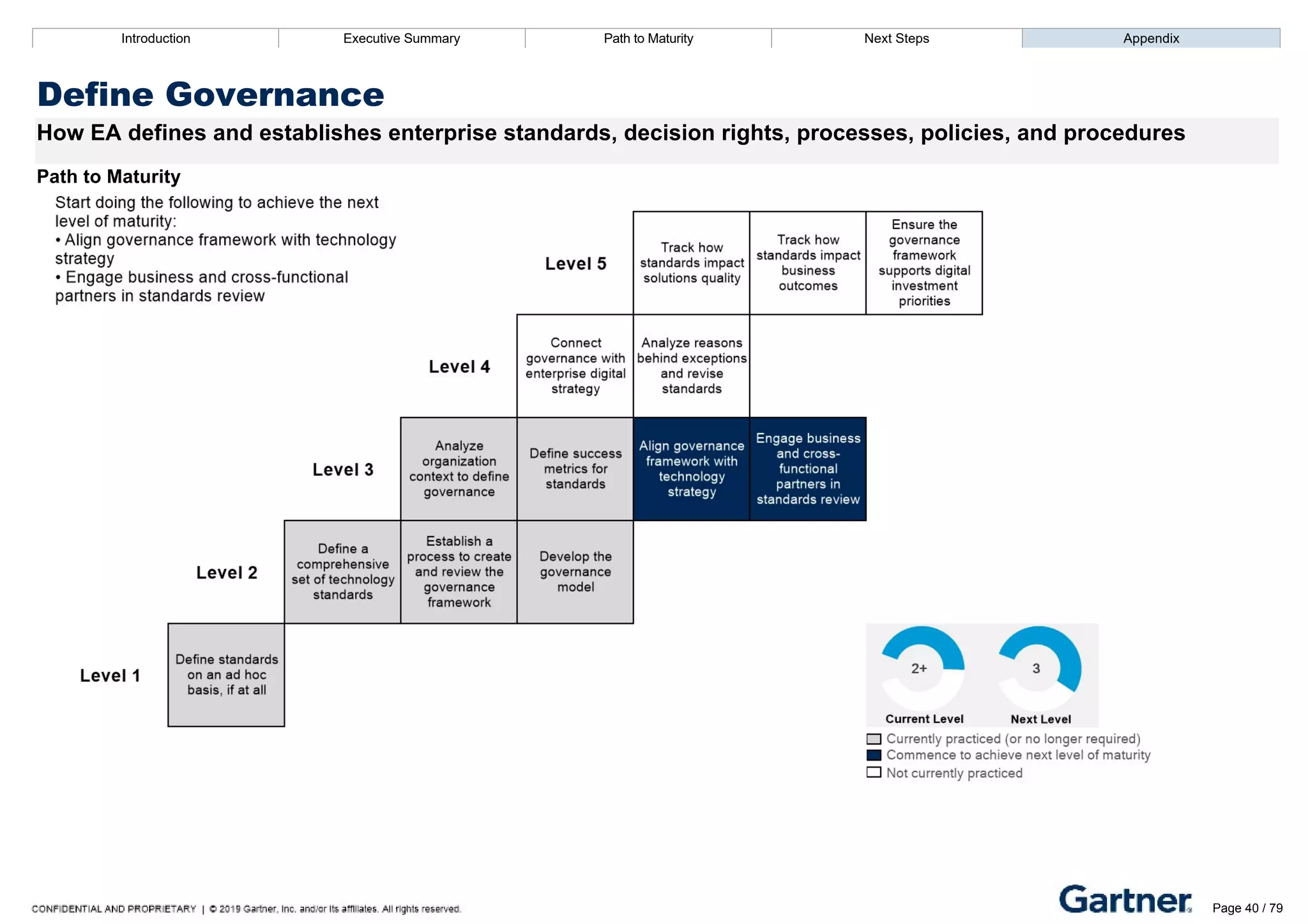
Define Governance
How EA defines and establishes enterprise standards, decision rights, processes, policies, and procedures
Path to Maturity
Page 39 / 79
Introduction Executive Summary Path to Maturity Next Steps Appendix
Define Governance
How EA defines and establishes enterprise standards, decision rights, processes, policies, and procedures
Path to Maturity
Introduction Executive Summary Path to Maturity Next Steps Appendix
Define Governance – Recommended Resources Page 40 / 79
Introduction Executive Summary Path to Maturity Next Steps Appendix
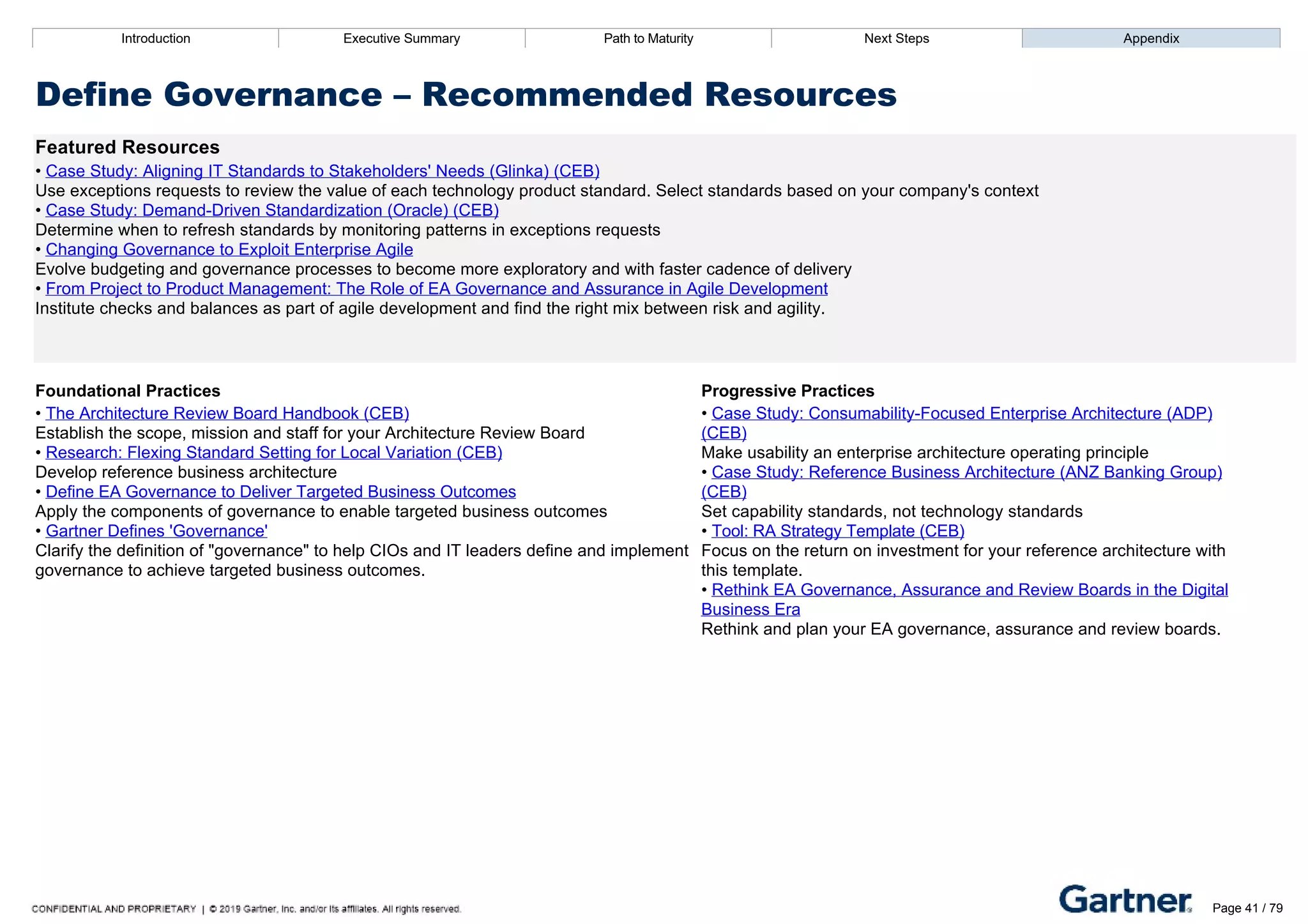
Define Governance – Recommended Resources
Featured Resources
• Case Study: Aligning IT Standards to Stakeholders' Needs (Glinka) (CEB)
Use exceptions requests to review the value of each technology product standard. Select standards based on your company's context
• Case Study: Demand­Driven Standardization (Oracle) (CEB)
Determine when to refresh standards by monitoring patterns in exceptions requests
• Changing Governance to Exploit Enterprise Agile
Evolve budgeting and governance processes to become more exploratory and with faster cadence of delivery
• From Project to Product Management: The Role of EA Governance and Assurance in Agile Development
Institute checks and balances as part of agile development and find the right mix between risk and agility.
Foundational Practices Progressive Practices
• The Architecture Review Board Handbook (CEB)
Establish the scope, mission and staff for your Architecture Review Board
• Research: Flexing Standard Setting for Local Variation (CEB)
Develop reference business architecture
• Define EA Governance to Deliver Targeted Business Outcomes
Apply the components of governance to enable targeted business outcomes
• Gartner Defines 'Governance'
Clarify the definition of "governance" to help CIOs and IT leaders define and implement
governance to achieve targeted business outcomes.
• Case Study: Consumability­Focused Enterprise Architecture (ADP)
(CEB)
Make usability an enterprise architecture operating principle
• Case Study: Reference Business Architecture (ANZ Banking Group)
(CEB)
Set capability standards, not technology standards
• Tool: RA Strategy Template (CEB)
Focus on the return on investment for your reference architecture with
this template.
• Rethink EA Governance, Assurance and Review Boards in the Digital
Business Era
Rethink and plan your EA governance, assurance and review boards.
Introduction Executive Summary Path to Maturity Next Steps Appendix
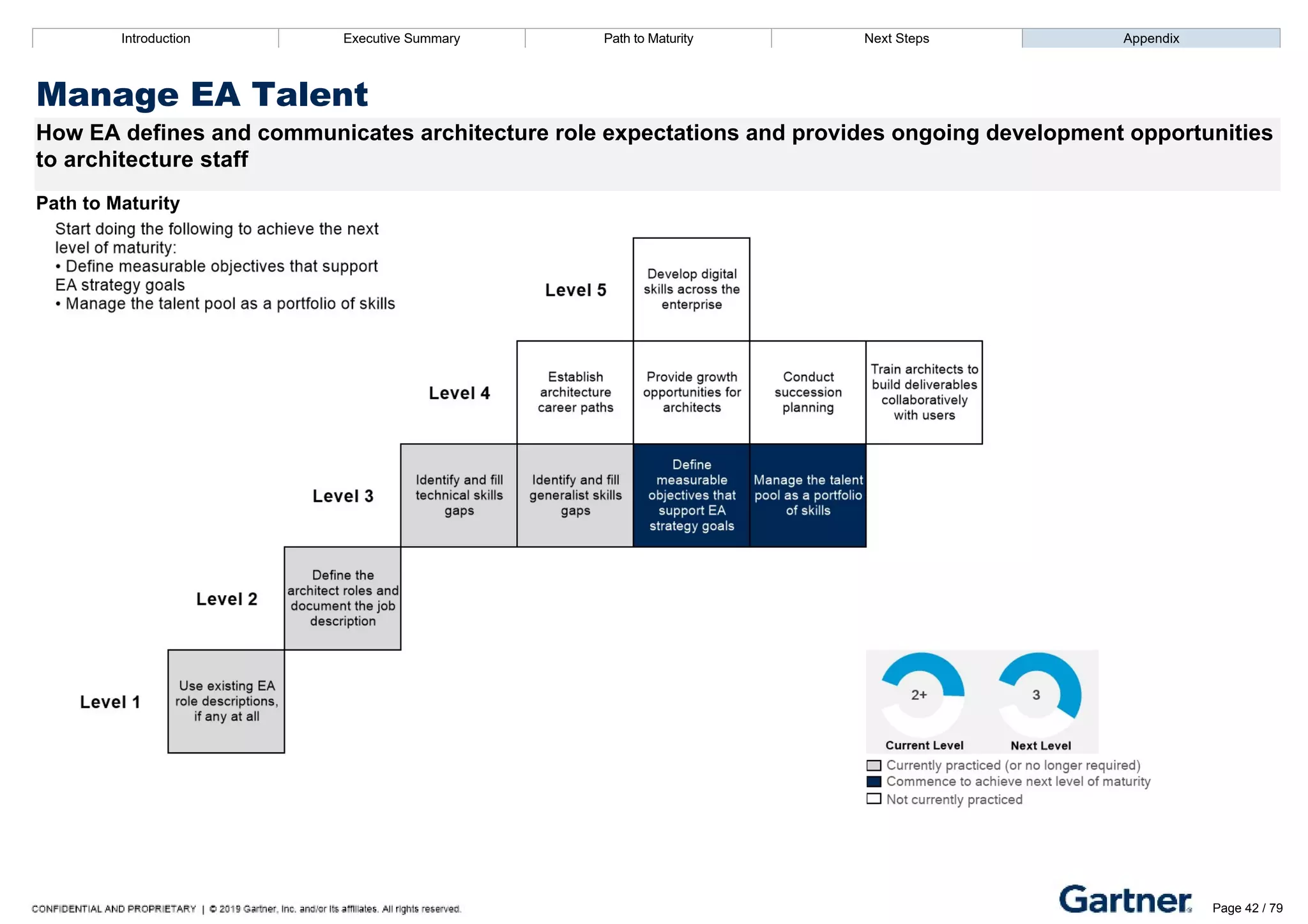
Manage EA Talent
How EA defines and communicates architecture role expectations and provides ongoing development opportunities
to architecture staff
Path to Maturity Page 41 / 79
Introduction Executive Summary Path to Maturity Next Steps Appendix
Manage EA Talent
How EA defines and communicates architecture role expectations and provides ongoing development opportunities
to architecture staff
Path to Maturity
Introduction Executive Summary Path to Maturity Next Steps Appendix
Page 42 / 79
Introduction Executive Summary Path to Maturity Next Steps Appendix
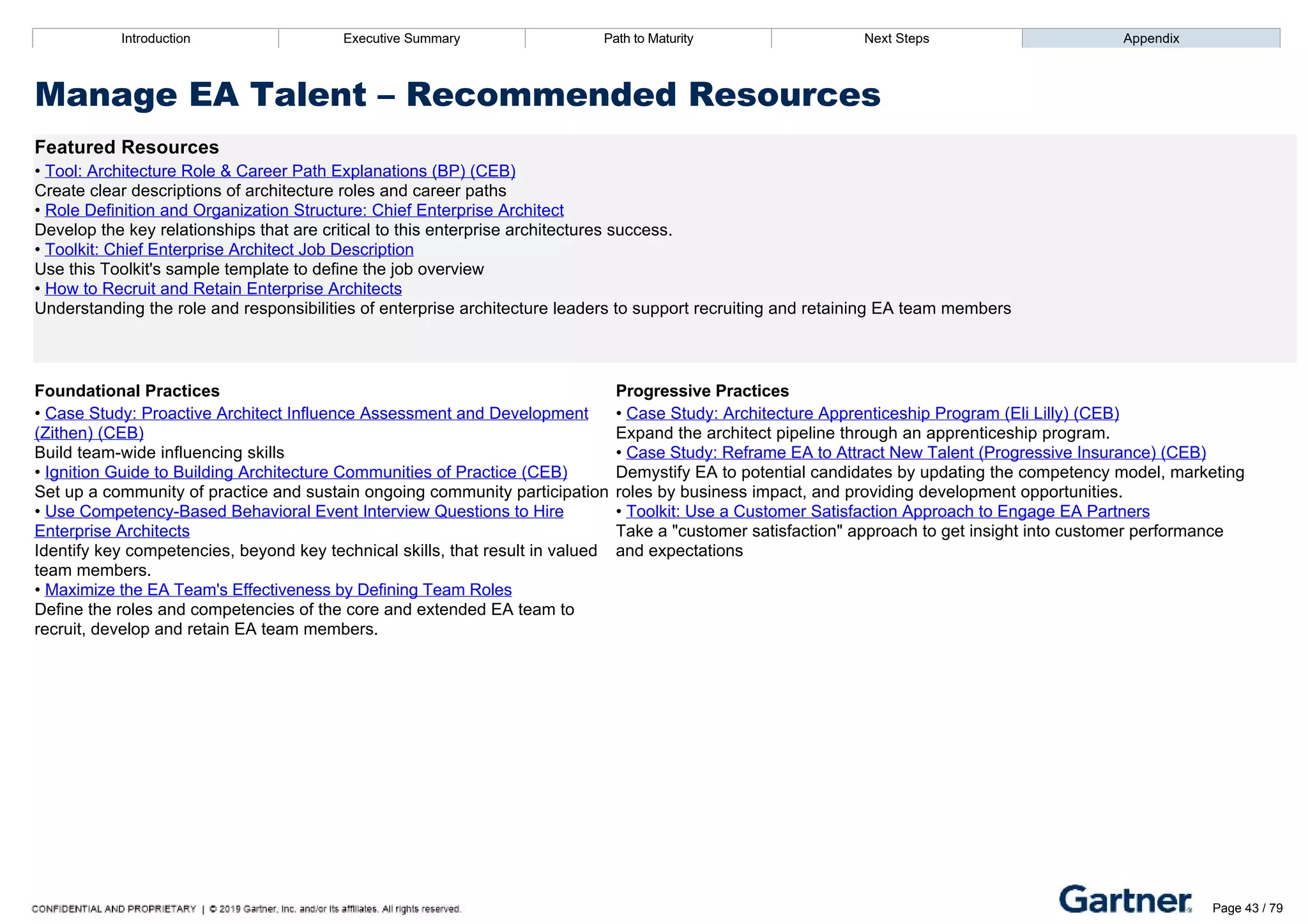
Manage EA Talent – Recommended Resources
Featured Resources
• Tool: Architecture Role & Career Path Explanations (BP) (CEB)
Create clear descriptions of architecture roles and career paths
• Role Definition and Organization Structure: Chief Enterprise Architect
Develop the key relationships that are critical to this enterprise architectures success.
• Toolkit: Chief Enterprise Architect Job Description
Use this Toolkit's sample template to define the job overview
• How to Recruit and Retain Enterprise Architects
Understanding the role and responsibilities of enterprise architecture leaders to support recruiting and retaining EA team members
Foundational Practices Progressive Practices
• Case Study: Proactive Architect Influence Assessment and Development
(Zithen) (CEB)
Build team­wide influencing skills
• Ignition Guide to Building Architecture Communities of Practice (CEB)
Set up a community of practice and sustain ongoing community participation
• Use Competency­Based Behavioral Event Interview Questions to Hire
Enterprise Architects
Identify key competencies, beyond key technical skills, that result in valued
team members.
• Maximize the EA Team's Effectiveness by Defining Team Roles
Define the roles and competencies of the core and extended EA team to
recruit, develop and retain EA team members.
• Case Study: Architecture Apprenticeship Program (Eli Lilly) (CEB)
Expand the architect pipeline through an apprenticeship program.
• Case Study: Reframe EA to Attract New Talent (Progressive Insurance) (CEB)
Demystify EA to potential candidates by updating the competency model, marketing
roles by business impact, and providing development opportunities.
• Toolkit: Use a Customer Satisfaction Approach to Engage EA Partners
Take a "customer satisfaction" approach to get insight into customer performance
and expectations
Introduction Executive Summary Path to Maturity Next Steps Appendix
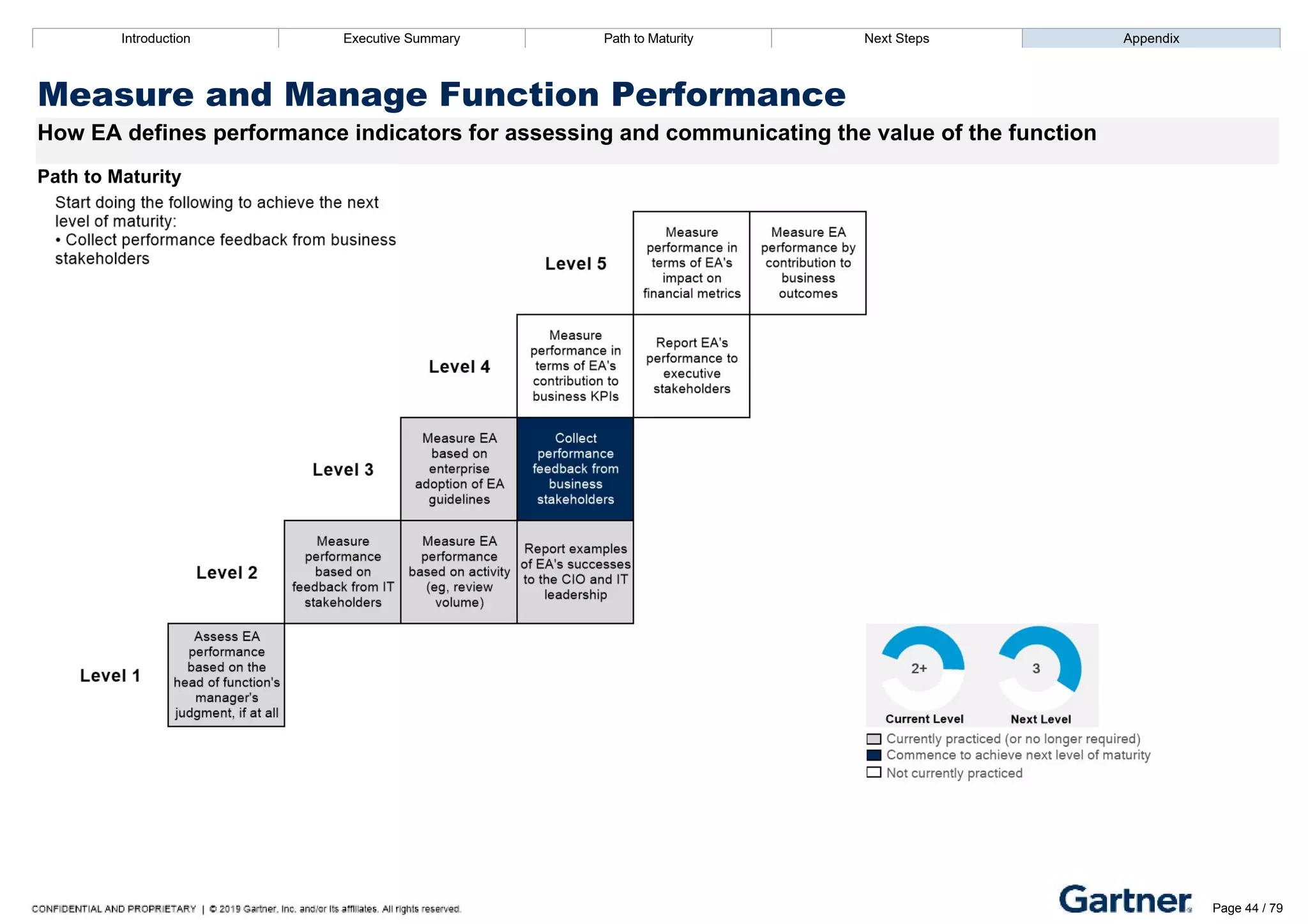
Measure and Manage Function Performance
How EA defines performance indicators for assessing and communicating the value of the function
Path to Maturity
Page 43 / 79
Introduction Executive Summary Path to Maturity Next Steps Appendix
Measure and Manage Function Performance
How EA defines performance indicators for assessing and communicating the value of the function
Path to Maturity
Introduction Executive Summary Path to Maturity Next Steps Appendix
Measure and Manage Function Performance – Recommended Page 44 / 79
Introduction Executive Summary Path to Maturity Next Steps Appendix
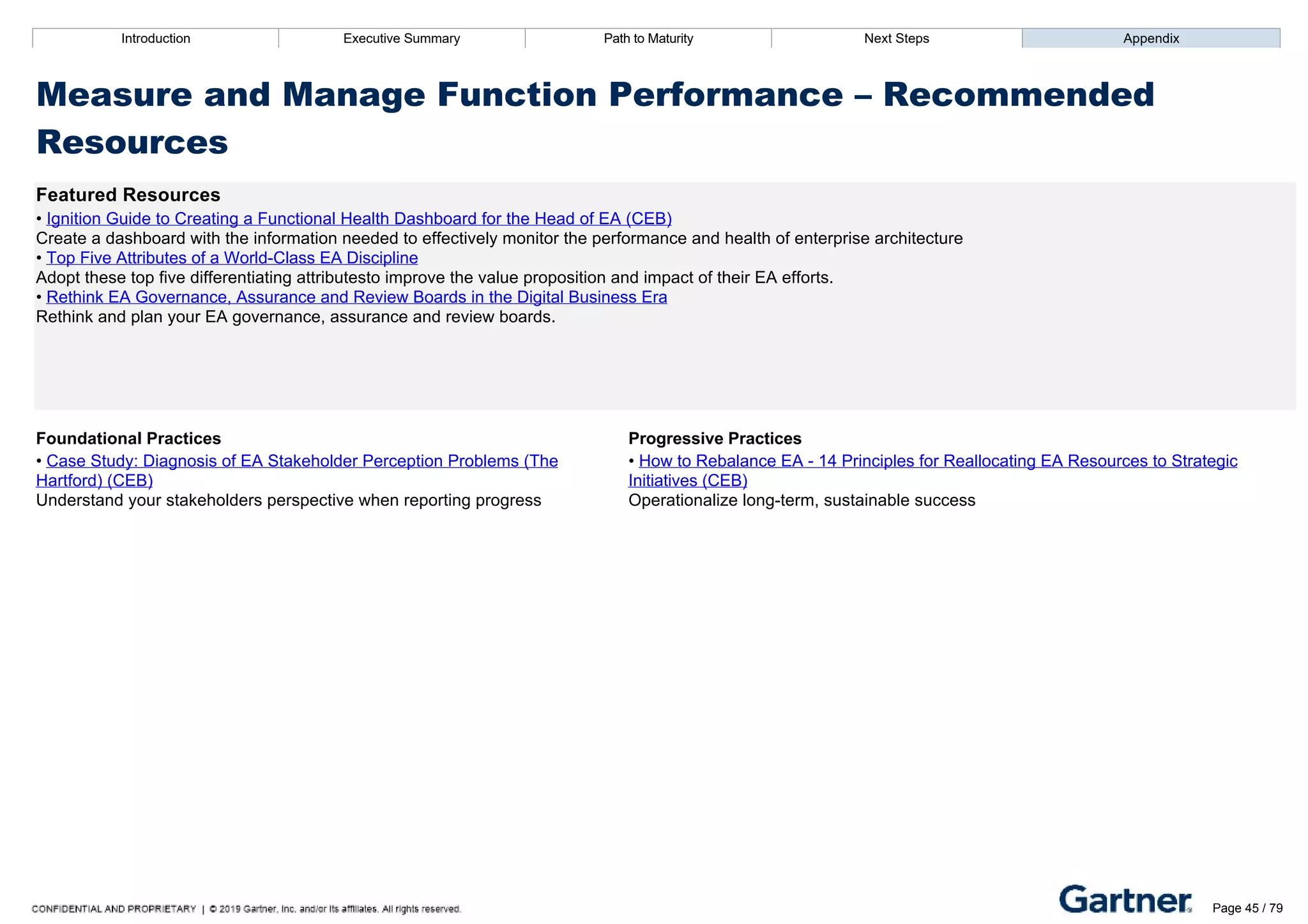
Measure and Manage Function Performance – Recommended
Resources
Featured Resources
• Ignition Guide to Creating a Functional Health Dashboard for the Head of EA (CEB)
Create a dashboard with the information needed to effectively monitor the performance and health of enterprise architecture
• Top Five Attributes of a World­Class EA Discipline
Adopt these top five differentiating attributesto improve the value proposition and impact of their EA efforts.
• Rethink EA Governance, Assurance and Review Boards in the Digital Business Era
Rethink and plan your EA governance, assurance and review boards.
Foundational Practices Progressive Practices
• Case Study: Diagnosis of EA Stakeholder Perception Problems (The
Hartford) (CEB)
Understand your stakeholders perspective when reporting progress
• How to Rebalance EA ­ 14 Principles for Reallocating EA Resources to Strategic
Initiatives (CEB)
Operationalize long­term, sustainable success
Introduction Executive Summary Path to Maturity Next Steps Appendix
Develop and Maintain Roadmaps
How EA provides a consistent framework to align technology investments with IT and business objectives
Page 45 / 79
Introduction Executive Summary Path to Maturity Next Steps Appendix
Develop and Maintain Roadmaps
How EA provides a consistent framework to align technology investments with IT and business objectives
Path to Maturity
Introduction Executive Summary Path to Maturity Next Steps Appendix
Develop and Maintain Roadmaps – Recommended Resources Page 46 / 79
Introduction Executive Summary Path to Maturity Next Steps Appendix
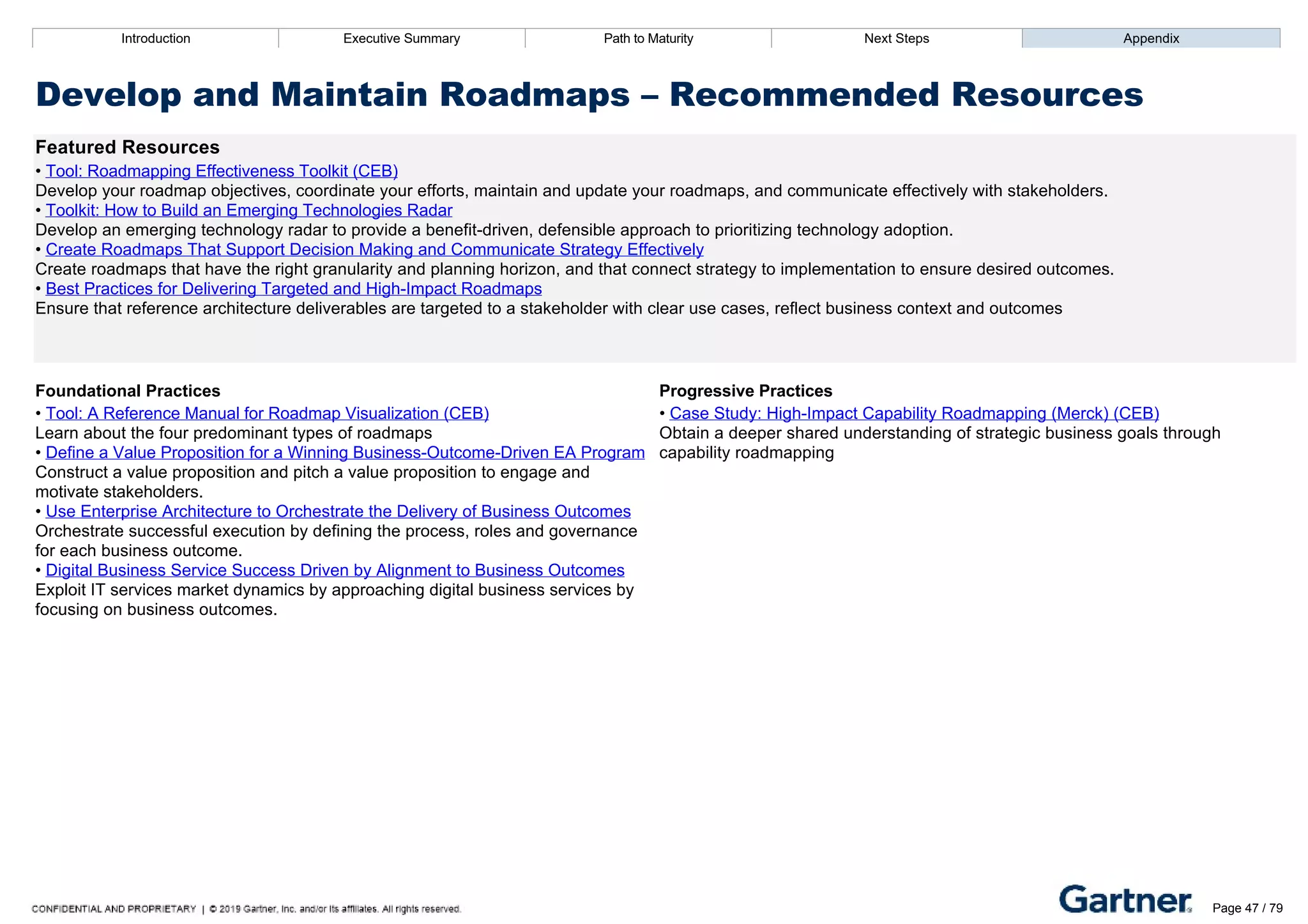
Develop and Maintain Roadmaps – Recommended Resources
Featured Resources
• Tool: Roadmapping Effectiveness Toolkit (CEB)
Develop your roadmap objectives, coordinate your efforts, maintain and update your roadmaps, and communicate effectively with stakeholders.
• Toolkit: How to Build an Emerging Technologies Radar
Develop an emerging technology radar to provide a benefit­driven, defensible approach to prioritizing technology adoption.
• Create Roadmaps That Support Decision Making and Communicate Strategy Effectively
Create roadmaps that have the right granularity and planning horizon, and that connect strategy to implementation to ensure desired outcomes.
• Best Practices for Delivering Targeted and High­Impact Roadmaps
Ensure that reference architecture deliverables are targeted to a stakeholder with clear use cases, reflect business context and outcomes
Foundational Practices Progressive Practices
• Tool: A Reference Manual for Roadmap Visualization (CEB)
Learn about the four predominant types of roadmaps
• Define a Value Proposition for a Winning Business­Outcome­Driven EA Program
Construct a value proposition and pitch a value proposition to engage and
motivate stakeholders.
• Use Enterprise Architecture to Orchestrate the Delivery of Business Outcomes
Orchestrate successful execution by defining the process, roles and governance
for each business outcome.
• Digital Business Service Success Driven by Alignment to Business Outcomes
Exploit IT services market dynamics by approaching digital business services by
focusing on business outcomes.
• Case Study: High­Impact Capability Roadmapping (Merck) (CEB)
Obtain a deeper shared understanding of strategic business goals through
capability roadmapping
Introduction Executive Summary Path to Maturity Next Steps Appendix
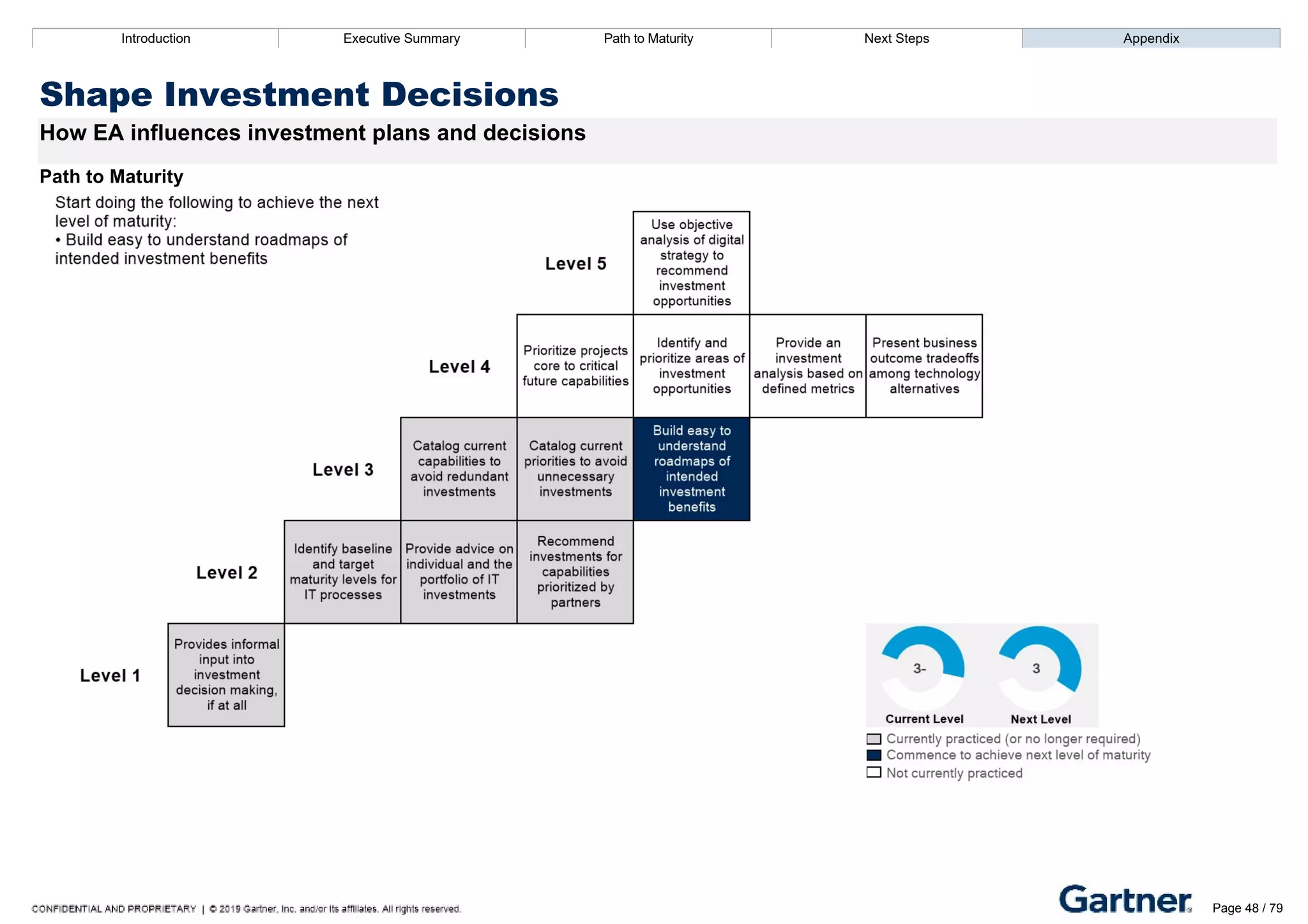
Shape Investment Decisions
How EA influences investment plans and decisions
Path to Maturity
Page 47 / 79
Introduction Executive Summary Path to Maturity Next Steps Appendix
Shape Investment Decisions
How EA influences investment plans and decisions
Path to Maturity
Introduction Executive Summary Path to Maturity Next Steps Appendix
Shape Investment Decisions – Recommended Resources Page 48 / 79
Introduction Executive Summary Path to Maturity Next Steps Appendix
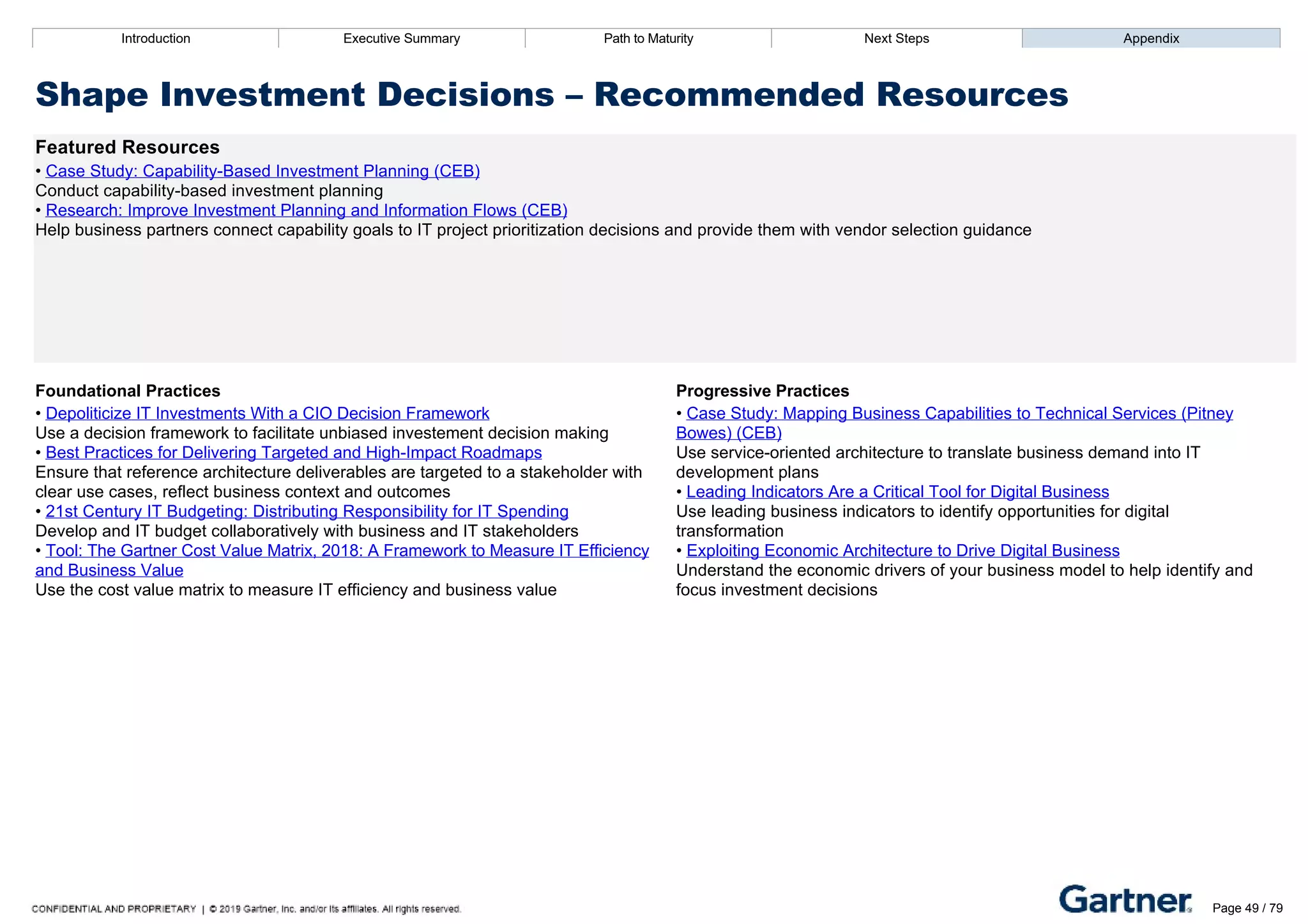
Shape Investment Decisions – Recommended Resources
Featured Resources
• Case Study: Capability­Based Investment Planning (CEB)
Conduct capability­based investment planning
• Research: Improve Investment Planning and Information Flows (CEB)
Help business partners connect capability goals to IT project prioritization decisions and provide them with vendor selection guidance
Foundational Practices Progressive Practices
• Depoliticize IT Investments With a CIO Decision Framework
Use a decision framework to facilitate unbiased investement decision making
• Best Practices for Delivering Targeted and High­Impact Roadmaps
Ensure that reference architecture deliverables are targeted to a stakeholder with
clear use cases, reflect business context and outcomes
• 21st Century IT Budgeting: Distributing Responsibility for IT Spending
Develop and IT budget collaboratively with business and IT stakeholders
• Tool: The Gartner Cost Value Matrix, 2018: A Framework to Measure IT Efficiency
and Business Value
Use the cost value matrix to measure IT efficiency and business value
• Case Study: Mapping Business Capabilities to Technical Services (Pitney
Bowes) (CEB)
Use service­oriented architecture to translate business demand into IT
development plans
• Leading Indicators Are a Critical Tool for Digital Business
Use leading business indicators to identify opportunities for digital
transformation
• Exploiting Economic Architecture to Drive Digital Business
Understand the economic drivers of your business model to help identify and
focus investment decisions
Introduction Executive Summary Path to Maturity Next Steps Appendix
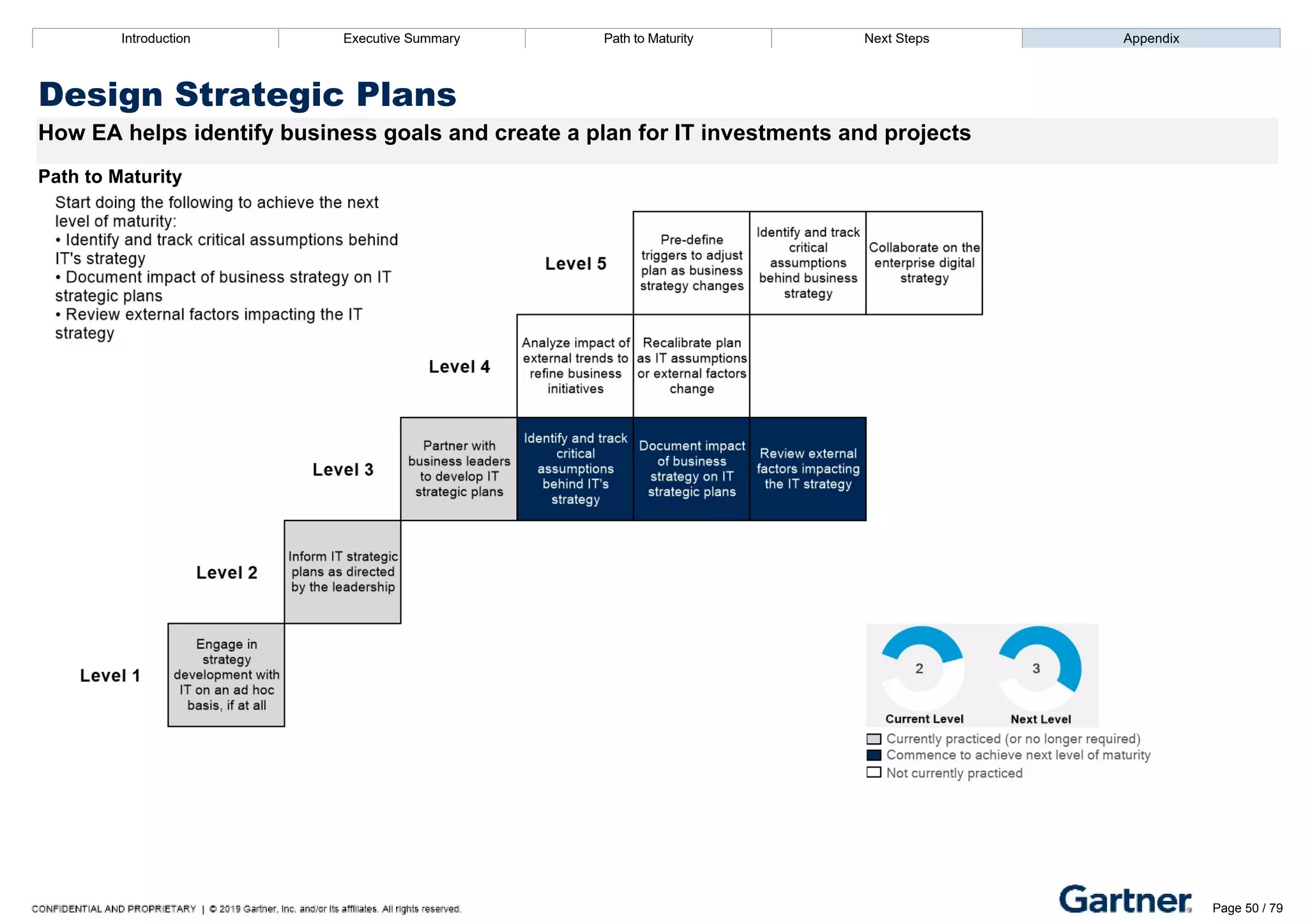
Design Strategic Plans
How EA helps identify business goals and create a plan for IT investments and projects
Path to Maturity
Page 49 / 79
Introduction Executive Summary Path to Maturity Next Steps Appendix
Design Strategic Plans
How EA helps identify business goals and create a plan for IT investments and projects
Path to Maturity
Introduction Executive Summary Path to Maturity Next Steps Appendix
Design Strategic Plans – Recommended Resources Page 50 / 79
Introduction Executive Summary Path to Maturity Next Steps Appendix
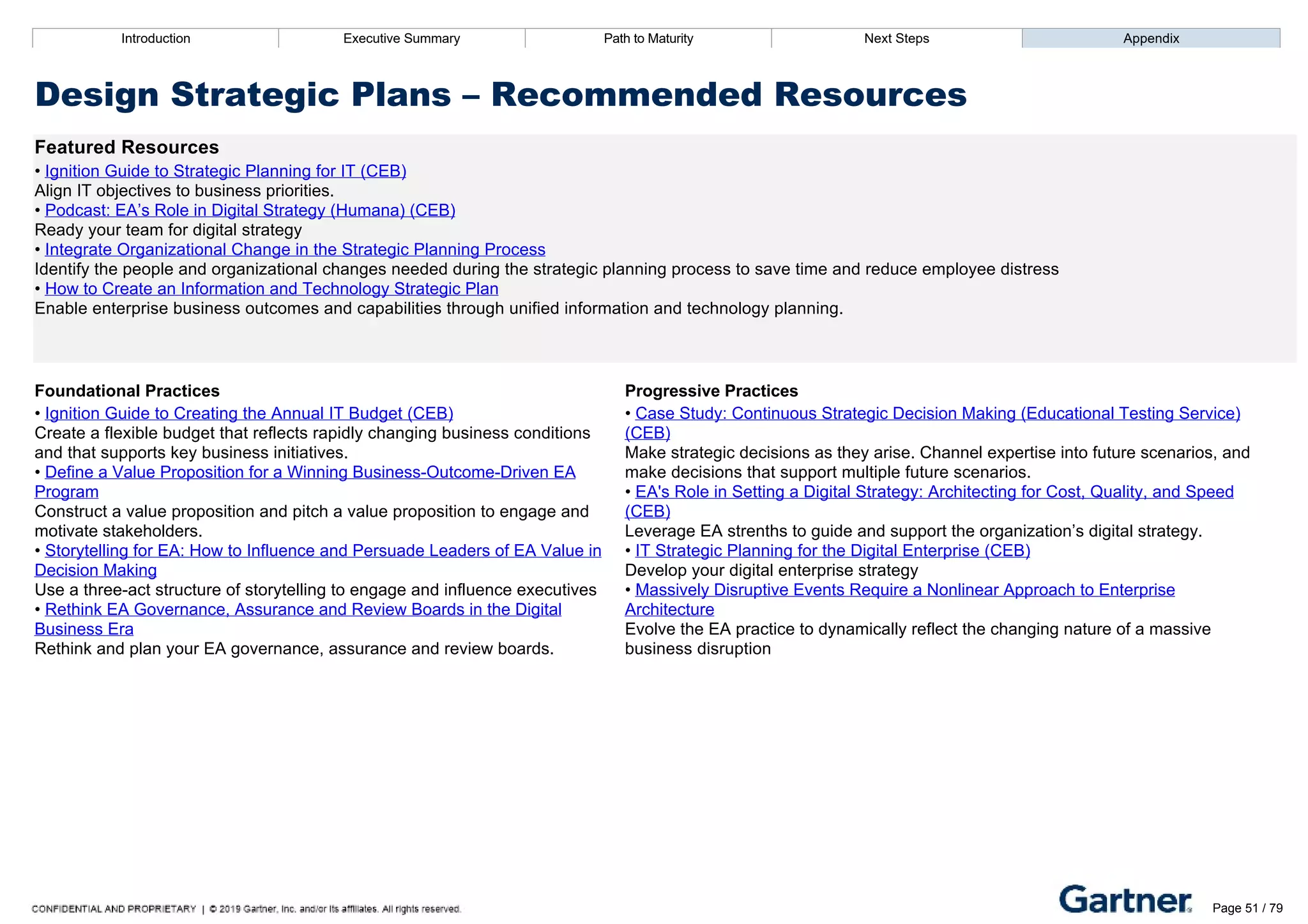
Design Strategic Plans – Recommended Resources
Featured Resources
• Ignition Guide to Strategic Planning for IT (CEB)
Align IT objectives to business priorities.
• Podcast: EA’s Role in Digital Strategy (Humana) (CEB)
Ready your team for digital strategy
• Integrate Organizational Change in the Strategic Planning Process
Identify the people and organizational changes needed during the strategic planning process to save time and reduce employee distress
• How to Create an Information and Technology Strategic Plan
Enable enterprise business outcomes and capabilities through unified information and technology planning.
Foundational Practices Progressive Practices
• Ignition Guide to Creating the Annual IT Budget (CEB)
Create a flexible budget that reflects rapidly changing business conditions
and that supports key business initiatives.
• Define a Value Proposition for a Winning Business­Outcome­Driven EA
Program
Construct a value proposition and pitch a value proposition to engage and
motivate stakeholders.
• Storytelling for EA: How to Influence and Persuade Leaders of EA Value in
Decision Making
Use a three­act structure of storytelling to engage and influence executives
• Rethink EA Governance, Assurance and Review Boards in the Digital
Business Era
Rethink and plan your EA governance, assurance and review boards.
• Case Study: Continuous Strategic Decision Making (Educational Testing Service)
(CEB)
Make strategic decisions as they arise. Channel expertise into future scenarios, and
make decisions that support multiple future scenarios.
• EA's Role in Setting a Digital Strategy: Architecting for Cost, Quality, and Speed
(CEB)
Leverage EA strenths to guide and support the organization’s digital strategy.
• IT Strategic Planning for the Digital Enterprise (CEB)
Develop your digital enterprise strategy
• Massively Disruptive Events Require a Nonlinear Approach to Enterprise
Architecture
Evolve the EA practice to dynamically reflect the changing nature of a massive
business disruption
Introduction Executive Summary Path to Maturity Next Steps Appendix
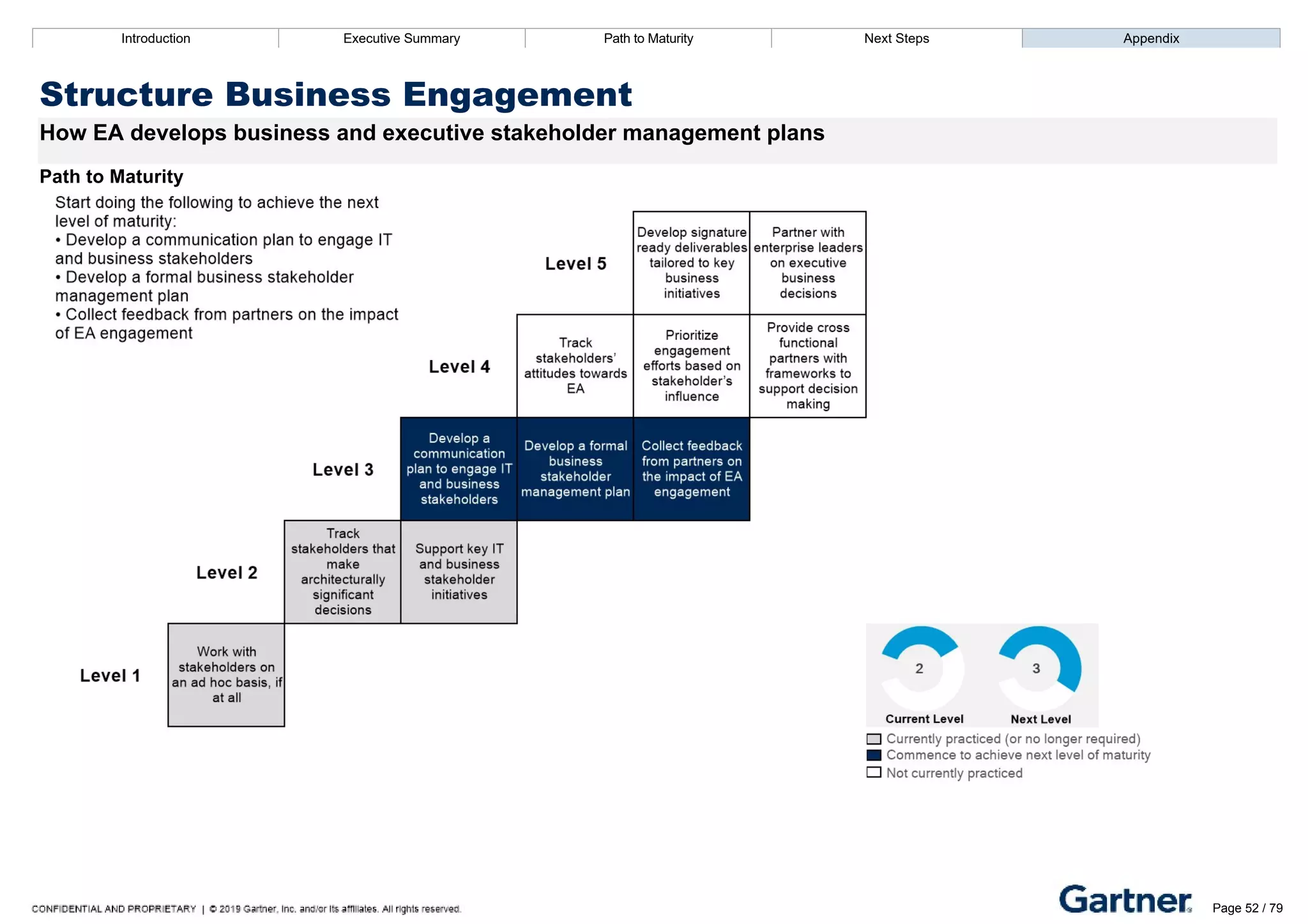
Structure Business Engagement
How EA develops business and executive stakeholder management plans
Path to Maturity
Page 51 / 79
Introduction Executive Summary Path to Maturity Next Steps Appendix
Structure Business Engagement
How EA develops business and executive stakeholder management plans
Path to Maturity
Introduction Executive Summary Path to Maturity Next Steps Appendix
Structure Business Engagement – Recommended Resources Page 52 / 79
Introduction Executive Summary Path to Maturity Next Steps Appendix
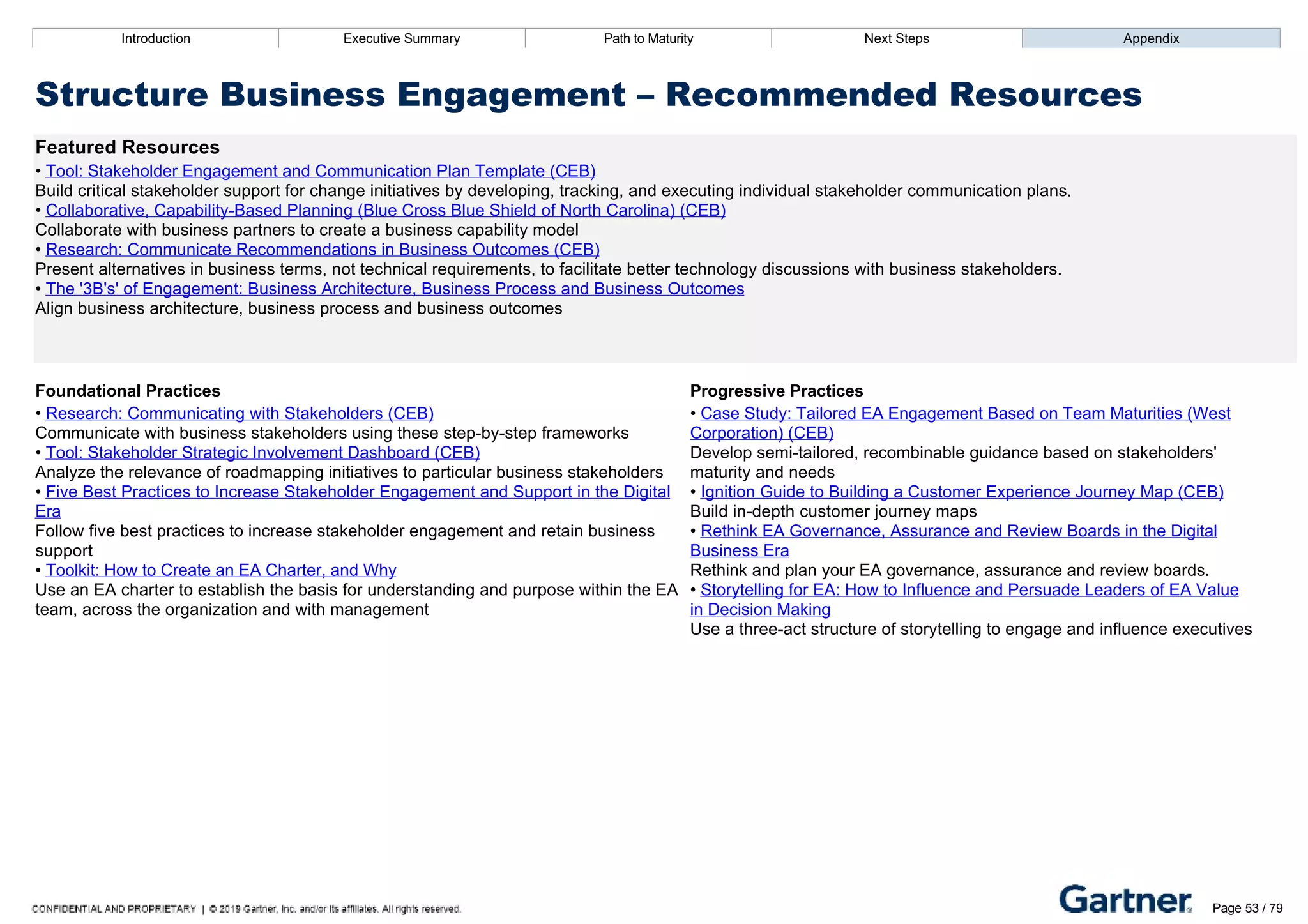
Structure Business Engagement – Recommended Resources
Featured Resources
• Tool: Stakeholder Engagement and Communication Plan Template (CEB)
Build critical stakeholder support for change initiatives by developing, tracking, and executing individual stakeholder communication plans.
• Collaborative, Capability­Based Planning (Blue Cross Blue Shield of North Carolina) (CEB)
Collaborate with business partners to create a business capability model
• Research: Communicate Recommendations in Business Outcomes (CEB)
Present alternatives in business terms, not technical requirements, to facilitate better technology discussions with business stakeholders.
• The '3B's' of Engagement: Business Architecture, Business Process and Business Outcomes
Align business architecture, business process and business outcomes
Foundational Practices Progressive Practices
• Research: Communicating with Stakeholders (CEB)
Communicate with business stakeholders using these step­by­step frameworks
• Tool: Stakeholder Strategic Involvement Dashboard (CEB)
Analyze the relevance of roadmapping initiatives to particular business stakeholders
• Five Best Practices to Increase Stakeholder Engagement and Support in the Digital
Era
Follow five best practices to increase stakeholder engagement and retain business
support
• Toolkit: How to Create an EA Charter, and Why
Use an EA charter to establish the basis for understanding and purpose within the EA
team, across the organization and with management
• Case Study: Tailored EA Engagement Based on Team Maturities (West
Corporation) (CEB)
Develop semi­tailored, recombinable guidance based on stakeholders'
maturity and needs
• Ignition Guide to Building a Customer Experience Journey Map (CEB)
Build in­depth customer journey maps
• Rethink EA Governance, Assurance and Review Boards in the Digital
Business Era
Rethink and plan your EA governance, assurance and review boards.
• Storytelling for EA: How to Influence and Persuade Leaders of EA Value
in Decision Making
Use a three­act structure of storytelling to engage and influence executives
Introduction Executive Summary Path to Maturity Next Steps Appendix
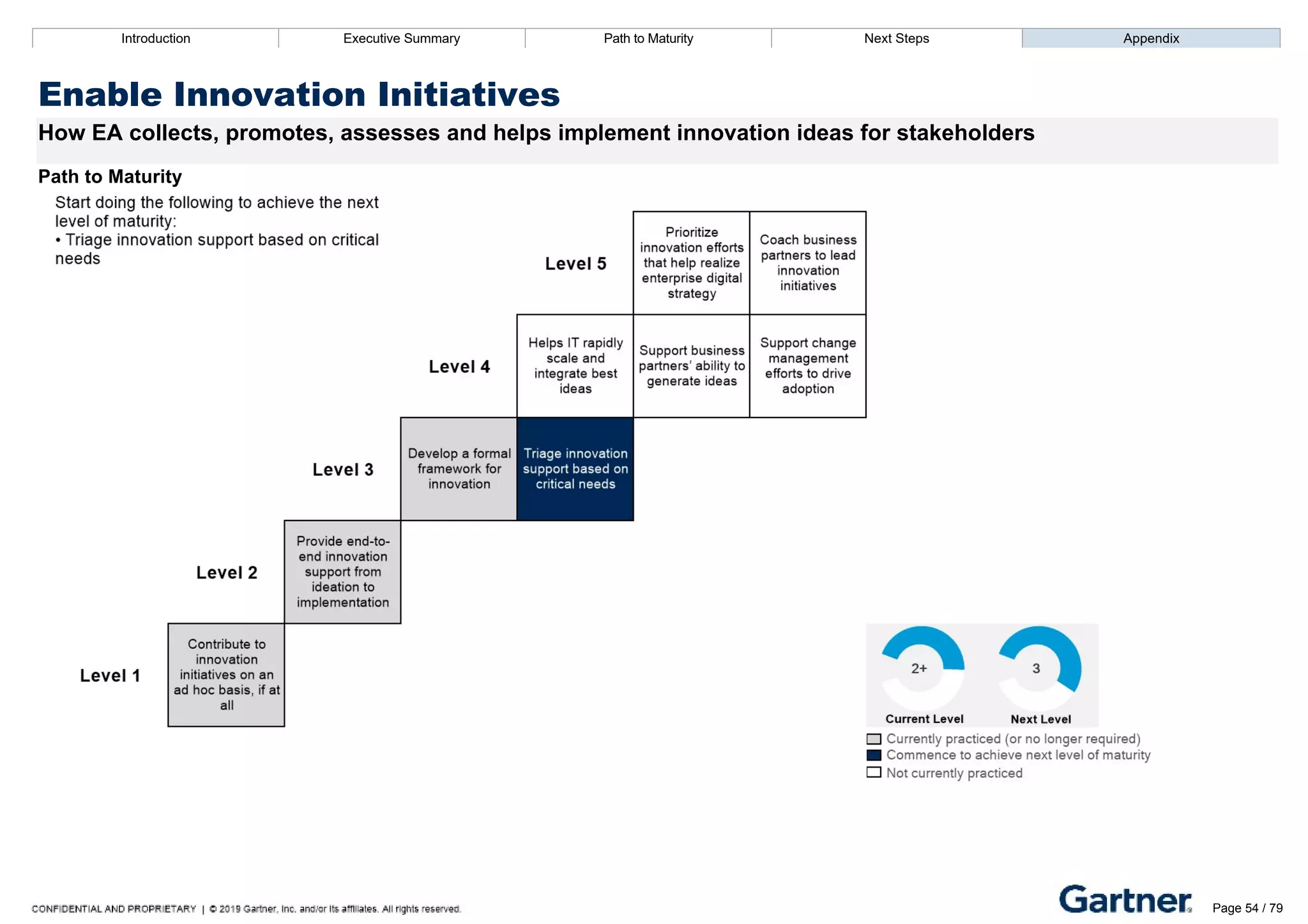
Enable Innovation Initiatives
How EA collects, promotes, assesses and helps implement innovation ideas for stakeholders
Path to Maturity
Page 53 / 79
Introduction Executive Summary Path to Maturity Next Steps Appendix
Enable Innovation Initiatives
How EA collects, promotes, assesses and helps implement innovation ideas for stakeholders
Path to Maturity
Introduction Executive Summary Path to Maturity Next Steps Appendix
Enable Innovation Initiatives – Recommended Resources Page 54 / 79
Introduction Executive Summary Path to Maturity Next Steps Appendix
Enable Innovation Initiatives – Recommended Resources
Featured Resources
• Podcast: EA and Digital Innovation (With Alex Sirkovich and Mauricio Munguia, Capital Group) (CEB)
Insert your team into the innovation lifecycle where it will have the biggest impact
• Case Study: Simplify Communication of Architecture Debt (Capital Group) (CEB)
Frame architecture debt as a business decision
• How Enterprise Architecture Can Use Lean Practices
Use lean practices to enable increased respect for people and continuous improvement across the value chain.
• Best Practices for Modeling Business Ecosystems
Use these seven best practices to develop business ecosystem models and build a world­class EA capability.
Foundational Practices Progressive Practices
• Use Enterprise Architecture to Orchestrate the Delivery of Business Outcomes
Orchestrate successful execution by defining the process, roles and governance
for each business outcome.
• Create Roadmaps That Support Decision Making and Communicate Strategy
Effectively
Create roadmaps that have the right granularity and planning horizon, and that
connect strategy to implementation to ensure desired outcomes.
• Culture Crush: Design Your Roadmap for a Culture of Innovation
Develop a culture of innovative culture with innovation activities and a customizable
framework.
• Case Study: Hypothesis Driven Innovation (Capital Group) (CEB)
Empower architects with hypothesis­driven innovation
• Case Study: The New Creative Agency: Transforming EA’s Role in Innovation
(HEINEKEN) (CEB)
Lead innovation in your organization by becoming a "creative agency"
• Market Guide for Strategy and Innovation Roadmapping Tools
Use the Market Guide for Strategy and Innovation Roadmapping Tools to
understand the trends and representitive vendors
• Leading From the Heart: You Don't Become a Digital Humanist by Fixing
Problems
Change your organizations focus from fixing problems to augmenting people's
capabilities and effectiveness.
Introduction Executive Summary Path to Maturity Next Steps Appendix
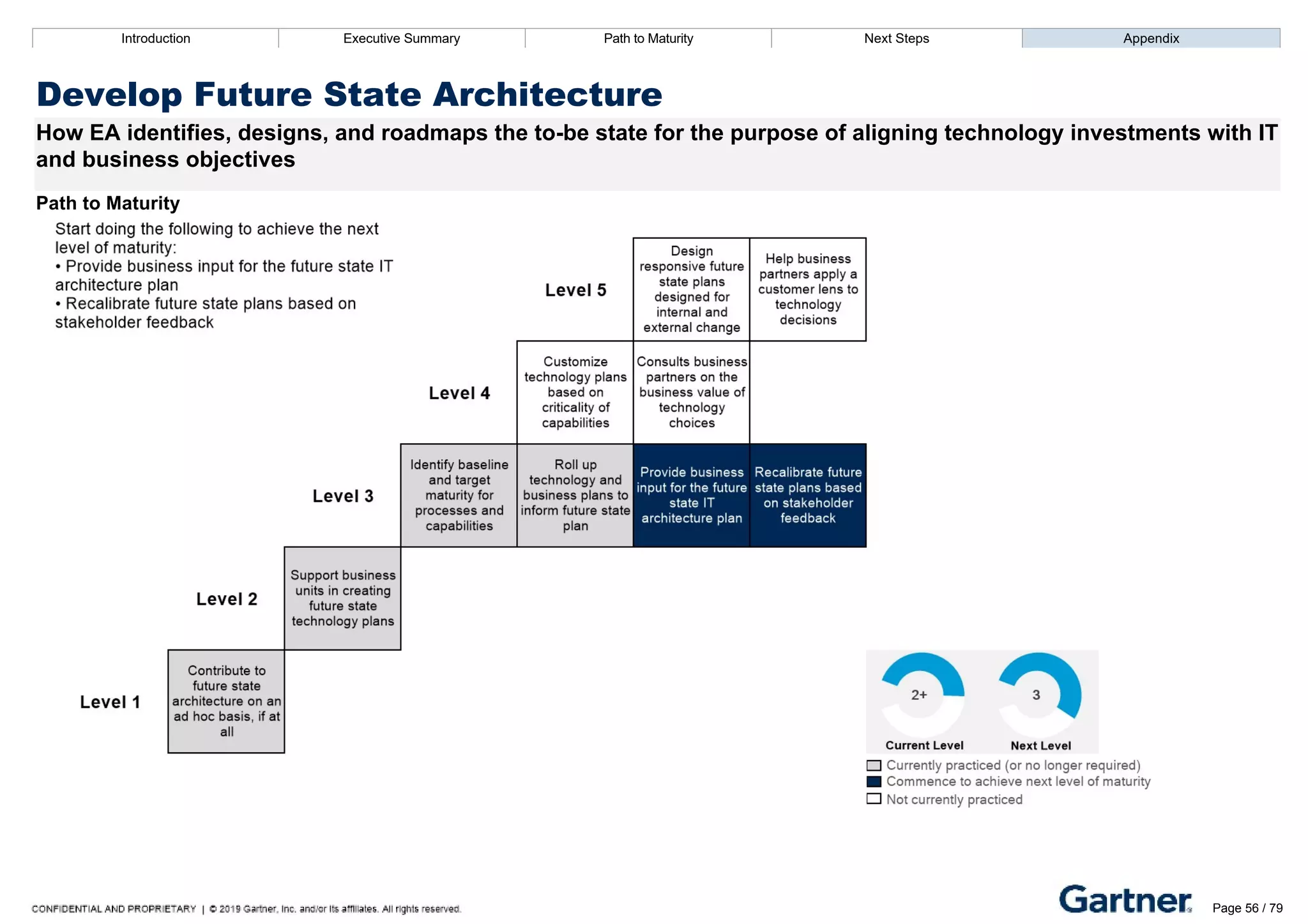
Develop Future State Architecture
How EA identifies, designs, and roadmaps the to­be state for the purpose of aligning technology investments with IT
and business objectives
Path to Maturity Page 55 / 79
Introduction Executive Summary Path to Maturity Next Steps Appendix
Develop Future State Architecture
How EA identifies, designs, and roadmaps the to­be state for the purpose of aligning technology investments with IT
and business objectives
Path to Maturity
Introduction Executive Summary Path to Maturity Next Steps Appendix
Page 56 / 79
Introduction Executive Summary Path to Maturity Next Steps Appendix
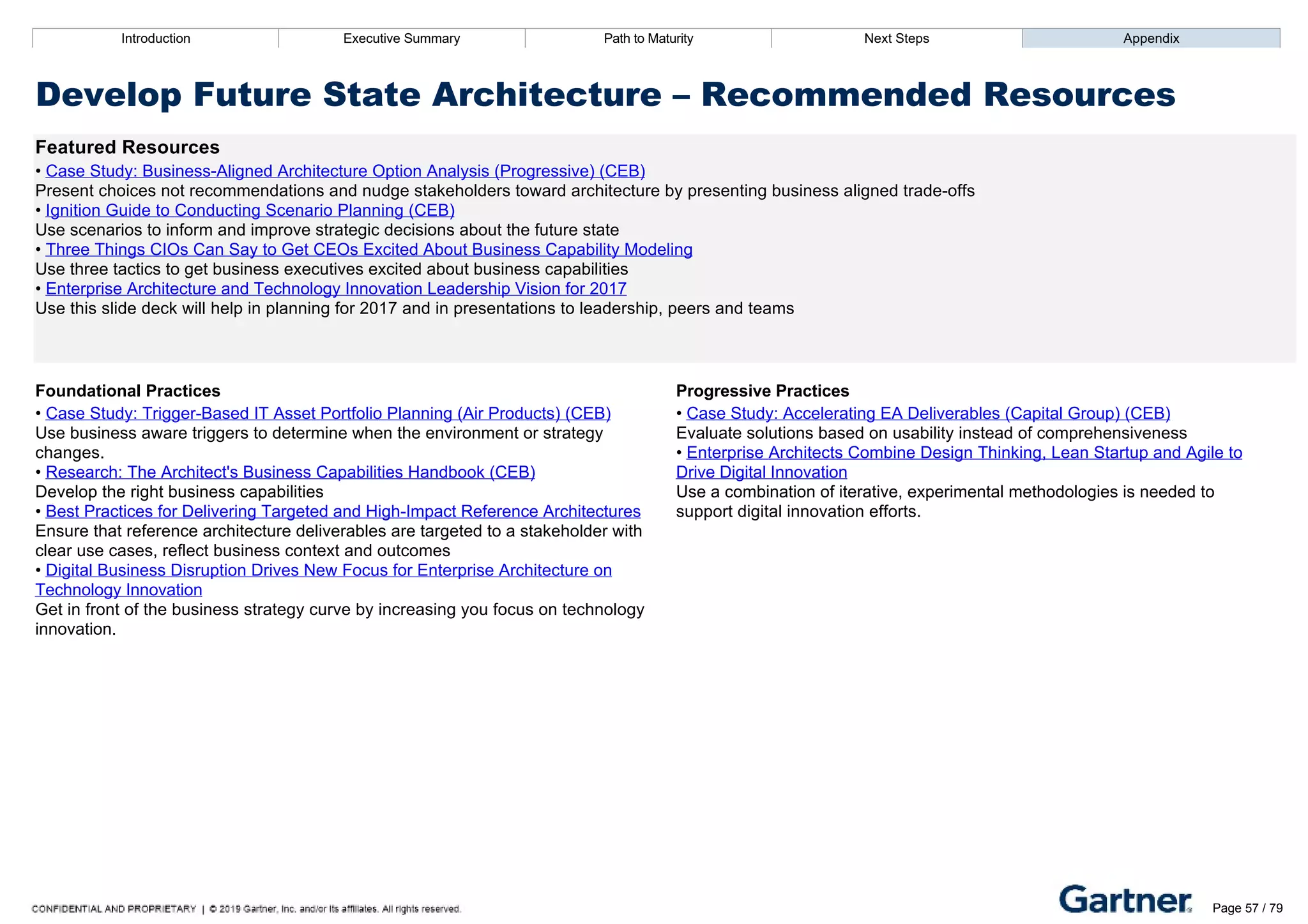
Develop Future State Architecture – Recommended Resources
Featured Resources
• Case Study: Business­Aligned Architecture Option Analysis (Progressive) (CEB)
Present choices not recommendations and nudge stakeholders toward architecture by presenting business aligned trade­offs
• Ignition Guide to Conducting Scenario Planning (CEB)
Use scenarios to inform and improve strategic decisions about the future state
• Three Things CIOs Can Say to Get CEOs Excited About Business Capability Modeling
Use three tactics to get business executives excited about business capabilities
• Enterprise Architecture and Technology Innovation Leadership Vision for 2017
Use this slide deck will help in planning for 2017 and in presentations to leadership, peers and teams
Foundational Practices Progressive Practices
• Case Study: Trigger­Based IT Asset Portfolio Planning (Air Products) (CEB)
Use business aware triggers to determine when the environment or strategy
changes.
• Research: The Architect's Business Capabilities Handbook (CEB)
Develop the right business capabilities
• Best Practices for Delivering Targeted and High­Impact Reference Architectures
Ensure that reference architecture deliverables are targeted to a stakeholder with
clear use cases, reflect business context and outcomes
• Digital Business Disruption Drives New Focus for Enterprise Architecture on
Technology Innovation
Get in front of the business strategy curve by increasing you focus on technology
innovation.
• Case Study: Accelerating EA Deliverables (Capital Group) (CEB)
Evaluate solutions based on usability instead of comprehensiveness
• Enterprise Architects Combine Design Thinking, Lean Startup and Agile to
Drive Digital Innovation
Use a combination of iterative, experimental methodologies is needed to
support digital innovation efforts.
Introduction Executive Summary Path to Maturity Next Steps Appendix
Manage Cross­Functional Relationships
How EA interacts with business partners and IT staff to coordinate the prioritization, planning and execution of EA
activities to achieve business goals
Path to Maturity Page 57 / 79
Introduction Executive Summary Path to Maturity Next Steps Appendix
Manage Cross­Functional Relationships
How EA interacts with business partners and IT staff to coordinate the prioritization, planning and execution of EA
activities to achieve business goals
Path to Maturity
Introduction Executive Summary Path to Maturity Next Steps Appendix
Page 58 / 79
Introduction Executive Summary Path to Maturity Next Steps Appendix
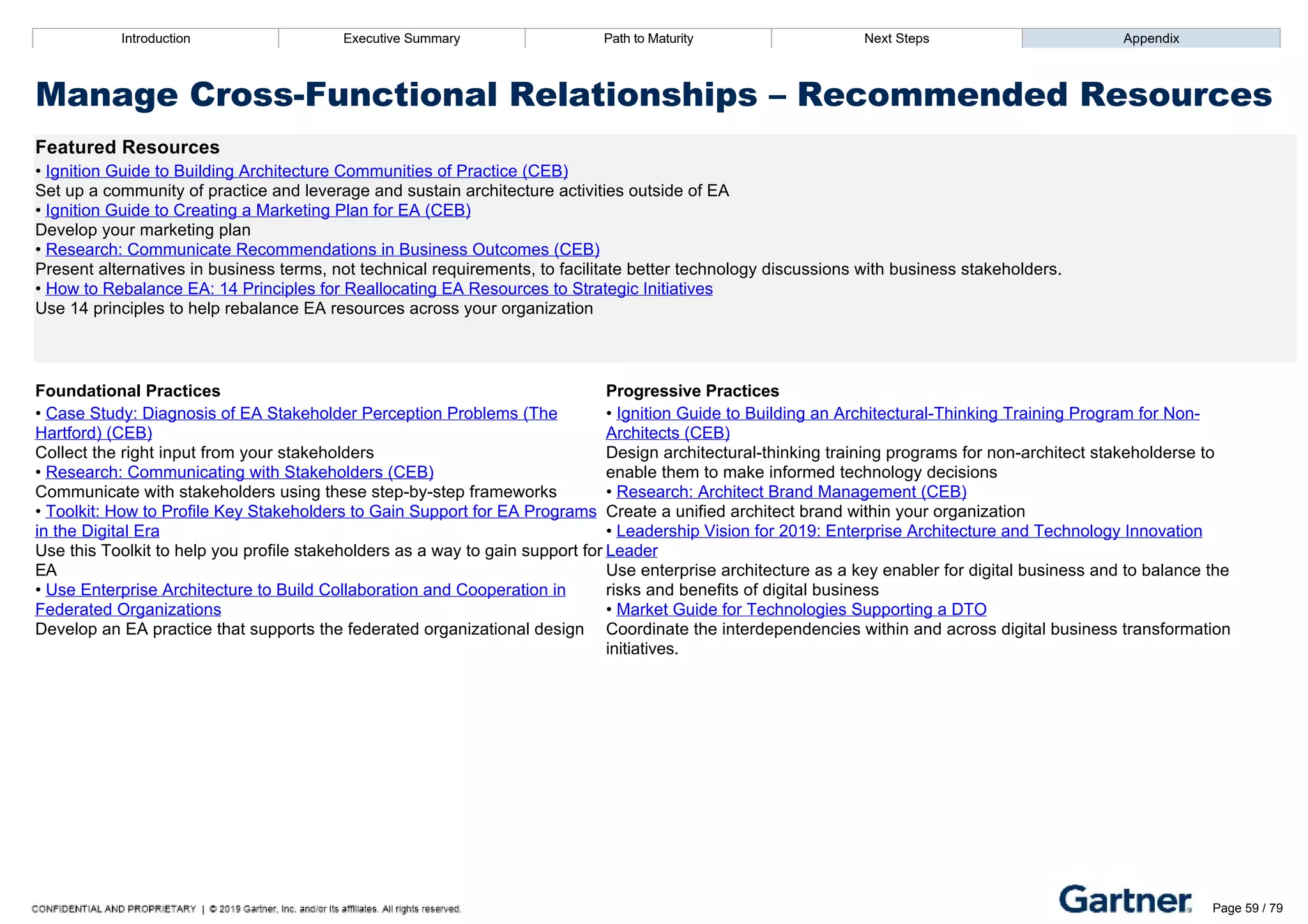
Manage Cross­Functional Relationships – Recommended Resources
Featured Resources
• Ignition Guide to Building Architecture Communities of Practice (CEB)
Set up a community of practice and leverage and sustain architecture activities outside of EA
• Ignition Guide to Creating a Marketing Plan for EA (CEB)
Develop your marketing plan
• Research: Communicate Recommendations in Business Outcomes (CEB)
Present alternatives in business terms, not technical requirements, to facilitate better technology discussions with business stakeholders.
• How to Rebalance EA: 14 Principles for Reallocating EA Resources to Strategic Initiatives
Use 14 principles to help rebalance EA resources across your organization
Foundational Practices Progressive Practices
• Case Study: Diagnosis of EA Stakeholder Perception Problems (The
Hartford) (CEB)
Collect the right input from your stakeholders
• Research: Communicating with Stakeholders (CEB)
Communicate with stakeholders using these step­by­step frameworks
• Toolkit: How to Profile Key Stakeholders to Gain Support for EA Programs
in the Digital Era
Use this Toolkit to help you profile stakeholders as a way to gain support for
EA
• Use Enterprise Architecture to Build Collaboration and Cooperation in
Federated Organizations
Develop an EA practice that supports the federated organizational design
• Ignition Guide to Building an Architectural­Thinking Training Program for Non­
Architects (CEB)
Design architectural­thinking training programs for non­architect stakeholderse to
enable them to make informed technology decisions
• Research: Architect Brand Management (CEB)
Create a unified architect brand within your organization
• Leadership Vision for 2019: Enterprise Architecture and Technology Innovation
Leader
Use enterprise architecture as a key enabler for digital business and to balance the
risks and benefits of digital business
• Market Guide for Technologies Supporting a DTO
Coordinate the interdependencies within and across digital business transformation
initiatives.
Introduction Executive Summary Path to Maturity Next Steps Appendix
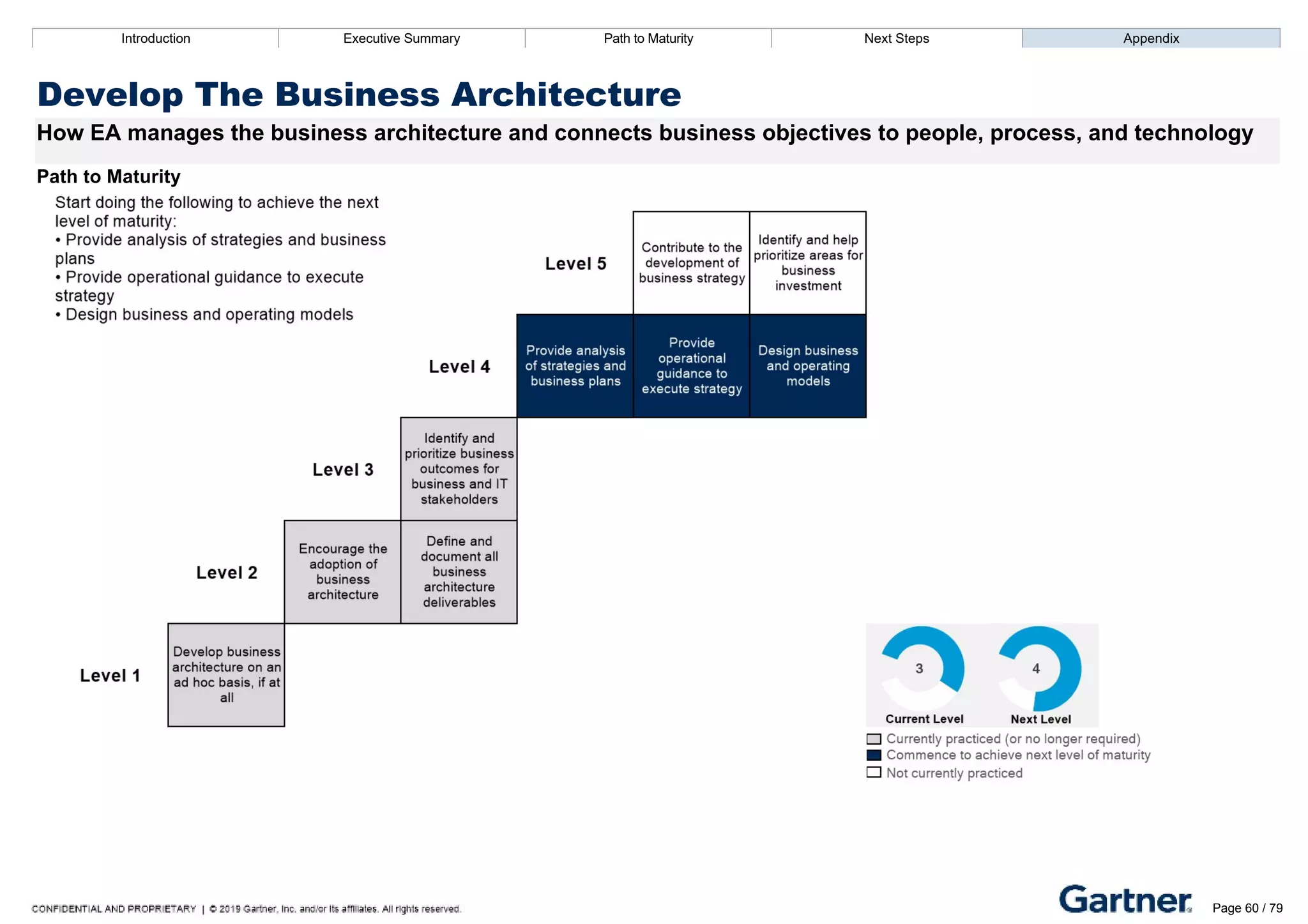
Develop The Business Architecture
How EA manages the business architecture and connects business objectives to people, process, and technology
Path to Maturity
Page 59 / 79
Introduction Executive Summary Path to Maturity Next Steps Appendix
Develop The Business Architecture
How EA manages the business architecture and connects business objectives to people, process, and technology
Path to Maturity
Introduction Executive Summary Path to Maturity Next Steps Appendix
Develop The Business Architecture – Recommended Resources Page 60 / 79
Introduction Executive Summary Path to Maturity Next Steps Appendix
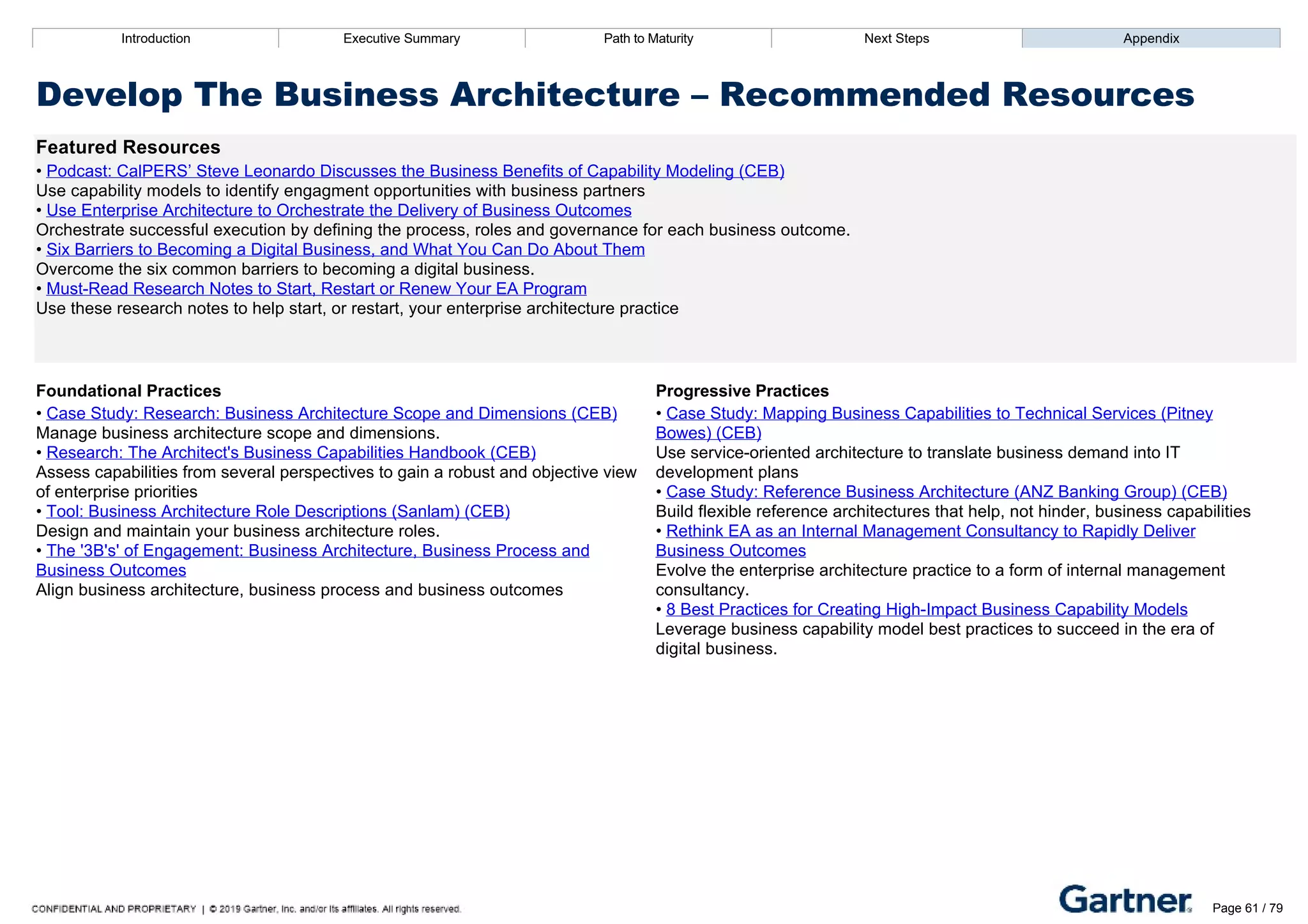
Develop The Business Architecture – Recommended Resources
Featured Resources
• Podcast: CalPERS’ Steve Leonardo Discusses the Business Benefits of Capability Modeling (CEB)
Use capability models to identify engagment opportunities with business partners
• Use Enterprise Architecture to Orchestrate the Delivery of Business Outcomes
Orchestrate successful execution by defining the process, roles and governance for each business outcome.
• Six Barriers to Becoming a Digital Business, and What You Can Do About Them
Overcome the six common barriers to becoming a digital business.
• Must­Read Research Notes to Start, Restart or Renew Your EA Program
Use these research notes to help start, or restart, your enterprise architecture practice
Foundational Practices Progressive Practices
• Case Study: Research: Business Architecture Scope and Dimensions (CEB)
Manage business architecture scope and dimensions.
• Research: The Architect's Business Capabilities Handbook (CEB)
Assess capabilities from several perspectives to gain a robust and objective view
of enterprise priorities
• Tool: Business Architecture Role Descriptions (Sanlam) (CEB)
Design and maintain your business architecture roles.
• The '3B's' of Engagement: Business Architecture, Business Process and
Business Outcomes
Align business architecture, business process and business outcomes
• Case Study: Mapping Business Capabilities to Technical Services (Pitney
Bowes) (CEB)
Use service­oriented architecture to translate business demand into IT
development plans
• Case Study: Reference Business Architecture (ANZ Banking Group) (CEB)
Build flexible reference architectures that help, not hinder, business capabilities
• Rethink EA as an Internal Management Consultancy to Rapidly Deliver
Business Outcomes
Evolve the enterprise architecture practice to a form of internal management
consultancy.
• 8 Best Practices for Creating High­Impact Business Capability Models
Leverage business capability model best practices to succeed in the era of
digital business.
Introduction Executive Summary Path to Maturity Next Steps Appendix
Provide Internal Consulting Advice
How EA defines and delivers a portfolio of consulting services within the organization
Path to Maturity
Page 61 / 79
Introduction Executive Summary Path to Maturity Next Steps Appendix
Provide Internal Consulting Advice
How EA defines and delivers a portfolio of consulting services within the organization
Path to Maturity
Introduction Executive Summary Path to Maturity Next Steps Appendix
Provide Internal Consulting Advice – Recommended Resources Page 62 / 79
Introduction Executive Summary Path to Maturity Next Steps Appendix
Provide Internal Consulting Advice – Recommended Resources
Featured Resources
• Case Study: Tailored EA Engagement Based on Team Maturities (West Corporation) (CEB)
Use a management consulting framework to develop scalable, recombinable, and semi­tailored guidance to stakeholders.
• Podcast: CalPERS’ Steve Leonardo Discusses the Business Benefits of Capability Modeling (CEB)
Use capability models to identify engagment opportunities with business partners
• Rethink EA as an Internal Management Consultancy to Rapidly Deliver Business Outcomes
Evolve the enterprise architecture practice to a form of internal management consultancy.
Foundational Practices Progressive Practices
• Business Architecture Development and Applications (Department for Work
and Pensions) (CEB)
Articulate business strategy and initiate transformation
• Collaborative, Capability­Based Planning (Blue Cross Blue Shield of North
Carolina) (CEB)
Collaborate with business partners to create a business capability model
• Use 4 Enterprise Architecture Practices to Enable Digital Business
Transformation
Use these four practices to build collaboration around digital transformation
efforts
• Top Five Attributes of a World­Class EA Discipline
Adopt these top five differentiating attributesto improve the value proposition
and impact of their EA efforts.
• Case Study: Business Model Impact Consulting (Upsilon) (CEB)
Create a consulting service focused on impact to the business model to equip
business partners for success
• Model Your Ecosystem to Identify the Partners Needed for Digital Business
Model your business ecosystem to understand how the ecosystem needs to
evolve to support digital business
• Use Design Thinking to Architect Customer Experience Into Your Digital
Platforms
Take a design thinking approch to create the services and experiences the
customer wants and needs
• How Organizations Can Survive and Thrive Using Architecture at the Edge of
Chaos
Use enterprise architecture to support agility and continous change
Introduction Executive Summary Path to Maturity Next Steps Appendix
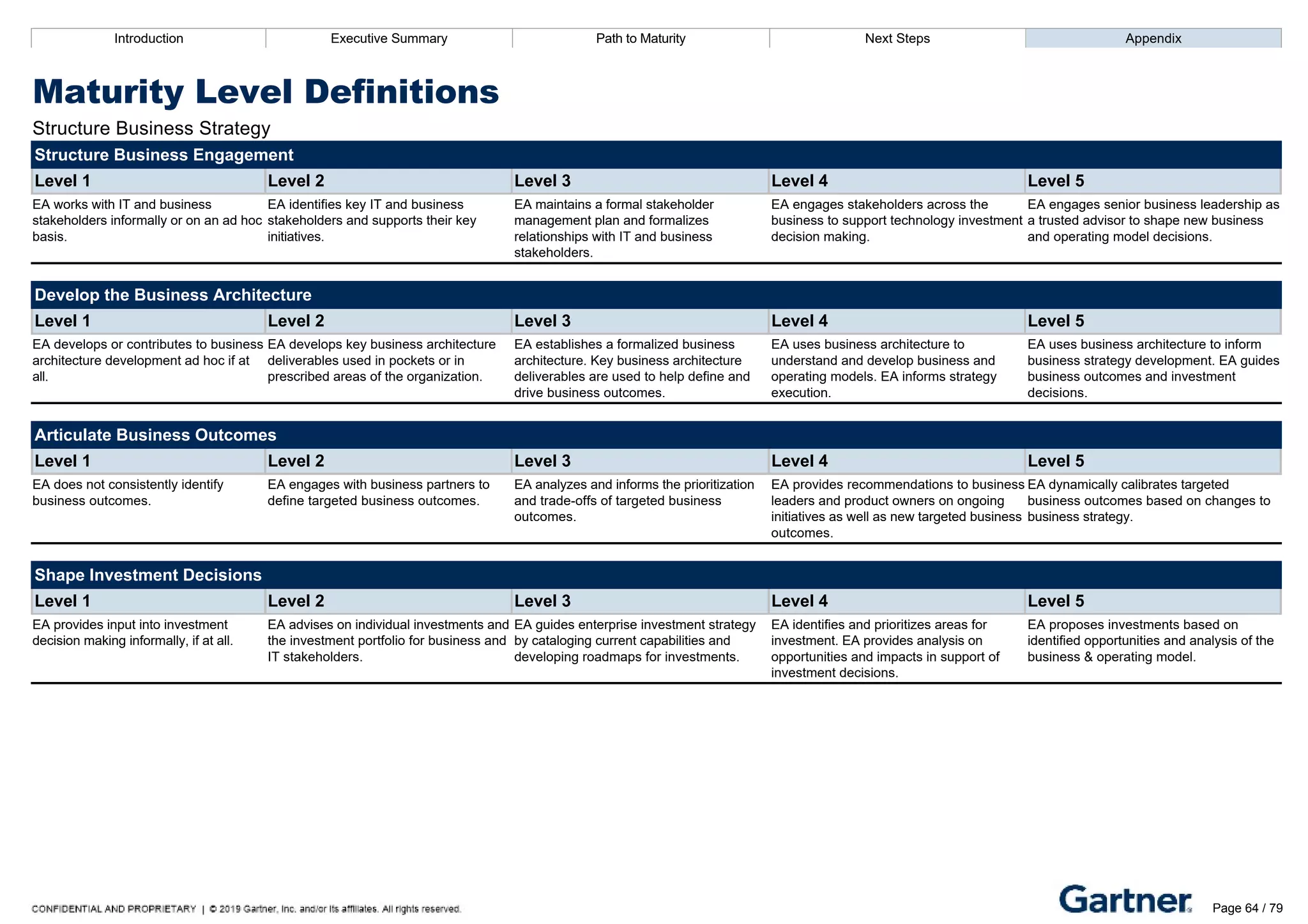
Maturity Level Definitions
Structure Business Strategy
Structure Business Engagement
Level 1 Level 2 Level 3 Level 4 Level 5
EA works with IT and business EA identifies key IT and business EA maintains a formal stakeholder EA engages stakeholders across the EA engages senior business leadership as
Page 63 / 79
Introduction Executive Summary Path to Maturity Next Steps Appendix
Maturity Level Definitions
Structure Business Strategy
Structure Business Engagement
Level 1 Level 2 Level 3 Level 4 Level 5
EA works with IT and business
stakeholders informally or on an ad hoc
basis.
EA identifies key IT and business
stakeholders and supports their key
initiatives.
EA maintains a formal stakeholder
management plan and formalizes
relationships with IT and business
stakeholders.
EA engages stakeholders across the
business to support technology investment
decision making.
EA engages senior business leadership as
a trusted advisor to shape new business
and operating model decisions.
Develop the Business Architecture
Level 1 Level 2 Level 3 Level 4 Level 5
EA develops or contributes to business
architecture development ad hoc if at
all.
EA develops key business architecture
deliverables used in pockets or in
prescribed areas of the organization.
EA establishes a formalized business
architecture. Key business architecture
deliverables are used to help define and
drive business outcomes.
EA uses business architecture to
understand and develop business and
operating models. EA informs strategy
execution.
EA uses business architecture to inform
business strategy development. EA guides
business outcomes and investment
decisions.
Articulate Business Outcomes
Level 1 Level 2 Level 3 Level 4 Level 5
EA does not consistently identify
business outcomes.
EA engages with business partners to
define targeted business outcomes.
EA analyzes and informs the prioritization
and trade­offs of targeted business
outcomes.
EA provides recommendations to business
leaders and product owners on ongoing
initiatives as well as new targeted business
outcomes.
EA dynamically calibrates targeted
business outcomes based on changes to
business strategy.
Shape Investment Decisions
Level 1 Level 2 Level 3 Level 4 Level 5
EA provides input into investment
decision making informally, if at all.
EA advises on individual investments and
the investment portfolio for business and
IT stakeholders.
EA guides enterprise investment strategy
by cataloging current capabilities and
developing roadmaps for investments.
EA identifies and prioritizes areas for
investment. EA provides analysis on
opportunities and impacts in support of
investment decisions.
EA proposes investments based on
identified opportunities and analysis of the
business & operating model.
Introduction Executive Summary Path to Maturity Next Steps Appendix
Maturity Level Definitions
Structure Business Strategy
Provide Internal Consulting Advice
Level 1 Level 2 Level 3 Level 4 Level 5
EA provides advice or guidance to
business and IT stakeholders when
asked, if at all.
EA works with business stakeholders to
deliver a limited set of consulting advice to
support the design and delivery of targeted
EA formally defines a set of consulting
offerings for the organization in
collaboration with business partners.
EA has optimized its operating and
delivery model around its consulting
offerings.
EA uses its own consulting offerings and
experience to support business executives
to shape new business and operating
Page 64 / 79
Introduction Executive Summary Path to Maturity Next Steps Appendix
Maturity Level Definitions
Structure Business Strategy
Provide Internal Consulting Advice
Level 1 Level 2 Level 3 Level 4 Level 5
EA provides advice or guidance to
business and IT stakeholders when
asked, if at all.
EA works with business stakeholders to
deliver a limited set of consulting advice to
support the design and delivery of targeted
business outcomes.
EA formally defines a set of consulting
offerings for the organization in
collaboration with business partners.
EA has optimized its operating and
delivery model around its consulting
offerings.
EA uses its own consulting offerings and
experience to support business executives
to shape new business and operating
models.
Introduction Executive Summary Path to Maturity Next Steps Appendix
Maturity Level Definitions
Facilitate Innovation
Evaluate and Track Emerging Technologies
Level 1 Level 2 Level 3 Level 4 Level 5
EA evaluates emerging technologies
in a reactive ad hoc way.
EA identifies and evaluates some
emerging technologies for incremental
optimization of existing IT portfolio.
EA tracks and evaluates emerging
technologies for existing and new business
capabilities and services.
EA formally defines a process to identify,
track and evaluate emerging technologies
for their contribution toward business
outcomes.
EA collaborates with stakeholders to
recommend emerging technologies across
the organization based on business
direction, strategy, and outcomes.
Identify Innovation Opportunities
Level 1 Level 2 Level 3 Level 4 Level 5
EA weighs in on innovation
opportunities on an ad hoc basis, if at
all.
EA assesses innovation opportunities
for technical fit with the future state on a
regular basis with stakeholders.
EA assess innovation opportunities for
impact on business outcomes and formally
prioritizes opportunities for innovation in
collaboration with stakeholders.
EA proactively and systematically reviews
innovation opportunities and presents them
to stakeholders.
EA collaboratively contextualizes innovative
business and operating models for the
enterprise to identify competitive
opportunities.
Enable Innovation Initiatives
Page 65 / 79
Introduction Executive Summary Path to Maturity Next Steps Appendix
Maturity Level Definitions
Facilitate Innovation
Evaluate and Track Emerging Technologies
Level 1 Level 2 Level 3 Level 4 Level 5
EA evaluates emerging technologies
in a reactive ad hoc way.
EA identifies and evaluates some
emerging technologies for incremental
optimization of existing IT portfolio.
EA tracks and evaluates emerging
technologies for existing and new business
capabilities and services.
EA formally defines a process to identify,
track and evaluate emerging technologies
for their contribution toward business
outcomes.
EA collaborates with stakeholders to
recommend emerging technologies across
the organization based on business
direction, strategy, and outcomes.
Identify Innovation Opportunities
Level 1 Level 2 Level 3 Level 4 Level 5
EA weighs in on innovation
opportunities on an ad hoc basis, if at
all.
EA assesses innovation opportunities
for technical fit with the future state on a
regular basis with stakeholders.
EA assess innovation opportunities for
impact on business outcomes and formally
prioritizes opportunities for innovation in
collaboration with stakeholders.
EA proactively and systematically reviews
innovation opportunities and presents them
to stakeholders.
EA collaboratively contextualizes innovative
business and operating models for the
enterprise to identify competitive
opportunities.
Enable Innovation Initiatives
Level 1 Level 2 Level 3 Level 4 Level 5
EA is involved in the innovation
process in an ad hoc way, if at all.
EA provides end­to­end support for
innovation including ideation,
experimentation, scaling, and
integration.
EA works with business and IT
stakeholders to facilitate the innovation
process, and to engage at various stage in
the process based on organizational need.
EA sets up pathways to help business
partners experiment, scale and integrate the
best ideas for innovation, and supports
ideation through tactics such as design
thinking.
EA advises business partners or innovation
leaders to rapidly test their ideas, build
prototypes, then integrate and scale the best
ideas for targeted business outcomes.
Introduction Executive Summary Path to Maturity Next Steps Appendix
Maturity Level Definitions
Plan and Manage IT Portfolio
Develop Future State Architecture
Level 1 Level 2 Level 3 Level 4 Level 5
EA coordinates independent
technology or business areas’ future
state plans on ad hoc basis, if at all.
EA supports stakeholders/business
units by compiling artifacts and
developing future state technology
plans.
EA coordinates with stakeholders to
create an enterprise future state plan
across technology domains and/or
business areas
EA regularly recalibrates the future state
plan based on criticality of business
capabilities and technical debt.
EA consults with business leaders and
external partners to make the future state plan
responsive to external factors and changing
investment priorities.
Define Current State Architecture
Page 66 / 79
Introduction Executive Summary Path to Maturity Next Steps Appendix
Maturity Level Definitions
Plan and Manage IT Portfolio
Develop Future State Architecture
Level 1 Level 2 Level 3 Level 4 Level 5
EA coordinates independent
technology or business areas’ future
state plans on ad hoc basis, if at all.
EA supports stakeholders/business
units by compiling artifacts and
developing future state technology
plans.
EA coordinates with stakeholders to
create an enterprise future state plan
across technology domains and/or
business areas
EA regularly recalibrates the future state
plan based on criticality of business
capabilities and technical debt.
EA consults with business leaders and
external partners to make the future state plan
responsive to external factors and changing
investment priorities.
Define Current State Architecture
Level 1 Level 2 Level 3 Level 4 Level 5
EA documents few IT specific assets
e.g., major applications and
technologies, if any current state is
documented.
EA inventories major enterprise
applications and infrastructure.
EA documents the entire IT portfolio and
dependencies between technology and
business capabilities.
EA assesses impact of current and
proposed technology investments on
complexity of the overall IT portfolio.
EA assesses ability of the current technology
portfolio to support business capabilities and
create opportunities for new or improved
capabilities.
Design Strategic Plans
Level 1 Level 2 Level 3 Level 4 Level 5
EA is informally involved in strategy
development with IT, providing ad hoc
input on technology consideration.
EA informs IT strategic plans regarding
integration, applications, information,
systems, and processes using
accepted practices.
EA shapes IT strategic plans based on
business strategy with inputs from
internal and external factors.
EA calibrates IT strategic plans in
response to business needs while
informing business strategic plans with
technical considerations.
EA influences enterprise digital strategy in
response to trend analysis, future planning,
and external environment factors.
Develop and Maintain Roadmaps
Level 1 Level 2 Level 3 Level 4 Level 5
EA creates informal roadmaps that are
updated in response to technology
changes, if at all.
EA maintains technology roadmaps that
reflect collected input from
stakeholders.
EA applies a formal process to roadmap
how IT initiatives support business
capabilities, while tracking project costs,
benefits, risks and interdependencies.
EA continuously reviews and refreshes
roadmaps that reflect multiple time
horizons and business scenarios designed
to improve or maintain capability health.
EA uses roadmaps to communicate specific
capability gaps, define business change
events to automatically trigger revisions, and
provide scenario­driven guidance to help
business partners respond to market
disruptions.
Introduction Executive Summary Path to Maturity Next Steps Appendix
Maturity Level Definitions
Plan and Manage IT Portfolio
Support Portfolio Modernization
Level 1 Level 2 Level 3 Level 4 Level 5
EA makes occasional EA regularly performs an analysis of EA has a comprehensive view across the EA tracks how existing technologies EA assesses and advises business leaders
Page 67 / 79
Introduction Executive Summary Path to Maturity Next Steps Appendix
Maturity Level Definitions
Plan and Manage IT Portfolio
Support Portfolio Modernization
Level 1 Level 2 Level 3 Level 4 Level 5
EA makes occasional
recommendations about technology
retirement or updates, if requested.
EA regularly performs an analysis of
opportunities for portfolio rationalization
and makes complexity reduction
recommendations.
EA has a comprehensive view across the
technology stack and advises IT delivery
teams on sunset or update decisions
based on an analysis of costs and benefits
and business needs.
EA tracks how existing technologies
support business capabilities and targeted
outcomes and makes recommendations
based on opportunity cost and impact on
speed to value.
EA assesses and advises business leaders
and product owners on technology
advancements when triggers indicate a
change in business needs or environmental
factors such as market disruptions or
regulatory requirements.
Enable Information Strategy
Level 1 Level 2 Level 3 Level 4 Level 5
EA manages data architecture and
data control issues on an ad hoc basis,
if at all.
EA documents disparate data sources,
sets standards, and provides
governance for information.
EA defines enterprise information
management goals and activities.
EA works to align the information
management strategy to support business
and IT strategies.
EA extends existing capabilities, (e.g. ability
to attain, use, or analyze information) to drive
competitive advantage and opportunities for
disruption.
Introduction Executive Summary Path to Maturity Next Steps Appendix
Maturity Level Definitions
Enable Solutions Delivery
Support Solutions Design
Level 1 Level 2 Level 3 Level 4 Level 5
EA creates guidance only for solutions
within individual projects or products if
at all.
EA facilitates design efforts to ensure
solutions abide by enterprise standards
and meet criteria for impact, risk, and
budget.
EA provides development teams with
enterprise­level guidance through design
patterns, and triages involvement in
projects based on business impact.
EA helps development teams apply a
customer­centric lens to solution design
and supporting architectural decisions for
improved usability.
EA helps business partners and solutions
development teams to collaborate better
using design thinking approaches.
Guide Solutions Delivery
Level 1 Level 2 Level 3 Level 4 Level 5
EA involvement in solutions EA engages with development teams A provides packaged guidance to keep EA makes packaged solutions guidance EA provides pre­configured development
Page 68 / 79
Introduction Executive Summary Path to Maturity Next Steps Appendix
Maturity Level Definitions
Enable Solutions Delivery
Support Solutions Design
Level 1 Level 2 Level 3 Level 4 Level 5
EA creates guidance only for solutions
within individual projects or products if
at all.
EA facilitates design efforts to ensure
solutions abide by enterprise standards
and meet criteria for impact, risk, and
budget.
EA provides development teams with
enterprise­level guidance through design
patterns, and triages involvement in
projects based on business impact.
EA helps development teams apply a
customer­centric lens to solution design
and supporting architectural decisions for
improved usability.
EA helps business partners and solutions
development teams to collaborate better
using design thinking approaches.
Guide Solutions Delivery
Level 1 Level 2 Level 3 Level 4 Level 5
EA involvement in solutions
development is limited or ad hoc.
EA engages with development teams
across the delivery lifecycle through a
stage­gated process to review
compliance with internal standards.
A provides packaged guidance to keep
solutions development on track with
targeted business outcomes and manage
risk to business processes and operations.
EA makes packaged solutions guidance
accessible and customizable while
tailoring their involvement based on
project criticality and business impact.
EA provides pre­configured development
environments that allow for automated review
of ongoing solution development, reduce
architectural friction and increase speed of
delivery.
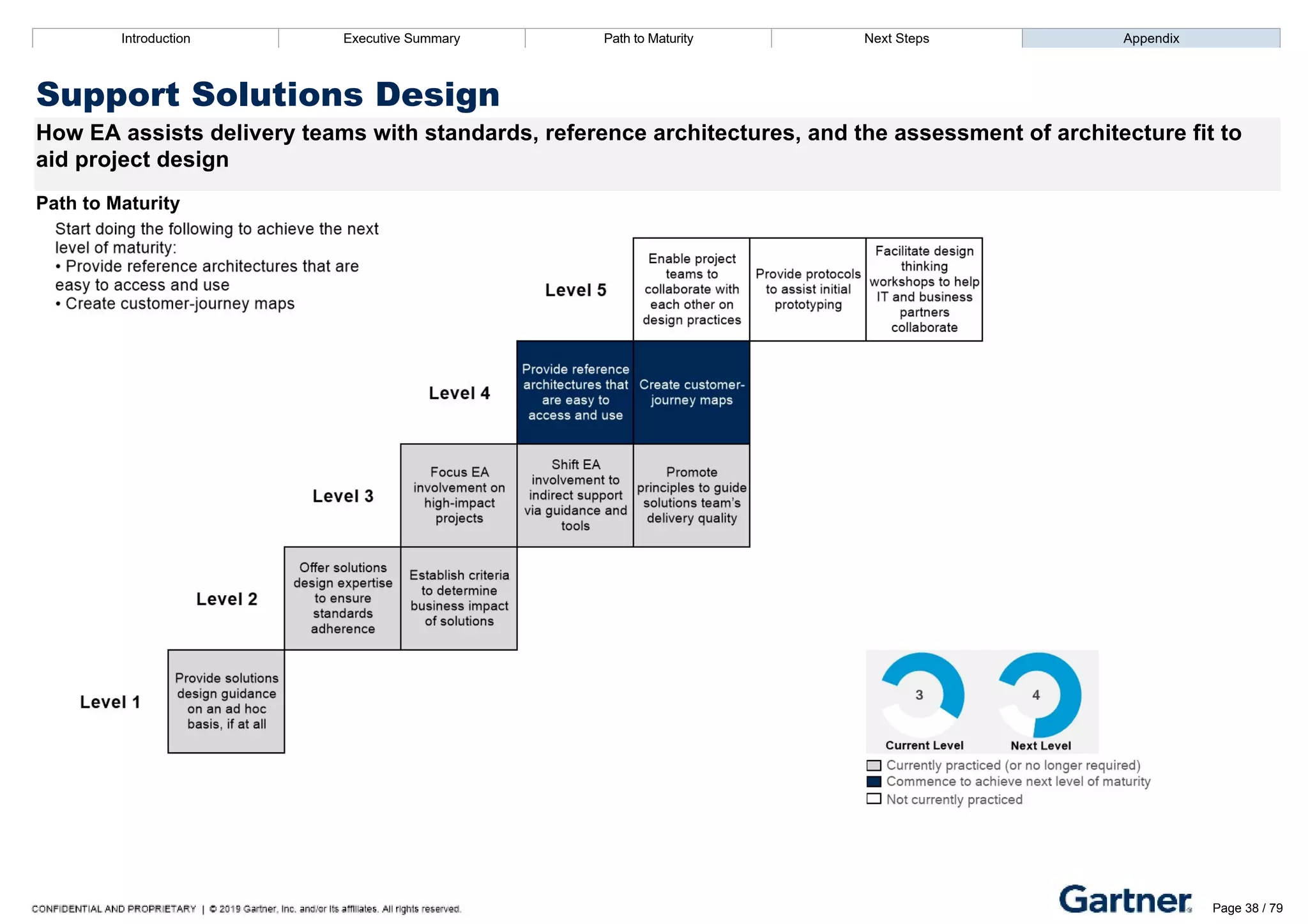
Support Integration
Level 1 Level 2 Level 3 Level 4 Level 5
EA provides limited or no guidance on
how to do integration.
EA works with delivery teams to identify
integration needs and uses legacy (point­
to­point or platform­based) approaches
to address integration needs.
EA manages reusable services (APIs) and
defines standards to support ease of
integration.
EA regularly assesses integration
standards for relevance and defines and
curates reusable services that accelerate
integration.
EA makes application building blocks such
as APIs widely accessible to enable rapid
integration and speed to market of digital
business initiatives.
Introduction Executive Summary Path to Maturity Next Steps Appendix
Maturity Level Definitions
Establish EA Frameworks and Tools
Develop EA Frameworks and Tools
Level 1 Level 2 Level 3 Level 4 Level 5
EA uses existing, basic suite of tools
(e.g. Office, Vizio). Tool and framework
plans are ad hoc.
EA develops use cases to demonstrate the
value of tools and frameworks and to justify
invest. Usage is prescriptive and in support
of projects, focusing on gathering artifacts,
documentation and modeling.
EA assess tool and framework utility
holistically to best support future and
current state architecture.
EA uses frameworks and tools to create
linkages and different architectural
viewpoints across the organization.
EA extends and customizes frameworks
strategically to meet dynamic organization­
specific needs.
Page 69 / 79
Introduction Executive Summary Path to Maturity Next Steps Appendix
Maturity Level Definitions
Establish EA Frameworks and Tools
Develop EA Frameworks and Tools
Level 1 Level 2 Level 3 Level 4 Level 5
EA uses existing, basic suite of tools
(e.g. Office, Vizio). Tool and framework
plans are ad hoc.
EA develops use cases to demonstrate the
value of tools and frameworks and to justify
invest. Usage is prescriptive and in support
of projects, focusing on gathering artifacts,
documentation and modeling.
EA assess tool and framework utility
holistically to best support future and
current state architecture.
EA uses frameworks and tools to create
linkages and different architectural
viewpoints across the organization.
EA extends and customizes frameworks
strategically to meet dynamic organization­
specific needs.
Define Governance
Level 1 Level 2 Level 3 Level 4 Level 5
EA defines governance in an ad hoc
way if at all.
EA defines a governance framework
including principles, standards, reference
models, and a means for review, like an
Architecture Review Board.
EA aligns the governance framework with
IT strategy and includes business context
and cross­functional perspectives in
strategic review of technology standards.
EA connects governance with enterprise
digital strategy by means of a forum like a
strategy review board and analyzes
exceptions to review and update
standards.
EA consults with business and IT partners to
track how standards impact business
outcomes and the technology portfolio and
sets triggers to update governance as the
digital investment priorities evolve.
Manage Standards Compliance
Level 1 Level 2 Level 3 Level 4 Level 5
EA relies on top­down mandates and
EA­centric review boards to promote
and enforce standards compliance.
EA establishes formal processes and
ownership to review standards adherence
and relies on SMEs from across the firm to
support compliance efforts.
EA engages directly with delivery teams
through architecture councils to ensure
standards adherence and outlines clear
steps for granting exceptions.
EA promotes guardrails by offering self­
service tools, highlighting business
benefits such as speed and innovation,
and accelerating remediation for granted
exceptions.
EA embeds guardrails within delivery
workflows to improve speed and ease of
adherence and preempt need to enforce
standards adherence.
Introduction Executive Summary Path to Maturity Next Steps Appendix
Maturity Level Definitions
Manage EA
Define Function Strategy
Level 1 Level 2 Level 3 Level 4 Level 5
EA communicates project or product
objectives outside to a limited IT
constituency on an ad­hoc basis.
EA works with IT leadership to
collaboratively define a clear mandate for
EA. EA identifies all IT stakeholders who
contribute to enterprise architecture.
EA defines and regularly communicates
its remit and artifacts to the broader IT
organization and regularly meets with IT
leadership and business partners.
EA regularly assesses the relevance,
impact, and alignment of its remit to
business strategy. EA targets business
stakeholders who make architecturally
EA actively collaborates with business
strategy leadership and provides
recommendations and policies for business
strategy, goals, and objectives. Page 70 / 79
Introduction Executive Summary Path to Maturity Next Steps Appendix
Maturity Level Definitions
Manage EA
Define Function Strategy
Level 1 Level 2 Level 3 Level 4 Level 5
EA communicates project or product
objectives outside to a limited IT
constituency on an ad­hoc basis.
EA works with IT leadership to
collaboratively define a clear mandate for
EA. EA identifies all IT stakeholders who
contribute to enterprise architecture.
EA defines and regularly communicates
its remit and artifacts to the broader IT
organization and regularly meets with IT
leadership and business partners.
EA regularly assesses the relevance,
impact, and alignment of its remit to
business strategy. EA targets business
stakeholders who make architecturally
significant decisions with consultative
advice.
EA actively collaborates with business
strategy leadership and provides
recommendations and policies for business
strategy, goals, and objectives.
Manage EA talent
Level 1 Level 2 Level 3 Level 4 Level 5
Chief Architect does not formally define
enterprise architect roles.
Chief Architect formally defines the
enterprise architect roles and identifies
talent that aligns with those roles.
Chief Architect manages the talent pool of
enterprise architects by addressing
missing or incomplete hard and soft skills
and competencies.
EA leads career pathing, builds stretch or
rotational opportunities, and conducts
succession planning to evolve the talent
bench.
Chief Architect supports development of
architectural thinking and digital skills in IT
and business partners.
Measure and Manage Function Performance
Level 1 Level 2 Level 3 Level 4 Level 5
The EA Leader’s manager uses
judgment to assess EA’s performance.
EA measures performance based on
qualitative feedback from IT
stakeholders and internally focused
activity and efficiency metrics.
EA measures performance through
enterprise adoption of EA guidelines and
collects feedback from business partners.
EA measures performance by its
contribution to business objectives, using
metrics that are aligned to business KPIs.
EA measures performance by its impact on
quantitative measures related to business
outcomes (cost, speed, and growth).
Manage Cross­Functional relationships
Level 1 Level 2 Level 3 Level 4 Level 5
EA engages IT stakeholders in IT
planning sessions about changes to
infrastructure through standards and
approvals, if at all.
EA regularly interacts with senior IT
stakeholders about infrastructure
changes and applications development
to drive reuse and delivery consistency.
EA engages with IT executives to make
architectural decisions that support
business outcomes and seeks occasional
input from stakeholders outside IT and
external partners like vendors.
EA formally and regularly engages
business leaders to ensure that
architecturally significant decisions support
business outcomes.
EA leaders consult enterprise leaders on
enterprise digital strategy through business
strategy sessions and develop an
architectural mindset in executive
stakeholders to help them make technology
decisions.
Introduction Executive Summary Path to Maturity Next Steps Appendix
Team Consensus
Maturity (Activities Ranked by Maturity Gap)
Page 71 / 79
Introduction Executive Summary Path to Maturity Next Steps Appendix
Team Consensus
Maturity (Activities Ranked by Maturity Gap)
Objective Activity Benchmark Overall
(n = 2)
Leader Score
(n = 1)
Staff Score
(n = 1)
Gap (Leader minus
Staff)
Enable Solutions Delivery Guide Solutions Delivery Not Available 2.00 3.50 2.00 1.50
Plan and Manage IT Portfolio Design Strategic Plans Not Available 2.25 3.50 2.25 1.25
Facilitate Innovation Identify Innovation Opportunities Not Available 2.33 3.50 2.33 1.17
Manage EA Manage Cross­Functional Relationships Not Available 3.00 3.50 3.00 0.50
Manage EA Measure and Manage Function Performance Not Available 2.50 3.00 2.50 0.50
Manage EA Define Function Strategy Not Available 1.67 2.00 1.67 0.33
Establish EA Frameworks and Tools Define Governance Not Available 2.50 2.75 2.50 0.25
Manage EA Manage EA Talent Not Available 2.50 2.75 2.50 0.25
Structure Business Strategy Provide Internal Consulting Advice Not Available 3.50 3.50 3.50 0.00
Structure Business Strategy Develop The Business Architecture Not Available 3.00 3.00 3.00 0.00
Structure Business Strategy Articulate Business Outcomes Not Available 2.75 2.75 2.75 0.00
Structure Business Strategy Shape Investment Decisions Not Available 2.67 2.67 2.67 0.00
Structure Business Strategy Structure Business Engagement Not Available 2.00 2.00 2.00 0.00
Facilitate Innovation Evaluate Emerging Technologies and Trends Not Available 2.00 2.00 2.00 0.00
Plan and Manage IT Portfolio Develop and Maintain Roadmaps Not Available 2.00 2.00 2.33 ­0.33
Plan and Manage IT Portfolio Support Portfolio Modernization Not Available 2.00 2.00 2.33 ­0.33
Enable Solutions Delivery Support Integration Not Available 1.67 1.67 2.00 ­0.33
Plan and Manage IT Portfolio Enable Information Strategy Not Available 2.33 2.33 2.67 ­0.34
Establish EA Frameworks and Tools Develop EA Frameworks and Tools Not Available 2.33 2.33 2.67 ­0.34
Enable Solutions Delivery Support Solutions Design Not Available 3.00 3.00 3.50 ­0.50
Plan and Manage IT Portfolio Develop Future State Architecture Not Available 2.50 2.50 3.00 ­0.50
Plan and Manage IT Portfolio Define Current State Architecture Not Available 2.67 2.67 3.33 ­0.66
Facilitate Innovation Enable Innovation Initiatives Not Available 2.50 2.50 3.33 ­0.83
Establish EA Frameworks and Tools Manage Standards Compliance Not Available 1.67 1.67 3.00 ­1.33
Introduction Executive Summary Path to Maturity Next Steps Appendix
Team Consensus
Importance (Activities Ranked by Importance Gap)
Objective Activity Benchmark Overall
(n = 2)
Leader Score
(n = 1)
Staff Score
(n = 1)
Gap (Leader minus
Staff)
Page 72 / 79
Introduction Executive Summary Path to Maturity Next Steps Appendix
Team Consensus
Importance (Activities Ranked by Importance Gap)
Objective Activity Benchmark Overall
(n = 2)
Leader Score
(n = 1)
Staff Score
(n = 1)
Gap (Leader minus
Staff)
Establish EA Frameworks and Tools Manage Standards Compliance Not Available 3.50 5.00 2.00 3.00
Structure Business Strategy Articulate Business Outcomes Not Available 4.00 5.00 3.00 2.00
Plan and Manage IT Portfolio Support Portfolio Modernization Not Available 4.00 5.00 3.00 2.00
Enable Solutions Delivery Guide Solutions Delivery Not Available 3.00 4.00 2.00 2.00
Facilitate Innovation Identify Innovation Opportunities Not Available 3.50 4.00 3.00 1.00
Enable Solutions Delivery Support Solutions Design Not Available 3.50 4.00 3.00 1.00
Structure Business Strategy Develop The Business Architecture Not Available 2.50 3.00 2.00 1.00
Facilitate Innovation Enable Innovation Initiatives Not Available 2.50 3.00 2.00 1.00
Plan and Manage IT Portfolio Develop and Maintain Roadmaps Not Available 2.50 3.00 2.00 1.00
Structure Business Strategy Shape Investment Decisions Not Available 3.00 3.00 3.00 0.00
Enable Solutions Delivery Support Integration Not Available 3.00 3.00 3.00 0.00
Establish EA Frameworks and Tools Define Governance Not Available 3.00 3.00 3.00 0.00
Manage EA Measure and Manage Function Performance Not Available 3.00 3.00 3.00 0.00
Manage EA Manage Cross­Functional Relationships Not Available 3.00 3.00 3.00 0.00
Structure Business Strategy Structure Business Engagement Not Available 2.00 2.00 2.00 0.00
Plan and Manage IT Portfolio Define Current State Architecture Not Available 4.50 4.00 5.00 ­1.00
Plan and Manage IT Portfolio Develop Future State Architecture Not Available 2.50 2.00 3.00 ­1.00
Plan and Manage IT Portfolio Design Strategic Plans Not Available 2.50 2.00 3.00 ­1.00
Manage EA Define Function Strategy Not Available 2.50 2.00 3.00 ­1.00
Facilitate Innovation Evaluate Emerging Technologies and Trends Not Available 4.00 3.00 5.00 ­2.00
Structure Business Strategy Provide Internal Consulting Advice Not Available 3.00 2.00 4.00 ­2.00
Plan and Manage IT Portfolio Enable Information Strategy Not Available 3.00 2.00 4.00 ­2.00
Manage EA Manage EA Talent Not Available 3.00 2.00 4.00 ­2.00
Establish EA Frameworks and Tools Develop EA Frameworks and Tools Not Available 3.50 2.00 5.00 ­3.00
Introduction Executive Summary Path to Maturity Next Steps Appendix
Team Consensus
Prioritization (Activities Ranked by API Gap)
Objective Activity Benchmark
Rank
Overall
(n = 2)
Leader Score
(n = 1)
Staff Score
(n = 1)
Gap (Leader minus
Staff)
Page 73 / 79
Introduction Executive Summary Path to Maturity Next Steps Appendix
Team Consensus
Prioritization (Activities Ranked by API Gap)
Objective Activity Benchmark
Rank
Overall
(n = 2)
Leader Score
(n = 1)
Staff Score
(n = 1)
Gap (Leader minus
Staff)
Establish EA Frameworks and Tools Manage Standards Compliance Not Available 6.41 16.65 ­2.00 18.65
Plan and Manage IT Portfolio Support Portfolio Modernization Not Available 8.00 15.00 2.01 12.99
Structure Business Strategy Articulate Business Outcomes Not Available 5.00 11.25 0.75 10.50
Enable Solutions Delivery Support Solutions Design Not Available 1.75 4.00 ­1.50 5.50
Facilitate Innovation Enable Innovation Initiatives Not Available 0.00 1.50 ­2.66 4.16
Plan and Manage IT Portfolio Develop and Maintain Roadmaps Not Available 1.25 3.00 ­0.66 3.66
Enable Solutions Delivery Guide Solutions Delivery Not Available 3.00 2.00 0.00 2.00
Structure Business Strategy Develop The Business Architecture Not Available ­1.25 0.00 ­2.00 2.00
Enable Solutions Delivery Support Integration Not Available 3.99 3.99 3.00 0.99
Structure Business Strategy Shape Investment Decisions Not Available 0.99 0.99 0.99 0.00
Structure Business Strategy Structure Business Engagement Not Available 0.00 0.00 0.00 0.00
Facilitate Innovation Identify Innovation Opportunities Not Available 4.10 2.00 2.01 ­0.01
Establish EA Frameworks and Tools Define Governance Not Available 1.50 0.75 1.50 ­0.75
Plan and Manage IT Portfolio Develop Future State Architecture Not Available 0.00 ­1.00 0.00 ­1.00
Manage EA Measure and Manage Function Performance Not Available 1.50 0.00 1.50 ­1.50
Manage EA Manage Cross­Functional Relationships Not Available 0.00 ­1.50 0.00 ­1.50
Plan and Manage IT Portfolio Define Current State Architecture Not Available 8.24 5.32 8.35 ­3.03
Manage EA Define Function Strategy Not Available 2.08 0.00 3.99 ­3.99
Structure Business Strategy Provide Internal Consulting Advice Not Available ­1.50 ­3.00 2.00 ­5.00
Plan and Manage IT Portfolio Design Strategic Plans Not Available 0.63 ­3.00 2.25 ­5.25
Plan and Manage IT Portfolio Enable Information Strategy Not Available 2.01 ­0.66 5.32 ­5.98
Manage EA Manage EA Talent Not Available 1.50 ­1.50 6.00 ­7.50
Facilitate Innovation Evaluate Emerging Technologies and Trends Not Available 8.00 3.00 15.00 ­12.00
Establish EA Frameworks and Tools Develop EA Frameworks and Tools Not Available 4.10 ­0.66 11.65 ­12.31
Introduction Executive Summary Path to Maturity Next Steps Appendix
What are the High Priority Areas for Your Function? (Leader Scores
Only)
The Activity Priority Index identifies where the function is less mature in activities of greater importance.
Page 74 / 79
Introduction Executive Summary Path to Maturity Next Steps Appendix
What are the High Priority Areas for Your Function? (Leader Scores
Only)
The Activity Priority Index identifies where the function is less mature in activities of greater importance.
n = 1
Highest Priority Lowest Priority
• Manage Standards Compliance
• Support Portfolio Modernization
• Articulate Business Outcomes
• Design Strategic Plans
• Provide Internal Consulting Advice
• Manage Cross­Functional Relationships and more activities
* Activity Priority Index: Activity Priority Index (API) for an activity is computed as average importance minus maturity multiplied by its average importance. A higher Activity Priority Index
score indicates a greater priority to the organization.
Introduction Executive Summary Path to Maturity Next Steps Appendix
Functional Activity Map for IT Score for Enterprise Architecture &
Page 75 / 79
score indicates a greater priority to the organization.
Introduction Executive Summary Path to Maturity Next Steps Appendix
Functional Activity Map for IT Score for Enterprise Architecture &
Technology Innovation
Gartner has developed the framework below to comprehensively represent the scope of the activities for the typical IT Score for Enterprise Architecture & Technology Innovation function.
Introduction Executive Summary Path to Maturity Next Steps Appendix
Methodology Details
Survey Instrument
The diagnostic assesses functional activities along two primary dimensions: maturity and importance.
To assess maturity, respondents are presented a series of statements that represent component sub­activities of a particular functional activity. Respondents are
asked to check all statements that represent currently performed sub­activities. Through an understanding of which sub­activities are currently being performed,
Gartner can determine the level of maturity for any given functional activity. Page 76 / 79
Introduction Executive Summary Path to Maturity Next Steps Appendix
Methodology Details
Survey Instrument
The diagnostic assesses functional activities along two primary dimensions: maturity and importance.
To assess maturity, respondents are presented a series of statements that represent component sub­activities of a particular functional activity. Respondents are
asked to check all statements that represent currently performed sub­activities. Through an understanding of which sub­activities are currently being performed,
Gartner can determine the level of maturity for any given functional activity.
Each whole level in the model is assigned one point. Gartner’s proprietary logic calculates the fractional contribution of each sub­activity statement to the overall
maturity score for that activity.
Scoring of Maturity Setting Priorities (API Calculation)
Range Maturity Level To understand priorities, Gartner calculates the Activity Priority Index, which is weighted by importance.
The Activity Priority Index is calculated as follows:
API = (Importance – Maturity) x Importance
For precision, the maturity score expressed as a decimal is used in this calculation.
Higher API scores indicate very important or most important functional activities with low maturity, while lower
API scores indicate lower importance activities with high maturity.
The API proposes a set of priorities on the assumption that highly important activities with low maturity should
be targeted first to increase functional performance.
1.00–1.32
1.33–1.66
1.67–1.99
2.00–2.32
2.33–2.66
2.67–2.99
3.00–3.32
3.33–3.66
3.67–3.99
4.00–4.32
4.33–4.66
4.67–4.99
5
1
1+
2­
2
2+
3­
3
3+
4­
4
4+
5­
5
Introduction Executive Summary Path to Maturity Next Steps Appendix
Calculation of Maturity Scores
Introduction Page 77 / 79
Introduction Executive Summary Path to Maturity Next Steps Appendix
Calculation of Maturity Scores
Introduction
Gartner Score takes a unique approach to assessing maturity. It disaggregates the five­level maturity model for a given activity into 5–15 discrete statements that
describe sub­activities. Those sub­activities are each associated with a maturity level, one to five, of the given activity.
The entire five­level maturity model for an activity is assigned five points, one point for each level. Within a level, the one point is allocated evenly across all of the sub­
activities associated with that level. If there is one sub­activity, it is allocated 1.0 point; if there are two, each is worth 0.5 points, if there are three, then 0.33 points
each, and so forth. Note that the sum of the fractional points across all the sub­activities for each level is 1.0 and the sum across all levels of an activity is always 5.0.
Assessing Maturity
Each sub­activity is then directly assessed by respondents as being present and effective in the organization, or not.
Rather than creating a maturity score for each respondent for an activity and then averaging those, Gartner first aggregates the responses across all respondents for
each sub­activity. To be scored as a “Yes” (present and effective) for the organization, more than 50% of the respondents must have assessed that Sub­Activity as a
“Yes”. Otherwise that sub­activity is scored as a “No” overall. In the case of a single respondent (only one surveyed, or sub­group of one) the individual response is
taken as the “group” response.
This approach offers two important advantages. First, it provides a better assessment of maturity, as each individual sub­activity must be judged by a majority of
respondents to be present and effective to contribute to the overall maturity score for an activity. Second, it allows for more precise identification of which components
of that level of maturity are already present and which specific next steps the organization should take to achieve a particular higher level of maturity for a given
activity.
Calculating Maturity Scores
Sub­activities scored as a “Yes” for the organization earn the full fractional point value associated with them (as described in the second paragraph on this page).
Those scored as “No” receive zero points.*
The earned fractional values of the sub­activities are then totaled to calculate the organization’s maturity score for that activity. Scores ranging from x.00 to x.32 are
assigned an ordinal value of x (e.g., 3.15 is presented as “3”). Those ranging from x.33 to x.66 are reported as x+ (e.g., 3.50 is presented as “3+”), and those from x.67
to x.99 as (x+1)­ (e.g., 3.83 is presented as “4­”).
Please see the next page for an example.
* An exception occurs when a function is generally operating at a higher level of maturity for an activity but still performing a lower­level sub­activity that should be discontinued. In this situation, the overall maturity score is penalized by subtracting one­half of the assigned fractional value of that sub­activity.
Introduction Executive Summary Path to Maturity Next Steps Appendix
Calculation of Maturity Scores
Page 78 / 79
Introduction Executive Summary Path to Maturity Next Steps Appendix
Calculation of Maturity Scores
Page 79 / 79

EA Report.pdf

  • 1.
  • 2.
    Confidentiality and IntellectualProperty These materials have been prepared by Gartner Inc. and/or its affiliates (“Gartner”) for the exclusive and individual use of our clients. These materials contain valuable confidential and proprietary information belonging to Gartner, and they may not be shared with any third party (including independent contractors and consultants) without the prior approval of Gartner. Gartner retains any and all intellectual property rights in these materials and requires retention of the copyright mark on all pages reproduced. Legal Caveat These materials have been prepared by Gartner Inc. and/or its affiliates (“Gartner”) for the exclusive and individual use of our clients. These materials contain valuable confidential and proprietary information belonging to Gartner, and they may not be shared with any third party (including independent contractors and consultants) without the prior approval of Gartner. Gartner retains any and all intellectual property rights in these materials and requires retention of the copyright mark on all pages reproduced. Disclaimer Unless otherwise set forth in your Service Description or marked expressly for external use, these items may be downloaded and customized for internal noncommercial use by the Client. The items contained in this report may not be repackaged or resold. Gartner makes no representations or warranties as to the suitability of this report for any particular purpose, and disclaims all liability for any damage or loss, whether direct, consequential, incidental or special, arising out of the use of or inability to use this material or the information provided herein. Introduction Executive Summary Path to Maturity Next Steps Appendix Report Roadmap Page 2 / 79
  • 3.
    Introduction Executive SummaryPath to Maturity Next Steps Appendix Report Roadmap Introduction Gartner Score Overview and Model Executive Summary Key Findings Path to Maturity Next Steps on the Path to Increased Maturity Next Steps How Can Gartner Help Appendix Additional Pathways, Detailed Data, and Methodology Introduction Executive Summary Path to Maturity Next Steps Appendix Gartner Score Overview Introduction to Gartner Score Gartner Score enables organizations to improve functional performance by assessing their performance across a broad set of functional activities. The diagnostic Page 3 / 79
  • 4.
    Introduction Executive SummaryPath to Maturity Next Steps Appendix Gartner Score Overview Introduction to Gartner Score Gartner Score enables organizations to improve functional performance by assessing their performance across a broad set of functional activities. The diagnostic measures two primary dimensions: maturity and importance. IT Score for Enterprise Architecture & Technology Innovation covers 24 functional activities across 6 functional objectives. Explanation of Scales Maturity Importance Measured on a scale ranging from 1 (low) to 5 (high), maturity measures how advanced an organization’s development is in a functional activity relative to Gartner’s best practice research. Maturity scores are refined with a (+) or (–) to indicate intermediate levels of maturity. Maturity level descriptions are dependent on the specific activity being assessed. As measured by survey participants on a scale ranging from 1 (not important) to 5 (most important), importance measures how important each function activity is to the overall effectiveness of your function in meeting its business objectives. Value Description 1 2 3 4 5 Not Important Somewhat Important Important Very Important Most Important Research Methodology Activity Priority Index (API) is used to identify the activities that should be prioritized for improving maturity. It is defined as the average gap between importance and maturity and is computed for each activity and then weighted by its average importance. Introduction Executive Summary Path to Maturity Next Steps Appendix Participants Page 4 / 79
  • 5.
    Introduction Executive SummaryPath to Maturity Next Steps Appendix Participants Responded as Leader Introduction Executive Summary Path to Maturity Next Steps Appendix Report Roadmap Page 5 / 79
  • 6.
    Responded as Leader IntroductionExecutive Summary Path to Maturity Next Steps Appendix Report Roadmap Introduction Gartner Score Overview and Model Executive Summary Key Findings Path to Maturity Next Steps on the Path to Increased Maturity Next Steps How Can Gartner Help Appendix Additional Pathways, Detailed Data, and Methodology Introduction Executive Summary Path to Maturity Next Steps Appendix What is Your Overall Maturity? Page 6 / 79
  • 7.
    Introduction Executive SummaryPath to Maturity Next Steps Appendix What is Your Overall Maturity? Introduction Executive Summary Path to Maturity Next Steps Appendix How Mature Are Your Functional Activities? Page 7 / 79
  • 8.
    Introduction Executive SummaryPath to Maturity Next Steps Appendix How Mature Are Your Functional Activities? Legend High Maturity Medium Maturity Low Maturity Not Assessed n = 2 Maturity: Measured on a scale ranging from 1 (Low) to 5 (High), maturity measures how advanced an organization’s development is in a functional activity relative to Gartner’s best practice research. Maturity scores are refined with a (+) or (­) to indicate intermediate levels of maturity. Introduction Executive Summary Path to Maturity Next Steps Appendix How Do Maturity and Importance Compare? Page 8 / 79
  • 9.
    to Gartner’s bestpractice research. Maturity scores are refined with a (+) or (­) to indicate intermediate levels of maturity. Introduction Executive Summary Path to Maturity Next Steps Appendix How Do Maturity and Importance Compare? n = 2 Lowest Maturity Highest Importance • Define Function Strategy • Manage Standards Compliance • Support Integration • Guide Solutions Delivery • Define Current State Architecture • Articulate Business Outcomes • Evaluate Emerging Technologies and Trends • Support Portfolio Modernization Importance: Measured on a scale ranging from 1 (Not Important) to 5 (Most Important), Importance measures how important each functional activity is to the overall effectiveness of your function in meeting its business objectives. Please refer to appendix section for scores. Introduction Executive Summary Path to Maturity Next Steps Appendix What are the High Priority Areas for Your Function? Page 9 / 79
  • 10.
    effectiveness of yourfunction in meeting its business objectives. Please refer to appendix section for scores. Introduction Executive Summary Path to Maturity Next Steps Appendix What are the High Priority Areas for Your Function? The Activity Priority Index identifies where the function is less mature in activities of greater importance. n = 2 Highest Priority Lowest Priority • Define Current State Architecture • Evaluate Emerging Technologies and Trends • Support Portfolio Modernization • Provide Internal Consulting Advice • Develop The Business Architecture • Manage Cross­Functional Relationships and more activities * Activity Priority Index: Activity Priority Index (API) for an activity is computed as average importance minus maturity multiplied by its average importance. A higher Activity Priority Index score indicates a greater priority to the organization. Introduction Executive Summary Path to Maturity Next Steps Appendix Do We Have Team Consensus on Maturity and Importance? Presented below are the differences between the leader’s and staff’s maturity and importance scores for the activities with the highest score gaps. Page 10 / 79
  • 11.
    Activity Priority Indexscore indicates a greater priority to the organization. Introduction Executive Summary Path to Maturity Next Steps Appendix Do We Have Team Consensus on Maturity and Importance? Presented below are the differences between the leader’s and staff’s maturity and importance scores for the activities with the highest score gaps. * Importance & Maturity Gap: An activity’s importance and maturity gaps are the functional head’s importance/maturity score minus the staff’s average importance/maturity score. Note: Additional activities not shown here may have equally high importance/maturity score gaps. The importance and maturity score gaps for all activities are provided in the appendix. Introduction Executive Summary Path to Maturity Next Steps Appendix Report Roadmap Page 11 / 79
  • 12.
    appendix. Introduction Executive SummaryPath to Maturity Next Steps Appendix Report Roadmap Introduction Gartner Score Overview and Model Executive Summary Key Findings Path to Maturity Next Steps on the Path to Increased Maturity Next Steps How Can Gartner Help Appendix Additional Pathways, Detailed Data, and Methodology Introduction Executive Summary Path to Maturity Next Steps Appendix High Priority Area: Define Current State Architecture How EA documents and analyzes technologies in the IT portfolio including applications, infrastructure, and data to drive informed decisions Path to Maturity Page 12 / 79
  • 13.
    Introduction Executive SummaryPath to Maturity Next Steps Appendix High Priority Area: Define Current State Architecture How EA documents and analyzes technologies in the IT portfolio including applications, infrastructure, and data to drive informed decisions Path to Maturity Introduction Executive Summary Path to Maturity Next Steps Appendix Page 13 / 79
  • 14.
    Introduction Executive SummaryPath to Maturity Next Steps Appendix Define Current State Architecture – Recommended Resources Featured Resources • Case Study: Actionable Portfolio Complexity Metrics (Air Products) (CEB) Learn how Air Products used a Standardization Index to reduce portfolio complexity despite business expansion. • Avoid the 13 Worst EA Practices and Ensure Your Success in the Digital Business Era Undestand the 13 worst EA practices and use our guidance on how to avoid them. • Digital Business Disruption Drives New Focus for Enterprise Architecture on Technology Innovation Get in front of the business strategy curve by increasing you focus on technology innovation. Foundational Practices Progressive Practices • Tool: IT Portfolio Value and Risk Analysis and Rationalization Tool (CEB) Assess the overall value and risk of existing IT assets • Best Practices for Delivering Targeted and High­Impact Reference Architectures Ensure that reference architecture deliverables are targeted to a stakeholder with clear use cases, reflect business context and outcomes • Using Gartner's Reference Architecture to Improve Architectural Decisions Create a general­purpose infrastructures while balancing competing expectations • Podcast: CalPERS’ Steve Leonardo Discusses the Business Benefits of Capability Modeling (CEB) Assess the fit of your current state with business needs and strategy by using a business capabilty model • Case Study: Opportunity Exploration Using Information Health (First Group) (CEB) Use information health KPIs related to business capabilities to assess the current state architecture. Introduction Executive Summary Path to Maturity Next Steps Appendix High Priority Area: Evaluate Emerging Technologies and Trends How EA evaluates and recommends emerging and new­to­enterprise technologies Path to Maturity Page 14 / 79
  • 15.
    Introduction Executive SummaryPath to Maturity Next Steps Appendix High Priority Area: Evaluate Emerging Technologies and Trends How EA evaluates and recommends emerging and new­to­enterprise technologies Path to Maturity Introduction Executive Summary Path to Maturity Next Steps Appendix Evaluate Emerging Technologies and Trends – Recommended Page 15 / 79
  • 16.
    Introduction Executive SummaryPath to Maturity Next Steps Appendix Evaluate Emerging Technologies and Trends – Recommended Resources Featured Resources • Hype Cycle for Emerging Technologies, 2018 Use the emerigng technologies hype cycle to support your digital innovation and investment planning • Driving the STREET Process for Emerging Technology and Innovation Adoption Follow the STREET process to identify and evaluate high­impact emerging technologies • Top 10 Strategic Technology Trends for 2019 Use the top 10 strategic technology trends to support digital strategy and investment Foundational Practices Progressive Practices • Tool: IT Portfolio Value and Risk Analysis and Rationalization Tool (CEB) Assess the overall value and risk of existing IT assets • Toolkit: An Enterprise Architect's Guide to Ideation Use this guide as an education and best­practice tool totake a leadership position in digital disruptions. • Predicts 2019: Enterprise Architecture Evolves Into an Internal Management Consultancy Evolve the enterprise architecture practice to a form of internal management consultancy. • Driving Business Transformation Through Technology Innovation Primer for 2018 Rationalize emerging technologies and drive strategic business innovations by focusing on key technologies • Toolkit: Create Your Own Hype Cycle With Gartner's Technology Database Use this Toolkit to create your own hype cycles Introduction Executive Summary Path to Maturity Next Steps Appendix High Priority Area: Support Portfolio Modernization How EA understands the IT portfolio and supports updates and additions to technology in the IT portfolio Page 16 / 79
  • 17.
    Introduction Executive SummaryPath to Maturity Next Steps Appendix High Priority Area: Support Portfolio Modernization How EA understands the IT portfolio and supports updates and additions to technology in the IT portfolio Path to Maturity Introduction Executive Summary Path to Maturity Next Steps Appendix Support Portfolio Modernization – Recommended Resources Page 17 / 79
  • 18.
    Introduction Executive SummaryPath to Maturity Next Steps Appendix Support Portfolio Modernization – Recommended Resources Featured Resources • Case Study: Simplify Communication of Architecture Debt (Capital Group) (CEB) Frame architecture debt as a business decision • Tool: IT Portfolio Value and Risk Analysis and Rationalization Tool (CEB) Assess the overall value and risk of existing IT assets • Engage the Business by Developing an Application Strategy Together Develop an application strategy that focuses on business outcomes and eschews technology discussions • Create Roadmaps That Support Decision Making and Communicate Strategy Effectively Create roadmaps that have the right granularity and planning horizon, and that connect strategy to implementation to ensure desired outcomes. Foundational Practices Progressive Practices • How to Rebalance EA ­ 14 Principles for Reallocating EA Resources to Strategic Initiatives (CEB) Reallocate resources by triaging, delegating, and automating • Tool: Budget Reallocation Toolkit (CEB) Structure delivery teams for change • Best Practices for Delivering Targeted and High­Impact Reference Architectures Ensure that reference architecture deliverables are targeted to a stakeholder with clear use cases, reflect business context and outcomes • Classify Roadmap Styles to Guide Roadmap Development Create roadmaps that inform better decisions across business and IT and have the right focus and scope to enable better business outcomes. • Case Study: Business­Aligned Architecture Option Analysis (Progressive) (CEB) Provide frameworks that compare alternative solutions for business partners • Case Study: Platform­Enabled Citizen Development (BP) (CEB) Streamline your portfolio by building and managing a portfolio of platforms • Building a Multiplatform Application Modernization Business Case Take a business­focused approach, chunking the work to target the most critical business capabilities, and delivering in multiple waves. • Use Continuous Modernization to Build Digital Platforms From Legacy Applications Manage the application portfolio as an asset, removing impediments and executing continuous business­driven modernization Introduction Executive Summary Path to Maturity Next Steps Appendix Report Roadmap Introduction Gartner Score Overview and Model Page 18 / 79
  • 19.
    Introduction Executive SummaryPath to Maturity Next Steps Appendix Report Roadmap Introduction Gartner Score Overview and Model Executive Summary Key Findings Path to Maturity Next Steps on the Path to Increased Maturity Next Steps How Can Gartner Help Appendix Additional Pathways, Detailed Data, and Methodology Introduction Executive Summary Path to Maturity Next Steps Appendix How Can Gartner Help Us? Gartner Resources and Membership Support Key Takeaways to review with Gartner Page 19 / 79
  • 20.
    Introduction Executive SummaryPath to Maturity Next Steps Appendix How Can Gartner Help Us? Gartner Resources and Membership Support Key Takeaways to review with Gartner Introduction Executive Summary Path to Maturity Next Steps Appendix Report Roadmap Introduction Gartner Score Overview and Model Executive Summary Key Findings Page 20 / 79
  • 21.
    Introduction Executive SummaryPath to Maturity Next Steps Appendix Report Roadmap Introduction Gartner Score Overview and Model Executive Summary Key Findings Path to Maturity Next Steps on the Path to Increased Maturity Next Steps How Can Gartner Help Appendix Additional Pathways, Detailed Data, and Methodology Introduction Executive Summary Path to Maturity Next Steps Appendix Manage Standards Compliance How EA shares viewpoints, reviews design principles, and enables or enforces adherence Path to Maturity Page 21 / 79
  • 22.
    Introduction Executive SummaryPath to Maturity Next Steps Appendix Manage Standards Compliance How EA shares viewpoints, reviews design principles, and enables or enforces adherence Path to Maturity Introduction Executive Summary Path to Maturity Next Steps Appendix Manage Standards Compliance – Recommended Resources Page 22 / 79
  • 23.
    Introduction Executive SummaryPath to Maturity Next Steps Appendix Manage Standards Compliance – Recommended Resources Featured Resources • Case Study: Consumability­Focused Enterprise Architecture (ADP) (CEB) Make developer­centric, usability focused adherence recommendations • Ignition Guide to Building an Architectural­thinking Training Program for Non­Architects (CEB) Design architectural­thinking training programs for non­architect stakeholderse to help them understand the business value of adherence to standards • Tool: Portfolio Efficiency Toolkit (CEB) Promote standards by reducing complexity and building an efficient portfolio with • Magic Quadrant for Enterprise Architecture Tools Use the Magic Quadrant to evaluate EA tool vendors in an evolving marketplace driven by the dynamics of digital business Foundational Practices Progressive Practices • Case Study: Architecture Peer Reviews (Adderley) (CEB) Accelerate architecture reviews using a peer review process instead of a review board • Case Study: Expanding Capacity through "Architecture Deputies" (The Hartford) (CEB) Gain capacity by delegating design solutions to architecture deputies • The Architecture Review Board Handbook (CEB) Establish the scope, mission and staff for your Architecture Review Board • Rethink EA Governance, Assurance and Review Boards in the Digital Business Era Rethink and plan your EA governance, assurance and review boards. • Case Study: Business­Aligned Architecture Option Analysis (Progressive) (CEB) Present choices not recommendations and nudge stakeholders toward architecture by presenting business aligned trade­offs • Case Study: Embedding Governance in IT Automation (CEB) Design and review automation that builds environments used by developers. Embed standards and controls into the automation. • Case Study: Simplify Communication of Architecture Debt (Capital Group) (CEB) Build awareness of architecture debt and speed trade­offs using simple communication frameworks Introduction Executive Summary Path to Maturity Next Steps Appendix Articulate Business Outcomes How EA identifies critical business outcomes to drive EA activities Path to Maturity Page 23 / 79
  • 24.
    Introduction Executive SummaryPath to Maturity Next Steps Appendix Articulate Business Outcomes How EA identifies critical business outcomes to drive EA activities Path to Maturity Introduction Executive Summary Path to Maturity Next Steps Appendix Articulate Business Outcomes – Recommended Resources Page 24 / 79
  • 25.
    Introduction Executive SummaryPath to Maturity Next Steps Appendix Articulate Business Outcomes – Recommended Resources Featured Resources • Case Study: Business­Aligned Architecture Option Analysis (Progressive) (CEB) Present choices not recommendations and support good decision­making by presenting trade­offs for each choice • Research: Communicate Recommendations in Business Outcomes (CEB) Present alternatives in business terms, not technical requirements, to facilitate better technology discussions with business stakeholders. • Toolkit: Business Outcome Statements Deliver Value to Your Business and Guidance for EA Enterprise architecture must leverage a business outcome statement to deliver guidance to the organization. • Toolkit: How to Develop a One­Page Business Strategy Enterprise architects can use this research to develop a simple, one­page business strategy of their organization's strategy and its key outcomes. Foundational Practices Progressive Practices • Case Study: Research: Business Architecture Scope and Dimensions (CEB) Manage business architecture scope and dimensions. • Executive Summary: Building Better Roadmaps: Nine Best Practices (CEB) Build roadmaps that tie IT investment to business goals • Four Techniques EA Can Use To Make Smarter Strategic Decisions To deliver valuable business outcomes, EA must help inform and guide a rigorous analysis of business strategy and the disruption it faces. • 8 Best Practices for Creating High­Impact Business Capability Models Create high impact business capability models • Collaborative, Capability­Based Planning (Blue Cross Blue Shield of North Carolina) (CEB) Collaborate with business partners to create a business capability model • Ignition Guide to Building a Customer Experience Journey Map (CEB) Build in­depth customer journey maps • Better Digital Business by Design With the Business Architecture Landscape Enterprise architecture must use a business architecture landscape to provide the insight and analysis required by senior leaders. • Four Definitions Make a Digital Business Strategy Process More Effective Business strategy and outcomes development requires a common vocabulary, and how to decribe business outcomes with confidence. Introduction Executive Summary Path to Maturity Next Steps Appendix Identify Innovation Opportunities How EA collaborates with stakeholders to source ideas for innovation Path to Maturity Page 25 / 79
  • 26.
    Introduction Executive SummaryPath to Maturity Next Steps Appendix Identify Innovation Opportunities How EA collaborates with stakeholders to source ideas for innovation Path to Maturity Introduction Executive Summary Path to Maturity Next Steps Appendix Identify Innovation Opportunities – Recommended Resources Page 26 / 79
  • 27.
    Introduction Executive SummaryPath to Maturity Next Steps Appendix Identify Innovation Opportunities – Recommended Resources Featured Resources • Podcast: EA and Digital Innovation (With Alex Sirkovich and Mauricio Munguia, Capital Group) (CEB) Insert your team into the innovation lifecycle where it will have the biggest impact • Quarterly Briefing Q3 2018: EA’s Role in Accelerating Digitization (CEB) Take a leading role in digitally optimizing and transforming your organization • Toolkit: How to Build an Emerging Technologies Radar Develop an emerging technology radar to provide a benefit­driven, defensible approach to prioritizing technology adoption. • Design Thinking Can Revolutionize Your Customer Experience Strategies Use Design Thinking to support digital business solutions delivery Foundational Practices Progressive Practices • Use 4 Enterprise Architecture Practices to Enable Digital Business Transformation Use these four practices to build collaboration around digital transformation efforts • Build the Design Capability of Your EA Practice to Drive Digital Innovation Build the design capability of your EA practice to master emerging and strategic trends, and to drive their organizations' digital innovation efforts. • Case Study: Coaching Start­Ups to Unlock Innovation (Coca­Cola) (CEB) Collaborate with start­ups and innovators to co­source fresh ideas • Case Study: Hypothesis Driven Innovation (Capital Group) (CEB) Empower your team to act as coaches to teams that are experimenting with new technologies. • Case Study: The New Creative Agency: Transforming EA’s Role in Innovation (HEINEKEN) (CEB) Lead innovation in your organization by becoming a "creative agency" • Enterprise Architects Combine Design Thinking, Lean Startup and Agile to Drive Digital Innovation Use a combination of iterative, experimental methodologies is needed to support digital innovation efforts. Introduction Executive Summary Path to Maturity Next Steps Appendix Develop EA Frameworks and Tools How EA selects and uses architecture frameworks and EA tools to support IT and business objectives Path to Maturity Page 27 / 79
  • 28.
    Introduction Executive SummaryPath to Maturity Next Steps Appendix Develop EA Frameworks and Tools How EA selects and uses architecture frameworks and EA tools to support IT and business objectives Path to Maturity Introduction Executive Summary Path to Maturity Next Steps Appendix Develop EA Frameworks and Tools – Recommended Resources Page 28 / 79
  • 29.
    Introduction Executive SummaryPath to Maturity Next Steps Appendix Develop EA Frameworks and Tools – Recommended Resources Featured Resources • Tool: EA Tool Evaluation Template (CEB) Evaluate six commonly used tools based on your organization's priorities and compare tools with others in the marketplace • Determine the Critical Capabilities That Distinguish EA Tool Offerings Understand these critical capabilities to assess and differentiate vendors and their respective offerings, leading to smarter purchasing decisions. • Understand the Eight Core Capabilities of an Enterprise Architecture Tool Use the eight core capabilities of an EA tool to better understand their own tool requirements for designing use cases and selecting EA tools • Critical Capabilities for Enterprise Architecture Tools Assess the tool performance versus specific enterprise use cases Foundational Practices Progressive Practices • Research: EA Frameworks Advice From Enterprise Adopters (CEB) Learn key lessons from enterprise framework adopters ­ adoption assessment included • Research: EA Tools Implementation Playbook (CEB) Learn how to overcome the most difficult obstacles to successful tool adoption. • Hype Cycle for Enterprise Architecture, 2018 Use the emerigng technologies hype cycle to support your digital innovation and investment planning • Toolkit: How to Build an Emerging Technologies Radar Develop an emerging technology radar to provide a benefit­driven, defensible approach to prioritizing technology adoption. • Market Guide for Strategy Execution Management Software Evaluate strategy execution tools to create shared objectives and business value measure for business strategists and those executing the change • Market Guide for Strategy and Innovation Roadmapping Tools Use the Market Guide for Strategy and Innovation Roadmapping Tools to understand the trends and representitive vendors • Market Guide for Business Ecosystem Modeling and Analysis Software Use the Market Guide for Business Ecosystem Modeling and Analysis to assess vendors and their offerings Introduction Executive Summary Path to Maturity Next Steps Appendix Support Integration How EA curates frameworks to guide integration across data, applications, and infrastructure technologies to achieve business objectives Path to Maturity Page 29 / 79
  • 30.
    Introduction Executive SummaryPath to Maturity Next Steps Appendix Support Integration How EA curates frameworks to guide integration across data, applications, and infrastructure technologies to achieve business objectives Path to Maturity Introduction Executive Summary Path to Maturity Next Steps Appendix Page 30 / 79
  • 31.
    Introduction Executive SummaryPath to Maturity Next Steps Appendix Support Integration – Recommended Resources Featured Resources • Podcast: Establishing an API Marketplace (A Conversation with Brad Fedosoff, CIBC) (CEB) Learn about how CIBC pulled together an API platform from open source components while still meeting their regulatory needs. • Create Roadmaps That Support Decision Making and Communicate Strategy Effectively Create roadmaps that have the right granularity and planning horizon, and that connect strategy to implementation to ensure desired outcomes. • The Distinction Between EA and Application Architecture Makes a Difference to Business Outcomes Engage application architects to clarify boundaries, provide context and enable line of sight between strategy and execution • Best Practices for Modeling Business Ecosystems Use these seven best practices to develop business ecosystem models and build a world­class EA capability. Foundational Practices Progressive Practices • Research: Flexible Interfaces, Foundational Services (CEB) Develop robust integration services using flexible interfaces • The Five Talents Enterprise Architects Need to Support Digital Innovation Adopt these five talents to support digital innovation and transform everything from culture through to technologies. • Stage Planning a Business­Outcome­Driven Enterprise Architecture Create a stage plan to provide the structure to guide building a world­class EA capability. • EA Business­Value Metrics You Must Have Today Use these examples of metrics that enterprise architecture and technology innovation leaders must use to define and track the business value of EA. • Must­Have Critical Project Assurance Metrics for Enterprise Architecture Use these simple project assurance metrics that can support predicting the impact of more advanced measurements. Introduction Executive Summary Path to Maturity Next Steps Appendix Guide Solutions Delivery How EA engages stakeholders, identifies appropriate solutions to the right problems, and enables better business outcomes Path to Maturity Page 31 / 79
  • 32.
    Introduction Executive SummaryPath to Maturity Next Steps Appendix Guide Solutions Delivery How EA engages stakeholders, identifies appropriate solutions to the right problems, and enables better business outcomes Path to Maturity Introduction Executive Summary Path to Maturity Next Steps Appendix Page 32 / 79
  • 33.
    Introduction Executive SummaryPath to Maturity Next Steps Appendix Guide Solutions Delivery – Recommended Resources Featured Resources • Ignition Guide to Building Architecture Communities of Practice (CEB) Build communities of practice to empower autonomous decision­making • Tool: Hiring Guide for a Solutions Architect (CEB) Hire a Solutions architect to design and support technology solutions that support business goals and processes. • Developing the Enterprise Solutions Architecture: Architecting Individual Solutions Build better enterprise Solutions and reduce complexity, while increasing the enterprise's adaptability to business needs and time frames. • Use Quality Attributes to Align Business Requirements and Guide Solutions Architecture Use quality attributes to improve stakeholder communication and guide architecture to achieve business outcomes. Foundational Practices Progressive Practices • Enterprise Solutions Architecture: An Overview Enable the success of business strategies while reducing complexity and inflexibility with enterprise Solutions architecture. • Focus Enterprise and Application Architecture on Distinct, but Complementary Business Outcomes Coordinate enterprise architecture closely with application architects to guide success. • Bimodal Simplifies and Focuses Digital Transformation How Gartner's bimodal model complements other established product development frameworks. • Use EA to Ensure Your Agile Development Succeeds Prepare for how EA supports agile development. • Case Study: Accelerating EA Deliverables (Capital Group) (CEB) Evaluate solutions based on usability instead of comprehensiveness • Case Study: Expanding Architecture Accountability (Red Hat) (CEB) Teach architecture skills to your stakeholders to increase their autonomy • Case Study: Tailored EA Engagement Based on Team Maturities (West Corporation) (CEB) Support delivery teams with semi­tailored, recombinable guidance based on teams' maturity and needs • How Enterprise Architecture Can Use Lean Practices Using lean principles and practices to enable increased respect for people and continuous improvement across the value chain. Introduction Executive Summary Path to Maturity Next Steps Appendix Define Function Strategy How EA defines and communicates its core objectives and services to stakeholders Path to Maturity Page 33 / 79
  • 34.
    Introduction Executive SummaryPath to Maturity Next Steps Appendix Define Function Strategy How EA defines and communicates its core objectives and services to stakeholders Path to Maturity Introduction Executive Summary Path to Maturity Next Steps Appendix Define Function Strategy – Recommended Resources Page 34 / 79
  • 35.
    Introduction Executive SummaryPath to Maturity Next Steps Appendix Define Function Strategy – Recommended Resources Featured Resources • Research: Re­Envisioning EA's Role for the Digitization Era (CEB) Design EA to support a digital enterprise. • Tool: Presentation Template ­ Reinventing Enterprise Architecture (CEB) Imagine and communicate the reinvention of enterprise architecture • The Enterprise Architect's First 100 Days Develop your 100 day plan to build the EA practice • Business Architecture Is Not Optional for Business­Outcome­Driven EA Develp business architecture as an integral part of EA to develop a clear understanding of the strategy and its impact on business and IT Foundational Practices Progressive Practices • Case Study: Gaining Support from EA’s Critical Stakeholders (Dayson) (CEB) Prioritize your engagement with stakeholders based on relevance to your objectives • Avoid the 13 Worst EA Practices and Ensure Your Success in the Digital Business Era Undestand the 13 worst EA practices and use our guidance on how to avoid them. • Toolkit: Determining Your Business Scope and Focus for Enterprise Architecture Use this Toolkit to communicate the value and impact of EA, given the allocation of work efforts today and the tasks planned for the future • Toolkit: How to Create an EA Charter, and Why Use an EA charter to establish the basis for understanding and purpose within the EA team, across the organization and with management • Case Study: Building a Business Outcome­Focused Architecture Team (BMO) (CEB) Shift incentives to encourage an "advisor" mindset • Tool: Enterprise Architecture Activity Guidebook (CEB) Define EA's role in the digital enterprise. • Ignition Guide to Designing and Managing EA Activities as Products Design and develop EA deliverables as 'products' to support deliver of business outcomes • Top Five Attributes of a World­Class EA Discipline Adopt these top five differentiating attributesto improve the value proposition and impact of their EA efforts. Introduction Executive Summary Path to Maturity Next Steps Appendix Enable Information Strategy How EA participates in the enablement and support of information management strategy Path to Maturity Page 35 / 79
  • 36.
    Introduction Executive SummaryPath to Maturity Next Steps Appendix Enable Information Strategy How EA participates in the enablement and support of information management strategy Path to Maturity Introduction Executive Summary Path to Maturity Next Steps Appendix Enable Information Strategy – Recommended Resources Page 36 / 79
  • 37.
    Introduction Executive SummaryPath to Maturity Next Steps Appendix Enable Information Strategy – Recommended Resources Featured Resources • Case Study: On­Demand Analytics (MetLife) (CEB) Design data standards to feed on­demand analytics • Tool: Hiring Guide for an Information Architect (CEB) Hire an information architect to provide technical leadership and strategy for standards and processes for information across the enterprise. • Tool: Information Management Strategy on a Page (CEB) Develop a concise strategy that is easy to communicate and measure. • Developing Strategic Plans: A Practical Guide to Getting Started Develop impactful IT strategic plans by orienting to business strategy and redesigning the strategic planning process Foundational Practices Progressive Practices • Case Study: Identify Data Breakpoints and Monitor Data Quality (Intel) (CEB) Map data flows to identify data sources, owners, and points of potential disruption. Monitor metrics to measure the quality of critical data. • Case Study: Targeted Information Asset Strategy (Gryphon Bank) (CEB) Identify the most important enterprise information assets and build governance structures to ensure accountable business ownership. • Toolkit: The Gartner Execution Model Use this Toolkit to provide a structured method for communicating initiatives and cross­functional metrics of success • How to Create an Information and Technology Strategic Plan Enable enterprise business outcomes and capabilities through unified information and technology planning. • Executive Summary: Unlocking a DIY Approach to Big Data Analytics (CEB) Use data access as a core design principle • Massively Disruptive Events Require a Nonlinear Approach to Enterprise Architecture Evolve the EA practice to dynamically reflect the changing nature of a massive business disruption Introduction Executive Summary Path to Maturity Next Steps Appendix Support Solutions Design How EA assists delivery teams with standards, reference architectures, and the assessment of architecture fit to aid project design Path to Maturity Page 37 / 79
  • 38.
    Introduction Executive SummaryPath to Maturity Next Steps Appendix Support Solutions Design How EA assists delivery teams with standards, reference architectures, and the assessment of architecture fit to aid project design Path to Maturity Introduction Executive Summary Path to Maturity Next Steps Appendix Page 38 / 79
  • 39.
    Introduction Executive SummaryPath to Maturity Next Steps Appendix Support Solutions Design – Recommended Resources Featured Resources • Research: Architecting for Cost, Quality, and Speed (CEB) Design for cost, quality, and speed • Use Quality Attributes to Align Business Requirements and Guide Solutions Architecture Create formal quality assurance practices that ensure a consistent approach , improve stakeholder communication and achieve business outcomes. • Best Practices for Delivering Targeted and High­Impact Reference Architectures Ensure that reference architecture deliverables are targeted to a stakeholder with clear use cases, reflect business context and outcomes • Five Best Practices to Increase Stakeholder Engagement and Support in the Digital Era Follow five best practices to increase stakeholder engagement and retain business support Foundational Practices Progressive Practices • Case Study: Consumability­Focused Enterprise Architecture (ADP) (CEB) Design architecture from the perspective of the user • Case Study: Reference Architecture Management Framework (American Express) (CEB) Manage reference architecture to enable SMEs to build RAs in a consistent framework and lease them to consumers in the enterprise • Design Thinking Can Revolutionize Your Customer Experience Strategies Use Design Thinking to support digital business solutions delivery • Use EA to Ensure Your Agile Development Succeeds Prepare for how EA supports agile development. • Case Study: Business­Aligned Architecture Option Analysis (Progressive) (CEB) Present choices not recommendations and support good decision­making by presenting trade­offs for each choice • Ignition Guide to Building a Customer Experience Journey Map (CEB) Build in­depth customer journey maps • How Architecting for Next­Generation Experiences Helps to Deliver Customer and Business Outcomes Help their organizations link customer experiences to clear business outcomes. • Take a Human­Centered Approach to Digital Design Put people at the center of your digital innovation design efforts Introduction Executive Summary Path to Maturity Next Steps Appendix Define Governance How EA defines and establishes enterprise standards, decision rights, processes, policies, and procedures Path to Maturity Page 39 / 79
  • 40.
    Introduction Executive SummaryPath to Maturity Next Steps Appendix Define Governance How EA defines and establishes enterprise standards, decision rights, processes, policies, and procedures Path to Maturity Introduction Executive Summary Path to Maturity Next Steps Appendix Define Governance – Recommended Resources Page 40 / 79
  • 41.
    Introduction Executive SummaryPath to Maturity Next Steps Appendix Define Governance – Recommended Resources Featured Resources • Case Study: Aligning IT Standards to Stakeholders' Needs (Glinka) (CEB) Use exceptions requests to review the value of each technology product standard. Select standards based on your company's context • Case Study: Demand­Driven Standardization (Oracle) (CEB) Determine when to refresh standards by monitoring patterns in exceptions requests • Changing Governance to Exploit Enterprise Agile Evolve budgeting and governance processes to become more exploratory and with faster cadence of delivery • From Project to Product Management: The Role of EA Governance and Assurance in Agile Development Institute checks and balances as part of agile development and find the right mix between risk and agility. Foundational Practices Progressive Practices • The Architecture Review Board Handbook (CEB) Establish the scope, mission and staff for your Architecture Review Board • Research: Flexing Standard Setting for Local Variation (CEB) Develop reference business architecture • Define EA Governance to Deliver Targeted Business Outcomes Apply the components of governance to enable targeted business outcomes • Gartner Defines 'Governance' Clarify the definition of "governance" to help CIOs and IT leaders define and implement governance to achieve targeted business outcomes. • Case Study: Consumability­Focused Enterprise Architecture (ADP) (CEB) Make usability an enterprise architecture operating principle • Case Study: Reference Business Architecture (ANZ Banking Group) (CEB) Set capability standards, not technology standards • Tool: RA Strategy Template (CEB) Focus on the return on investment for your reference architecture with this template. • Rethink EA Governance, Assurance and Review Boards in the Digital Business Era Rethink and plan your EA governance, assurance and review boards. Introduction Executive Summary Path to Maturity Next Steps Appendix Manage EA Talent How EA defines and communicates architecture role expectations and provides ongoing development opportunities to architecture staff Path to Maturity Page 41 / 79
  • 42.
    Introduction Executive SummaryPath to Maturity Next Steps Appendix Manage EA Talent How EA defines and communicates architecture role expectations and provides ongoing development opportunities to architecture staff Path to Maturity Introduction Executive Summary Path to Maturity Next Steps Appendix Page 42 / 79
  • 43.
    Introduction Executive SummaryPath to Maturity Next Steps Appendix Manage EA Talent – Recommended Resources Featured Resources • Tool: Architecture Role & Career Path Explanations (BP) (CEB) Create clear descriptions of architecture roles and career paths • Role Definition and Organization Structure: Chief Enterprise Architect Develop the key relationships that are critical to this enterprise architectures success. • Toolkit: Chief Enterprise Architect Job Description Use this Toolkit's sample template to define the job overview • How to Recruit and Retain Enterprise Architects Understanding the role and responsibilities of enterprise architecture leaders to support recruiting and retaining EA team members Foundational Practices Progressive Practices • Case Study: Proactive Architect Influence Assessment and Development (Zithen) (CEB) Build team­wide influencing skills • Ignition Guide to Building Architecture Communities of Practice (CEB) Set up a community of practice and sustain ongoing community participation • Use Competency­Based Behavioral Event Interview Questions to Hire Enterprise Architects Identify key competencies, beyond key technical skills, that result in valued team members. • Maximize the EA Team's Effectiveness by Defining Team Roles Define the roles and competencies of the core and extended EA team to recruit, develop and retain EA team members. • Case Study: Architecture Apprenticeship Program (Eli Lilly) (CEB) Expand the architect pipeline through an apprenticeship program. • Case Study: Reframe EA to Attract New Talent (Progressive Insurance) (CEB) Demystify EA to potential candidates by updating the competency model, marketing roles by business impact, and providing development opportunities. • Toolkit: Use a Customer Satisfaction Approach to Engage EA Partners Take a "customer satisfaction" approach to get insight into customer performance and expectations Introduction Executive Summary Path to Maturity Next Steps Appendix Measure and Manage Function Performance How EA defines performance indicators for assessing and communicating the value of the function Path to Maturity Page 43 / 79
  • 44.
    Introduction Executive SummaryPath to Maturity Next Steps Appendix Measure and Manage Function Performance How EA defines performance indicators for assessing and communicating the value of the function Path to Maturity Introduction Executive Summary Path to Maturity Next Steps Appendix Measure and Manage Function Performance – Recommended Page 44 / 79
  • 45.
    Introduction Executive SummaryPath to Maturity Next Steps Appendix Measure and Manage Function Performance – Recommended Resources Featured Resources • Ignition Guide to Creating a Functional Health Dashboard for the Head of EA (CEB) Create a dashboard with the information needed to effectively monitor the performance and health of enterprise architecture • Top Five Attributes of a World­Class EA Discipline Adopt these top five differentiating attributesto improve the value proposition and impact of their EA efforts. • Rethink EA Governance, Assurance and Review Boards in the Digital Business Era Rethink and plan your EA governance, assurance and review boards. Foundational Practices Progressive Practices • Case Study: Diagnosis of EA Stakeholder Perception Problems (The Hartford) (CEB) Understand your stakeholders perspective when reporting progress • How to Rebalance EA ­ 14 Principles for Reallocating EA Resources to Strategic Initiatives (CEB) Operationalize long­term, sustainable success Introduction Executive Summary Path to Maturity Next Steps Appendix Develop and Maintain Roadmaps How EA provides a consistent framework to align technology investments with IT and business objectives Page 45 / 79
  • 46.
    Introduction Executive SummaryPath to Maturity Next Steps Appendix Develop and Maintain Roadmaps How EA provides a consistent framework to align technology investments with IT and business objectives Path to Maturity Introduction Executive Summary Path to Maturity Next Steps Appendix Develop and Maintain Roadmaps – Recommended Resources Page 46 / 79
  • 47.
    Introduction Executive SummaryPath to Maturity Next Steps Appendix Develop and Maintain Roadmaps – Recommended Resources Featured Resources • Tool: Roadmapping Effectiveness Toolkit (CEB) Develop your roadmap objectives, coordinate your efforts, maintain and update your roadmaps, and communicate effectively with stakeholders. • Toolkit: How to Build an Emerging Technologies Radar Develop an emerging technology radar to provide a benefit­driven, defensible approach to prioritizing technology adoption. • Create Roadmaps That Support Decision Making and Communicate Strategy Effectively Create roadmaps that have the right granularity and planning horizon, and that connect strategy to implementation to ensure desired outcomes. • Best Practices for Delivering Targeted and High­Impact Roadmaps Ensure that reference architecture deliverables are targeted to a stakeholder with clear use cases, reflect business context and outcomes Foundational Practices Progressive Practices • Tool: A Reference Manual for Roadmap Visualization (CEB) Learn about the four predominant types of roadmaps • Define a Value Proposition for a Winning Business­Outcome­Driven EA Program Construct a value proposition and pitch a value proposition to engage and motivate stakeholders. • Use Enterprise Architecture to Orchestrate the Delivery of Business Outcomes Orchestrate successful execution by defining the process, roles and governance for each business outcome. • Digital Business Service Success Driven by Alignment to Business Outcomes Exploit IT services market dynamics by approaching digital business services by focusing on business outcomes. • Case Study: High­Impact Capability Roadmapping (Merck) (CEB) Obtain a deeper shared understanding of strategic business goals through capability roadmapping Introduction Executive Summary Path to Maturity Next Steps Appendix Shape Investment Decisions How EA influences investment plans and decisions Path to Maturity Page 47 / 79
  • 48.
    Introduction Executive SummaryPath to Maturity Next Steps Appendix Shape Investment Decisions How EA influences investment plans and decisions Path to Maturity Introduction Executive Summary Path to Maturity Next Steps Appendix Shape Investment Decisions – Recommended Resources Page 48 / 79
  • 49.
    Introduction Executive SummaryPath to Maturity Next Steps Appendix Shape Investment Decisions – Recommended Resources Featured Resources • Case Study: Capability­Based Investment Planning (CEB) Conduct capability­based investment planning • Research: Improve Investment Planning and Information Flows (CEB) Help business partners connect capability goals to IT project prioritization decisions and provide them with vendor selection guidance Foundational Practices Progressive Practices • Depoliticize IT Investments With a CIO Decision Framework Use a decision framework to facilitate unbiased investement decision making • Best Practices for Delivering Targeted and High­Impact Roadmaps Ensure that reference architecture deliverables are targeted to a stakeholder with clear use cases, reflect business context and outcomes • 21st Century IT Budgeting: Distributing Responsibility for IT Spending Develop and IT budget collaboratively with business and IT stakeholders • Tool: The Gartner Cost Value Matrix, 2018: A Framework to Measure IT Efficiency and Business Value Use the cost value matrix to measure IT efficiency and business value • Case Study: Mapping Business Capabilities to Technical Services (Pitney Bowes) (CEB) Use service­oriented architecture to translate business demand into IT development plans • Leading Indicators Are a Critical Tool for Digital Business Use leading business indicators to identify opportunities for digital transformation • Exploiting Economic Architecture to Drive Digital Business Understand the economic drivers of your business model to help identify and focus investment decisions Introduction Executive Summary Path to Maturity Next Steps Appendix Design Strategic Plans How EA helps identify business goals and create a plan for IT investments and projects Path to Maturity Page 49 / 79
  • 50.
    Introduction Executive SummaryPath to Maturity Next Steps Appendix Design Strategic Plans How EA helps identify business goals and create a plan for IT investments and projects Path to Maturity Introduction Executive Summary Path to Maturity Next Steps Appendix Design Strategic Plans – Recommended Resources Page 50 / 79
  • 51.
    Introduction Executive SummaryPath to Maturity Next Steps Appendix Design Strategic Plans – Recommended Resources Featured Resources • Ignition Guide to Strategic Planning for IT (CEB) Align IT objectives to business priorities. • Podcast: EA’s Role in Digital Strategy (Humana) (CEB) Ready your team for digital strategy • Integrate Organizational Change in the Strategic Planning Process Identify the people and organizational changes needed during the strategic planning process to save time and reduce employee distress • How to Create an Information and Technology Strategic Plan Enable enterprise business outcomes and capabilities through unified information and technology planning. Foundational Practices Progressive Practices • Ignition Guide to Creating the Annual IT Budget (CEB) Create a flexible budget that reflects rapidly changing business conditions and that supports key business initiatives. • Define a Value Proposition for a Winning Business­Outcome­Driven EA Program Construct a value proposition and pitch a value proposition to engage and motivate stakeholders. • Storytelling for EA: How to Influence and Persuade Leaders of EA Value in Decision Making Use a three­act structure of storytelling to engage and influence executives • Rethink EA Governance, Assurance and Review Boards in the Digital Business Era Rethink and plan your EA governance, assurance and review boards. • Case Study: Continuous Strategic Decision Making (Educational Testing Service) (CEB) Make strategic decisions as they arise. Channel expertise into future scenarios, and make decisions that support multiple future scenarios. • EA's Role in Setting a Digital Strategy: Architecting for Cost, Quality, and Speed (CEB) Leverage EA strenths to guide and support the organization’s digital strategy. • IT Strategic Planning for the Digital Enterprise (CEB) Develop your digital enterprise strategy • Massively Disruptive Events Require a Nonlinear Approach to Enterprise Architecture Evolve the EA practice to dynamically reflect the changing nature of a massive business disruption Introduction Executive Summary Path to Maturity Next Steps Appendix Structure Business Engagement How EA develops business and executive stakeholder management plans Path to Maturity Page 51 / 79
  • 52.
    Introduction Executive SummaryPath to Maturity Next Steps Appendix Structure Business Engagement How EA develops business and executive stakeholder management plans Path to Maturity Introduction Executive Summary Path to Maturity Next Steps Appendix Structure Business Engagement – Recommended Resources Page 52 / 79
  • 53.
    Introduction Executive SummaryPath to Maturity Next Steps Appendix Structure Business Engagement – Recommended Resources Featured Resources • Tool: Stakeholder Engagement and Communication Plan Template (CEB) Build critical stakeholder support for change initiatives by developing, tracking, and executing individual stakeholder communication plans. • Collaborative, Capability­Based Planning (Blue Cross Blue Shield of North Carolina) (CEB) Collaborate with business partners to create a business capability model • Research: Communicate Recommendations in Business Outcomes (CEB) Present alternatives in business terms, not technical requirements, to facilitate better technology discussions with business stakeholders. • The '3B's' of Engagement: Business Architecture, Business Process and Business Outcomes Align business architecture, business process and business outcomes Foundational Practices Progressive Practices • Research: Communicating with Stakeholders (CEB) Communicate with business stakeholders using these step­by­step frameworks • Tool: Stakeholder Strategic Involvement Dashboard (CEB) Analyze the relevance of roadmapping initiatives to particular business stakeholders • Five Best Practices to Increase Stakeholder Engagement and Support in the Digital Era Follow five best practices to increase stakeholder engagement and retain business support • Toolkit: How to Create an EA Charter, and Why Use an EA charter to establish the basis for understanding and purpose within the EA team, across the organization and with management • Case Study: Tailored EA Engagement Based on Team Maturities (West Corporation) (CEB) Develop semi­tailored, recombinable guidance based on stakeholders' maturity and needs • Ignition Guide to Building a Customer Experience Journey Map (CEB) Build in­depth customer journey maps • Rethink EA Governance, Assurance and Review Boards in the Digital Business Era Rethink and plan your EA governance, assurance and review boards. • Storytelling for EA: How to Influence and Persuade Leaders of EA Value in Decision Making Use a three­act structure of storytelling to engage and influence executives Introduction Executive Summary Path to Maturity Next Steps Appendix Enable Innovation Initiatives How EA collects, promotes, assesses and helps implement innovation ideas for stakeholders Path to Maturity Page 53 / 79
  • 54.
    Introduction Executive SummaryPath to Maturity Next Steps Appendix Enable Innovation Initiatives How EA collects, promotes, assesses and helps implement innovation ideas for stakeholders Path to Maturity Introduction Executive Summary Path to Maturity Next Steps Appendix Enable Innovation Initiatives – Recommended Resources Page 54 / 79
  • 55.
    Introduction Executive SummaryPath to Maturity Next Steps Appendix Enable Innovation Initiatives – Recommended Resources Featured Resources • Podcast: EA and Digital Innovation (With Alex Sirkovich and Mauricio Munguia, Capital Group) (CEB) Insert your team into the innovation lifecycle where it will have the biggest impact • Case Study: Simplify Communication of Architecture Debt (Capital Group) (CEB) Frame architecture debt as a business decision • How Enterprise Architecture Can Use Lean Practices Use lean practices to enable increased respect for people and continuous improvement across the value chain. • Best Practices for Modeling Business Ecosystems Use these seven best practices to develop business ecosystem models and build a world­class EA capability. Foundational Practices Progressive Practices • Use Enterprise Architecture to Orchestrate the Delivery of Business Outcomes Orchestrate successful execution by defining the process, roles and governance for each business outcome. • Create Roadmaps That Support Decision Making and Communicate Strategy Effectively Create roadmaps that have the right granularity and planning horizon, and that connect strategy to implementation to ensure desired outcomes. • Culture Crush: Design Your Roadmap for a Culture of Innovation Develop a culture of innovative culture with innovation activities and a customizable framework. • Case Study: Hypothesis Driven Innovation (Capital Group) (CEB) Empower architects with hypothesis­driven innovation • Case Study: The New Creative Agency: Transforming EA’s Role in Innovation (HEINEKEN) (CEB) Lead innovation in your organization by becoming a "creative agency" • Market Guide for Strategy and Innovation Roadmapping Tools Use the Market Guide for Strategy and Innovation Roadmapping Tools to understand the trends and representitive vendors • Leading From the Heart: You Don't Become a Digital Humanist by Fixing Problems Change your organizations focus from fixing problems to augmenting people's capabilities and effectiveness. Introduction Executive Summary Path to Maturity Next Steps Appendix Develop Future State Architecture How EA identifies, designs, and roadmaps the to­be state for the purpose of aligning technology investments with IT and business objectives Path to Maturity Page 55 / 79
  • 56.
    Introduction Executive SummaryPath to Maturity Next Steps Appendix Develop Future State Architecture How EA identifies, designs, and roadmaps the to­be state for the purpose of aligning technology investments with IT and business objectives Path to Maturity Introduction Executive Summary Path to Maturity Next Steps Appendix Page 56 / 79
  • 57.
    Introduction Executive SummaryPath to Maturity Next Steps Appendix Develop Future State Architecture – Recommended Resources Featured Resources • Case Study: Business­Aligned Architecture Option Analysis (Progressive) (CEB) Present choices not recommendations and nudge stakeholders toward architecture by presenting business aligned trade­offs • Ignition Guide to Conducting Scenario Planning (CEB) Use scenarios to inform and improve strategic decisions about the future state • Three Things CIOs Can Say to Get CEOs Excited About Business Capability Modeling Use three tactics to get business executives excited about business capabilities • Enterprise Architecture and Technology Innovation Leadership Vision for 2017 Use this slide deck will help in planning for 2017 and in presentations to leadership, peers and teams Foundational Practices Progressive Practices • Case Study: Trigger­Based IT Asset Portfolio Planning (Air Products) (CEB) Use business aware triggers to determine when the environment or strategy changes. • Research: The Architect's Business Capabilities Handbook (CEB) Develop the right business capabilities • Best Practices for Delivering Targeted and High­Impact Reference Architectures Ensure that reference architecture deliverables are targeted to a stakeholder with clear use cases, reflect business context and outcomes • Digital Business Disruption Drives New Focus for Enterprise Architecture on Technology Innovation Get in front of the business strategy curve by increasing you focus on technology innovation. • Case Study: Accelerating EA Deliverables (Capital Group) (CEB) Evaluate solutions based on usability instead of comprehensiveness • Enterprise Architects Combine Design Thinking, Lean Startup and Agile to Drive Digital Innovation Use a combination of iterative, experimental methodologies is needed to support digital innovation efforts. Introduction Executive Summary Path to Maturity Next Steps Appendix Manage Cross­Functional Relationships How EA interacts with business partners and IT staff to coordinate the prioritization, planning and execution of EA activities to achieve business goals Path to Maturity Page 57 / 79
  • 58.
    Introduction Executive SummaryPath to Maturity Next Steps Appendix Manage Cross­Functional Relationships How EA interacts with business partners and IT staff to coordinate the prioritization, planning and execution of EA activities to achieve business goals Path to Maturity Introduction Executive Summary Path to Maturity Next Steps Appendix Page 58 / 79
  • 59.
    Introduction Executive SummaryPath to Maturity Next Steps Appendix Manage Cross­Functional Relationships – Recommended Resources Featured Resources • Ignition Guide to Building Architecture Communities of Practice (CEB) Set up a community of practice and leverage and sustain architecture activities outside of EA • Ignition Guide to Creating a Marketing Plan for EA (CEB) Develop your marketing plan • Research: Communicate Recommendations in Business Outcomes (CEB) Present alternatives in business terms, not technical requirements, to facilitate better technology discussions with business stakeholders. • How to Rebalance EA: 14 Principles for Reallocating EA Resources to Strategic Initiatives Use 14 principles to help rebalance EA resources across your organization Foundational Practices Progressive Practices • Case Study: Diagnosis of EA Stakeholder Perception Problems (The Hartford) (CEB) Collect the right input from your stakeholders • Research: Communicating with Stakeholders (CEB) Communicate with stakeholders using these step­by­step frameworks • Toolkit: How to Profile Key Stakeholders to Gain Support for EA Programs in the Digital Era Use this Toolkit to help you profile stakeholders as a way to gain support for EA • Use Enterprise Architecture to Build Collaboration and Cooperation in Federated Organizations Develop an EA practice that supports the federated organizational design • Ignition Guide to Building an Architectural­Thinking Training Program for Non­ Architects (CEB) Design architectural­thinking training programs for non­architect stakeholderse to enable them to make informed technology decisions • Research: Architect Brand Management (CEB) Create a unified architect brand within your organization • Leadership Vision for 2019: Enterprise Architecture and Technology Innovation Leader Use enterprise architecture as a key enabler for digital business and to balance the risks and benefits of digital business • Market Guide for Technologies Supporting a DTO Coordinate the interdependencies within and across digital business transformation initiatives. Introduction Executive Summary Path to Maturity Next Steps Appendix Develop The Business Architecture How EA manages the business architecture and connects business objectives to people, process, and technology Path to Maturity Page 59 / 79
  • 60.
    Introduction Executive SummaryPath to Maturity Next Steps Appendix Develop The Business Architecture How EA manages the business architecture and connects business objectives to people, process, and technology Path to Maturity Introduction Executive Summary Path to Maturity Next Steps Appendix Develop The Business Architecture – Recommended Resources Page 60 / 79
  • 61.
    Introduction Executive SummaryPath to Maturity Next Steps Appendix Develop The Business Architecture – Recommended Resources Featured Resources • Podcast: CalPERS’ Steve Leonardo Discusses the Business Benefits of Capability Modeling (CEB) Use capability models to identify engagment opportunities with business partners • Use Enterprise Architecture to Orchestrate the Delivery of Business Outcomes Orchestrate successful execution by defining the process, roles and governance for each business outcome. • Six Barriers to Becoming a Digital Business, and What You Can Do About Them Overcome the six common barriers to becoming a digital business. • Must­Read Research Notes to Start, Restart or Renew Your EA Program Use these research notes to help start, or restart, your enterprise architecture practice Foundational Practices Progressive Practices • Case Study: Research: Business Architecture Scope and Dimensions (CEB) Manage business architecture scope and dimensions. • Research: The Architect's Business Capabilities Handbook (CEB) Assess capabilities from several perspectives to gain a robust and objective view of enterprise priorities • Tool: Business Architecture Role Descriptions (Sanlam) (CEB) Design and maintain your business architecture roles. • The '3B's' of Engagement: Business Architecture, Business Process and Business Outcomes Align business architecture, business process and business outcomes • Case Study: Mapping Business Capabilities to Technical Services (Pitney Bowes) (CEB) Use service­oriented architecture to translate business demand into IT development plans • Case Study: Reference Business Architecture (ANZ Banking Group) (CEB) Build flexible reference architectures that help, not hinder, business capabilities • Rethink EA as an Internal Management Consultancy to Rapidly Deliver Business Outcomes Evolve the enterprise architecture practice to a form of internal management consultancy. • 8 Best Practices for Creating High­Impact Business Capability Models Leverage business capability model best practices to succeed in the era of digital business. Introduction Executive Summary Path to Maturity Next Steps Appendix Provide Internal Consulting Advice How EA defines and delivers a portfolio of consulting services within the organization Path to Maturity Page 61 / 79
  • 62.
    Introduction Executive SummaryPath to Maturity Next Steps Appendix Provide Internal Consulting Advice How EA defines and delivers a portfolio of consulting services within the organization Path to Maturity Introduction Executive Summary Path to Maturity Next Steps Appendix Provide Internal Consulting Advice – Recommended Resources Page 62 / 79
  • 63.
    Introduction Executive SummaryPath to Maturity Next Steps Appendix Provide Internal Consulting Advice – Recommended Resources Featured Resources • Case Study: Tailored EA Engagement Based on Team Maturities (West Corporation) (CEB) Use a management consulting framework to develop scalable, recombinable, and semi­tailored guidance to stakeholders. • Podcast: CalPERS’ Steve Leonardo Discusses the Business Benefits of Capability Modeling (CEB) Use capability models to identify engagment opportunities with business partners • Rethink EA as an Internal Management Consultancy to Rapidly Deliver Business Outcomes Evolve the enterprise architecture practice to a form of internal management consultancy. Foundational Practices Progressive Practices • Business Architecture Development and Applications (Department for Work and Pensions) (CEB) Articulate business strategy and initiate transformation • Collaborative, Capability­Based Planning (Blue Cross Blue Shield of North Carolina) (CEB) Collaborate with business partners to create a business capability model • Use 4 Enterprise Architecture Practices to Enable Digital Business Transformation Use these four practices to build collaboration around digital transformation efforts • Top Five Attributes of a World­Class EA Discipline Adopt these top five differentiating attributesto improve the value proposition and impact of their EA efforts. • Case Study: Business Model Impact Consulting (Upsilon) (CEB) Create a consulting service focused on impact to the business model to equip business partners for success • Model Your Ecosystem to Identify the Partners Needed for Digital Business Model your business ecosystem to understand how the ecosystem needs to evolve to support digital business • Use Design Thinking to Architect Customer Experience Into Your Digital Platforms Take a design thinking approch to create the services and experiences the customer wants and needs • How Organizations Can Survive and Thrive Using Architecture at the Edge of Chaos Use enterprise architecture to support agility and continous change Introduction Executive Summary Path to Maturity Next Steps Appendix Maturity Level Definitions Structure Business Strategy Structure Business Engagement Level 1 Level 2 Level 3 Level 4 Level 5 EA works with IT and business EA identifies key IT and business EA maintains a formal stakeholder EA engages stakeholders across the EA engages senior business leadership as Page 63 / 79
  • 64.
    Introduction Executive SummaryPath to Maturity Next Steps Appendix Maturity Level Definitions Structure Business Strategy Structure Business Engagement Level 1 Level 2 Level 3 Level 4 Level 5 EA works with IT and business stakeholders informally or on an ad hoc basis. EA identifies key IT and business stakeholders and supports their key initiatives. EA maintains a formal stakeholder management plan and formalizes relationships with IT and business stakeholders. EA engages stakeholders across the business to support technology investment decision making. EA engages senior business leadership as a trusted advisor to shape new business and operating model decisions. Develop the Business Architecture Level 1 Level 2 Level 3 Level 4 Level 5 EA develops or contributes to business architecture development ad hoc if at all. EA develops key business architecture deliverables used in pockets or in prescribed areas of the organization. EA establishes a formalized business architecture. Key business architecture deliverables are used to help define and drive business outcomes. EA uses business architecture to understand and develop business and operating models. EA informs strategy execution. EA uses business architecture to inform business strategy development. EA guides business outcomes and investment decisions. Articulate Business Outcomes Level 1 Level 2 Level 3 Level 4 Level 5 EA does not consistently identify business outcomes. EA engages with business partners to define targeted business outcomes. EA analyzes and informs the prioritization and trade­offs of targeted business outcomes. EA provides recommendations to business leaders and product owners on ongoing initiatives as well as new targeted business outcomes. EA dynamically calibrates targeted business outcomes based on changes to business strategy. Shape Investment Decisions Level 1 Level 2 Level 3 Level 4 Level 5 EA provides input into investment decision making informally, if at all. EA advises on individual investments and the investment portfolio for business and IT stakeholders. EA guides enterprise investment strategy by cataloging current capabilities and developing roadmaps for investments. EA identifies and prioritizes areas for investment. EA provides analysis on opportunities and impacts in support of investment decisions. EA proposes investments based on identified opportunities and analysis of the business & operating model. Introduction Executive Summary Path to Maturity Next Steps Appendix Maturity Level Definitions Structure Business Strategy Provide Internal Consulting Advice Level 1 Level 2 Level 3 Level 4 Level 5 EA provides advice or guidance to business and IT stakeholders when asked, if at all. EA works with business stakeholders to deliver a limited set of consulting advice to support the design and delivery of targeted EA formally defines a set of consulting offerings for the organization in collaboration with business partners. EA has optimized its operating and delivery model around its consulting offerings. EA uses its own consulting offerings and experience to support business executives to shape new business and operating Page 64 / 79
  • 65.
    Introduction Executive SummaryPath to Maturity Next Steps Appendix Maturity Level Definitions Structure Business Strategy Provide Internal Consulting Advice Level 1 Level 2 Level 3 Level 4 Level 5 EA provides advice or guidance to business and IT stakeholders when asked, if at all. EA works with business stakeholders to deliver a limited set of consulting advice to support the design and delivery of targeted business outcomes. EA formally defines a set of consulting offerings for the organization in collaboration with business partners. EA has optimized its operating and delivery model around its consulting offerings. EA uses its own consulting offerings and experience to support business executives to shape new business and operating models. Introduction Executive Summary Path to Maturity Next Steps Appendix Maturity Level Definitions Facilitate Innovation Evaluate and Track Emerging Technologies Level 1 Level 2 Level 3 Level 4 Level 5 EA evaluates emerging technologies in a reactive ad hoc way. EA identifies and evaluates some emerging technologies for incremental optimization of existing IT portfolio. EA tracks and evaluates emerging technologies for existing and new business capabilities and services. EA formally defines a process to identify, track and evaluate emerging technologies for their contribution toward business outcomes. EA collaborates with stakeholders to recommend emerging technologies across the organization based on business direction, strategy, and outcomes. Identify Innovation Opportunities Level 1 Level 2 Level 3 Level 4 Level 5 EA weighs in on innovation opportunities on an ad hoc basis, if at all. EA assesses innovation opportunities for technical fit with the future state on a regular basis with stakeholders. EA assess innovation opportunities for impact on business outcomes and formally prioritizes opportunities for innovation in collaboration with stakeholders. EA proactively and systematically reviews innovation opportunities and presents them to stakeholders. EA collaboratively contextualizes innovative business and operating models for the enterprise to identify competitive opportunities. Enable Innovation Initiatives Page 65 / 79
  • 66.
    Introduction Executive SummaryPath to Maturity Next Steps Appendix Maturity Level Definitions Facilitate Innovation Evaluate and Track Emerging Technologies Level 1 Level 2 Level 3 Level 4 Level 5 EA evaluates emerging technologies in a reactive ad hoc way. EA identifies and evaluates some emerging technologies for incremental optimization of existing IT portfolio. EA tracks and evaluates emerging technologies for existing and new business capabilities and services. EA formally defines a process to identify, track and evaluate emerging technologies for their contribution toward business outcomes. EA collaborates with stakeholders to recommend emerging technologies across the organization based on business direction, strategy, and outcomes. Identify Innovation Opportunities Level 1 Level 2 Level 3 Level 4 Level 5 EA weighs in on innovation opportunities on an ad hoc basis, if at all. EA assesses innovation opportunities for technical fit with the future state on a regular basis with stakeholders. EA assess innovation opportunities for impact on business outcomes and formally prioritizes opportunities for innovation in collaboration with stakeholders. EA proactively and systematically reviews innovation opportunities and presents them to stakeholders. EA collaboratively contextualizes innovative business and operating models for the enterprise to identify competitive opportunities. Enable Innovation Initiatives Level 1 Level 2 Level 3 Level 4 Level 5 EA is involved in the innovation process in an ad hoc way, if at all. EA provides end­to­end support for innovation including ideation, experimentation, scaling, and integration. EA works with business and IT stakeholders to facilitate the innovation process, and to engage at various stage in the process based on organizational need. EA sets up pathways to help business partners experiment, scale and integrate the best ideas for innovation, and supports ideation through tactics such as design thinking. EA advises business partners or innovation leaders to rapidly test their ideas, build prototypes, then integrate and scale the best ideas for targeted business outcomes. Introduction Executive Summary Path to Maturity Next Steps Appendix Maturity Level Definitions Plan and Manage IT Portfolio Develop Future State Architecture Level 1 Level 2 Level 3 Level 4 Level 5 EA coordinates independent technology or business areas’ future state plans on ad hoc basis, if at all. EA supports stakeholders/business units by compiling artifacts and developing future state technology plans. EA coordinates with stakeholders to create an enterprise future state plan across technology domains and/or business areas EA regularly recalibrates the future state plan based on criticality of business capabilities and technical debt. EA consults with business leaders and external partners to make the future state plan responsive to external factors and changing investment priorities. Define Current State Architecture Page 66 / 79
  • 67.
    Introduction Executive SummaryPath to Maturity Next Steps Appendix Maturity Level Definitions Plan and Manage IT Portfolio Develop Future State Architecture Level 1 Level 2 Level 3 Level 4 Level 5 EA coordinates independent technology or business areas’ future state plans on ad hoc basis, if at all. EA supports stakeholders/business units by compiling artifacts and developing future state technology plans. EA coordinates with stakeholders to create an enterprise future state plan across technology domains and/or business areas EA regularly recalibrates the future state plan based on criticality of business capabilities and technical debt. EA consults with business leaders and external partners to make the future state plan responsive to external factors and changing investment priorities. Define Current State Architecture Level 1 Level 2 Level 3 Level 4 Level 5 EA documents few IT specific assets e.g., major applications and technologies, if any current state is documented. EA inventories major enterprise applications and infrastructure. EA documents the entire IT portfolio and dependencies between technology and business capabilities. EA assesses impact of current and proposed technology investments on complexity of the overall IT portfolio. EA assesses ability of the current technology portfolio to support business capabilities and create opportunities for new or improved capabilities. Design Strategic Plans Level 1 Level 2 Level 3 Level 4 Level 5 EA is informally involved in strategy development with IT, providing ad hoc input on technology consideration. EA informs IT strategic plans regarding integration, applications, information, systems, and processes using accepted practices. EA shapes IT strategic plans based on business strategy with inputs from internal and external factors. EA calibrates IT strategic plans in response to business needs while informing business strategic plans with technical considerations. EA influences enterprise digital strategy in response to trend analysis, future planning, and external environment factors. Develop and Maintain Roadmaps Level 1 Level 2 Level 3 Level 4 Level 5 EA creates informal roadmaps that are updated in response to technology changes, if at all. EA maintains technology roadmaps that reflect collected input from stakeholders. EA applies a formal process to roadmap how IT initiatives support business capabilities, while tracking project costs, benefits, risks and interdependencies. EA continuously reviews and refreshes roadmaps that reflect multiple time horizons and business scenarios designed to improve or maintain capability health. EA uses roadmaps to communicate specific capability gaps, define business change events to automatically trigger revisions, and provide scenario­driven guidance to help business partners respond to market disruptions. Introduction Executive Summary Path to Maturity Next Steps Appendix Maturity Level Definitions Plan and Manage IT Portfolio Support Portfolio Modernization Level 1 Level 2 Level 3 Level 4 Level 5 EA makes occasional EA regularly performs an analysis of EA has a comprehensive view across the EA tracks how existing technologies EA assesses and advises business leaders Page 67 / 79
  • 68.
    Introduction Executive SummaryPath to Maturity Next Steps Appendix Maturity Level Definitions Plan and Manage IT Portfolio Support Portfolio Modernization Level 1 Level 2 Level 3 Level 4 Level 5 EA makes occasional recommendations about technology retirement or updates, if requested. EA regularly performs an analysis of opportunities for portfolio rationalization and makes complexity reduction recommendations. EA has a comprehensive view across the technology stack and advises IT delivery teams on sunset or update decisions based on an analysis of costs and benefits and business needs. EA tracks how existing technologies support business capabilities and targeted outcomes and makes recommendations based on opportunity cost and impact on speed to value. EA assesses and advises business leaders and product owners on technology advancements when triggers indicate a change in business needs or environmental factors such as market disruptions or regulatory requirements. Enable Information Strategy Level 1 Level 2 Level 3 Level 4 Level 5 EA manages data architecture and data control issues on an ad hoc basis, if at all. EA documents disparate data sources, sets standards, and provides governance for information. EA defines enterprise information management goals and activities. EA works to align the information management strategy to support business and IT strategies. EA extends existing capabilities, (e.g. ability to attain, use, or analyze information) to drive competitive advantage and opportunities for disruption. Introduction Executive Summary Path to Maturity Next Steps Appendix Maturity Level Definitions Enable Solutions Delivery Support Solutions Design Level 1 Level 2 Level 3 Level 4 Level 5 EA creates guidance only for solutions within individual projects or products if at all. EA facilitates design efforts to ensure solutions abide by enterprise standards and meet criteria for impact, risk, and budget. EA provides development teams with enterprise­level guidance through design patterns, and triages involvement in projects based on business impact. EA helps development teams apply a customer­centric lens to solution design and supporting architectural decisions for improved usability. EA helps business partners and solutions development teams to collaborate better using design thinking approaches. Guide Solutions Delivery Level 1 Level 2 Level 3 Level 4 Level 5 EA involvement in solutions EA engages with development teams A provides packaged guidance to keep EA makes packaged solutions guidance EA provides pre­configured development Page 68 / 79
  • 69.
    Introduction Executive SummaryPath to Maturity Next Steps Appendix Maturity Level Definitions Enable Solutions Delivery Support Solutions Design Level 1 Level 2 Level 3 Level 4 Level 5 EA creates guidance only for solutions within individual projects or products if at all. EA facilitates design efforts to ensure solutions abide by enterprise standards and meet criteria for impact, risk, and budget. EA provides development teams with enterprise­level guidance through design patterns, and triages involvement in projects based on business impact. EA helps development teams apply a customer­centric lens to solution design and supporting architectural decisions for improved usability. EA helps business partners and solutions development teams to collaborate better using design thinking approaches. Guide Solutions Delivery Level 1 Level 2 Level 3 Level 4 Level 5 EA involvement in solutions development is limited or ad hoc. EA engages with development teams across the delivery lifecycle through a stage­gated process to review compliance with internal standards. A provides packaged guidance to keep solutions development on track with targeted business outcomes and manage risk to business processes and operations. EA makes packaged solutions guidance accessible and customizable while tailoring their involvement based on project criticality and business impact. EA provides pre­configured development environments that allow for automated review of ongoing solution development, reduce architectural friction and increase speed of delivery. Support Integration Level 1 Level 2 Level 3 Level 4 Level 5 EA provides limited or no guidance on how to do integration. EA works with delivery teams to identify integration needs and uses legacy (point­ to­point or platform­based) approaches to address integration needs. EA manages reusable services (APIs) and defines standards to support ease of integration. EA regularly assesses integration standards for relevance and defines and curates reusable services that accelerate integration. EA makes application building blocks such as APIs widely accessible to enable rapid integration and speed to market of digital business initiatives. Introduction Executive Summary Path to Maturity Next Steps Appendix Maturity Level Definitions Establish EA Frameworks and Tools Develop EA Frameworks and Tools Level 1 Level 2 Level 3 Level 4 Level 5 EA uses existing, basic suite of tools (e.g. Office, Vizio). Tool and framework plans are ad hoc. EA develops use cases to demonstrate the value of tools and frameworks and to justify invest. Usage is prescriptive and in support of projects, focusing on gathering artifacts, documentation and modeling. EA assess tool and framework utility holistically to best support future and current state architecture. EA uses frameworks and tools to create linkages and different architectural viewpoints across the organization. EA extends and customizes frameworks strategically to meet dynamic organization­ specific needs. Page 69 / 79
  • 70.
    Introduction Executive SummaryPath to Maturity Next Steps Appendix Maturity Level Definitions Establish EA Frameworks and Tools Develop EA Frameworks and Tools Level 1 Level 2 Level 3 Level 4 Level 5 EA uses existing, basic suite of tools (e.g. Office, Vizio). Tool and framework plans are ad hoc. EA develops use cases to demonstrate the value of tools and frameworks and to justify invest. Usage is prescriptive and in support of projects, focusing on gathering artifacts, documentation and modeling. EA assess tool and framework utility holistically to best support future and current state architecture. EA uses frameworks and tools to create linkages and different architectural viewpoints across the organization. EA extends and customizes frameworks strategically to meet dynamic organization­ specific needs. Define Governance Level 1 Level 2 Level 3 Level 4 Level 5 EA defines governance in an ad hoc way if at all. EA defines a governance framework including principles, standards, reference models, and a means for review, like an Architecture Review Board. EA aligns the governance framework with IT strategy and includes business context and cross­functional perspectives in strategic review of technology standards. EA connects governance with enterprise digital strategy by means of a forum like a strategy review board and analyzes exceptions to review and update standards. EA consults with business and IT partners to track how standards impact business outcomes and the technology portfolio and sets triggers to update governance as the digital investment priorities evolve. Manage Standards Compliance Level 1 Level 2 Level 3 Level 4 Level 5 EA relies on top­down mandates and EA­centric review boards to promote and enforce standards compliance. EA establishes formal processes and ownership to review standards adherence and relies on SMEs from across the firm to support compliance efforts. EA engages directly with delivery teams through architecture councils to ensure standards adherence and outlines clear steps for granting exceptions. EA promotes guardrails by offering self­ service tools, highlighting business benefits such as speed and innovation, and accelerating remediation for granted exceptions. EA embeds guardrails within delivery workflows to improve speed and ease of adherence and preempt need to enforce standards adherence. Introduction Executive Summary Path to Maturity Next Steps Appendix Maturity Level Definitions Manage EA Define Function Strategy Level 1 Level 2 Level 3 Level 4 Level 5 EA communicates project or product objectives outside to a limited IT constituency on an ad­hoc basis. EA works with IT leadership to collaboratively define a clear mandate for EA. EA identifies all IT stakeholders who contribute to enterprise architecture. EA defines and regularly communicates its remit and artifacts to the broader IT organization and regularly meets with IT leadership and business partners. EA regularly assesses the relevance, impact, and alignment of its remit to business strategy. EA targets business stakeholders who make architecturally EA actively collaborates with business strategy leadership and provides recommendations and policies for business strategy, goals, and objectives. Page 70 / 79
  • 71.
    Introduction Executive SummaryPath to Maturity Next Steps Appendix Maturity Level Definitions Manage EA Define Function Strategy Level 1 Level 2 Level 3 Level 4 Level 5 EA communicates project or product objectives outside to a limited IT constituency on an ad­hoc basis. EA works with IT leadership to collaboratively define a clear mandate for EA. EA identifies all IT stakeholders who contribute to enterprise architecture. EA defines and regularly communicates its remit and artifacts to the broader IT organization and regularly meets with IT leadership and business partners. EA regularly assesses the relevance, impact, and alignment of its remit to business strategy. EA targets business stakeholders who make architecturally significant decisions with consultative advice. EA actively collaborates with business strategy leadership and provides recommendations and policies for business strategy, goals, and objectives. Manage EA talent Level 1 Level 2 Level 3 Level 4 Level 5 Chief Architect does not formally define enterprise architect roles. Chief Architect formally defines the enterprise architect roles and identifies talent that aligns with those roles. Chief Architect manages the talent pool of enterprise architects by addressing missing or incomplete hard and soft skills and competencies. EA leads career pathing, builds stretch or rotational opportunities, and conducts succession planning to evolve the talent bench. Chief Architect supports development of architectural thinking and digital skills in IT and business partners. Measure and Manage Function Performance Level 1 Level 2 Level 3 Level 4 Level 5 The EA Leader’s manager uses judgment to assess EA’s performance. EA measures performance based on qualitative feedback from IT stakeholders and internally focused activity and efficiency metrics. EA measures performance through enterprise adoption of EA guidelines and collects feedback from business partners. EA measures performance by its contribution to business objectives, using metrics that are aligned to business KPIs. EA measures performance by its impact on quantitative measures related to business outcomes (cost, speed, and growth). Manage Cross­Functional relationships Level 1 Level 2 Level 3 Level 4 Level 5 EA engages IT stakeholders in IT planning sessions about changes to infrastructure through standards and approvals, if at all. EA regularly interacts with senior IT stakeholders about infrastructure changes and applications development to drive reuse and delivery consistency. EA engages with IT executives to make architectural decisions that support business outcomes and seeks occasional input from stakeholders outside IT and external partners like vendors. EA formally and regularly engages business leaders to ensure that architecturally significant decisions support business outcomes. EA leaders consult enterprise leaders on enterprise digital strategy through business strategy sessions and develop an architectural mindset in executive stakeholders to help them make technology decisions. Introduction Executive Summary Path to Maturity Next Steps Appendix Team Consensus Maturity (Activities Ranked by Maturity Gap) Page 71 / 79
  • 72.
    Introduction Executive SummaryPath to Maturity Next Steps Appendix Team Consensus Maturity (Activities Ranked by Maturity Gap) Objective Activity Benchmark Overall (n = 2) Leader Score (n = 1) Staff Score (n = 1) Gap (Leader minus Staff) Enable Solutions Delivery Guide Solutions Delivery Not Available 2.00 3.50 2.00 1.50 Plan and Manage IT Portfolio Design Strategic Plans Not Available 2.25 3.50 2.25 1.25 Facilitate Innovation Identify Innovation Opportunities Not Available 2.33 3.50 2.33 1.17 Manage EA Manage Cross­Functional Relationships Not Available 3.00 3.50 3.00 0.50 Manage EA Measure and Manage Function Performance Not Available 2.50 3.00 2.50 0.50 Manage EA Define Function Strategy Not Available 1.67 2.00 1.67 0.33 Establish EA Frameworks and Tools Define Governance Not Available 2.50 2.75 2.50 0.25 Manage EA Manage EA Talent Not Available 2.50 2.75 2.50 0.25 Structure Business Strategy Provide Internal Consulting Advice Not Available 3.50 3.50 3.50 0.00 Structure Business Strategy Develop The Business Architecture Not Available 3.00 3.00 3.00 0.00 Structure Business Strategy Articulate Business Outcomes Not Available 2.75 2.75 2.75 0.00 Structure Business Strategy Shape Investment Decisions Not Available 2.67 2.67 2.67 0.00 Structure Business Strategy Structure Business Engagement Not Available 2.00 2.00 2.00 0.00 Facilitate Innovation Evaluate Emerging Technologies and Trends Not Available 2.00 2.00 2.00 0.00 Plan and Manage IT Portfolio Develop and Maintain Roadmaps Not Available 2.00 2.00 2.33 ­0.33 Plan and Manage IT Portfolio Support Portfolio Modernization Not Available 2.00 2.00 2.33 ­0.33 Enable Solutions Delivery Support Integration Not Available 1.67 1.67 2.00 ­0.33 Plan and Manage IT Portfolio Enable Information Strategy Not Available 2.33 2.33 2.67 ­0.34 Establish EA Frameworks and Tools Develop EA Frameworks and Tools Not Available 2.33 2.33 2.67 ­0.34 Enable Solutions Delivery Support Solutions Design Not Available 3.00 3.00 3.50 ­0.50 Plan and Manage IT Portfolio Develop Future State Architecture Not Available 2.50 2.50 3.00 ­0.50 Plan and Manage IT Portfolio Define Current State Architecture Not Available 2.67 2.67 3.33 ­0.66 Facilitate Innovation Enable Innovation Initiatives Not Available 2.50 2.50 3.33 ­0.83 Establish EA Frameworks and Tools Manage Standards Compliance Not Available 1.67 1.67 3.00 ­1.33 Introduction Executive Summary Path to Maturity Next Steps Appendix Team Consensus Importance (Activities Ranked by Importance Gap) Objective Activity Benchmark Overall (n = 2) Leader Score (n = 1) Staff Score (n = 1) Gap (Leader minus Staff) Page 72 / 79
  • 73.
    Introduction Executive SummaryPath to Maturity Next Steps Appendix Team Consensus Importance (Activities Ranked by Importance Gap) Objective Activity Benchmark Overall (n = 2) Leader Score (n = 1) Staff Score (n = 1) Gap (Leader minus Staff) Establish EA Frameworks and Tools Manage Standards Compliance Not Available 3.50 5.00 2.00 3.00 Structure Business Strategy Articulate Business Outcomes Not Available 4.00 5.00 3.00 2.00 Plan and Manage IT Portfolio Support Portfolio Modernization Not Available 4.00 5.00 3.00 2.00 Enable Solutions Delivery Guide Solutions Delivery Not Available 3.00 4.00 2.00 2.00 Facilitate Innovation Identify Innovation Opportunities Not Available 3.50 4.00 3.00 1.00 Enable Solutions Delivery Support Solutions Design Not Available 3.50 4.00 3.00 1.00 Structure Business Strategy Develop The Business Architecture Not Available 2.50 3.00 2.00 1.00 Facilitate Innovation Enable Innovation Initiatives Not Available 2.50 3.00 2.00 1.00 Plan and Manage IT Portfolio Develop and Maintain Roadmaps Not Available 2.50 3.00 2.00 1.00 Structure Business Strategy Shape Investment Decisions Not Available 3.00 3.00 3.00 0.00 Enable Solutions Delivery Support Integration Not Available 3.00 3.00 3.00 0.00 Establish EA Frameworks and Tools Define Governance Not Available 3.00 3.00 3.00 0.00 Manage EA Measure and Manage Function Performance Not Available 3.00 3.00 3.00 0.00 Manage EA Manage Cross­Functional Relationships Not Available 3.00 3.00 3.00 0.00 Structure Business Strategy Structure Business Engagement Not Available 2.00 2.00 2.00 0.00 Plan and Manage IT Portfolio Define Current State Architecture Not Available 4.50 4.00 5.00 ­1.00 Plan and Manage IT Portfolio Develop Future State Architecture Not Available 2.50 2.00 3.00 ­1.00 Plan and Manage IT Portfolio Design Strategic Plans Not Available 2.50 2.00 3.00 ­1.00 Manage EA Define Function Strategy Not Available 2.50 2.00 3.00 ­1.00 Facilitate Innovation Evaluate Emerging Technologies and Trends Not Available 4.00 3.00 5.00 ­2.00 Structure Business Strategy Provide Internal Consulting Advice Not Available 3.00 2.00 4.00 ­2.00 Plan and Manage IT Portfolio Enable Information Strategy Not Available 3.00 2.00 4.00 ­2.00 Manage EA Manage EA Talent Not Available 3.00 2.00 4.00 ­2.00 Establish EA Frameworks and Tools Develop EA Frameworks and Tools Not Available 3.50 2.00 5.00 ­3.00 Introduction Executive Summary Path to Maturity Next Steps Appendix Team Consensus Prioritization (Activities Ranked by API Gap) Objective Activity Benchmark Rank Overall (n = 2) Leader Score (n = 1) Staff Score (n = 1) Gap (Leader minus Staff) Page 73 / 79
  • 74.
    Introduction Executive SummaryPath to Maturity Next Steps Appendix Team Consensus Prioritization (Activities Ranked by API Gap) Objective Activity Benchmark Rank Overall (n = 2) Leader Score (n = 1) Staff Score (n = 1) Gap (Leader minus Staff) Establish EA Frameworks and Tools Manage Standards Compliance Not Available 6.41 16.65 ­2.00 18.65 Plan and Manage IT Portfolio Support Portfolio Modernization Not Available 8.00 15.00 2.01 12.99 Structure Business Strategy Articulate Business Outcomes Not Available 5.00 11.25 0.75 10.50 Enable Solutions Delivery Support Solutions Design Not Available 1.75 4.00 ­1.50 5.50 Facilitate Innovation Enable Innovation Initiatives Not Available 0.00 1.50 ­2.66 4.16 Plan and Manage IT Portfolio Develop and Maintain Roadmaps Not Available 1.25 3.00 ­0.66 3.66 Enable Solutions Delivery Guide Solutions Delivery Not Available 3.00 2.00 0.00 2.00 Structure Business Strategy Develop The Business Architecture Not Available ­1.25 0.00 ­2.00 2.00 Enable Solutions Delivery Support Integration Not Available 3.99 3.99 3.00 0.99 Structure Business Strategy Shape Investment Decisions Not Available 0.99 0.99 0.99 0.00 Structure Business Strategy Structure Business Engagement Not Available 0.00 0.00 0.00 0.00 Facilitate Innovation Identify Innovation Opportunities Not Available 4.10 2.00 2.01 ­0.01 Establish EA Frameworks and Tools Define Governance Not Available 1.50 0.75 1.50 ­0.75 Plan and Manage IT Portfolio Develop Future State Architecture Not Available 0.00 ­1.00 0.00 ­1.00 Manage EA Measure and Manage Function Performance Not Available 1.50 0.00 1.50 ­1.50 Manage EA Manage Cross­Functional Relationships Not Available 0.00 ­1.50 0.00 ­1.50 Plan and Manage IT Portfolio Define Current State Architecture Not Available 8.24 5.32 8.35 ­3.03 Manage EA Define Function Strategy Not Available 2.08 0.00 3.99 ­3.99 Structure Business Strategy Provide Internal Consulting Advice Not Available ­1.50 ­3.00 2.00 ­5.00 Plan and Manage IT Portfolio Design Strategic Plans Not Available 0.63 ­3.00 2.25 ­5.25 Plan and Manage IT Portfolio Enable Information Strategy Not Available 2.01 ­0.66 5.32 ­5.98 Manage EA Manage EA Talent Not Available 1.50 ­1.50 6.00 ­7.50 Facilitate Innovation Evaluate Emerging Technologies and Trends Not Available 8.00 3.00 15.00 ­12.00 Establish EA Frameworks and Tools Develop EA Frameworks and Tools Not Available 4.10 ­0.66 11.65 ­12.31 Introduction Executive Summary Path to Maturity Next Steps Appendix What are the High Priority Areas for Your Function? (Leader Scores Only) The Activity Priority Index identifies where the function is less mature in activities of greater importance. Page 74 / 79
  • 75.
    Introduction Executive SummaryPath to Maturity Next Steps Appendix What are the High Priority Areas for Your Function? (Leader Scores Only) The Activity Priority Index identifies where the function is less mature in activities of greater importance. n = 1 Highest Priority Lowest Priority • Manage Standards Compliance • Support Portfolio Modernization • Articulate Business Outcomes • Design Strategic Plans • Provide Internal Consulting Advice • Manage Cross­Functional Relationships and more activities * Activity Priority Index: Activity Priority Index (API) for an activity is computed as average importance minus maturity multiplied by its average importance. A higher Activity Priority Index score indicates a greater priority to the organization. Introduction Executive Summary Path to Maturity Next Steps Appendix Functional Activity Map for IT Score for Enterprise Architecture & Page 75 / 79
  • 76.
    score indicates agreater priority to the organization. Introduction Executive Summary Path to Maturity Next Steps Appendix Functional Activity Map for IT Score for Enterprise Architecture & Technology Innovation Gartner has developed the framework below to comprehensively represent the scope of the activities for the typical IT Score for Enterprise Architecture & Technology Innovation function. Introduction Executive Summary Path to Maturity Next Steps Appendix Methodology Details Survey Instrument The diagnostic assesses functional activities along two primary dimensions: maturity and importance. To assess maturity, respondents are presented a series of statements that represent component sub­activities of a particular functional activity. Respondents are asked to check all statements that represent currently performed sub­activities. Through an understanding of which sub­activities are currently being performed, Gartner can determine the level of maturity for any given functional activity. Page 76 / 79
  • 77.
    Introduction Executive SummaryPath to Maturity Next Steps Appendix Methodology Details Survey Instrument The diagnostic assesses functional activities along two primary dimensions: maturity and importance. To assess maturity, respondents are presented a series of statements that represent component sub­activities of a particular functional activity. Respondents are asked to check all statements that represent currently performed sub­activities. Through an understanding of which sub­activities are currently being performed, Gartner can determine the level of maturity for any given functional activity. Each whole level in the model is assigned one point. Gartner’s proprietary logic calculates the fractional contribution of each sub­activity statement to the overall maturity score for that activity. Scoring of Maturity Setting Priorities (API Calculation) Range Maturity Level To understand priorities, Gartner calculates the Activity Priority Index, which is weighted by importance. The Activity Priority Index is calculated as follows: API = (Importance – Maturity) x Importance For precision, the maturity score expressed as a decimal is used in this calculation. Higher API scores indicate very important or most important functional activities with low maturity, while lower API scores indicate lower importance activities with high maturity. The API proposes a set of priorities on the assumption that highly important activities with low maturity should be targeted first to increase functional performance. 1.00–1.32 1.33–1.66 1.67–1.99 2.00–2.32 2.33–2.66 2.67–2.99 3.00–3.32 3.33–3.66 3.67–3.99 4.00–4.32 4.33–4.66 4.67–4.99 5 1 1+ 2­ 2 2+ 3­ 3 3+ 4­ 4 4+ 5­ 5 Introduction Executive Summary Path to Maturity Next Steps Appendix Calculation of Maturity Scores Introduction Page 77 / 79
  • 78.
    Introduction Executive SummaryPath to Maturity Next Steps Appendix Calculation of Maturity Scores Introduction Gartner Score takes a unique approach to assessing maturity. It disaggregates the five­level maturity model for a given activity into 5–15 discrete statements that describe sub­activities. Those sub­activities are each associated with a maturity level, one to five, of the given activity. The entire five­level maturity model for an activity is assigned five points, one point for each level. Within a level, the one point is allocated evenly across all of the sub­ activities associated with that level. If there is one sub­activity, it is allocated 1.0 point; if there are two, each is worth 0.5 points, if there are three, then 0.33 points each, and so forth. Note that the sum of the fractional points across all the sub­activities for each level is 1.0 and the sum across all levels of an activity is always 5.0. Assessing Maturity Each sub­activity is then directly assessed by respondents as being present and effective in the organization, or not. Rather than creating a maturity score for each respondent for an activity and then averaging those, Gartner first aggregates the responses across all respondents for each sub­activity. To be scored as a “Yes” (present and effective) for the organization, more than 50% of the respondents must have assessed that Sub­Activity as a “Yes”. Otherwise that sub­activity is scored as a “No” overall. In the case of a single respondent (only one surveyed, or sub­group of one) the individual response is taken as the “group” response. This approach offers two important advantages. First, it provides a better assessment of maturity, as each individual sub­activity must be judged by a majority of respondents to be present and effective to contribute to the overall maturity score for an activity. Second, it allows for more precise identification of which components of that level of maturity are already present and which specific next steps the organization should take to achieve a particular higher level of maturity for a given activity. Calculating Maturity Scores Sub­activities scored as a “Yes” for the organization earn the full fractional point value associated with them (as described in the second paragraph on this page). Those scored as “No” receive zero points.* The earned fractional values of the sub­activities are then totaled to calculate the organization’s maturity score for that activity. Scores ranging from x.00 to x.32 are assigned an ordinal value of x (e.g., 3.15 is presented as “3”). Those ranging from x.33 to x.66 are reported as x+ (e.g., 3.50 is presented as “3+”), and those from x.67 to x.99 as (x+1)­ (e.g., 3.83 is presented as “4­”). Please see the next page for an example. * An exception occurs when a function is generally operating at a higher level of maturity for an activity but still performing a lower­level sub­activity that should be discontinued. In this situation, the overall maturity score is penalized by subtracting one­half of the assigned fractional value of that sub­activity. Introduction Executive Summary Path to Maturity Next Steps Appendix Calculation of Maturity Scores Page 78 / 79
  • 79.
    Introduction Executive SummaryPath to Maturity Next Steps Appendix Calculation of Maturity Scores Page 79 / 79