

www.atdsolution.com
PRESENTS
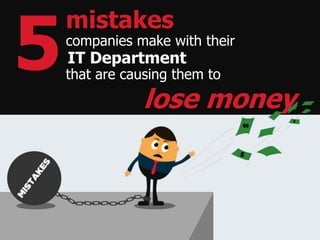
mistakes
IT Department
lose money
companies make with their
that are causing them to
5
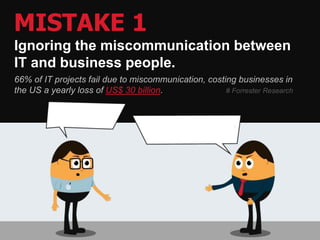
MISTAKE 1
Ignoring the miscommunication between
IT and business people.
66% of IT projects fail due to miscommunication, costing businesses in
the US a yearly loss of US$ 30 billion. # Forrester Research
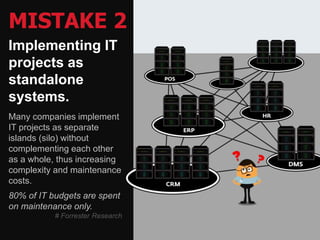
MISTAKE 2
Implementing IT
projects as
standalone
systems.
Many companies implement
IT projects as separate
islands (silo) without
complementing each other
as a whole, thus increasing
complexity and maintenance
costs.
80% of IT budgets are spent
on maintenance only.
# Forrester Research
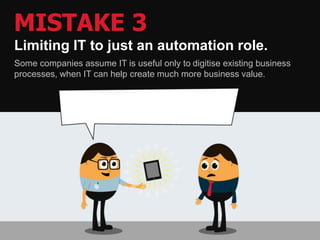
MISTAKE 3
Limiting IT to just an automation role.
Some companies assume IT is useful only to digitise existing business
processes, when IT can help create much more business value.
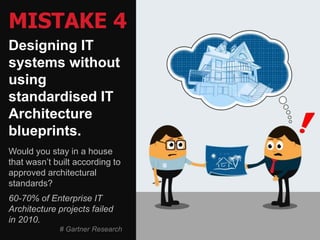
MISTAKE 4
Designing IT
systems without
using
standardised IT
Architecture
blueprints.
Would you stay in a house
that wasn’t built according to
approved architectural
standards?
60-70% of Enterprise IT
Architecture projects failed
in 2010.
# Gartner Research
MISTAKE 5
Treating IT projects as an expense,
instead of as an investment with returns.
Would you want to reduce the budget of an IT department that helps
generate profit?
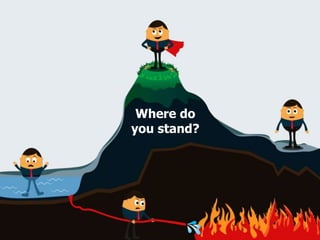
Where do
you stand?
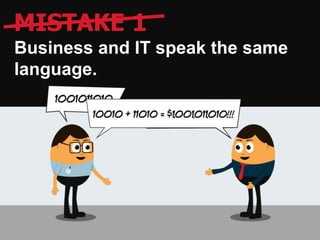
MISTAKE 1
Business and IT speak the same
language.
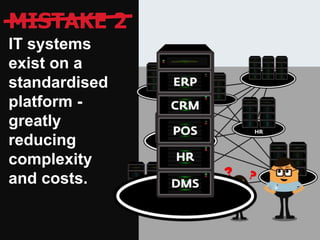
MISTAKE 2
IT systems
exist on a
standardised
platform -
greatly
reducing
complexity
and costs.
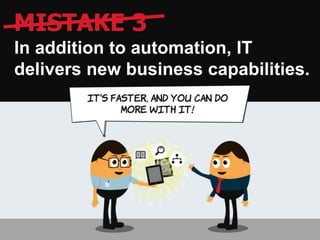
MISTAKE 3
In addition to automation, IT
delivers new business capabilities.
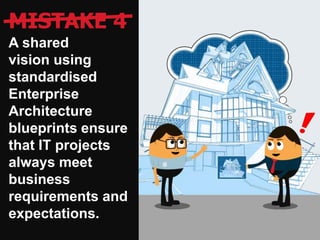
MISTAKE 4
A shared
vision using
standardised
Enterprise
Architecture
blueprints ensure
that IT projects
always meet
business
requirements and
expectations.
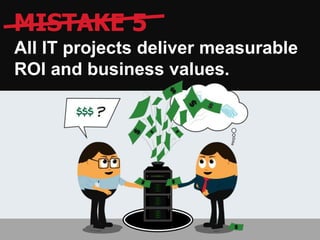
MISTAKE 5
All IT projects deliver measurable
ROI and business values.
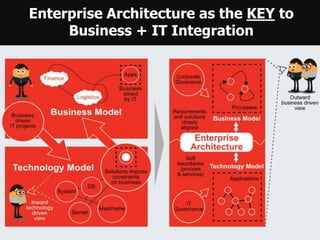
Enterprise Architecture as the KEY to
Business + IT Integration
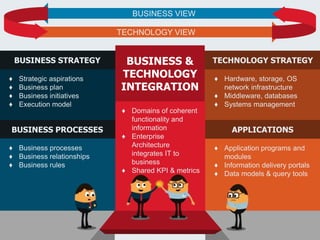
♦ Strategic aspirations
♦ Business plan
♦ Business initiatives
♦ Execution model
BUSINESS STRATEGY
♦ Hardware, storage, OS
network infrastructure
♦ Middleware, databases
♦ Systems management
TECHNOLOGY STRATEGY
♦ Application programs and
modules
♦ Information delivery portals
♦ Data models & query tools
APPLICATIONSBUSINESS PROCESSES
♦ Business processes
♦ Business relationships
♦ Business rules
♦ Domains of coherent
functionality and
information
♦ Enterprise
Architecture
integrates IT to
business
♦ Shared KPI & metrics
BUSINESS &
TECHNOLOGY
INTEGRATION
BUSINESS VIEW
TECHNOLOGY VIEW
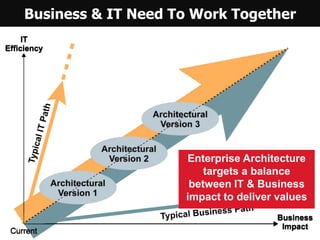
Are you a good chef?Business & IT Need To Work Together
♦ Long lead time to delivery
with little business impact
during the interim
♦ Solution likely not well
aligned with business
needs
♦ Requires unrealistically fast IT
response to deliver business value
♦ Results in unsupportable "spaghetti"
IT systems and inefficient IT
Architecture
Enterprise Architecture
targets a balance
between IT & Business
impact to deliver values
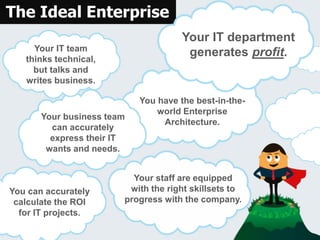
You have the best-in-the-
world Enterprise
Architecture.
The Ideal Enterprise
Your staff are equipped
with the right skillsets to
progress with the company.
Your business team
can accurately
express their IT
wants and needs.
Your IT team
thinks technical,
but talks and
writes business.
You can accurately
calculate the ROI
for IT projects.
Your IT department
generates profit.
Enterprise Architecture
as the KEY to Establishing
Business + IT Integration
Have you ever attended
a musical orchestra?
EA Landscape based on F-T-S-N
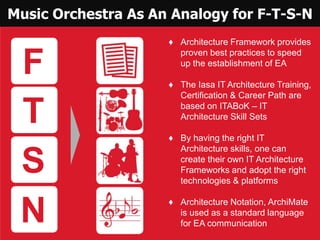
Music Orchestra As An Analogy for F-T-S-N
F
T
S
N
♦ Architecture Framework provides
proven best practices to speed
up the establishment of EA
♦ The Iasa IT Architecture Training,
Certification & Career Path are
based on ITABoK – IT
Architecture Skill Sets
♦ By having the right IT
Architecture skills, one can
create their own IT Architecture
Frameworks and adopt the right
technologies & platforms
♦ Architecture Notation, ArchiMate
is used as a standard language
for EA communication
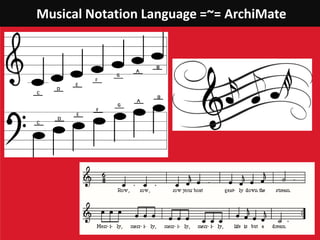
Musical Notation Language =~= ArchiMate
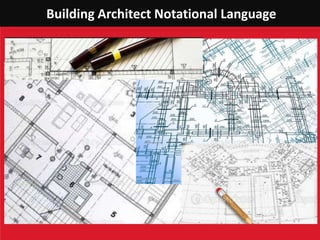
Building Architect Notational Language
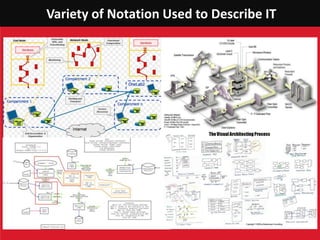
Variety of Notation Used to Describe IT
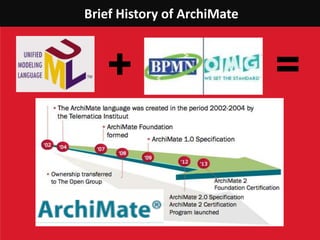
Brief History of ArchiMate
+ =
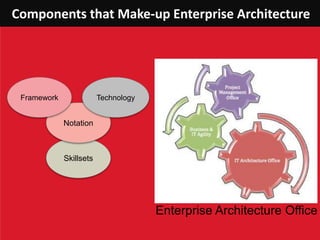
Components that Make-up Enterprise Architecture
Enterprise Architecture Office
Skillsets
Notation
Framework Technology
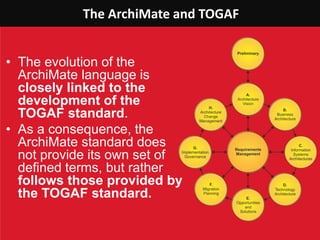
The ArchiMate and TOGAF
• The evolution of the
ArchiMate language is
closely linked to the
development of the
TOGAF standard.
• As a consequence, the
ArchiMate standard does
not provide its own set of
defined terms, but rather
follows those provided by
the TOGAF standard.
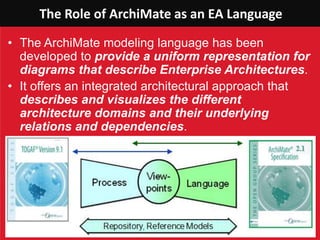
The Role of ArchiMate as an EA Language
• The ArchiMate modeling language has been
developed to provide a uniform representation for
diagrams that describe Enterprise Architectures.
• It offers an integrated architectural approach that
describes and visualizes the different
architecture domains and their underlying
relations and dependencies.
The ArchiMate Language is Lightweight and Scalable
• The ArchiMate language is lightweight and
scalable in several respects:
– Its architecture framework is simple and yet
comprehensive enough to provide a good
structuring mechanism.
– It incorporates the concepts of the “service
orientation” paradigm.
– It represents enterprise architectures as they
change over time.
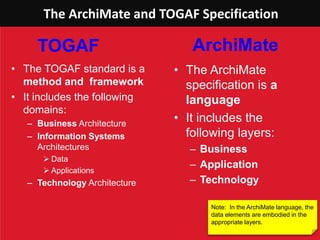
The ArchiMate and TOGAF Specification
• The TOGAF standard is a
method and framework
• It includes the following
domains:
– Business Architecture
– Information Systems
Architectures
 Data
 Applications
– Technology Architecture
• The ArchiMate
specification is a
language
• It includes the
following layers:
– Business
– Application
– Technology
Note: In the ArchiMate language, the
data elements are embodied in the
appropriate layers.
TOGAF ArchiMate
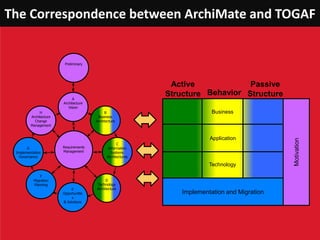
The Correspondence between ArchiMate and TOGAF
A
Architecture
Vision
H
Architecture
Change
Management
G
Implementation
Governance
C
Information
Systems
Architectures
B
Business
Architecture
E
Opportunitie
s
& Solutions
F
Migration
Planning
Preliminary
D
Technology
Architecture
Requirements
Management
Business
Application
Technology
Motivation
Implementation and Migration
Active
Structure
Passive
StructureBehavior
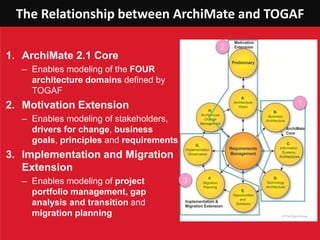
The Relationship between ArchiMate and TOGAF
1. ArchiMate 2.1 Core
– Enables modeling of the FOUR
architecture domains defined by
TOGAF
2. Motivation Extension
– Enables modeling of stakeholders,
drivers for change, business
goals, principles and requirements
3. Implementation and Migration
Extension
– Enables modeling of project
portfolio management, gap
analysis and transition and
migration planning
1
3
2
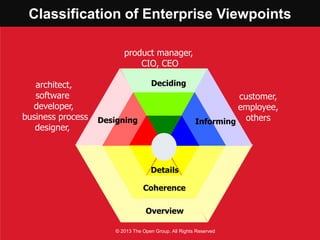
Classification of Enterprise Viewpoints
Designing
Deciding
Informing
Details
Coherence
Overview
product manager,
CIO, CEO
customer,
employee,
others
architect,
software
developer,
business process
designer,
© 2013 The Open Group. All Rights Reserved
Career Paths for
Business and
IT Professionals
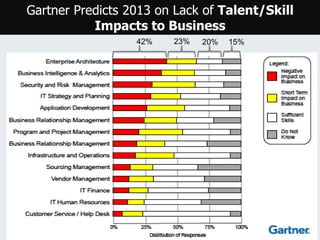
Gartner Predicts 2013 on Lack of Talent/Skill
Impacts to Business
42% 23% 20% 15%
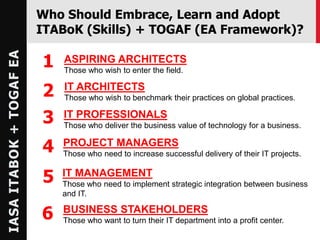
IASAITABOK+TOGAFEA Who Should Embrace, Learn and Adopt
ITABoK (Skills) + TOGAF (EA Framework)?
ASPIRING ARCHITECTS
Those who wish to enter the field.
1
IT ARCHITECTS
Those who wish to benchmark their practices on global practices.2
IT PROFESSIONALS
Those who deliver the business value of technology for a business.
3
PROJECT MANAGERS
Those who need to increase successful delivery of their IT projects.
4
IT MANAGEMENT
Those who need to implement strategic integration between business
and IT.
5
BUSINESS STAKEHOLDERS
Those who want to turn their IT department into a profit center.6
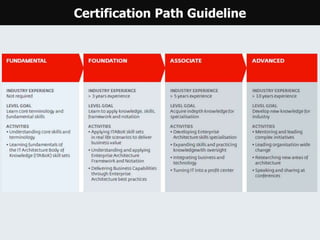
Certification Path Guideline
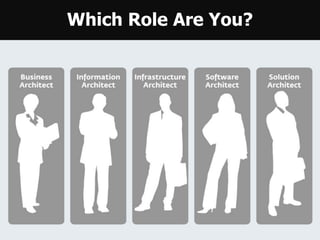
Which Role Are You?
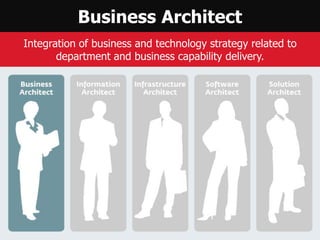
Business Architect
Integration of business and technology strategy related to
department and business capability delivery.
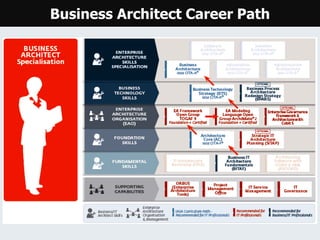
Business Architect Career Path
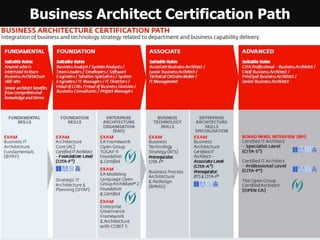
Business Architect Certification Path
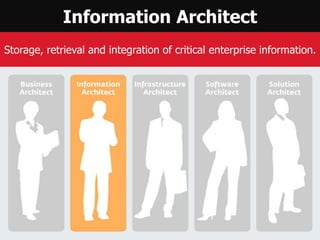
Information Architect
Storage, retrieval and integration of critical enterprise information.
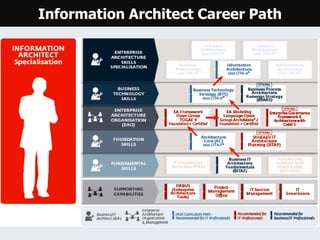
Information Architect Career Path
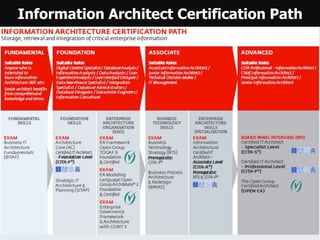
Information Architect Certification Path
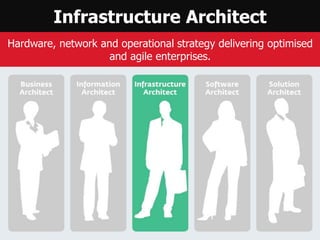
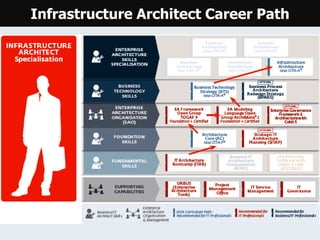
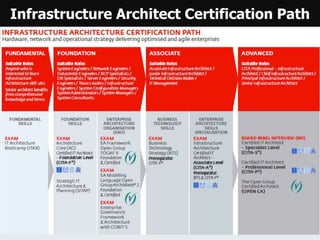
Infrastructure Architect
Hardware, network and operational strategy delivering optimised
and agile enterprises.
Infrastructure Architect Career Path
Infrastructure Architect Certification Path
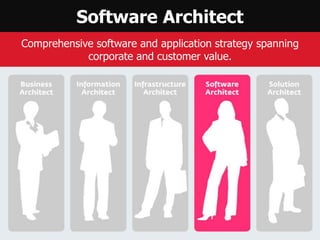
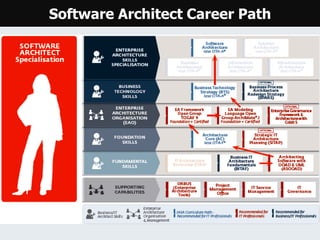
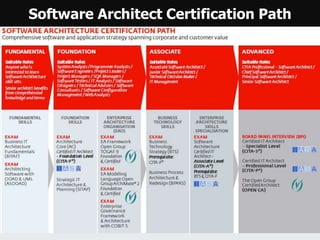
Software Architect
Comprehensive software and application strategy spanning
corporate and customer value.
Software Architect Career Path
Software Architect Certification Path
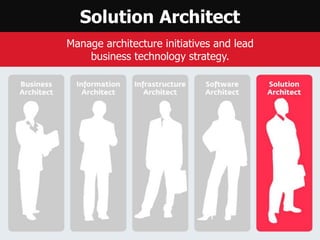
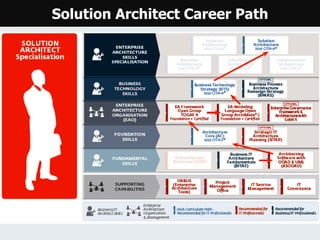
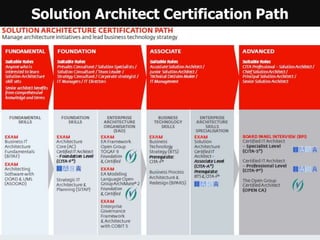
Solution Architect
Manage architecture initiatives and lead
business technology strategy.
Solution Architect Career Path
Solution Architect Certification Path
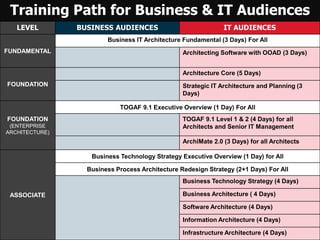
Training Path for Business & IT Audiences
LEVEL BUSINESS AUDIENCES IT AUDIENCES
FUNDAMENTAL
Business IT Architecture Fundamental (3 Days) For All
Architecting Software with OOAD (3 Days)
FOUNDATION
Architecture Core (5 Days)
Strategic IT Architecture and Planning (3
Days)
FOUNDATION
(ENTERPRISE
ARCHITECTURE)
TOGAF 9.1 Executive Overview (1 Day) For All
TOGAF 9.1 Level 1 & 2 (4 Days) for all
Architects and Senior IT Management
ArchiMate 2.0 (3 Days) for all Architects
ASSOCIATE
Business Technology Strategy Executive Overview (1 Day) for All
Business Process Architecture Redesign Strategy (2+1 Days) For All
Business Technology Strategy (4 Days)
Business Architecture ( 4 Days)
Software Architecture (4 Days)
Information Architecture (4 Days)
Infrastructure Architecture (4 Days)
Turn your IT cost into profit.
Put IT back in business.

Enterprise architecture-career-path

  • 1.
  • 2.
  • 3.
    mistakes IT Department lose money companiesmake with their that are causing them to 5
  • 4.
    MISTAKE 1 Ignoring themiscommunication between IT and business people. 66% of IT projects fail due to miscommunication, costing businesses in the US a yearly loss of US$ 30 billion. # Forrester Research
  • 5.
    MISTAKE 2 Implementing IT projectsas standalone systems. Many companies implement IT projects as separate islands (silo) without complementing each other as a whole, thus increasing complexity and maintenance costs. 80% of IT budgets are spent on maintenance only. # Forrester Research
  • 6.
    MISTAKE 3 Limiting ITto just an automation role. Some companies assume IT is useful only to digitise existing business processes, when IT can help create much more business value.
  • 7.
    MISTAKE 4 Designing IT systemswithout using standardised IT Architecture blueprints. Would you stay in a house that wasn’t built according to approved architectural standards? 60-70% of Enterprise IT Architecture projects failed in 2010. # Gartner Research
  • 8.
    MISTAKE 5 Treating ITprojects as an expense, instead of as an investment with returns. Would you want to reduce the budget of an IT department that helps generate profit?
  • 9.
  • 10.
    MISTAKE 1 Business andIT speak the same language.
  • 11.
    MISTAKE 2 IT systems existon a standardised platform - greatly reducing complexity and costs.
  • 12.
    MISTAKE 3 In additionto automation, IT delivers new business capabilities.
  • 13.
    MISTAKE 4 A shared visionusing standardised Enterprise Architecture blueprints ensure that IT projects always meet business requirements and expectations.
  • 14.
    MISTAKE 5 All ITprojects deliver measurable ROI and business values.
  • 15.
    Enterprise Architecture asthe KEY to Business + IT Integration
  • 16.
    ♦ Strategic aspirations ♦Business plan ♦ Business initiatives ♦ Execution model BUSINESS STRATEGY ♦ Hardware, storage, OS network infrastructure ♦ Middleware, databases ♦ Systems management TECHNOLOGY STRATEGY ♦ Application programs and modules ♦ Information delivery portals ♦ Data models & query tools APPLICATIONSBUSINESS PROCESSES ♦ Business processes ♦ Business relationships ♦ Business rules ♦ Domains of coherent functionality and information ♦ Enterprise Architecture integrates IT to business ♦ Shared KPI & metrics BUSINESS & TECHNOLOGY INTEGRATION BUSINESS VIEW TECHNOLOGY VIEW
  • 17.
    Are you agood chef?Business & IT Need To Work Together ♦ Long lead time to delivery with little business impact during the interim ♦ Solution likely not well aligned with business needs ♦ Requires unrealistically fast IT response to deliver business value ♦ Results in unsupportable "spaghetti" IT systems and inefficient IT Architecture Enterprise Architecture targets a balance between IT & Business impact to deliver values
  • 18.
    You have thebest-in-the- world Enterprise Architecture. The Ideal Enterprise Your staff are equipped with the right skillsets to progress with the company. Your business team can accurately express their IT wants and needs. Your IT team thinks technical, but talks and writes business. You can accurately calculate the ROI for IT projects. Your IT department generates profit.
  • 19.
    Enterprise Architecture as theKEY to Establishing Business + IT Integration
  • 20.
    Have you everattended a musical orchestra? EA Landscape based on F-T-S-N
  • 21.
    Music Orchestra AsAn Analogy for F-T-S-N F T S N ♦ Architecture Framework provides proven best practices to speed up the establishment of EA ♦ The Iasa IT Architecture Training, Certification & Career Path are based on ITABoK – IT Architecture Skill Sets ♦ By having the right IT Architecture skills, one can create their own IT Architecture Frameworks and adopt the right technologies & platforms ♦ Architecture Notation, ArchiMate is used as a standard language for EA communication
  • 22.
  • 23.
  • 24.
    Variety of NotationUsed to Describe IT
  • 25.
    Brief History ofArchiMate + =
  • 26.
    Components that Make-upEnterprise Architecture Enterprise Architecture Office Skillsets Notation Framework Technology
  • 27.
    The ArchiMate andTOGAF • The evolution of the ArchiMate language is closely linked to the development of the TOGAF standard. • As a consequence, the ArchiMate standard does not provide its own set of defined terms, but rather follows those provided by the TOGAF standard.
  • 28.
    The Role ofArchiMate as an EA Language • The ArchiMate modeling language has been developed to provide a uniform representation for diagrams that describe Enterprise Architectures. • It offers an integrated architectural approach that describes and visualizes the different architecture domains and their underlying relations and dependencies.
  • 29.
    The ArchiMate Languageis Lightweight and Scalable • The ArchiMate language is lightweight and scalable in several respects: – Its architecture framework is simple and yet comprehensive enough to provide a good structuring mechanism. – It incorporates the concepts of the “service orientation” paradigm. – It represents enterprise architectures as they change over time.
  • 30.
    The ArchiMate andTOGAF Specification • The TOGAF standard is a method and framework • It includes the following domains: – Business Architecture – Information Systems Architectures  Data  Applications – Technology Architecture • The ArchiMate specification is a language • It includes the following layers: – Business – Application – Technology Note: In the ArchiMate language, the data elements are embodied in the appropriate layers. TOGAF ArchiMate
  • 31.
    The Correspondence betweenArchiMate and TOGAF A Architecture Vision H Architecture Change Management G Implementation Governance C Information Systems Architectures B Business Architecture E Opportunitie s & Solutions F Migration Planning Preliminary D Technology Architecture Requirements Management Business Application Technology Motivation Implementation and Migration Active Structure Passive StructureBehavior
  • 32.
    The Relationship betweenArchiMate and TOGAF 1. ArchiMate 2.1 Core – Enables modeling of the FOUR architecture domains defined by TOGAF 2. Motivation Extension – Enables modeling of stakeholders, drivers for change, business goals, principles and requirements 3. Implementation and Migration Extension – Enables modeling of project portfolio management, gap analysis and transition and migration planning 1 3 2
  • 33.
    Classification of EnterpriseViewpoints Designing Deciding Informing Details Coherence Overview product manager, CIO, CEO customer, employee, others architect, software developer, business process designer, © 2013 The Open Group. All Rights Reserved
  • 34.
    Career Paths for Businessand IT Professionals
  • 35.
    Gartner Predicts 2013on Lack of Talent/Skill Impacts to Business 42% 23% 20% 15%
  • 36.
    IASAITABOK+TOGAFEA Who ShouldEmbrace, Learn and Adopt ITABoK (Skills) + TOGAF (EA Framework)? ASPIRING ARCHITECTS Those who wish to enter the field. 1 IT ARCHITECTS Those who wish to benchmark their practices on global practices.2 IT PROFESSIONALS Those who deliver the business value of technology for a business. 3 PROJECT MANAGERS Those who need to increase successful delivery of their IT projects. 4 IT MANAGEMENT Those who need to implement strategic integration between business and IT. 5 BUSINESS STAKEHOLDERS Those who want to turn their IT department into a profit center.6
  • 37.
  • 38.
  • 39.
    Business Architect Integration ofbusiness and technology strategy related to department and business capability delivery.
  • 40.
  • 41.
  • 42.
    Information Architect Storage, retrievaland integration of critical enterprise information.
  • 43.
  • 44.
  • 45.
    Infrastructure Architect Hardware, networkand operational strategy delivering optimised and agile enterprises.
  • 46.
  • 47.
  • 48.
    Software Architect Comprehensive softwareand application strategy spanning corporate and customer value.
  • 49.
  • 50.
  • 51.
    Solution Architect Manage architectureinitiatives and lead business technology strategy.
  • 52.
  • 53.
  • 54.
    Training Path forBusiness & IT Audiences LEVEL BUSINESS AUDIENCES IT AUDIENCES FUNDAMENTAL Business IT Architecture Fundamental (3 Days) For All Architecting Software with OOAD (3 Days) FOUNDATION Architecture Core (5 Days) Strategic IT Architecture and Planning (3 Days) FOUNDATION (ENTERPRISE ARCHITECTURE) TOGAF 9.1 Executive Overview (1 Day) For All TOGAF 9.1 Level 1 & 2 (4 Days) for all Architects and Senior IT Management ArchiMate 2.0 (3 Days) for all Architects ASSOCIATE Business Technology Strategy Executive Overview (1 Day) for All Business Process Architecture Redesign Strategy (2+1 Days) For All Business Technology Strategy (4 Days) Business Architecture ( 4 Days) Software Architecture (4 Days) Information Architecture (4 Days) Infrastructure Architecture (4 Days)
  • 55.
    Turn your ITcost into profit. Put IT back in business.