Making Technology Work for
You!
Series 2 of 2
Enterprise Architecture &
Project Portfolio Management
Translation to Execution
Delivering
Excellence
1
1
Shared Industry
Challenges
2
Industry
Response
3 Best Practices
4 Devise a Plan
2
Shared Industry Challenges
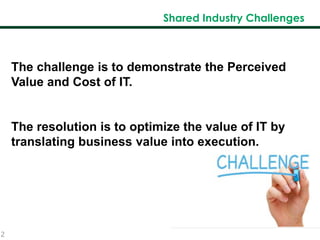
The challenge is to demonstrate the Perceived
Value and Cost of IT.
The resolution is to optimize the value of IT by
translating business value into execution.
3
Shared Industry Challenges
Industry analysts predict the biggest challenges the
EA and PPM share;
• Refine your value propositions
• Better translate business and technology
strategies into execution
• Increase your understanding
of business value
• Link the desired outcomes to the
delivered outcomes
4
Shared Industry Challenges
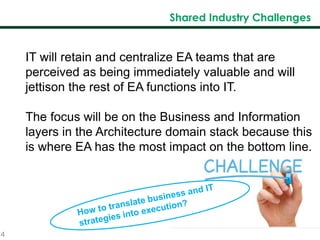
IT will retain and centralize EA teams that are
perceived as being immediately valuable and will
jettison the rest of EA functions into IT.
The focus will be on the Business and Information
layers in the Architecture domain stack because this
is where EA has the most impact on the bottom line.
5
Shared Industry Challenges
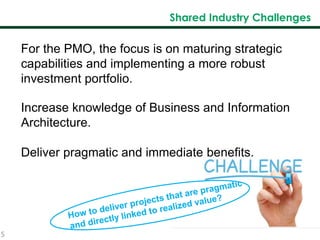
For the PMO, the focus is on maturing strategic
capabilities and implementing a more robust
investment portfolio.
Increase knowledge of Business and Information
Architecture.
Deliver pragmatic and immediate benefits.
6
Shared Industry Challenges
IT’s FUTURE IS CREATED BY
WHAT WE DO {TODAY}
NOT TOMORROW
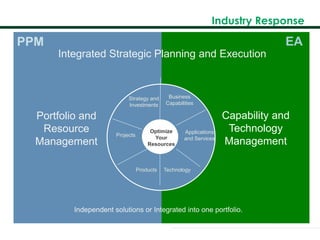
Industry Response
Portfolio and
Resource
Management
Capability and
Technology
Management
Strategy and
Investments
Products
Applications
and Services
Projects
Technology
Business
Capabilities
Independent solutions or Integrated into one portfolio.
Integrated Strategic Planning and Execution
Optimize
Your
Resources
PPM EA
Industry Response
.
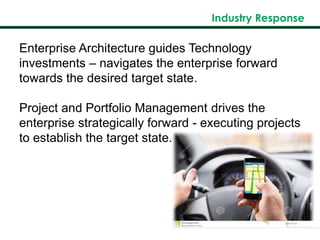
Enterprise Architecture guides Technology
investments – navigates the enterprise forward
towards the desired target state.
Project and Portfolio Management drives the
enterprise strategically forward - executing projects
to establish the target state.
9
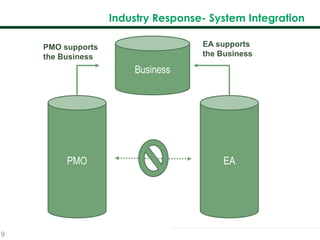
Industry Response- System Integration
Business
PMO EA
EA supports
the Business
PMO supports
the Business
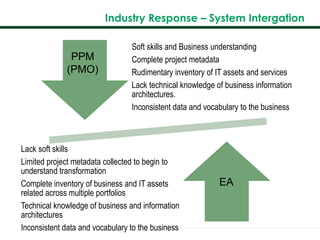
Industry Response – System Intergation
Soft skills and Business understanding
Complete project metadata
Rudimentary inventory of IT assets and services
Lack technical knowledge of business information
architectures.
Inconsistent data and vocabulary to the business
Lack soft skills
Limited project metadata collected to begin to
understand transformation
Complete inventory of business and IT assets
related across multiple portfolios
Technical knowledge of business and information
architectures
Inconsistent data and vocabulary to the business
PPM
(PMO)
EA
11
Industry Response – System Intergation
PPM
EAMS
Business
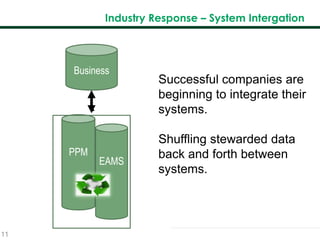
Successful companies are
beginning to integrate their
systems.
Shuffling stewarded data
back and forth between
systems.
12
Industry Response- System Integration
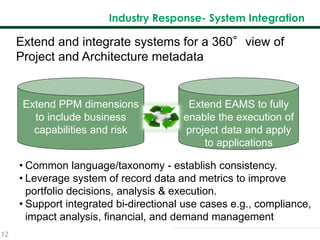
Extend and integrate systems for a 360°view of
Project and Architecture metadata
Extend EAMS to fully
enable the execution of
project data and apply
to applications
Extend PPM dimensions
to include business
capabilities and risk
• Common language/taxonomy - establish consistency.
• Leverage system of record data and metrics to improve
portfolio decisions, analysis & execution.
• Support integrated bi-directional use cases e.g., compliance,
impact analysis, financial, and demand management
13
Industry Response – System Integration
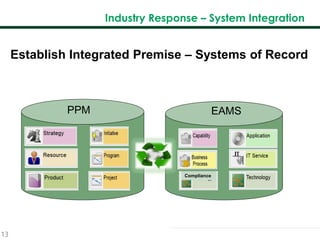
Establish Integrated Premise – Systems of Record
Compliance
PPM EAMS
14
Best Practices
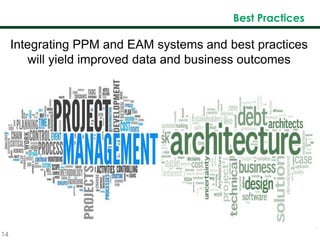
Integrating PPM and EAM systems and best practices
will yield improved data and business outcomes
15
Best Practice
Improve project selection decisions
• Prioritize by determining which future
business capability is supported and align
with strategy and architectures.
Improve strategic leverage of technology
• Leverage technologies by linking to business
outcomes.
Increase business value delivery
• Reuse of reference models, patterns and
technical standards (assets).
Build a Case for Integration – Focused on Business
Value Outcomes
16
Best Practice
• Proposed Project/Business Cases
• Project Dependencies Report
• Project Fulfillment of EA Requirements
• PPM/EA Governance Process
• Project Design Reviews
• PPM Training for EA staff
Ensure PPM Provides Key Deliverables to EA
17
Best Practice
Actionable and Diagnostic Deliverables;
• Enterprise context
• Collaborative new project or project
change proposals:
• Project architectural assessments
• EA road maps
• Project Waivers
• EA training for PPM staff
Ensure EA Provides Key Deliverables to PPM
18
Devise an Integration Plan
In the short term –
• Build relationships across the disciplines.
• Secure C-level sponsor support for the integration.
• Identify and focus on common ground.
• Build the case using the benefits we’ve discussed like
Project Architecture and Architecture Consults
• Cross-train teams to build understanding and enable more-
informed working relationships.
In the long term - Define data points in the
EA and PPM systems and processes
where reviews, interfaces and artifact
handoffs should occur to enable
integration.
19
Conclusion
EA and PPM Integration - Translation to Execution
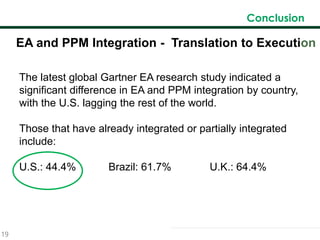
The latest global Gartner EA research study indicated a
significant difference in EA and PPM integration by country,
with the U.S. lagging the rest of the world.
Those that have already integrated or partially integrated
include:
U.S.: 44.4% Brazil: 61.7% U.K.: 64.4%
Jean Gehring
.Senior advisor in IT
Transformation
Services for
fortune 500 and
fast growth
companies
Partnering with a
network of industry
experts brings
unique strengths to
clients transforming
their IT capabilities
into actionable and
sustainable
operations
jeangehring@gmail.com
Reston, Virginia
Enterprise Architecture • IT Portfolio Management • Governance

Enterprise Architecture & Project Portfolio Management 2/2

  • 1.
    Making Technology Workfor You! Series 2 of 2 Enterprise Architecture & Project Portfolio Management Translation to Execution
  • 2.
    Translation to Execution Delivering Excellence 1 1 SharedIndustry Challenges 2 Industry Response 3 Best Practices 4 Devise a Plan
  • 3.
    2 Shared Industry Challenges Thechallenge is to demonstrate the Perceived Value and Cost of IT. The resolution is to optimize the value of IT by translating business value into execution.
  • 4.
    3 Shared Industry Challenges Industryanalysts predict the biggest challenges the EA and PPM share; • Refine your value propositions • Better translate business and technology strategies into execution • Increase your understanding of business value • Link the desired outcomes to the delivered outcomes
  • 5.
    4 Shared Industry Challenges ITwill retain and centralize EA teams that are perceived as being immediately valuable and will jettison the rest of EA functions into IT. The focus will be on the Business and Information layers in the Architecture domain stack because this is where EA has the most impact on the bottom line.
  • 6.
    5 Shared Industry Challenges Forthe PMO, the focus is on maturing strategic capabilities and implementing a more robust investment portfolio. Increase knowledge of Business and Information Architecture. Deliver pragmatic and immediate benefits.
  • 7.
    6 Shared Industry Challenges IT’sFUTURE IS CREATED BY WHAT WE DO {TODAY} NOT TOMORROW
  • 8.
    Industry Response Portfolio and Resource Management Capabilityand Technology Management Strategy and Investments Products Applications and Services Projects Technology Business Capabilities Independent solutions or Integrated into one portfolio. Integrated Strategic Planning and Execution Optimize Your Resources PPM EA
  • 9.
    Industry Response . Enterprise Architectureguides Technology investments – navigates the enterprise forward towards the desired target state. Project and Portfolio Management drives the enterprise strategically forward - executing projects to establish the target state.
  • 10.
    9 Industry Response- SystemIntegration Business PMO EA EA supports the Business PMO supports the Business
  • 11.
    Industry Response –System Intergation Soft skills and Business understanding Complete project metadata Rudimentary inventory of IT assets and services Lack technical knowledge of business information architectures. Inconsistent data and vocabulary to the business Lack soft skills Limited project metadata collected to begin to understand transformation Complete inventory of business and IT assets related across multiple portfolios Technical knowledge of business and information architectures Inconsistent data and vocabulary to the business PPM (PMO) EA
  • 12.
    11 Industry Response –System Intergation PPM EAMS Business Successful companies are beginning to integrate their systems. Shuffling stewarded data back and forth between systems.
  • 13.
    12 Industry Response- SystemIntegration Extend and integrate systems for a 360°view of Project and Architecture metadata Extend EAMS to fully enable the execution of project data and apply to applications Extend PPM dimensions to include business capabilities and risk • Common language/taxonomy - establish consistency. • Leverage system of record data and metrics to improve portfolio decisions, analysis & execution. • Support integrated bi-directional use cases e.g., compliance, impact analysis, financial, and demand management
  • 14.
    13 Industry Response –System Integration Establish Integrated Premise – Systems of Record Compliance PPM EAMS
  • 15.
    14 Best Practices Integrating PPMand EAM systems and best practices will yield improved data and business outcomes
  • 16.
    15 Best Practice Improve projectselection decisions • Prioritize by determining which future business capability is supported and align with strategy and architectures. Improve strategic leverage of technology • Leverage technologies by linking to business outcomes. Increase business value delivery • Reuse of reference models, patterns and technical standards (assets). Build a Case for Integration – Focused on Business Value Outcomes
  • 17.
    16 Best Practice • ProposedProject/Business Cases • Project Dependencies Report • Project Fulfillment of EA Requirements • PPM/EA Governance Process • Project Design Reviews • PPM Training for EA staff Ensure PPM Provides Key Deliverables to EA
  • 18.
    17 Best Practice Actionable andDiagnostic Deliverables; • Enterprise context • Collaborative new project or project change proposals: • Project architectural assessments • EA road maps • Project Waivers • EA training for PPM staff Ensure EA Provides Key Deliverables to PPM
  • 19.
    18 Devise an IntegrationPlan In the short term – • Build relationships across the disciplines. • Secure C-level sponsor support for the integration. • Identify and focus on common ground. • Build the case using the benefits we’ve discussed like Project Architecture and Architecture Consults • Cross-train teams to build understanding and enable more- informed working relationships. In the long term - Define data points in the EA and PPM systems and processes where reviews, interfaces and artifact handoffs should occur to enable integration.
  • 20.
    19 Conclusion EA and PPMIntegration - Translation to Execution The latest global Gartner EA research study indicated a significant difference in EA and PPM integration by country, with the U.S. lagging the rest of the world. Those that have already integrated or partially integrated include: U.S.: 44.4% Brazil: 61.7% U.K.: 64.4%
  • 21.
    Jean Gehring .Senior advisorin IT Transformation Services for fortune 500 and fast growth companies Partnering with a network of industry experts brings unique strengths to clients transforming their IT capabilities into actionable and sustainable operations jeangehring@gmail.com Reston, Virginia Enterprise Architecture • IT Portfolio Management • Governance