Green Finance
By:
Charvie Mishra
Neeti Mahajan
MBA Sustainability Management
Corporate Finance – PPM 122
Table of
Contents:
Green for Money?
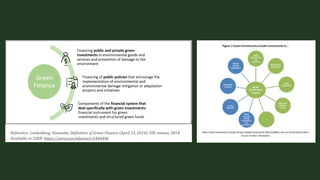
Green Finance
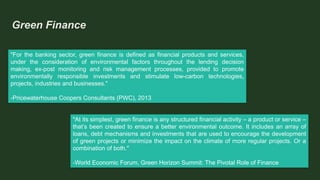
"For the banking sector, green finance is defined as financial products and services,
under the consideration of environmental factors throughout the lending decision
making, ex-post monitoring and risk management processes, provided to promote
environmentally responsible investments and stimulate low-carbon technologies,
projects, industries and businesses."
-Pricewaterhouse Coopers Consultants (PWC), 2013
"At its simplest, green finance is any structured financial activity – a product or service –
that’s been created to ensure a better environmental outcome. It includes an array of
loans, debt mechanisms and investments that are used to encourage the development
of green projects or minimize the impact on the climate of more regular projects. Or a
combination of both."
-World Economic Forum, Green Horizon Summit: The Pivotal Role of Finance
Government Policies and Green Finance
→ Public policies have a significant
influence on how markets develop.
Policy actors can use a range of
powerful interventions to shape
markets around key policy agendas.
→ Policy agendas that are focused on
sustainable finance are likely to be
geographically contingent based
upon the political, economic, and
cultural traditions of a given country
or region.
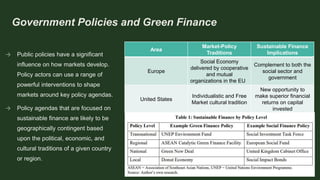
Area
Market-Policy
Traditions
Sustainable Finance
Implications
Europe
Social Economy
delivered by cooperative
and mutual
organizations in the EU
Complement to both the
social sector and
government
United States
Individualistic and Free
Market cultural tradition
New opportunity to
make superior financial
returns on capital
invested
Investors and Green Finance
→ The race to net zero and decarbonization are now central to investors’ investment decision-making.
This will likely require significant scenario analysis capability for both corporates and investors.
→ Investors see a significant opportunity from efforts by national governments to drive a green recovery from
the COVID-19 pandemic, but there are some concerns about a market bubble as demand outstrips the
supply of opportunities in innovative new renewables solutions.
→ However, there are two issues that could dampen the threat of a market bubble: first, the sheer volume of
finance required to achieve renewables goals and the investment flow funding gap; second, the
significant amount of funding likely required to “green the brown” by decarbonizing many industry sectors.
Types of Bonds
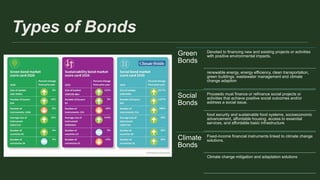
Green
Bonds
Devoted to financing new and existing projects or activities
with positive environmental impacts.
renewable energy, energy efficiency, clean transportation,
green buildings, wastewater management and climate
change adaption
Social
Bonds
Proceeds must finance or refinance social projects or
activities that achieve positive social outcomes and/or
address a social issue.
food security and sustainable food systems, socioeconomic
advancement, affordable housing, access to essential
services, and affordable basic infrastructure
Climate
Bonds
Fixed-income financial instruments linked to climate change
solutions.
Climate change mitigation and adaptation solutions
Sustainability Linked Instruments
Sustainability
Linked
Bonds
Sustainability
Linked Loans
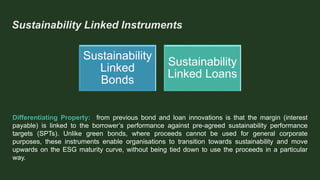
Differentiating Property: from previous bond and loan innovations is that the margin (interest
payable) is linked to the borrower’s performance against pre-agreed sustainability performance
targets (SPTs). Unlike green bonds, where proceeds cannot be used for general corporate
purposes, these instruments enable organisations to transition towards sustainability and move
upwards on the ESG maturity curve, without being tied down to use the proceeds in a particular
way.
Understanding ESG Bonds , Score Cards and Loans
→ An ESG bond or a Green bond is a promissory note, a
debt security and contract issued by an investment fund
that invests in companies with high environmental, social
and governance standards.
→ Also known as socially responsible or environmentally
friendly investments – as the company has to use the
investor's money only for environmentally conscious and
responsible investments.
→ Globally, ESG bond issuance in 2020 was over $500
billion. This went up to over $900 billion in 2021. This
year, Bank of America anticipates ESG bond issuances
in the $1.2-1.4 trillion range. In India, ESG issuance
were around $10 billion in 2021
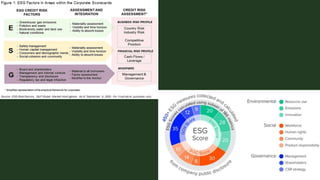
→ ESG Score cards are a tool for investors to
understand how much of the money was used for green
and clean projects and higher the rating, higher are the
Interlinking Green Finance, Cryptocurrency and Blockchain
The Bitcoin and other
cryptocurrencies have been
dominating the FinTech
markets a lot through multiple
avenues.
Cryptocurrencies are known to
be extremely energy intensive
and carbon consuming as
well, but eco-
friendly cryptocurrencies as
well -
1. Ripple – Crypto + Digital
Payment Gateway, private
blockchain, no mining, proof of
stake, 0.0079 kW/hr v/s
Bitcoin's 707 kW/hr
2. Stellar Lumens (PayPal
alternative, Federated
Byzantine Agreement – energy
efficient.
3. Cardano – 0.01% of energy
used of what Bitcoin uses –
innovation, globalisation and
sustainability – 6 GWh
annually v/s BT's 110 TWh
4. Chia – farming instead of
mining – proof of space and
time instead of computers –
empty hard-disks
5. Nano – no mining, minting,
printing – light-weight proof of
work model – delegated proof-
of-stake – DAG (Directed
Acyclic Graph Tech instead of
blockchain, scalability) -
0.000112 KWh per transaction
Exploring the role of FinTech in Green Finance
→ As blockchain establishes direct contact between the two parties, it is easier to deploy blockchain networks in the
energy sector.
→ It is expected to lead to much more direct relationships between energy producers and consumers, and to
strengthen the market participation opportunities for small energy providers and prosumers.
→ In a decentralised energy system, blockchain could enable energy supply contracts to be made directly between
energy producers and energy consumers, and for them to be carried out automatically.
→ Peer-to-Peer trading can be carried out with prosumer-encouraged electricity and energy trade in multiple cycles,
Carbon credits can also be exchanged via blockchain technologies
→ 'Enerchain' is at the proof-of-concept stage and is designed to determine whether a decentralized blockchain-based
model can support the trading volumes and transaction speeds required for trade execution in the gas and electricity
markets.
→ Subnational Pooled Financing Mechanisms (SPFMs) as means of raising sustainability-oriented capital from
financial markets. An SPFM aggregates the financial needs of members into a pooled financing agency (PFA),
which then issues debt and distributes the proceeds from the bond offering to its members.
Green Finance for Developing Countries
“The key driver for sustainable
finance in our country is financial
inclusion – making sure that the
financial system serves the
population and helps to
overcome poverty and economic
exclusion.”
Green Financing in an Indian Scenario
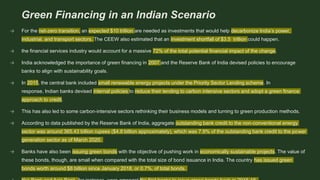
→ For the net-zero transition, an expected $10 trillion are needed as investments that would help decarbonize India’s power,
industrial, and transport sectors. The CEEW also estimated that an investment shortfall of $3.5 trillion could happen.
→ the financial services industry would account for a massive 72% of the total potential financial impact of the change.
→ India acknowledged the importance of green financing in 2007 and the Reserve Bank of India devised policies to encourage
banks to align with sustainability goals.
→ In 2015, the central bank included small renewable energy projects under the Priority Sector Lending scheme. In
response, Indian banks devised internal policies to reduce their lending to carbon intensive sectors and adopt a green finance
approach to credit.
→ This has also led to some carbon-intensive sectors rethinking their business models and turning to green production methods.
→ According to data published by the Reserve Bank of India, aggregate outstanding bank credit to the non-conventional energy
sector was around 365.43 billion rupees ($4.8 billion approximately), which was 7.9% of the outstanding bank credit to the power
generation sector as of March 2020.
→ Banks have also been issuing green bonds with the objective of pushing work in economically sustainable projects. The value of
these bonds, though, are small when compared with the total size of bond issuance in India. The country has issued green
bonds worth around $8 billion since January 2018, or 0.7%, of total bonds.
Challenges and Way forward
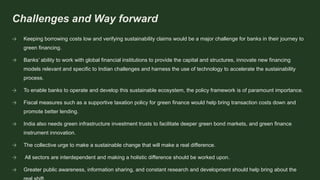
→ Keeping borrowing costs low and verifying sustainability claims would be a major challenge for banks in their journey to
green financing.
→ Banks’ ability to work with global financial institutions to provide the capital and structures, innovate new financing
models relevant and specific to Indian challenges and harness the use of technology to accelerate the sustainability
process.
→ To enable banks to operate and develop this sustainable ecosystem, the policy framework is of paramount importance.
→ Fiscal measures such as a supportive taxation policy for green finance would help bring transaction costs down and
promote better lending.
→ India also needs green infrastructure investment trusts to facilitate deeper green bond markets, and green finance
instrument innovation.
→ The collective urge to make a sustainable change that will make a real difference.
→ All sectors are interdependent and making a holistic difference should be worked upon.
→ Greater public awareness, information sharing, and constant research and development should help bring about the
References:
→ https://www.adb.org/sites/default/files/publication/464821/adbi-wp883.pdf
→ https://www.worldbank.org/en/news/feature/2021/10/04/what-you-need-to-know-about-green-loans
→ https://www.youtube.com/watch?v=d9H_XG8RCzU
→ https://www.youtube.com/watch?v=vTT_q4Qziv0
→ https://www.cbd.int/financial/gcf/unep-greendeveloping2016.pdf
→ https://www.weforum.org/agenda/2022/01/green-finance-bolster-india-transition-net-
zero/#:~:text=India%20acknowledged%20the%20importance%20of,the%20Priority%20Sector%20Lending%20scheme
→ https://www.adb.org/sites/default/files/institutional-document/691951/ado2021bp-policies-initiatives-regulations.pdf
→ https://www.cbd.int/financial/gcf/definition-greenfinance.pdf
→ https://www.greenfinanceplatform.org/page/explore-green-finance
→ https://www.ey.com/en_gl/assurance/how-investors-can-help-finance-a-green-recovery
Green Finance.pptx

Green Finance.pptx

  • 1.
    Green Finance By: Charvie Mishra NeetiMahajan MBA Sustainability Management Corporate Finance – PPM 122
  • 2.
  • 3.
  • 4.
    Green Finance "For thebanking sector, green finance is defined as financial products and services, under the consideration of environmental factors throughout the lending decision making, ex-post monitoring and risk management processes, provided to promote environmentally responsible investments and stimulate low-carbon technologies, projects, industries and businesses." -Pricewaterhouse Coopers Consultants (PWC), 2013 "At its simplest, green finance is any structured financial activity – a product or service – that’s been created to ensure a better environmental outcome. It includes an array of loans, debt mechanisms and investments that are used to encourage the development of green projects or minimize the impact on the climate of more regular projects. Or a combination of both." -World Economic Forum, Green Horizon Summit: The Pivotal Role of Finance
  • 6.
    Government Policies andGreen Finance → Public policies have a significant influence on how markets develop. Policy actors can use a range of powerful interventions to shape markets around key policy agendas. → Policy agendas that are focused on sustainable finance are likely to be geographically contingent based upon the political, economic, and cultural traditions of a given country or region. Area Market-Policy Traditions Sustainable Finance Implications Europe Social Economy delivered by cooperative and mutual organizations in the EU Complement to both the social sector and government United States Individualistic and Free Market cultural tradition New opportunity to make superior financial returns on capital invested
  • 7.
    Investors and GreenFinance → The race to net zero and decarbonization are now central to investors’ investment decision-making. This will likely require significant scenario analysis capability for both corporates and investors. → Investors see a significant opportunity from efforts by national governments to drive a green recovery from the COVID-19 pandemic, but there are some concerns about a market bubble as demand outstrips the supply of opportunities in innovative new renewables solutions. → However, there are two issues that could dampen the threat of a market bubble: first, the sheer volume of finance required to achieve renewables goals and the investment flow funding gap; second, the significant amount of funding likely required to “green the brown” by decarbonizing many industry sectors.
  • 8.
    Types of Bonds Green Bonds Devotedto financing new and existing projects or activities with positive environmental impacts. renewable energy, energy efficiency, clean transportation, green buildings, wastewater management and climate change adaption Social Bonds Proceeds must finance or refinance social projects or activities that achieve positive social outcomes and/or address a social issue. food security and sustainable food systems, socioeconomic advancement, affordable housing, access to essential services, and affordable basic infrastructure Climate Bonds Fixed-income financial instruments linked to climate change solutions. Climate change mitigation and adaptation solutions
  • 9.
    Sustainability Linked Instruments Sustainability Linked Bonds Sustainability LinkedLoans Differentiating Property: from previous bond and loan innovations is that the margin (interest payable) is linked to the borrower’s performance against pre-agreed sustainability performance targets (SPTs). Unlike green bonds, where proceeds cannot be used for general corporate purposes, these instruments enable organisations to transition towards sustainability and move upwards on the ESG maturity curve, without being tied down to use the proceeds in a particular way.
  • 10.
    Understanding ESG Bonds, Score Cards and Loans → An ESG bond or a Green bond is a promissory note, a debt security and contract issued by an investment fund that invests in companies with high environmental, social and governance standards. → Also known as socially responsible or environmentally friendly investments – as the company has to use the investor's money only for environmentally conscious and responsible investments. → Globally, ESG bond issuance in 2020 was over $500 billion. This went up to over $900 billion in 2021. This year, Bank of America anticipates ESG bond issuances in the $1.2-1.4 trillion range. In India, ESG issuance were around $10 billion in 2021 → ESG Score cards are a tool for investors to understand how much of the money was used for green and clean projects and higher the rating, higher are the
  • 12.
    Interlinking Green Finance,Cryptocurrency and Blockchain The Bitcoin and other cryptocurrencies have been dominating the FinTech markets a lot through multiple avenues. Cryptocurrencies are known to be extremely energy intensive and carbon consuming as well, but eco- friendly cryptocurrencies as well - 1. Ripple – Crypto + Digital Payment Gateway, private blockchain, no mining, proof of stake, 0.0079 kW/hr v/s Bitcoin's 707 kW/hr 2. Stellar Lumens (PayPal alternative, Federated Byzantine Agreement – energy efficient. 3. Cardano – 0.01% of energy used of what Bitcoin uses – innovation, globalisation and sustainability – 6 GWh annually v/s BT's 110 TWh 4. Chia – farming instead of mining – proof of space and time instead of computers – empty hard-disks 5. Nano – no mining, minting, printing – light-weight proof of work model – delegated proof- of-stake – DAG (Directed Acyclic Graph Tech instead of blockchain, scalability) - 0.000112 KWh per transaction
  • 13.
    Exploring the roleof FinTech in Green Finance → As blockchain establishes direct contact between the two parties, it is easier to deploy blockchain networks in the energy sector. → It is expected to lead to much more direct relationships between energy producers and consumers, and to strengthen the market participation opportunities for small energy providers and prosumers. → In a decentralised energy system, blockchain could enable energy supply contracts to be made directly between energy producers and energy consumers, and for them to be carried out automatically. → Peer-to-Peer trading can be carried out with prosumer-encouraged electricity and energy trade in multiple cycles, Carbon credits can also be exchanged via blockchain technologies → 'Enerchain' is at the proof-of-concept stage and is designed to determine whether a decentralized blockchain-based model can support the trading volumes and transaction speeds required for trade execution in the gas and electricity markets. → Subnational Pooled Financing Mechanisms (SPFMs) as means of raising sustainability-oriented capital from financial markets. An SPFM aggregates the financial needs of members into a pooled financing agency (PFA), which then issues debt and distributes the proceeds from the bond offering to its members.
  • 14.
    Green Finance forDeveloping Countries “The key driver for sustainable finance in our country is financial inclusion – making sure that the financial system serves the population and helps to overcome poverty and economic exclusion.”
  • 17.
    Green Financing inan Indian Scenario → For the net-zero transition, an expected $10 trillion are needed as investments that would help decarbonize India’s power, industrial, and transport sectors. The CEEW also estimated that an investment shortfall of $3.5 trillion could happen. → the financial services industry would account for a massive 72% of the total potential financial impact of the change. → India acknowledged the importance of green financing in 2007 and the Reserve Bank of India devised policies to encourage banks to align with sustainability goals. → In 2015, the central bank included small renewable energy projects under the Priority Sector Lending scheme. In response, Indian banks devised internal policies to reduce their lending to carbon intensive sectors and adopt a green finance approach to credit. → This has also led to some carbon-intensive sectors rethinking their business models and turning to green production methods. → According to data published by the Reserve Bank of India, aggregate outstanding bank credit to the non-conventional energy sector was around 365.43 billion rupees ($4.8 billion approximately), which was 7.9% of the outstanding bank credit to the power generation sector as of March 2020. → Banks have also been issuing green bonds with the objective of pushing work in economically sustainable projects. The value of these bonds, though, are small when compared with the total size of bond issuance in India. The country has issued green bonds worth around $8 billion since January 2018, or 0.7%, of total bonds.
  • 18.
    Challenges and Wayforward → Keeping borrowing costs low and verifying sustainability claims would be a major challenge for banks in their journey to green financing. → Banks’ ability to work with global financial institutions to provide the capital and structures, innovate new financing models relevant and specific to Indian challenges and harness the use of technology to accelerate the sustainability process. → To enable banks to operate and develop this sustainable ecosystem, the policy framework is of paramount importance. → Fiscal measures such as a supportive taxation policy for green finance would help bring transaction costs down and promote better lending. → India also needs green infrastructure investment trusts to facilitate deeper green bond markets, and green finance instrument innovation. → The collective urge to make a sustainable change that will make a real difference. → All sectors are interdependent and making a holistic difference should be worked upon. → Greater public awareness, information sharing, and constant research and development should help bring about the
  • 19.
    References: → https://www.adb.org/sites/default/files/publication/464821/adbi-wp883.pdf → https://www.worldbank.org/en/news/feature/2021/10/04/what-you-need-to-know-about-green-loans →https://www.worldbank.org/en/news/feature/2021/10/04/what-you-need-to-know-about-green-loans → https://www.youtube.com/watch?v=d9H_XG8RCzU → https://www.youtube.com/watch?v=vTT_q4Qziv0 → https://www.cbd.int/financial/gcf/unep-greendeveloping2016.pdf → https://www.weforum.org/agenda/2022/01/green-finance-bolster-india-transition-net- zero/#:~:text=India%20acknowledged%20the%20importance%20of,the%20Priority%20Sector%20Lending%20scheme → https://www.adb.org/sites/default/files/institutional-document/691951/ado2021bp-policies-initiatives-regulations.pdf → https://www.cbd.int/financial/gcf/definition-greenfinance.pdf → https://www.greenfinanceplatform.org/page/explore-green-finance → https://www.ey.com/en_gl/assurance/how-investors-can-help-finance-a-green-recovery

Editor's Notes

  • #7 We have seen this in our macroeconomics classes. Transnational : Paris Agreement National: India's Net Zero Targets
  • #8 Gap of 5.2 trillion US dollars for renewable transition
  • #10  Under these circumstances, it is even more crucial to ensure the integrity of the product, as the risk of [perceived] greenwashing is higher. If the issuer or borrower achieves its SPTs then its margin on the debt instrument is reduced, acting as an incentive to move towards sustainability by a cost-saving mechanism. The mechanism can work the other way too. If the SPTs are not achieved, then the interest payable is increased by pre-agreed basis points. Example SPTs can range from CO2 emission reductions, reduction in the use of single use plastics or quantitative improvements in ESG ratings such as Ecovardis, MSCI or Sustainalytics; targets being calculated from a baseline year.