SEMINAR PRESENTATION
Presented by
ANJALI.M & AMRITHA
4 th SEM M COM
Concept of hire purchase
 Hire purchase is the mode of financing the price of the
goods to be sold on future date. In a hire purchase
transaction, the goods are let on hire, the purchase price is
to be paid in instalments and hirer is allowed an option to
purchase the goods by paying all the instalments. In a hire
purchase transaction the goods are let out on hire by a
finance company to the hirer .The buyer is required to pay
an agreed amount in periodical instalments during a given
period. The ownership of the property remains with creditor
and passes on to hirer on the payment of the last instalment.
MEANING AND DEFINITION
A transaction of finance whereby goods are bought and sold
as per the terms and conditions specified below is known as hire
purchase finance.
A. Payment of periodic instalments.
B. Immediate possession of goods by the buyer.
C. Ownership of goods remaining with the vendor until the
payment of last instalment.
D. Vendors right to repossess the goods in the event of default
committed by the buyer.
E. Treatment of each instalment as hire charge till the
payment of last instalment.
According to the Hire Purchase Act of 1972 , The term Hire
Purchase can be defined as “ an agreement under which
goods are let on hire and under which the hirer has an option
to purchase them in accordance with the terms of agreement,
and it includes;
1. Possession of goods is delivered by the owner thereof to a
person on the condition that such person pays the agreed
amount in periodic payments.
2. The property of the goods is to pass such a person on the
payment of last of such instalment.
3. Such a person has a right to terminate the agreement any
time before the property so passes.
Features :
 Hire purchase is based on an agreement in writing.
 The buyer takes possession of the goods at the time of
entering into contract.
 Each instalment is treated as hire charges.
 Ownership transfer from buyer to seller on the payment
of last instalment.
 The purchaser has the right to terminate the agreement any
time before the property passes.
Hire PurchaseAgreement
 Hire purchase has to be in writing and signed by both parties. The
agreement must contain:
 Description of the goods
 Hire purchase price of the goods.
 The date of commencement of the agreement.
 The number of instalments, amount and due date.
Terms used in Hire purchase agreements
 Hire purchaser : A hire purchaser is a person who possess the
goods under hire purchase agreement.
 Hire vendor: Is a person who sells the goods under hire purchase
agreement.
 Cash price: It is the price of the goods which is sold under contract
of sale.
 Hire purchase price: It is the price at which goods are sold under
hire purchase system. It includes cash price of the goods and
interest.
 Instalment money: It is the part of hire purchase price paid by the
hire purchaser . In periodic intervals.
 Down payment: It is the initial payment made by the hire
purchaser to the hire vendor at the time of entering in to
hire purchase agreement.
 Hire charge: It refers to the difference between hire
purchase price and cash price.
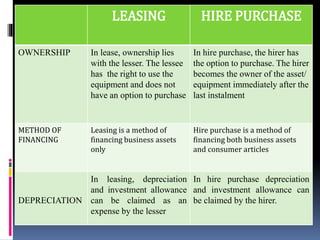
LEASING HIRE PURCHASE
OWNERSHIP In lease, ownership lies
with the lesser. The lessee
has the right to use the
equipment and does not
have an option to purchase
In hire purchase, the hirer has
the option to purchase. The hirer
becomes the owner of the asset/
equipment immediately after the
last instalment
METHOD OF
FINANCING
Leasing is a method of
financing business assets
only
Hire purchase is a method of
financing both business assets
and consumer articles
DEPRECIATION
In leasing, depreciation
and investment allowance
can be claimed as an
expense by the lesser
In hire purchase depreciation
and investment allowance can
be claimed by the hirer.
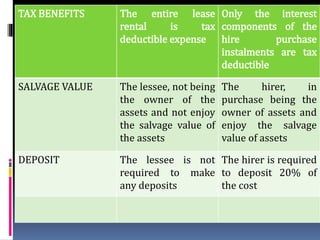
TAX BENEFITS The entire lease
rental is tax
deductible expense
Only the interest
components of the
hire purchase
instalments are tax
deductible
SALVAGE VALUE The lessee, not being
the owner of the
assets and not enjoy
the salvage value of
the assets
The hirer, in
purchase being the
owner of assets and
enjoy the salvage
value of assets
DEPOSIT The lessee is not
required to make
any deposits
The hirer is required
to deposit 20% of
the cost
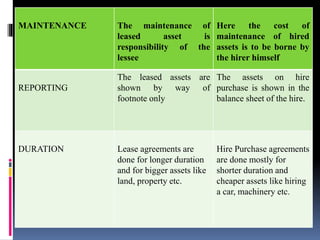
MAINTENANCE The maintenance of
leased asset is
responsibility of the
lessee
Here the cost of
maintenance of hired
assets is to be borne by
the hirer himself
REPORTING
The leased assets are
shown by way of
footnote only
The assets on hire
purchase is shown in the
balance sheet of the hire.
DURATION Lease agreements are
done for longer duration
and for bigger assets like
land, property etc.
Hire Purchase agreements
are done mostly for
shorter duration and
cheaper assets like hiring
a car, machinery etc.
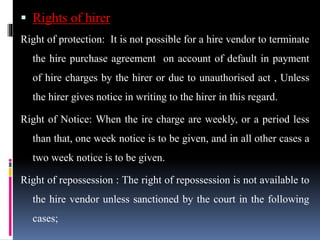
 Rights of hirer
Right of protection: It is not possible for a hire vendor to terminate
the hire purchase agreement on account of default in payment
of hire charges by the hirer or due to unauthorised act , Unless
the hirer gives notice in writing to the hirer in this regard.
Right of Notice: When the ire charge are weekly, or a period less
than that, one week notice is to be given, and in all other cases a
two week notice is to be given.
Right of repossession : The right of repossession is not available to
the hire vendor unless sanctioned by the court in the following
cases;
 a. One half of the price has been paid where the hire
purchase price is less than Rs. 15000 ( Rs 5000 in case of
motor vehicles)
b. Three fourth of the price has been paid where the hire
purchase price is not less than Rs 15000(Rs 5000 in case of
motor vehicle).
c. Three fourth or such higher proportion , not exceeding nine
tenth where the hire purchase price is not less than Rs 15000.
 Right to excess amount: The hirer has the right to
obtain any amount in excess of the value of goods
repossessed , over and above the amount of
instalments payable by the hirer , in the event of a
default.
Hirer’s obligation
 To pay the hire instalments.
 To take reasonable care of the goods ( if the hirer damages the
goods by using them in a non standard way, he or she must
continue to pay instalment and , it appropriate ,compensate
the owner foe any loss in asset value)
 To inform the owner where the goods will be kept.
 A hirer can sell the products if, and only if, he has purchased
the goods finally or else not to any other third party.
Problems of hire purchasing companies in India
 Legal Restrictions.
 Competitions.
 Bankruptcy.
 No separate legislations.
 Poor government support.
 Diminishing tendency of price.
CONCLUSION
 In a hire purchase transaction the goods are let out on
hire by a finance company to the hirer .The buyer is
required to pay an agreed amount in periodical
instalments during a given period. The ownership of the
property remains with creditor and passes on to hirer on
the payment of the last instalment.
Hire purchase

Hire purchase

  • 1.
  • 2.
    Concept of hirepurchase  Hire purchase is the mode of financing the price of the goods to be sold on future date. In a hire purchase transaction, the goods are let on hire, the purchase price is to be paid in instalments and hirer is allowed an option to purchase the goods by paying all the instalments. In a hire purchase transaction the goods are let out on hire by a finance company to the hirer .The buyer is required to pay an agreed amount in periodical instalments during a given period. The ownership of the property remains with creditor and passes on to hirer on the payment of the last instalment.
  • 3.
    MEANING AND DEFINITION Atransaction of finance whereby goods are bought and sold as per the terms and conditions specified below is known as hire purchase finance. A. Payment of periodic instalments. B. Immediate possession of goods by the buyer. C. Ownership of goods remaining with the vendor until the payment of last instalment. D. Vendors right to repossess the goods in the event of default committed by the buyer. E. Treatment of each instalment as hire charge till the payment of last instalment.
  • 4.
    According to theHire Purchase Act of 1972 , The term Hire Purchase can be defined as “ an agreement under which goods are let on hire and under which the hirer has an option to purchase them in accordance with the terms of agreement, and it includes; 1. Possession of goods is delivered by the owner thereof to a person on the condition that such person pays the agreed amount in periodic payments. 2. The property of the goods is to pass such a person on the payment of last of such instalment. 3. Such a person has a right to terminate the agreement any time before the property so passes.
  • 5.
    Features :  Hirepurchase is based on an agreement in writing.  The buyer takes possession of the goods at the time of entering into contract.  Each instalment is treated as hire charges.  Ownership transfer from buyer to seller on the payment of last instalment.  The purchaser has the right to terminate the agreement any time before the property passes.
  • 6.
    Hire PurchaseAgreement  Hirepurchase has to be in writing and signed by both parties. The agreement must contain:  Description of the goods  Hire purchase price of the goods.  The date of commencement of the agreement.  The number of instalments, amount and due date.
  • 7.
    Terms used inHire purchase agreements  Hire purchaser : A hire purchaser is a person who possess the goods under hire purchase agreement.  Hire vendor: Is a person who sells the goods under hire purchase agreement.  Cash price: It is the price of the goods which is sold under contract of sale.  Hire purchase price: It is the price at which goods are sold under hire purchase system. It includes cash price of the goods and interest.  Instalment money: It is the part of hire purchase price paid by the hire purchaser . In periodic intervals.
  • 8.
     Down payment:It is the initial payment made by the hire purchaser to the hire vendor at the time of entering in to hire purchase agreement.  Hire charge: It refers to the difference between hire purchase price and cash price.
  • 9.
    LEASING HIRE PURCHASE OWNERSHIPIn lease, ownership lies with the lesser. The lessee has the right to use the equipment and does not have an option to purchase In hire purchase, the hirer has the option to purchase. The hirer becomes the owner of the asset/ equipment immediately after the last instalment METHOD OF FINANCING Leasing is a method of financing business assets only Hire purchase is a method of financing both business assets and consumer articles DEPRECIATION In leasing, depreciation and investment allowance can be claimed as an expense by the lesser In hire purchase depreciation and investment allowance can be claimed by the hirer.
  • 10.
    TAX BENEFITS Theentire lease rental is tax deductible expense Only the interest components of the hire purchase instalments are tax deductible SALVAGE VALUE The lessee, not being the owner of the assets and not enjoy the salvage value of the assets The hirer, in purchase being the owner of assets and enjoy the salvage value of assets DEPOSIT The lessee is not required to make any deposits The hirer is required to deposit 20% of the cost
  • 11.
    MAINTENANCE The maintenanceof leased asset is responsibility of the lessee Here the cost of maintenance of hired assets is to be borne by the hirer himself REPORTING The leased assets are shown by way of footnote only The assets on hire purchase is shown in the balance sheet of the hire. DURATION Lease agreements are done for longer duration and for bigger assets like land, property etc. Hire Purchase agreements are done mostly for shorter duration and cheaper assets like hiring a car, machinery etc.
  • 12.
     Rights ofhirer Right of protection: It is not possible for a hire vendor to terminate the hire purchase agreement on account of default in payment of hire charges by the hirer or due to unauthorised act , Unless the hirer gives notice in writing to the hirer in this regard. Right of Notice: When the ire charge are weekly, or a period less than that, one week notice is to be given, and in all other cases a two week notice is to be given. Right of repossession : The right of repossession is not available to the hire vendor unless sanctioned by the court in the following cases;
  • 13.
     a. Onehalf of the price has been paid where the hire purchase price is less than Rs. 15000 ( Rs 5000 in case of motor vehicles) b. Three fourth of the price has been paid where the hire purchase price is not less than Rs 15000(Rs 5000 in case of motor vehicle). c. Three fourth or such higher proportion , not exceeding nine tenth where the hire purchase price is not less than Rs 15000.
  • 14.
     Right toexcess amount: The hirer has the right to obtain any amount in excess of the value of goods repossessed , over and above the amount of instalments payable by the hirer , in the event of a default.
  • 15.
    Hirer’s obligation  Topay the hire instalments.  To take reasonable care of the goods ( if the hirer damages the goods by using them in a non standard way, he or she must continue to pay instalment and , it appropriate ,compensate the owner foe any loss in asset value)  To inform the owner where the goods will be kept.  A hirer can sell the products if, and only if, he has purchased the goods finally or else not to any other third party.
  • 16.
    Problems of hirepurchasing companies in India  Legal Restrictions.  Competitions.  Bankruptcy.  No separate legislations.  Poor government support.  Diminishing tendency of price.
  • 17.
    CONCLUSION  In ahire purchase transaction the goods are let out on hire by a finance company to the hirer .The buyer is required to pay an agreed amount in periodical instalments during a given period. The ownership of the property remains with creditor and passes on to hirer on the payment of the last instalment.