Compiled by :
Navita Khanna
   CRM is a strategy by which companies optimise
    profitability through enhanced customer satisfaction.

   CRM is about automating and enhancing the customer-
    centric business processes of Sales, Marketing, and
    Service.

   CRM also focuses on added customer loyalty that
    directly affects the organization’s bottom line.
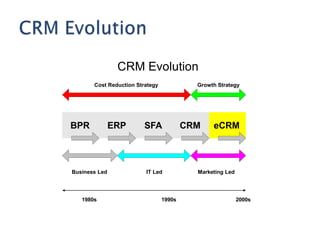
CRM Evolution
       Cost Reduction Strategy             Growth Strategy


BPR            ERP       SFA             CRM    eCRM


Business Led             IT Led            Marketing Led


   1980s                         1990s                     2000s
ECRM is the customer focussed management of the
whole eBusiness relationship with each customer, in
order to measure, create and increase income and
reduce costs for each customer & segment and thus to
generate greater positive lifetime value.

Put simply, eCRM means CRM-
database access via the Web. It
means Intranet access for
internal users, extranet access
for business partners and
customers and of
course, Internet access for the
market at large.
e-CRM expands the traditional CRM
techniques by integrating new electronic
channels, such as Web, wireless, and voice
technologies and combines it with e-business
applications into the overall enterprise CRM
strategy.

   Traditional CRM + Internet = e-CRM
   Due to the introduction of new technology
   Due to globalization
   Changing customer attitudes and
    expectations
   To gain competitive advantage
   To measure, create and increase income for
    the business
   To reduce costs
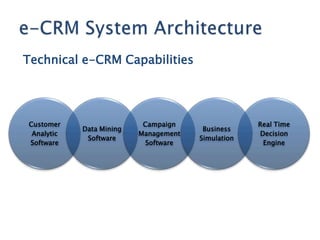
Technical e-CRM Capabilities


Customer                   Campaign                 Real Time
            Data Mining                 Business
 Analytic                 Management                Decision
             Software                  Simulation
Software                    Software                 Engine
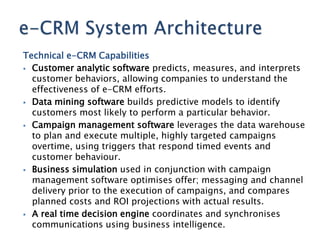
Technical e-CRM Capabilities
 Customer analytic software predicts, measures, and interprets
  customer behaviors, allowing companies to understand the
  effectiveness of e-CRM efforts.
 Data mining software builds predictive models to identify
  customers most likely to perform a particular behavior.
 Campaign management software leverages the data warehouse
  to plan and execute multiple, highly targeted campaigns
  overtime, using triggers that respond timed events and
  customer behaviour.
 Business simulation used in conjunction with campaign
  management software optimises offer; messaging and channel
  delivery prior to the execution of campaigns, and compares
  planned costs and ROI projections with actual results.
 A real time decision engine coordinates and synchronises
  communications using business intelligence.
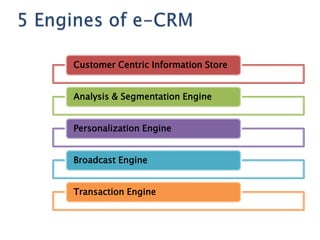
Customer Centric Information Store


Analysis & Segmentation Engine


Personalization Engine


Broadcast Engine


Transaction Engine
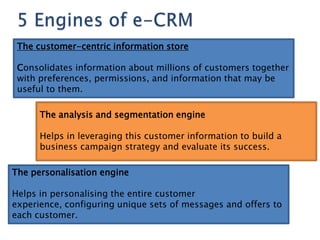
The customer-centric information store

 Consolidates information about millions of customers together
 with preferences, permissions, and information that may be
 useful to them.

      The analysis and segmentation engine

      Helps in leveraging this customer information to build a
      business campaign strategy and evaluate its success.

The personalisation engine

Helps in personalising the entire customer
experience, configuring unique sets of messages and offers to
each customer.
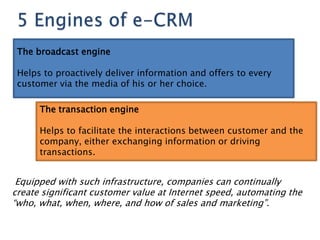
The broadcast engine

 Helps to proactively deliver information and offers to every
 customer via the media of his or her choice.

      The transaction engine

      Helps to facilitate the interactions between customer and the
      company, either exchanging information or driving
      transactions.


 Equipped with such infrastructure, companies can continually
create significant customer value at Internet speed, automating the
―who, what, when, where, and how of sales and marketing‖.
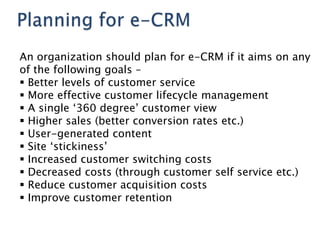
An organization should plan for e-CRM if it aims on any
of the following goals –
 Better levels of customer service
 More effective customer lifecycle management
 A single ‗360 degree‘ customer view
 Higher sales (better conversion rates etc.)
 User-generated content
 Site ‗stickiness‘
 Increased customer switching costs
 Decreased costs (through customer self service etc.)
 Reduce customer acquisition costs
 Improve customer retention
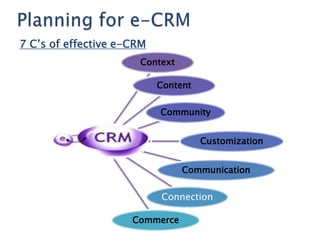
7 C‘s of effective e-CRM
                      Context

                           Content


                           Community


                                     Customization


                                Communication


                           Connection

                     Commerce
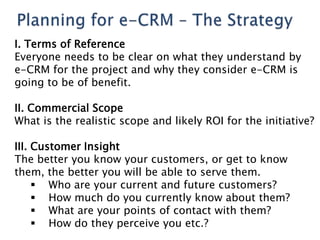
I. Terms of Reference
Everyone needs to be clear on what they understand by
e-CRM for the project and why they consider e-CRM is
going to be of benefit.

II. Commercial Scope
What is the realistic scope and likely ROI for the initiative?

III. Customer Insight
The better you know your customers, or get to know
them, the better you will be able to serve them.
      Who are your current and future customers?
      How much do you currently know about them?
      What are your points of contact with them?
      How do they perceive you etc.?
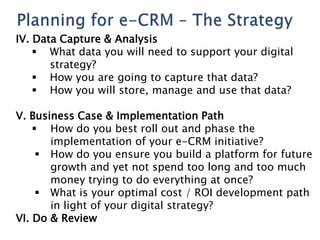
IV. Data Capture & Analysis
     What data you will need to support your digital
       strategy?
     How you are going to capture that data?
     How you will store, manage and use that data?

V. Business Case & Implementation Path
     How do you best roll out and phase the
       implementation of your e-CRM initiative?
      How do you ensure you build a platform for future
       growth and yet not spend too long and too much
       money trying to do everything at once?
      What is your optimal cost / ROI development path
       in light of your digital strategy?
VI. Do & Review
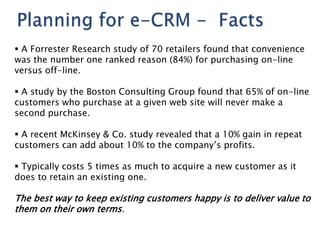
 A Forrester Research study of 70 retailers found that convenience
was the number one ranked reason (84%) for purchasing on-line
versus off-line.

 A study by the Boston Consulting Group found that 65% of on-line
customers who purchase at a given web site will never make a
second purchase.

 A recent McKinsey & Co. study revealed that a 10% gain in repeat
customers can add about 10% to the company‘s profits.

 Typically costs 5 times as much to acquire a new customer as it
does to retain an existing one.

The best way to keep existing customers happy is to deliver value to
them on their own terms.
Oracle
                                        1


India‘s                                Demand Products
                                2
 Top 5
e-CRMs

                                    SAP CRM
                         3


                         MS Dynamics
              4              CRM


                  Sage
          5
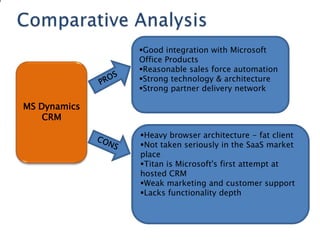
Good integration with Microsoft
              Office Products
              Reasonable sales force automation
              Strong technology & architecture
              Strong partner delivery network

MS Dynamics
    CRM
              Heavy browser architecture - fat client
              Not taken seriously in the SaaS market
              place
              Titan is Microsoft's first attempt at
              hosted CRM
              Weak marketing and customer support
              Lacks functionality depth
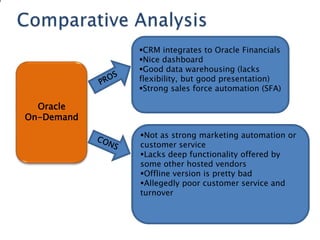
CRM integrates to Oracle Financials
            Nice dashboard
            Good data warehousing (lacks
            flexibility, but good presentation)
            Strong sales force automation (SFA)

  Oracle
On-Demand
            Not as strong marketing automation or
            customer service
            Lacks deep functionality offered by
            some other hosted vendors
            Offline version is pretty bad
            Allegedly poor customer service and
            turnover
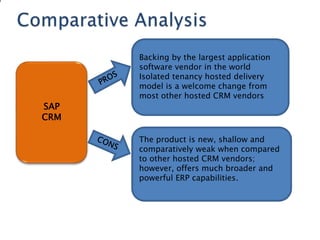
Backing by the largest application
      software vendor in the world
      Isolated tenancy hosted delivery
      model is a welcome change from
      most other hosted CRM vendors
SAP
CRM

      The product is new, shallow and
      comparatively weak when compared
      to other hosted CRM vendors;
      however, offers much broader and
      powerful ERP capabilities.
Get a ‗360—degree‘ view of your
           customer
E-CRM

E-CRM

  • 1.
  • 2.
    CRM is a strategy by which companies optimise profitability through enhanced customer satisfaction.  CRM is about automating and enhancing the customer- centric business processes of Sales, Marketing, and Service.  CRM also focuses on added customer loyalty that directly affects the organization’s bottom line.
  • 4.
    CRM Evolution Cost Reduction Strategy Growth Strategy BPR ERP SFA CRM eCRM Business Led IT Led Marketing Led 1980s 1990s 2000s
  • 5.
    ECRM is thecustomer focussed management of the whole eBusiness relationship with each customer, in order to measure, create and increase income and reduce costs for each customer & segment and thus to generate greater positive lifetime value. Put simply, eCRM means CRM- database access via the Web. It means Intranet access for internal users, extranet access for business partners and customers and of course, Internet access for the market at large.
  • 6.
    e-CRM expands thetraditional CRM techniques by integrating new electronic channels, such as Web, wireless, and voice technologies and combines it with e-business applications into the overall enterprise CRM strategy. Traditional CRM + Internet = e-CRM
  • 7.
    Due to the introduction of new technology  Due to globalization  Changing customer attitudes and expectations  To gain competitive advantage  To measure, create and increase income for the business  To reduce costs
  • 9.
    Technical e-CRM Capabilities Customer Campaign Real Time Data Mining Business Analytic Management Decision Software Simulation Software Software Engine
  • 10.
    Technical e-CRM Capabilities Customer analytic software predicts, measures, and interprets customer behaviors, allowing companies to understand the effectiveness of e-CRM efforts.  Data mining software builds predictive models to identify customers most likely to perform a particular behavior.  Campaign management software leverages the data warehouse to plan and execute multiple, highly targeted campaigns overtime, using triggers that respond timed events and customer behaviour.  Business simulation used in conjunction with campaign management software optimises offer; messaging and channel delivery prior to the execution of campaigns, and compares planned costs and ROI projections with actual results.  A real time decision engine coordinates and synchronises communications using business intelligence.
  • 12.
    Customer Centric InformationStore Analysis & Segmentation Engine Personalization Engine Broadcast Engine Transaction Engine
  • 13.
    The customer-centric informationstore Consolidates information about millions of customers together with preferences, permissions, and information that may be useful to them. The analysis and segmentation engine Helps in leveraging this customer information to build a business campaign strategy and evaluate its success. The personalisation engine Helps in personalising the entire customer experience, configuring unique sets of messages and offers to each customer.
  • 14.
    The broadcast engine Helps to proactively deliver information and offers to every customer via the media of his or her choice. The transaction engine Helps to facilitate the interactions between customer and the company, either exchanging information or driving transactions. Equipped with such infrastructure, companies can continually create significant customer value at Internet speed, automating the ―who, what, when, where, and how of sales and marketing‖.
  • 15.
    An organization shouldplan for e-CRM if it aims on any of the following goals –  Better levels of customer service  More effective customer lifecycle management  A single ‗360 degree‘ customer view  Higher sales (better conversion rates etc.)  User-generated content  Site ‗stickiness‘  Increased customer switching costs  Decreased costs (through customer self service etc.)  Reduce customer acquisition costs  Improve customer retention
  • 16.
    7 C‘s ofeffective e-CRM Context Content Community Customization Communication Connection Commerce
  • 17.
    I. Terms ofReference Everyone needs to be clear on what they understand by e-CRM for the project and why they consider e-CRM is going to be of benefit. II. Commercial Scope What is the realistic scope and likely ROI for the initiative? III. Customer Insight The better you know your customers, or get to know them, the better you will be able to serve them.  Who are your current and future customers?  How much do you currently know about them?  What are your points of contact with them?  How do they perceive you etc.?
  • 18.
    IV. Data Capture& Analysis  What data you will need to support your digital strategy?  How you are going to capture that data?  How you will store, manage and use that data? V. Business Case & Implementation Path  How do you best roll out and phase the implementation of your e-CRM initiative?  How do you ensure you build a platform for future growth and yet not spend too long and too much money trying to do everything at once?  What is your optimal cost / ROI development path in light of your digital strategy? VI. Do & Review
  • 19.
     A ForresterResearch study of 70 retailers found that convenience was the number one ranked reason (84%) for purchasing on-line versus off-line.  A study by the Boston Consulting Group found that 65% of on-line customers who purchase at a given web site will never make a second purchase.  A recent McKinsey & Co. study revealed that a 10% gain in repeat customers can add about 10% to the company‘s profits.  Typically costs 5 times as much to acquire a new customer as it does to retain an existing one. The best way to keep existing customers happy is to deliver value to them on their own terms.
  • 20.
    Oracle 1 India‘s Demand Products 2 Top 5 e-CRMs SAP CRM 3 MS Dynamics 4 CRM Sage 5
  • 21.
    Good integration withMicrosoft Office Products Reasonable sales force automation Strong technology & architecture Strong partner delivery network MS Dynamics CRM Heavy browser architecture - fat client Not taken seriously in the SaaS market place Titan is Microsoft's first attempt at hosted CRM Weak marketing and customer support Lacks functionality depth
  • 22.
    CRM integrates toOracle Financials Nice dashboard Good data warehousing (lacks flexibility, but good presentation) Strong sales force automation (SFA) Oracle On-Demand Not as strong marketing automation or customer service Lacks deep functionality offered by some other hosted vendors Offline version is pretty bad Allegedly poor customer service and turnover
  • 23.
    Backing by thelargest application software vendor in the world Isolated tenancy hosted delivery model is a welcome change from most other hosted CRM vendors SAP CRM The product is new, shallow and comparatively weak when compared to other hosted CRM vendors; however, offers much broader and powerful ERP capabilities.
  • 24.
    Get a ‗360—degree‘view of your customer

Editor's Notes

  • #6 It is the expected profit that you will realize from sales to a particular customer in the future. Although it builds on past customer history, LTV is all about the future.