Strategic Alliance 
Presented By: Mohamed Zakaria 
Presented To: Dr. Amr Kheir El din 
ESLSCA Global Business Diploma 
October 2014
Definition of Strategic alliances 
• Strategic alliances are cooperative agreements 
between two or more companies to work together 
and share resources to achieve a common 
business objective, Each company maintains its 
autonomy while gaining a new opportunity 
• A global strategic alliance is an agreement among 
two or more independent firm to co-operate for 
the purpose of achieving common goal such as a 
competitive advantage or customer value creation 
while remaining independent
Definition of Strategic alliances 
Strategic alliances are agreements 
between companies (partners) to reach 
objectives of a common interest. Alliances 
are among the various options which 
companies can use to achieve their goals. 
They are based on cooperation between Companies
Motives for Alliances 
• You can’t do everything. 
• Adding value to product. 
• Improving market access. 
• Strengthening operations. 
• Adding technological strength. 
• Enhancing strategic growth. 
• Building finance strength. 
• New market entry INFORMATION
WHY STRATEGIC ALLIANCE..? 
• Sharing resources like products, distribution 
channels, manufacturing capability, project 
funding, capital equipment, knowledge, expertise, 
or intellectual property, to create Synergy to gain 
Competitive Advantage 
• “Our success has really been based 
on partnerships from the very beginning.” Bill Gates
Purposes of Strategic Alliances 
• Alliances enable buying & supplying firms to 
combine their individual strengths & work 
together to reduce non-value-adding activities 
& facilitate improved performance. 
• In order for both parties to remain committed 
to this form of relationship, mutual benefit 
must exist (i.e. a "win-win" relationship) 
1+1=3
KEY FACTORS OF STRATEGIC ALLIANCE 
• Select the proper partners for the intended goals 
• Share the right information 
• Negotiate A deal that includes risk and benefit 
• Come to a realistic agreement on the time 
• Mutual, flexible commitment on what's suitable to 
change, measure and share within each partner's 
culture 
• Respect and protect the brand of each partner
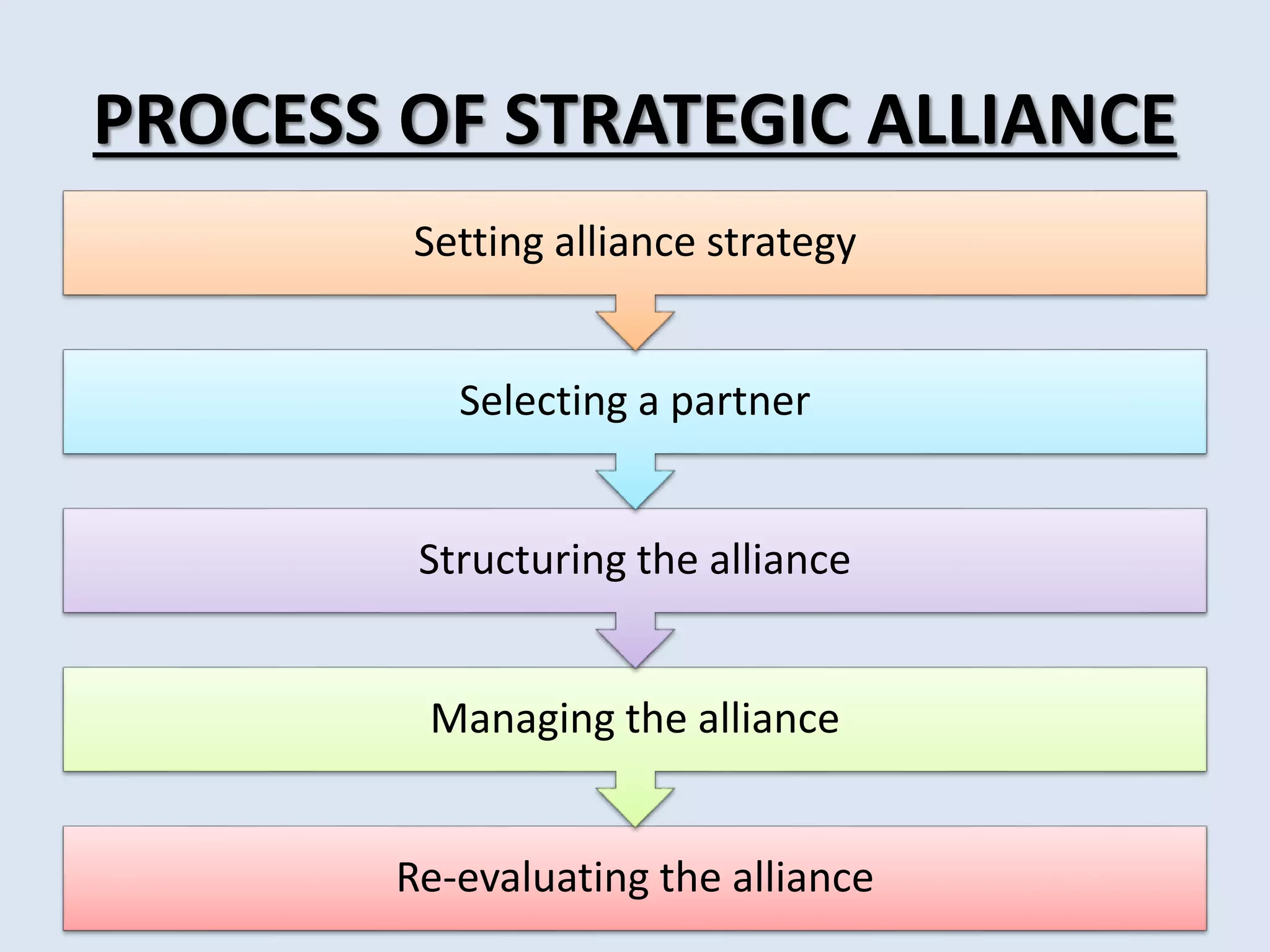
PROCESS OF STRATEGIC ALLIANCE 
Setting alliance strategy 
Selecting a partner 
Structuring the alliance 
Managing the alliance 
Re-evaluating the alliance
Types OF STRATEGIC ALLIANCE 
Joint venture Equity strategic 
alliance 
Non- Equity 
strategic alliance 
Global Strategic 
Alliances
Types of Strategic Alliances 
• Joint Venture: an agreement by two or more parties to form 
a single entity to undertake a certain project. Each of the 
businesses has an equity stake in the individual business and 
share revenues, expenses & profits. 
• Global Strategic Alliances: working partnerships between 
companies (often more than 2) across national boundaries & 
increasingly across industries. Sometimes formed between 
company & a foreign government, or among companies & 
governments
Types of Strategic Alliances 
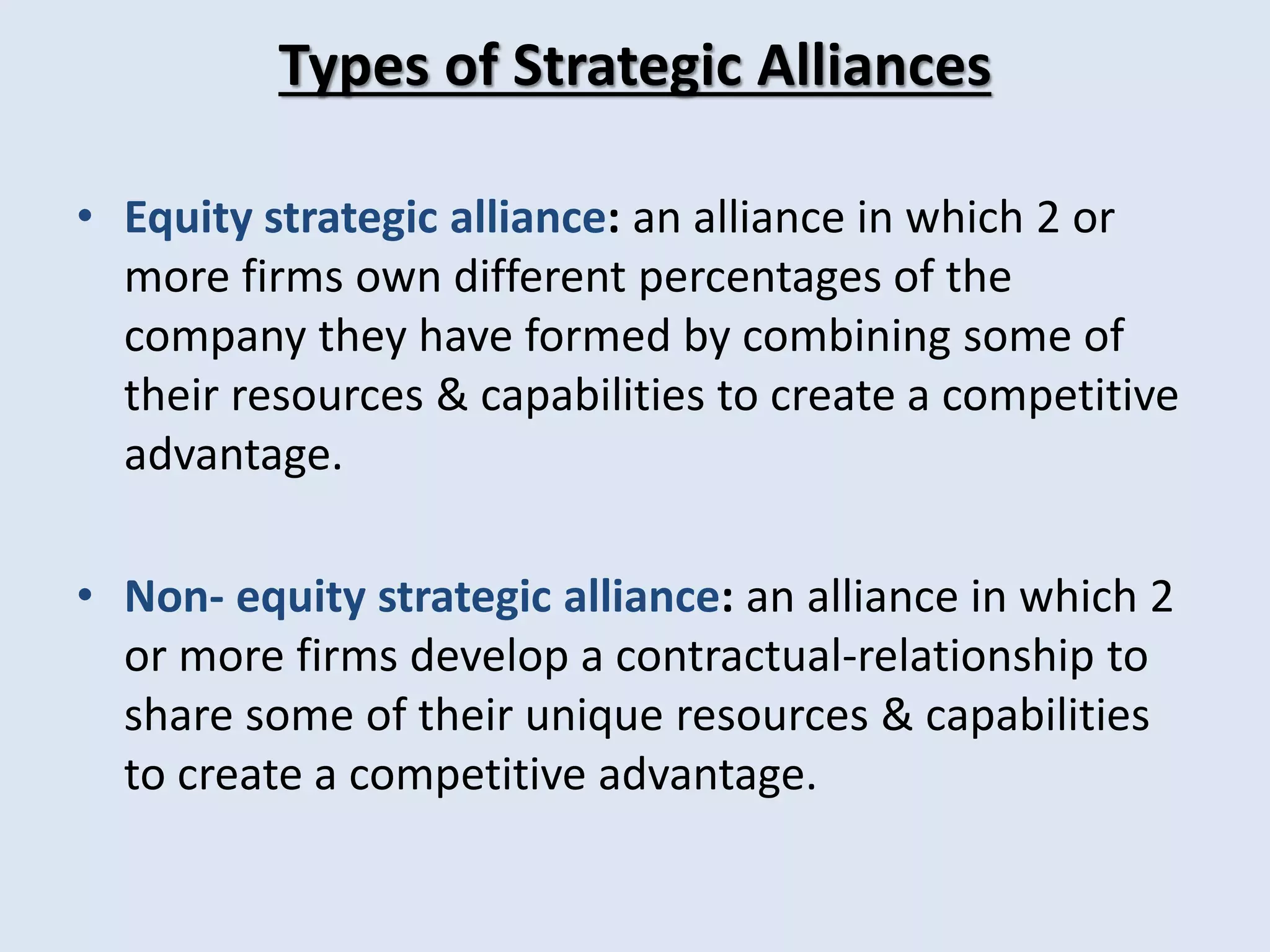
• Equity strategic alliance: an alliance in which 2 or 
more firms own different percentages of the 
company they have formed by combining some of 
their resources & capabilities to create a competitive 
advantage. 
• Non- equity strategic alliance: an alliance in which 2 
or more firms develop a contractual-relationship to 
share some of their unique resources & capabilities 
to create a competitive advantage.
ADVANTAGES 
• Improve organization efficiency. 
• Offer to access new market and technologies. 
• Reduce the impact of risk. 
• Learning from partners 
• Alliance could help a company develop a more 
effective process expand into a new market or 
develop an advantage over a competitor. 
Competitive Advantage
Disadvantages 
• Significant differences between the 
objectives 
• Irreconcilable differences in business 
culture and management styles. 
• Loss of control over such important issues 
as product quality, operating costs, 
employees, etc.
Examples of Alliances 
Starbucks 
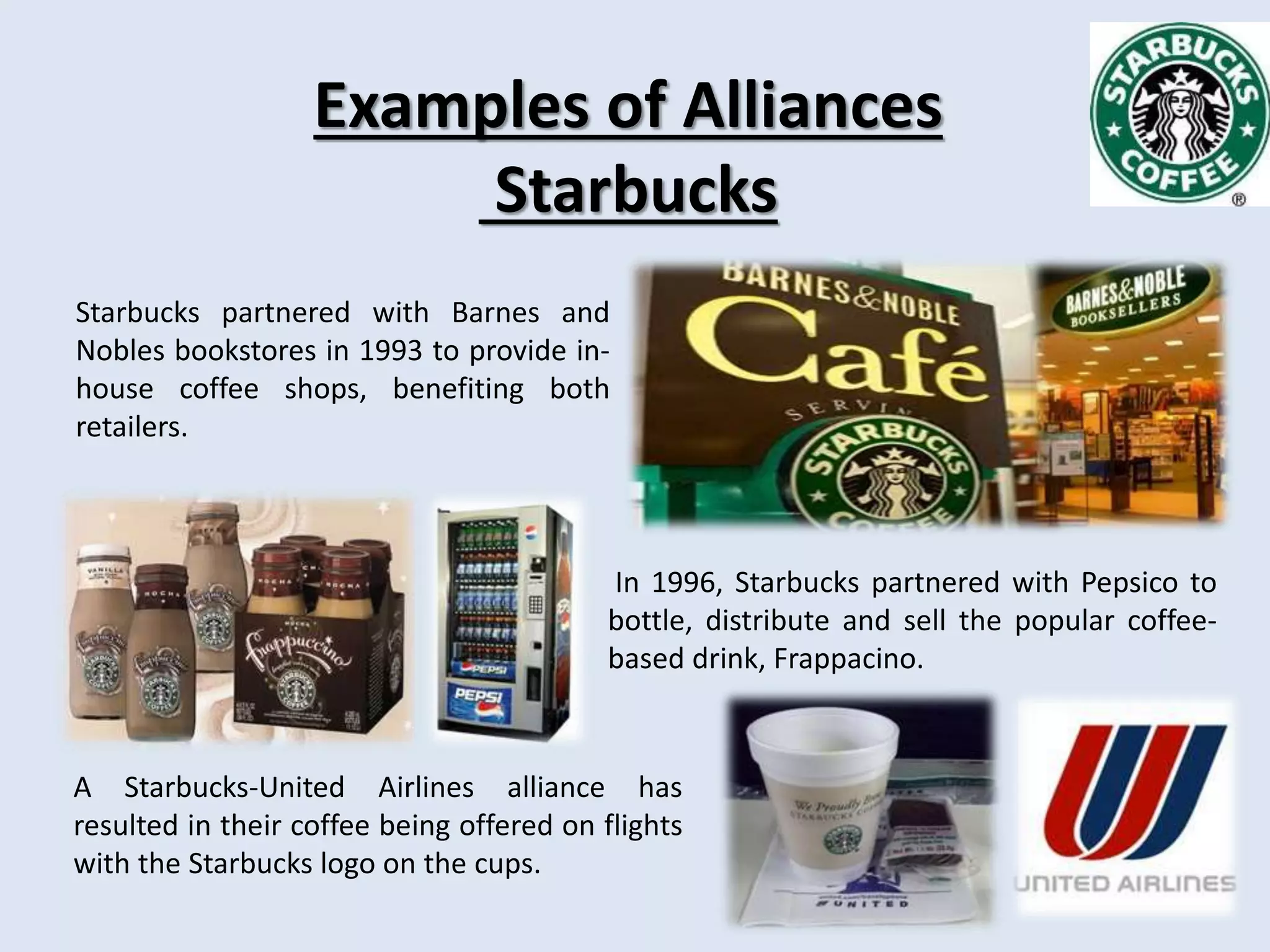
Starbucks partnered with Barnes and 
Nobles bookstores in 1993 to provide in-house 
coffee shops, benefiting both 
retailers. 
In 1996, Starbucks partnered with Pepsico to 
bottle, distribute and sell the popular coffee-based 
drink, Frappacino. 
A Starbucks-United Airlines alliance has 
resulted in their coffee being offered on flights 
with the Starbucks logo on the cups.
Mistakes Leading to Failure 
• Alliance business is viewed internally by one 
partner. 
• One of the partners is too dependent on the 
other’s capabilities. 
• Problems and mistrust. 
• Cultural & language barriers. 
• Collaboration in competitively sensitive areas can 
be difficult. 
• A clash of egos might occur.
Examples of Alliances 
• Nokia and Microsoft in alliance to make Zune phone 
• Star Alliance – Airlines alliances. 
• Philips and Sony jointly launched the mini-CD. 
• Nestlé and Fonterra Sign Agreement on Dairy Alliance for 
the America 
• McDonald’s with Disney, Coca-Cola & Walmart 
• Motorola-Toshiba: In 1987- Toshiba to produce 
microprocessors & contribute access to the distribution 
network.
THANKS

Strategic Alliance

  • 1.
    Strategic Alliance PresentedBy: Mohamed Zakaria Presented To: Dr. Amr Kheir El din ESLSCA Global Business Diploma October 2014
  • 2.
    Definition of Strategicalliances • Strategic alliances are cooperative agreements between two or more companies to work together and share resources to achieve a common business objective, Each company maintains its autonomy while gaining a new opportunity • A global strategic alliance is an agreement among two or more independent firm to co-operate for the purpose of achieving common goal such as a competitive advantage or customer value creation while remaining independent
  • 3.
    Definition of Strategicalliances Strategic alliances are agreements between companies (partners) to reach objectives of a common interest. Alliances are among the various options which companies can use to achieve their goals. They are based on cooperation between Companies
  • 4.
    Motives for Alliances • You can’t do everything. • Adding value to product. • Improving market access. • Strengthening operations. • Adding technological strength. • Enhancing strategic growth. • Building finance strength. • New market entry INFORMATION
  • 5.
    WHY STRATEGIC ALLIANCE..? • Sharing resources like products, distribution channels, manufacturing capability, project funding, capital equipment, knowledge, expertise, or intellectual property, to create Synergy to gain Competitive Advantage • “Our success has really been based on partnerships from the very beginning.” Bill Gates
  • 6.
    Purposes of StrategicAlliances • Alliances enable buying & supplying firms to combine their individual strengths & work together to reduce non-value-adding activities & facilitate improved performance. • In order for both parties to remain committed to this form of relationship, mutual benefit must exist (i.e. a "win-win" relationship) 1+1=3
  • 7.
    KEY FACTORS OFSTRATEGIC ALLIANCE • Select the proper partners for the intended goals • Share the right information • Negotiate A deal that includes risk and benefit • Come to a realistic agreement on the time • Mutual, flexible commitment on what's suitable to change, measure and share within each partner's culture • Respect and protect the brand of each partner
  • 8.
    PROCESS OF STRATEGICALLIANCE Setting alliance strategy Selecting a partner Structuring the alliance Managing the alliance Re-evaluating the alliance
  • 9.
    Types OF STRATEGICALLIANCE Joint venture Equity strategic alliance Non- Equity strategic alliance Global Strategic Alliances
  • 10.
    Types of StrategicAlliances • Joint Venture: an agreement by two or more parties to form a single entity to undertake a certain project. Each of the businesses has an equity stake in the individual business and share revenues, expenses & profits. • Global Strategic Alliances: working partnerships between companies (often more than 2) across national boundaries & increasingly across industries. Sometimes formed between company & a foreign government, or among companies & governments
  • 11.
    Types of StrategicAlliances • Equity strategic alliance: an alliance in which 2 or more firms own different percentages of the company they have formed by combining some of their resources & capabilities to create a competitive advantage. • Non- equity strategic alliance: an alliance in which 2 or more firms develop a contractual-relationship to share some of their unique resources & capabilities to create a competitive advantage.
  • 12.
    ADVANTAGES • Improveorganization efficiency. • Offer to access new market and technologies. • Reduce the impact of risk. • Learning from partners • Alliance could help a company develop a more effective process expand into a new market or develop an advantage over a competitor. Competitive Advantage
  • 13.
    Disadvantages • Significantdifferences between the objectives • Irreconcilable differences in business culture and management styles. • Loss of control over such important issues as product quality, operating costs, employees, etc.
  • 14.
    Examples of Alliances Starbucks Starbucks partnered with Barnes and Nobles bookstores in 1993 to provide in-house coffee shops, benefiting both retailers. In 1996, Starbucks partnered with Pepsico to bottle, distribute and sell the popular coffee-based drink, Frappacino. A Starbucks-United Airlines alliance has resulted in their coffee being offered on flights with the Starbucks logo on the cups.
  • 15.
    Mistakes Leading toFailure • Alliance business is viewed internally by one partner. • One of the partners is too dependent on the other’s capabilities. • Problems and mistrust. • Cultural & language barriers. • Collaboration in competitively sensitive areas can be difficult. • A clash of egos might occur.
  • 16.
    Examples of Alliances • Nokia and Microsoft in alliance to make Zune phone • Star Alliance – Airlines alliances. • Philips and Sony jointly launched the mini-CD. • Nestlé and Fonterra Sign Agreement on Dairy Alliance for the America • McDonald’s with Disney, Coca-Cola & Walmart • Motorola-Toshiba: In 1987- Toshiba to produce microprocessors & contribute access to the distribution network.
  • 17.