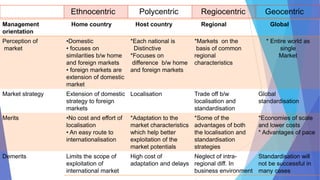
The document discusses four orientations - or levels of involvement - that firms can take when entering international business:
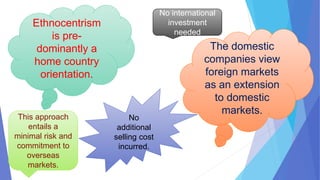
1. Ethnocentric orientation views foreign markets as an extension of the domestic market. Management and operations are controlled from the home country. This approach has minimal risk but also limited potential.
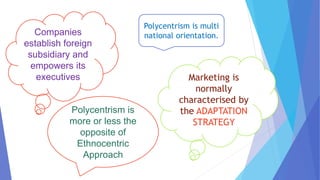
2. Polycentric orientation establishes independent foreign subsidiaries that adapt to local conditions. Each market is viewed as distinct. This increases commitment but allows for better adaptation.
3. Regiocentric orientation groups countries into regions and coordinates strategy at a regional level. This provides improved control while considering regional differences.
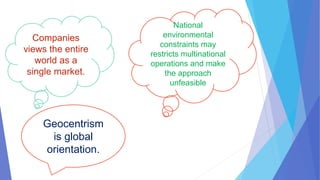
4. Geocentric orientation treats the entire world as a single market. A uniform global strategy is developed