AI in Advertising 2026:
Optimization,
Expectations,
Framework.
A. What is AI In Advertising
● Using AI technologies to automate, optimize, and improve
campaign performance.
● This means AI identifies predictive performance signals after
analyzing data and helps marketers manage bids & budgets,
precise targeting and measure results better.
● You can also use AI to create and refresh creatives/copy and
deploy at scale.
● Result- more personalized, timely, and relevant advertising at a
scale and efficiency that was previously impossible with human
effort alone.
● (And definitely, better ROAS).
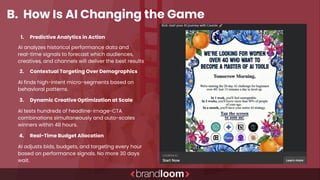
B. How Is AI Changing the Game
1. Predictive Analytics in Action
AI analyzes historical performance data and
real-time signals to forecast which audiences,
creatives, and channels will deliver the best results
2. Contextual Targeting Over Demographics
AI finds high-intent micro-segments based on
behavioral patterns.
3. Dynamic Creative Optimization at Scale
AI tests hundreds of headline-image-CTA
combinations simultaneously and auto-scales
winners within 48 hours.
4. Real-Time Budget Allocation
AI adjusts bids, budgets, and targeting every hour
based on performance signals. No more 30 days
wait.
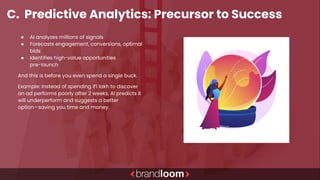
C. Predictive Analytics: Precursor to Success
● AI analyzes millions of signals
● Forecasts engagement, conversions, optimal
bids
● Identifies high-value opportunities
pre-launch
And this is before you even spend a single buck.
Example: Instead of spending ₹1 lakh to discover
an ad performs poorly after 2 weeks, AI predicts it
will underperform and suggests a better
option—saving you time and money.
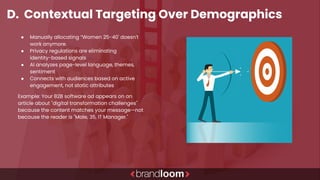
D. Contextual Targeting Over Demographics
● Manually allocating “Women 25-40' doesn't
work anymore.
● Privacy regulations are eliminating
identity-based signals
● AI analyzes page-level language, themes,
sentiment
● Connects with audiences based on active
engagement, not static attributes
Example: Your B2B software ad appears on an
article about "digital transformation challenges"
because the content matches your message—not
because the reader is "Male, 35, IT Manager."
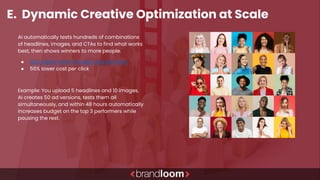
E. Dynamic Creative Optimization at Scale
AI automatically tests hundreds of combinations
of headlines, images, and CTAs to find what works
best, then shows winners to more people.
● 32% higher click-through rate with DCO
● 56% lower cost per click
Example: You upload 5 headlines and 10 images.
AI creates 50 ad versions, tests them all
simultaneously, and within 48 hours automatically
increases budget on the top 3 performers while
pausing the rest.
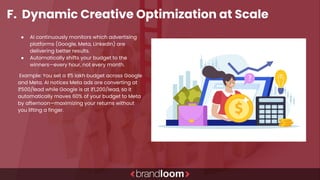
F. Dynamic Creative Optimization at Scale
● AI continuously monitors which advertising
platforms (Google, Meta, LinkedIn) are
delivering better results.
● Automatically shifts your budget to the
winners—every hour, not every month.
Example: You set a ₹5 lakh budget across Google
and Meta. AI notices Meta ads are converting at
₹500/lead while Google is at ₹1,200/lead, so it
automatically moves 60% of your budget to Meta
by afternoon—maximizing your returns without
you lifting a finger.
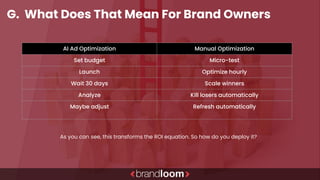
G. What Does That Mean For Brand Owners
AI Ad Optimization Manual Optimization
Set budget Micro-test
Launch Optimize hourly
Wait 30 days Scale winners
Analyze Kill losers automatically
Maybe adjust Refresh automatically
As you can see, this transforms the ROI equation. So how do you deploy it?
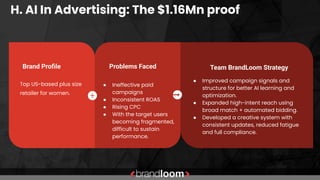
Problems Faced
● Ineffective paid
campaigns
● Inconsistent ROAS
● Rising CPC
● With the target users
becoming fragmented,
difficult to sustain
performance.
Brand Profile
Top US-based plus size
retailer for women.
Team BrandLoom Strategy
● Improved campaign signals and
structure for better AI learning and
optimization.
● Expanded high-intent reach using
broad match + automated bidding.
● Developed a creative system with
consistent updates, reduced fatigue
and full compliance.
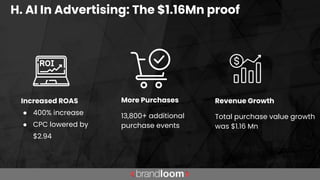
H. AI In Advertising: The $1.16Mn proof
Increased ROAS
● 400% increase
● CPC lowered by
$2.94
More Purchases
13,800+ additional
purchase events
Revenue Growth
Total purchase value growth
was $1.16 Mn
H. AI In Advertising: The $1.16Mn proof
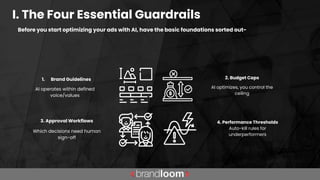
I. The Four Essential Guardrails
Before you start optimizing your ads with AI, have the basic foundations sorted out-
1. Brand Guidelines
AI operates within defined
voice/values
2. Budget Caps
AI optimizes, you control the
ceiling
3. Approval Workflows
Which decisions need human
sign-off
4. Performance Thresholds
Auto-kill rules for
underperformers
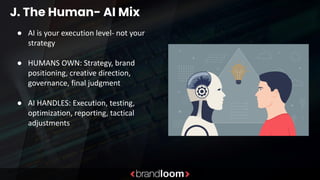
J. The Human- AI Mix
● AI is your execution level- not your
strategy
● HUMANS OWN: Strategy, brand
positioning, creative direction,
governance, final judgment
● AI HANDLES: Execution, testing,
optimization, reporting, tactical
adjustments
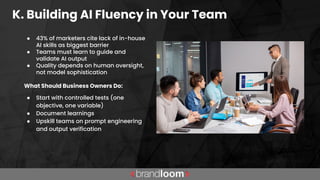
K. Building AI Fluency in Your Team
● 43% of marketers cite lack of in-house
AI skills as biggest barrier
● Teams must learn to guide and
validate AI output
● Quality depends on human oversight,
not model sophistication
What Should Business Owners Do:
● Start with controlled tests (one
objective, one variable)
● Document learnings
● Upskill teams on prompt engineering
and output verification
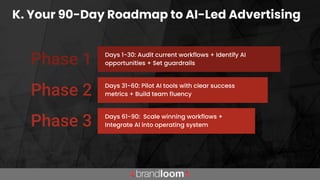
K. Your 90-Day Roadmap to AI-Led Advertising
Phase 1 Days 1-30: Audit current workflows + Identify AI
opportunities + Set guardrails
Phase 2 Days 31-60: Pilot AI tools with clear success
metrics + Build team fluency
Phase 3 Days 61-90: Scale winning workflows +
Integrate AI into operating system
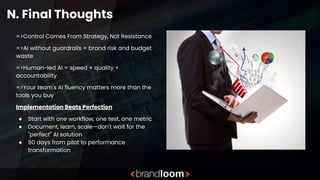
N. Final Thoughts
=>Control Comes From Strategy, Not Resistance
=>AI without guardrails = brand risk and budget
waste
=>Human-led AI = speed + quality +
accountability
=>Your team's AI fluency matters more than the
tools you buy
Implementation Beats Perfection
● Start with one workflow, one test, one metric
● Document, learn, scale—don't wait for the
"perfect" AI solution
● 90 days from pilot to performance
transformation
AI In Advertising 2026 - Optimization Expectation and Framework

AI In Advertising 2026 - Optimization Expectation and Framework

  • 1.
    AI in Advertising2026: Optimization, Expectations, Framework.
  • 2.
    A. What isAI In Advertising ● Using AI technologies to automate, optimize, and improve campaign performance. ● This means AI identifies predictive performance signals after analyzing data and helps marketers manage bids & budgets, precise targeting and measure results better. ● You can also use AI to create and refresh creatives/copy and deploy at scale. ● Result- more personalized, timely, and relevant advertising at a scale and efficiency that was previously impossible with human effort alone. ● (And definitely, better ROAS).
  • 3.
    B. How IsAI Changing the Game 1. Predictive Analytics in Action AI analyzes historical performance data and real-time signals to forecast which audiences, creatives, and channels will deliver the best results 2. Contextual Targeting Over Demographics AI finds high-intent micro-segments based on behavioral patterns. 3. Dynamic Creative Optimization at Scale AI tests hundreds of headline-image-CTA combinations simultaneously and auto-scales winners within 48 hours. 4. Real-Time Budget Allocation AI adjusts bids, budgets, and targeting every hour based on performance signals. No more 30 days wait.
  • 4.
    C. Predictive Analytics:Precursor to Success ● AI analyzes millions of signals ● Forecasts engagement, conversions, optimal bids ● Identifies high-value opportunities pre-launch And this is before you even spend a single buck. Example: Instead of spending ₹1 lakh to discover an ad performs poorly after 2 weeks, AI predicts it will underperform and suggests a better option—saving you time and money.
  • 5.
    D. Contextual TargetingOver Demographics ● Manually allocating “Women 25-40' doesn't work anymore. ● Privacy regulations are eliminating identity-based signals ● AI analyzes page-level language, themes, sentiment ● Connects with audiences based on active engagement, not static attributes Example: Your B2B software ad appears on an article about "digital transformation challenges" because the content matches your message—not because the reader is "Male, 35, IT Manager."
  • 6.
    E. Dynamic CreativeOptimization at Scale AI automatically tests hundreds of combinations of headlines, images, and CTAs to find what works best, then shows winners to more people. ● 32% higher click-through rate with DCO ● 56% lower cost per click Example: You upload 5 headlines and 10 images. AI creates 50 ad versions, tests them all simultaneously, and within 48 hours automatically increases budget on the top 3 performers while pausing the rest.
  • 7.
    F. Dynamic CreativeOptimization at Scale ● AI continuously monitors which advertising platforms (Google, Meta, LinkedIn) are delivering better results. ● Automatically shifts your budget to the winners—every hour, not every month. Example: You set a ₹5 lakh budget across Google and Meta. AI notices Meta ads are converting at ₹500/lead while Google is at ₹1,200/lead, so it automatically moves 60% of your budget to Meta by afternoon—maximizing your returns without you lifting a finger.
  • 8.
    G. What DoesThat Mean For Brand Owners AI Ad Optimization Manual Optimization Set budget Micro-test Launch Optimize hourly Wait 30 days Scale winners Analyze Kill losers automatically Maybe adjust Refresh automatically As you can see, this transforms the ROI equation. So how do you deploy it?
  • 9.
    Problems Faced ● Ineffectivepaid campaigns ● Inconsistent ROAS ● Rising CPC ● With the target users becoming fragmented, difficult to sustain performance. Brand Profile Top US-based plus size retailer for women. Team BrandLoom Strategy ● Improved campaign signals and structure for better AI learning and optimization. ● Expanded high-intent reach using broad match + automated bidding. ● Developed a creative system with consistent updates, reduced fatigue and full compliance. H. AI In Advertising: The $1.16Mn proof
  • 10.
    Increased ROAS ● 400%increase ● CPC lowered by $2.94 More Purchases 13,800+ additional purchase events Revenue Growth Total purchase value growth was $1.16 Mn H. AI In Advertising: The $1.16Mn proof
  • 11.
    I. The FourEssential Guardrails Before you start optimizing your ads with AI, have the basic foundations sorted out- 1. Brand Guidelines AI operates within defined voice/values 2. Budget Caps AI optimizes, you control the ceiling 3. Approval Workflows Which decisions need human sign-off 4. Performance Thresholds Auto-kill rules for underperformers
  • 12.
    J. The Human-AI Mix ● AI is your execution level- not your strategy ● HUMANS OWN: Strategy, brand positioning, creative direction, governance, final judgment ● AI HANDLES: Execution, testing, optimization, reporting, tactical adjustments
  • 13.
    K. Building AIFluency in Your Team ● 43% of marketers cite lack of in-house AI skills as biggest barrier ● Teams must learn to guide and validate AI output ● Quality depends on human oversight, not model sophistication What Should Business Owners Do: ● Start with controlled tests (one objective, one variable) ● Document learnings ● Upskill teams on prompt engineering and output verification
  • 14.
    K. Your 90-DayRoadmap to AI-Led Advertising Phase 1 Days 1-30: Audit current workflows + Identify AI opportunities + Set guardrails Phase 2 Days 31-60: Pilot AI tools with clear success metrics + Build team fluency Phase 3 Days 61-90: Scale winning workflows + Integrate AI into operating system
  • 15.
    N. Final Thoughts =>ControlComes From Strategy, Not Resistance =>AI without guardrails = brand risk and budget waste =>Human-led AI = speed + quality + accountability =>Your team's AI fluency matters more than the tools you buy Implementation Beats Perfection ● Start with one workflow, one test, one metric ● Document, learn, scale—don't wait for the "perfect" AI solution ● 90 days from pilot to performance transformation