Competitor Analysis
18- 2
Objectives
Learn how to understand competitors asLearn how to understand competitors as
well as customers via competitorwell as customers via competitor
analysis.analysis.
Learn the fundamentals of competitiveLearn the fundamentals of competitive
marketing strategies based on creatingmarketing strategies based on creating
value for customers.value for customers.
Realize the need for balancing customerRealize the need for balancing customer
and competitor organizations in order toand competitor organizations in order to
become a truly market-centeredbecome a truly market-centered
organization.organization.
18- 3
Has dominated theHas dominated the
chip industrychip industry
Success is directlySuccess is directly
related torelated to Intel’sIntel’s
competitivecompetitive
strategystrategy
Strategy focusesStrategy focuses
on superior valueon superior value
and productand product
leadershipleadership
Heavy focus onHeavy focus on
product andproduct and
advertising innovationadvertising innovation
and R&D investmentsand R&D investments
Changing marketChanging market
needs haveneeds have
challenged Intel tochallenged Intel to
adaptadapt
Intel is capitalizing onIntel is capitalizing on
the Internet nowthe Internet now
cIntelIntel
18- 4
Definition
CompetitiveCompetitive AdvantageAdvantage
 An advantageAn advantage
over competitorsover competitors
gained by offeringgained by offering
consumers greaterconsumers greater
value thanvalue than
competitors offer.competitors offer.
18- 5
Definition
Competitive AnalysisCompetitive Analysis
 The process of identifying keyThe process of identifying key
competitors; assessing theircompetitors; assessing their
objectives, strategies, strengthsobjectives, strategies, strengths
and weaknesses, and reactionand weaknesses, and reaction
patterns; and selecting whichpatterns; and selecting which
competitors to attack or avoid.competitors to attack or avoid.
18- 6
Figure 18-1:
Steps in Analyzing
Competitors
18- 7
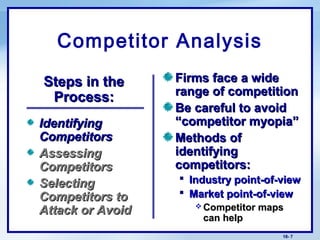
Competitor Analysis
Firms face a wideFirms face a wide
range of competitionrange of competition
Be careful to avoidBe careful to avoid
“competitor myopia”“competitor myopia”
Methods ofMethods of
identifyingidentifying
competitors:competitors:
 Industry point-of-viewIndustry point-of-view
 Market point-of-viewMarket point-of-view
 Competitor mapsCompetitor maps
can helpcan help
IdentifyingIdentifying
CompetitorsCompetitors
AssessingAssessing
CompetitorsCompetitors
SelectingSelecting
Competitors toCompetitors to
Attack or AvoidAttack or Avoid
Steps in theSteps in the
Process:Process:
18- 8
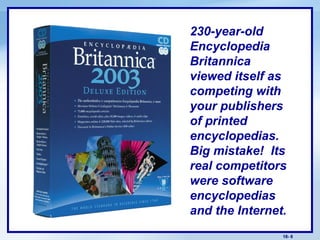
230-year-old
Encyclopedia
Britannica
viewed itself as
competing with
your publishers
of printed
encyclopedias.
Big mistake! Its
real competitors
were software
encyclopedias
and the Internet.
18- 9
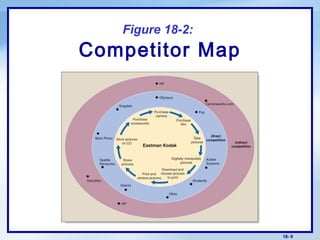
Figure 18-2:
Competitor Map
18- 10
Create a competitorCreate a competitor
map for one of themap for one of the
following:following:
• WalMartWalMart
• McDonald’sMcDonald’s
• NikeNike
• StarbucksStarbucks
• GoogleGoogle
Discussion Question
18- 11
Competitor Analysis
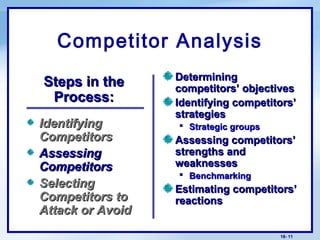
DeterminingDetermining
competitors’ objectivescompetitors’ objectives
Identifying competitors’Identifying competitors’
strategiesstrategies
 Strategic groupsStrategic groups
Assessing competitors’Assessing competitors’
strengths andstrengths and
weaknessesweaknesses
 BenchmarkingBenchmarking
Estimating competitors’Estimating competitors’
reactionsreactions
IdentifyingIdentifying
CompetitorsCompetitors
AssessingAssessing
CompetitorsCompetitors
SelectingSelecting
Competitors toCompetitors to
Attack or AvoidAttack or Avoid
Steps in theSteps in the
Process:Process:
18- 12
Competitor Analysis
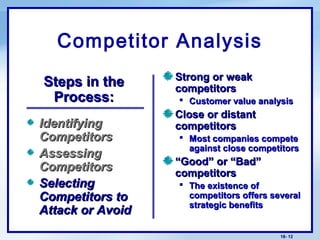
Strong or weakStrong or weak
competitorscompetitors
 Customer value analysisCustomer value analysis
Close or distantClose or distant
competitorscompetitors
 Most companies competeMost companies compete
against close competitorsagainst close competitors
““Good” or “Bad”Good” or “Bad”
competitorscompetitors
 The existence ofThe existence of
competitors offers severalcompetitors offers several
strategic benefitsstrategic benefits
IdentifyingIdentifying
CompetitorsCompetitors
AssessingAssessing
CompetitorsCompetitors
SelectingSelecting
Competitors toCompetitors to
Attack or AvoidAttack or Avoid
Steps in theSteps in the
Process:Process:
18- 13
Basic Winning CompetitiveBasic Winning Competitive
Strategies: PorterStrategies: Porter
 Overall cost leadershipOverall cost leadership
 Lowest production andLowest production and
distribution costsdistribution costs
 DifferentiationDifferentiation
 Creating a highlyCreating a highly
differentiated product linedifferentiated product line
and marketing programand marketing program
 FocusFocus
 Effort is focused on servingEffort is focused on serving
a few market segmentsa few market segments
Competitive Strategies
18- 14
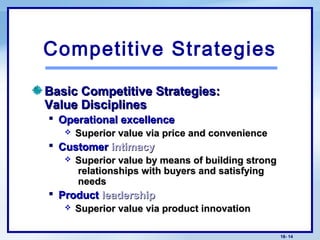
Basic Competitive Strategies:Basic Competitive Strategies:
Value DisciplinesValue Disciplines
 Operational excellenceOperational excellence
 Superior value via price and convenienceSuperior value via price and convenience
 CustomerCustomer intimacyintimacy
 Superior value by means of building strongSuperior value by means of building strong
relationships with buyers and satisfyingrelationships with buyers and satisfying
needsneeds
 ProductProduct leadershipleadership
 Superior value via product innovationSuperior value via product innovation
Competitive Strategies
18- 15
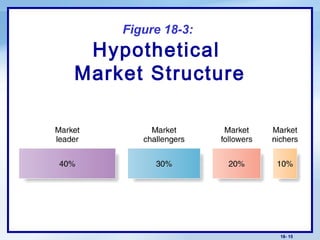
Figure 18-3:
Hypothetical
Market Structure
18- 16
Competitive Strategy
Expanding the totalExpanding the total
demanddemand
 Finding new usersFinding new users
 Discovering andDiscovering and
promoting new productpromoting new product
usesuses
 Encouraging greaterEncouraging greater
product usageproduct usage
Protecting market shareProtecting market share
 ManyMany considerationsconsiderations
 Continuous innovationContinuous innovation
Expanding market shareExpanding market share
 Profitability rises withProfitability rises with
market sharemarket share
Market LeaderMarket Leader
MarketMarket
ChallengerChallenger
MarketMarket
FollowerFollower
Market NicherMarket Nicher
CompetitiveCompetitive
PositionsPositions
18- 17
Competitive Strategy
WD-40 has a knack
for developing new
uses for its product.
What other brands
have adopted a
similar strategy?
WD40
18- 18
Competitive Strategy
Option 1:Option 1: challenge thechallenge the
market leadermarket leader
 High-risk but high-gainHigh-risk but high-gain
 Sustainable competitiveSustainable competitive
advantage over the leaderadvantage over the leader
is key to successis key to success
Option 2:Option 2: challenge firmschallenge firms
of the same size, smallerof the same size, smaller
size or challengesize or challenge
regional or local firmsregional or local firms
Full frontal vs. indirectFull frontal vs. indirect
attacksattacks
Market LeaderMarket Leader
MarketMarket
ChallengerChallenger
MarketMarket
FollowerFollower
Market NicherMarket Nicher
CompetitiveCompetitive
PositionsPositions
18- 19
Pepsi is an
example of
market
challenger
that has
chosen to use
a full frontal
attack
18- 20
Competitive Strategy
Follow the marketFollow the market
leaderleader
 Focus is on improvingFocus is on improving
profit instead ofprofit instead of
market sharemarket share
 Many advantages:Many advantages:
 LearnLearn from thefrom the
market leader’smarket leader’s
experienceexperience
 Copy or improve onCopy or improve on
the leader’s offeringsthe leader’s offerings
 Strong profitabilityStrong profitability
Market LeaderMarket Leader
MarketMarket
ChallengerChallenger
MarketMarket
FollowerFollower
Market NicherMarket Nicher
CompetitiveCompetitive
PositionsPositions
18- 21
Dial Corporation
successfully
uses a market
follower strategy
18- 22
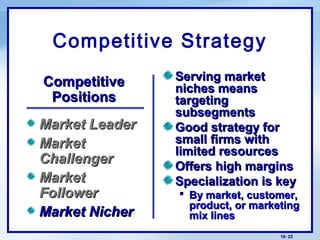
Competitive Strategy
Serving marketServing market
niches meansniches means
targetingtargeting
subsegmentssubsegments
Good strategy forGood strategy for
small firms withsmall firms with
limited resourceslimited resources
Offers high marginsOffers high margins
Specialization is keySpecialization is key
 By market, customer,By market, customer,
product, or marketingproduct, or marketing
mix linesmix lines
Market LeaderMarket Leader
MarketMarket
ChallengerChallenger
MarketMarket
FollowerFollower
Market NicherMarket Nicher
CompetitiveCompetitive
PositionsPositions
18- 23
Companies can become soCompanies can become so
competitor centered that theycompetitor centered that they
lose their customer focus.lose their customer focus.
Types of companies:Types of companies:
 Competitor-centered companiesCompetitor-centered companies
 Customer-centered companiesCustomer-centered companies
 Market-centered companiesMarket-centered companies
Balancing Customer and
Competitor Orientations
18- 24
Game playing industry
a.a. NintendoNintendo
a.a. Wii hyperlinkWii hyperlink
b.b. MicrosoftMicrosoft
a.a. Xbox 360Xbox 360
c.c. SonySony
a.a. Play StationPlay Station

Competitor Analysis

  • 1.
  • 2.
    18- 2 Objectives Learn howto understand competitors asLearn how to understand competitors as well as customers via competitorwell as customers via competitor analysis.analysis. Learn the fundamentals of competitiveLearn the fundamentals of competitive marketing strategies based on creatingmarketing strategies based on creating value for customers.value for customers. Realize the need for balancing customerRealize the need for balancing customer and competitor organizations in order toand competitor organizations in order to become a truly market-centeredbecome a truly market-centered organization.organization.
  • 3.
    18- 3 Has dominatedtheHas dominated the chip industrychip industry Success is directlySuccess is directly related torelated to Intel’sIntel’s competitivecompetitive strategystrategy Strategy focusesStrategy focuses on superior valueon superior value and productand product leadershipleadership Heavy focus onHeavy focus on product andproduct and advertising innovationadvertising innovation and R&D investmentsand R&D investments Changing marketChanging market needs haveneeds have challenged Intel tochallenged Intel to adaptadapt Intel is capitalizing onIntel is capitalizing on the Internet nowthe Internet now cIntelIntel
  • 4.
    18- 4 Definition CompetitiveCompetitive AdvantageAdvantage An advantageAn advantage over competitorsover competitors gained by offeringgained by offering consumers greaterconsumers greater value thanvalue than competitors offer.competitors offer.
  • 5.
    18- 5 Definition Competitive AnalysisCompetitiveAnalysis  The process of identifying keyThe process of identifying key competitors; assessing theircompetitors; assessing their objectives, strategies, strengthsobjectives, strategies, strengths and weaknesses, and reactionand weaknesses, and reaction patterns; and selecting whichpatterns; and selecting which competitors to attack or avoid.competitors to attack or avoid.
  • 6.
    18- 6 Figure 18-1: Stepsin Analyzing Competitors
  • 7.
    18- 7 Competitor Analysis Firmsface a wideFirms face a wide range of competitionrange of competition Be careful to avoidBe careful to avoid “competitor myopia”“competitor myopia” Methods ofMethods of identifyingidentifying competitors:competitors:  Industry point-of-viewIndustry point-of-view  Market point-of-viewMarket point-of-view  Competitor mapsCompetitor maps can helpcan help IdentifyingIdentifying CompetitorsCompetitors AssessingAssessing CompetitorsCompetitors SelectingSelecting Competitors toCompetitors to Attack or AvoidAttack or Avoid Steps in theSteps in the Process:Process:
  • 8.
    18- 8 230-year-old Encyclopedia Britannica viewed itselfas competing with your publishers of printed encyclopedias. Big mistake! Its real competitors were software encyclopedias and the Internet.
  • 9.
  • 10.
    18- 10 Create acompetitorCreate a competitor map for one of themap for one of the following:following: • WalMartWalMart • McDonald’sMcDonald’s • NikeNike • StarbucksStarbucks • GoogleGoogle Discussion Question
  • 11.
    18- 11 Competitor Analysis DeterminingDetermining competitors’objectivescompetitors’ objectives Identifying competitors’Identifying competitors’ strategiesstrategies  Strategic groupsStrategic groups Assessing competitors’Assessing competitors’ strengths andstrengths and weaknessesweaknesses  BenchmarkingBenchmarking Estimating competitors’Estimating competitors’ reactionsreactions IdentifyingIdentifying CompetitorsCompetitors AssessingAssessing CompetitorsCompetitors SelectingSelecting Competitors toCompetitors to Attack or AvoidAttack or Avoid Steps in theSteps in the Process:Process:
  • 12.
    18- 12 Competitor Analysis Strongor weakStrong or weak competitorscompetitors  Customer value analysisCustomer value analysis Close or distantClose or distant competitorscompetitors  Most companies competeMost companies compete against close competitorsagainst close competitors ““Good” or “Bad”Good” or “Bad” competitorscompetitors  The existence ofThe existence of competitors offers severalcompetitors offers several strategic benefitsstrategic benefits IdentifyingIdentifying CompetitorsCompetitors AssessingAssessing CompetitorsCompetitors SelectingSelecting Competitors toCompetitors to Attack or AvoidAttack or Avoid Steps in theSteps in the Process:Process:
  • 13.
    18- 13 Basic WinningCompetitiveBasic Winning Competitive Strategies: PorterStrategies: Porter  Overall cost leadershipOverall cost leadership  Lowest production andLowest production and distribution costsdistribution costs  DifferentiationDifferentiation  Creating a highlyCreating a highly differentiated product linedifferentiated product line and marketing programand marketing program  FocusFocus  Effort is focused on servingEffort is focused on serving a few market segmentsa few market segments Competitive Strategies
  • 14.
    18- 14 Basic CompetitiveStrategies:Basic Competitive Strategies: Value DisciplinesValue Disciplines  Operational excellenceOperational excellence  Superior value via price and convenienceSuperior value via price and convenience  CustomerCustomer intimacyintimacy  Superior value by means of building strongSuperior value by means of building strong relationships with buyers and satisfyingrelationships with buyers and satisfying needsneeds  ProductProduct leadershipleadership  Superior value via product innovationSuperior value via product innovation Competitive Strategies
  • 15.
  • 16.
    18- 16 Competitive Strategy Expandingthe totalExpanding the total demanddemand  Finding new usersFinding new users  Discovering andDiscovering and promoting new productpromoting new product usesuses  Encouraging greaterEncouraging greater product usageproduct usage Protecting market shareProtecting market share  ManyMany considerationsconsiderations  Continuous innovationContinuous innovation Expanding market shareExpanding market share  Profitability rises withProfitability rises with market sharemarket share Market LeaderMarket Leader MarketMarket ChallengerChallenger MarketMarket FollowerFollower Market NicherMarket Nicher CompetitiveCompetitive PositionsPositions
  • 17.
    18- 17 Competitive Strategy WD-40has a knack for developing new uses for its product. What other brands have adopted a similar strategy? WD40
  • 18.
    18- 18 Competitive Strategy Option1:Option 1: challenge thechallenge the market leadermarket leader  High-risk but high-gainHigh-risk but high-gain  Sustainable competitiveSustainable competitive advantage over the leaderadvantage over the leader is key to successis key to success Option 2:Option 2: challenge firmschallenge firms of the same size, smallerof the same size, smaller size or challengesize or challenge regional or local firmsregional or local firms Full frontal vs. indirectFull frontal vs. indirect attacksattacks Market LeaderMarket Leader MarketMarket ChallengerChallenger MarketMarket FollowerFollower Market NicherMarket Nicher CompetitiveCompetitive PositionsPositions
  • 19.
    18- 19 Pepsi isan example of market challenger that has chosen to use a full frontal attack
  • 20.
    18- 20 Competitive Strategy Followthe marketFollow the market leaderleader  Focus is on improvingFocus is on improving profit instead ofprofit instead of market sharemarket share  Many advantages:Many advantages:  LearnLearn from thefrom the market leader’smarket leader’s experienceexperience  Copy or improve onCopy or improve on the leader’s offeringsthe leader’s offerings  Strong profitabilityStrong profitability Market LeaderMarket Leader MarketMarket ChallengerChallenger MarketMarket FollowerFollower Market NicherMarket Nicher CompetitiveCompetitive PositionsPositions
  • 21.
  • 22.
    18- 22 Competitive Strategy ServingmarketServing market niches meansniches means targetingtargeting subsegmentssubsegments Good strategy forGood strategy for small firms withsmall firms with limited resourceslimited resources Offers high marginsOffers high margins Specialization is keySpecialization is key  By market, customer,By market, customer, product, or marketingproduct, or marketing mix linesmix lines Market LeaderMarket Leader MarketMarket ChallengerChallenger MarketMarket FollowerFollower Market NicherMarket Nicher CompetitiveCompetitive PositionsPositions
  • 23.
    18- 23 Companies canbecome soCompanies can become so competitor centered that theycompetitor centered that they lose their customer focus.lose their customer focus. Types of companies:Types of companies:  Competitor-centered companiesCompetitor-centered companies  Customer-centered companiesCustomer-centered companies  Market-centered companiesMarket-centered companies Balancing Customer and Competitor Orientations
  • 24.
    18- 24 Game playingindustry a.a. NintendoNintendo a.a. Wii hyperlinkWii hyperlink b.b. MicrosoftMicrosoft a.a. Xbox 360Xbox 360 c.c. SonySony a.a. Play StationPlay Station

Editor's Notes

  • #18 Clicking the WWW icon will open your web browser and link to the web site pictured in the screen shot.