UNIT I
1
DEFINITION
ļ‚—PROMOTION MIX is the specific
blend of promotional tools that the
company uses to persuasively
communicate customer value and build
customer relationships.
2
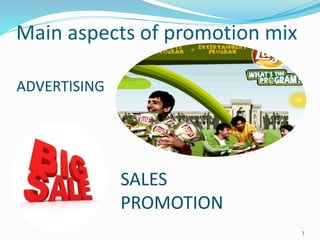
Main aspects of promotion mix
SALES
PROMOTION
ADVERTISING
3
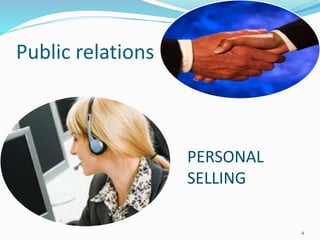
Public relations
PERSONAL
SELLING
4
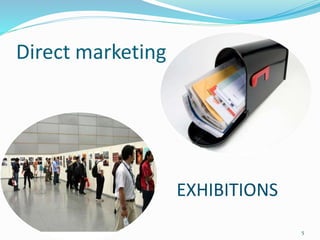
Direct marketing
EXHIBITIONS
5
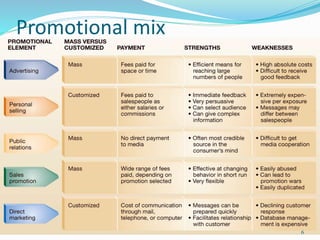
Promotional mix
6
Advertising is any paid form of
non-personal presentation and
promotion of ideas, goods, or
services by an identified sponsor.
Like Advertisements in news
papers, electronic Media,
hoardings , wall paintings, posters,
etc.
7
Personal selling is personal
presentation by the firm’s sales
force for the purpose of making
sales and building customer
relationships.
A sales person interacting with
prospective customers and wants to
sell a product.
8
Public relations involves building
good relations with the company’s
various publics by obtaining
favorable publicity, building up a
good corporate image, and handling
or heading off unfavorable rumors,
stories, and events.
9
Sales promotions are short-term
incentives to encourage the
purchase or sale of a product or
service.
Example -Discount sale, Offers, more
Product, facilities, service and
guarantee, etc.
10
Direct marketing establishes direct
connections with carefully targeted
individual consumers to both obtain
an immediate response and cultivate
lasting customer relationships.
A company wants to market/sell
its products directly to its customers
is called Direct Marketing
11
INTEGRATED MARKETING
COMMUNICATIONS (IMC)
The concept under which a company
carefully integrates and coordinates its many
communications channels to deliver a clear,
consistent, and compelling message about
the organization and its products.
Integrating all promotion Mix elements
for effective marketing and Selling is called
Integrated Marketing Communication
ā€œIMCā€.
12
ONLINE MARKETING
ļ‚—Online / Digital/ Internet Marketing is
the component of marketing that
utilizes internet and online based
digital technologies such as desktop
computers, mobile phones and other
digital media and platforms to promote
products and services.
13
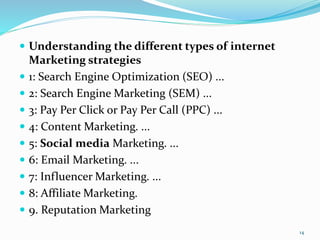
ļ‚— Understanding the different types of internet
Marketing strategies
ļ‚— 1: Search Engine Optimization (SEO) ...
ļ‚— 2: Search Engine Marketing (SEM) ...
ļ‚— 3: Pay Per Click or Pay Per Call (PPC) ...
ļ‚— 4: Content Marketing. ...
ļ‚— 5: Social media Marketing. ...
ļ‚— 6: Email Marketing. ...
ļ‚— 7: Influencer Marketing. ...
ļ‚— 8: Affiliate Marketing.
ļ‚— 9. Reputation Marketing
14
ļ‚— 1: Search Engine Optimization (SEO)
ļ‚— SEO or search engine optimization is the process
of adjusting your website to improve its organic,
free, or ā€œnaturalā€ placement in search results. SEO
consists of on-page factors (content, structure,
and user-friendliness) and off-page factors (links
from other sites, social shares, authority).
ļ‚— SEO strategies involve adjusting certain elements
on your website so it meets Google’s requirements
while making sure your website presents the best
overall experience for visitors.
15
ļ‚—2: Search Engine Marketing (SEM)
ļ‚— Search engine marketing or SEM is the
process of using paid search (Pay Per Click
ads) to gain website traffic. In the past, SEM
was used as an umbrella term that
encompassed SEO and paid search.
ļ‚— Over time, as the digital marketing industry
evolved, the term SEM stopped being used
for both types of internet marketing
strategies, and has come to typically refer
exclusively to paid search activities
16
ļ‚— 3: Pay Per Click or Pay Per Call (PPC)
ļ‚— PPC marketing can be broken down into two
main categories: paid search (see above) and
paid social marketing. Ads are published on
search engines or social platforms, and
companies are charged every time their ad is
clicked.
ļ‚— Google AdWords is the most popular paid
search platform, followed by Bing Ads, which
also serves search ads on Yahoo. Search
marketing encompasses display, mobile,
retargeting / remarketing, and paid social
advertising. 17
ļ‚—4: Content Marketing
ļ‚— Moz defines content marketing as the creation and
distribution of relevant, valuable content to communicate
with customers and achieve your marketing
goals. Content marketing strategies focus on
communicating with customers, rather than selling,
providing content that educates, amuses, or otherwise
provides value to customers on a consistent basis in order
to attract and retain a specific desired audience.
ļ‚— Content encompasses virtually any information format
disseminated online such as blogs, videos, podcasts,
infograms, social media posts, and more. High quality
content plays a role in all the main types of online
marketing strategies, including SEO, PPC, social media
marketing, email marketing, etc.
18
ļ‚—5: Social media marketing
ļ‚—Social media marketing is the use of
social media platforms and websites to
promote your business and connect
with customers. Social media
marketing does not necessarily drive
sales. Instead, it is often used to
increase engagement, build links and
bring content to the attention of
customers, and create a distinctive
ā€œbrandā€.
19
ļ‚—6: Email marketing
ļ‚— Email marketing is one of the most cost-
effective types of digital marketing
strategies. Email is often cited as the ā€œmore
effective replacementā€ for direct mail
marketing, as you can directly reach a wide
network of customers in an instant with
newsletters, ads, or reminders through
email. Email marketing can be very
specifically targeted using demographics
and other information to segment lists and
achieve the best result.
20
ļ‚—7: Influencer marketing
ļ‚— Influencer marketing is one of the newest
types of internet marketing strategies but it
is expected to become increasingly popular
in 2018. Influencers (individuals with a
strong social following) are paid to promote
your company’s products or services. When
you find influencers who are in line with
your company’s values and resonate with
your customers, this marketing strategy can
be highly effective for some companies.
21
ļ‚—8: Affiliate Marketing
ļ‚—Affiliate marketing is the process of
earning a commission by promoting or
advertising other companies’ products
or services. Affiliate marketing often
consists of promoting a product
through a blog or video, or featuring
ads on your website. You receive a
payment for every sale made through
your links.
22
ļ‚— 9: Reputation marketing
ļ‚— Reputation marketing consists of using press
releases, social media, and customer review
platforms to develop a positive perception of a
company. Online referrals and reviews have
become increasingly important in certain
industries such as the travel industry.
Reputation marketing involves developing a
distinctive brand, encouraging customers to
post reviews, and responding quickly to resolve
customer concerns or complaints on social
media and review platforms.
23
Multilevel Marketing
ļ‚—Multilevel marketing (MLM) is a
strategy some direct sales companies
use to encourage existing distributors
to recruit new distributors who are paid
a percentage of their recruits' sales. The
recruits are the distributor's
"downline." Distributors also make
money through direct sales of products
to customers.
24
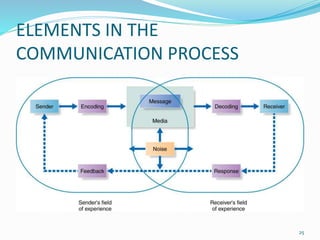
ELEMENTS IN THE
COMMUNICATION PROCESS
25
STEPS IN EFFECTIVE PROMOTIONAL
PROGRAMME
ļ‚— Identifying the target audience
ļ‚— Determining the promotion objectives
ļ‚— Setting the promotional budget
ļ‚— Selecting the right promotional tools
ļ‚— Designing the promotion activities
ļ‚— Scheduling the promotion activity
ļ‚— Feedback from the Market
26
Slide 18-23
Factors that influence the use of
promotional tools
27
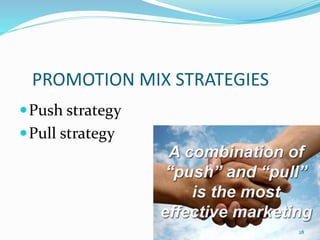
PROMOTION MIX STRATEGIES
ļ‚—Push strategy
ļ‚—Pull strategy
28
A comparison of push and pull
strategies
29
Marketing and Society Marketing refers
to the process through which businesses
and organizations promote themselves
and their products by communication
with potential customers. Businesses
spend huge sums of money
on marketing to improve their sales,
but marketing also benefits society as a
whole in several key ways in developing
products to society for benefit them.
30
Marketing benefits society in
general by improving people's lives
in two ways. The first it improves /
better more successful companies,
jobs are created. This generates
wealth for people, who are then
able to make purchases, which, in
turn, creates more jobs. 31
The second is Marketing develops
many more products and services to
the people in need and satisfy their
needs and wants there by the
standard of living improves. It also
solves the problems of public by
invention and innovation for the
development new products services
32
Legal responsibilities.
Follow laws and regulations
Economic responsibilities. Produce
and market goods / services that
society wants, and make
reasonable profits. Voluntary
responsibilities. Make social (EG
philanthropic) contributions to the
benefit of society. 33
Legal Responsibilities and Marketing Management
Laws and regulations by local, state, or central
governments have impact on sales management
Price discrimination. As per MRTP act, 1969, seller
should not discriminate prices among similar
buyers (e.g. retailers)
Price fixing. Under MRTP act, it is unlawful for
suppliers to fix prices
34
Consumer protection. As per Consumer
Protection Act, 1986, it is illegal to make
false or misleading claims about products /
services
Bribes. Payment of money or giving gifts to
gain a customer is illegal under Indian
Contracts Act 1872 and Sale of Goods act,
1930. Sales managers must take
responsibility that laws are not violated
35
Business Ethics and Marketing
Marketing managers and salespeople have ethical
responsibilities. Some of the ethical situations are:
Relations with the company. EGs. Expense
statements, credit for damaged merchandise
Relations with customers. EGs. Gifts, false
information to get business, customer entertainment
Ethical guidelines
A code of ethics developed by the company would
be effective if it is enforced by top management.
36
Corporate social responsibility means distinguishing
right from wrong and doing the right thing/activities.
Social responsibility is the management’s
responsibility to take decisions and actions for
welfare and interests of society and the company
A company has following four responsibilities to its
eight stakeholders: Customers, Community,
Creditors, Government, Owners, Managers,
Employees, and Suppliers, acronym: CCCGOMES
Ethical responsibilities. Deal with fairness, equity,
impartiality towards the different category of
people.
37
Global marketing is defined as
the marketing strategies of a
company to adapt to the conditions
of global market or other countries. If
a business chooses not to extend
internationally, it can face domestic
competition from international
companies that are extending their
international presence. 38
The Old and New Economies
The old economy differs from new
economy in that it relies on traditional
methods of doing business rather than
leveraging new cutting-edge
technology. This
traditional economic system dates
back to the Industrial Revolution and
revolves around producing goods as
opposed to the of information. 39
Demand-side Marketing is always
thinking and creating demand for the
goods and services produced by a
company. In fact the object of any
marketing program is to create demand
in the market and sell the same to the
society at profit. Creating demand and
selling is the principle in a competitive
Marketing. 40
41

I PROMOTIONAL MIX Introduction to IMC.pptx

  • 1.
  • 2.
    DEFINITION ļ‚—PROMOTION MIX isthe specific blend of promotional tools that the company uses to persuasively communicate customer value and build customer relationships. 2
  • 3.
    Main aspects ofpromotion mix SALES PROMOTION ADVERTISING 3
  • 4.
  • 5.
  • 6.
  • 7.
    Advertising is anypaid form of non-personal presentation and promotion of ideas, goods, or services by an identified sponsor. Like Advertisements in news papers, electronic Media, hoardings , wall paintings, posters, etc. 7
  • 8.
    Personal selling ispersonal presentation by the firm’s sales force for the purpose of making sales and building customer relationships. A sales person interacting with prospective customers and wants to sell a product. 8
  • 9.
    Public relations involvesbuilding good relations with the company’s various publics by obtaining favorable publicity, building up a good corporate image, and handling or heading off unfavorable rumors, stories, and events. 9
  • 10.
    Sales promotions areshort-term incentives to encourage the purchase or sale of a product or service. Example -Discount sale, Offers, more Product, facilities, service and guarantee, etc. 10
  • 11.
    Direct marketing establishesdirect connections with carefully targeted individual consumers to both obtain an immediate response and cultivate lasting customer relationships. A company wants to market/sell its products directly to its customers is called Direct Marketing 11
  • 12.
    INTEGRATED MARKETING COMMUNICATIONS (IMC) Theconcept under which a company carefully integrates and coordinates its many communications channels to deliver a clear, consistent, and compelling message about the organization and its products. Integrating all promotion Mix elements for effective marketing and Selling is called Integrated Marketing Communication ā€œIMCā€. 12
  • 13.
    ONLINE MARKETING ļ‚—Online /Digital/ Internet Marketing is the component of marketing that utilizes internet and online based digital technologies such as desktop computers, mobile phones and other digital media and platforms to promote products and services. 13
  • 14.
    ļ‚— Understanding thedifferent types of internet Marketing strategies ļ‚— 1: Search Engine Optimization (SEO) ... ļ‚— 2: Search Engine Marketing (SEM) ... ļ‚— 3: Pay Per Click or Pay Per Call (PPC) ... ļ‚— 4: Content Marketing. ... ļ‚— 5: Social media Marketing. ... ļ‚— 6: Email Marketing. ... ļ‚— 7: Influencer Marketing. ... ļ‚— 8: Affiliate Marketing. ļ‚— 9. Reputation Marketing 14
  • 15.
    ļ‚— 1: SearchEngine Optimization (SEO) ļ‚— SEO or search engine optimization is the process of adjusting your website to improve its organic, free, or ā€œnaturalā€ placement in search results. SEO consists of on-page factors (content, structure, and user-friendliness) and off-page factors (links from other sites, social shares, authority). ļ‚— SEO strategies involve adjusting certain elements on your website so it meets Google’s requirements while making sure your website presents the best overall experience for visitors. 15
  • 16.
    ļ‚—2: Search EngineMarketing (SEM) ļ‚— Search engine marketing or SEM is the process of using paid search (Pay Per Click ads) to gain website traffic. In the past, SEM was used as an umbrella term that encompassed SEO and paid search. ļ‚— Over time, as the digital marketing industry evolved, the term SEM stopped being used for both types of internet marketing strategies, and has come to typically refer exclusively to paid search activities 16
  • 17.
    ļ‚— 3: PayPer Click or Pay Per Call (PPC) ļ‚— PPC marketing can be broken down into two main categories: paid search (see above) and paid social marketing. Ads are published on search engines or social platforms, and companies are charged every time their ad is clicked. ļ‚— Google AdWords is the most popular paid search platform, followed by Bing Ads, which also serves search ads on Yahoo. Search marketing encompasses display, mobile, retargeting / remarketing, and paid social advertising. 17
  • 18.
    ļ‚—4: Content Marketing ļ‚—Moz defines content marketing as the creation and distribution of relevant, valuable content to communicate with customers and achieve your marketing goals. Content marketing strategies focus on communicating with customers, rather than selling, providing content that educates, amuses, or otherwise provides value to customers on a consistent basis in order to attract and retain a specific desired audience. ļ‚— Content encompasses virtually any information format disseminated online such as blogs, videos, podcasts, infograms, social media posts, and more. High quality content plays a role in all the main types of online marketing strategies, including SEO, PPC, social media marketing, email marketing, etc. 18
  • 19.
    ļ‚—5: Social mediamarketing ļ‚—Social media marketing is the use of social media platforms and websites to promote your business and connect with customers. Social media marketing does not necessarily drive sales. Instead, it is often used to increase engagement, build links and bring content to the attention of customers, and create a distinctive ā€œbrandā€. 19
  • 20.
    ļ‚—6: Email marketing ļ‚—Email marketing is one of the most cost- effective types of digital marketing strategies. Email is often cited as the ā€œmore effective replacementā€ for direct mail marketing, as you can directly reach a wide network of customers in an instant with newsletters, ads, or reminders through email. Email marketing can be very specifically targeted using demographics and other information to segment lists and achieve the best result. 20
  • 21.
    ļ‚—7: Influencer marketing ļ‚—Influencer marketing is one of the newest types of internet marketing strategies but it is expected to become increasingly popular in 2018. Influencers (individuals with a strong social following) are paid to promote your company’s products or services. When you find influencers who are in line with your company’s values and resonate with your customers, this marketing strategy can be highly effective for some companies. 21
  • 22.
    ļ‚—8: Affiliate Marketing ļ‚—Affiliatemarketing is the process of earning a commission by promoting or advertising other companies’ products or services. Affiliate marketing often consists of promoting a product through a blog or video, or featuring ads on your website. You receive a payment for every sale made through your links. 22
  • 23.
    ļ‚— 9: Reputationmarketing ļ‚— Reputation marketing consists of using press releases, social media, and customer review platforms to develop a positive perception of a company. Online referrals and reviews have become increasingly important in certain industries such as the travel industry. Reputation marketing involves developing a distinctive brand, encouraging customers to post reviews, and responding quickly to resolve customer concerns or complaints on social media and review platforms. 23
  • 24.
    Multilevel Marketing ļ‚—Multilevel marketing(MLM) is a strategy some direct sales companies use to encourage existing distributors to recruit new distributors who are paid a percentage of their recruits' sales. The recruits are the distributor's "downline." Distributors also make money through direct sales of products to customers. 24
  • 25.
  • 26.
    STEPS IN EFFECTIVEPROMOTIONAL PROGRAMME ļ‚— Identifying the target audience ļ‚— Determining the promotion objectives ļ‚— Setting the promotional budget ļ‚— Selecting the right promotional tools ļ‚— Designing the promotion activities ļ‚— Scheduling the promotion activity ļ‚— Feedback from the Market 26
  • 27.
    Slide 18-23 Factors thatinfluence the use of promotional tools 27
  • 28.
    PROMOTION MIX STRATEGIES ļ‚—Pushstrategy ļ‚—Pull strategy 28
  • 29.
    A comparison ofpush and pull strategies 29
  • 30.
    Marketing and SocietyMarketing refers to the process through which businesses and organizations promote themselves and their products by communication with potential customers. Businesses spend huge sums of money on marketing to improve their sales, but marketing also benefits society as a whole in several key ways in developing products to society for benefit them. 30
  • 31.
    Marketing benefits societyin general by improving people's lives in two ways. The first it improves / better more successful companies, jobs are created. This generates wealth for people, who are then able to make purchases, which, in turn, creates more jobs. 31
  • 32.
    The second isMarketing develops many more products and services to the people in need and satisfy their needs and wants there by the standard of living improves. It also solves the problems of public by invention and innovation for the development new products services 32
  • 33.
    Legal responsibilities. Follow lawsand regulations Economic responsibilities. Produce and market goods / services that society wants, and make reasonable profits. Voluntary responsibilities. Make social (EG philanthropic) contributions to the benefit of society. 33
  • 34.
    Legal Responsibilities andMarketing Management Laws and regulations by local, state, or central governments have impact on sales management Price discrimination. As per MRTP act, 1969, seller should not discriminate prices among similar buyers (e.g. retailers) Price fixing. Under MRTP act, it is unlawful for suppliers to fix prices 34
  • 35.
    Consumer protection. Asper Consumer Protection Act, 1986, it is illegal to make false or misleading claims about products / services Bribes. Payment of money or giving gifts to gain a customer is illegal under Indian Contracts Act 1872 and Sale of Goods act, 1930. Sales managers must take responsibility that laws are not violated 35
  • 36.
    Business Ethics andMarketing Marketing managers and salespeople have ethical responsibilities. Some of the ethical situations are: Relations with the company. EGs. Expense statements, credit for damaged merchandise Relations with customers. EGs. Gifts, false information to get business, customer entertainment Ethical guidelines A code of ethics developed by the company would be effective if it is enforced by top management. 36
  • 37.
    Corporate social responsibilitymeans distinguishing right from wrong and doing the right thing/activities. Social responsibility is the management’s responsibility to take decisions and actions for welfare and interests of society and the company A company has following four responsibilities to its eight stakeholders: Customers, Community, Creditors, Government, Owners, Managers, Employees, and Suppliers, acronym: CCCGOMES Ethical responsibilities. Deal with fairness, equity, impartiality towards the different category of people. 37
  • 38.
    Global marketing isdefined as the marketing strategies of a company to adapt to the conditions of global market or other countries. If a business chooses not to extend internationally, it can face domestic competition from international companies that are extending their international presence. 38
  • 39.
    The Old andNew Economies The old economy differs from new economy in that it relies on traditional methods of doing business rather than leveraging new cutting-edge technology. This traditional economic system dates back to the Industrial Revolution and revolves around producing goods as opposed to the of information. 39
  • 40.
    Demand-side Marketing isalways thinking and creating demand for the goods and services produced by a company. In fact the object of any marketing program is to create demand in the market and sell the same to the society at profit. Creating demand and selling is the principle in a competitive Marketing. 40
  • 41.