Steps to formulate
Hypothesis
By
Simran Sakshi
BBM Hons.
Contents
Hypothesis
Types of
hypothesis
Formulation
Advantages of
hypothesis
Steps in
formulation
References
Hypothesis is a gut feeling, an assumption, a proposition, a
guess which is tentative, provisional & explains the
situation under observation but is yet to be proved or
disproved.
It is a tentative assumption made in order to draw logical
and empirical consequences.
Hypothesis
Hypothesis formulation helps in formulating the research problem. A
properly formulated hypothesis helps in drawing proper and reasonable
conclusions.
Formulation of hypothesis gives a definite point to enquiry, helps in
establishing direction in which to proceed and helps to delimit the field of
enquiry by choosing the point on which to concentrate.
However, hypothesis formulation is not necessary. It depends upon the
type of study.
Hypothesis
formulation
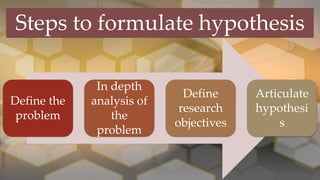
Define the
problem
In depth
analysis of
the
problem
Define
research
objectives
Articulate
hypothesi
s
Steps to formulate hypothesis
Discussions with colleagues and experts by keeping in view the objectives
Common sense, wisdom and practice
Keen observation, disciplined imagination & creative thinking
Literature & some formulated theoretical frameworks
Personal experiences and the way an individual reacts to culture, discipline etc.
Examination of data and records if available
Review of similar studies
Personal investigation in the field by interviews with interested parties and
individuals to secure better insight on the subject of research
A hypothesis can be developed by:
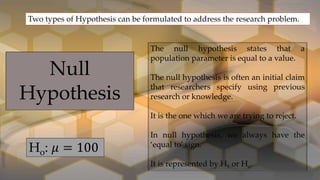
Two types of Hypothesis can be formulated to address the research problem.
Null
Hypothesis
The null hypothesis states that a
population parameter is equal to a value.
The null hypothesis is often an initial claim
that researchers specify using previous
research or knowledge.
It is the one which we are trying to reject.
In null hypothesis, we always have the
‘equal to’ sign.
It is represented by H1 or Ho.
Ho: 𝜇 = 100
The alternative hypothesis states that
the population parameter is different
than the value of the population
parameter in the null hypothesis.
The alternative hypothesis is what we
wish to prove.
It is opposite of null hypothesis and is
only reached when null hypothesis is
rejected.
It is represented by Ha.
Alternate
Hypothesis
Ha: 𝜇 ≠ 100
Hypothesis should have the following characteristics:
Goal oriented Testable
Simple Relevant
Through in depth study of the problem, we
identified four variables of study:
Preference Usage
Income
level
Age
We define the research objectives with
respect to our study and accordingly frame
the null and alternate hypothesis.
To study the customer perception
towards cashless economy
Null Hypothesis
Customers do not prefer
e-payment modes
Alternate Hypothesis
Customers prefer e-
payment modes
To study the usage of e- payment modes
in Agra
Null
Hypothesis
•People do not use
digital payment
modes
Alternate
Hypothesis
•People use digital
payment modes
Null Hypothesis
•Income level is
independent of
payment mode
Alternate Hypothesis
•Income level is not
independent of
payment mode
To study the dependence of income level
on payment mode
To test the dependence of age on payment mode
Null
Hypothesis
• Age is
independent of
payment mode
Alternate
Hypothesis
• Age is not
independent of
payment mode
Advantages of
Hypothesis
Hypothesis brings a clarity in the way we have to
conduct a research. This also saves time and money.
Clarity
It ensures that the research does not deviate from its
objective. The research becomes organized as
irrelevant factors are dropped.
Focus
It sets a direction of research and prevents blind
search. This direction shows what should be the
objectives, methodology, mode of analysis and research
design.
Direction
Every research requires objectivity but without
hypothesis, one may collect data which is irrelevant and
this decreases the objectivity. With the help of
hypothesis, we collect only the required data and so
objectivity and validity of research increases.
Objectivity
A hypothesis adds to the available body of knowledge.
Through literature review, we identify gaps and then
concentrate on what has not been done yet on that topic.
Adds to the
body of
knowledge
References
Research Methodology – C.R. Kothari
http://www.public.asu.edu/~kroel/www500/hypothesis.pdf
https://www.etsu.edu/apl/Documents/.../Hypothesis%20Formulation.doc
http://blog.brand24.com/7-steps-to-formulate-a-strong-hypothesis-for-your-next-ab-test/
https://www.boundless.com/sociology/textbooks/boundless-sociology-
textbook/sociological-research-2/the-research-process-26/formulating-the-hypothesis-
167-7473/
http://readingcraze.com/index.php/hypothesis-formulation-research/
http://www.shareyouressays.com/116021/6-advantages-of-hypothesis-in-social-research
http://kiskash.com/hypothesisdefinitionsfunctionstypes/
Hypothesis

Hypothesis

  • 1.
  • 2.
  • 3.
    Hypothesis is agut feeling, an assumption, a proposition, a guess which is tentative, provisional & explains the situation under observation but is yet to be proved or disproved. It is a tentative assumption made in order to draw logical and empirical consequences. Hypothesis
  • 4.
    Hypothesis formulation helpsin formulating the research problem. A properly formulated hypothesis helps in drawing proper and reasonable conclusions. Formulation of hypothesis gives a definite point to enquiry, helps in establishing direction in which to proceed and helps to delimit the field of enquiry by choosing the point on which to concentrate. However, hypothesis formulation is not necessary. It depends upon the type of study. Hypothesis formulation
  • 5.
    Define the problem In depth analysisof the problem Define research objectives Articulate hypothesi s Steps to formulate hypothesis
  • 6.
    Discussions with colleaguesand experts by keeping in view the objectives Common sense, wisdom and practice Keen observation, disciplined imagination & creative thinking Literature & some formulated theoretical frameworks Personal experiences and the way an individual reacts to culture, discipline etc. Examination of data and records if available Review of similar studies Personal investigation in the field by interviews with interested parties and individuals to secure better insight on the subject of research A hypothesis can be developed by:
  • 7.
    Two types ofHypothesis can be formulated to address the research problem. Null Hypothesis The null hypothesis states that a population parameter is equal to a value. The null hypothesis is often an initial claim that researchers specify using previous research or knowledge. It is the one which we are trying to reject. In null hypothesis, we always have the ‘equal to’ sign. It is represented by H1 or Ho. Ho: 𝜇 = 100
  • 8.
    The alternative hypothesisstates that the population parameter is different than the value of the population parameter in the null hypothesis. The alternative hypothesis is what we wish to prove. It is opposite of null hypothesis and is only reached when null hypothesis is rejected. It is represented by Ha. Alternate Hypothesis Ha: 𝜇 ≠ 100
  • 9.
    Hypothesis should havethe following characteristics: Goal oriented Testable Simple Relevant
  • 11.
    Through in depthstudy of the problem, we identified four variables of study: Preference Usage Income level Age
  • 12.
    We define theresearch objectives with respect to our study and accordingly frame the null and alternate hypothesis.
  • 13.
    To study thecustomer perception towards cashless economy Null Hypothesis Customers do not prefer e-payment modes Alternate Hypothesis Customers prefer e- payment modes
  • 14.
    To study theusage of e- payment modes in Agra Null Hypothesis •People do not use digital payment modes Alternate Hypothesis •People use digital payment modes
  • 15.
    Null Hypothesis •Income levelis independent of payment mode Alternate Hypothesis •Income level is not independent of payment mode To study the dependence of income level on payment mode
  • 16.
    To test thedependence of age on payment mode Null Hypothesis • Age is independent of payment mode Alternate Hypothesis • Age is not independent of payment mode
  • 17.
  • 18.
    Hypothesis brings aclarity in the way we have to conduct a research. This also saves time and money. Clarity It ensures that the research does not deviate from its objective. The research becomes organized as irrelevant factors are dropped. Focus It sets a direction of research and prevents blind search. This direction shows what should be the objectives, methodology, mode of analysis and research design. Direction
  • 19.
    Every research requiresobjectivity but without hypothesis, one may collect data which is irrelevant and this decreases the objectivity. With the help of hypothesis, we collect only the required data and so objectivity and validity of research increases. Objectivity A hypothesis adds to the available body of knowledge. Through literature review, we identify gaps and then concentrate on what has not been done yet on that topic. Adds to the body of knowledge
  • 20.
    References Research Methodology –C.R. Kothari http://www.public.asu.edu/~kroel/www500/hypothesis.pdf https://www.etsu.edu/apl/Documents/.../Hypothesis%20Formulation.doc http://blog.brand24.com/7-steps-to-formulate-a-strong-hypothesis-for-your-next-ab-test/ https://www.boundless.com/sociology/textbooks/boundless-sociology- textbook/sociological-research-2/the-research-process-26/formulating-the-hypothesis- 167-7473/ http://readingcraze.com/index.php/hypothesis-formulation-research/ http://www.shareyouressays.com/116021/6-advantages-of-hypothesis-in-social-research http://kiskash.com/hypothesisdefinitionsfunctionstypes/

Editor's Notes

  • #4 unsettled in mind or opinion
  • #5 . Some studies are conducted to develop a hypothesis, like exploratory studies, so exploratory studies do not have a clear hypothesis. Descriptive studies can also be conducted without a hypothesis. In explanatory studies, that develop a relationship between dependent and independent variable, as well as, explain the type of relationship between the two variables, there is always a hypothesis.
  • #8 If we want to test d hypothesis that d population mean is equal to hypothesized mean which is 100. then d null hypothesis would be.
  • #9 D alternate hypo would be.
  • #10 It is goal oriented—it clearly states what needs to be accomplished It can be tested—it can easily be implemented relevant to the study
  • #16 As per BCG Google Report 2016, 50% of internet users use digital payment modes. So, the total internet users being 462 million, we calculated the percentage of digital payment users of the total population of India which was 17.42%
  • #17 Subsequently, after the collection of data the null hypothesis would be tested and conclusion of the study would be drawn.
  • #19 a tentative assumption made in order to draw logical and empirical consequences.
  • #20 Objectivity- judgment based on observable phenomena and uninfluenced by emotions or personal prejudices For example you study different literature and you find out that this much work has already been done on this topic and you should concentrate on the gaps that are yet to be filled by new research you formulate a hypothesis and keep your direction towards it.