Research: Hypothesis
Definition
 the word hypothesis is derived form the Greek words
 “hypo” means under
 “tithemi” means place
 Under known facts of the problem to explain relationship between these
 ........ is a statement subject to verification
 ......... a guess but experienced guess based on some facts
..is a hunch, assumption, suspicion, assertion or an idea about a phenomena,
relationship, or situation, the reality of truth of which one do not know
a researcher calls these assumptions, assertions, statements, or hunches
hypotheses and they become the basis of an inquiry.
In most cases, the hypothesis will be based upon either previous studies or the
researcher’s own or someone else’s observations
Hypothesis is a conjectural statement of relationship between two or more
variable (Kerlinger, Fried N, Foundations of Behabioural Research , 3rd edition,
New York: Holt, Rinehart and Winston, 1986)

Definition
 Hypothesis is proposition, condition or principle which is assumed, perhaps
without belief, in order to draw its logical consequences and by this method
to test its accord with facts which are known or may be determined .
 Atentative statement about something, the validity of which is usually
unknown .
 Hypothesis is proposition that is stated is a testable form and that predicts a
particular relationship between two or more variable. In other words, id we
think that a relationship exists, we first state it is hypothesis and then test
hypothesis in the field.
Definition
 A hypothesis is written in such a way that it can be proven or disproven by
valid and reliable data – in order to obtain these data that we perform our
study.
 A hypothesis may be defined as a tentative theory or supposition set up and
adopted provisionally as a basis of explaining certain facts or relationships and
as a guide in the further investigation of other facts or relationships.
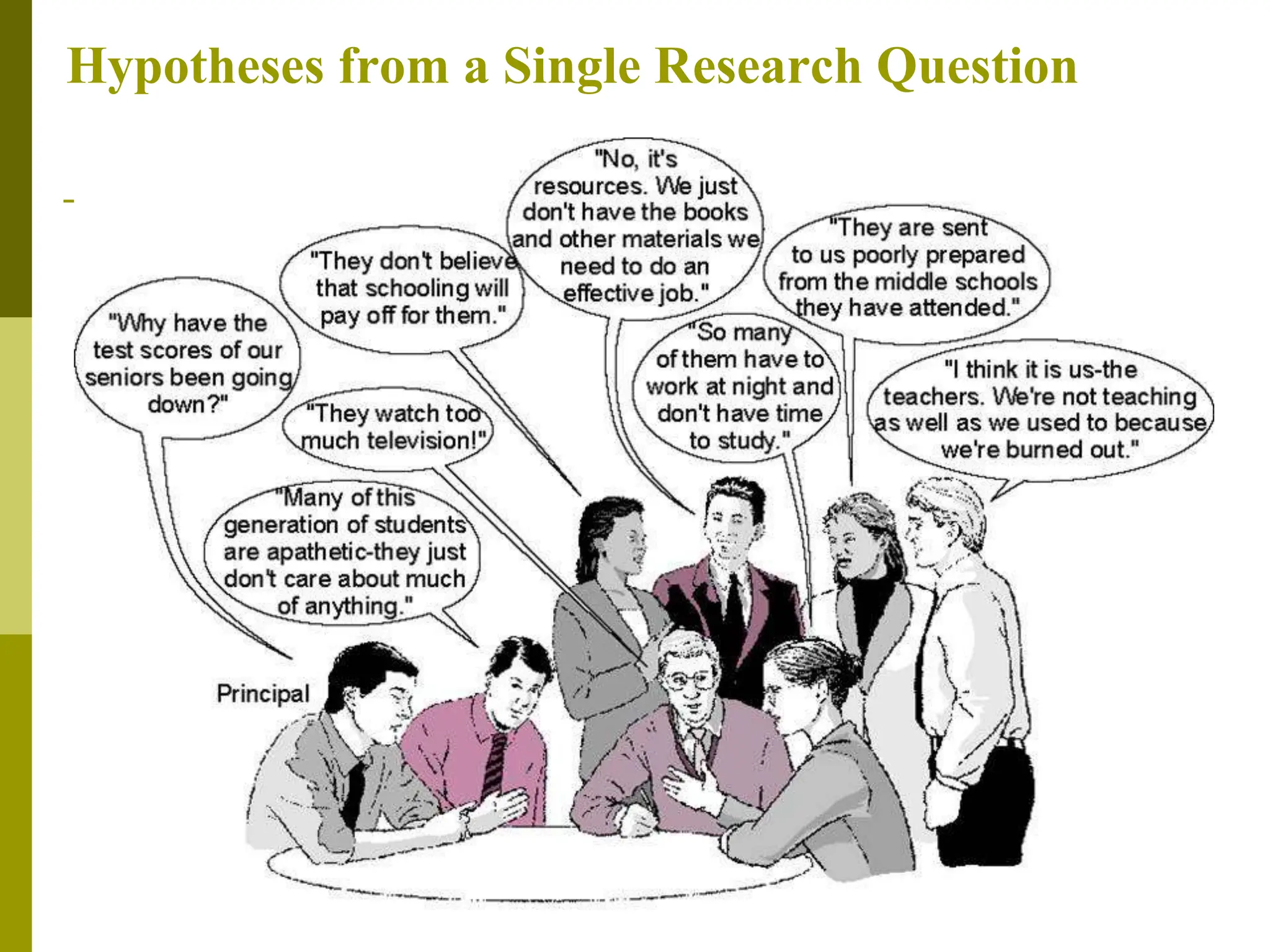
Hypotheses from a Single Research Question
Characteristics
 Hypotheses has the following characteristics:
 a tentative proposition
 unknown validity
 specifies relation between two or more variables

Functions
 Bringing clarity to the research problem
 Serves the following functions
 provides a study with focus
 signifies what specific aspects of a research problem is to investigate
 what data to be collected and what not to be collected
 enhancement of objectivity of the study
 formulate the theory
 enable to conclude with what is true or what is false
Characteristics
 Simple, specific, and contextually clear
 Capable of verification
 Related to the existing body of knowledge
 Operationalisable
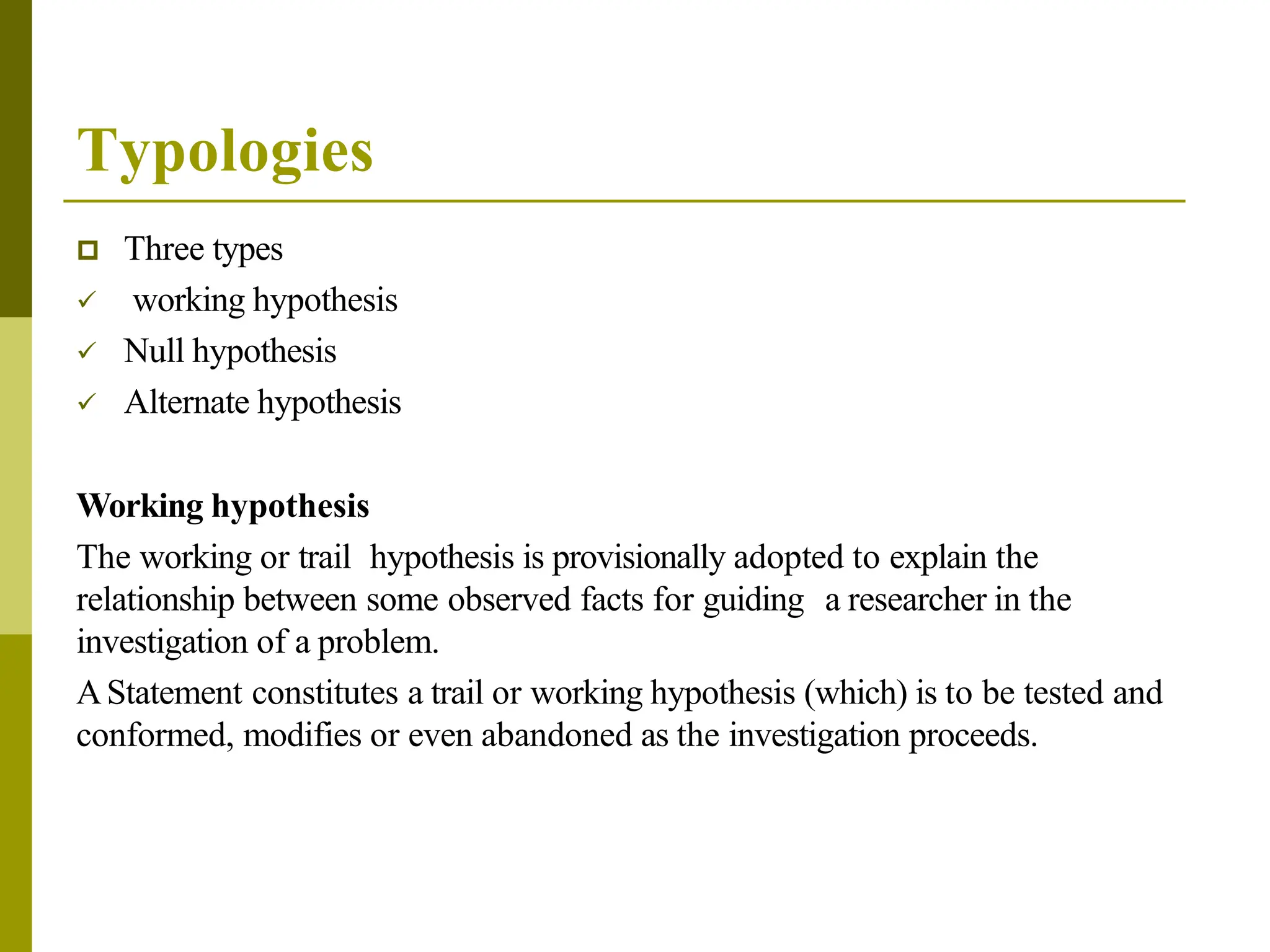
Typologies
 Three types
 working hypothesis
 Null hypothesis
 Alternate hypothesis
Working hypothesis
The working or trail hypothesis is provisionally adopted to explain the
relationship between some observed facts for guiding a researcher in the
investigation of a problem.
AStatement constitutes a trail or working hypothesis (which) is to be tested and
conformed, modifies or even abandoned as the investigation proceeds.
Typologies
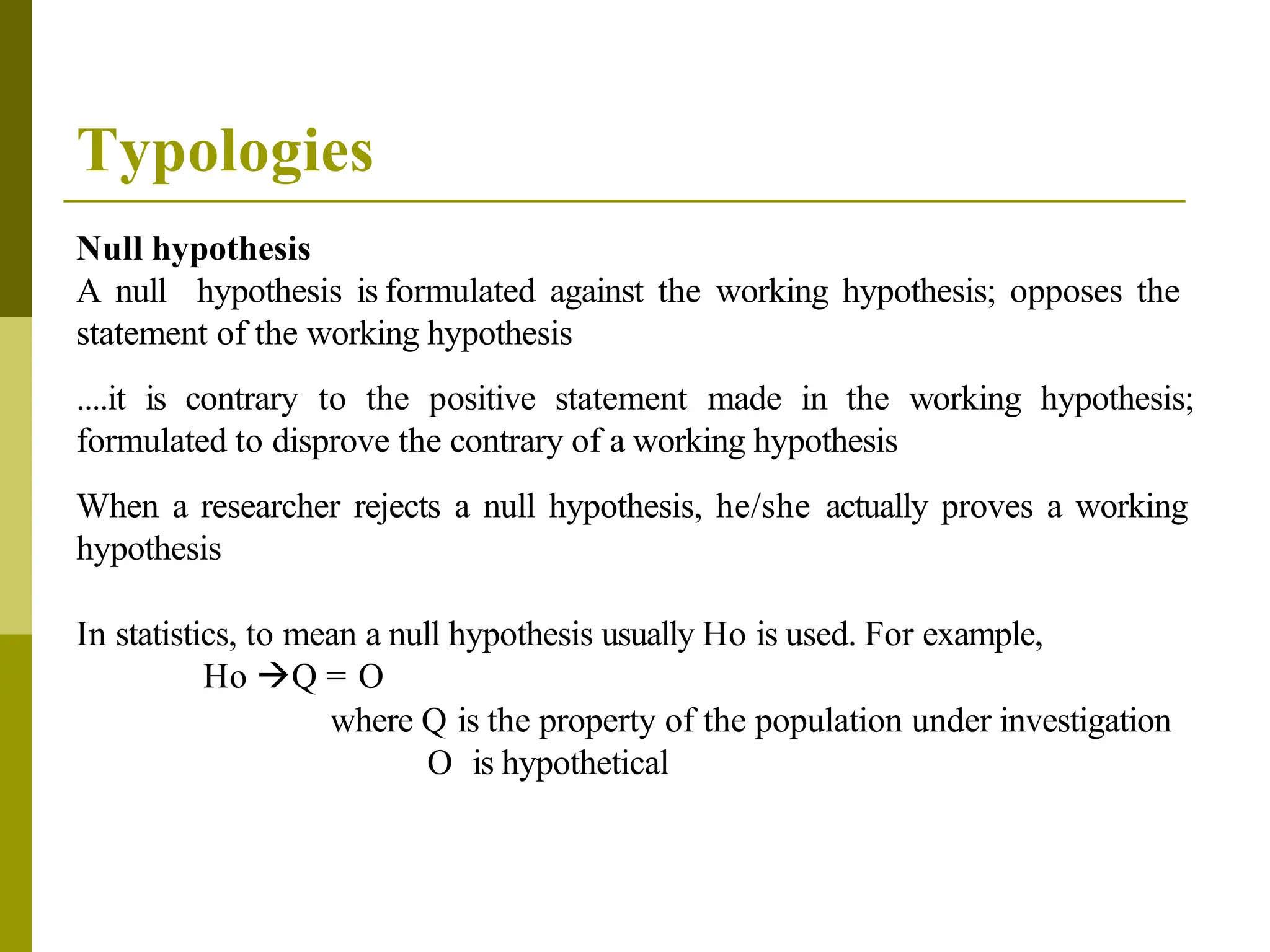
Null hypothesis
A null hypothesis is formulated against the working hypothesis; opposes the
statement of the working hypothesis
....it is contrary to the positive statement made in the working hypothesis;
formulated to disprove the contrary of a working hypothesis
When a researcher rejects a null hypothesis, he/she actually proves a working
hypothesis
In statistics, to mean a null hypothesis usually Ho is used. For example,
Ho Q = O
where Q is the property of the population under investigation
O is hypothetical
Typologies
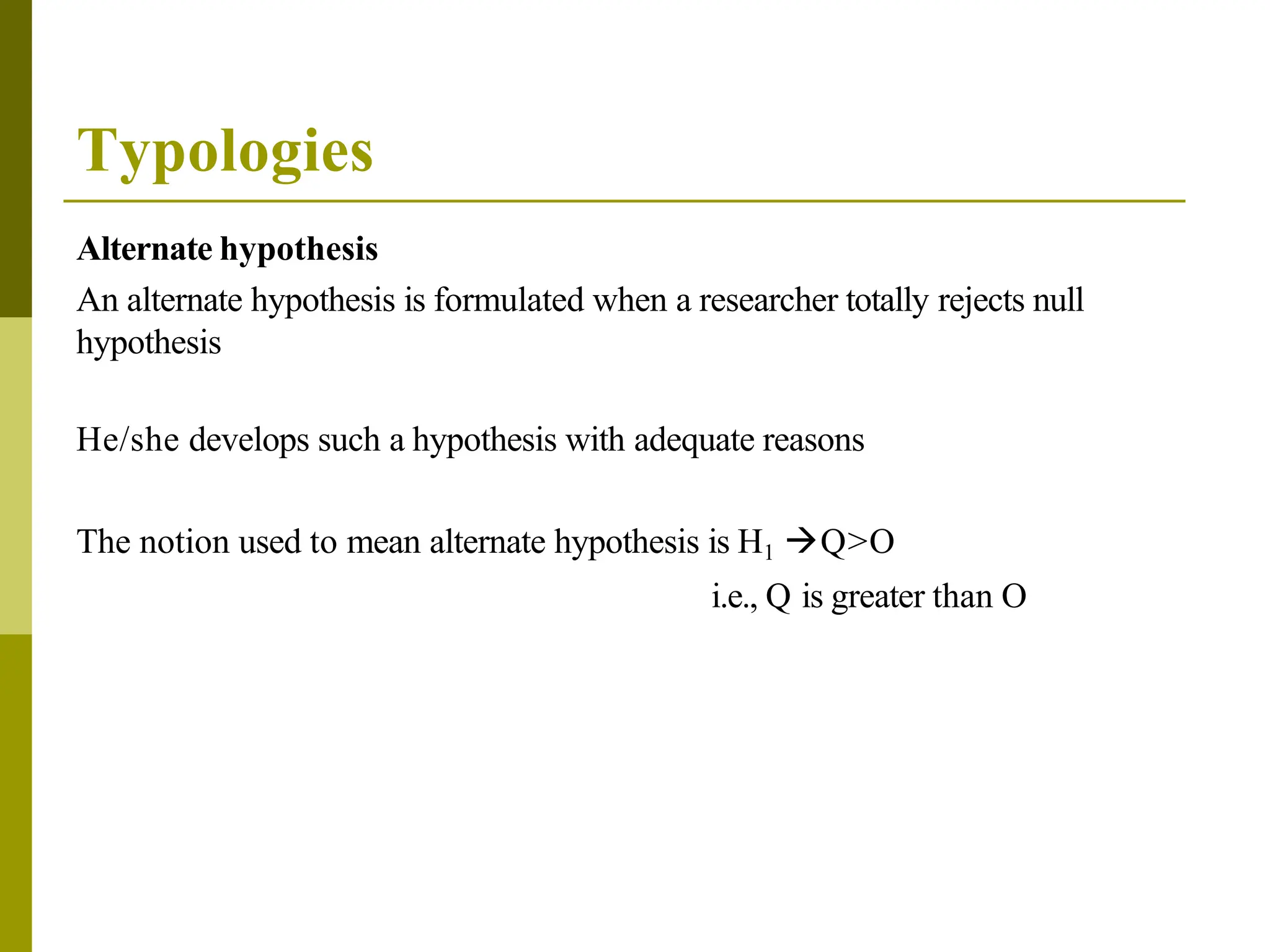
Alternate hypothesis
An alternate hypothesis is formulated when a researcher totally rejects null
hypothesis
He/she develops such a hypothesis with adequate reasons
The notion used to mean alternate hypothesis is H1 Q>O
i.e., Q is greater than O
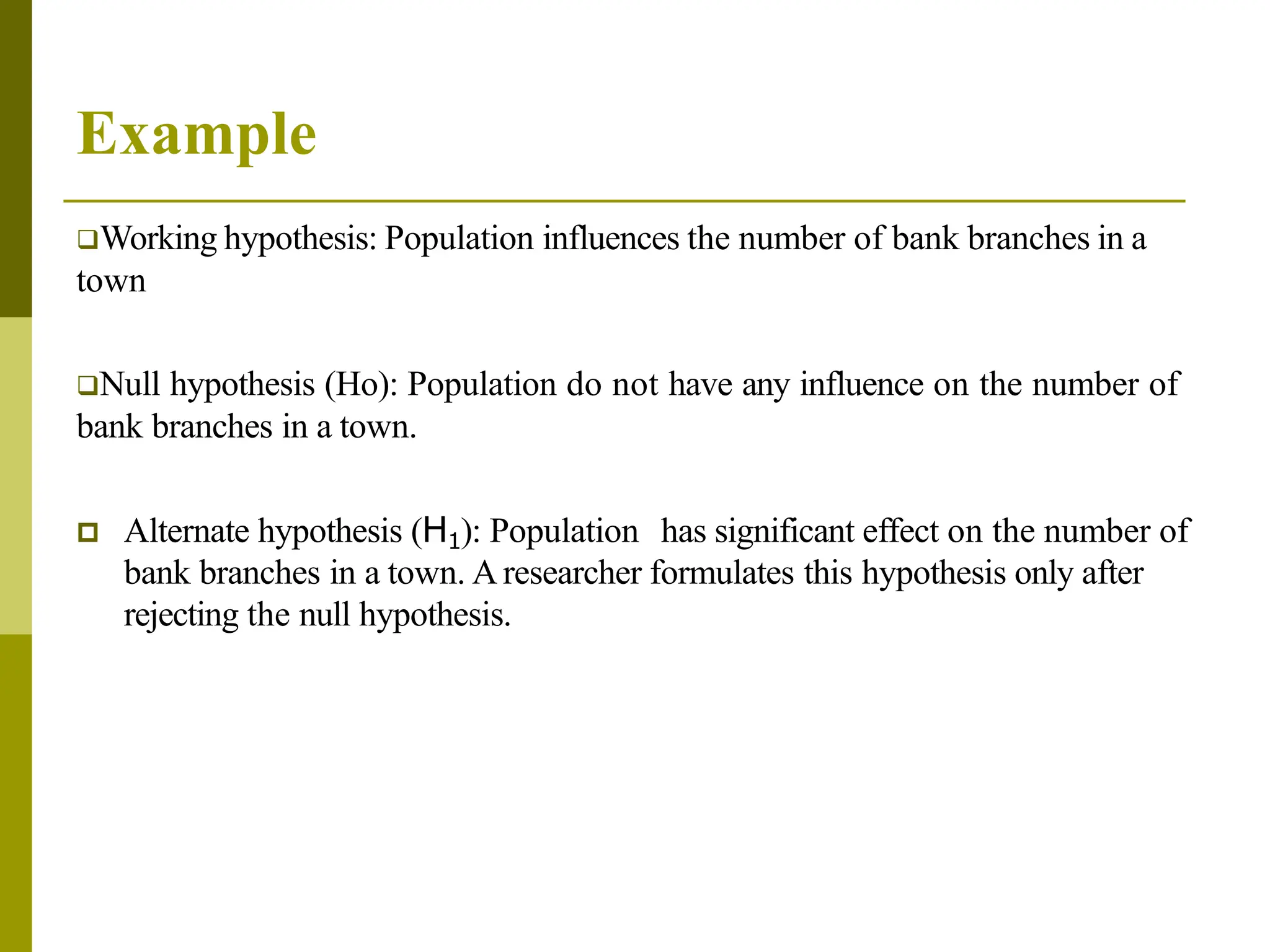
Example
Working hypothesis: Population influences the number of bank branches in a
town
Null hypothesis (Ho): Population do not have any influence on the number of
bank branches in a town.
 Alternate hypothesis (H1): Population has significant effect on the number of
bank branches in a town. A researcher formulates this hypothesis only after
rejecting the null hypothesis.
What is a Variable?
A variable is a variation within a class of objects (i.e., eye
color).
A constant is a characteristic with no variations within a
class of objects (i.e., grade level of ninth graders).
Researchers choose certain variables to study since they
are suspected to be related to a possible relationship to be
discovered.
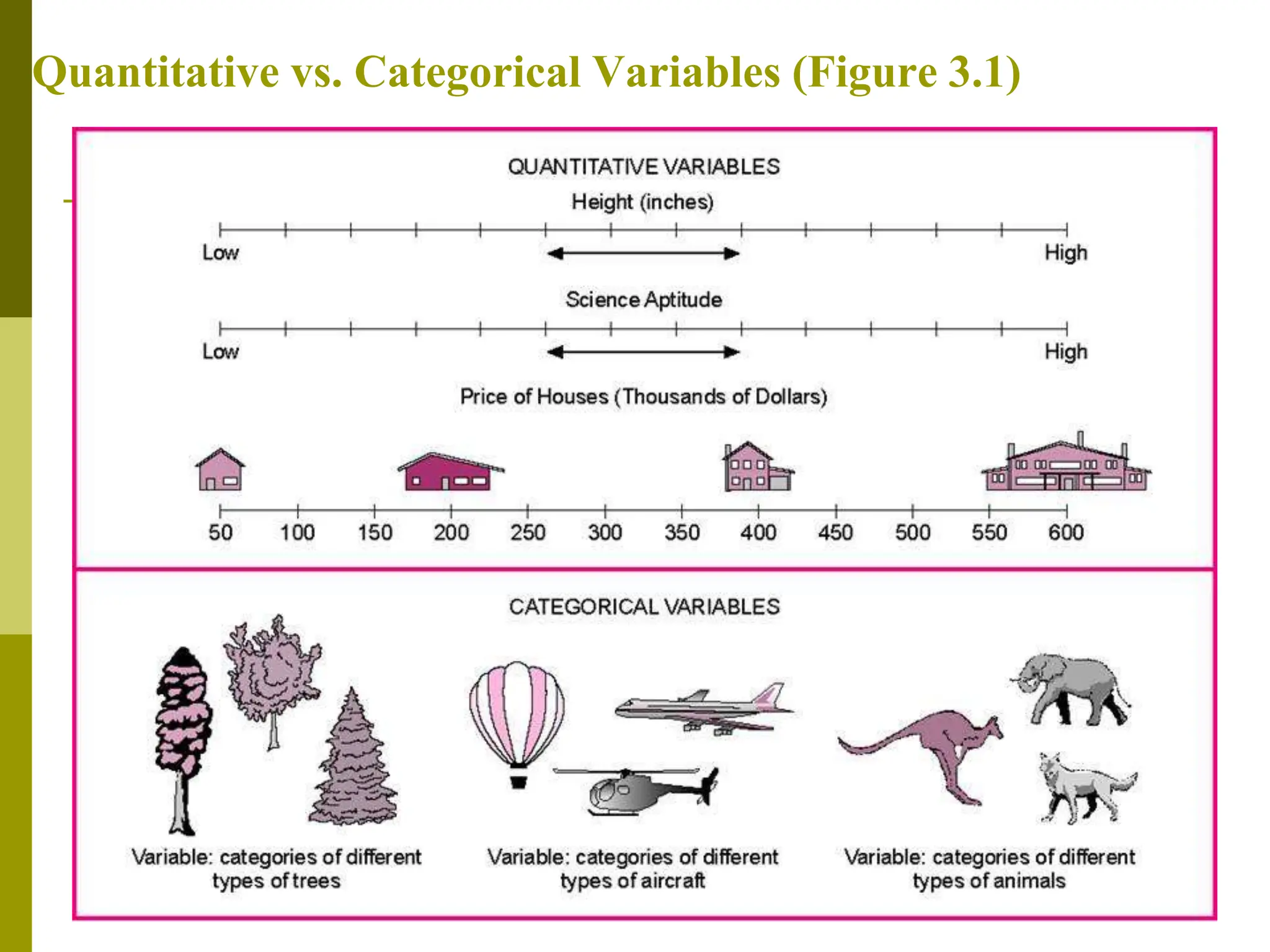
Quantitative vs. Categorical Variables
Variables are classified as either quantitative or
categorical
A quantitative variable is conceptualized and
analyzed in distinct categories, with no continuum
implied (i.e., height).
Can be subdivided into smaller units
A categorical variable does not vary in degree,
amount, or quantity, but are qualitatively different
(i.e., political party).
There is no middle ground or in-between measurement
Quantitative vs. Categorical Variables (Figure 3.1)
Independent vs. Dependent Variables
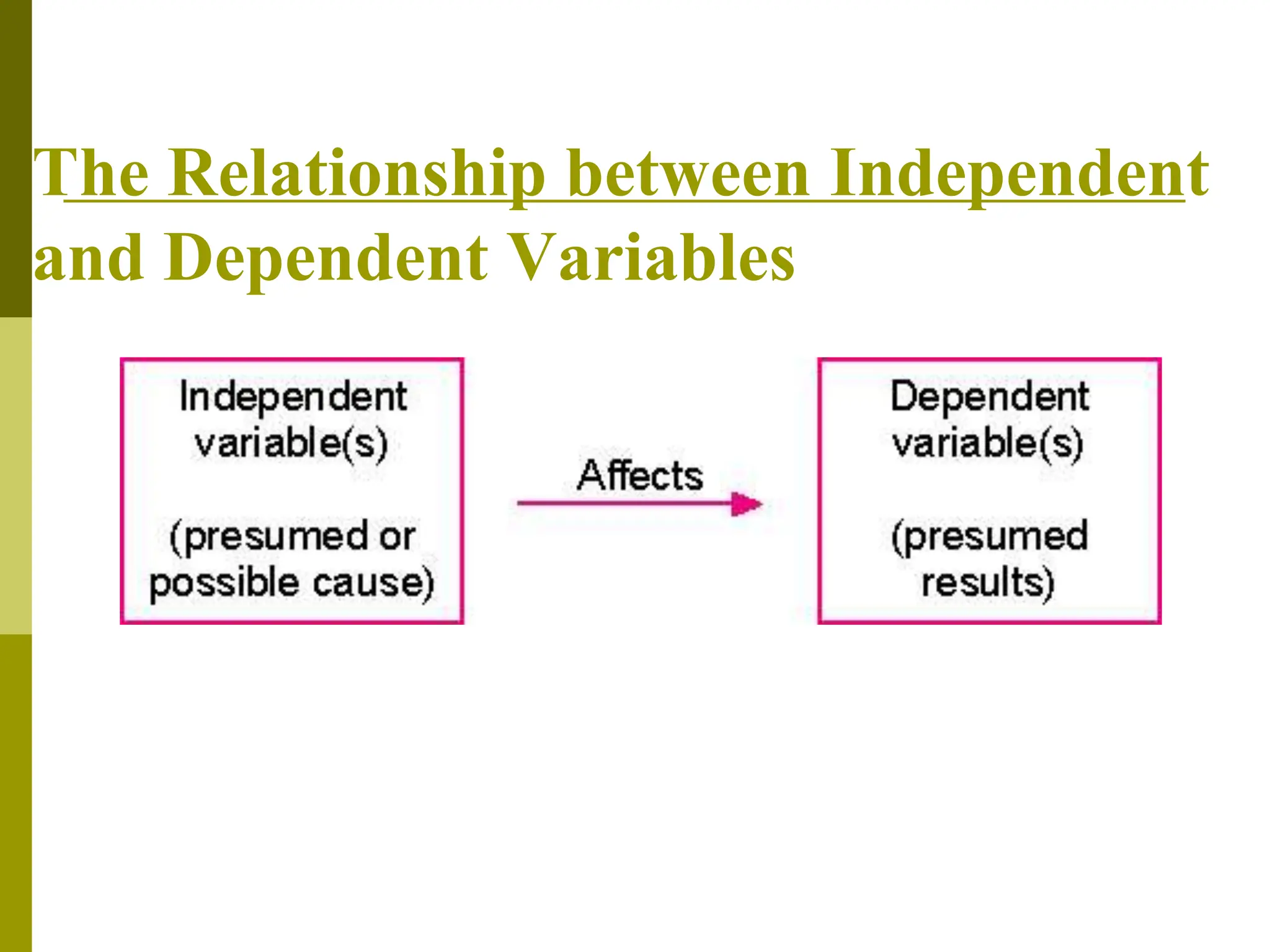
The independent variable is what the researcher studies to see
its relationship or effects.
Presumed or possible cause
The dependent variable is what is being influenced or affected
by the independent variable
Presumed results
Independent variables may be either manipulated or selected
A manipulated variable is a changed condition the researcher creates
during a study, also known as an experimental or treatment variable
A selected variable is an independent variable that already exists
The Relationship between Independent
and Dependent Variables

Hypothesis - I.pptx Reasearch hyposthesis

  • 1.
  • 2.
    Definition  the wordhypothesis is derived form the Greek words  “hypo” means under  “tithemi” means place  Under known facts of the problem to explain relationship between these  ........ is a statement subject to verification  ......... a guess but experienced guess based on some facts ..is a hunch, assumption, suspicion, assertion or an idea about a phenomena, relationship, or situation, the reality of truth of which one do not know a researcher calls these assumptions, assertions, statements, or hunches hypotheses and they become the basis of an inquiry. In most cases, the hypothesis will be based upon either previous studies or the researcher’s own or someone else’s observations Hypothesis is a conjectural statement of relationship between two or more variable (Kerlinger, Fried N, Foundations of Behabioural Research , 3rd edition, New York: Holt, Rinehart and Winston, 1986) 
  • 3.
    Definition  Hypothesis isproposition, condition or principle which is assumed, perhaps without belief, in order to draw its logical consequences and by this method to test its accord with facts which are known or may be determined .  Atentative statement about something, the validity of which is usually unknown .  Hypothesis is proposition that is stated is a testable form and that predicts a particular relationship between two or more variable. In other words, id we think that a relationship exists, we first state it is hypothesis and then test hypothesis in the field.
  • 4.
    Definition  A hypothesisis written in such a way that it can be proven or disproven by valid and reliable data – in order to obtain these data that we perform our study.  A hypothesis may be defined as a tentative theory or supposition set up and adopted provisionally as a basis of explaining certain facts or relationships and as a guide in the further investigation of other facts or relationships.
  • 5.
    Hypotheses from aSingle Research Question
  • 6.
    Characteristics  Hypotheses hasthe following characteristics:  a tentative proposition  unknown validity  specifies relation between two or more variables 
  • 7.
    Functions  Bringing clarityto the research problem  Serves the following functions  provides a study with focus  signifies what specific aspects of a research problem is to investigate  what data to be collected and what not to be collected  enhancement of objectivity of the study  formulate the theory  enable to conclude with what is true or what is false
  • 8.
    Characteristics  Simple, specific,and contextually clear  Capable of verification  Related to the existing body of knowledge  Operationalisable
  • 9.
    Typologies  Three types working hypothesis  Null hypothesis  Alternate hypothesis Working hypothesis The working or trail hypothesis is provisionally adopted to explain the relationship between some observed facts for guiding a researcher in the investigation of a problem. AStatement constitutes a trail or working hypothesis (which) is to be tested and conformed, modifies or even abandoned as the investigation proceeds.
  • 10.
    Typologies Null hypothesis A nullhypothesis is formulated against the working hypothesis; opposes the statement of the working hypothesis ....it is contrary to the positive statement made in the working hypothesis; formulated to disprove the contrary of a working hypothesis When a researcher rejects a null hypothesis, he/she actually proves a working hypothesis In statistics, to mean a null hypothesis usually Ho is used. For example, Ho Q = O where Q is the property of the population under investigation O is hypothetical
  • 11.
    Typologies Alternate hypothesis An alternatehypothesis is formulated when a researcher totally rejects null hypothesis He/she develops such a hypothesis with adequate reasons The notion used to mean alternate hypothesis is H1 Q>O i.e., Q is greater than O
  • 12.
    Example Working hypothesis: Populationinfluences the number of bank branches in a town Null hypothesis (Ho): Population do not have any influence on the number of bank branches in a town.  Alternate hypothesis (H1): Population has significant effect on the number of bank branches in a town. A researcher formulates this hypothesis only after rejecting the null hypothesis.
  • 13.
    What is aVariable? A variable is a variation within a class of objects (i.e., eye color). A constant is a characteristic with no variations within a class of objects (i.e., grade level of ninth graders). Researchers choose certain variables to study since they are suspected to be related to a possible relationship to be discovered.
  • 14.
    Quantitative vs. CategoricalVariables Variables are classified as either quantitative or categorical A quantitative variable is conceptualized and analyzed in distinct categories, with no continuum implied (i.e., height). Can be subdivided into smaller units A categorical variable does not vary in degree, amount, or quantity, but are qualitatively different (i.e., political party). There is no middle ground or in-between measurement
  • 15.
    Quantitative vs. CategoricalVariables (Figure 3.1)
  • 16.
    Independent vs. DependentVariables The independent variable is what the researcher studies to see its relationship or effects. Presumed or possible cause The dependent variable is what is being influenced or affected by the independent variable Presumed results Independent variables may be either manipulated or selected A manipulated variable is a changed condition the researcher creates during a study, also known as an experimental or treatment variable A selected variable is an independent variable that already exists
  • 17.
    The Relationship betweenIndependent and Dependent Variables