Diluwar Hassan
MLIS, P.U
diluwarhassan48@gmail.com
Research Problem
INTRODUCTION
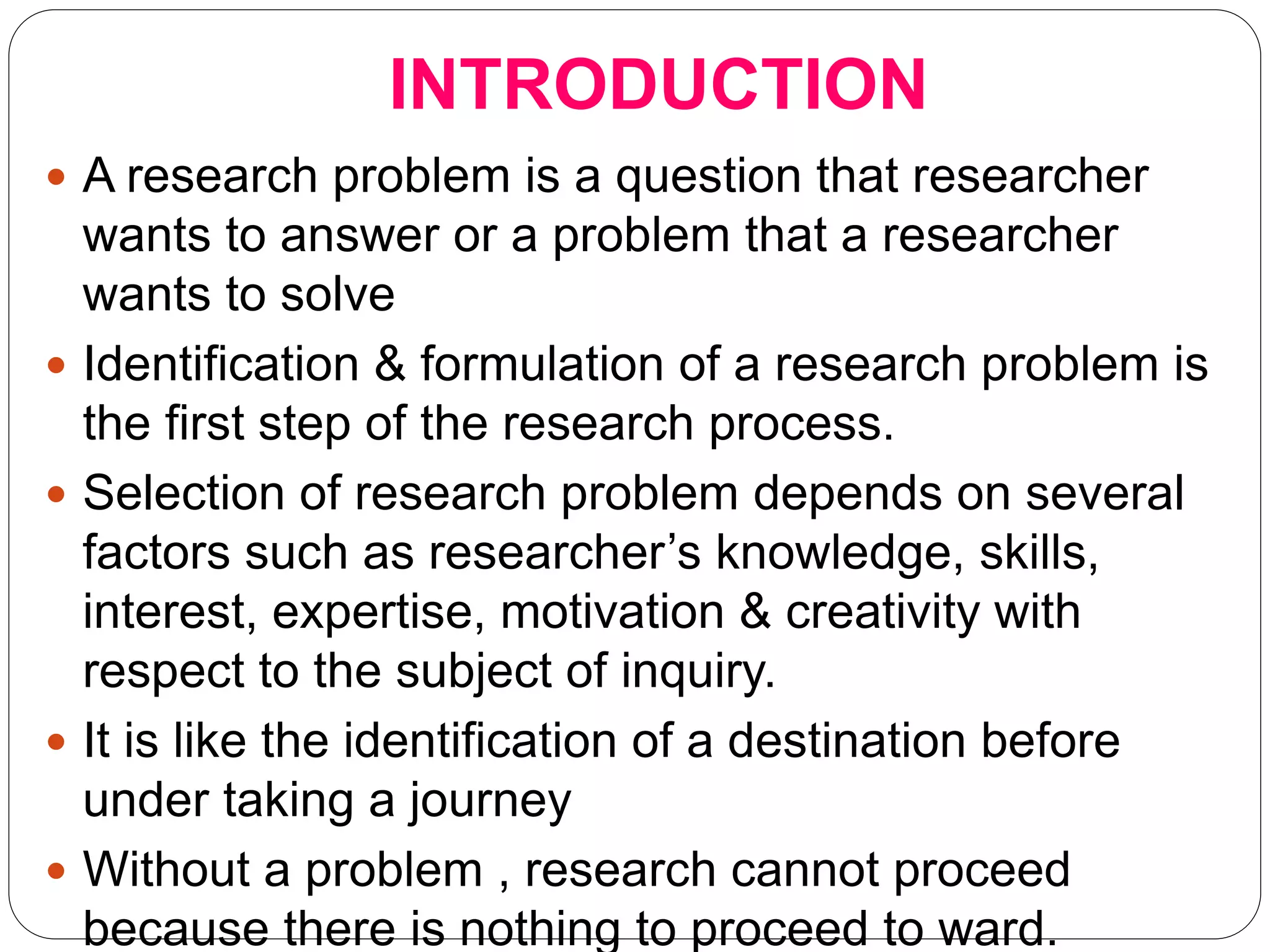
 A research problem is a question that researcher
wants to answer or a problem that a researcher
wants to solve
 Identification & formulation of a research problem is
the first step of the research process.
 Selection of research problem depends on several
factors such as researcher’s knowledge, skills,
interest, expertise, motivation & creativity with
respect to the subject of inquiry.
 It is like the identification of a destination before
under taking a journey
 Without a problem , research cannot proceed
because there is nothing to proceed to ward.
Count…
 “If one wants to solve a problem , one must generally
know what the problem is . It can be said that a large
part of the problem lies in knowing what one is trying
to do.
 Research problem may take a number of forms ,
from the very simple to the very complex
Research Topic:
The broad general area expected to investigate. It is a
broad idea or concept from which many problems may be
delineated.
Research Problem:
A situation or circumstance that requires a solution to be
described, explained, or predicted. It is an unsatisfactory
DEFINITION
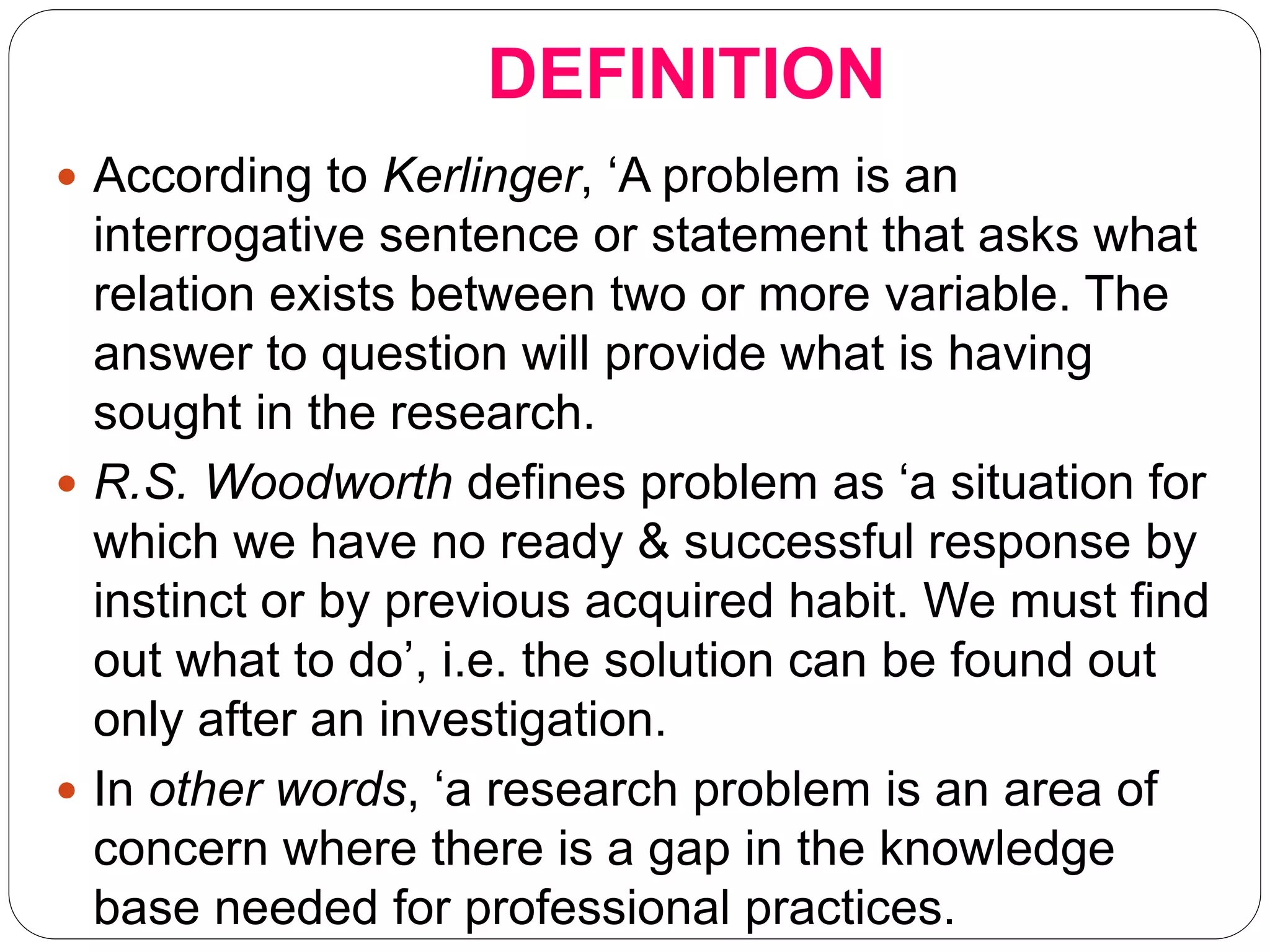
 According to Kerlinger, ‘A problem is an
interrogative sentence or statement that asks what
relation exists between two or more variable. The
answer to question will provide what is having
sought in the research.
 R.S. Woodworth defines problem as ‘a situation for
which we have no ready & successful response by
instinct or by previous acquired habit. We must find
out what to do’, i.e. the solution can be found out
only after an investigation.
 In other words, ‘a research problem is an area of
concern where there is a gap in the knowledge
base needed for professional practices.
SELECTION OF RESEARCH
PROBLEM
Any research problem does exist if the following condition
are in existence:-
1.There must be an individual or a group or an
organization having different types of environment.
2.There must be atlest two course of action is defined by
one or more values of the controlled variable.
3. There must be atlest two possible outcomes .Out of
these two a researcher wants an objective.
Count…
4. The courses of action available must provide some
chance of obtaining the objective but they cannot
provide the same chance as they have unequal
efficiencies for the desired result.
R.L.ACKOFF has discussed the five components of a
research problem as under:-
1. Research consumer:
-individuals or group which have some difficulty or
problem. they may be researcher or other.
2. Research – consumer’s objective:-
- there must be some objective to be attained as
the research consumer must have something to get
it. If one wants noting one cannot have a problem.
Count…
3.Alternative means to meet the objective:
-this means that there must be at least two means(courses
of action) available to a researcher or if has no choice of
means, he/she cannot have a problem.
4. Doubt in regard to selection of alternatives:
-the existence of alternative courses of action is not enough
to experience a problem
-The researcher must have some doubt as to which
alternative to select.
-without such a doubt there can be no problem
5. There must be one or more environments:
- there must be some environment to which the difficulty or
problem pertains
- A researcher may have doubts as to which will be most
efficient means in one environment.
- -some problems are specific to any one environment while
others are quite general.
The following points should be kept in mind by a researcher in
selecting a research problem:
1.The subject on which research work has been overdue should
not be chosen, because it will be a difficult task to throw any
new light.
2.The problem should neither be too narrow nor too vague.
3.The topic of the research should be familiar and feasible so
that the researcher can easily have an access to related
research materials or source of research.
4.Controversial subject should be avoided while selecting a
research problem.
5.While selecting a research problem the researcher should also
take into account the various factors such as the importance of
subject, the qualifications , the training of researcher , the
investment elements in the research in terms of time, money and
energy.
A research problem
may come from
several sources
Selection of a research
areas
Formulating final statement
of research problem
Reviewing the literature &
theories
Delimiting the research
topic
Evaluating the research
problem
Selection of a research area:
Formulation of a research problem begins with
selection of a broad research topic from personal
experience, literature, previous research, & theories in
which researcher is interested & has significance for
library profession.
For example, a researcher gets an idea to conduct a
study on the Impact of library internship on MLIS
Student.
Therefore, he or she initially begins with such broad
Reviewing literature &
theories:
After getting a broad idea for research, he or she needs
to review the LISc. literature & theories.
Literature is reviewed to know what has already been
done in this selected areas of research.
Review of library theories provides an opportunity for
LISc researcher to plan a research problem to
contribute towards either testing or development of a
theory/conceptual model.
Delimiting the research topic:
In this step, researcher proceeds from a general area of
interest to more specific topic of research to conduct a
study.
For example, initially a researcher decides to conduct a
study on Impact of library internship on MLIS Student;
later in this stage researcher limits it to specific research
topic ‘a study on perception of MLIS Students about
impact on internship in pondicherry university ’.
In this stage, a researcher clearly identifies variables,
Evaluating the research problem
Once researcher is clear about the specific research
problem, next the research problem must be carefully
evaluated for its significance, researchability, &
feasibility.
Feasibility of the research problem should be
evaluated for time, cost, availability of subjects &
resources, administrative & peer support, ethical
consideration, & researcher’s competence & interest.
Formulating final statement of
research problem:
After establishing the significance, researchability, &
feasibility, then researcher finally formulates a final
statement of a research problem.
A statement of research problem could be in
declarative or interrogative format
Count…
1.Declarative format:
In this format, a research problem is
stated in declarative statement.
e.g.- impact of library internship on MLIS student of
Pondicherry University.
2. Interrogative format:
In interrogative format, a research
problem is stated in question form.
e.g- “What is the Impact of library internship on MLIS
Student of Pondicherry University ?”
Count…
The choice of either of these two types of format formulation
of a research problem depends on the researcher’s
preference & institutional policies.
Declarative format much popular among researchers.
For the formulation of a research problem it is preferable it it
fulfils the following features:
 Research problem is clearly, precisely articulated.
 It clearly states the variables, population, & research setting
under study.
 Variable are expressed in measurable terms.
 The type of study also may be included in the statement of
research problem.
Thank you

Research problem

  • 1.
  • 2.
    INTRODUCTION  A researchproblem is a question that researcher wants to answer or a problem that a researcher wants to solve  Identification & formulation of a research problem is the first step of the research process.  Selection of research problem depends on several factors such as researcher’s knowledge, skills, interest, expertise, motivation & creativity with respect to the subject of inquiry.  It is like the identification of a destination before under taking a journey  Without a problem , research cannot proceed because there is nothing to proceed to ward.
  • 3.
    Count…  “If onewants to solve a problem , one must generally know what the problem is . It can be said that a large part of the problem lies in knowing what one is trying to do.  Research problem may take a number of forms , from the very simple to the very complex Research Topic: The broad general area expected to investigate. It is a broad idea or concept from which many problems may be delineated. Research Problem: A situation or circumstance that requires a solution to be described, explained, or predicted. It is an unsatisfactory
  • 4.
    DEFINITION  According toKerlinger, ‘A problem is an interrogative sentence or statement that asks what relation exists between two or more variable. The answer to question will provide what is having sought in the research.  R.S. Woodworth defines problem as ‘a situation for which we have no ready & successful response by instinct or by previous acquired habit. We must find out what to do’, i.e. the solution can be found out only after an investigation.  In other words, ‘a research problem is an area of concern where there is a gap in the knowledge base needed for professional practices.
  • 6.
    SELECTION OF RESEARCH PROBLEM Anyresearch problem does exist if the following condition are in existence:- 1.There must be an individual or a group or an organization having different types of environment. 2.There must be atlest two course of action is defined by one or more values of the controlled variable. 3. There must be atlest two possible outcomes .Out of these two a researcher wants an objective.
  • 7.
    Count… 4. The coursesof action available must provide some chance of obtaining the objective but they cannot provide the same chance as they have unequal efficiencies for the desired result. R.L.ACKOFF has discussed the five components of a research problem as under:- 1. Research consumer: -individuals or group which have some difficulty or problem. they may be researcher or other. 2. Research – consumer’s objective:- - there must be some objective to be attained as the research consumer must have something to get it. If one wants noting one cannot have a problem.
  • 8.
    Count… 3.Alternative means tomeet the objective: -this means that there must be at least two means(courses of action) available to a researcher or if has no choice of means, he/she cannot have a problem. 4. Doubt in regard to selection of alternatives: -the existence of alternative courses of action is not enough to experience a problem -The researcher must have some doubt as to which alternative to select. -without such a doubt there can be no problem 5. There must be one or more environments: - there must be some environment to which the difficulty or problem pertains - A researcher may have doubts as to which will be most efficient means in one environment. - -some problems are specific to any one environment while others are quite general.
  • 9.
    The following pointsshould be kept in mind by a researcher in selecting a research problem: 1.The subject on which research work has been overdue should not be chosen, because it will be a difficult task to throw any new light. 2.The problem should neither be too narrow nor too vague. 3.The topic of the research should be familiar and feasible so that the researcher can easily have an access to related research materials or source of research. 4.Controversial subject should be avoided while selecting a research problem. 5.While selecting a research problem the researcher should also take into account the various factors such as the importance of subject, the qualifications , the training of researcher , the investment elements in the research in terms of time, money and energy.
  • 10.
    A research problem maycome from several sources
  • 13.
    Selection of aresearch areas Formulating final statement of research problem Reviewing the literature & theories Delimiting the research topic Evaluating the research problem
  • 14.
    Selection of aresearch area: Formulation of a research problem begins with selection of a broad research topic from personal experience, literature, previous research, & theories in which researcher is interested & has significance for library profession. For example, a researcher gets an idea to conduct a study on the Impact of library internship on MLIS Student. Therefore, he or she initially begins with such broad
  • 15.
    Reviewing literature & theories: Aftergetting a broad idea for research, he or she needs to review the LISc. literature & theories. Literature is reviewed to know what has already been done in this selected areas of research. Review of library theories provides an opportunity for LISc researcher to plan a research problem to contribute towards either testing or development of a theory/conceptual model.
  • 16.
    Delimiting the researchtopic: In this step, researcher proceeds from a general area of interest to more specific topic of research to conduct a study. For example, initially a researcher decides to conduct a study on Impact of library internship on MLIS Student; later in this stage researcher limits it to specific research topic ‘a study on perception of MLIS Students about impact on internship in pondicherry university ’. In this stage, a researcher clearly identifies variables,
  • 17.
    Evaluating the researchproblem Once researcher is clear about the specific research problem, next the research problem must be carefully evaluated for its significance, researchability, & feasibility. Feasibility of the research problem should be evaluated for time, cost, availability of subjects & resources, administrative & peer support, ethical consideration, & researcher’s competence & interest.
  • 18.
    Formulating final statementof research problem: After establishing the significance, researchability, & feasibility, then researcher finally formulates a final statement of a research problem. A statement of research problem could be in declarative or interrogative format
  • 19.
    Count… 1.Declarative format: In thisformat, a research problem is stated in declarative statement. e.g.- impact of library internship on MLIS student of Pondicherry University. 2. Interrogative format: In interrogative format, a research problem is stated in question form. e.g- “What is the Impact of library internship on MLIS Student of Pondicherry University ?”
  • 20.
    Count… The choice ofeither of these two types of format formulation of a research problem depends on the researcher’s preference & institutional policies. Declarative format much popular among researchers. For the formulation of a research problem it is preferable it it fulfils the following features:  Research problem is clearly, precisely articulated.  It clearly states the variables, population, & research setting under study.  Variable are expressed in measurable terms.  The type of study also may be included in the statement of research problem.
  • 21.