By
Simran Sakshi
Roll- 147522
BBM Hons.
2016
FEMA
• Introduction
• Hierarchal Structure
• Objectives
FEMA, 2016
• Prohibition on remittance outside India of
assets held in India
• Permission for remittance of assets in
certain cases
• Permission to an Indian entity to remit funds
in certain cases
• Permission for remittance of assets on
closure or remittance of winding up
proceeds of branch office/ liaison office
(other than project office)
• Reserve Bank’s prior permission in certain
cases
• Payment of taxes
 The Foreign Exchange Management Act (FEMA) was introduced as a replacement
for earlier Foreign Exchange Regulation Act (FERA).
 FEMA came into act on 1st June, 2000.
 The main objective behind the FEMA (1999) is to consolidate and amend the law
related to foreign exchange with the objective of facilitating external trade and
payments. It was also formulated to promote the orderly development and
maintenance of foreign exchange market in India.
 It is applicable throughout India. It is also applicable to all branches, offices and
agencies outside India that are owned or controlled by an Indian resident.
Introduction
Hierarchical Structure
Head office in Delhi
(headed by a Director)
Five zonal offices, each headed by
a Deputy Director
Delhi Mumbai Kolkata ChennaiJalandhar
Each zonal is divided into 7 sub-zonal offices headed by the Assistant Directors and 5 field units headed by Chief Enforcement Officers
The legislations, rules and regulations relating to FEMA
FEMA contains 7
chapters divided
into 49 sections
(Supreme
Legislation)
5 sets of rules made by
Ministry under Section 46 of
FEMA (Delegated Legislations)
23 sets of regulations made by RBI
under Section 47 of FEMA
(Subordinate Legislations) Master Circular
issued by RBI every
year
FDI policy issued by
Department of Industrial
Policy and Promotion from
time
Notifications
and circulars
issued by RBI
Foreign Exchange Management (Remittance of Assets) Regulations, 2016
The Reserve Bank made regulations relating to deposits between a person
resident in India and a person resident outside India.
These regulations are deemed to have come into force with effect from 21st
January, 2016.
Prohibition on Remittance outside India of assets held in India
As provided in the act, no person, whether resident in India or not, shall make remittance of
any asset held in India by him or by any other person:
Provided that the Reserve Bank may, for sufficient reasons, permit any person to make
remittance of any asset held in India by him or by any other person.
Permission for remittance of assets in certain conditions
has retired from an employment in India
has inherited the assets from a person referred to in sub-section (5) of section 6 of the Act
is a widow/ widower resident outside India and has inherited assets of the deceased spouse
who was an Indian citizen resident in India
had come to India for studies/ training and has completed his studies/ training, may remit the
balance available in his account, provided such balance represents funds derived out of
remittances received from abroad
(i)
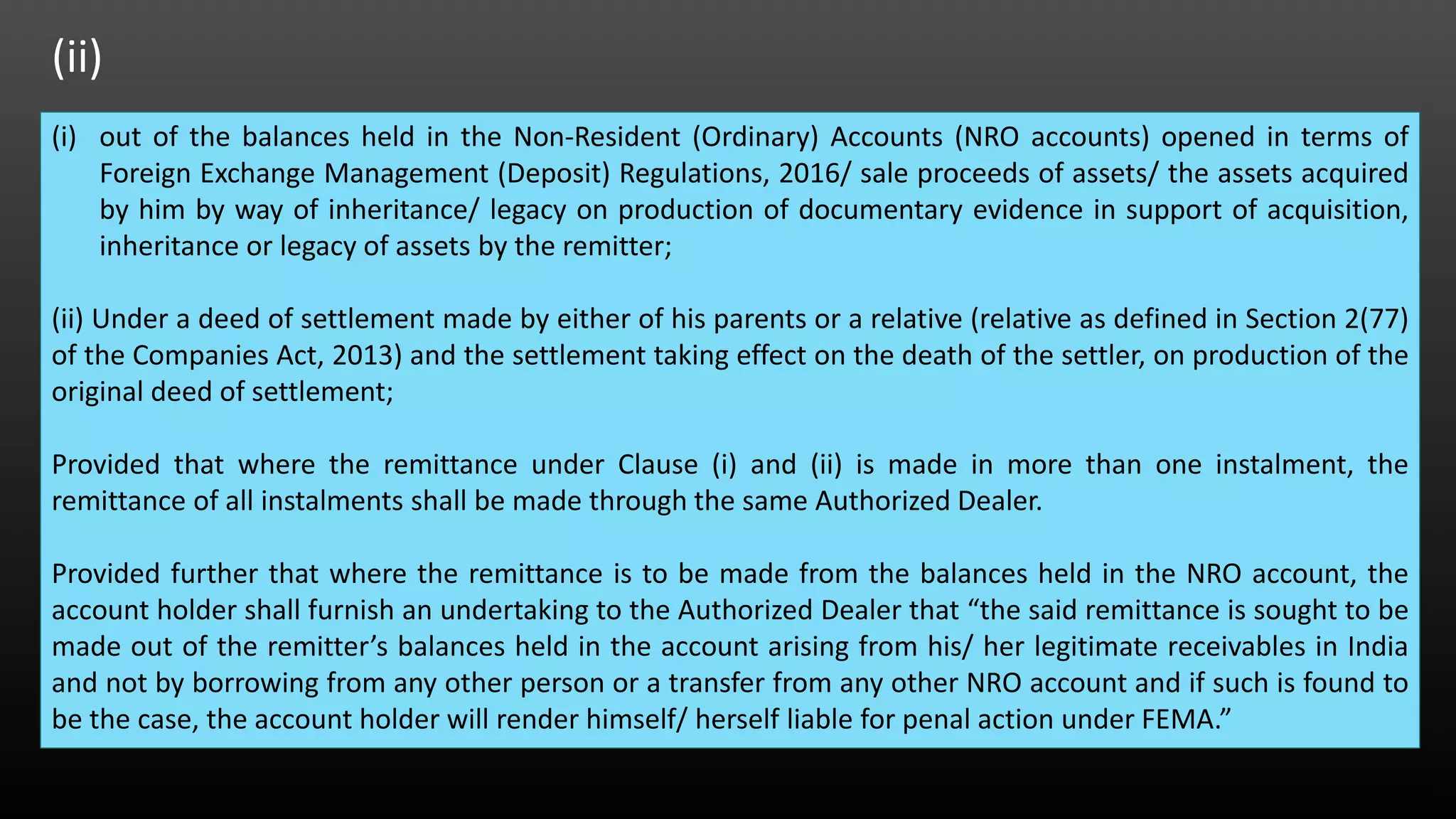
(i) out of the balances held in the Non-Resident (Ordinary) Accounts (NRO accounts) opened in terms of
Foreign Exchange Management (Deposit) Regulations, 2016/ sale proceeds of assets/ the assets acquired
by him by way of inheritance/ legacy on production of documentary evidence in support of acquisition,
inheritance or legacy of assets by the remitter;
(ii) Under a deed of settlement made by either of his parents or a relative (relative as defined in Section 2(77)
of the Companies Act, 2013) and the settlement taking effect on the death of the settler, on production of the
original deed of settlement;
Provided that where the remittance under Clause (i) and (ii) is made in more than one instalment, the
remittance of all instalments shall be made through the same Authorized Dealer.
Provided further that where the remittance is to be made from the balances held in the NRO account, the
account holder shall furnish an undertaking to the Authorized Dealer that “the said remittance is sought to be
made out of the remitter’s balances held in the account arising from his/ her legitimate receivables in India
and not by borrowing from any other person or a transfer from any other NRO account and if such is found to
be the case, the account holder will render himself/ herself liable for penal action under FEMA.”
(ii)
Authorized Dealer shall ensure that
the remittance is in compliance with
the order issued by a court in India/
order issued by the official liquidator
or the liquidator in the case of
voluntary winding up
No remittance shall be allowed unless
the applicant submits:
(a) Auditor’s certificate confirming that all
liabilities in India have been either fully paid or
adequately provided for.
(b) Auditor’s certificate to the effect that the
winding up is in accordance with the provisions
of the Companies Act, 2013.
(c) In case of winding up otherwise than by a
court, an auditor’s certificate to the effect that
there is no legal proceedings pending in any
court in India against the applicant or the
company under liquidation and there is no legal
impediment in permitting the remittance.
(iii)
Permission to an Indian entity to remit funds in certain cases
An entity in India may remit the
amount being its contribution towards
the provident fund/ superannuation/
pension fund in respect of the
expatriate staff in its employment who
are resident in India but not
permanently resident therein.
A branch or office
established in India by a
person resident outside
India may, for making
remittance of assets on
closure or remittance of its
winding up proceeds, apply
to the Authorized Dealer
concerned supported by the
following documents and on
consideration of the
application, the authorized
dealer concerned may
permit the remittance
subject to the directions
issued by the Reserve Bank
in this regard, from time to
time.
Permission for remittance of assets on closure or remittance of winding up
proceeds of branch office/ liaison office (other than project office)
A copy of the Reserve Bank’s permission for establishing the branch/ office in
India
• Wherever applicable
Auditor’s certificate
• indicating the manner in which the remittable amount has been arrived and indicating
the manner of disposal of assets
• confirming that all liabilities in India including arrears of gratuity and other benefits to
the employees etc., of the branch/ office have been either fully met or adequately
provided for
• confirming that no income accruing from sources outside India (including proceeds of
exports) has remained un-repatriated to India
• confirming that the branch/office has complied with all regulatory requirementsA confirmation from the applicant that no legal proceedings are pending in any
Court in India and there is no legal impediment to the remittance
A report from the Registrar of Companies regarding compliance with the
provisions of the Companies Act, 2013
• in case of winding up of the office in India
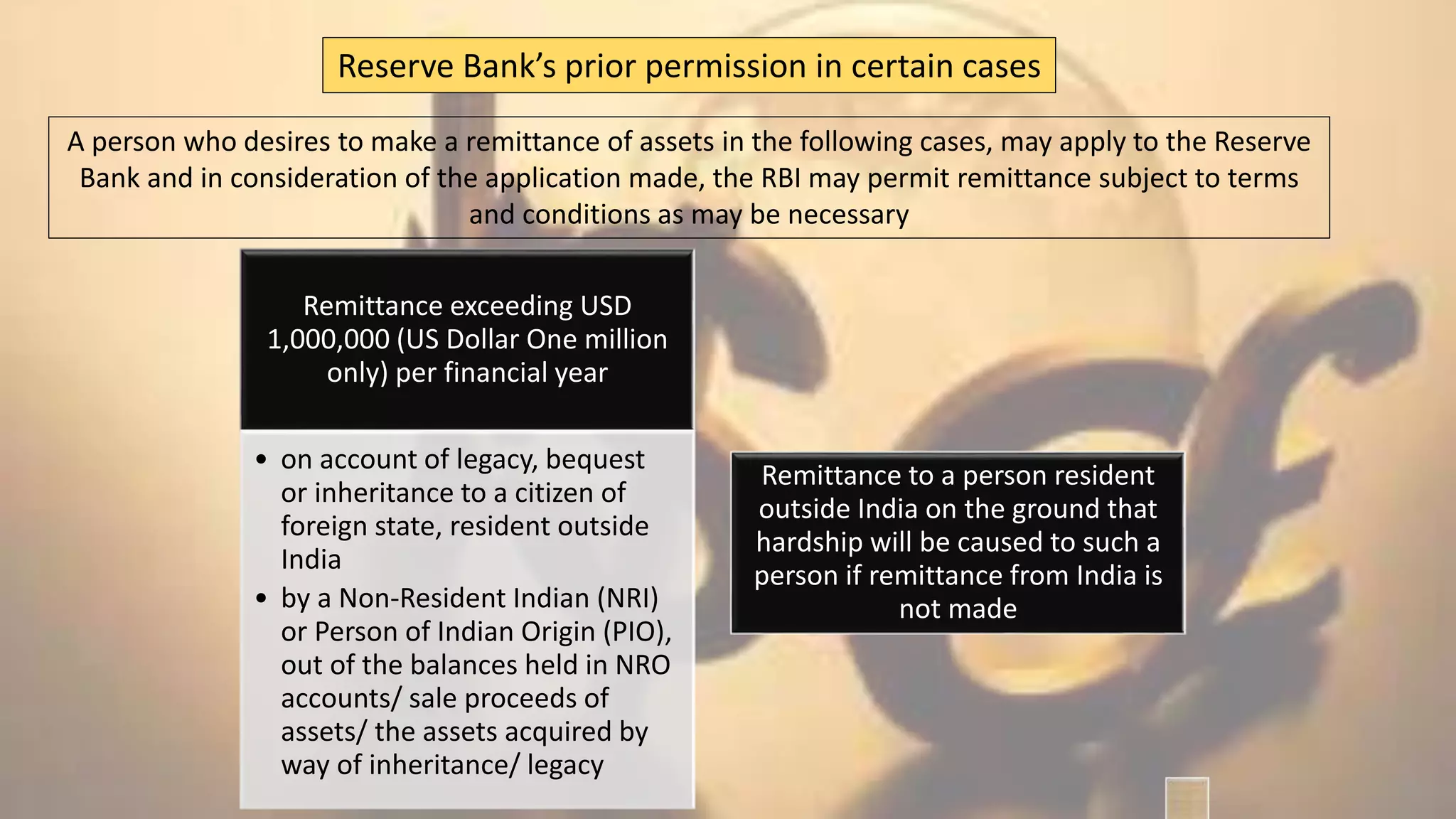
A person who desires to make a remittance of assets in the following cases, may apply to the Reserve
Bank and in consideration of the application made, the RBI may permit remittance subject to terms
and conditions as may be necessary
Reserve Bank’s prior permission in certain cases
Remittance exceeding USD
1,000,000 (US Dollar One million
only) per financial year
• on account of legacy, bequest
or inheritance to a citizen of
foreign state, resident outside
India
• by a Non-Resident Indian (NRI)
or Person of Indian Origin (PIO),
out of the balances held in NRO
accounts/ sale proceeds of
assets/ the assets acquired by
way of inheritance/ legacy
Remittance to a person resident
outside India on the ground that
hardship will be caused to such a
person if remittance from India is
not made
Payment of taxes
Any transaction involving remittance of assets under
these regulations shall be subject to the applicable tax
laws in India.
 http://www.caclubindia.com/articles/foreign-exchange-management-act-1999-fema-basic-
understanding-13654.asp
 https://rbi.org.in/scripts/BS_FemaNotifications.aspx?Id=10325
 http://www.yourarticlelibrary.com/economics/indian-economy/main-features-of-the-foreign-
exchange-management-act-fema/39551/
 http://www.slideshare.net/casudhagbhushan/fema-an-overview-a-presentation-by-ca-sudha-g-
bhushan
 http://caclub.in/fema-remittance-of-assets-regulations-2016-notified-by-rbi/
 http://www.slideshare.net/jincegomez/fema-introduction
REFERENCES

Fema

  • 1.
  • 2.
    FEMA • Introduction • HierarchalStructure • Objectives FEMA, 2016 • Prohibition on remittance outside India of assets held in India • Permission for remittance of assets in certain cases • Permission to an Indian entity to remit funds in certain cases • Permission for remittance of assets on closure or remittance of winding up proceeds of branch office/ liaison office (other than project office) • Reserve Bank’s prior permission in certain cases • Payment of taxes
  • 3.
     The ForeignExchange Management Act (FEMA) was introduced as a replacement for earlier Foreign Exchange Regulation Act (FERA).  FEMA came into act on 1st June, 2000.  The main objective behind the FEMA (1999) is to consolidate and amend the law related to foreign exchange with the objective of facilitating external trade and payments. It was also formulated to promote the orderly development and maintenance of foreign exchange market in India.  It is applicable throughout India. It is also applicable to all branches, offices and agencies outside India that are owned or controlled by an Indian resident. Introduction
  • 4.
    Hierarchical Structure Head officein Delhi (headed by a Director) Five zonal offices, each headed by a Deputy Director Delhi Mumbai Kolkata ChennaiJalandhar Each zonal is divided into 7 sub-zonal offices headed by the Assistant Directors and 5 field units headed by Chief Enforcement Officers
  • 5.
    The legislations, rulesand regulations relating to FEMA FEMA contains 7 chapters divided into 49 sections (Supreme Legislation) 5 sets of rules made by Ministry under Section 46 of FEMA (Delegated Legislations) 23 sets of regulations made by RBI under Section 47 of FEMA (Subordinate Legislations) Master Circular issued by RBI every year FDI policy issued by Department of Industrial Policy and Promotion from time Notifications and circulars issued by RBI
  • 6.
    Foreign Exchange Management(Remittance of Assets) Regulations, 2016 The Reserve Bank made regulations relating to deposits between a person resident in India and a person resident outside India. These regulations are deemed to have come into force with effect from 21st January, 2016.
  • 8.
    Prohibition on Remittanceoutside India of assets held in India As provided in the act, no person, whether resident in India or not, shall make remittance of any asset held in India by him or by any other person: Provided that the Reserve Bank may, for sufficient reasons, permit any person to make remittance of any asset held in India by him or by any other person.
  • 9.
    Permission for remittanceof assets in certain conditions
  • 10.
    has retired froman employment in India has inherited the assets from a person referred to in sub-section (5) of section 6 of the Act is a widow/ widower resident outside India and has inherited assets of the deceased spouse who was an Indian citizen resident in India had come to India for studies/ training and has completed his studies/ training, may remit the balance available in his account, provided such balance represents funds derived out of remittances received from abroad (i)
  • 11.
    (i) out ofthe balances held in the Non-Resident (Ordinary) Accounts (NRO accounts) opened in terms of Foreign Exchange Management (Deposit) Regulations, 2016/ sale proceeds of assets/ the assets acquired by him by way of inheritance/ legacy on production of documentary evidence in support of acquisition, inheritance or legacy of assets by the remitter; (ii) Under a deed of settlement made by either of his parents or a relative (relative as defined in Section 2(77) of the Companies Act, 2013) and the settlement taking effect on the death of the settler, on production of the original deed of settlement; Provided that where the remittance under Clause (i) and (ii) is made in more than one instalment, the remittance of all instalments shall be made through the same Authorized Dealer. Provided further that where the remittance is to be made from the balances held in the NRO account, the account holder shall furnish an undertaking to the Authorized Dealer that “the said remittance is sought to be made out of the remitter’s balances held in the account arising from his/ her legitimate receivables in India and not by borrowing from any other person or a transfer from any other NRO account and if such is found to be the case, the account holder will render himself/ herself liable for penal action under FEMA.” (ii)
  • 12.
    Authorized Dealer shallensure that the remittance is in compliance with the order issued by a court in India/ order issued by the official liquidator or the liquidator in the case of voluntary winding up No remittance shall be allowed unless the applicant submits: (a) Auditor’s certificate confirming that all liabilities in India have been either fully paid or adequately provided for. (b) Auditor’s certificate to the effect that the winding up is in accordance with the provisions of the Companies Act, 2013. (c) In case of winding up otherwise than by a court, an auditor’s certificate to the effect that there is no legal proceedings pending in any court in India against the applicant or the company under liquidation and there is no legal impediment in permitting the remittance. (iii)
  • 13.
    Permission to anIndian entity to remit funds in certain cases An entity in India may remit the amount being its contribution towards the provident fund/ superannuation/ pension fund in respect of the expatriate staff in its employment who are resident in India but not permanently resident therein.
  • 14.
    A branch oroffice established in India by a person resident outside India may, for making remittance of assets on closure or remittance of its winding up proceeds, apply to the Authorized Dealer concerned supported by the following documents and on consideration of the application, the authorized dealer concerned may permit the remittance subject to the directions issued by the Reserve Bank in this regard, from time to time. Permission for remittance of assets on closure or remittance of winding up proceeds of branch office/ liaison office (other than project office) A copy of the Reserve Bank’s permission for establishing the branch/ office in India • Wherever applicable Auditor’s certificate • indicating the manner in which the remittable amount has been arrived and indicating the manner of disposal of assets • confirming that all liabilities in India including arrears of gratuity and other benefits to the employees etc., of the branch/ office have been either fully met or adequately provided for • confirming that no income accruing from sources outside India (including proceeds of exports) has remained un-repatriated to India • confirming that the branch/office has complied with all regulatory requirementsA confirmation from the applicant that no legal proceedings are pending in any Court in India and there is no legal impediment to the remittance A report from the Registrar of Companies regarding compliance with the provisions of the Companies Act, 2013 • in case of winding up of the office in India
  • 15.
    A person whodesires to make a remittance of assets in the following cases, may apply to the Reserve Bank and in consideration of the application made, the RBI may permit remittance subject to terms and conditions as may be necessary Reserve Bank’s prior permission in certain cases Remittance exceeding USD 1,000,000 (US Dollar One million only) per financial year • on account of legacy, bequest or inheritance to a citizen of foreign state, resident outside India • by a Non-Resident Indian (NRI) or Person of Indian Origin (PIO), out of the balances held in NRO accounts/ sale proceeds of assets/ the assets acquired by way of inheritance/ legacy Remittance to a person resident outside India on the ground that hardship will be caused to such a person if remittance from India is not made
  • 16.
    Payment of taxes Anytransaction involving remittance of assets under these regulations shall be subject to the applicable tax laws in India.
  • 17.
     http://www.caclubindia.com/articles/foreign-exchange-management-act-1999-fema-basic- understanding-13654.asp  https://rbi.org.in/scripts/BS_FemaNotifications.aspx?Id=10325 http://www.yourarticlelibrary.com/economics/indian-economy/main-features-of-the-foreign- exchange-management-act-fema/39551/  http://www.slideshare.net/casudhagbhushan/fema-an-overview-a-presentation-by-ca-sudha-g- bhushan  http://caclub.in/fema-remittance-of-assets-regulations-2016-notified-by-rbi/  http://www.slideshare.net/jincegomez/fema-introduction REFERENCES

Editor's Notes

  • #4 FEMA was introduced because the FERA didn’t fit in with post-liberalisation policies. A significant change that the FEMA brought with it, was that it made all offenses regarding foreign exchange civil offenses, as opposed to criminal offenses as dictated by FERA. FERA was an act to prohibit foreign exchange to enable economic dev of India. But in 2000, after liberaalisation, this act was amended to FEMA.
  • #6 12 sections among 49 sections cover the operational part whereas the rest 37 sections deal with contraventions, penalties, adjudication, appeals, enforcement directions etc.
  • #7 Remittance - a payment of money sent to a person in another place
  • #10 PIO- person of Indian origin
  • #11 is a widow/ widower resident outside India and has inherited assets of the deceased spouse who was an Indian citizen resident in India may remit through an authorised dealer an amount, not exceeding USD 1,000,000 (US Dollar One million only) per financial year on production of documentary evidence in support of acquisition, inheritance or legacy of assets by the remitter Provided that for the purpose of arriving at annual ceiling of remittance, the funds representing sale proceeds of shares and immovable property owned or held by the citizen of foreign state on repatriation basis in accordance with the Foreign Exchange Management (Acquisition and transfer of immovable property in India) Regulations, 2016 and Foreign Exchange Management (Transfer or issue of security by a person resident outside India) Regulations, 2000 made under the Act, shall not be included. Provided further that where the remittance is made in more than one instalment, the remittance of all instalments shall be made through the same authorized dealer. had come to India for studies/ training and has completed his studies/ training, may remit the balance available in his account, provided such balance represents funds derived out of remittances received from abroad through normal banking channels or rupee proceeds of foreign exchange brought by such person and sold to an authorised dealer or out of stipend/ scholarship received from the Government or any Organisation in India
  • #14 (a) ‘expatriate staff’ means a person whose provident/ superannuation/ pension fund is maintained outside India by his principal employer outside India; (b) ‘not permanently resident’ means a person resident in India for employment of a specified duration (irrespective of length thereof) or for a specific job or assignment, the duration of which does not exceed three years.