HYPOTHESIS

   BY
     BINCY M KURIEN
      MAR ATHANASIOS COLLEGE
          FOR ADVANCED
       STUDIES THIRUVALLA
Meaning and Definition

A hypothesis, generally means a mere assumption or
supposition to be proved or disproved.
Hypothesis provides the basis for investigation and ensures
proper direction in which the study should proceed.
It facilitates the collection of adequate facts and helps one
to arrive at appropriate conclusions, suggestions and
observations.
E.g.: ”Sales growth is directly correlated to the expenditure
on advertisement ”
Sources of hypothesis


Following are the sources of hypothesis:
1.   Similarity between phenomena.
2.   Observations in the day to day practices.
3.   Observations in past studies.
4.   Findings of research and development department.
5.   Experience or observations of the competitors.
6.   Suggestions from functional executives.
7.   Suggestions from shop floor.
8.   Scientific theory.
Formulation of hypothesis


  Formulation of hypothesis gives a definite point to the
  enquiry, helps in establishing direction in which to
  proceed and helps to delimit the field of enquiry by
  choosing the permanent point on which to concentrate.
  Problems in the formulation of hypothesis are
1. Absence of theoretical base.
2. Lack of ability to use the frame work logically.
3. Failure to acquaint with techniques.
Steps in hypothesis


Following are the steps in formulating a hypothesis

1. Observation
2. Reflection
3. Deduction
4. Verification
Characteristics of good hypothesis
 (Condition for a valid hypothesis)


The basic characteristics of a good hypothesis are:
1.   Conceptual clarity and definiteness.
2.   Verifiable and capable of being tested.
3.   Specific in nature.
4.   Non contradictoriness.
5.   Simplicity.
6.   Related to available techniques.
7.   Related to body of theory.
Types of hypothesis


There are mainly two types of hypothesis:
1) Crude hypothesis:
  A crude hypothesis is at the low level of abstraction. It
indicates the kind of data to be collected and it does not lead
to higher theoretical research in the nature of a law or a theory.
2) Refined hypothesis.
Refined hypothesis are a) hypothesis that state the existence
of empirical uniformities b)Hypothesis that are concerned with
relation of analytical variables.
Forms of hypothesis

The various forms of hypothesis are:
1) Descriptive hypothesis:
    When a hypothesis relates to the cause and effect relationship of
a phenomenon it is called descriptive hypothesis.
E.g:“ Public enterprises are more amenable for centralized
planning”.
2) Explanatory hypothesis:
    This type of hypothesis explains the happenings of a
phenomenon.
E.g:“ Families with higher incomes spend more for recreation”
Cont…..

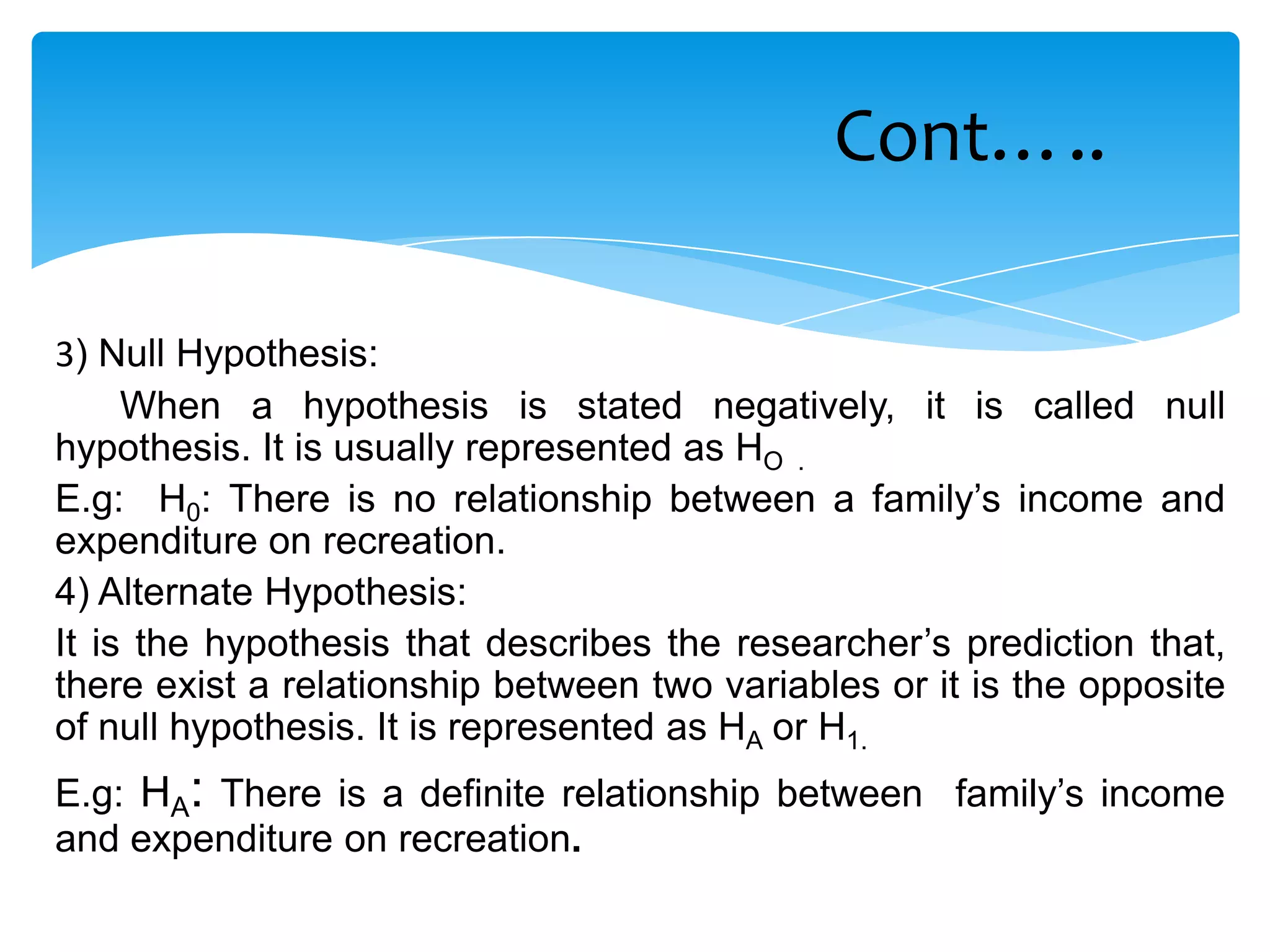
3) Null Hypothesis:
     When a hypothesis is stated negatively, it is called null
hypothesis. It is usually represented as HO .
E.g: H0: There is no relationship between a family’s income and
expenditure on recreation.
4) Alternate Hypothesis:
It is the hypothesis that describes the researcher’s prediction that,
there exist a relationship between two variables or it is the opposite
of null hypothesis. It is represented as HA or H1.
E.g: HA: There is a definite relationship between family’s income
and expenditure on recreation.
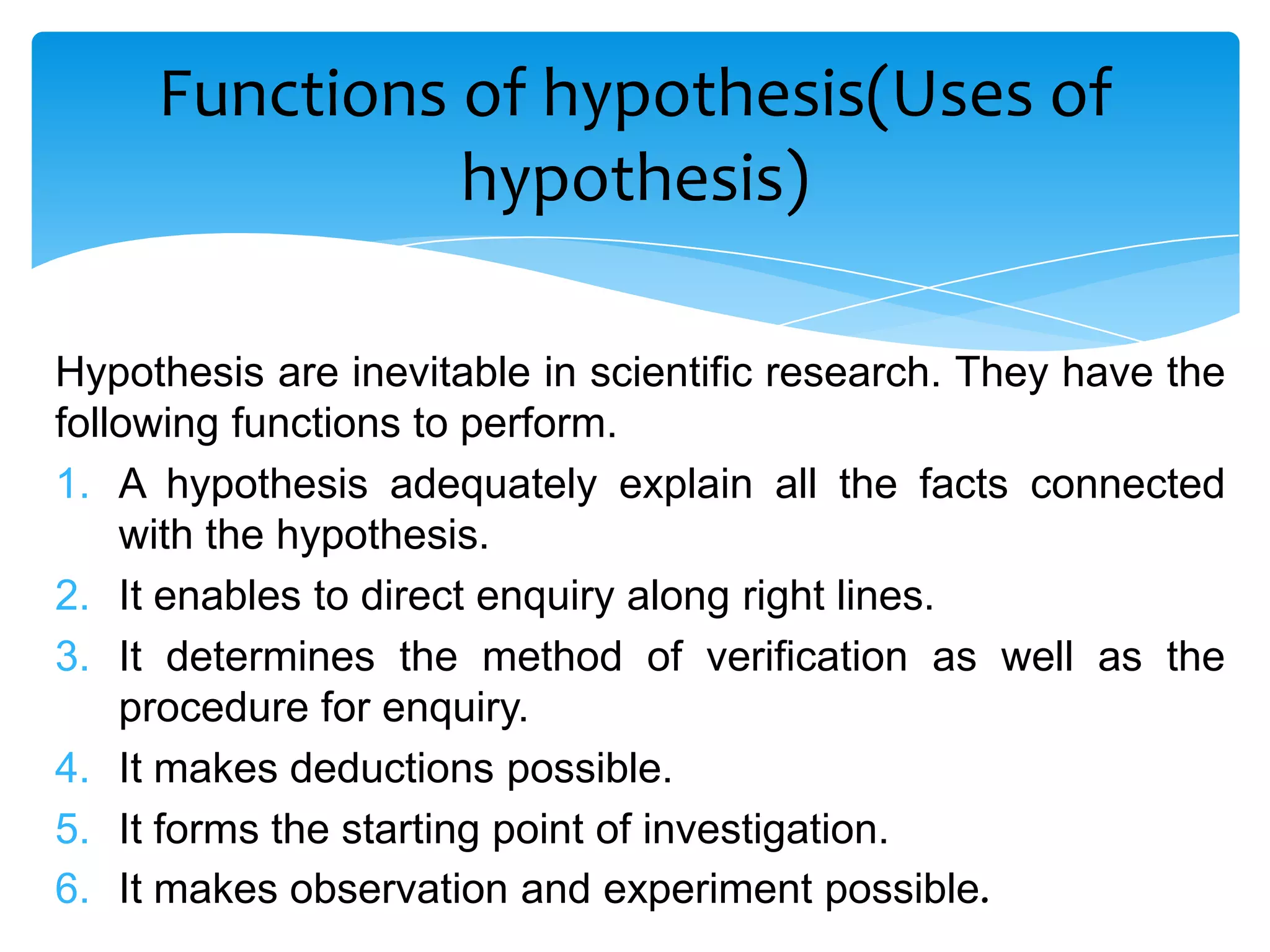
Functions of hypothesis(Uses of
               hypothesis)

Hypothesis are inevitable in scientific research. They have the
following functions to perform.
1. A hypothesis adequately explain all the facts connected
    with the hypothesis.
2. It enables to direct enquiry along right lines.
3. It determines the method of verification as well as the
    procedure for enquiry.
4. It makes deductions possible.
5. It forms the starting point of investigation.
6. It makes observation and experiment possible.

Hypothesis

  • 1.
    HYPOTHESIS BY BINCY M KURIEN MAR ATHANASIOS COLLEGE FOR ADVANCED STUDIES THIRUVALLA
  • 2.
    Meaning and Definition Ahypothesis, generally means a mere assumption or supposition to be proved or disproved. Hypothesis provides the basis for investigation and ensures proper direction in which the study should proceed. It facilitates the collection of adequate facts and helps one to arrive at appropriate conclusions, suggestions and observations. E.g.: ”Sales growth is directly correlated to the expenditure on advertisement ”
  • 3.
    Sources of hypothesis Followingare the sources of hypothesis: 1. Similarity between phenomena. 2. Observations in the day to day practices. 3. Observations in past studies. 4. Findings of research and development department. 5. Experience or observations of the competitors. 6. Suggestions from functional executives. 7. Suggestions from shop floor. 8. Scientific theory.
  • 4.
    Formulation of hypothesis Formulation of hypothesis gives a definite point to the enquiry, helps in establishing direction in which to proceed and helps to delimit the field of enquiry by choosing the permanent point on which to concentrate. Problems in the formulation of hypothesis are 1. Absence of theoretical base. 2. Lack of ability to use the frame work logically. 3. Failure to acquaint with techniques.
  • 5.
    Steps in hypothesis Followingare the steps in formulating a hypothesis 1. Observation 2. Reflection 3. Deduction 4. Verification
  • 6.
    Characteristics of goodhypothesis (Condition for a valid hypothesis) The basic characteristics of a good hypothesis are: 1. Conceptual clarity and definiteness. 2. Verifiable and capable of being tested. 3. Specific in nature. 4. Non contradictoriness. 5. Simplicity. 6. Related to available techniques. 7. Related to body of theory.
  • 7.
    Types of hypothesis Thereare mainly two types of hypothesis: 1) Crude hypothesis: A crude hypothesis is at the low level of abstraction. It indicates the kind of data to be collected and it does not lead to higher theoretical research in the nature of a law or a theory. 2) Refined hypothesis. Refined hypothesis are a) hypothesis that state the existence of empirical uniformities b)Hypothesis that are concerned with relation of analytical variables.
  • 8.
    Forms of hypothesis Thevarious forms of hypothesis are: 1) Descriptive hypothesis: When a hypothesis relates to the cause and effect relationship of a phenomenon it is called descriptive hypothesis. E.g:“ Public enterprises are more amenable for centralized planning”. 2) Explanatory hypothesis: This type of hypothesis explains the happenings of a phenomenon. E.g:“ Families with higher incomes spend more for recreation”
  • 9.
    Cont….. 3) Null Hypothesis: When a hypothesis is stated negatively, it is called null hypothesis. It is usually represented as HO . E.g: H0: There is no relationship between a family’s income and expenditure on recreation. 4) Alternate Hypothesis: It is the hypothesis that describes the researcher’s prediction that, there exist a relationship between two variables or it is the opposite of null hypothesis. It is represented as HA or H1. E.g: HA: There is a definite relationship between family’s income and expenditure on recreation.
  • 10.
    Functions of hypothesis(Usesof hypothesis) Hypothesis are inevitable in scientific research. They have the following functions to perform. 1. A hypothesis adequately explain all the facts connected with the hypothesis. 2. It enables to direct enquiry along right lines. 3. It determines the method of verification as well as the procedure for enquiry. 4. It makes deductions possible. 5. It forms the starting point of investigation. 6. It makes observation and experiment possible.

Editor's Notes