DISCOVER . LEARN . EMPOWER
Hypothesis Testing
UNIVERSITY SCHOOL OF BUSINESS
DEPARTMENT OF COMMERCE
B.Com (Hons)
Subject Name – Research Methodology
Code – CMT 302
2
Hypothesis
Testing
CO
Number
Title Level
CO1 The students would be able toto measure and analyze
the data so that students can fully understand various
business operations.
Remember
CO2 The students would be able to to analyze the possible
alternatives while doing job in corporate sector about
the strengths and overcoming weaknesses.
Understand
CO3 The students would be able to apply the knowledge of
research while making rational decisions or strategies in
their working life.
Understand
Course Outcome
Will be covered in this
lecture
1. Meaning
2. Features
3. Various Types of tests
3
Hypothesis
Testing
HYPOTHESIS
 Research Hypothesis is a predictive statement that
relates an independent variable to a dependant
variable.
Hypothesis must contain atleast one independent
variable and one dependant variable.
Objectives
• Define hypothesis
• Types of Hypothesis
• Procedure for testing Hypothesis
Meaning
• In ordinary context:
• Hypothesis means mere assumptions or supposition which are to be proved
or disproved.
• In research context:
• Hypothesis is a formal question that is intended to resolve.
Definition
• Hypothesis may be defined as a proposition of a set of proposition set
forth as an explanation for the occurrence of some specified group
phenomenon either asserted merely as a provisional conjecture to
guide some investigation or accepted as highly probable in the light of
established facts.
Definition by Various Authors
• “A hypothesis is a conjectural statement of the relation between two
or more variables”. (Kerlinger, 1956)
• “Hypotheses are single tentative guesses, good hunches – assumed
for use in devising theory or planning experiments intended to be
given a direct experimental test when possible”. (Eric Rogers, 1966)
• “Hypothesis is a formal statement that presents the expected
relationship between an independent and dependent
variable.”(Creswell, 1994)
Characteristics
• Related to problem
• State relationship
• Clear and precise
• Testable
• Amenable with time
• Specific and simple
Purpose
• Guides/gives direction to the study/investigation
• Defines Facts that are relevant and not relevant
• Suggests which form of research design is likely to be the most appropriate
• Provides a framework for organizing the conclusions of the findings
• Limits the research to specific area
• Offers explanations for the relationships between those variables that can
be empirically tested
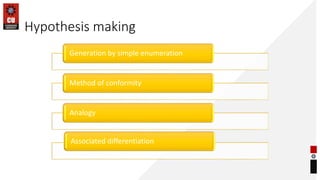
Hypothesis making
Generation by simple enumeration
Method of conformity
Analogy
Associated differentiation
Types of hypothesis
Null
hypothesis
Alternate
hypothesis
Null Hypothesis
• Null hypothesis always predicts that there is no relationship between
the variables being studied.
• The researcher wishes to disapprove this hypothesis.
• It is denoted by H0
• For example:
• “There is no relationship between smoking and lung cancer.”
Null Hypothesis
Alternate Hypothesis
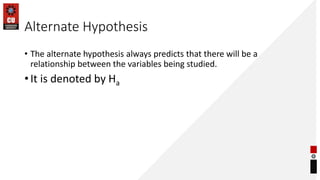
• The alternate hypothesis always predicts that there will be a
relationship between the variables being studied.
• It is denoted by Ha
Procedure for hypothesis testing
Making a Formal
Statement
Selecting a
significance level
Deciding the
distribution to use
Selecting a random
sample & compute
appropriate value
Calculation of
probability
Comparing the
probability
Flow diagram of hypothesis testing
REFERENCES
• Donald R. Cooper & Pamela S. Schindler, Business Research Methods, Tata McGraw-Hill Publishing Co. Ltd., New Delhi, 9th Edition.
• Gupta S.C, 2010 “Fundamentals of Statistics”, 6th Ed. HPH, Mumbai.
• Gupta S. P, 2002 Statistical Methods, Sultan Chand & Sons, New Delhi.
• Beri, G. C. Business Statistics, Tata McGraw-Hill Publishing Co. Ltd., New Delhi, 2nd Edition.
• Zikmund, Business Research Methods, Cenage Learning, New Delhi.
17
THANK YOU
For queries
Email: anile7666.usb@cumail.in

Hypothsis Testing.pptx

  • 1.
    DISCOVER . LEARN. EMPOWER Hypothesis Testing UNIVERSITY SCHOOL OF BUSINESS DEPARTMENT OF COMMERCE B.Com (Hons) Subject Name – Research Methodology Code – CMT 302
  • 2.
    2 Hypothesis Testing CO Number Title Level CO1 Thestudents would be able toto measure and analyze the data so that students can fully understand various business operations. Remember CO2 The students would be able to to analyze the possible alternatives while doing job in corporate sector about the strengths and overcoming weaknesses. Understand CO3 The students would be able to apply the knowledge of research while making rational decisions or strategies in their working life. Understand Course Outcome Will be covered in this lecture
  • 3.
    1. Meaning 2. Features 3.Various Types of tests 3 Hypothesis Testing
  • 4.
    HYPOTHESIS  Research Hypothesisis a predictive statement that relates an independent variable to a dependant variable. Hypothesis must contain atleast one independent variable and one dependant variable.
  • 5.
    Objectives • Define hypothesis •Types of Hypothesis • Procedure for testing Hypothesis
  • 6.
    Meaning • In ordinarycontext: • Hypothesis means mere assumptions or supposition which are to be proved or disproved. • In research context: • Hypothesis is a formal question that is intended to resolve.
  • 7.
    Definition • Hypothesis maybe defined as a proposition of a set of proposition set forth as an explanation for the occurrence of some specified group phenomenon either asserted merely as a provisional conjecture to guide some investigation or accepted as highly probable in the light of established facts.
  • 8.
    Definition by VariousAuthors • “A hypothesis is a conjectural statement of the relation between two or more variables”. (Kerlinger, 1956) • “Hypotheses are single tentative guesses, good hunches – assumed for use in devising theory or planning experiments intended to be given a direct experimental test when possible”. (Eric Rogers, 1966) • “Hypothesis is a formal statement that presents the expected relationship between an independent and dependent variable.”(Creswell, 1994)
  • 9.
    Characteristics • Related toproblem • State relationship • Clear and precise • Testable • Amenable with time • Specific and simple
  • 10.
    Purpose • Guides/gives directionto the study/investigation • Defines Facts that are relevant and not relevant • Suggests which form of research design is likely to be the most appropriate • Provides a framework for organizing the conclusions of the findings • Limits the research to specific area • Offers explanations for the relationships between those variables that can be empirically tested
  • 11.
    Hypothesis making Generation bysimple enumeration Method of conformity Analogy Associated differentiation
  • 12.
  • 13.
    Null Hypothesis • Nullhypothesis always predicts that there is no relationship between the variables being studied. • The researcher wishes to disapprove this hypothesis. • It is denoted by H0 • For example: • “There is no relationship between smoking and lung cancer.” Null Hypothesis
  • 14.
    Alternate Hypothesis • Thealternate hypothesis always predicts that there will be a relationship between the variables being studied. • It is denoted by Ha
  • 15.
    Procedure for hypothesistesting Making a Formal Statement Selecting a significance level Deciding the distribution to use Selecting a random sample & compute appropriate value Calculation of probability Comparing the probability
  • 16.
    Flow diagram ofhypothesis testing
  • 17.
    REFERENCES • Donald R.Cooper & Pamela S. Schindler, Business Research Methods, Tata McGraw-Hill Publishing Co. Ltd., New Delhi, 9th Edition. • Gupta S.C, 2010 “Fundamentals of Statistics”, 6th Ed. HPH, Mumbai. • Gupta S. P, 2002 Statistical Methods, Sultan Chand & Sons, New Delhi. • Beri, G. C. Business Statistics, Tata McGraw-Hill Publishing Co. Ltd., New Delhi, 2nd Edition. • Zikmund, Business Research Methods, Cenage Learning, New Delhi. 17
  • 18.
    THANK YOU For queries Email:anile7666.usb@cumail.in