Accept deposits
Grant loans
Keeping valuables in safe custody
Limited services
Limited use of technology
Traditional banks
E-Banking
Merits & Demerits of E-banking
Popular services covered under E-banking
Focus aspects of Banking sector
Conclusion
References
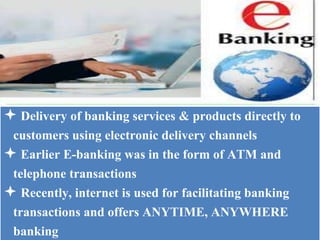
 Delivery of banking services & products directly to
customers using electronic delivery channels
 Earlier E-banking was in the form of ATM and
telephone transactions
 Recently, internet is used for facilitating banking
transactions and offers ANYTIME, ANYWHERE
banking
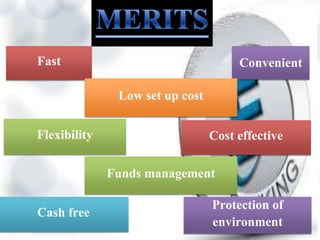
Fast
Flexibility
Convenient
Cash free
Low set up cost
Cost effective
Funds management
Protection of
environment
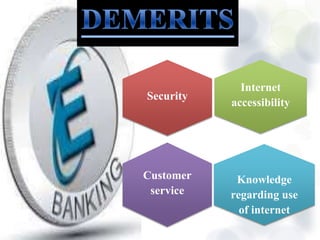
Security
Internet
accessibility
Customer
service
Knowledge
regarding use
of internet
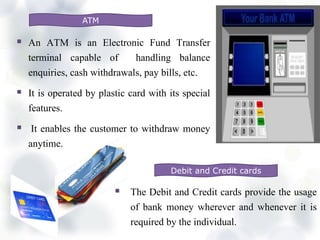
 An ATM is an Electronic Fund Transfer
terminal capable of handling balance
enquiries, cash withdrawals, pay bills, etc.
 It is operated by plastic card with its special
features.
 It enables the customer to withdraw money
anytime.
ATM
Debit and Credit cards
 The Debit and Credit cards provide the usage
of bank money wherever and whenever it is
required by the individual.
 Banks are adding chips to their current magnetic stripe cards to
enhance security and offer new service
 It can have a monetary balance downloaded to the card which can
then be used like cash for transportation, event admission, etc.
 A Smart Card can be reconfigured for different uses through the
interface machine.
Smart cards
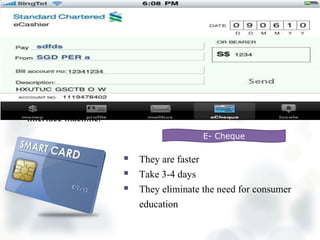
 They are faster
 Take 3-4 days
 They eliminate the need for consumer
education
E- Cheque
 Use of the Internet to deliver banking activities such as
funds transfer, paying bills, viewing account balance,
paying mortgages and purchasing financial instruments
 Allows customers to conduct financial transactions on a
secure website operated by their retail or virtual bank
 Any user with a personal computer and a browser can get
connected to his bank -s website to perform any of the
virtual banking functions
Internet/Online Banking
 Used for performing balance checks, account transactions,
payments etc. via a mobile phone or PDA
 Performed via SMS or internet through mobile
 Doesn’t allow cash withdrawal and deposits but offers all other
features of ATM
 Enables banks to operate selected banking services over
customer’s mobile
 SMS banking services are operated using push and pull messages
M- Banking
SMS Banking
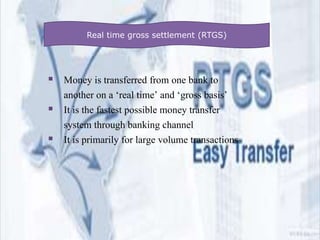
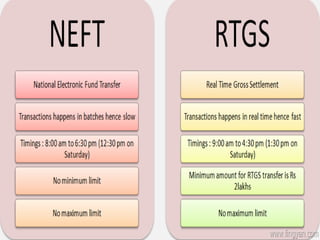
 Money is transferred from one bank to
another on a ‘real time’ and ‘gross basis’
 It is the fastest possible money transfer
system through banking channel
 It is primarily for large volume transactions
Real time gross settlement (RTGS)
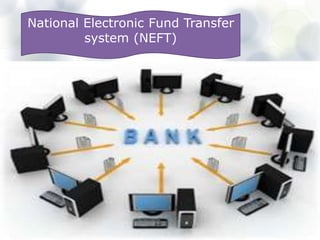
 Facilitates one-to-one funds transfer individuals can
electronically transfer
 Can transfer funds from any bank branch to any
individual having an account with any other bank branch
in the country participating in the Scheme
 Simple, secure, safe, fastest and cost effective way to
transfer funds
 Facility available through online mode for all internet
banking and mobile banking customers
National Electronic Fund Transfer
system (NEFT)
 The approach of identifying, establishing maintaining and
enhancing relationships with the customers
 Places equal emphasis on SALES & SERVICE
 Can increase banks profitability
“Having the right offer for the right client at the right time via the
right channel”
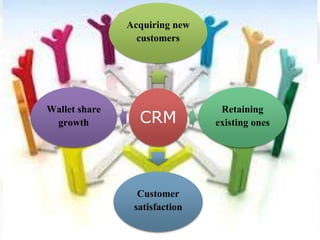
CRM
Acquiring new
customers
Retaining
existing ones
Customer
satisfaction
Wallet share
growth
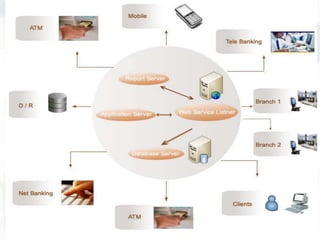
 Networking of branches, which enables Customers to
operate their accounts, and avail banking services from any
branch of the Bank on CBS network
 All CBS branches are inter-connected with each other so a
consumer is a bank’s customer and not of any branch
 Various branches use technology to focus on customer
interface and service and to make them comfortable
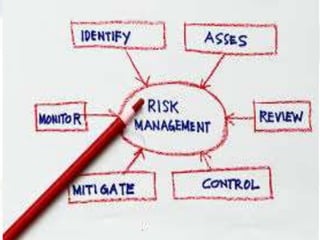
Practice of identifying potential risks in advance, analyzing them and
taking precautionary steps to reduce the risk
Risk management in bank operations includes risk identification,
measurement and assessment
Its objective is to minimize the negative effects risks can have on the
financial result and capital of a bank
A bank is exposed to various kinds of risks in its operations such as
liquidity risk, credit risk, market risks, exposure risks, investment risks etc.
 The banking industry has changed drastically over the past decade.
 Internet has created plenty of opportunities for players in the banking sector
 While the new entrants have the advantages of latest technology; the goodwill
of the established banks gives them a special opportunity to lead the online
world
 But increasing security threats is leading to unpopularity of e-Banking
 There are certain efforts which should be made by the banking industry and
also the customers to decrease the possibility of such problems
 www.google.co.in
 www.impactjournals.us/download.p..nage-Internet-
Jayashree%20chawan%20.pdf
 www.businesstoday.intoday.in
 www.indianresearchjournals.com
 www.slideshare.net/chaswals/e-banking-y-sanjeev-kumar-chaswal-compatibility
mode
 www.slideshare.net/PerminderSingh1/29381388innovationinindianbankingsector
?related=3
 www.slideshare.net/RoyThomas3/new-trends-in-indian-banking-
system?related=1
 www.slideshare.net/sojsisytas/trends-and-technology-in-banking?related=1
 www.infosys.com
 www.forbes.com
 www.necsi.edu/events/iccs/2002/nap12_onutrmiccs2002-2fixed.pdf
 www.nbs.rs/internet/english/55/55_6/
Modern banking

Modern banking

  • 2.
    Accept deposits Grant loans Keepingvaluables in safe custody Limited services Limited use of technology Traditional banks
  • 3.
    E-Banking Merits & Demeritsof E-banking Popular services covered under E-banking Focus aspects of Banking sector Conclusion References
  • 4.
     Delivery ofbanking services & products directly to customers using electronic delivery channels  Earlier E-banking was in the form of ATM and telephone transactions  Recently, internet is used for facilitating banking transactions and offers ANYTIME, ANYWHERE banking
  • 5.
    Fast Flexibility Convenient Cash free Low setup cost Cost effective Funds management Protection of environment
  • 6.
  • 8.
     An ATMis an Electronic Fund Transfer terminal capable of handling balance enquiries, cash withdrawals, pay bills, etc.  It is operated by plastic card with its special features.  It enables the customer to withdraw money anytime. ATM Debit and Credit cards  The Debit and Credit cards provide the usage of bank money wherever and whenever it is required by the individual.
  • 9.
     Banks areadding chips to their current magnetic stripe cards to enhance security and offer new service  It can have a monetary balance downloaded to the card which can then be used like cash for transportation, event admission, etc.  A Smart Card can be reconfigured for different uses through the interface machine. Smart cards  They are faster  Take 3-4 days  They eliminate the need for consumer education E- Cheque
  • 11.
     Use ofthe Internet to deliver banking activities such as funds transfer, paying bills, viewing account balance, paying mortgages and purchasing financial instruments  Allows customers to conduct financial transactions on a secure website operated by their retail or virtual bank  Any user with a personal computer and a browser can get connected to his bank -s website to perform any of the virtual banking functions Internet/Online Banking
  • 14.
     Used forperforming balance checks, account transactions, payments etc. via a mobile phone or PDA  Performed via SMS or internet through mobile  Doesn’t allow cash withdrawal and deposits but offers all other features of ATM  Enables banks to operate selected banking services over customer’s mobile  SMS banking services are operated using push and pull messages M- Banking SMS Banking
  • 15.
     Money istransferred from one bank to another on a ‘real time’ and ‘gross basis’  It is the fastest possible money transfer system through banking channel  It is primarily for large volume transactions Real time gross settlement (RTGS)
  • 16.
     Facilitates one-to-onefunds transfer individuals can electronically transfer  Can transfer funds from any bank branch to any individual having an account with any other bank branch in the country participating in the Scheme  Simple, secure, safe, fastest and cost effective way to transfer funds  Facility available through online mode for all internet banking and mobile banking customers National Electronic Fund Transfer system (NEFT)
  • 19.
     The approachof identifying, establishing maintaining and enhancing relationships with the customers  Places equal emphasis on SALES & SERVICE  Can increase banks profitability “Having the right offer for the right client at the right time via the right channel”
  • 20.
  • 21.
     Networking ofbranches, which enables Customers to operate their accounts, and avail banking services from any branch of the Bank on CBS network  All CBS branches are inter-connected with each other so a consumer is a bank’s customer and not of any branch  Various branches use technology to focus on customer interface and service and to make them comfortable
  • 23.
    Practice of identifyingpotential risks in advance, analyzing them and taking precautionary steps to reduce the risk Risk management in bank operations includes risk identification, measurement and assessment Its objective is to minimize the negative effects risks can have on the financial result and capital of a bank A bank is exposed to various kinds of risks in its operations such as liquidity risk, credit risk, market risks, exposure risks, investment risks etc.
  • 25.
     The bankingindustry has changed drastically over the past decade.  Internet has created plenty of opportunities for players in the banking sector  While the new entrants have the advantages of latest technology; the goodwill of the established banks gives them a special opportunity to lead the online world  But increasing security threats is leading to unpopularity of e-Banking  There are certain efforts which should be made by the banking industry and also the customers to decrease the possibility of such problems
  • 26.
     www.google.co.in  www.impactjournals.us/download.p..nage-Internet- Jayashree%20chawan%20.pdf www.businesstoday.intoday.in  www.indianresearchjournals.com  www.slideshare.net/chaswals/e-banking-y-sanjeev-kumar-chaswal-compatibility mode  www.slideshare.net/PerminderSingh1/29381388innovationinindianbankingsector ?related=3  www.slideshare.net/RoyThomas3/new-trends-in-indian-banking- system?related=1  www.slideshare.net/sojsisytas/trends-and-technology-in-banking?related=1  www.infosys.com  www.forbes.com  www.necsi.edu/events/iccs/2002/nap12_onutrmiccs2002-2fixed.pdf  www.nbs.rs/internet/english/55/55_6/

Editor's Notes

  • #5 Modern banking is the term basically used for e banking suggesting that banking no longer follows the old traditonal way but the new modern techno way….. E banking has two parts – Internet banking and banking through other electronic modes such as ATM, M-banking etc Also, internet banking and mobile banking are different from e-banking and in the coming slides we will know the difference
  • #6 Fast – Flexibility – Convenient –Cash free- Low set up cost – Cost effective- Funds management – Protection of environment First we will go through the merits & demerits associated with e-banking
  • #10 ATM or credit card may be cards that have both IC and magnetic stripe. For this kind of cards, it is still a smart card. Smart cards could be categorized into memory card and microprocessor card. ATM or credit cards should be the latter.
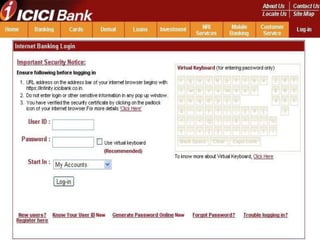
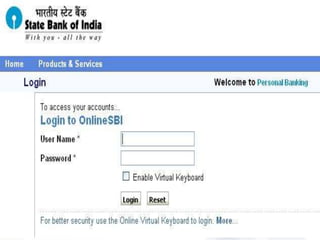
  • #13 First we see the login page for any person who is new Next, this is a security notice
  • #15 Personal Digital Assistant (PDA).
  • #16 RTGS 'Real Time' means the processing of instructions at the time they are received rather than at some later time. 'Gross Settlement' means the settlement of funds transfer instructions occurs individually (on an instruction by instruction basis).
  • #24 market risks (interest rate risk, foreign exchange risk and risk from change in market price of securities, financial derivatives and commodities),
  • #26 E-security should be handled efficiently