RESEARCH PROCESS
 Identifying the problem;
 Reviewing of literature;
 Setting research questions,
objectives, and hypothesis;
 Choosing the study design;
6/14/2022
Research Process (Presented by- M.
Nurul Islam, Ph. D, Former Professor,
Department of Statistics, University of
1
All research endeavors share a common goal of furthering
our understanding of the problem and thus all share
certain basic stages forming a process called research
process. These stages involved in the research process are
as follows:
 Deciding on the sample
design;
 Collecting data;
 Processing and analyzing
data;
 Writing the report.
RESEARCH PROCESS
6/14/2022
Research Process (Presented by- M.
Nurul Islam, Ph. D, Former Professor,
Department of Statistics, University of
2
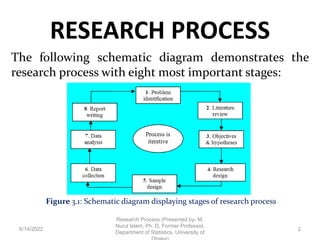
The following schematic diagram demonstrates the
research process with eight most important stages:
Figure 3.1: Schematic diagram displaying stages of research process
RESEARCH PROCESS
6/14/2022
Research Process (Presented by- M.
Nurul Islam, Ph. D, Former Professor,
Department of Statistics, University of
3
Problem Identification:
1. Research problem and
2. Non-Research problem
There are two kinds of problem in the context of
research:
RESEARCH PROCESS
6/14/2022
Research Process (Presented by- M.
Nurul Islam, Ph. D, Former Professor,
Department of Statistics, University of
4
2. Non-research Problem:
a. A non-research problem is one that does not
require any research to arrive at a solution.
b. A non-researchable problem consists of vague
details and cannot be resolved through research.
c. It is a managerial or built-in problem that may be
solved at the administrative or management level.
d. The answer to any question raised in a non-
research setting is almost always obvious.
RESEARCH PROCESS
6/14/2022
Research Process (Presented by- M.
Nurul Islam, Ph. D, Former Professor,
Department of Statistics, University of
5
2. Non-research Problem:
Here are some of the problems we frequently
encounter, which may well be considered as non-
research problems:
a. Rises in price of warm cloths during winter;
b. Preferring admission in public universities over private
universities;
c. Crisis of accommodations in sea resorts during summer
d. Traffic jam in the city street after office hours;
e. High sales in department stores after an offer of
discount
RESEARCH PROCESS
6/14/2022
Research Process (Presented by- M.
Nurul Islam, Ph. D, Former Professor,
Department of Statistics, University of
6
1. Research Problem:
A research problem is a perceived difficulty, a feeling of discomfort or a
discrepancy between the common belief and the reality.
As noted by Fisher et al. (1993), a problem will qualify as a potential research
problem when the following three conditions exist:
a. There should be a perceived discrepancy between “what it is” and
“what it should have been”. This implies that there should be a
difference between “what actually exists” and the “ideal or planned
situation”;
b. A question about “why” the discrepancy exists. This implies that the
reason(s) for this discrepancy is unclear to the researcher (so that it
makes sense to develop a research question); and
c. There should be at least two possible answers or solutions to the
questions or problems.
RESEARCH PROCESS
6/14/2022
Research Process (Presented by- M.
Nurul Islam, Ph. D, Former Professor,
Department of Statistics, University of
7
1. Research Problem:
The third point is important. If there is only one possible
and plausible answer to the question about the
discrepancy, then a research situation does not exist. It is a
non-research problem that can be tackled at the
managerial or administrative level.
RESEARCH PROCESS
6/14/2022
Research Process (Presented by- M.
Nurul Islam, Ph. D, Former Professor,
Department of Statistics, University of
8
Literature Review
We enumerate the following arguments in favor of reviewing literature:
1. It avoids duplication of the work that has been done in the recent past
2. It helps the researcher to find out what others have learned and reported on the
problem.
3. It helps the researcher to become familiar with the types of methodology followed by
others.
4. It helps the researcher to understand what concepts and theories are relevant to his
area of investigation.
5. It helps the researcher to understand if there are any significant controversies,
contradiction and inconsistencies in findings.
6. It allows the researcher to understand if there is any unanswered research questions.
7. It might help the researcher to develop an analytical framework.
8. It will help the researcher to consider the inclusion of variables in his research that he
might not otherwise have thought about.
RESEARCH PROCESS
6/14/2022
Research Process (Presented by- M.
Nurul Islam, Ph. D, Former Professor,
Department of Statistics, University of
9
Objectives and Hypotheses
An objective will precisely say what should be researched, so
as to delineate the type of information that should be
collected and provide a framework for the scope of the study.
The best expression of a research objective is a well-
formulated, testable research hypothesis.
A hypothesis is an unproven statement or proposition that
can be refuted or supported by empirical data. Hypothetical
statements assert possible answer to a research question.
RESEARCH PROCESS
6/14/2022
Research Process (Presented by- M.
Nurul Islam, Ph. D, Former Professor,
Department of Statistics, University of
10
Research Design
There are four basic research designs that a researcher can use to
conduct his or her study:
a. Survey,
b. Experiment,
c. Secondary data study
d. Observational study.
The type of research design to be chosen from among the above four
designs depends primarily on four factors:
a. The type of problem
b. The objectives of the study,
c. The existing state of knowledge about the problem that is being studied,
and
d. The resources available for the study.
RESEARCH PROCESS
6/14/2022
Research Process (Presented by- M.
Nurul Islam, Ph. D, Former Professor,
Department of Statistics, University of
11
Sample Design
Sample design refers to the methods to be followed in selecting sample from the
population and the estimating technique, vis-à-vis formula for computing the
sample statistics.
A sample is a part of the population, carefully selected to represent that
population.
Sample is of two types:
a. Probability sample
b. Non-probability sample
RESEARCH PROCESS
6/14/2022
Research Process (Presented by- M.
Nurul Islam, Ph. D, Former Professor,
Department of Statistics, University of
12
Sample Design
The basic question is then, how to select a sample? The most widely used
probability sampling methods are
I. Simple random sampling,
II. Stratified random sampling,
III. Cluster sampling and
IV. Systematic sampling.
RESEARCH PROCESS
6/14/2022
Research Process (Presented by- M.
Nurul Islam, Ph. D, Former Professor,
Department of Statistics, University of
13
Data Collection
With the variation in the type of data (qualitative or quantitative) to be collected,
the method of data collection also varies.
The most common means for collecting quantitative data is the structured
interview. Studies that obtain data by interviewing respondents are called
surveys. Data can also be collected by using self-administered questionnaires.
Telephone interviewing is another way in which data may be collected. We will
discuss these methods in great details later.
Other means of data collection include the use of secondary sources, such as the
census, vital registration records, official documents, previous surveys etc.
Qualitative data are collected mainly through in-depth interviews, focus group
discussions, and observational studies. We have discussed various methods of
data collection at length in a separate chapter in this text.
RESEARCH PROCESS
6/14/2022
Research Process (Presented by- M.
Nurul Islam, Ph. D, Former Professor,
Department of Statistics, University of
14
Data Processing And Data Analysis
Data processing generally begins with editing and coding of data. Data analysis
usually involves reducing accumulated data to a manageable size, developing
summaries, searching for patterns, and applying statistical techniques for
understanding and interpreting the findings in the light of the research questions..
RESEARCH PROCESS
6/14/2022
Research Process (Presented by- M.
Nurul Islam, Ph. D, Former Professor,
Department of Statistics, University of
15
Research Proposal
The entire task of a research study is accumulated in a document called proposal.
A research proposal is a work plan, prospectus, outline, an offer, a statement of
intent or commitment from an individual researcher or an organization to produce
a product or render a service to a potential client or sponsor. The proposal will be
prepared keeping in view the sequence presented in the research process. The
proposal tells us what, how, where, and to whom it will be done.
RESEARCH PROCESS
6/14/2022
Research Process (Presented by- M.
Nurul Islam, Ph. D, Former Professor,
Department of Statistics, University of
16
Report Writing and Dissemination Of Results
The style and organization of the report will differ according to the
target audience, the occasion, and the purpose of the research. Reports
should be developed from the client’s perspectives. A report is an
excellent means that helps to establish the researcher’s credibility. At a
bare minimum, a research report should contain sections on:
a. An executive summary;
b. Background of the problem;
c. Literature review;
d. Methodology;
e. Findings;
f. Discussion;
g. Conclusions and
h. Recommendations.

RESEARCH PROCESS.ppt

  • 1.
    RESEARCH PROCESS  Identifyingthe problem;  Reviewing of literature;  Setting research questions, objectives, and hypothesis;  Choosing the study design; 6/14/2022 Research Process (Presented by- M. Nurul Islam, Ph. D, Former Professor, Department of Statistics, University of 1 All research endeavors share a common goal of furthering our understanding of the problem and thus all share certain basic stages forming a process called research process. These stages involved in the research process are as follows:  Deciding on the sample design;  Collecting data;  Processing and analyzing data;  Writing the report.
  • 2.
    RESEARCH PROCESS 6/14/2022 Research Process(Presented by- M. Nurul Islam, Ph. D, Former Professor, Department of Statistics, University of 2 The following schematic diagram demonstrates the research process with eight most important stages: Figure 3.1: Schematic diagram displaying stages of research process
  • 3.
    RESEARCH PROCESS 6/14/2022 Research Process(Presented by- M. Nurul Islam, Ph. D, Former Professor, Department of Statistics, University of 3 Problem Identification: 1. Research problem and 2. Non-Research problem There are two kinds of problem in the context of research:
  • 4.
    RESEARCH PROCESS 6/14/2022 Research Process(Presented by- M. Nurul Islam, Ph. D, Former Professor, Department of Statistics, University of 4 2. Non-research Problem: a. A non-research problem is one that does not require any research to arrive at a solution. b. A non-researchable problem consists of vague details and cannot be resolved through research. c. It is a managerial or built-in problem that may be solved at the administrative or management level. d. The answer to any question raised in a non- research setting is almost always obvious.
  • 5.
    RESEARCH PROCESS 6/14/2022 Research Process(Presented by- M. Nurul Islam, Ph. D, Former Professor, Department of Statistics, University of 5 2. Non-research Problem: Here are some of the problems we frequently encounter, which may well be considered as non- research problems: a. Rises in price of warm cloths during winter; b. Preferring admission in public universities over private universities; c. Crisis of accommodations in sea resorts during summer d. Traffic jam in the city street after office hours; e. High sales in department stores after an offer of discount
  • 6.
    RESEARCH PROCESS 6/14/2022 Research Process(Presented by- M. Nurul Islam, Ph. D, Former Professor, Department of Statistics, University of 6 1. Research Problem: A research problem is a perceived difficulty, a feeling of discomfort or a discrepancy between the common belief and the reality. As noted by Fisher et al. (1993), a problem will qualify as a potential research problem when the following three conditions exist: a. There should be a perceived discrepancy between “what it is” and “what it should have been”. This implies that there should be a difference between “what actually exists” and the “ideal or planned situation”; b. A question about “why” the discrepancy exists. This implies that the reason(s) for this discrepancy is unclear to the researcher (so that it makes sense to develop a research question); and c. There should be at least two possible answers or solutions to the questions or problems.
  • 7.
    RESEARCH PROCESS 6/14/2022 Research Process(Presented by- M. Nurul Islam, Ph. D, Former Professor, Department of Statistics, University of 7 1. Research Problem: The third point is important. If there is only one possible and plausible answer to the question about the discrepancy, then a research situation does not exist. It is a non-research problem that can be tackled at the managerial or administrative level.
  • 8.
    RESEARCH PROCESS 6/14/2022 Research Process(Presented by- M. Nurul Islam, Ph. D, Former Professor, Department of Statistics, University of 8 Literature Review We enumerate the following arguments in favor of reviewing literature: 1. It avoids duplication of the work that has been done in the recent past 2. It helps the researcher to find out what others have learned and reported on the problem. 3. It helps the researcher to become familiar with the types of methodology followed by others. 4. It helps the researcher to understand what concepts and theories are relevant to his area of investigation. 5. It helps the researcher to understand if there are any significant controversies, contradiction and inconsistencies in findings. 6. It allows the researcher to understand if there is any unanswered research questions. 7. It might help the researcher to develop an analytical framework. 8. It will help the researcher to consider the inclusion of variables in his research that he might not otherwise have thought about.
  • 9.
    RESEARCH PROCESS 6/14/2022 Research Process(Presented by- M. Nurul Islam, Ph. D, Former Professor, Department of Statistics, University of 9 Objectives and Hypotheses An objective will precisely say what should be researched, so as to delineate the type of information that should be collected and provide a framework for the scope of the study. The best expression of a research objective is a well- formulated, testable research hypothesis. A hypothesis is an unproven statement or proposition that can be refuted or supported by empirical data. Hypothetical statements assert possible answer to a research question.
  • 10.
    RESEARCH PROCESS 6/14/2022 Research Process(Presented by- M. Nurul Islam, Ph. D, Former Professor, Department of Statistics, University of 10 Research Design There are four basic research designs that a researcher can use to conduct his or her study: a. Survey, b. Experiment, c. Secondary data study d. Observational study. The type of research design to be chosen from among the above four designs depends primarily on four factors: a. The type of problem b. The objectives of the study, c. The existing state of knowledge about the problem that is being studied, and d. The resources available for the study.
  • 11.
    RESEARCH PROCESS 6/14/2022 Research Process(Presented by- M. Nurul Islam, Ph. D, Former Professor, Department of Statistics, University of 11 Sample Design Sample design refers to the methods to be followed in selecting sample from the population and the estimating technique, vis-à-vis formula for computing the sample statistics. A sample is a part of the population, carefully selected to represent that population. Sample is of two types: a. Probability sample b. Non-probability sample
  • 12.
    RESEARCH PROCESS 6/14/2022 Research Process(Presented by- M. Nurul Islam, Ph. D, Former Professor, Department of Statistics, University of 12 Sample Design The basic question is then, how to select a sample? The most widely used probability sampling methods are I. Simple random sampling, II. Stratified random sampling, III. Cluster sampling and IV. Systematic sampling.
  • 13.
    RESEARCH PROCESS 6/14/2022 Research Process(Presented by- M. Nurul Islam, Ph. D, Former Professor, Department of Statistics, University of 13 Data Collection With the variation in the type of data (qualitative or quantitative) to be collected, the method of data collection also varies. The most common means for collecting quantitative data is the structured interview. Studies that obtain data by interviewing respondents are called surveys. Data can also be collected by using self-administered questionnaires. Telephone interviewing is another way in which data may be collected. We will discuss these methods in great details later. Other means of data collection include the use of secondary sources, such as the census, vital registration records, official documents, previous surveys etc. Qualitative data are collected mainly through in-depth interviews, focus group discussions, and observational studies. We have discussed various methods of data collection at length in a separate chapter in this text.
  • 14.
    RESEARCH PROCESS 6/14/2022 Research Process(Presented by- M. Nurul Islam, Ph. D, Former Professor, Department of Statistics, University of 14 Data Processing And Data Analysis Data processing generally begins with editing and coding of data. Data analysis usually involves reducing accumulated data to a manageable size, developing summaries, searching for patterns, and applying statistical techniques for understanding and interpreting the findings in the light of the research questions..
  • 15.
    RESEARCH PROCESS 6/14/2022 Research Process(Presented by- M. Nurul Islam, Ph. D, Former Professor, Department of Statistics, University of 15 Research Proposal The entire task of a research study is accumulated in a document called proposal. A research proposal is a work plan, prospectus, outline, an offer, a statement of intent or commitment from an individual researcher or an organization to produce a product or render a service to a potential client or sponsor. The proposal will be prepared keeping in view the sequence presented in the research process. The proposal tells us what, how, where, and to whom it will be done.
  • 16.
    RESEARCH PROCESS 6/14/2022 Research Process(Presented by- M. Nurul Islam, Ph. D, Former Professor, Department of Statistics, University of 16 Report Writing and Dissemination Of Results The style and organization of the report will differ according to the target audience, the occasion, and the purpose of the research. Reports should be developed from the client’s perspectives. A report is an excellent means that helps to establish the researcher’s credibility. At a bare minimum, a research report should contain sections on: a. An executive summary; b. Background of the problem; c. Literature review; d. Methodology; e. Findings; f. Discussion; g. Conclusions and h. Recommendations.