HYPOTHESIS
Dr. KAVITHAMANI R
Assistant Professor
Department of Commerce
Sri Ramakrishna College of Arts & Science
Coimbatore - 641 006
Tamil Nadu, India
1
RESEARCH METHODOLOGY
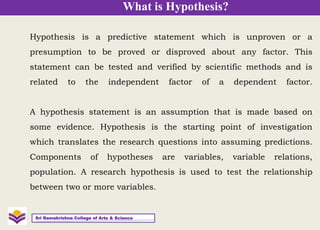
Hypothesis is a predictive statement which is unproven or a
presumption to be proved or disproved about any factor. This
statement can be tested and verified by scientific methods and is
related to the independent factor of a dependent factor.
A hypothesis statement is an assumption that is made based on
some evidence. Hypothesis is the starting point of investigation
which translates the research questions into assuming predictions.
Components of hypotheses are variables, variable relations,
population. A research hypothesis is used to test the relationship
between two or more variables.
What is Hypothesis?
Sri Ramakrishna College of Arts & Science
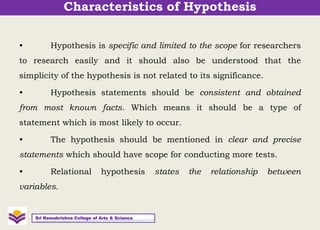
• Hypothesis is specific and limited to the scope for researchers
to research easily and it should also be understood that the
simplicity of the hypothesis is not related to its significance.
• Hypothesis statements should be consistent and obtained
from most known facts. Which means it should be a type of
statement which is most likely to occur.
• The hypothesis should be mentioned in clear and precise
statements which should have scope for conducting more tests.
• Relational hypothesis states the relationship between
variables.
Sri Ramakrishna College of Arts & Science
Characteristics of Hypothesis
The various types of Hypothesis are:
1. Simple Hypothesis
Simple Hypothesis defines the relation between the two variables
such as independent and dependent variables. For example – If you
exercise, you will lose weight faster. Here, exercising is an
independent variable, while losing weight is the dependent variable.
2. Complex Hypothesis
Complex Hypothesis contains more than one variable, which makes
the hypothesis more complex and harder to understand. It shows
the relationship between two or more dependent variables and two
or more independent variables. Eating healthy food and exercising
leads to weight loss, glowing skin, and reduces the risk of heart
disease.
Sri Ramakrishna College of Arts & Science
Types of Hypothesis
3. Null Hypothesis
Null hypothesis is a type of hypothesis which predicts that there is
no relationship between the two variables at test. It provides a
statement which is always contrary to the hypothesis. It’s a negative
statement, and there is no relationship between independent and
dependent variables. The symbol is denoted by “HO”.
4. Directional Hypothesis
Directional hypothesis predicts the positivity or negativity of an
effect prior to the test being conducted.
5. Non-Directional Hypothesis
Non- Directional hypothesis doesn’t predict the positivity or
negativity of the effect of an independent variable on the dependent
variable.
Sri Ramakrishna College of Arts & Science
Types of Hypothesis
6. Logical Hypothesis
Logical Hypothesis cannot be tested but it has some logical basis in
support of our assumptions.
7. Statistical Hypothesis
Statistical hypothesis makes use of representative statistical models
to come to a conclusion about broader populations.
Sri Ramakrishna College of Arts & Science
Types of Hypothesis
The sources of hypothesis are-
• Resemblance between the phenomenon of hypothesis.
• Observations from past studies, competitors and present-day
experiences
• Scientific theories by researchers.
• The thinking process of people is another source of hypothesis
Sri Ramakrishna College of Arts & Science
Sources of Hypothesis
Following are the functions performed by the hypothesis statement:
• Hypothesis helps in making an observation made by the
researcher.
• Hypothesis becomes the initial point of an investigation.
• Hypothesis helps in verifying the observations made.
• Hypothesis helps in directing the inquiries in the right direction.
Sri Ramakrishna College of Arts & Science
Functions of Hypothesis

Hypothesis - Meaning, Types, Sources and Functions

  • 1.
    HYPOTHESIS Dr. KAVITHAMANI R AssistantProfessor Department of Commerce Sri Ramakrishna College of Arts & Science Coimbatore - 641 006 Tamil Nadu, India 1 RESEARCH METHODOLOGY
  • 2.
    Hypothesis is apredictive statement which is unproven or a presumption to be proved or disproved about any factor. This statement can be tested and verified by scientific methods and is related to the independent factor of a dependent factor. A hypothesis statement is an assumption that is made based on some evidence. Hypothesis is the starting point of investigation which translates the research questions into assuming predictions. Components of hypotheses are variables, variable relations, population. A research hypothesis is used to test the relationship between two or more variables. What is Hypothesis? Sri Ramakrishna College of Arts & Science
  • 3.
    • Hypothesis isspecific and limited to the scope for researchers to research easily and it should also be understood that the simplicity of the hypothesis is not related to its significance. • Hypothesis statements should be consistent and obtained from most known facts. Which means it should be a type of statement which is most likely to occur. • The hypothesis should be mentioned in clear and precise statements which should have scope for conducting more tests. • Relational hypothesis states the relationship between variables. Sri Ramakrishna College of Arts & Science Characteristics of Hypothesis
  • 4.
    The various typesof Hypothesis are: 1. Simple Hypothesis Simple Hypothesis defines the relation between the two variables such as independent and dependent variables. For example – If you exercise, you will lose weight faster. Here, exercising is an independent variable, while losing weight is the dependent variable. 2. Complex Hypothesis Complex Hypothesis contains more than one variable, which makes the hypothesis more complex and harder to understand. It shows the relationship between two or more dependent variables and two or more independent variables. Eating healthy food and exercising leads to weight loss, glowing skin, and reduces the risk of heart disease. Sri Ramakrishna College of Arts & Science Types of Hypothesis
  • 5.
    3. Null Hypothesis Nullhypothesis is a type of hypothesis which predicts that there is no relationship between the two variables at test. It provides a statement which is always contrary to the hypothesis. It’s a negative statement, and there is no relationship between independent and dependent variables. The symbol is denoted by “HO”. 4. Directional Hypothesis Directional hypothesis predicts the positivity or negativity of an effect prior to the test being conducted. 5. Non-Directional Hypothesis Non- Directional hypothesis doesn’t predict the positivity or negativity of the effect of an independent variable on the dependent variable. Sri Ramakrishna College of Arts & Science Types of Hypothesis
  • 6.
    6. Logical Hypothesis LogicalHypothesis cannot be tested but it has some logical basis in support of our assumptions. 7. Statistical Hypothesis Statistical hypothesis makes use of representative statistical models to come to a conclusion about broader populations. Sri Ramakrishna College of Arts & Science Types of Hypothesis
  • 7.
    The sources ofhypothesis are- • Resemblance between the phenomenon of hypothesis. • Observations from past studies, competitors and present-day experiences • Scientific theories by researchers. • The thinking process of people is another source of hypothesis Sri Ramakrishna College of Arts & Science Sources of Hypothesis
  • 8.
    Following are thefunctions performed by the hypothesis statement: • Hypothesis helps in making an observation made by the researcher. • Hypothesis becomes the initial point of an investigation. • Hypothesis helps in verifying the observations made. • Hypothesis helps in directing the inquiries in the right direction. Sri Ramakrishna College of Arts & Science Functions of Hypothesis