Dr Neeta Gupta
Associate Professor
Department of psychology
Certified Practitioner of EFT &
REBT (London) & CBT
(Scotland)
DAV PG College
Dehradun
Hypothesis
A hypothesis (plural hypotheses) is a
proposed explanation for
a phenomenon.
A hypothesis is a suggested, testable
proposition or answer to a problem. A
hypothesis is a testable relationship between
two or more than two variables. Hypothesis are
always in declarative sentence form.
Hypothesis is an assumption that is made
on the basis of some evidence. This is the
initial point of any investigation that
translates the research questions into a
prediction. It includes components like
variables, population and the relation
between the variables. A research
hypothesis is a hypothesis that is used to
test the relationship between two or more
variables.
On the basis of these explanations two points can be
suggested about hypothesis
1.A hypothesis is a testable statement which displays
the relationship between those variables which are
measurable or potentially measureable
2.A hypothesis exhibits either a general or specific
relationship between variables.
Characteristics of a good research hypothesis
1.Conceptually Clear
2. Testable
3.Parsimonious
4.It Should be Related to existing body of theory and
fact.
5.It should be general in Scope.
Problems in formulating in a Research
Hypothesis :
Goode and Hatt have pointed out following
difficulties
1.The absence of knowledge of a theoretical
framework.
2.Investigators, inabilities to utilize the
knowledge of the Theoretical Framework.
3.Lack of Awareness of the important scientific
research technique
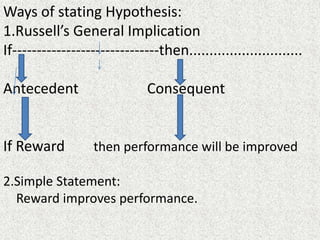
Ways of stating Hypothesis:
1.Russell’s General Implication
If------------------------------then............................
Antecedent Consequent
If Reward then performance will be improved
2.Simple Statement:
Reward improves performance.
Sources of Hypothesis
1. Existing research
2. Expert opinion
3. Scientific Theory
Types of Hypothesis
There are various forms of
hypothesis and they are:
Simple hypothesis
Complex hypothesis
Directional hypothesis
Non-directional hypothesis
Null hypothesis
Associative and casual hypothesis
1.Simple Hypothesis
It shows a relationship between one dependent
variable and a single independent variable.
2.Complex Hypothesis
It shows the relationship between two or more
dependent variables and two or more
independent variables.
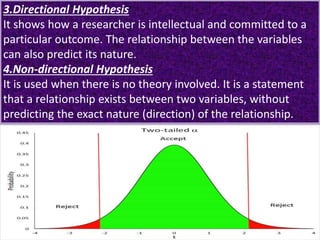
3.Directional Hypothesis
It shows how a researcher is intellectual and committed to a
particular outcome. The relationship between the variables
can also predict its nature.
4.Non-directional Hypothesis
It is used when there is no theory involved. It is a statement
that a relationship exists between two variables, without
predicting the exact nature (direction) of the relationship.
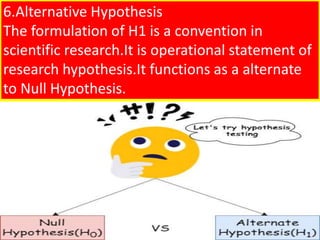
5.Null Hypothesis
It provides the statement which is contrary to the
hypothesis. It’s a negative statement, and there is no
relationship between independent and dependent
variables. The symbol is denoted by “HO”.
6.Alternative Hypothesis
The formulation of H1 is a convention in
scientific research.It is operational statement of
research hypothesis.It functions as a alternate
to Null Hypothesis.
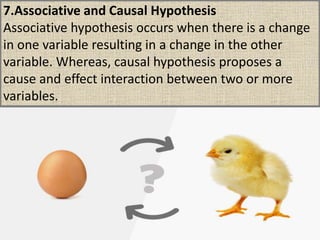
7.Associative and Causal Hypothesis
Associative hypothesis occurs when there is a change
in one variable resulting in a change in the other
variable. Whereas, causal hypothesis proposes a
cause and effect interaction between two or more
variables.
Research Hypothesis: It is derived from the researcher’s
theory about some aspects of behaviour is called a research
hypothesis or is also known as a working hypothesis. These
hypotheses are true to the extent that the theory from which
thet were derived is adequate. According to Siegel & Castellan
“the prediction derived from the theory under test.”
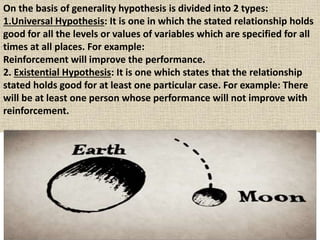
On the basis of generality hypothesis is divided into 2 types:
1.Universal Hypothesis: It is one in which the stated relationship holds
good for all the levels or values of variables which are specified for all
times at all places. For example:
Reinforcement will improve the performance.
2. Existential Hypothesis: It is one which states that the relationship
stated holds good for at least one particular case. For example: There
will be at least one person whose performance will not improve with
reinforcement.
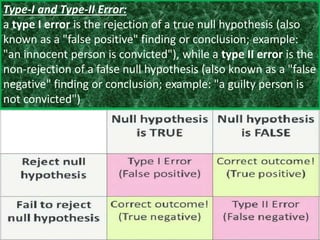
Type-I and Type-II Error:
a type I error is the rejection of a true null hypothesis (also
known as a "false positive" finding or conclusion; example:
"an innocent person is convicted"), while a type II error is the
non-rejection of a false null hypothesis (also known as a "false
negative" finding or conclusion; example: "a guilty person is
not convicted")
REFERENCE:
https://en.wikipedia.org/wiki/Hypothesis
https://byjus.com/physics/hypothesis/
https://en.wikipedia.org/wiki/Type_I_and_type_II_errors#:~:text=In%20statistical%20hypothesi
s%20testing%2C%20a,false%20negative%22%20finding%20or%20conclusion
https://miro.medium.com/max/461/1*BozzCpcQDj4YSPkl0etSEw.png
https://lh3.googleusercontent.com/proxy/aatvwDvMw8FaKmvI5Y4KHcyD6JaGB8v1wXuRyBiWM
VeeTuGR9G5CP2sMVh8QjhQcjzSjqF-Bs-fkf22DgM623hidB38M2qICXw
https://online.stat.psu.edu/onlinecourses/sites/stat100/files/lesson11/hypothesis_animated.gif
https://static.wixstatic.com/media/f46c02_fd3dd021ae2f4801b6083b98ddb42ba9.gif
http://kseany.org/wp-content/uploads/2015/09/KSEANY_smart_guy_with_atatom_.gif
https://concept-stories.s3.ap-south-1.amazonaws.com/test/Stories%20-
%20Images_story_76499/image_2019-08-01%2012%3A34%3A01.312988%2B00%3A00
https://media1.giphy.com/media/i0GlE1yskKkus/giphy.gif
https://magazine.calpoly.edu/wp-content/uploads/2017/06/TWO-Animated-690x955.gif
https://i.pinimg.com/originals/fe/b7/26/feb7267dfd0a57beeb6ec6af19634050.gif
http://sciences.usca.edu/biology/zelmer/305/hypo/tails/tails.gif
https://clockwise.software/img/blog/solve-the-chicken-and-egg-problem/header-
background.png
https://thumbs.gfycat.com/ElaborateVapidKoalabear-size_restricted.gif
https://www.researchgate.net/profile/William_Anderegg/publication/268035363/figure/fig1/A
S:392140141154312@1470504903728/Graphical-representation-of-type-1-and-type-2-
errors.png
A.K.Singh: Tests,Measurement,and Research Methods in Behavioural Sciences
Hypothesis

Hypothesis